
Kostenlose Sofortanalyse
Airbnb-Umsatz für jede Adresse oder Stadt anzeigen
Airbnb-Leistung in Memphis nach Schlafzimmern
Marktweite Airbnb- und Vrbo-Daten für Memphis.
Studio
Aktive Inserate
52
Unterdurchschnittlich
Jahresumsatz
2976,6 $
Übernachtungspreis
32,1 $
Belegung
30 %
Bruttorendite
3.2%
Typisch
Jahresumsatz
6987,6 $
Übernachtungspreis
81,0 $
Belegung
30 %
Bruttorendite
7.6%
Überdurchschnittlich
Jahresumsatz
25.539,0 $
Übernachtungspreis
131,2 $
Belegung
48 %
Bruttorendite
27.8%
1 Schlafzimmer
Aktive Inserate
395
Unterdurchschnittlich
Jahresumsatz
4714,8 $
Übernachtungspreis
92,9 $
Belegung
18 %
Bruttorendite
5.1%
Typisch
Jahresumsatz
16.815,3 $
Übernachtungspreis
99,4 $
Belegung
44 %
Bruttorendite
18.3%
Überdurchschnittlich
Jahresumsatz
29.440,6 $
Übernachtungspreis
124,3 $
Belegung
55 %
Bruttorendite
32.0%
2 Schlafzimmer
Aktive Inserate
307
Unterdurchschnittlich
Jahresumsatz
7749,8 $
Übernachtungspreis
128,1 $
Belegung
24 %
Bruttorendite
5.1%
Typisch
Jahresumsatz
25.686,6 $
Übernachtungspreis
147,9 $
Belegung
44 %
Bruttorendite
16.9%
Überdurchschnittlich
Jahresumsatz
45.486,1 $
Übernachtungspreis
198,0 $
Belegung
51 %
Bruttorendite
30.0%
3 Schlafzimmer
Aktive Inserate
379
Unterdurchschnittlich
Jahresumsatz
11.087,9 $
Übernachtungspreis
178,4 $
Belegung
24 %
Bruttorendite
4.7%
Typisch
Jahresumsatz
34.704,0 $
Übernachtungspreis
197,8 $
Belegung
45 %
Bruttorendite
14.8%
Überdurchschnittlich
Jahresumsatz
62.370,4 $
Übernachtungspreis
266,2 $
Belegung
53 %
Bruttorendite
26.7%
4+ Schlafzimmer
Aktive Inserate
312
Unterdurchschnittlich
Jahresumsatz
14.356,3 $
Übernachtungspreis
272,4 $
Belegung
21 %
Bruttorendite
4.3%
Typisch
Jahresumsatz
46.293,1 $
Übernachtungspreis
285,1 $
Belegung
42 %
Bruttorendite
14.0%
Überdurchschnittlich
Jahresumsatz
95.342,5 $
Übernachtungspreis
427,2 $
Belegung
49 %
Bruttorendite
28.8%
| Schlafzimmer | Leistungsgruppe | Jahresumsatz | Übernachtungspreis | Belegung | Bruttorendite | Aktive Inserate |
|---|---|---|---|---|---|---|
| Studio | Unterdurchschnittlich | 2976,6 $ | 32,1 $ | 30 % | 3.2% | 52 |
Typisch | 6987,6 $ | 81,0 $ | 30 % | 7.6% | ||
Überdurchschnittlich | 25.539,0 $ | 131,2 $ | 48 % | 27.8% | ||
| 1 Schlafzimmer | Unterdurchschnittlich | 4714,8 $ | 92,9 $ | 18 % | 5.1% | 395 |
Typisch | 16.815,3 $ | 99,4 $ | 44 % | 18.3% | ||
Überdurchschnittlich | 29.440,6 $ | 124,3 $ | 55 % | 32.0% | ||
| 2 Schlafzimmer | Unterdurchschnittlich | 7749,8 $ | 128,1 $ | 24 % | 5.1% | 307 |
Typisch | 25.686,6 $ | 147,9 $ | 44 % | 16.9% | ||
Überdurchschnittlich | 45.486,1 $ | 198,0 $ | 51 % | 30.0% | ||
| 3 Schlafzimmer | Unterdurchschnittlich | 11.087,9 $ | 178,4 $ | 24 % | 4.7% | 379 |
Typisch | 34.704,0 $ | 197,8 $ | 45 % | 14.8% | ||
Überdurchschnittlich | 62.370,4 $ | 266,2 $ | 53 % | 26.7% | ||
| 4+ Schlafzimmer | Unterdurchschnittlich | 14.356,3 $ | 272,4 $ | 21 % | 4.3% | 312 |
Typisch | 46.293,1 $ | 285,1 $ | 42 % | 14.0% | ||
Überdurchschnittlich | 95.342,5 $ | 427,2 $ | 49 % | 28.8% |
Niedrige, typische und höhere Leistungsgruppen sind Marktbenchmarks und keine garantierten Ergebnisse. Daten aktualisiert: Sept. 2026.
How much does a Memphis short-term rental bring in, and what will the city actually let you run?
Well, Memphis answers the second question more openly than most cities its size, so let me take that one first. You don't have to live in the property, the ordinance doesn't cap how many permits a single owner can hold, and it sets no minimum distance between one permitted rental and the next. What the city polices instead is the building itself: a permitted Memphis rental, in the city's own words, "can have three rooms used as bedrooms", and each unit needs its own permit at $300 to apply and $150 a year after that. So if you've been picturing a big Memphis house sleeping a wedding party, read that rule twice, because it decides which of this market's numbers you could copy.
The market you'd be joining stopped growing and got busier instead. Across every listing BNBCalc tracks here, active supply held roughly flat over the past year, occupancy improved by about 7%, and hosts added about 12% to their average nightly rate. I'm covering Memphis, the seat of Shelby County, Tennessee, although the market data crosses two state lines into suburbs in Mississippi and Arkansas, and none of those answer to Memphis.
How Much Do Memphis Airbnbs Earn in 2026?
Inside the Memphis city line, the middle short-term rental took $19,105 in the last twelve months, at a $176 median nightly rate, and a listing needed $28,452 to make the top quarter, about half again as much. Out in the towns beyond the city line the middle listing did better, at $25,133.
The three-room ceiling matters because earnings here climb steadily with the size of the home, and the biggest jump sits at the top of the range. Those bedroom figures cover the whole market, suburbs included, so the four-bedroom end tells you what big houses earn across the metro, which isn't what one could earn on a new Memphis permit.
Stay inside one bedroom count, though, and the distance between that size's strongest and weakest listings beats the whole step up to the next size. A well-placed one-bedroom clears what a struggling four-bedroom-plus brings in, and a two-bedroom running near its ceiling lands about where an ordinary four-plus does. If I had to guess, most of the difference inside a single size comes down to the block, the setup and the operator, which happen to be the three things you decide.
Gross yield tells a different story from revenue, though, and it's the one I'd weigh if you're buying on price. Among homes with bedrooms, yield is highest on one-bedrooms and slides with every bedroom you add, so the four-plus houses that earn the most gross return the least per dollar of purchase price. Studios sit below all of them, returning less than half what a one-bedroom does, and I wouldn't plan around them on a sample this thin.
You'd be pricing against professionals, too, since hosts who do this for a living account for a large share of the Memphis market. The typical booking runs a little past six nights, which is long for a city market and leaves you with fewer changeovers than a beach town would. If you'd rather not run those changeovers and the guest messages yourself, the Memphis property management roundup lays out who takes that work on locally, though keep in mind the permit and the city's monthly tax return stay with whoever owns the place.
There's real headroom above the middle, too, since BNBCalc's top performance band, the best-performing slice of the listings it tracks, fills its calendar in the low fifties where the market as a whole sits in the high thirties. So I'd aim at that, and underwrite the middle.
Is the Memphis Airbnb Market Oversaturated?
No, and the year that just closed is the clearest evidence for it.
| Metric | Year-over-year change |
|---|---|
| Average nightly rate | +12% |
| Occupancy | +7% |
| Booking lead time | Down |
| Active supply | Roughly flat |
| Purchase price | Roughly flat |
BNBCalc data across all listings BNBCalc tracks in the market, suburbs in Mississippi and Arkansas included, for September 2025 to August 2026 set against September 2024 to August 2025, with every change rounded and each measure averaged on its own. Booking lead time shows a direction only, because the size of that move isn't settled yet. Purchase price tracks home values rather than listings.
Crowding has a signature, and I can't find it here. When a market floods, the listing count climbs and occupancy falls, because there are more calendars chasing the same nights.
In Memphis the count of listings barely shifted while occupancy rose about 7%. That's a relative rise, worth roughly two more booked nights in every hundred, and it came on roughly the same number of homes, so the extra bookings went to places already operating instead of being split among new ones.
The nightly rate is the part I'd underline. In a crowded market hosts cut prices to win bookings, yet Memphis hosts pushed their average rate up about 12% and still gained occupancy. That pairing is rare enough that I wouldn't assume it'll happen twice, and my guess is that weaker listings dropped out while stronger ones took their place, though the data can't confirm that.
Guests also moved their bookings nearer to the trip during the year, and over the twelve months just gone they reserved roughly 24 days ahead of check-in. Three and a half weeks isn't much warning, so set your minimum stays and your late-window prices to catch the people who decide inside a month.
When Is Memphis's Peak Airbnb Season?
Twenty-four days of notice also means the calendar you're looking at in February tells you very little about March, which is why the shape of the year matters more here than a single week's bookings.
| Month | Occupancy | Avg nightly rate |
|---|---|---|
| Sep 2025 | 34% | $186 |
| Oct 2025 | 38% | $192 |
| Nov 2025 | 39% | $211 |
| Dec 2025 | 32% | $195 |
| Jan 2026 | 30% | $166 |
| Feb 2026 | 30% | $170 |
| Mar 2026 | 40% | $189 |
| Apr 2026 | 42% | $193 |
| May 2026 | 47% | $222 |
| Jun 2026 | 39% | $208 |
| Jul 2026 | 44% | $215 |
| Aug 2026 | 41% | $197 |
BNBCalc market data across all listings in the market, one row per month for September 2025 through August 2026. Occupancy and nightly rate are averaged independently, so read each column on its own.
From March through August every month books at least 39% of its nights, and from December through February none of them gets past 32%. May carries the year's highest average rate, $222, on 47% occupancy, which made sense to me the moment I looked at the calendar: Memphis in May runs through the month, and the World Championship Barbecue Cooking Contest alone fills four days of it.
Winter is where I see budgets go wrong, because a plan built on the year's average assumes January fills like everything else. It doesn't. January sits at the bottom of the year on both measures, filling 30% of its nights at a $166 average rate, and February matches it on occupancy while barely beating it on price. November is the one that caught me out, holding a $211 average rate on 39% occupancy, so the fall shoulder prices better than the spring one does.
The week has a sharper rhythm than the year does. On occupancy a Saturday beats the average day by 28% and a Friday by 25%, while a Monday comes in 19% under it. Prices rise about 17% over the average on those same two nights, less than occupancy does, so Friday and Saturday are the nights to push harder. Of everything you could touch in your pricing here, that gap is the one I'd widen first.
Where Should You Buy an Airbnb in Memphis?
Before picking a street, I'd settle one thing: how much of the market Memphis itself accounts for. Around 80% of what BNBCalc tracks here falls inside the Memphis line, making the city the main event in a way it usually isn't across a metro area. Two tables follow, built on different boundary sets, first the planning districts Memphis draws for itself and then the towns ringing it, so their rows don't correspond and shouldn't be ranked against each other.
Inside the City of Memphis
Memphis splits itself into 14 official planning districts under its comprehensive plan, so every measurable listing inside the city went into whichever district contains it, and the eight districts deep enough to read make up the ranking.
| Rank | Planning district | Median annual revenue | Median nightly rate | Median occupancy | 75th-percentile revenue |
|---|---|---|---|---|---|
| 1 | East | $33,937 | $347 | 28% | $44,780 |
| 2 | Whitehaven | $26,032 | $236 | 33% | $33,950 |
| 3 | Cordova | $24,050 | $215 | 32% | $37,921 |
| 4 | North | $22,297 | $221 | 30% | $30,428 |
| 5 | University | $21,615 | $182 | 32% | $29,096 |
| 6 | Parkway Village | $20,852 | $170 | 27% | $24,875 |
| 7 | Jackson | $18,980 | $169 | 32% | $20,956 |
| 8 | Core City | $17,302 | $155 | 31% | $24,935 |
BNBCalc 2026 listing data inside the City of Memphis planning districts, trailing twelve months. Revenue, rate and occupancy are medians, and the final column shows the 75th percentile, where a district's top quarter of listings starts. Each column is worked out separately, so they don't multiply together, and districts with too little data to measure reliably are left out. Parkway Village sits right at that threshold, so its row is thin and can move between refreshes.
Careful with that occupancy column, since it isn't built the way the monthly occupancy figures are. Each entry is the middle listing's own rate of fill rather than an average over the market, and because the busiest listings pull an average up while a median ignores them, these run low enough that East's 28% sits below even January's 30%. That makes the column good for setting one district beside another and not much else.
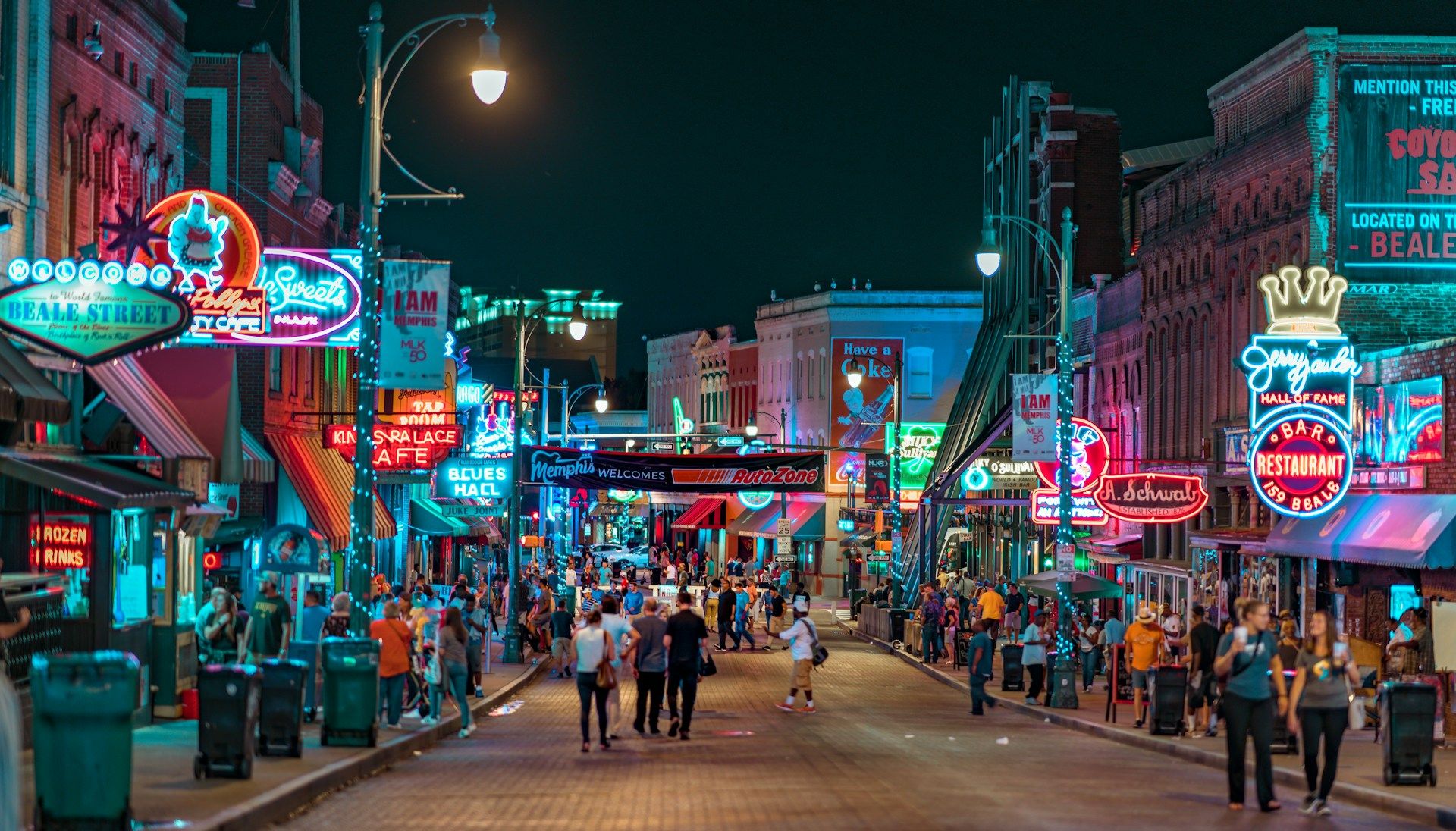
If you came to Memphis for the tourism, the ranking is close to upside down. Core City takes in downtown and Midtown, so Beale Street, the National Civil Rights Museum, Sun Studio, Overton Park and Cooper-Young all sit in that bottom row, and most of the city's listings sit there with them, which means buying near the attractions hasn't paid the way buying a bigger house has.
East, at the top, follows the Poplar corridor out past the Botanic Garden, and the district's usual listing carries four bedrooms where Core City's carries two, so square footage explains a good part of that $33,937. Whitehaven comes second, the district Graceland sits in, and it reaches a $26,032 median on three-bedroom houses.
That fourth bedroom means East's figure isn't one you can copy as it stands, because the city's permit rule stops at three rooms used as bedrooms and I can't tell a permitted listing from an unpermitted one in BNBCalc's data. A four-bedroom East listing might be licensed with one room kept out of use as a bedroom, grandfathered under the city's earlier rules, or running without a permit at all. Only the first could work for a new buyer, and only if the city agrees, since grandfathered protection ends when a house sells. So if you want a median you can copy with a new permit, Whitehaven's and Cordova's are the closer guide, because both are earned on typical three-bedroom houses, and if it's an East four-bedroom you're after, price it as a three-bedroom until the city tells you in writing it'll license the house that way.
Cordova, out by Shelby Farms, lands a little below Whitehaven's median while posting the best top quarter of any district except East, at $37,921. When a district's top quarter sits that far above its middle, I read it as room for a sharp operator to climb.
Set a small downtown unit against a house farther out and the districts point at the house, although the three-room rule decides how far that reasoning can run. None of this says what a given part of town feels like to own property in, and that's the ground the best Memphis neighborhoods for Airbnb walks.
The Towns Around Memphis
The ring is small, but it earns. This table maps the places with enough listings to measure by US Census boundaries, and it keeps Memphis itself as the last row, so you can see the city measured the same way as its suburbs.
| Rank | City or town | Median annual revenue | Median nightly rate | Median occupancy | 75th-percentile revenue |
|---|---|---|---|---|---|
| 1 | Southaven, MS | $32,205 | $271 | 34% | $41,131 |
| 2 | Olive Branch, MS | $29,711 | $290 | 28% | $32,649 |
| 3 | Horn Lake, MS | $26,589 | $241 | 31% | $33,950 |
| 4 | Lakeland, TN | $22,867 | $231 | 30% | $37,931 |
| 5 | Hernando, MS | $22,653 | $216 | 25% | $28,301 |
| 6 | West Memphis, AR | $22,116 | $249 | 25% | $26,155 |
| 7 | Memphis, TN | $19,105 | $176 | 31% | $28,452 |
BNBCalc 2026 listing data inside US Census place boundaries, trailing twelve months, for the places with enough listings to measure, with medians in every column except the 75th percentile, and each column worked out separately. Occupancy is each place's middle listing, so it runs below the market-wide monthly average. Horn Lake and Lakeland sit right at the threshold, so their rows are thin and can move between refreshes.
What jumps out at me is that Memphis lands last there, with four of the six places above it in Mississippi.
Southaven, Olive Branch and Horn Lake get there on typical three-bedroom houses, too, so unlike East their medians don't lean on a fourth bedroom. If a three-bedroom house is what you'd buy anyway, price one in Southaven or Olive Branch against one in Whitehaven or Cordova, with one warning attached: crossing into DeSoto County takes you out of the Memphis ordinance and out of Tennessee law altogether, and West Memphis puts you in Arkansas, so the permit, the fees and the filings belong to somebody else's rulebook. Lakeland sits in Shelby County but is its own town, so the Memphis ordinance stops at its line too, while unincorporated Shelby County runs on the county's own process, which BNBCalc's Shelby County short-term rental guide walks through. I haven't checked those towns' rules, so read the town's own before you assume its bedroom limit matches the city's or that it has none.
Which Amenities Make the Most Money in Memphis?
Wherever you land, a handful of features lift revenue more than anything else you could put in the place.
Across the whole market, BNBCalc's amenity model as it stands today puts a hot tub roughly 18% ahead on revenue for a Memphis listing. Break the model down by size and the hot tub leads at one, two and three bedrooms while fading as the house grows, running to about 23% on a one-bedroom and about 17% on a three-bedroom. My read is that a couple pays for the hot tub whereas a family of eight pays for the room to spread out.
At four bedrooms and above the hot tub hands the lead to a pool. Keep in mind that a house that size runs straight into the city's three-room rule, so the pool matters most on a house outside the city line, where the town's own rules apply instead. At the studio end, nothing much registers beyond allowing pets.
Beyond the hot tub, nine features leave a mark the model can follow in Memphis: a pool, an EV charger, a gym, a barbecue, lake access, internet, a sauna, bicycles and allowing pets. Internet made that list here even though the model sets aside a few fixtures every guest takes for granted.
Cleaning fees are the loose change I keep seeing Memphis hosts leave on the floor. As of September 2026 only 48% of listings charged one at all, at an average of about $117 among those that did. Averaged over every listing, the ones charging nothing included, that comes to near $1,600 a year, so a host who does charge collects roughly twice that. And because the typical booking here runs past six nights, a $117 fee adds under $20 a night to the price a guest compares, which is why skipping it buys you so little. Don't forget to charge one.
Is Airbnb Legal in Memphis?
Yes, and unusually for a city this size, it's legal for an investor who lives somewhere else.
The rules come from the city's short-term rental ordinance, number 5856, which amended the Memphis code and took effect on July 1, 2023. It defines a short-term rental as a home "containing not more than three sleeping rooms" that's rented to guests passing through, while a place rented to one person for over 30 days in a row falls outside the definition altogether. Nobody may operate or advertise one without a permit for that specific unit, and where a single dwelling holds more than one of them, each needs its own permit, so if you own five, you apply five times.
So what happens if the house has four bedrooms? The ordinance never says, and I couldn't find the city saying either. Its definition counts what a home contains, whereas the city's own guidance counts use, saying a rental under the ordinance "can have three rooms used as bedrooms". Read the city's way, a four-bedroom house with one room kept out of use as a bedroom could fit, but read the ordinance's way it wouldn't, and neither text says what a bigger house becomes instead.
The city's own PDF of the ordinance muddies this a little, because the newspaper notice printed at the back of it, published on March 3, 2023, before the second and third readings, still prints four sleeping rooms. The signed text and the city's live guidance both say three, so three is the number to plan against. Before you sign on anything bigger, put the address and a floor plan to the Division of Planning and Development, which runs the registration process today, and keep its answer in writing.
What the ordinance never does is narrow the pool of people allowed in, since there's no residency test, no ceiling on how many permits one owner may hold, and no spacing rule keeping two permitted rentals apart. For an investor I'd call that about as open as a big American city gets, which is why the constraint that bites here is the building rather than the buyer.
The application asks for a good deal, though. You submit a site plan drawn to scale with your maximum overnight capacity, proof that you own the place, evidence of fire, hazard and liability coverage of at least $1,000,000 per occurrence, a signed form certifying the unit meets building, health and life safety codes, and any citations issued at the property in the past year. You also have to name a responsible party, a person or business within 50 miles who'll show up at the property to deal with complaints about noise, crowding, traffic or nuisance. The city can inspect before it issues the permit and again before each renewal, and it won't issue one at all unless you're current on local property taxes for that property and every other property you own in the city.
Once you're in, the permit lasts 365 days and renews for $150, with the paperwork due at least 30 days before it lapses. It doesn't travel with a sale either, so a buyer starts over, and you'll want to price that delay into any offer on a rental that's already operating. Every listing and every ad you run has to show your permit number. If your responsible party fails to show up when the city calls, a show-cause notice can suspend the permit for up to 30 days, while a false statement on the application gets it revoked for a full year. Operate without one and get caught, and the fees double when you eventually apply.
State law can override some of that, although for fewer properties than I first thought. Tennessee's Short-Term Rental Unit Act, passed in 2018, says an ordinance regulating short-term rentals doesn't apply to a property the owner was already using as one before it, and the Memphis ordinance repeats that for rentals operating before July 1, 2023. "Using" has a technical meaning here, though. Where a city already required a permit, the act counts a property only if a permit was actually issued, and Memphis had required one since its first short-term rental ordinance took effect in March 2017, so for anything that started renting after that, the protection reaches only a rental that held a permit, not one rented out without it. A protected rental keeps the rules it started under until it's sold or transferred, sits unused as a short-term rental for 30 continuous months, or racks up three separate violations of generally applicable local law, so buying one ends the protection and you'd apply under the 2023 rules like anyone else. The same state law leaves private restrictions alone, which means an HOA, a condo declaration or your own lease can still ban short-term renting outright, whatever the city says.
Tax is the layer I'd model first, because it adds almost a fifth to a guest's bill beyond your rate. The guest owes it, not you, although the city still looks to you when it goes unpaid.
Four separate charges stack up on a stay: 7% in Tennessee state sales tax, another 2.75% in city sales tax, a 5% Shelby County room occupancy tax set by a 1969 private act, and the City of Memphis short-term room occupancy tax of 4%. The county describes its 5% in hotel terms, but state revenue rules count private-act occupancy taxes like it as charges on a short-term rental, and local taxes follow the address, so a rental inside the city owes the county's 5% as well as the city's 4%. Memphis voters raised the city sales rate to 2.75%, the top of Tennessee's local range, from January 2020, and the Council lifted the city's occupancy tax from 3.5% to 4% in April 2025.
Totaled up, that's 18.75%, and a flat $2 assessment for destination marketing rides on top of it for every paid occupied room night. Neither the ordinance nor the city's form says whether a whole house counts as one room or several, so ask the city Treasury when you register.
Under state law a qualifying platform collects both sales taxes and both local occupancy taxes on whatever it books for you and pays them to the state, which leaves every direct booking in your lap, where you collect all four yourself. On top of that, the city's own return stays with you, filed monthly by the 20th even in a month when nothing's due, and it carries the city's 4% and the $2 assessment. That form has no line for bookings a platform already taxed, so make sure to ask the Treasury how to report them before your first filing. If you want the mechanics, BNBCalc's Tennessee short-term rental tax guide goes through the filings themselves.
Enforcement, though, has been the soft spot, and the Council is leaning on it now. In March 2026 its planning and zoning committee put on its agenda a resolution citing public safety concerns at short-term rentals and asking the mayor's administration to work with an organization to strengthen enforcement of the ordinance. The ordinance already lets the city suspend or revoke a permit, whereas three violations are what it takes to end a grandfathered rental's protection under state law, so my guess is that the listings with the most to lose from a tougher push are the ones running with neither a permit nor a grandfathered start. That's one more reason to look a house up in the city's short-term rental registry before you pay for its past earnings.
The application steps, the forms, the contacts and the county's separate process are all in the Memphis short-term rental regulation guide.
Where Does BNBCalc Get Its Memphis Airbnb Data?
You'll get the paperwork from the guide. What I've quoted for Memphis, meanwhile, all traces to BNBCalc Markets, the BNBCalc tool for sizing up a market before you buy there, which watches how each city's short-term rentals book and earn. It also does something an article has no room for, naming the operators behind a market's listings and showing how well each of them performs. Where one owner can permit as many units as they can buy, study that before pricing anything, because the names near the top in Memphis aren't people with a spare house.
How Do You Estimate Airbnb Revenue for a Memphis Property?
Every figure so far describes the market as a whole, whereas you're deciding about one address.
Begin at the Memphis market page. It keeps the revenue, the occupancy and the season's shape up to date. If you haven't settled on Memphis yet, line it up against everywhere else in the best Tennessee markets ranked by gross yield. After that, with a real house in front of you, give BNBCalc an asking price, your loan terms and a running-cost figure.
Then hold that number against four Memphis realities before you believe it. Count the sleeping rooms first, because a fourth room used for sleeping takes the house outside the ordinance's definition, and that makes it a question for the city before it's a question for a spreadsheet. Price the winter next, since January and February fill only 30% of their nights at rates in the $160s and $170s. Remember that the 18.75% and the $2 per room night sit on top of what you quote, so a guest's total runs well above your headline rate. And don't underwrite another 12% rate rise on the strength of one year, because I can't tell you yet what produced it.
A city this open to outside buyers leaves the house as the thing that decides a deal, so settle the fourth bedroom with the city, in writing, before you settle on a price.
Frequently Asked Questions
What Is the Average Airbnb Income in Memphis?
Inside the Memphis city line the middle listing, the median, took $19,105 in the last twelve months, at a $176 median nightly rate, and $28,452 marks where the top quarter begins. In the towns outside the city line the median was $25,133. Earnings vary widely at every bedroom count, and a well-placed one-bedroom beats a struggling four-bedroom-plus house.
Is Airbnb Still Profitable in Memphis in 2026?
The past year favored hosts. Counting every listing in the BNBCalc market, suburbs in Mississippi and Arkansas included, active supply held roughly flat, occupancy improved by about 7% and average nightly rates gained about 12%. Memphis licenses short-term rentals without asking the owner to live there and without limiting how many one person may hold. Whether one particular house pays still comes down to the purchase price, the running costs and whether it fits the city's three-room rule.
What Is the Best Month for Airbnb in Memphis?
May's average nightly rate of $222 topped every other month's, and it filled 47% of its nights during the Memphis in May festival season. Every month from March to August books at least 39% of its nights. January is the softest month of the year, filling 30% of its nights at a $166 average rate, and weekends outperform, with Saturday and Friday the busiest nights.
Do You Need a Permit to Run an Airbnb in Memphis?
Yes. Under City of Memphis Ordinance 5856, in force since July 1, 2023, every unit needs its own permit, which costs $300 to apply for and $150 a year to keep. An application carries a site plan, proof of ownership, coverage of at least $1,000,000 per occurrence, a code compliance form and a named responsible party within 50 miles, and the applicant has to be current on local property taxes. The ordinance's definition stops at three sleeping rooms, and neither it nor the city's permit pages say whether a four-bedroom house with one room kept out of use can be permitted, so ask the Division of Planning and Development in writing before buying one.
Can One Owner Run Several Airbnbs in Memphis?
Yes. Every short-term rental property takes its own permit, and where one dwelling holds several such units, each of them is permitted separately. The ordinance puts no ceiling on the number one owner may hold and no minimum distance between two of them. It also never asks the owner to live in the property, or in Memphis at all.
Where in Memphis Do Short-Term Rentals Earn the Most?
Among the city's planning districts, East posts the highest median at $33,937, but on typically four-bedroom homes, a size the city's three-room permit rule may not cover, so Whitehaven at $26,032 and Cordova at $24,050, both earned on typical three-bedroom houses, are the closer guide for a new permit. Core City, which covers downtown and Midtown, sits last at $17,302 despite holding most of the city's listings. Outside the city limits, Southaven, Olive Branch and Horn Lake in Mississippi post the ring's highest medians, at $32,205, $29,711 and $26,589, all above the $19,105 median inside the Memphis line.
How Much Tax Do Memphis Airbnb Guests Pay?
A Memphis short-term rental stay carries 18.75% in taxes: Tennessee's 7% state sales tax, the city's 2.75% local sales tax, Shelby County's 5% room occupancy tax and the City of Memphis short-term room occupancy tax of 4%. A flat $2 destination marketing assessment applies to every paid occupied room night. Qualifying platforms collect both sales taxes and both occupancy taxes on bookings they handle, while the host collects them on direct bookings and files the city's own return monthly, by the 20th.
Are Older Memphis Airbnbs Exempt From the Permit Rule?
Some are, though fewer than the question suggests. Tennessee's Short-Term Rental Unit Act says an ordinance regulating short-term rentals doesn't apply to a property already being used as one before it, and the Memphis ordinance repeats that for rentals operating before July 1, 2023. Because Memphis had required a permit since March 2017, a rental that started after that qualifies only if it actually held one. The protection ends when the property is sold or transferred, goes 30 continuous months without being used as a short-term rental, or breaks generally applicable local law three separate times, so a buyer never inherits it.
Airbnb Tax Deduction Calculator
Paying too much in taxes? We have the perfect solution. Simulate an Airbnb home purchase below.
Purchase Price
$450K
Structure Value
70%
Apply Trump's Tax Cut (Bonus Depreciation)
Depreciation
$117,695
Interest
$21,600
Tax
$6,750
Year 1 Deduction
$146,045
Want to claim this deduction? Get a free cost segregation benefit analysis from CSA Partners — no obligation.
Get Full Analysis