
Free instant analysis
Reveal Airbnb revenue for any address or city
What goes into an Airbnb pro forma, and how do you build one before you buy? Well, it's a one-page projection of the property's first year, from what it should earn down to the cash flow left once the running costs, the loan and the property tax are paid.
On a typical three-bedroom in BNBCalc's Michigan City, Indiana market data, bought for an illustrative $264,777 with 25% down at the Calculator's default 6.00% rate, that page ends at $5,518 of cash flow and an 8.4% cash-on-cash return. However, revenue only has to come in about 15% light for that cash flow to disappear, which is why a pro forma isn't finished until you've stress tested it.
The BNBCalc Calculator builds that page from an address, so I'll start there, and then build the Michigan City pro forma line by line, put it through four stress tests and size a reserve for the slow months.
What Is an Airbnb Pro Forma?
A pro forma is a projection, not a record. A host's statement shows what a property already did, whereas a pro forma shows what you expect it to do once you own it, so every line in it is an assumption you'll want to be able to defend.
For a short-term rental, it runs in the same order every time: revenue, then the operating expenses that come out of it, then operating income, then the loan payments and property tax, and finally the cash flow and returns.
And if a seller or their agent hands you a pro forma, keep in mind that someone else chose its assumptions, so build your own before you make an offer.
How to Build an Airbnb Pro Forma in the BNBCalc Calculator
If you've got an address or a Zillow link, the BNBCalc Calculator builds the pro forma for you, and each part of its report fills one line of it.
| Pro forma line | Where the BNBCalc Calculator gets it |
|---|---|
| Revenue | Up to 50 comparable listings nearby, or AI Underwriter's closest picks for a US property |
| Operating expenses | Line by line: utilities, insurance and upkeep, cleaning, the Airbnb fee, management and lodging tax |
| Operating income | Revenue minus operating expenses |
| Mortgage & Taxes | Your loan payments plus property tax |
| Profit (Cash Flow) | Operating income minus Mortgage & Taxes |
| Returns | Cap rate, cash-on-cash return, DSCR and a letter grade from A+ to F |
Read it top to bottom, the way the Calculator's Profit box runs. The one line you might not expect is property tax, which BNBCalc keeps with the loan instead of in operating expenses.
Step 1: Check the Rules, Then Enter the Address
Make sure the house can legally take short-term guests before any number matters, and BNBCalc's regulation guides by city are a good place to start. Then give the Calculator the address, the bedrooms, bathrooms and guests, and the price. For a US home, the price starts at the property's estimated value, so overwrite it with what you'd actually pay.
Step 2: Build the Revenue Line From Comps
Revenue is the line every other one rests on, which is why the Calculator builds it from comparable listings nearby. For a US property, you can also run its AI Underwriter, which reviews each comp's photos, layout and amenities against yours, aims for about five of the closest, never more than eight, and explains why it kept or left out each one.
If you disagree with its picks, you can tick a comp back in, choose the set yourself or type your own figure into Manual revenue input, and BNBCalc's guide to running Airbnb comps shows how to check them by hand. Once the report reflects the house, use its revenue as your baseline and sanity check.
Step 3: Fill In Operating Expenses Line by Line
Every expense line starts at a US default. The Calculator's Estimate with AI button can then propose values for that specific property, each with its source, such as insurance from the listing record or property tax from the latest tax bill, as BNBCalc's post on AI expense estimates explains.
Two lines need care, though. The first is the host fee, because Airbnb's service-fee page says it's moving every home host to its single fee, where most hosts pay 15.5%, and phasing out the split fee, where most pay 3%. So plan on 15.5%, which is also the Calculator's default.
The second is cleaning. BNBCalc's revenue figures already include the cleaning fees guests pay, so only count what you pay your cleaner. Don't forget the management fee and lodging tax, either, since you enter both yourself.
Step 4: Add the Loan and Property Tax
Next, open Mortgage & Taxes and enter the down payment, rate and term from a real loan quote. Property tax goes in here too, so the Calculator subtracts it after operating income rather than before. That's why the cap rate you'll read next leaves it out, while DSCR counts it as a payment.
Step 5: Read Cash Flow, Returns and Break-Even
What's left after Mortgage & Taxes is Profit (Cash Flow), the bottom line. From there, the Calculator works out a cap rate, a cash-on-cash return that adds one year of revenue growth from its Revenue Appreciation setting (3% by default) and, on a US purchase, DSCR. It also works out a monthly break-even and draws it as a line across the year on its Seasonality card.
I won't repeat the math behind each return, since BNBCalc's guide to calculating Airbnb ROI works through cash-on-cash return and cap rate. Its guide to analyzing an investment property covers DSCR and break-even.
What Does a Pro Forma Look Like for a 3-Bedroom Airbnb in Michigan City?
Say you buy a typical three-bedroom in BNBCalc's Michigan City market for an illustrative $264,777. By typical, I mean BNBCalc's average performance tier, which earned $48,410 over the 12 months to September 2026.
Keep in mind that a BNBCalc market can cover a whole region, so check where its listings sit before you read the figures as the city's. About half of this one's listings are in Michigan City's own ZIP code, and most of the rest are in nearby Northwest Indiana towns like Valparaiso, Gary and Chesterton.
Since this example has no specific address, I've used that $48,410 in place of a comps estimate, which is what the Calculator's Manual revenue input is for. Every other input stays at the Calculator's US defaults except two: cleaning, at an illustrative $400 a month, and the down payment, at 25% instead of the default 20%. The loan is a 30-year fixed at the Calculator's default 6.00% rate. For comparison, Freddie Mac's survey average was 7.40% as of October 15, 2026.
Lodging tax stays at 0%, since Airbnb's Indiana tax page says guests pay the state and county taxes as part of reservations of 29 nights or shorter. I've also assumed the house can legally rent short term all year, which you'd want to confirm with the city first, and BNBCalc's Indiana regulation guide covers the state rules that sit above the city's.
| Line | Year one | How it's figured |
|---|---|---|
| Revenue | $48,410 | BNBCalc typical listing, cleaning included |
| Airbnb host fee | -$7,504 | 15.5% of revenue (default) |
| Cleaning | -$4,800 | $400 a month (illustrative) |
| Utilities | -$5,280 | $440 a month (defaults) |
| Insurance and upkeep | -$8,400 | $700 a month (defaults) |
| Operating income | $22,426 | Revenue minus the four lines above |
| Loan payments | -$14,287 | $1,190.60 a month on a $198,583 loan |
| Property tax | -$2,621 | 0.99% of $264,777 (default) |
| Profit (Cash Flow) | $5,518 | Operating income minus loan payments and property tax |
| Cash invested | $82,638 | 25% down and 3% closing ($74,138) + $8,500 furnishing at the defaults ($2,000 a bedroom, $250 a bathroom, two assumed, $2,000 a living space) |
| Cap rate | 8.5% | $22,426 ÷ $264,777 |
| Cash-on-cash return | 8.4% | ($5,518 + $1,452 of revenue growth at 3%) ÷ $82,638 |
| DSCR | 1.33 | $22,426 ÷ ($14,287 + $2,621) |
| Break-even line | $3,574 a month | Every cost above ÷ 12, at this revenue (the Calculator's Seasonality line) |
The first nine lines follow the Calculator's Profit box, and the last five are the cash you'd put in and the returns built on it.
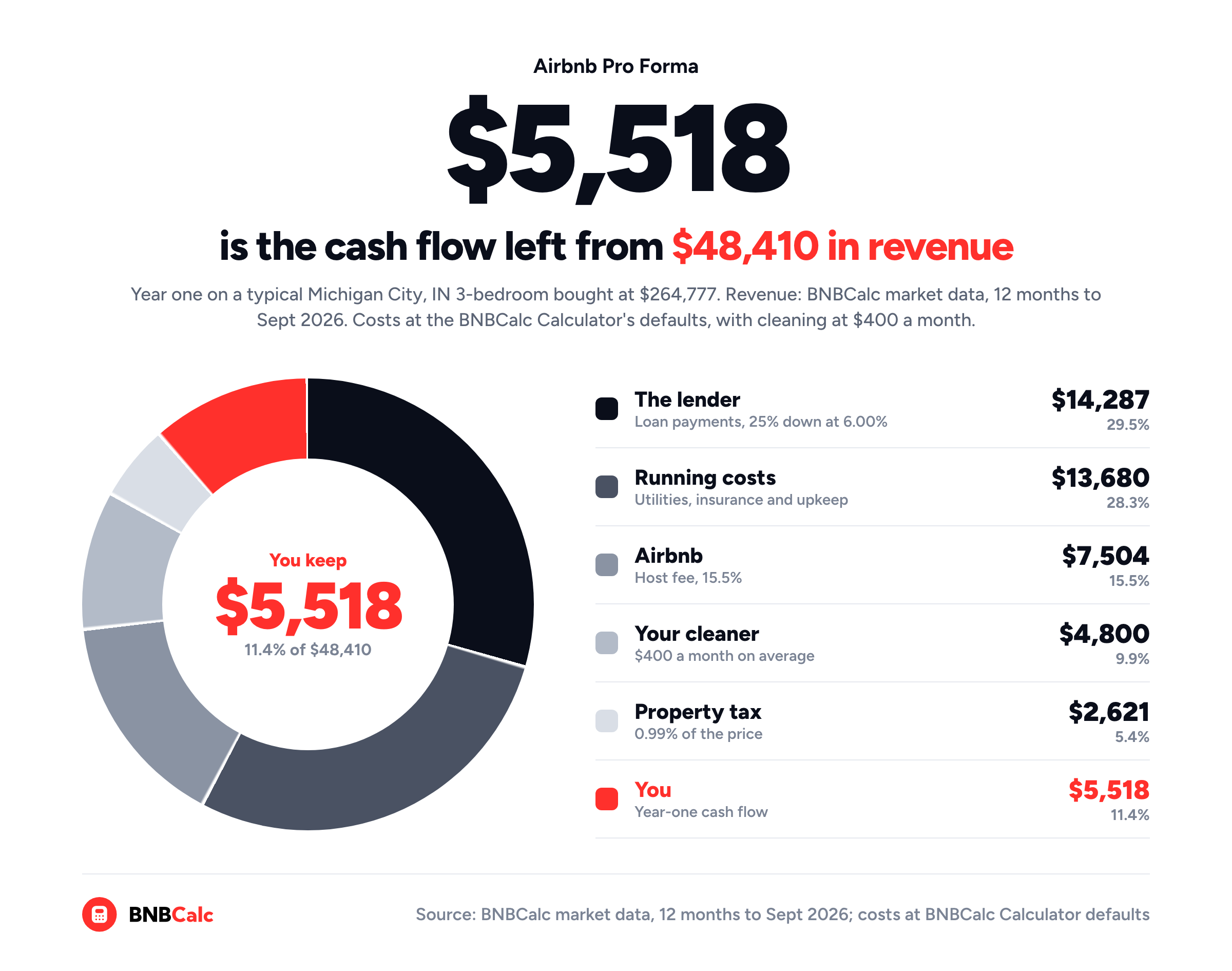
Where does the $48,410 go, then? The lender takes $14,287 and the running costs take $13,680, then Airbnb takes $7,504, the cleaner $4,800 and the property tax $2,621. That leaves you $5,518, or about $460 a month.
The deal works, just not by much.
The house's DSCR of 1.33 clears the 1.25 the Calculator rates Strong, while the deal earns a C on the Calculator's Investor Score, which leans mostly on cash-on-cash return.
How Do You Stress Test an Airbnb Pro Forma?
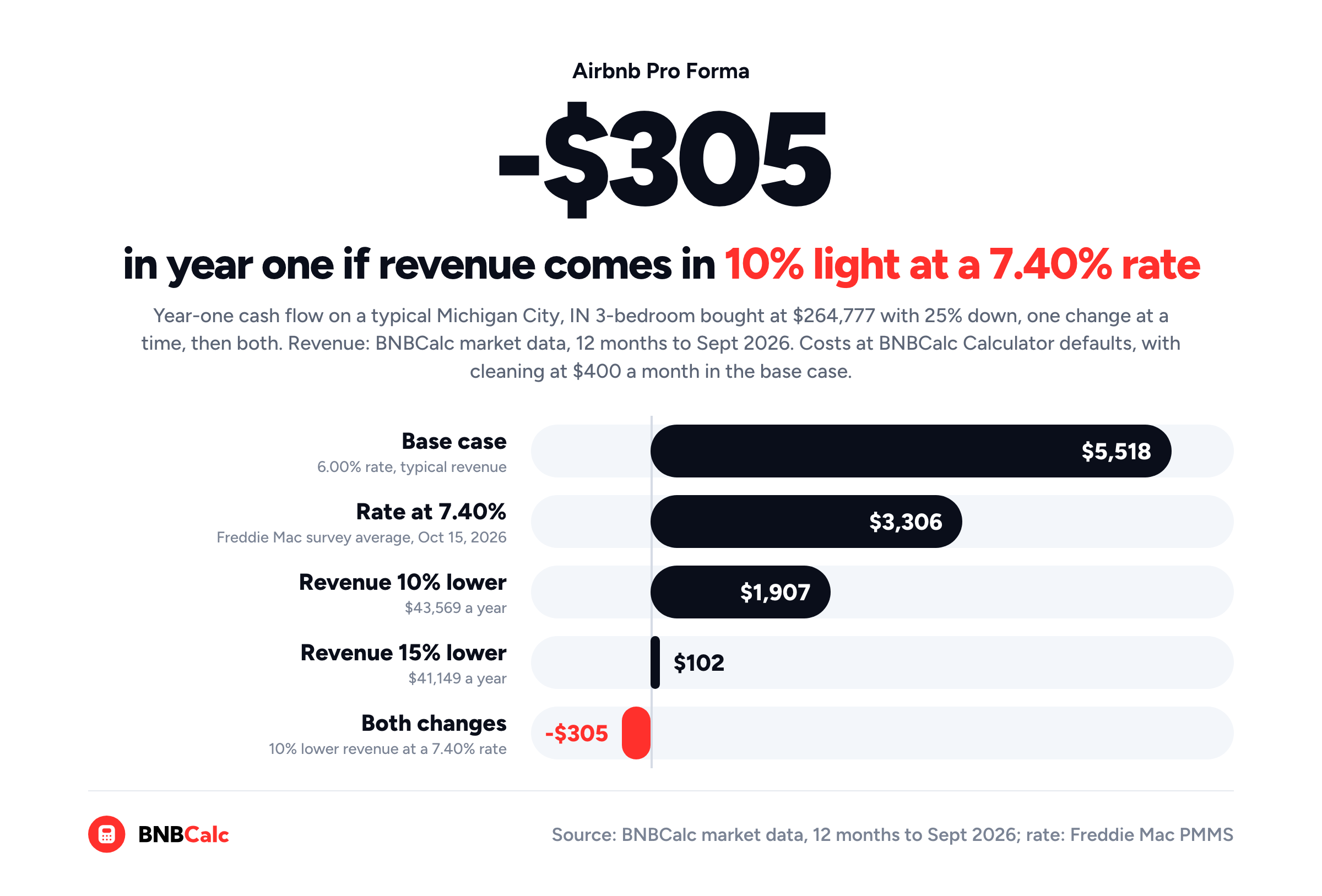
That thin margin is exactly why the pro forma isn't done yet. Change one input at a time and watch the bottom line: in the Calculator, you'd type a lower figure into Manual revenue input for the revenue cases and change the rate in Mortgage & Taxes for the loan case.
| What changes | Revenue | Cash flow | Cash-on-cash | DSCR |
|---|---|---|---|---|
| Base case (6.00%) | $48,410 | $5,518 | 8.4% | 1.33 |
| Revenue 10% below typical | $43,569 | $1,907 | 3.9% | 1.11 |
| Revenue 15% below typical | $41,149 | $102 | 1.6% | 1.01 |
| Rate at the 7.40% survey average | $48,410 | $3,306 | 5.8% | 1.17 |
| 10% less revenue at the 7.40% rate | $43,569 | -$305 | 1.2% | 0.98 |
Each row changes one thing against the base case, except the last, which changes two. Because the Calculator keeps cleaning and the Airbnb fee as a share of revenue, both shrink in the revenue rows, while the other costs stay put. And cash-on-cash stays above zero in the last row, even with the year in the red, because it adds that year's 3% revenue growth.
Revenue is the line to watch.
A 10% miss cuts the cash flow by about two-thirds, and it reaches zero at $41,012 of revenue, 15.3% below the typical $48,410. That's less than 12 months of the $3,574 break-even line, because Airbnb's fee and the cleaning shrink as the bookings fall.
So remember that number when you print the report, because its revenue range shows a low estimate 15% below your projection by default, and on this house, that low estimate leaves about $100 of cash flow.
The rate matters less. Still, at the 7.40% survey average, the loan payments rise by about $2,212 a year, and if a 10% miss lands on top of that, the year ends $305 in the red.
Then again, the miss can run either way. Over the same 12 months, BNBCalc's low performers among Michigan City three-bedrooms averaged $18,804, against $89,776 for its top performers, so where your listing lands matters far more than the rate.
How Much Cash Should You Keep for Slow Months?
Even a year that hits its total can run short in the slow months, since the loan, the property tax, the insurance and the utilities don't take a season off. The Calculator's Seasonality card helps you plan for that, because its Profit tab draws your break-even across the year. To see which months are slow in a market, open it in BNBCalc Markets and hover the solid line on the Occupancy rate card's mini chart, which shows each of the last 12 months.
I'd hold a reserve that covers at least three months of the costs that keep coming when bookings don't. On this house, the loan payments, property tax, utilities, insurance and upkeep come to about $2,549 a month, so three months is $7,647. The Calculator's cash invested doesn't include a reserve, so make sure to set that cash aside on top of the $82,638.
How to Export an Airbnb Pro Forma to PDF or Excel
Once the pro forma looks right, you'll usually want to send it to a lender, a partner or a client, and the Calculator's toolbar gives you three ways to do it.
When you're signed in, Print opens Review & print, where you choose a Full report or a one-page Summary, add a cover note and your contact card, and show a low and high revenue estimate. Then choose Save as PDF in your browser's print dialog.
On a paid plan or a trial, Excel downloads a spreadsheet with the key metrics, revenue and expenses, projections for a month, one year, five and ten, the return metrics, the comps and your assumptions.
Share gives you a view-only link. Anyone can open it without signing in, and while they can try numbers on their screen, nothing they change is saved to your analysis.
So, How Do You Build an Airbnb Pro Forma?
You project the first year line by line: revenue from comps, operating expenses, operating income, loan payments and property tax, and then the cash flow and returns built on them. For a typical Michigan City three-bedroom in BNBCalc's data, that came to $5,518 of cash flow and an 8.4% cash-on-cash return, and a 15% revenue miss would wipe out nearly all of it.
For a house of your own, run the address through the BNBCalc Calculator, adjust the comps and costs until the report reflects the property, and stress test it before you print it.
No pro forma proves a deal works. What it can show you is how much has to go right, and how much room you've got when some of it doesn't.
Frequently Asked Questions
Is There a Free Airbnb Pro Forma Template?
The BNBCalc Calculator builds the pro forma for you instead of handing you a blank template, and you can run two property analyses free or start a 7-day free trial with full access. Give it an address or a Zillow link, and it fills in revenue from comparable listings nearby, operating expenses line by line, Mortgage & Taxes, cash flow and the returns. On a trial or a paid plan, its Excel button downloads the analysis as a spreadsheet.
What Should an Airbnb Pro Forma Include?
In the BNBCalc Calculator, it runs from revenue to operating expenses, operating income, Mortgage & Taxes (loan payments plus property tax) and Profit (Cash Flow), followed by cap rate, cash-on-cash return, DSCR and a monthly break-even. On a typical Michigan City three-bedroom in BNBCalc's data, with 25% down at 6.00%, that runs from $48,410 of revenue to $5,518 of year-one cash flow.
What Occupancy Rate Should I Use in an Airbnb Pro Forma?
Use the occupancy the BNBCalc Calculator builds from your comps. It's the average occupancy of the comps in your estimate, and the Calculator works the nightly rate back from the revenue, so both always agree with your revenue line. For reference, BNBCalc's data shows the typical Michigan City three-bedroom booked 43.5% of its bookable nights over the 12 months to September 2026.
What Stress Tests Should an Airbnb Pro Forma Include?
In the BNBCalc Calculator, test at least a revenue miss and a higher rate, one input at a time: type a lower figure into Manual revenue input, then change the rate in Mortgage & Taxes. On a typical Michigan City three-bedroom with 25% down at 6.00%, BNBCalc's data gives $5,518 of year-one cash flow, which falls to $1,907 with 10% less revenue and $102 with 15% less. The printed report can also show a revenue range 15% either side of your projection.
BNBCalc Calculator Pricing and Free Analyses
When you've got an address to check, the BNBCalc Calculator costs $30 a month or $199 a year as of October 2026. If you'd like to try it first, you can run two property analyses free, or start a 7-day free trial with full access.
And if you don't know where to invest yet, use BNBCalc Markets to compare US markets by gross yield.
Airbnb Tax Deduction Calculator
Paying too much in taxes? We have the perfect solution. Simulate an Airbnb home purchase below.
Purchase Price
$450K
Structure Value
70%
Apply Trump's Tax Cut (Bonus Depreciation)
Depreciation
$117,695
Interest
$21,600
Tax
$6,750
Year 1 Deduction
$146,045
Want to claim this deduction? Get a free cost segregation benefit analysis from CSA Partners — no obligation.
Get Full Analysis