
Free instant analysis
Reveal Airbnb revenue for any address or city
How do you run Airbnb comps on a house you haven't even bought yet? Well, you pull the nearby listings a guest would book instead of yours, keep the five to ten closest matches, and take the median comp's actual revenue as your base case.
When I did that for a hypothetical three-bedroom in East Nashville, using BNBCalc's listing data for Nashville, Tennessee, the five true comps earned $37,274 to $53,311 over the 12 months to September 2026, which put the base case at $45,505.
The tricky part is counting what those comps actually booked, because a calendar that looks full isn't always one that guests paid for.
Below, I'll show you how the BNBCalc Calculator picks comps from an address. Then I'll walk the same six steps by hand on that Nashville house, so you can check its work.
How to Run Airbnb Comps Step by Step
If you've got a specific house in mind, the quickest way to run its comps is to give the BNBCalc Calculator its address or a Zillow link, plus its bedrooms, bathrooms and guests.
First, it pulls up to 50 comparable listings nearby. Then, for a US property, its AI Underwriter reviews each one's photos, layout and amenities against yours, keeps the closest matches, aiming for about five and never more than eight, and tells you why it kept or left out each one. Your revenue estimate is then the median of the comps it kept.
And if you don't agree with its picks, you can tick a left-out comp back in, switch to Select comps and choose the set yourself, or override the revenue figure. Our launch post explains what AI Underwriter looks at when it picks comps.
BNBCalc Markets works from the other end: you browse and filter a market's listings, see what each one actually earned, and save the ones that match your house as a comp set.
Now let's run the same comps by hand. The example house is a three-bedroom, two-bath that sleeps eight, near the middle of East Nashville's 37206 ZIP code, and the comps are real Nashville listings from BNBCalc's data, with names and addresses left out.
Step 1: Define the Property You're Comping
Before you open a single listing, make sure to write down what a guest would be shopping for in your house, because that list decides what counts as a comp. AI Underwriter grades every candidate on eight kinds of fit, and they boil down to five questions you can just as easily ask by hand.
| Check | What to ask about each candidate |
|---|---|
| The home | Is it the same type of property (house, townhouse, condo or guesthouse), with the same bedrooms and similar baths, guests and layout? |
| Finish | Does it look like the same quality of stay, in its finishes, design, upkeep and photos? |
| Setting | Is it in the same kind of place, such as beach, lake, woods, downtown or suburb, with similar walkability, views and nearby draws? |
| Amenities | Does it have the same headline amenities, like a pool or hot tub, or different ones guests value just as much, like wooded privacy instead of a lake view? |
| Track record | Do its revenue, rate, occupancy, reviews and minimum stay make it a believable benchmark? |
Read each row as a question to ask about every candidate. The first four are about the house and where it sits, while the last one checks that its numbers are believable. Bedrooms matter more than the guest count, too, since any host can raise the guest count, but nobody adds a bedroom overnight.
On top of those, I'd add two rules of my own. Every comp needs a full year on the platform, so its numbers cover every season, and at least 60 booked nights in that year, because a listing that barely books says more about its host than about the market.
Step 2: Pull Candidate Listings Nearby
With that list in hand, you can filter a market's listings in BNBCalc Markets down to ones like yours, or search Airbnb the way a guest would. However, a search with dates leaves out any listing that's already booked, so you'll mostly see the ones that didn't sell.
Either way, start close to the house and cut hard. In a ZIP code as dense as 37206, the five comps I kept all sat within 0.29 miles, so only widen the search if you can't find five that close.
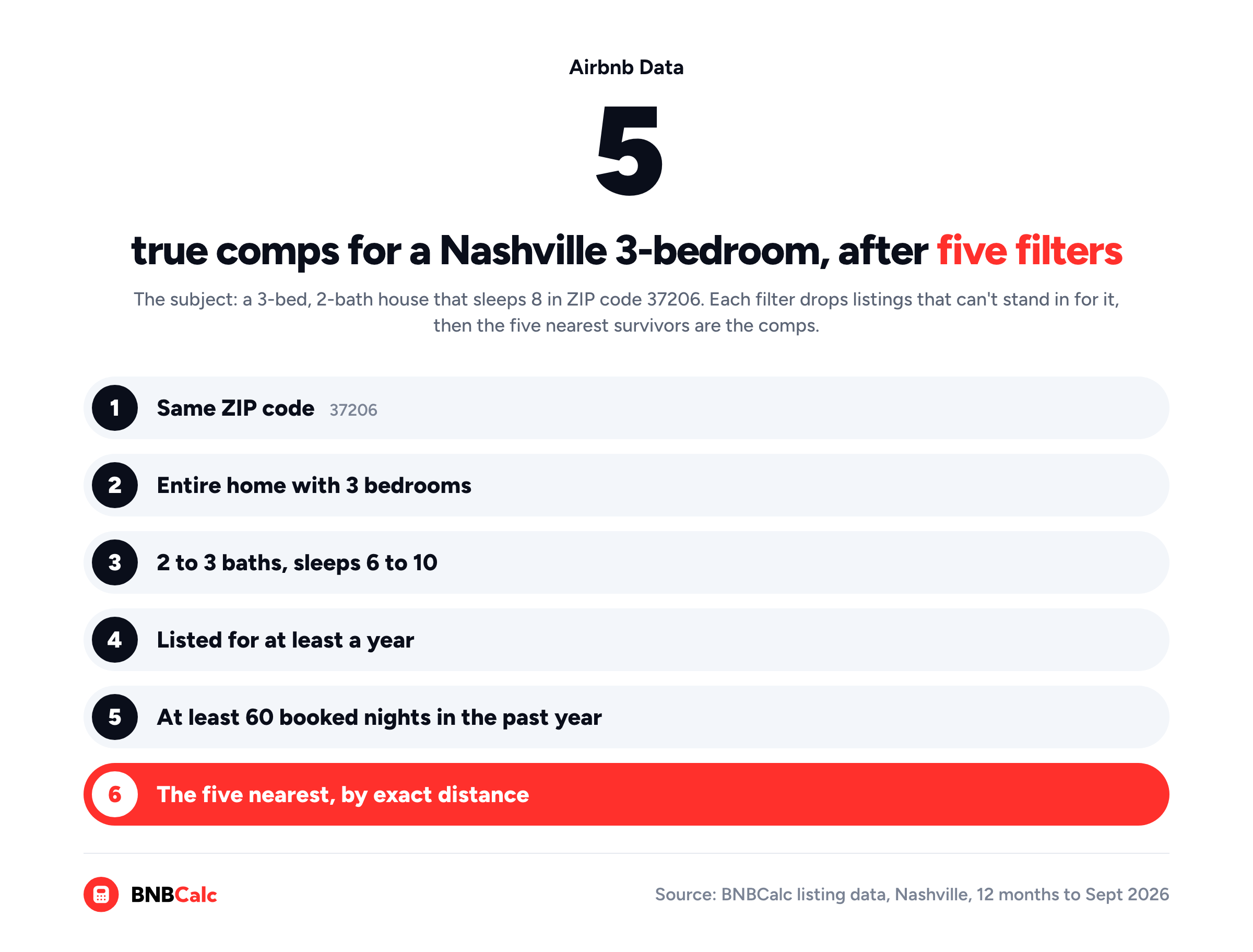
When I ran those cuts on BNBCalc's Nashville data, I kept only entire three-bedroom homes in ZIP code 37206, like the house. Then I dropped anything outside two to three baths or six to ten guests, and finally applied my two rules from Step 1.
That leaves a pool of houses that look alike on paper, until you see what they earned. Over the past year, their actual revenue ran from $17,467 to $72,840, with a median of $41,210. A range that wide could justify almost any offer, which is why I cut it down to the five closest.
Step 3: Cut the Pool to Five to Ten True Comps
Rather than lean on that whole pool, base your estimate on the five to ten listings a guest would most likely book instead of yours. For the Nashville example, I kept it simple and went by distance alone. On a real deal, though, you'd also open each one and compare its photos and amenities with your house, since my filters couldn't see either. That's the part AI Underwriter does for you.
Even with filters that simple, I hit two snags. The two listings nearest the house had the same host, the same map pin and identical calendars, so my read is that it's one home listed twice, and I counted it once, as Comp A.
I also left out a listing whose revenue came in far below its booked nights times its nightly rate. If a comp's own numbers don't hang together, it can't anchor your estimate. That's also why AI Underwriter grades every comp's revenue, rate and occupancy, not just its looks.
Step 4: Separate Booked Nights From Blocked Nights
Once you're down to five, split each comp's unavailable nights into booked and blocked, since that's where most comp runs go wrong.
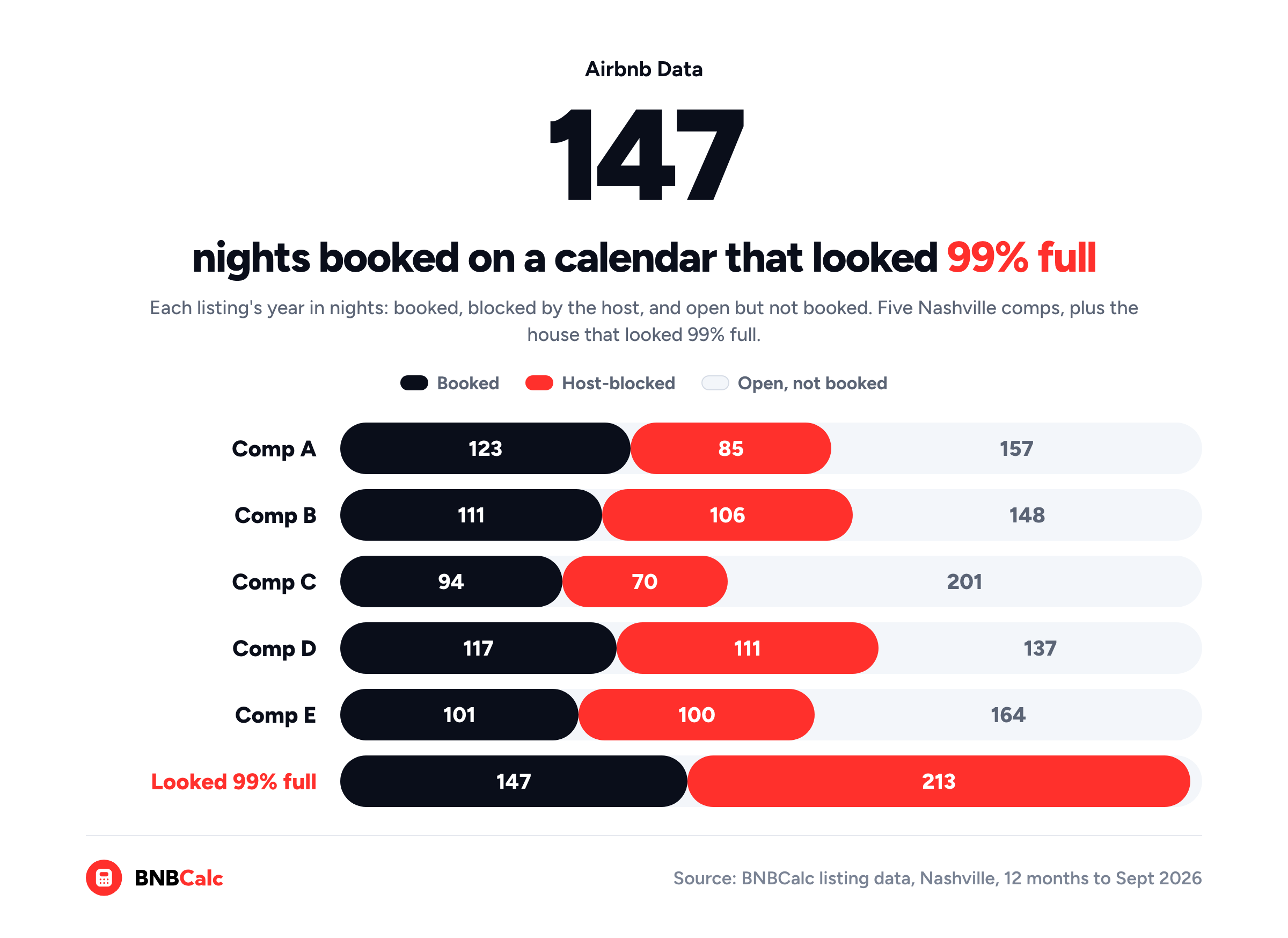
For example, take a three-bedroom, two-bath house in the Nashville pool that sleeps eight, 0.96 miles from the example house. Its calendar had 360 of 365 nights unavailable, about 99%, yet only 147 of those were bookings, and the host blocked the other 213.
Its occupancy looks great too, at 97% of the nights it was open, but that's 147 booked nights out of 152. Over the whole year, guests booked about 40% of its nights. And its actual revenue, $45,139, landed right beside the five comps' $45,505 median, so the calendar that looked full didn't show up as extra income.
Which number do you believe, then? BNBCalc estimates the house booked 147 nights, but nobody can tell you what the 213 blocked nights were. A blocked night could be the owner's own stay or a booking taken somewhere else, so I'd treat a heavily blocked comp as weak evidence either way.
Heavy blocking isn't rare, either. Across the Nashville pool, the median listing had 106 host-blocked nights, and just over a third had 120 or more.
Because heavy blocking is that common, you'll want to read three numbers together: the nights booked, the nights left open and the nights blocked. The good news is that each listing's detail panel in BNBCalc Markets shows all three, with its booked nights next to the days its host blocked.
My five comps had 70 to 111 nights blocked by their hosts, so next to them, that house's 213 stands out. In the chart below, each listing's year is split into booked, host-blocked and open-but-unbooked nights.
Step 5: Put Every Nightly Rate on the Same Basis
Counting booked nights fixes the occupancy side, so now put every comp's nightly rate on one basis too, because the same listing can show different prices depending on where you look. For example, Airbnb's search price for US guests is a fee-inclusive total before taxes, quoted for the dates you search. BNBCalc's booked nightly rate, by contrast, is the average guests actually paid per booked night, with the cleaning fee built in and before Airbnb's host fee comes out.
The cleaning fee alone moves a rate more than you'd think. Say a guest books three nights at $300 with a $150 cleaning fee, so the stay costs $1,050. Spread across the three nights, that's $350 a night with cleaning built in, or $50 more than the $300 rate without it, for exactly the same stay.
In other words, only compare rates with rates from the same source. BNBCalc's rates and revenue include cleaning for every comp, so if all five come from BNBCalc, they're already on one basis.
Step 6: Turn the Comps Into a Range and a Base Case
Once every comp is on the same basis, your five numbers become a range. I'd take the median comp's actual revenue as your base case, since a single outlier can drag an average around, and that's also how AI Underwriter sets its estimate from the comps it keeps. Then use the lowest comp as your low end, because that's a real year from a listing that passed every check.
Don't forget that the comps' revenue already reflects the nights their own hosts blocked, 70 to 111 for my five, so if you plan to block a lot more than that, expect to earn less than they did.
How Much Would a 3-Bedroom Airbnb Make in East Nashville?
These are the five comps that made it through every step, over the 12 months to September 2026. Four are on Airbnb, and Comp C is on Vrbo, which BNBCalc's data covers too.
| Comp | Distance | Booked nights | Host-blocked nights | Booked nightly rate | Actual revenue |
|---|---|---|---|---|---|
| A | 0.02 mi | 123 | 85 | $342 | $42,131 |
| B | 0.12 mi | 111 | 106 | $331 | $37,274 |
| C | 0.26 mi | 94 | 70 | $505 | $47,860 |
| D | 0.28 mi | 117 | 111 | $469 | $53,311 |
| E | 0.29 mi | 101 | 100 | $449 | $45,505 |
Each row is one comp, nearest first. Your base case is the median of the actual revenue column, Comp E's $45,505, while Comp B sets the low end at $37,274 and Comp D tops the range at $53,311. Across the five, the median nightly rate is $449.
Comp C is the one to watch. It charged the most per night but booked the fewest nights, so think twice before you copy its rate.
Keep in mind that $45,505 is revenue before any costs, so your next stop is to analyze the property's expenses and returns. The Calculator does that in the same report, with your loan included.
So, How Do You Run Airbnb Comps?
You keep the five to ten nearby listings a guest would book instead of yours, split their calendars into booked and blocked nights, and take the median comp's actual revenue as your base case. For the example East Nashville three-bedroom, that came to $45,505, and the house that looked 99% full turned out to have only 147 booked nights.
On a real address, the quickest way there is the BNBCalc Calculator. Let AI Underwriter pick and explain the closest comps, open its picks, and then use the optimized report as the baseline you build your costs and loan on.
Whichever way you run them, a comp is evidence of what guests chose, and the strongest evidence you'll get is a night somebody paid for. By contrast, everything else on a calendar is a guess about somebody else's plans. Treat it like one.
Frequently Asked Questions
Is There a Free Way to Pull Airbnb Comps for a Property?
Yes. The BNBCalc Calculator lets you run two property analyses free, or start a 7-day free trial with full access, and each analysis starts from up to 50 comparable listings near the address. Its AI Underwriter then grades every comp for fit and explains why each one stayed or got cut.
What Makes a Good Airbnb Comparable Listing?
A good comp is one a guest would book instead of yours. BNBCalc's AI Underwriter checks that on eight kinds of fit: the same type of home with the same bedrooms, a similar finish and setting, and the same headline amenities or ones guests value as much. Its revenue, rate, occupancy and reviews also have to make it a believable benchmark, and a full year of bookings behind it means its numbers cover every season.
How Many Airbnb Comps Do You Need?
You need five to ten true matches. The BNBCalc Calculator pulls up to 50 nearby listings, and its AI Underwriter narrows them to about five of the closest, never more than eight. A bigger, looser set won't help, because BNBCalc's Nashville data has three-bedroom homes in one ZIP code that looked alike on paper and still earned anywhere from $17,467 to $72,840 over the 12 months to September 2026.
Can You Tell If an Airbnb Night Was Booked From the Calendar?
Not from the calendar alone, since an unavailable night may be booked or host-blocked, but BNBCalc Markets splits the two, and each listing's detail panel shows its booked nights next to the days its host blocked. BNBCalc's Nashville data has a three-bedroom house with 360 of 365 nights unavailable over the 12 months to September 2026, yet guests booked 147 of them and the host blocked the other 213.
Should You Use the Average or the Median of Your Airbnb Comps?
Use the median, the way the BNBCalc Calculator does. Its AI Underwriter sets your revenue estimate at the median of the comps it keeps, so one unusually strong or weak listing can't drag the number around. In BNBCalc's Nashville data, five comps for a three-bedroom in East Nashville's 37206 ZIP code put the median at $45,505 over the 12 months to September 2026.
BNBCalc Calculator Pricing and Free Analyses
When you've got a property in mind, the BNBCalc Calculator costs $30 a month or $199 a year as of October 2026.
If you'd like to try it first, you can run two property analyses free, or start a 7-day free trial with full access.
Airbnb Tax Deduction Calculator
Paying too much in taxes? We have the perfect solution. Simulate an Airbnb home purchase below.
Purchase Price
$450K
Structure Value
70%
Apply Trump's Tax Cut (Bonus Depreciation)
Depreciation
$117,695
Interest
$21,600
Tax
$6,750
Year 1 Deduction
$146,045
Want to claim this deduction? Get a free cost segregation benefit analysis from CSA Partners — no obligation.
Get Full Analysis