
Free instant analysis
Reveal Airbnb revenue for any address or city
How do you analyze an Airbnb investment property before you make an offer? Well, you make sure the house can legally run as a short-term rental, and then you check eight numbers in order, from what similar listings actually earn to the most you can afford to pay.
To show you how, I ran all eight on a typical three-bedroom in Tampa, Florida, which grossed $60,418 over the 12 months to September 2026, according to BNBCalc's data. If you bought one for $387,485, it'd clear $6,458 in year-one cash flow, a 7.1% cash-on-cash return, once costs and a loan come out, though the price and the costs are both illustrative.
I've figured all eight the way the BNBCalc Calculator does, and with a house of your own, it works out most of them from the address, so let's start there.
How to Analyze an Airbnb Investment Property in Eight Numbers
If you've already got a house in mind, the BNBCalc Calculator is the STR deal analyzer to start with, since all it needs is the address or a Zillow link. It pulls up to 50 comparable listings nearby. For a US property, you can also run its AI Underwriter, which reviews each one's photos, layout and amenities against yours, keeps the closest matches and tells you why it kept or left out each one.
From those comps, it projects your year's revenue, slow months included. Its Estimate with AI button suggests your operating expenses line by line, showing where each number came from. Once you add the price, down payment, rate and term, it runs the deal through to cash flow, cap rate, cash-on-cash return and ROI, plus DSCR on a US purchase.
Still, you should be able to check its work, so let's take the eight numbers in order.
First, Make Sure the House Can Legally Operate as a Short-Term Rental
None of the eight numbers matter if the house can't take short-term guests. That's why the first check is the city and county rules, what the HOA allows and whether you'll need a permit or registration. Make sure to read the ordinance itself, too, rather than a listing description.
If you're not sure where to find it, BNBCalc's Airbnb laws and regulations by city is a good place to start.
1. Annual Revenue From Comparable Listings
Assuming you're able to host there, the first number is gross bookings, meaning everything guests pay you in a year, cleaning fees included. It should come from what similar listings nearby actually booked over the last 12 months, which is the job the Calculator's comps do.
And if you don't agree with AI Underwriter's picks, you can tick its left-out comps back in, choose the set yourself or override the revenue figure. Once you've optimized the report, use its revenue estimate as your baseline and your sanity check for the other seven numbers.
For the Tampa example, I've used BNBCalc's market data instead, where the typical three-bedroom, meaning its average performance tier, earned $60,418 over those 12 months.
2. Occupancy and Nightly Rate
Revenue tells you what a house like this earns, while occupancy and nightly rate show you how it gets there. BNBCalc's data shows the typical Tampa three-bedroom filled 46.5% of its available nights at $319 a night over the same 12 months. Before you compare those with another source, make sure you know how they're defined.
On BNBCalc's Tampa market page, occupancy is the share of bookable nights that got booked, so nights the host blocked off don't count against it. Its nightly rate is the average guests actually paid per booked night, which in BNBCalc's figures includes the cleaning fee. Since a market's ADR × occupancy × 365 assumes all 365 nights were open, I'd use occupancy and rate to judge whether the revenue is realistic rather than to rebuild it.
3. Operating Costs
Once you've got a revenue figure you trust, you still have to take out what it costs to earn it. In the Calculator, every expense line starts at a default, and Estimate with AI suggests most of them for the house, while the management fee and lodging tax are yours to enter. In the Tampa example, the costs come down to three lines.
First, there's Airbnb's host fee. As of October 2026, Airbnb's service-fee page says it's moving every home host to its single fee, where most hosts pay 15.5%, and phasing out the split fee, where most pay 3%. That's why I'd plan on 15.5%, the Calculator's default, since modeling 3% by mistake would understate the fee by more than the Tampa example's whole year-one cash flow.
Cleaning is next, and it's an easy line to count twice. Gross bookings already include the cleaning fees guests paid, so only take out what you pay your cleaner, which I've put at an illustrative $400 a month on average.
After that come the running costs, like utilities, supplies, insurance and repairs, but not property tax, which the Calculator counts with the mortgage. Get a real quote for each, and insurance most of all, since standard homeowners insurance typically doesn't cover short-term renting. BNBCalc's guide to short-term rental insurance goes through what to ask for.
For lodging tax, Airbnb's tax collection page lists Florida among the places where it handles tax collection for hosts, so make sure to check which taxes it covers before you enter a rate.
And if you'd rather use a flat percentage, keep in mind that insurance and internet cost the same in a slow year, which is why the example's operating expenses climb from 44.8% of bookings to 49.9% when revenue drops 15%.
4. Operating Income (NOI)
Once you take those three lines out of gross bookings, what's left is the Calculator's Operating Income, also called net operating income, or NOI. It's what the house earns before the mortgage and property tax, so it's the same number whether you pay cash or borrow, and the next three numbers all start from it.
5. Cap Rate
The Calculator's Cap Rate is operating income divided by the price. It leaves the loan out, so it shows what the house earns on what you paid, as if you'd paid cash. Since operating income comes before property tax, take the tax out of it first if you're comparing with a cap rate that counts the tax as an operating cost.
There's no single cap rate that counts as good, since it depends on the market and the risk you're taking on, and BNBCalc's post on what makes a good cap rate for an Airbnb goes through how to judge one.
6. Cash-on-Cash Return
Cash-on-cash return puts the loan back in.
First, take a year of Mortgage & Taxes, your loan payments plus property tax, out of operating income to get your cash flow, which the Calculator calls Profit (Cash Flow). Its Cash on Cash Return then adds a year of revenue growth from your Revenue Appreciation setting (3% by default, or 0% to leave it out) and divides by the cash you put in: your down payment, closing costs and furnishing.
For the loan, use the rate, term and down payment from a real quote, since a published average like Freddie Mac's comes from home purchase loans on owner-occupied homes, not rentals. BNBCalc's guide to investment property mortgage rates is worth a read before you call a lender.
The Calculator then grades the deal from A+ to F with its Investor Score, which weights cash-on-cash return at 85% and cap rate at 15%. BNBCalc's walkthrough of how to calculate ROI on rental property covers the parts of your return that cash flow leaves out.
7. Debt Service Coverage Ratio (DSCR)
On a DSCR loan, DSCR is the number your lender checks. For a US purchase, the Calculator works it out as operating income divided by a year of Mortgage & Taxes, so property tax counts as a payment along with the loan. It then rates 1.25 or more Strong, 1.0 to 1.25 Acceptable and anything lower Weak.
Lenders don't all count income and payments the same way, and each sets its own minimum, so ask yours how it calculates DSCR. If you're leaning toward a DSCR loan, BNBCalc's guide to getting a DSCR loan for an Airbnb walks you through it.
8. Break-Even Revenue and Your Offer Ceiling
DSCR tells you whether a lender's likely to back the deal, while break-even tells you how much room you have if bookings come in light. In the Calculator, break-even is what the house costs you each month, its operating expenses plus Mortgage & Taxes. Its Seasonality card draws it as a dashed line, so you can plan the cash reserve a slow stretch will need. To see which months run slow in your market, check the Occupancy rate card in BNBCalc Markets.
Now let's flip it around. How much could you pay before the cash flow disappears?
That price is your offer ceiling, and in the Calculator, you can find it by raising the purchase price until the cash flow hits zero. Treat it as the most you'd pay, not the price you offer, since it assumes every other line comes in exactly as you modeled it.
Is a Typical Tampa 3-Bedroom Airbnb a Good Investment?
Let's put all eight together on one house, a typical Tampa three-bedroom bought for $387,485. Its revenue comes from BNBCalc's Tampa market data, while the price and every cost are illustrative. That's a market-wide figure, though, so if you'd rather narrow Tampa down before you pick a house, BNBCalc's public pages for selected neighborhoods, such as South Tampa, set each area's yearly revenue, occupancy, nightly rate and gross yield against the whole Tampa market.
I've set the furnishing at the Calculator's defaults of $2,000 a bedroom, $250 a bathroom and $2,000 a living space. For the loan, I've assumed 25% down on a 30-year fixed at 6.00%, which is also the Calculator's default rate. For comparison, Freddie Mac's survey average was 7.40% as of October 15, 2026.
| Line | Year one | How it's figured |
|---|---|---|
| Gross bookings | $60,418 | BNBCalc typical listing, 12 months to Sept 2026, cleaning included |
| Airbnb host fee | -$9,365 | 15.5% of gross bookings |
| Cleaning | -$4,800 | $400 a month on average |
| Running costs | -$12,880 | Utilities and internet $4,200, supplies $1,200, insurance $4,000, repairs $3,000, software $480 |
| Operating income | $33,373 | Gross bookings minus the three lines above |
| Mortgage & Taxes | -$26,915 | $20,909 of loan payments ($1,742.38 a month on a $290,614 loan) + $6,006 property tax (1.55% of the price) |
| Profit (Cash Flow) | $6,458 | Operating income minus Mortgage & Taxes |
| Cash invested | $116,996 | $96,871 down (25%) + $11,625 closing (3%) + $8,500 furnishing |
| Cap rate | 8.6% | $33,373 ÷ $387,485 |
| Cash-on-cash return | 7.1% | ($6,458 + $1,813 of revenue growth at 3%) ÷ $116,996 |
| DSCR | 1.24 | $33,373 ÷ $26,915 |
| Break-even | $4,497 a month | ($9,365 + $4,800 + $12,880 + $26,915) ÷ 12 |
| Price where cash flow hits zero | About $480,000 | Same costs and loan terms, property tax at 1.55% of the price |
Read the table top to bottom, the way the Calculator's Profit box runs.
Is it a good investment, then? Only just.
Even after operating expenses take 44.8% of gross bookings and Mortgage & Taxes take $26,915, the house still clears $6,458, and its $4,497 break-even sits $538 below an average month's bookings. That's the good news. Its DSCR of 1.24, though, lands just under the 1.25 the Calculator rates Strong. Overall, the deal grades a C.
What Happens If the Rate, Price or Revenue Changes?
That said, the cushion is thinner than those checks make it look.
| What changes | Year-one cash flow | Cash-on-cash | DSCR | Break-even a month |
|---|---|---|---|---|
| Base case (6.00%) | $6,458 | 7.1% | 1.24 | $4,497 |
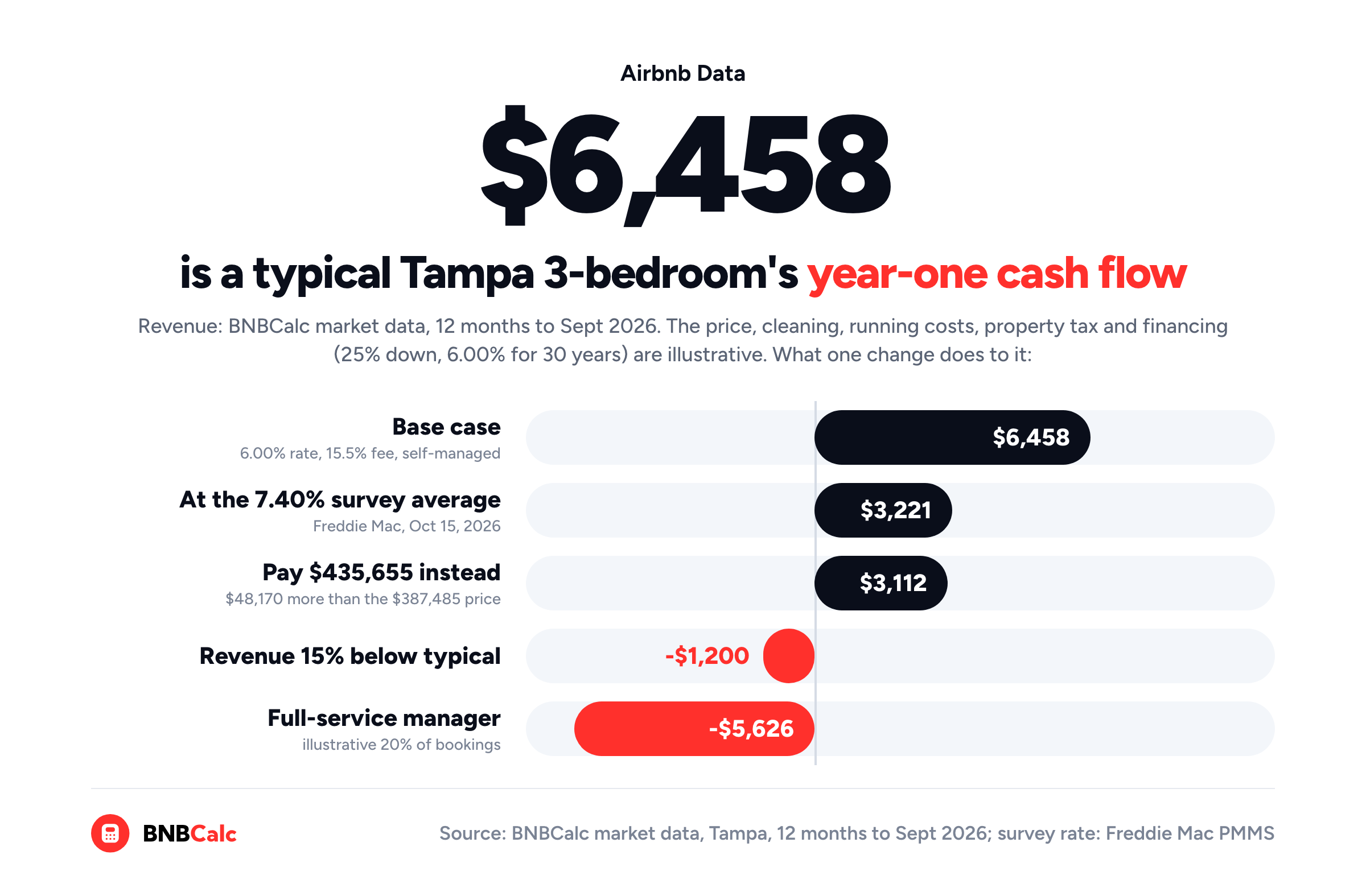
| Rate at the 7.40% survey average | $3,221 | 4.3% | 1.11 | $4,766 |
| Pay $435,655 instead of $387,485 | $3,112 | 3.8% | 1.10 | $4,775 |
| Revenue 15% below typical | -$1,200 | 0.3% | 0.96 | $4,380 |
| Full-service manager at an illustrative 20% of bookings | -$5,626 | -3.3% | 0.79 | $5,504 |
Each row changes one input, the way you would in the Calculator, so paying more also raises the loan and the property tax. The rows hold cleaning at $400 a month, though. Since the Calculator keeps cleaning as a share of revenue, the row with 15% less revenue would come out about $720 better there, at -$480.
At the 7.40% survey average, the loan payments climb by $3,237 a year, which halves the cash flow and drops the DSCR to 1.11.
Anything that eats into revenue hits harder. For example, a year 15% below typical turns the cash flow into a $1,200 loss, and only the year's revenue growth keeps its cash-on-cash above zero. A full-service manager at 20% of bookings is worse still, since it pushes the monthly break-even to $5,504, above the $5,035 a typical Tampa three-bedroom books in an average month.
Most of the risk sits on the revenue line, and so does most of the upside. Tampa's top-performing three-bedrooms averaged $130,369 over the same 12 months, more than twice the typical figure, and even a listing that earns 10% more than typical would add about $5,105 to the year's cash flow, with cleaning held at $400 a month. To find that 10%, check the comps the Calculator kept, and look at its amenity card, which shows which amenities earn more in that market for the house's bedroom count.
So, How Do You Analyze an Airbnb Investment Property?
You check that the house can legally take short-term guests, and then you work through the eight numbers in order, from comps-based revenue to the most you can pay.
For a typical Tampa three-bedroom, that took BNBCalc's $60,418 of gross bookings down to $6,458 of cash flow, which a year 15% below typical would wipe out.
The next step, then, is to put your own address into the BNBCalc Calculator. Adjust the comps and costs until the report reflects the house, and use it as the baseline for every other number.
Even then, a deal that only works when every line comes in exactly as modeled isn't one I'd count on. The analysis worth trusting is the one that still holds up after you've tried your hardest to break it.
Frequently Asked Questions
How Do I Check a Property's Airbnb Potential?
Run the property's address through the BNBCalc Calculator once you've confirmed the house can legally operate as a short-term rental. It pulls up to 50 comparable listings nearby and projects revenue from how they performed, with AI Underwriter there if you'd like each comp graded for fit. Then, with your price and loan, it shows cash flow, cap rate and cash-on-cash return. In Tampa, for example, BNBCalc's data shows a typical three-bedroom grossed $60,418 over the 12 months to September 2026.
What's a Good Cash-on-Cash Return for an Airbnb?
The BNBCalc Calculator grades it for you, from A+ to F, with an Investor Score that weights cash-on-cash return at 85% and cap rate at 15%. In BNBCalc's Tampa example, a typical three-bedroom bought for $387,485 returns 7.1% cash-on-cash in year one with an illustrative price, costs and financing, which grades a C, or 3.8% if you pay $435,655. Compare yours with what the same cash could earn elsewhere.
How Do I Calculate DSCR for a Short-Term Rental?
The BNBCalc Calculator works it out on a US purchase: operating income divided by a year of Mortgage & Taxes, meaning loan payments plus property tax. For a typical Tampa three-bedroom bought for $387,485, that's $33,373 against $26,915, a DSCR of 1.24 with an illustrative price, costs and financing, which the Calculator rates Acceptable, just short of Strong at 1.25. Lenders don't all count the same payments, so ask yours how it calculates DSCR.
Is the ADR × Occupancy × 365 Formula Accurate?
Only when the rate and occupancy come from the same estimate. In the BNBCalc Calculator, the nightly rate is worked back from the revenue projection, so ADR × occupancy × 365 lands on the revenue by design. If you multiply a market's published average rate by its average occupancy and 365, you won't reproduce its revenue, because BNBCalc counts occupancy against bookable nights and averages don't multiply that way. Start from revenue instead.
What Tools Do You Need to Analyze an Airbnb Deal?
You need one for picking a market and one for analyzing an address, and BNBCalc does both. BNBCalc Markets lets you compare markets and browse their Airbnb and Vrbo listings, while the BNBCalc Calculator pulls up to 50 comps for an address, projects a year of revenue and, with your price and loan, shows cash flow, cap rate and cash-on-cash return. If you analyze deals in bulk, BNBCalc's API puts the Calculator's engine inside your own software.
BNBCalc Calculator Pricing and Free Analyses
When you've got an address to check, the BNBCalc Calculator costs $30 a month or $199 a year as of October 2026. If you'd like to try it first, you can run two property analyses free, or start a 7-day free trial with full access.
And if you don't know where to invest yet, use BNBCalc Markets to compare US markets by gross yield.
Airbnb Tax Deduction Calculator
Paying too much in taxes? We have the perfect solution. Simulate an Airbnb home purchase below.
Purchase Price
$450K
Structure Value
70%
Apply Trump's Tax Cut (Bonus Depreciation)
Depreciation
$117,695
Interest
$21,600
Tax
$6,750
Year 1 Deduction
$146,045
Want to claim this deduction? Get a free cost segregation benefit analysis from CSA Partners — no obligation.
Get Full Analysis