
Free instant analysis
Reveal Airbnb revenue for any address or city
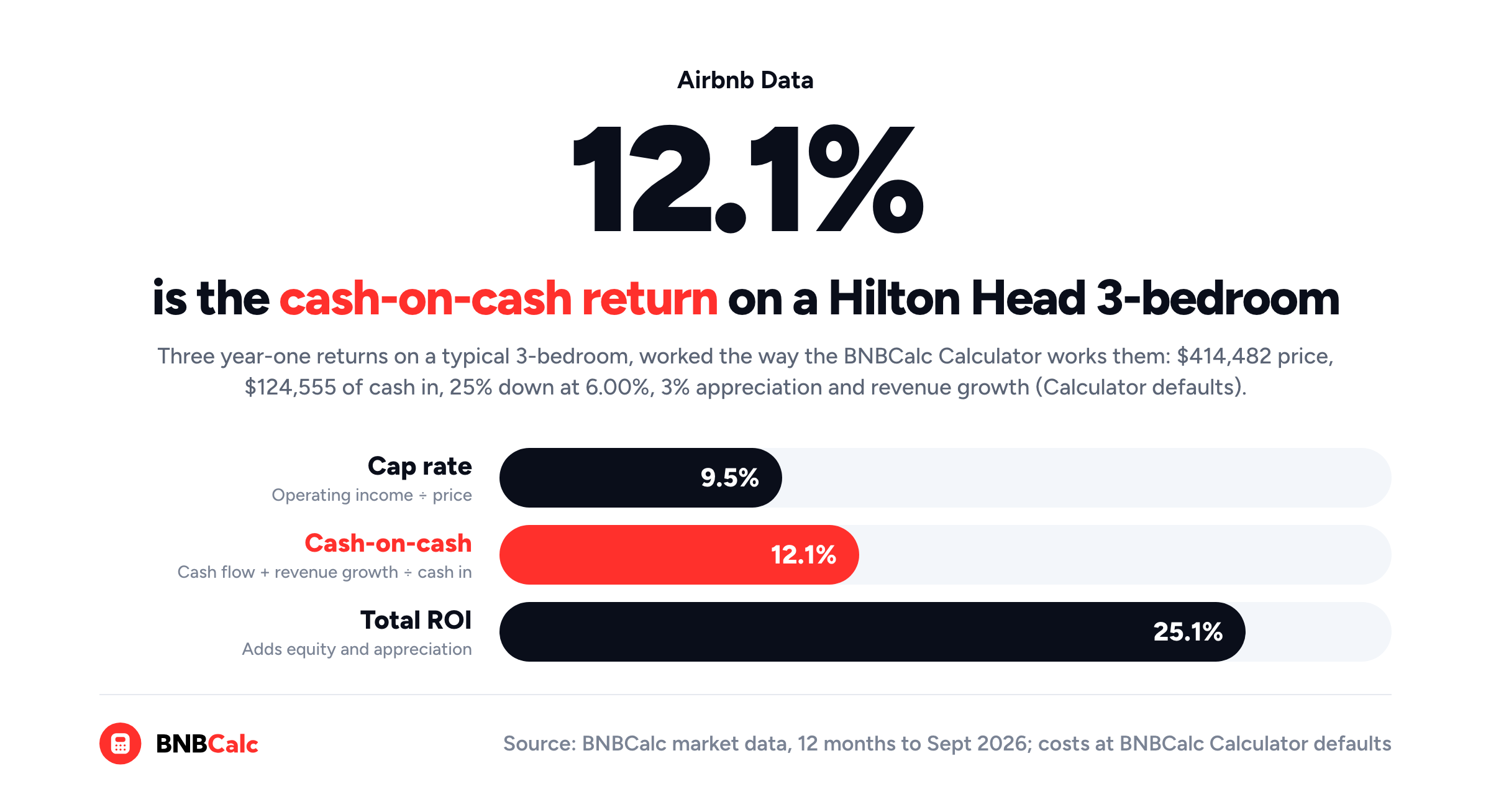
How do you calculate ROI on an Airbnb before you buy one? Well, you work out three numbers. On a typical three-bedroom in BNBCalc's Hilton Head Island, South Carolina market data, bought for an illustrative $414,482 with 25% down, they come to a 12.1% cash-on-cash return, a 9.5% cap rate and a 25.1% total ROI in year one.
Those three answer different questions, though, because each one counts something the others leave out. Cash-on-cash return is what your own cash earns, cap rate is what the house earns before any loan, and total ROI adds the loan paydown and appreciation you'd only collect when you sell or refinance.
The BNBCalc Calculator works out all three from an address, so I'll start there. Then I'll take that Hilton Head house from $68,529 in bookings to its cash flow and work each return by hand, the way the Calculator does, so you can check its math on your own deal.
How Does the BNBCalc Calculator Work Out Airbnb ROI?
If you've got an address or a Zillow link, the BNBCalc Calculator runs the whole calculation for you. It pulls up to 50 comparable listings nearby. For a US property, you can also run its AI Underwriter, which reviews each one's photos, layout and amenities against yours, keeps the closest matches and tells you why it kept or left out each one.
From those comps, it projects your year's revenue, slow months included, and then it fills in your operating expenses line by line. Its Estimate with AI button can also propose values for that specific property, each with its source.
Once you set the price, down payment, rate and term, the report shows your Profit (Cash Flow), your Cash Investment and all three returns, plus a letter grade it calls the Investor Score. Each return divides something different, which is why the same house can show three very different numbers.
| Return | How the BNBCalc Calculator figures it | What it tells you |
|---|---|---|
| Cash on Cash Return | (Year-one cash flow + one year of revenue growth) ÷ cash invested | What your own cash earns in year one |
| Cap Rate | Year-one operating income ÷ purchase price | What the house earns before any loan |
| Return on Investment | (Cash flow + loan principal paid + appreciation + revenue growth) ÷ cash invested | Your whole gain for the period, in cash and on paper |
The first and last rows divide by the same thing, your cash invested, meaning the down payment, closing costs and furnishing. Cap rate is the odd one out, since it divides by the price and ignores the loan altogether.
Cash flow and these three returns aren't the only numbers to check before an offer, of course, and BNBCalc's guide to analyzing an Airbnb investment property covers the rest, like DSCR and break-even revenue. For now, let's put the Hilton Head house through the Calculator's steps.
How Much Cash Flow Does a 3-Bedroom Airbnb in Hilton Head Make?
Say you buy a typical Hilton Head Island three-bedroom for $414,482.
The price is illustrative, but the house's $68,529 of revenue over the 12 months to September 2026 comes from BNBCalc's market data, and by typical, I mean BNBCalc's average performance tier, which sits between its low and top performers.
Since this example has no specific address, I've used that $68,529 in place of a comps estimate, which is what the Calculator's Manual revenue input is for, and left every cost at the Calculator's US defaults except the cleaning and the loan. I've also assumed the house can legally rent short term all year, which you'd confirm against the local rules before a real purchase, and BNBCalc's regulation guides by city are a good place to start.
The Inputs
| Input | Value | Source |
|---|---|---|
| Purchase price | $414,482 | Illustrative |
| Revenue | $68,529 a year, cleaning included | BNBCalc market data, typical listing, 12 months to Sept 2026 |
| Airbnb host fee | 15.5% of revenue | The Calculator's default; Airbnb's service-fee page says most hosts on its single fee pay 15.5% |
| Cleaning | $400 a month on average | Illustrative |
| Utilities | $440 a month | Calculator defaults |
| Insurance and upkeep | $700 a month | Calculator defaults: $150 each for insurance, landscaping, repairs and supplies; $50 each for pest control and software |
| Lodging tax | 0% | Calculator default; Airbnb's South Carolina tax page lists the state and Hilton Head Island taxes and fees guests pay as part of their reservation on stays of 89 nights or fewer |
| Property tax | 0.99% of the price a year | Calculator default |
| Loan | 25% down; 30-year fixed at 6.00% | 6.00% is the Calculator's default rate, and 25% down is illustrative; Freddie Mac's 30-year survey average was 7.40% as of October 15, 2026 |
| Closing and furnishing | 3% closing; $8,500 furnishing | Calculator defaults: $2,000 a bedroom, $250 a bathroom (two assumed), $2,000 a living space |
| Growth | 3% a year for home value and revenue | Calculator defaults |
The Source column splits the inputs three ways: BNBCalc's data, the Calculator's defaults and my own illustrative choices. Since the defaults are the Calculator's US starting values for any new analysis, I'd swap in real quotes on a real house, starting with insurance on the coast.
The Results
| Line | Year one | How it's figured |
|---|---|---|
| Revenue | $68,529 | BNBCalc typical listing, cleaning included |
| Airbnb host fee | -$10,622 | 15.5% of revenue |
| Cleaning | -$4,800 | $400 a month |
| Running costs | -$13,680 | $440 utilities + $700 insurance and upkeep a month |
| Operating income | $39,427 | Revenue minus $29,102 of operating expenses |
| Mortgage & Taxes | -$26,468 | $22,365 of loan payments ($1,863.77 a month on $310,861) + $4,103 property tax |
| Profit (Cash Flow) | $12,959 | Operating income minus Mortgage & Taxes |
| Cash Investment | $124,555 | $103,621 down + $12,434 closing + $8,500 furnishing |
Read the table top to bottom, the way the Calculator's Profit box runs: operating expenses come out of revenue first, then Mortgage & Taxes, and the last row is the cash you put in.
The line to notice is property tax, because BNBCalc counts it with the mortgage instead of with operating expenses, and that matters for the cap rate later on.
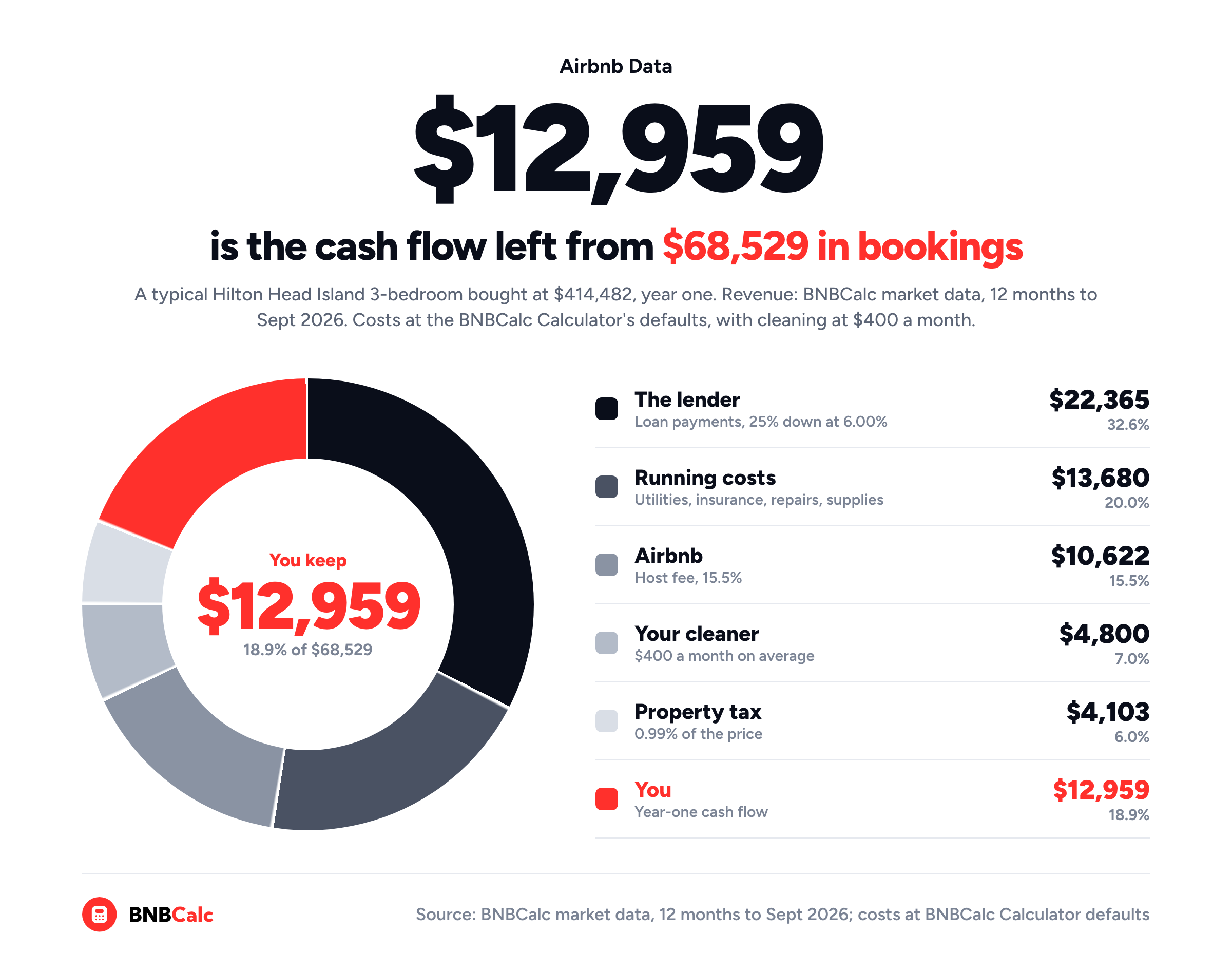
So where does the money go? Out of $68,529 in bookings, the lender takes $22,365, the running costs take $13,680 and Airbnb takes $10,622, and then the cleaner and the property tax take $4,800 and $4,103.
That leaves $12,959 of cash flow, about $1,080 a month, and that's the number cash-on-cash return and total ROI both start from.
How to Calculate Cash-on-Cash Return on an Airbnb
With the cash flow and the cash invested in hand, cash-on-cash return is one division, with one extra step first.
The Calculator's Cash on Cash Return adds a year of revenue growth to the cash flow before it divides. That growth is your Revenue Appreciation setting, 3% a year by default, applied to a year's revenue, which is $2,056 on this house:
($12,959 + $2,056) ÷ $124,555 = 12.1%
In other words, every $100 you put in returns about $12 in year one, counting the year's revenue growth.
Since Revenue Appreciation is an input, you decide how much growth goes into that return. At 0%, the same division is cash flow ÷ cash invested alone, which comes to 10.4% on this house.
How to Calculate Cap Rate on an Airbnb
Cap rate leaves the loan out. It's operating income divided by the price, so it comes out the same whether you pay cash or borrow:
$39,427 ÷ $414,482 = 9.5%
Since BNBCalc keeps property tax in Mortgage & Taxes, the operating income behind that 9.5% comes before property tax. If you're comparing it with a cap rate that counts property tax as an operating cost, take the tax out of operating income first.
That 9.5% also explains why cash-on-cash lands higher on this house: the loan costs 6.00%, less than the house earns on its price, so each borrowed dollar earns more than it costs.
For how to judge a cap rate on its own, see BNBCalc's post on what makes a good cap rate for an Airbnb.
How to Calculate Total ROI on an Airbnb
Total ROI counts the most. The Calculator's Return on Investment adds up a Total Gain for the period and divides it by your cash invested.
By default, that gain has four parts: the cash flow, the loan principal you paid down (Equity), the rise in the home's value (Appreciation) and the rise in revenue (Revenue Appreciation), while renovations and furniture stay unticked unless you add them.
($12,959 + $3,817 + $12,434 + $2,056) ÷ $124,555 = 25.1%
Keep in mind that only one of those parts is cash.
The $12,959 is in your account by the end of year one, while the $2,056 of revenue growth would show up in year two's bookings. The $3,817 of equity and the $12,434 of appreciation (3% of the price) are yours on paper until you sell or refinance, and both growth figures rest on the 3% a year you assume. Try unticking each box to see which part of the return carries the deal, or switch the period to five or ten years.
So which number should you lead with? If you're borrowing, I'd lead with cash-on-cash, since it's the one that counts both the loan and your own cash, and it's also the one the Calculator's grade leans on most.
Whichever you quote, say which one it is, because the same house returns 9.5%, 12.1% or 25.1% depending on what you count.
Is a 12.1% Cash-on-Cash Return Good for an Airbnb?
The Calculator answers that with its Investor Score, a letter grade from A+ to F on the report's Short Term Rental card.
It weights cash-on-cash return at 85% and cap rate at 15%. For example, a deal that returns 15% cash-on-cash with a 10% cap rate scores 75, the bottom of an A, while the Hilton Head house, at 12.1% and 9.5%, scores 62.
That's a B. Keep in mind that score rests on the Calculator's default 6.00% rate, though. At the 7.40% survey average, the same house would clear $9,496 in year one, a 9.3% cash-on-cash return and 21.6% total ROI, and it would score 50, still a B but only just.
How Can You Raise the ROI on an Airbnb?
If you'd like to move that B up, most of the upside sits in how well the listing performs. In BNBCalc's Hilton Head Island data, top-performing three-bedrooms averaged $138,385 over the same 12 months, about twice the typical $68,529.
Even a listing that earns 10% more than typical, or $6,853 more in bookings, would add about $5,311 to the year's cash flow: $6,853 minus $1,062 more to Airbnb and $480 more for cleaning, since the Calculator keeps cleaning as a share of revenue.
That lifts its cash-on-cash return from 12.1% to 16.5% and its Investor Score to an A.
Amenities are where I'd look first for that extra 10%, and BNBCalc Markets shows each one's estimated revenue lift in its Amenity revenue impact table, market by market and by bedroom count. For Hilton Head Island three-bedrooms, it puts an EV charger at +11% and a hot tub at +9%, so either one gets close to that 10% on its own. Both are rare there, too, since each is in fewer than one in ten three-bedrooms.
A pool doesn't make that list for three-bedrooms, even though nearly two in three of them have one, so in Hilton Head it's closer to standard than an edge. You can also filter a market's listings to its high performance tier to see what the top earners have in common.
The Calculator's amenity card does the same job for one address, naming the amenities that could raise annual revenue for your bedroom count in that market. If you'd like to see what one does to your returns, add its cost under Furniture & Renovation and type the higher revenue into Manual revenue input.
So, How Do You Calculate ROI on an Airbnb?
You work out the year's operating income and cash flow first, then divide three ways: cash flow plus a year of revenue growth over your cash for cash-on-cash return, operating income over the price for cap rate, and the whole gain, equity and appreciation included, over your cash for total ROI. On a typical Hilton Head Island three-bedroom with 25% down at 6.00%, BNBCalc's data puts those at 12.1%, 9.5% and 25.1% in year one.
For a house of your own, run the address through the BNBCalc Calculator, adjust the comps and costs until the report reflects the property, and use it as the baseline you build on.
All three returns are built from the same revenue and costs, so the hour that matters most on any deal is the one you spend getting those right, with a real insurance quote, a real tax bill and your cleaner's actual rate.
Frequently Asked Questions
Is There a Free Airbnb ROI Calculator?
Yes. The BNBCalc Calculator lets you run two property analyses free, or start a 7-day free trial with full access. Give it an address or a Zillow link and it pulls up to 50 comparable listings nearby and projects a year of revenue from them. Once you add your price and loan, it shows Profit (Cash Flow), Cash on Cash Return, Cap Rate, Return on Investment and a letter grade for the deal.
How Do You Calculate Airbnb Profit?
In the BNBCalc Calculator, profit is revenue minus operating expenses minus Mortgage & Taxes, and the report calls it Profit (Cash Flow). For a typical Hilton Head Island three-bedroom in BNBCalc's data, $68,529 minus $29,102 minus $26,468 leaves $12,959 in year one, or about $1,080 a month, with costs at the Calculator's defaults, cleaning at $400 a month and 25% down at 6.00%.
What's the Difference Between Cap Rate and Cash-on-Cash Return?
The BNBCalc Calculator shows both on the same report. Cap rate divides operating income by the price, so it leaves the loan out and judges the house. Cash-on-cash return takes your cash flow after loan payments and property tax, adds a year of revenue growth and divides by the cash you put in, so it judges your deal. On a typical Hilton Head Island three-bedroom with 25% down at 6.00%, BNBCalc's data gives 9.5% and 12.1%.
Does BNBCalc's Airbnb ROI Include Appreciation?
Yes, by default. The BNBCalc Calculator's Return on Investment counts cash flow, loan principal paid down, appreciation and revenue growth, each with its own checkbox, and both growth rates start at 3% a year, which you can change. On a typical Hilton Head Island three-bedroom with 25% down, that gives a 25.1% year-one ROI in BNBCalc's data.
What Revenue Should You Use to Calculate Airbnb ROI?
Start with the BNBCalc Calculator's estimate for the address, which it builds from comparable listings nearby. Once you've optimized the report with the comps you trust and the house's bedrooms, bathrooms and guests, use that estimate as your baseline. If you have the property's own booking history, type it into Manual revenue input instead, and every return recalculates.
BNBCalc Calculator Pricing and Free Analyses
When you've got an address to check, the BNBCalc Calculator costs $30 a month or $199 a year as of October 2026. If you'd like to try it first, you can run two property analyses free, or start a 7-day free trial with full access.
And if you don't know where to invest yet, use BNBCalc Markets to compare US markets by gross yield and see which amenities earn more in each one.
Airbnb Tax Deduction Calculator
Paying too much in taxes? We have the perfect solution. Simulate an Airbnb home purchase below.
Purchase Price
$450K
Structure Value
70%
Apply Trump's Tax Cut (Bonus Depreciation)
Depreciation
$117,695
Interest
$21,600
Tax
$6,750
Year 1 Deduction
$146,045
Want to claim this deduction? Get a free cost segregation benefit analysis from CSA Partners — no obligation.
Get Full Analysis