
Free instant analysis
Reveal Airbnb revenue for any address or city
A single bad review won't tank your Airbnb. But a 4.6 rating? That quietly kills your booking rate while you wonder why the calendar stays empty.
Airbnb reviews impact booking rate more directly than most hosts realize — not just through guest perception, but through Airbnb's algorithm, search filters, and the psychological triggers that turn a browse into a confirmed reservation. This article breaks down exactly how the review system works, what the data says about score thresholds, and what you can do right now to generate more 5-star reviews and protect your STR revenue.
Why Airbnb Reviews Matter for Your Investment
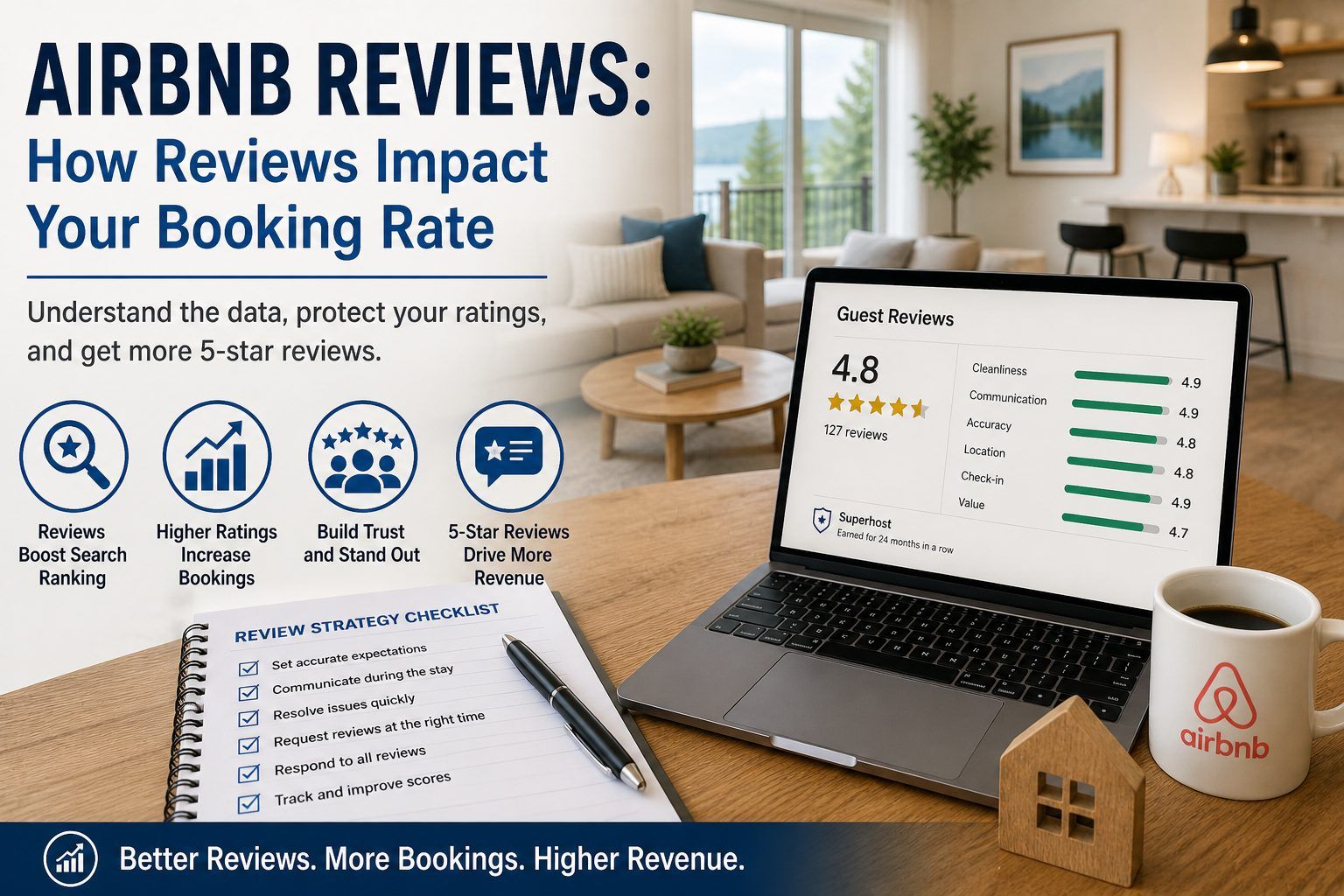
Airbnb host reviews are one of the highest-leverage levers in your entire short-term rental business. They affect search ranking, click-through rate, conversion rate, and average daily rate — all at once.
Reviews as a Trust Signal for Guests
Guests use reviews to make the final call. A listing with 80 reviews and a 4.8 rating converts at a dramatically higher rate than a listing with 12 reviews and a 4.6, even if the property itself is superior.
Short-term rental reviews function like a live social proof engine. Guests aren't reading every review — they're scanning star scores, checking recent dates, and looking for red flags. If your reviews are sparse or stale, guests assume something is wrong.
The recency effect is real: a listing with 10 reviews in the last 90 days outperforms one with 100 reviews spread over three years, because recent reviews signal that the property is actively maintained and consistently delivering.
How Reviews Influence Airbnb's Search Algorithm
Airbnb's search ranking factors in review score, review volume, and response rate — all simultaneously. A higher review score improves your position in search results, which drives more impressions, which produces more bookings, which generates more reviews. It compounds.
Airbnb also uses your ratings to determine Superhost eligibility (minimum 4.8 overall) and whether your listing appears in curated collections like "Guest Favorite." Listings outside those tiers get systematically deprioritized in Airbnb search ranking, regardless of how good the property actually is. If you're not sure whether Superhost status is worth pursuing, the data makes a compelling case.
The algorithm doesn't grade on a curve. A 4.7 and a 4.4 are treated very differently, even though they look similar to the casual observer.
The Direct Link Between Reviews and Booking Rate
Airbnb reviews impact booking rate through three distinct mechanisms: volume, score, and recency. Understanding each one lets you target the right fix.
Review Volume vs. Review Score: What Matters More?
In the early stages of a listing, volume matters more. A new listing with a 4.9 and 6 reviews will lose clicks to a competitor with a 4.8 and 60 reviews — guests don't trust thin review counts.
Once you cross a credibility threshold (more on that below), score starts to dominate. At scale, a 4.9 listing consistently outbooks a 4.7 listing in the same market, even when the 4.7 has more total reviews.
The practical takeaway: prioritize volume first, quality second. You need enough reviews to establish credibility before your star score becomes the differentiating factor.
The Tipping Point: How Many Reviews You Need to Convert
According to 2025 STR data, listings with fewer than 10 reviews convert at roughly half the rate of listings with 10–20 reviews. The jump from 0 to 10 reviews is the single biggest conversion gain you'll ever see.
The next meaningful inflection point is around 50 reviews, where guest hesitation drops significantly. At 100+ reviews, the listing effectively becomes self-selling — the social proof is strong enough that guests stop scrutinizing the score and start looking at availability.
New listings should treat the first 10 reviews as a launch phase: price aggressively, respond to every guest personally, and follow up with a review request within 24 hours of checkout.
Star Rating Thresholds That Guests Actually Filter By
Airbnb's search filter lets guests restrict results to listings rated 4.8 and above. That single filter is the reason a 4.79 listing is materially worse than a 4.80 — one appears in filtered searches, one doesn't.
Here's how the thresholds stack up in practice:
| Rating Range | Visibility Impact | Guest Perception |
|---|---|---|
| 4.9 – 5.0 | Maximum — "Guest Favorite" eligible | Exceptional, premium worthy |
| 4.8 – 4.89 | High — Superhost eligible, passes filter | Strong, trustworthy |
| 4.7 – 4.79 | Moderate — excluded from top filter | Decent, some hesitation |
| 4.5 – 4.69 | Low — hidden from most filtered searches | Risky, needs explanation |
| Below 4.5 | Minimal — Airbnb may delist | Significant concern |
A 4.5 is not a "pretty good" rating on Airbnb. It's a warning sign that costs you real money.
How Negative Reviews Hurt Your STR ROI
One negative review doesn't destroy a listing. A pattern of them — or a score that drifts below the key thresholds — creates a compounding revenue problem.
The Financial Cost of a 4.5 vs. 4.9 Rating
A short-term rental industry report from 2025 found that listings rated 4.9 or higher command average daily rates 18–23% higher than comparable listings rated 4.5–4.7. That's not just price tolerance — it's also occupancy.
Run the math on a property earning $150/night at 65% occupancy: that's $35,587 annually. Bump the rating from 4.6 to 4.9, push occupancy to 75% and ADR to $170, and you're at $46,537 — a $10,950 difference from reviews alone.
STR occupancy rate and star rating are directly correlated in every competitive market. Investors underestimate this when underwriting deals, which is why BNBCalc factors review tier benchmarks into its revenue modeling tools.
Responding to Bad Reviews: Damage Control That Works
A public response to a negative review isn't for the guest who left it — it's for every future guest who reads it. Your response signals how you handle problems, and a professional, solution-focused reply often neutralizes a 3-star review in the eyes of future bookers.
Keep responses under 100 words. Acknowledge the issue, explain what changed, and thank the guest. Never get defensive, assign blame, or over-explain. If you want to go further and attempt to remove a review entirely, learn how the Airbnb review removal process actually works before you spend time on a dispute.
If you're managing multiple properties, stay current on Airbnb's Terms of Service — the April 2026 update includes specific guidance on review disputes and host response policies that every active host needs to know.
Proven Strategies to Generate More 5-Star Reviews
The best Airbnb review strategy isn't reactive — it's built into every stage of the guest experience before the review is even requested.
Setting Accurate Expectations Before Check-In
The fastest way to get a bad review is to let a guest feel misled. If your photos show a mountain view but the angle required is from a specific corner of the deck, say so. If the neighborhood is busy on weekends, mention it.
Expectation management starts in your listing copy and continues through your pre-check-in message. A simple message 48 hours before arrival that confirms the property's best features — and its quirks — reduces complaints dramatically.
Hosts who invest in accurate, detailed listings consistently outperform those who optimize only for clicks. Guests who arrive knowing what to expect rarely leave negative short-term rental reviews. If you haven't revisited your listing recently, these proven Airbnb listing optimization strategies are worth reviewing.
In-Stay Touchpoints That Drive Positive Feedback
A brief check-in message (not a wall of text) sent 24 hours after arrival catches small problems before they become review fodder. Ask one direct question: "Is everything as expected?"
If a guest mentions an issue, fix it immediately. A guest who had a problem that got resolved quickly often leaves a better review than one who had no issues — because you demonstrated responsiveness.
A personalized house guide with local restaurant recommendations, parking tips, and WiFi speed specs adds perceived value without adding cost. Guests notice effort, and Airbnb host reviews are largely a reflection of how cared for the guest felt. Enhancing your guest communication at every touchpoint is one of the highest-ROI moves a host can make.
Timing Your Review Request for Maximum Response Rate
Airbnb sends an automatic review prompt, but hosts who add a personal message see significantly higher response rates. The optimal window is 2–4 hours after checkout — the guest is still in the positive afterglow of the stay but hasn't started unpacking and forgetting.
Keep the message short: thank them, mention something specific about their stay if you can, and ask them to share their experience. Don't use the word "review" as an ask — use "share your experience" or "let others know."
Guests who feel personally acknowledged are 2–3x more likely to leave a review than those who receive a generic automated message. Using a well-crafted Airbnb guest check-out message template makes this process repeatable without sacrificing the personal touch.
Tracking Review Performance as an Investor
Airbnb reviews impact booking rate consistently over time — which means tracking review metrics is a core investor activity, not an afterthought.
Key Metrics to Monitor in Your Airbnb Dashboard
Your Airbnb dashboard shows overall rating, subcategory scores (cleanliness, accuracy, communication, location, check-in, value), and review count. Monitor all of them monthly — subcategory drops often signal specific operational problems before they hit your overall score.
Watch for these warning signs:
- Cleanliness score below 4.8 — almost always a turnover or cleaning protocol issue
- Accuracy score below 4.7 — your listing copy or photos need updating
- Communication score below 4.9 — response time or pre-arrival messaging needs work
- Value score below 4.6 — pricing may be misaligned with the offering
- Check-in score below 4.8 — access instructions or lockbox reliability needs review
Tracking subcategory trends lets you fix problems surgically instead of guessing. If you're researching specific market benchmarks — like short-term rental performance in Reno, Nevada or Henderson, Nevada — local market data helps you understand whether your review scores are competitive within your specific submarket.
Using BNBCalc to Factor Review Impact Into Revenue Projections
Most STR revenue calculators plug in ADR and occupancy without accounting for review-driven variance. That's a significant underwriting gap, especially in competitive markets.
BNBCalc's property analyzer incorporates review tier benchmarks alongside occupancy and revenue data, so your projections reflect the realistic performance range for a listing at your current (or target) review score — not just the market average.
If you're evaluating a property in a market like Newark, New Jersey, where competition is intensifying, the difference between a 4.6-rated listing and a 4.9-rated listing in your projections can mean $8,000–$15,000 in annual revenue variance. Model that gap before you buy.
Frequently Asked Questions
How much do Airbnb reviews impact booking rate in competitive markets? In high-competition markets, Airbnb reviews impact booking rate by 20–35% based on recent STR market data comparing listings with similar properties and pricing. Listings rated below 4.7 are effectively excluded from the filtered searches most serious guests use. The impact compounds over time — lower ratings mean fewer bookings, which means fewer opportunities to recover your score.
How many reviews does a new Airbnb listing need before it starts converting? New listings see the steepest conversion improvement between 0 and 10 reviews. Hitting 10 verified reviews roughly doubles conversion rate compared to a listing with fewer than 5. Prioritize earning those first 10 reviews above all else — price competitively, follow up personally, and make the first wave of guests feel like VIPs.
Does responding to negative reviews actually help? Yes — but the audience for your response is future guests, not the reviewer. A calm, professional response that acknowledges the issue and explains how it was resolved reassures prospective guests that you take the hosting role seriously. Listings where hosts engage with negative feedback professionally tend to see lower bounce rates on those review pages.
What's the best way to get more Airbnb reviews without violating platform rules? The most effective approach is a personalized post-checkout message sent 2–4 hours after departure. Avoid incentivizing reviews or pressuring guests — both violate Airbnb's policies. Focus on delivering an experience worth reviewing, then make a direct, warm ask. Review platforms also favor recency, so consistent booking volume matters as much as any individual strategy for how to get more Airbnb reviews.
Is a 4.8 rating good enough, or do you need a 4.9? A 4.8 qualifies for Superhost status and passes Airbnb's top-tier search filter — so it's a solid floor. But a 4.9 unlocks "Guest Favorite" eligibility, commands higher ADR, and consistently outperforms 4.8 listings in click-through rate in the same market. If you're running STR investing as a serious income strategy, target 4.9 as your baseline, not your stretch goal.
Your review score is either working for you or against you every single day your listing is live. The gap between a 4.6 and a 4.9 isn't guest satisfaction nuance — it's algorithm placement, filter eligibility, ADR ceiling, and annual revenue. Start treating your Airbnb review strategy like the financial asset it actually is.
Airbnb Tax Deduction Calculator
Paying too much in taxes? We have the perfect solution. Simulate an Airbnb home purchase below.
Purchase Price
$450K
Structure Value
70%
Apply Trump's Tax Cut (Bonus Depreciation)
Depreciation
$117,695
Interest
$21,600
Tax
$6,750
Year 1 Deduction
$146,045
Want to claim this deduction? Get a free cost segregation benefit analysis from CSA Partners — no obligation.
Get Full Analysis