
Análise instantânea gratuita
Revele a receita do Airbnb para qualquer endereço ou cidade
Most Airbnb investors obsess over occupancy rates and nightly pricing — then get blindsided by the mortgage. Investment property mortgage rates run meaningfully higher than what you'd pay on a primary home, and on a $500,000 purchase, even a 0.75% difference costs you $300+ per month. That's the difference between a property that cash-flows and one that bleeds. Here's exactly what STR investors need to know before they sign anything.
Investment Property Mortgage Rates: What Airbnb Investors Need to Know
Investment property mortgage rates in 2026 typically run 0.50% to 1.25% higher than rates on a comparable primary residence loan. The spread depends on your credit score, down payment, loan type, and the property itself. Understanding that gap — and knowing how to close it — is one of the highest-leverage moves an Airbnb investor can make before closing.
How Investment Property Rates Differ from Primary Home Loans
Why lenders charge more for investment properties
Lenders price investment property loans higher because the default risk is measurably greater. When a borrower hits financial trouble, they protect the roof over their head first — rental property payments get skipped first.
This isn't speculation. Mortgage servicers have decades of data showing that investment property default rates spike faster and recover slower than primary residence defaults during economic downturns. Lenders bake that risk premium directly into the rate.
Typical rate premiums: what to expect
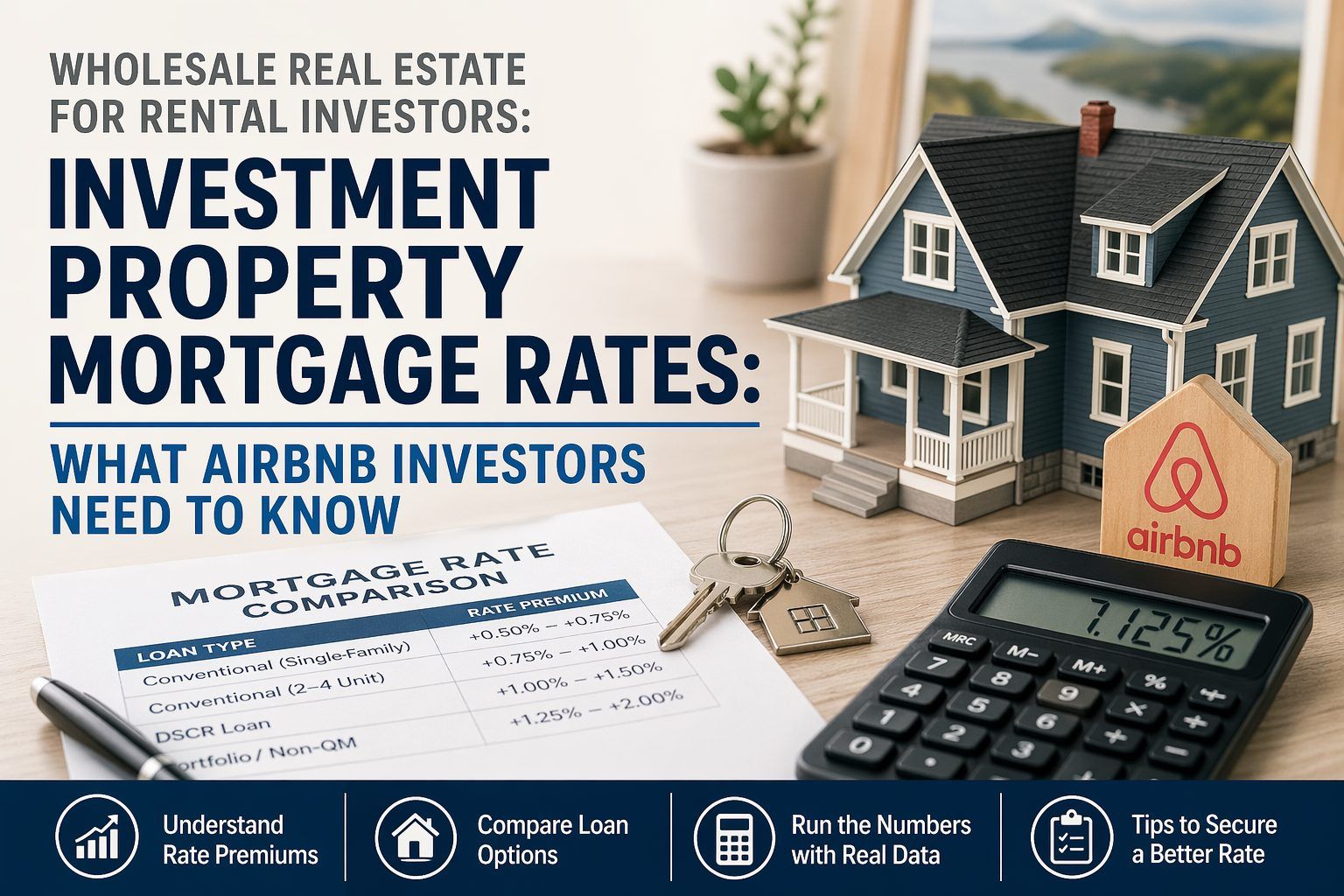
As of 2026, the rate premium on a conventional investment property loan ranges from 0.50% to 1.25% above 30-year primary residence rates. The table below shows how that premium stacks up across loan scenarios:
| Loan Type | Typical Premium Over Primary Rate | Minimum Down Payment |
|---|---|---|
| Conventional (single-family) | +0.50% – +0.75% | 15% |
| Conventional (2–4 unit) | +0.75% – +1.00% | 25% |
| DSCR loan | +1.00% – +1.50% | 20–25% |
| Portfolio / non-QM | +1.25% – +2.00% | 20–30% |
The premium grows with perceived risk. A two-unit STR in a tourist market with a first-time investor borrower will carry a higher rate than a single-family cabin owned by someone with a 780 credit score and 30% down.
For more context on how rates moved through a recent rate cycle, see our breakdown of investment property mortgage rates in 2024.
Loan Types Available to Airbnb Investors
Conventional investment property loans
Conventional loans are the default starting point for most STR investors. Fannie Mae and Freddie Mac back these loans, which means they come with standardized underwriting — and standardized limitations.
You'll need to qualify on your personal income (W-2 or tax returns), and lenders will apply strict debt-to-income ratio limits. One important upside: if you already live in the property or plan to rent it on a platform where market rents can be documented, some lenders will count 75% of projected rental income to offset the payment.
DSCR loans: qualifying on rental income
A DSCR loan — Debt Service Coverage Ratio loan — qualifies you based on the property's income potential rather than your personal tax returns. The lender looks at whether the property's rental income covers the mortgage payment, typically requiring a DSCR of 1.0 to 1.25.
DSCR loans are the most popular Airbnb investment loan product for self-employed investors and anyone whose personal income doesn't reflect their true cash position. The tradeoff is a slightly higher rate, but for many STR investors, the ability to qualify at all makes that premium worth paying. For a deeper dive into how these products compare, our guide on DSCR vs. conventional mortgages for short-term rentals breaks down the tradeoffs in detail.
This is one of the most misunderstood products in short-term rental financing — many investors don't realize DSCR lenders increasingly accept STR income, not just long-term lease income, for qualifying purposes.
Short-term rental-specific lenders
A growing tier of lenders now explicitly underwrites for Airbnb and Vrbo income. These portfolio lenders — Kiavi, Visio Lending, and a handful of regional banks — don't sell loans to Fannie/Freddie, so they set their own underwriting rules.
Some will use trailing 12-month STR platform statements as income documentation. Others apply a stabilized revenue estimate from market data to project income. STR-specific lenders often move faster than conventional lenders and are more comfortable with furnished, short-term rental properties — which can trip up traditional appraisers.
Key Factors That Affect Your Rate
Credit score and down payment requirements
Credit score is the single biggest lever you can pull as a borrower. The table below shows how credit score affects pricing on a standard investment property loan:
| Credit Score | Rate Impact |
|---|---|
| 760+ | Best available pricing |
| 740–759 | +0.25% |
| 720–739 | +0.50% |
| 700–719 | +0.75%–1.00% |
| Below 700 | Limited options; significantly higher rates |
Down payment matters nearly as much. At 25% down on a single-family investment property, you access better pricing tiers and avoid some loan-level price adjustments (LLPAs) that Fannie Mae applies to lower-equity investment purchases.
Property type and location
A single-family STR typically gets the most favorable underwriting. The more unusual the property — a mansion, a multi-unit building, a rural cabin — the more scrutiny it receives. If you're evaluating a larger property, our guide on whether a mansion works as an Airbnb investment covers the considerations in detail.
Location also matters: lenders in tourist-dependent markets may apply additional risk overlays, especially if local STR regulations are in flux.
Short-term vs. long-term rental income classification
This is where STR investors get tripped up. Many conventional lenders won't accept Airbnb income as qualifying rental income — they treat it the same as a vacant property. That forces investors into DSCR or portfolio products, which carry higher rental property interest rates.
The classification matters during underwriting, not just at application. A property appraised as a "vacation rental" rather than a standard residential rental can trigger different comparable selection, which affects value — and therefore your loan amount. Understanding how your lender classifies STR income before you apply saves time and surprises. If you're still weighing whether to operate short-term or long-term, our STR vs. LTR comparison lays out the full picture.
How to Calculate If the Numbers Still Work
Using STR revenue projections to stress-test your rate
Before locking any loan, run the revenue analysis at multiple rate scenarios — not just the rate you expect to get. A property that cash-flows at 7.0% may break even at 7.75% and go negative at 8.5%.
Recent STR data shows that top-performing markets average 55–70% occupancy with ADRs that vary dramatically by season. Anchoring your pro forma to peak-season numbers is how investors get burned. For a structured approach to building these projections, our guide to pro forma analysis for Airbnb hosts walks through the methodology step by step.
Break-even occupancy and cash-on-cash return
Break-even occupancy tells you how full your calendar needs to be just to cover expenses. If your mortgage, taxes, insurance, and platform fees total $4,200/month and your average nightly rate is $250, you need 17 booked nights — 55% occupancy — just to break even before STR management costs.
Cash-on-cash return is the cleaner metric for comparing properties with different financing structures. It measures annual pre-tax cash flow against your actual cash invested (down payment plus closing costs). A solid STR should target 8–12% cash-on-cash in most markets.
How BNBCalc can model financing scenarios
BNBCalc lets you plug in multiple rate scenarios and see how each one affects your projected cash flow, break-even occupancy, and cash-on-cash return — all against real market revenue data. Instead of building rate sensitivity tables in a spreadsheet, you get the full Airbnb cash flow analysis in one view.
If you're comparing BNBCalc against other investment analysis tools, our DealCheck review lays out how the tools differ for STR-specific underwriting.
Tips to Secure a Better Rate as an STR Investor
Improve your borrower profile
Six months of deliberate credit management before applying can shift your rate by 0.50% or more. Pay down revolving balances below 30% utilization, don't open new credit lines, and pull your own credit report to dispute any errors before a lender does.
Reserves also matter. Most lenders want to see 6 months of PITI (principal, interest, taxes, insurance) in liquid assets after closing. More reserves signal lower risk and can offset a lower credit score.
Shop DSCR and portfolio lenders
The spread between the best and worst rates on an Airbnb investment loan from competing lenders is routinely 0.50%–1.00% on the same borrower profile. Getting three to five loan quotes — including at least one from a DSCR-focused lender — is not optional if you're serious about maximizing returns.
Portfolio lenders and DSCR specialists are also more likely to be comfortable with STR income documentation. If you're deciding between property structures, our comparison of duplex vs. townhouse as STR investments may also affect which loan type makes the most sense.
Lock timing and rate buydowns
Rate locks typically run 30–60 days. If you're buying in a volatile rate environment, ask about extended lock options — they cost more upfront but protect you from rate increases during a slow closing process.
Permanent rate buydowns (paying points to lower your rate) make sense when you plan to hold the property long-term. On a DSCR loan for Airbnb, buying the rate down by 0.25% on a $400,000 loan costs roughly $1,000 per point and saves ~$55/month — a payback period of about 18 months. If you're keeping the property five-plus years, it almost always pencils out. Also explore whether a seller credit can offset the buydown cost at closing.
The investors who consistently get the best short-term rental financing aren't smarter — they're more prepared. Your rate is negotiated before you apply, not after.
Frequently Asked Questions
Can I use projected Airbnb income to qualify for a mortgage?
With a conventional loan, lenders generally require documented rental income — meaning a signed lease or two years of tax returns showing rental income. DSCR loans, by contrast, qualify the property on projected STR revenue, and many DSCR lenders accept short-term rental platform data as documentation. This makes DSCR the primary vehicle for investors whose Airbnb income isn't fully captured on tax returns.
What down payment is required for an STR investment property?
Conventional investment property loans require a minimum of 15% down for single-family properties and 25% for 2–4 unit properties. DSCR loans typically require 20–25% regardless of unit count. A larger down payment — 25–30% — not only opens better rate tiers but also strengthens your STR's cash-on-cash return by reducing the monthly debt service.
Are DSCR loans worth it for Airbnb properties?
DSCR loans are worth it when your personal income doesn't qualify you for conventional financing or when STR revenue is your primary cash flow story. The rates run slightly higher than conventional investment property mortgage rates, but the flexibility in qualification — no personal income verification, no DTI limits — is a meaningful advantage. Run both scenarios in a cash flow model before deciding.
How does STR regulation risk affect my mortgage options?
Lenders in markets with unstable or restrictive STR regulations may apply additional underwriting overlays or decline to lend entirely on properties zoned for short-term use only. Before applying, confirm local STR permit status and ask your lender directly whether they have market-level restrictions. Properties in markets with clear, permissive STR regulations get cleaner underwriting every time.
Does the platform I use — Airbnb vs. Vrbo — affect my financing?
The platform itself doesn't directly affect your rate, but it affects how lenders verify and project income. Some DSCR lenders prefer to see 12-month platform income statements, and Airbnb's payout documentation is generally easier to pull and present than multi-platform income. For a full breakdown of platform differences that affect investor returns, see our Vrbo vs. Airbnb comparison.
Airbnb Tax Deduction Calculator
Paying too much in taxes? We have the perfect solution. Simulate an Airbnb home purchase below.
Purchase Price
$450K
Structure Value
70%
Apply Trump's Tax Cut (Bonus Depreciation)
Depreciation
$117,695
Interest
$21,600
Tax
$6,750
Year 1 Deduction
$146,045
Want to claim this deduction? Get a free cost segregation benefit analysis from CSA Partners — no obligation.
Get Full Analysis