
Análisis instantáneo gratuito
Revele los ingresos de Airbnb para cualquier dirección o ciudad
Airbnb retired the Strict cancellation policy on October 1, 2025 — and it's not coming back. Every listing that used Strict was automatically migrated to the Firm policy on that date. There's no setting to switch back, and no new listing can select Strict.
Why Airbnb Retired the Strict Policy
Airbnb removed Strict as part of a platform-wide overhaul that introduced a universal 24-hour free-cancellation window for guests and a new Limited policy tier. The goal: make guests more confident booking early. Stricter refund terms suppress bookings, and Airbnb's own guidance on choosing a cancellation policy frames more flexible tiers as consistently converting better in search results and booking rate.
Strict was the most host-protective option Airbnb offered. Guests received a 50% refund if they canceled within 48 hours of booking — after that, no refund, regardless of how far out the stay was. Removing it shifted every host who depended on that protection onto Firm, which works differently at both ends of the booking window.
How Firm Compares to the Retired Strict Policy
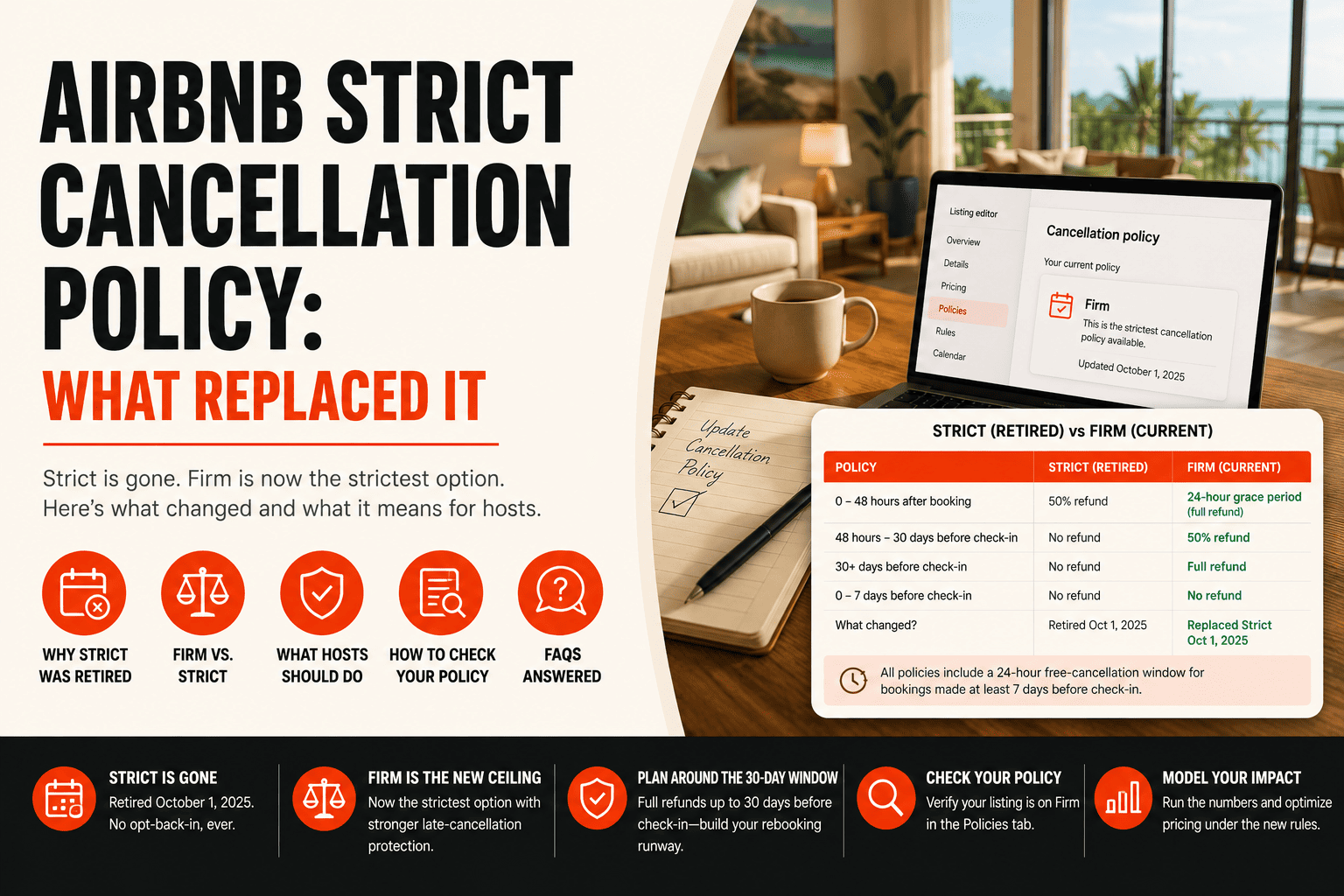
Firm is now Airbnb's strictest available cancellation policy. Here's how it stacks up against what Strict offered:
- Strict (retired): Guests canceled within 48 hours of booking for a 50% refund. After 48 hours, no refund — regardless of how far out the reservation was.
- Firm (current): Guests cancel up to 30 days before check-in for a full refund. Cancellations between 7 and 30 days before check-in receive a 50% refund. Inside 7 days of check-in, the booking is fully non-refundable — the host keeps 100% of the payout.
The practical trade-off: Firm gives guests a much longer full-refund window early on (30 days versus 48 hours), but it's stronger than Strict was for late cancellations. A guest who cancels within 7 days of check-in forfeits the entire booking — something Strict never fully guaranteed beyond its 48-hour window.
Every booking under Firm also includes the 24-hour guest grace period for reservations made at least 7 days before check-in. This applies to all policy tiers, not just Firm. The full 2026 cancellation policy breakdown covers exactly how that window interacts with each tier.
What Hosts Who Used Strict Should Do Now
If your listing previously ran on Strict, confirm it migrated to Firm and decide whether that tier still fits your property.
High-demand, book-far-ahead listings — seasonal properties and event-market homes — face the biggest adjustment. A booking made months out can still cancel with a full refund up to 30 days before arrival. Don't treat a reservation as locked in the moment it lands; build your rebooking runway around that 30-day window. Understanding how Airbnb fees affect your overall payout is equally important when projecting net revenue under the new policy structure.
Last-minute-heavy listings feel less of a difference. Firm's 7-day non-refundable cutoff is roughly comparable to what Strict offered past the 48-hour mark, so the day-to-day impact is smaller than the policy change sounds.
Hosts who want stricter terms than Firm hit a wall — there's nowhere else to go. Moderate, Limited, and Flexible are all more permissive. Firm is the ceiling, and that ceiling is unlikely to change. If you're evaluating whether your current listing setup still pencils out, Airbnb listing optimization strategies can help offset booking friction from the longer refund window.
How to Check Your Current Policy in Airbnb
Verifying your listing's cancellation policy takes less than two minutes. Log into Airbnb, go to your listing editor, and open the Policies tab — your active cancellation tier displays there. If it shows anything other than Firm and your listing previously used Strict, contact Airbnb support to confirm the migration applied correctly.
Hosts running multiple listings should check each one individually. Automatic migrations don't always apply uniformly across accounts with complex configurations or co-hosting arrangements.
Frequently Asked Questions
Is Airbnb getting rid of the Strict cancellation policy? It already happened. Airbnb retired Strict for every listing on October 1, 2025, with no phase-in period and no opt-out.
What cancellation policy replaced Strict on Airbnb? Firm replaced Strict. Every listing that used Strict was automatically migrated to Firm, and there's no way to revert to the old policy.
Do hosts earn more or less under Firm compared to Strict? It depends on when guests cancel. Firm gives guests a longer full-refund window (30 days) than Strict did, but guarantees hosts 100% of the payout for cancellations inside 7 days of check-in — a stronger late-cancellation guarantee than Strict ever provided.
Can I get the Strict policy back for my listing? No. Strict is fully retired. There's no opt-back-in option for existing listings or new ones.
Does the 24-hour free-cancellation window override Firm? Yes — for reservations made at least 7 days before check-in, guests have 24 hours after booking to cancel for a full refund, regardless of which cancellation policy the listing uses. This grace period is platform-wide.
The Bottom Line
Strict isn't being phased out — it's gone, and has been since October 2025. Firm is now the strictest option Airbnb offers. If you haven't confirmed which tier your previously-Strict listing landed on, check your listing settings today rather than assuming the migration went through.
Hosts also navigating the host-only fee structure alongside the cancellation policy changes should model both variables together to understand their true net payout per booking. Run your numbers with BNBCalc's free STR calculator and get a clear picture of what your property can earn under current market conditions.
Airbnb Tax Deduction Calculator
Paying too much in taxes? We have the perfect solution. Simulate an Airbnb home purchase below.
Purchase Price
$450K
Structure Value
70%
Apply Trump's Tax Cut (Bonus Depreciation)
Depreciation
$117,695
Interest
$21,600
Tax
$6,750
Year 1 Deduction
$146,045
Want to claim this deduction? Get a free cost segregation benefit analysis from CSA Partners — no obligation.
Get Full Analysis