
Free instant analysis
Reveal Airbnb revenue for any address or city
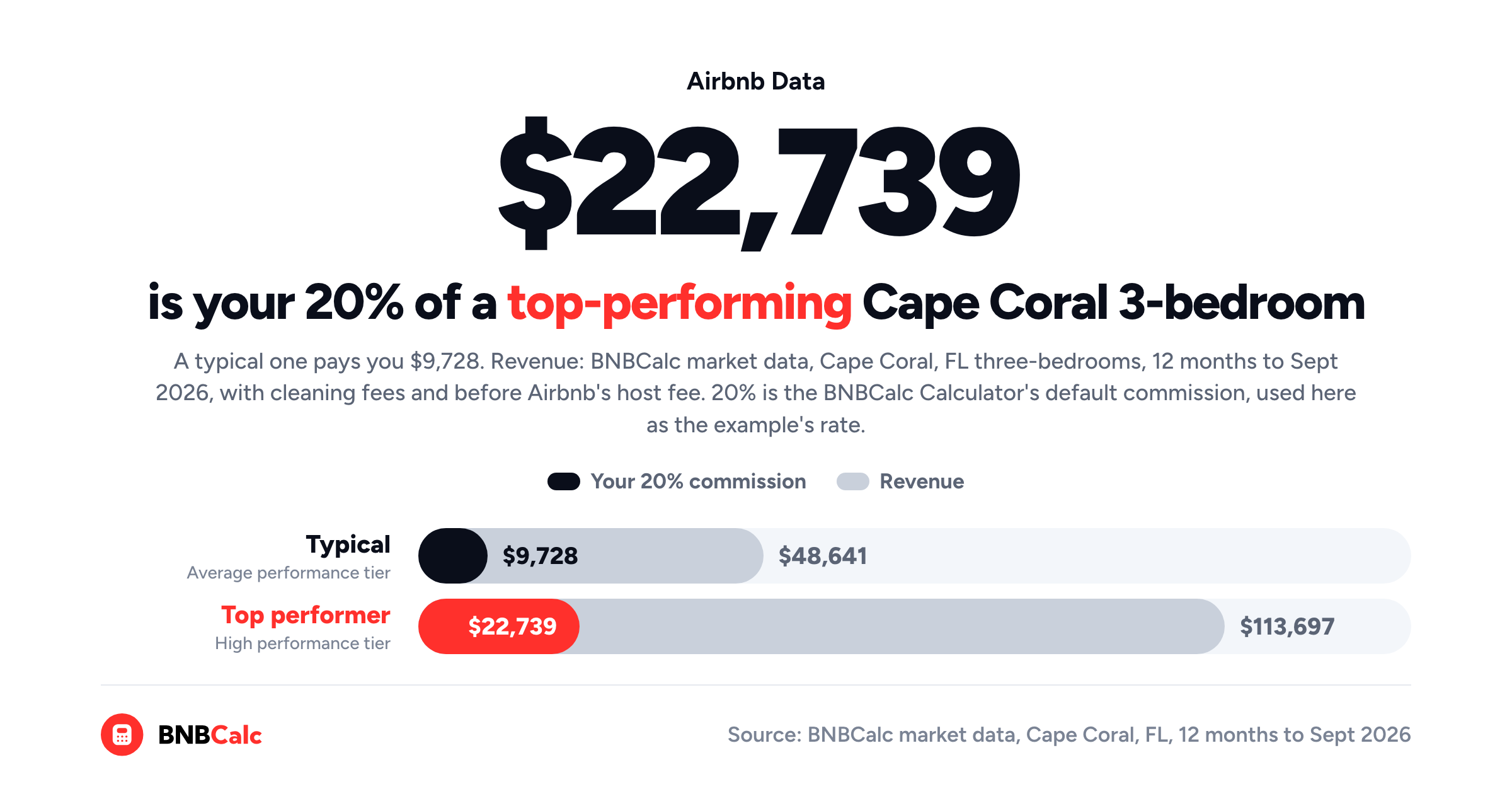
How much will an owner's house earn on Airbnb, and how much of that would end up as your commission if you co-hosted it? Well, BNBCalc's Cape Coral, Florida market data shows a typical three-bedroom grossed $48,641 over the 12 months to September 2026. At a 20% commission, that's $9,728 for you, while a top performer's $113,697 would pay you $22,739.
That gap is your pitch.
After all, your commission grows when the house earns more, and the owner's side turns out thinner than the revenue suggests, since Airbnb's fee and the owner's own bills still have to come out of it.
So I'll start with how the BNBCalc Calculator's Cohost analysis turns an address into an owner's revenue and your commission, and then show how Airbnb's own co-host payouts change the math. After that, I'll work both sides of that Cape Coral three-bedroom, first your commission and then what the owner keeps.
How to Estimate an Owner's Airbnb Revenue and Your Commission
The quickest way to do both at once is to run the owner's address through the BNBCalc Calculator as a Cohost analysis. That's the type it describes as "Manage this property for the owner," and it works like any other analysis up to the revenue estimate. Then, instead of a mortgage and returns, it shows your commission and the owner's payout.
Step 1: Run the Owner's Address as a Cohost Analysis
Type the address into the search box, then check the bedrooms, bathrooms and max guests it fills in, since the guest count feeds the revenue estimate. Pick Cohost when it asks for the analysis type. Then run it. There's no purchase price to enter, because you aren't buying anything. That means the report skips the mortgage, the return metrics and the tax section, and it sticks to revenue, costs, your commission and the owner payout.
Step 2: Check the Revenue Estimate Against the House
Now look hard at the revenue, since your commission and the owner's payout both come from it.
The Calculator builds it from up to 50 comparable listings nearby. For a US address, its AI Underwriter can also review each comp's photos, layout and amenities against the house, keep about five of the closest matches, never more than eight, and use their median. It does need photos of the house for that. If BNBCalc can't find at least eight photos of it, you can upload five or more of your own, and that's easy once you've walked through the place with the owner.
If you'd like to check its picks by hand, this guide to running Airbnb comps walks through the same steps on a Nashville house.
And if the house already has a booking history, switch on Manual revenue input and type in the owner's last 12 months.
Either way, once the estimate reflects the house, treat it as the baseline for the rest of the pitch.
Step 3: Set Your Commission Rate
Next, click the pencil on the Cohost commission row and set your rate, anywhere from 0% to 50%. It starts at 20%. That's the Calculator's default, so make sure to change it to whatever you'll actually charge.
If you charge every owner the same, I'd save the rate as a preset and set it as the default, so every new Cohost analysis starts from it.
Step 4: Put Cleaning and Supplies Where They Belong
The pencil on the Cleaning row opens the two costs a Cohost analysis tracks: cleaning, as a share of revenue or a dollar amount a month, and supplies. Cleaning starts at 8% of revenue and supplies at $150 a month, and Estimate with AI can suggest both for the house.
So who pays for what? In the Calculator's math, the owner does, because it takes both costs out of the owner payout, while your commission stays a straight share of the revenue. And if the cleaning fee passes through you to the cleaner, keep the cleaner's pay on the Cleaning row instead of folding it into your rate.
Step 5: Read Your Commission and the Owner Payout
On a Cohost analysis, the summary box is titled Revenue, and it shows four rows: Revenue, Cleaning (cleaning and supplies together), Cohost commission and Owner payout. You can view them for a month, a year, five years or ten.
Your commission is revenue times your rate, and the owner payout is whatever's left after cleaning, supplies and your commission. Keep in mind that it comes before Airbnb's host fee and the owner's other bills, like utilities, insurance and property tax, because a Cohost analysis keeps to your side of the deal.
I'll show how to get the owner's full picture once we get to the Cape Coral house.
How Do Airbnb Co-Host Payouts Work?
Before you quote that commission, though, make sure you know how you'll get paid, because Airbnb works out a co-host's share on a different base than the Calculator does.
Whatever access the owner gives you, only they can set up your payout, and Airbnb's help page on what co-hosts can do lists three levels of access: full, calendar and messaging, or calendar only. From there, the owner can share the cleaning fee, the cleaning fee plus a percentage, a straight percentage with or without the cleaning fee, or a fixed amount per booking.
The catch is the percentage.
Airbnb's article on co-host payouts says they "are calculated based on the amount of the host's potential earnings for each booking," and those earnings come after Airbnb's host service fee. Airbnb counts them as the nightly price times the nights, plus charges like the cleaning fee, minus that fee and any other taxes and fees that apply.
On the single fee structure, Airbnb's service-fee page says the whole fee comes out of the host's payout and most hosts pay 15.5%, as of October 2026, but it doesn't say what that 15.5% is a percentage of.
If the fee comes off the whole booking, cleaning fee included, then a 20% share through Airbnb works out to 16.9% of the booking (0.20 × 0.845 = 0.169). The Calculator, by contrast, takes your commission as a share of revenue before Airbnb's fee. That's why you should match the base first.
On that assumption, if you've agreed on 20% through Airbnb's payouts, enter 16.9% instead, and on a typical Cape Coral three-bedroom, you'll see $8,220 rather than $9,728, or $1,508 less over a year. To check the assumption, have the owner open a past booking in their Earnings dashboard, where Airbnb shows the service fee it took.
Your share drops again if the percentage leaves out the cleaning fee.
How Much Does a Co-Host Make on a 3-Bedroom Airbnb in Cape Coral?
Say a Cape Coral owner asks what you'd make co-hosting their three-bedroom. BNBCalc's Cape Coral market data puts a typical three-bedroom at $48,641 over the 12 months to September 2026 and its top performers at $113,697. Both are gross bookings, with cleaning fees included and before Airbnb's host fee. By typical, I mean BNBCalc's average performance tier, and by top performers, I mean its high tier.
That said, BNBCalc's Cape Coral market covers more than the city itself. About six in ten of the three-bedrooms in its listing data have a Cape Coral ZIP code, while most of the rest sit in nearby towns like Fort Myers Beach, Bonita Springs and Fort Myers. I've also assumed the house can be rented short term, which BNBCalc's Cape Coral regulation guide walks through.
Now picture each revenue figure typed into Manual revenue input on a Cohost analysis, with the Calculator's 20% default kept as this example's assumption. Cleaning is an illustrative $400 a month on the typical house, and supplies stay at the $150 default, so the Calculator's math gives you this.
| Line | Typical three-bedroom | Top performer |
|---|---|---|
| Revenue | $48,641 | $113,697 |
| Cleaning and supplies | $6,600 | $13,020 |
| Your commission (20%) | $9,728 | $22,739 |
| Owner payout | $32,313 | $77,938 |
Each column is one house, in the order the Calculator shows its rows, so the owner payout is revenue minus the two rows above it. Cleaning rises on the top performer, too, because the Calculator works it out as a share of revenue, so raising the revenue on the same analysis turns the typical house's $400 a month into $935.
On the top performer, your commission more than doubles. In fact, how the house performs moves your income more than your rate does. Each 5 points of commission is worth $2,432 a year on the typical house and $5,685 on the top performer, while going from typical to top-performer revenue is worth another $13,011 to you at the same 20%.
So what do Cape Coral's top-performing three-bedrooms do differently? According to BNBCalc's data, they averaged $538 a night against $303 for a typical one, with cleaning fees built into both. They also booked 50% of the nights they were open, against 42%. In other words, they charge far more per night and still fill more of the nights they're open. That's what you'd point to when you talk an owner through pricing, photos and how you look after guests.
Even so, where a particular house lands depends on the house itself and how well it's run, so I'd pitch the typical figure as the baseline and the top-performer figure as what's possible, never as a promise.
How Much Does the Owner Keep After Your Commission?
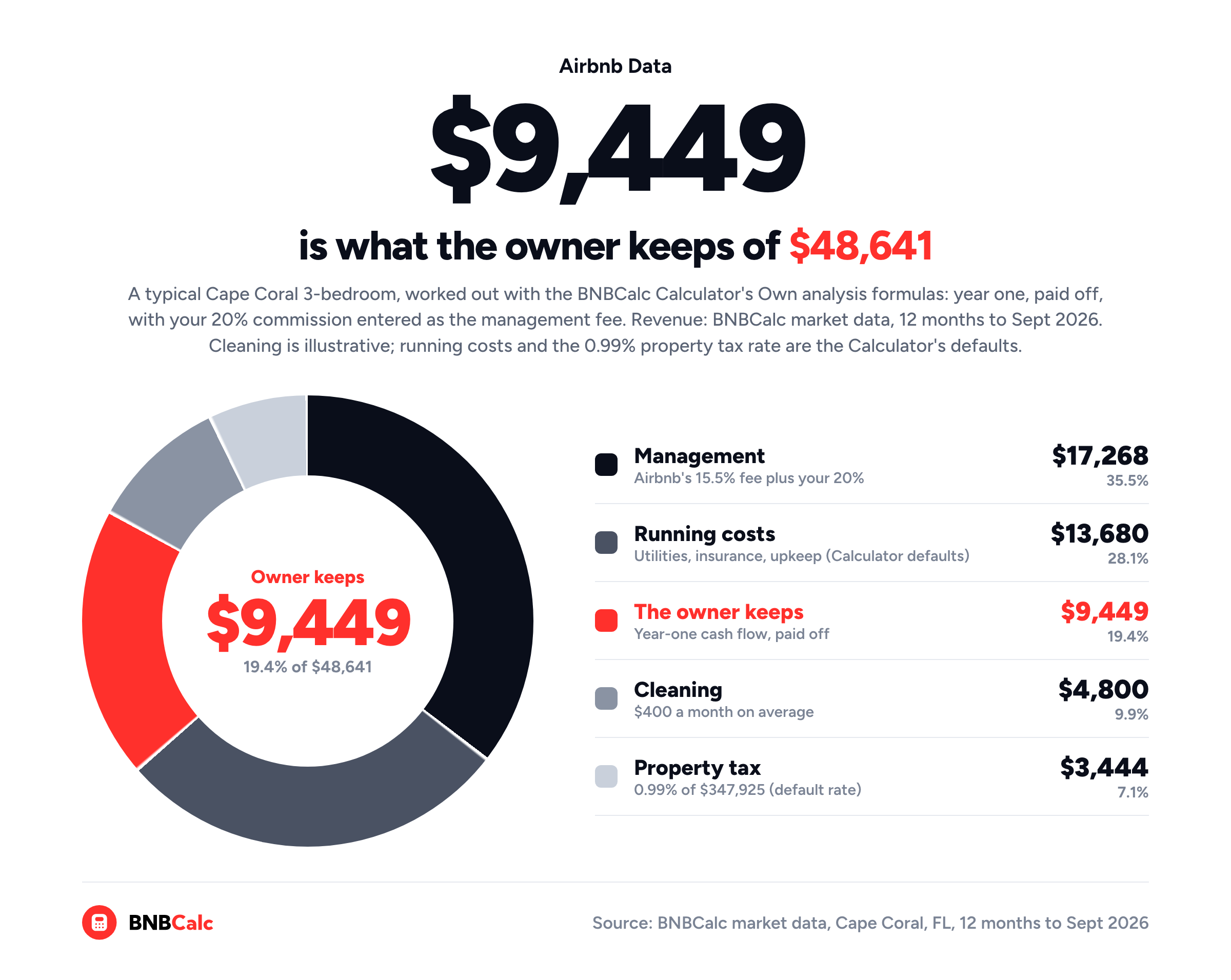
That $32,313 owner payout isn't what the owner keeps, though, because Airbnb's fee and the owner's own bills haven't come out yet. To show an owner their side, I'd run the same address a second time as an Own analysis, the type for a property that's already owned. Then enter your commission as its Property Management Fee, so both analyses take your cut from the same revenue.
An Own analysis assumes the house is paid off unless you say otherwise when you create it, and it takes Airbnb's 15.5% fee by default. For the typical Cape Coral house, the example keeps the Calculator's default running costs, $440 a month for utilities and $700 for insurance, upkeep, supplies and software.
Cleaning stays at the same $400 a month, and the price is an illustrative $347,925, with property tax at the 0.99% default.
| Line | Year one |
|---|---|
| Revenue | $48,641 |
| Management (Airbnb's 15.5% plus your 20%) | $17,268 |
| Cleaning | $4,800 |
| Running costs (Calculator defaults) | $13,680 |
| Operating income | $12,893 |
| Property tax (0.99% of $347,925) | $3,444 |
| Owner's cash flow | $9,449 |
As the table shows, the Calculator groups Airbnb's fee and your commission as management, while the owner's cash flow is what's left at the bottom. On these costs, the owner keeps $9,449 from a typical year, a little less than your $9,728 commission. That's a hard sell. At the top performer's revenue, by contrast, the same analysis leaves the owner $44,990, about twice your $22,739, so the conversation worth having is how the house gets closer to the top.
Make sure to swap in the owner's real bills before you show them anything, since the Calculator's defaults are US starting points. In Florida, the Mortgage & Taxes editor may also show the county's average property tax rate.
And if you've agreed on 20% through Airbnb's co-host payouts, enter 16.9% in both analyses, so your cut matches what Airbnb would send you if its fee comes off the whole booking.
How Do You Show an Owner Your Airbnb Revenue Estimate?
Once both analyses look right, you can hand them over in a link. They don't need an account. Share gives you an analysis link that anyone can open, comps table included, and it's view-only, so the owner can try their own numbers on screen without changing yours.
For a meeting, Print opens a Review & print window. There, you can put your name and photo on the report, pick Property manager as your role and add a cover note of up to 300 characters. You can also show a low and high estimate either side of the revenue, 15% each way by default, and then choose Save as PDF in your browser's print dialog to get a branded report you can leave behind.
And if you're pitching several owners at once, the Properties dashboard filters your analyses to Co-Host, with each card showing your commission and the owner's return.
So, How Do You Estimate an Owner's Revenue and Your Commission?
You run the owner's address through the BNBCalc Calculator as a Cohost analysis, check the revenue against the house, set your real rate and put cleaning and supplies on the owner's side. In BNBCalc's Cape Coral data, that's $9,728 at 20% on a typical three-bedroom and $22,739 on a top performer, before you adjust for how Airbnb pays you. Then run the owner's side as an Own analysis, so they can see what they'd keep.
A commission is only ever a share of somebody else's year, and owners can usually tell a co-host who knows that from one who's quoting a percentage. That's why I'd walk in with the owner's numbers before my own.
Frequently Asked Questions
How Much Does an Airbnb Co-Host Make per Property?
In the BNBCalc Calculator's Cohost analysis, your commission is the property's revenue times your rate, so the house's revenue sets it. BNBCalc's data shows a typical Cape Coral three-bedroom grossed $48,641 over the 12 months to September 2026, which is $9,728 at a 20% commission, while a top performer grossed $113,697, or $22,739 at the same rate.
Is There a Free Airbnb Co-Host Calculator?
The BNBCalc Calculator lets you run two property analyses free, or start a 7-day free trial with full access, and Cohost is one of its four analysis types. Give it the owner's address, bedrooms, bathrooms and guests, and it estimates revenue from nearby comps, then takes out cleaning, supplies and your commission to show the owner payout.
What Commission Rate Does the BNBCalc Calculator Use for Co-Hosts?
A Cohost analysis in the BNBCalc Calculator starts at 20%, and you can set anything from 0% to 50%, so change it to the rate in your agreement. If you charge every owner the same, save it as a preset and set it as your default, and every new Cohost analysis will open with it.
How Do I Show an Owner Their Airbnb Cash Flow in BNBCalc?
Run the same address in the BNBCalc Calculator as an Own analysis and enter your commission as the Property Management Fee, because a Cohost analysis's owner payout comes before Airbnb's host fee and the owner's other bills. For a typical Cape Coral three-bedroom, with cleaning at $400 a month and the Calculator's other defaults, the owner would keep $9,449 of $48,641, against a $9,728 commission at 20%.
BNBCalc Calculator Pricing and Free Analyses
When you've got an owner's address to run, the Calculator costs $30 a month or $199 a year as of October 2026, with unlimited property analyses and professional PDF reports.
If you'd like to try it first, you can run two property analyses free, or start a 7-day free trial with full access.
On the other hand, if you don't know where to find owners yet, use BNBCalc Markets to see what the listings in a market earned and filter for the ones in its low performance tier.
Airbnb Tax Deduction Calculator
Paying too much in taxes? We have the perfect solution. Simulate an Airbnb home purchase below.
Purchase Price
$450K
Structure Value
70%
Apply Trump's Tax Cut (Bonus Depreciation)
Depreciation
$117,695
Interest
$21,600
Tax
$6,750
Year 1 Deduction
$146,045
Want to claim this deduction? Get a free cost segregation benefit analysis from CSA Partners — no obligation.
Get Full Analysis