
Free instant analysis
Reveal Airbnb revenue for any address or city
Most investors assume buying rental property requires a fat down payment check. They're wrong — and the investors who figured that out first are now running profitable short-term rentals they bought with zero dollars down.
This guide is specifically for STR investors and Airbnb hosts who want to know whether you can actually buy a house with no money down, which programs work in 2026, and whether those deals still cash flow once you run the real numbers.
Can You Really Buy a House with No Money Down for a Rental?
Yes — but the answer depends entirely on your strategy, and most people ask the wrong question. The real question isn't whether zero down is possible. It's whether the higher monthly costs that come with zero down investment property financing still leave room for profit after your STR expenses hit.
Why This Strategy Appeals to STR Investors
Short-term rentals generate significantly more gross revenue than long-term leases — often 2–3x more on the same property. That income gap is precisely what makes zero down rental property financing more viable for STR operators than for traditional landlords. A deal that barely cash flows as a long-term rental can produce strong returns when nightly rates are involved. Understanding the core differences between short-term and long-term rental strategies helps clarify why the revenue premium matters so much in this financing context.
The other draw is capital preservation. Every dollar you don't tie up in a down payment is a dollar available for furnishings, photography, marketing, or a second property. STR investors who scale quickly almost always do it by recycling capital rather than concentrating it in down payments.
The Honest Trade-offs: What Zero Down Actually Costs You
Zero down is not free money — it's a trade between upfront cash and long-term cost. Without a down payment, you carry a larger loan balance, pay more interest over time, and often pay private mortgage insurance (PMI) on top.
On a $350,000 property at 7.25% interest, putting 0% down versus 20% down adds roughly $700–$850/month to your payment depending on the loan structure. Your STR income needs to absorb that gap before you see a dollar of profit. Know this number before you commit.
Zero Down Loan Programs That Work for STR Investors
Three government-backed programs can get you into a property with zero or near-zero down payment. Each has specific eligibility rules that directly affect how you can use the property as an STR.
VA Loans: The Best Zero Down Option (If You Qualify)
VA loans are the cleanest path to buy a house with no money down in 2026. No down payment, no PMI, and competitive interest rates — the total monthly savings versus a conventional loan on the same property can exceed $800/month.
The occupancy catch is real: VA loans require you to occupy the property as your primary residence. That doesn't kill the STR strategy — it creates one. A 2-4 unit property purchased with a VA loan lets you live in one unit and short-term rent the others. Some single-family buyers also rent spare bedrooms on Airbnb, which is permitted as long as the home remains your primary residence.
VA loan eligibility requires qualifying military service. If you qualify, this is the single most powerful tool available for zero down rental property financing.
USDA Loans: Rural Airbnb Markets Are a Hidden Opportunity
USDA loans offer 100% financing with no down payment on properties in USDA-designated rural and suburban areas. Interest rates are competitive, and the income limits are more flexible than most investors expect.
The STR angle here is underutilized. Some of the strongest short-term rental markets in the country sit inside USDA-eligible zones — think lake towns in Idaho, coastal communities in Maine, or rural retreats near national parks. A USDA loan on a cabin in a high-demand vacation area is a legitimate no down payment investment property strategy hiding in plain sight.
Like VA loans, USDA requires primary occupancy — but house hacking rules apply the same way. Know your county's USDA eligibility before you fall in love with a property.
FHA Loans: Not Zero Down, But Close (3.5% and House Hack-Friendly)
FHA loans require only 3.5% down, which on a $300,000 property is $10,500 — a fraction of the $60,000 a conventional 20% down deal demands. For most investors, this falls close enough to zero to belong in this conversation.
FHA loans allow purchases of 1–4 unit properties, which makes them the go-to tool for house hacking as an STR investor. You live in one unit, rent the others on Airbnb, and your rental income offsets most or all of your mortgage. FHA mortgage insurance adds cost, but the STR premium typically covers it and then some.
House Hacking: The Most Practical Path to Zero-Down STR Income
House hacking is the most widely accessible strategy for investors who want no down payment investment property exposure without military service history or rural property requirements.
How House Hacking Works with Short-Term Rentals
Buy a multifamily property (duplex, triplex, or fourplex) with an FHA or VA loan, live in one unit, and rent the remaining units on Airbnb or VRBO. The short-term rental income from the other units can cover your mortgage, effectively giving you free housing while your equity grows.
Even a single-family home with spare bedrooms works. Renting two bedrooms as private Airbnb rooms in a high-demand urban or tourist market can generate $1,500–$3,000/month in a city like Nashville, Scottsdale, or Austin. That income runs parallel to your primary residence status, keeping you compliant with FHA or VA loan terms.
Running the Numbers: What to Expect in Year One
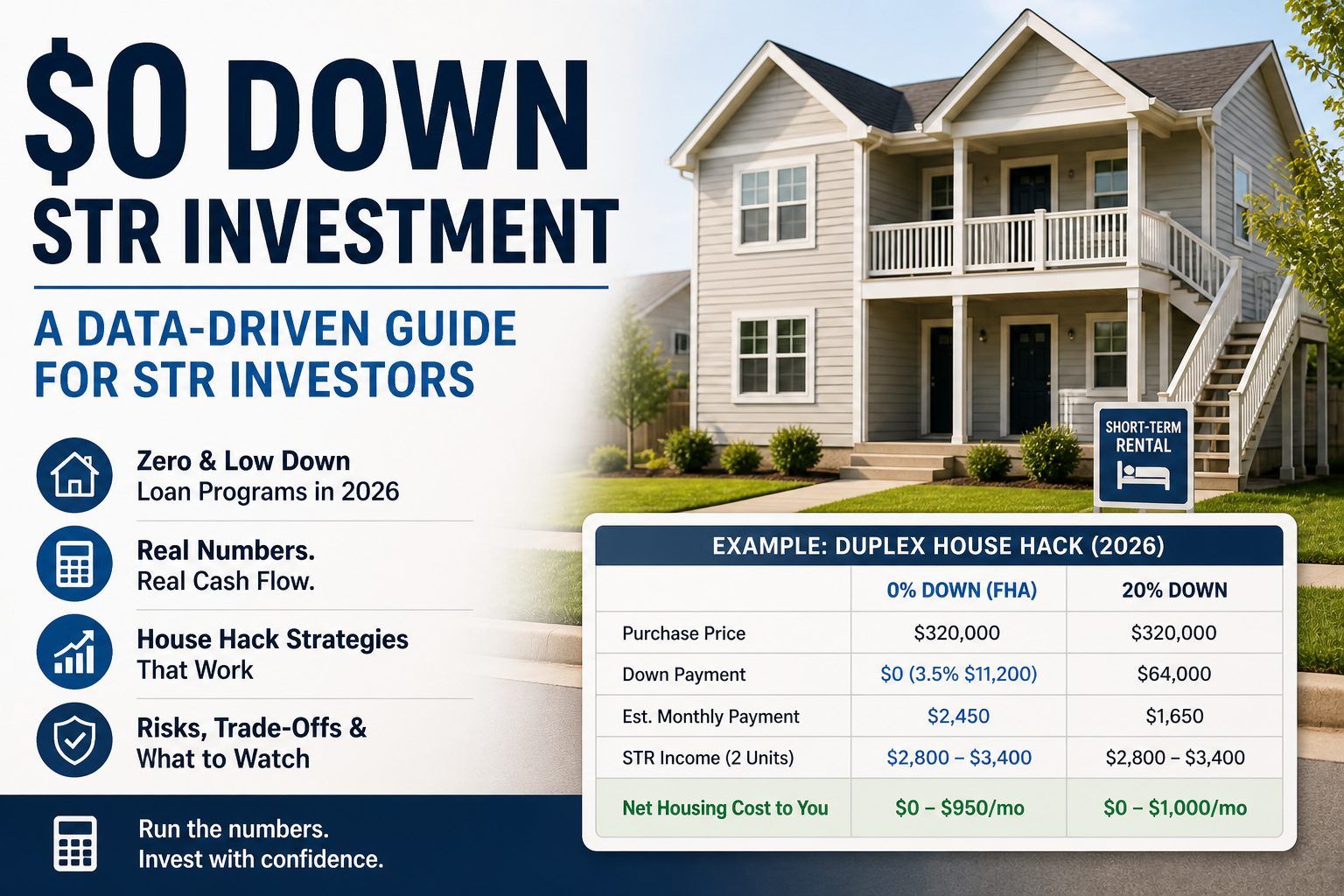
A realistic Year One projection on a house hack in a mid-tier STR market:
| Item | Amount |
|---|---|
| Purchase price | $320,000 |
| Down payment (FHA 3.5%) | $11,200 |
| Monthly mortgage (P&I + MIP) | $2,450 |
| STR income from 2 units/rooms | $2,800–$3,400/month |
| Net housing cost to you | $0–$950/month |
| Annual equity growth (est. 4%) | $12,800 |
These numbers shift based on market, seasonality, and management approach. The point is: the STR premium often turns a house hack into a near-free or profitable living situation in Year One.
Creative Financing Strategies Beyond Government Loans
Government loan programs work well for owner-occupants. For pure investment properties — where you won't be living on-site — the playbook changes.
Seller Financing and Subject-To Deals
Seller financing lets you buy a house with no money down by negotiating directly with the seller instead of a bank. The seller acts as the lender, and you make payments to them under terms you both agree on.
This works best with motivated sellers: estate sales, landlords tired of managing property, or owners who need income but don't need a lump sum. Down payment requirements are entirely negotiable. Some sellers accept zero down in exchange for a slightly higher purchase price or interest rate.
Subject-to deals are similar — you take over the seller's existing mortgage payments without formally assuming the loan. The deed transfers to you, but the original loan stays in the seller's name. These deals require trust, solid paperwork, and a real estate attorney. Investors who want a deeper look at how subject-to transactions work in practice will find this structure is one of the most powerful STR investor financing strategies available when done correctly.
Partnership Structures and Equity Splits
If you have the operational skills to run a profitable STR but lack the down payment, find a capital partner who has the opposite problem. You find the deal, manage the property, and handle all operations. They fund the down payment. You split equity and cash flow according to whatever terms you negotiate.
This is a zero out-of-pocket structure for the operator. The challenge is finding a trustworthy partner and structuring the agreement clearly — especially around exit rights, renovation decisions, and what happens if the STR underperforms.
HELOCs and Cash-Out Refis on Existing Property
If you already own a home with equity, a HELOC or cash-out refinance lets you pull that equity out and use it as a down payment — or the entire purchase price — on a new investment property. From the perspective of the new deal, you've bought a house with no money down out of pocket.
The risk is real: you're securing a new debt against your primary residence. If the STR market in your target area softens, you're still responsible for the HELOC payment. Understanding landlord insurance for rental investors and proper liability coverage becomes even more critical when a second property is leveraged against your home.
Data Check: Does Zero Down Still Cash Flow on Short-Term Rentals?
The math has to work. No-money-down enthusiasm without cash flow analysis is how investors end up underwater.
STR Revenue vs. Higher Monthly Payments
According to 2025 STR industry data, the average Airbnb property in a top-50 vacation market generates between $2,800 and $5,500/month in gross revenue. A no down payment investment property on the same asset carries a monthly payment 20–30% higher than a fully-financed deal.
In strong STR markets, the revenue premium absorbs that cost increase. In marginal markets — where average daily rates are low and occupancy is seasonal — it often doesn't. The margin between viable and unprofitable is thinner with zero down, which makes market selection more important, not less. Investors evaluating specific markets can use data from the best cities for Airbnb investing in 2026 to identify where revenue fundamentals support thinner-margin financing structures.
Using BNBCalc to Model No-Money-Down Scenarios
Before you commit to any zero down rental property financing structure, model the actual numbers. BNBCalc lets you input a specific address, adjust purchase price and loan terms, and see projected STR revenue, expenses, and cash-on-cash return for that property.
The top STR calculators all allow scenario modeling, but BNBCalc's property-specific revenue projections make it particularly useful for evaluating no-money-down deals where margin is tight. Run the 0% down scenario, the 3.5% down scenario, and the 20% down scenario side by side. The comparison makes the right move obvious.
Key Risks to Understand Before You Commit
Zero down financing amplifies both upside and downside. These are the two risks that matter most for STR investors specifically.
Negative Equity Risk in Volatile STR Markets
With zero or minimal equity at purchase, any market correction leaves you underwater fast. A 10% drop in property values on a zero down deal means you owe more than the property is worth — and you can't sell without bringing cash to closing.
STR markets tied to a single demand driver (one ski resort, one employer, one festival circuit) are especially exposed. Markets with diversified demand and strong year-round occupancy carry this risk more safely. Short-term rental regulations in Hawaii illustrate how quickly rules can shift in a market, cutting revenue and property values simultaneously — something to research before signing.
Occupancy Rate Requirements and Lender Rules
VA and USDA loans require primary occupancy. Using the property exclusively as an STR from day one violates the loan terms and constitutes mortgage fraud. The standard rule is to occupy the property for at least 12 months before converting to a full-time rental.
Lenders also scrutinize STR income differently than traditional rental income. If you're counting on projected Airbnb revenue to qualify for financing, many lenders won't accept it without a documented rental history. Work with a lender experienced in STR investment transactions — a conventional residential lender will create problems that a specialized lender won't. Understanding how investment property mortgage rates differ from primary residence rates is essential before approaching any lender about a zero down deal.
Bottom Line: Is No Money Down Right for Your STR Strategy?
You can absolutely buy a house with no money down and turn it into a profitable short-term rental — but only if the deal survives a real cash flow analysis, your occupancy and lender terms are airtight, and your market has the revenue to absorb higher monthly payments.
The investors who make zero down deals work aren't lucky. They're methodical. They use VA loans on multifamily house hacks, target markets with proven STR demand before committing, and they model every scenario before they make an offer.
Zero down is a tool, not a shortcut. Use it like one.
Frequently Asked Questions
Can I use a VA loan to buy a short-term rental property? Yes, with conditions. VA loans require primary occupancy, so you must live in the property. The most common STR strategy is to buy a 2–4 unit multifamily with a VA loan, occupy one unit, and short-term rent the others. Single-family buyers can also rent spare rooms on Airbnb while maintaining primary residency.
Is it possible to buy a pure investment property with no money down? Yes, through seller financing, subject-to deals, or partnership structures where a capital partner funds the down payment. Government loan programs (VA, USDA, FHA) require owner occupancy, so they don't apply to non-owner-occupied investment properties.
Do USDA loans work for vacation rental markets? They can. USDA-eligible zones include many rural and small-town markets that perform well as short-term rentals — lake towns, mountain retreats, and coastal communities outside major metro areas. You must occupy the property as your primary residence, but you can rent it short-term during periods you're not in residence depending on local regulations.
How does a lender treat projected Airbnb income during underwriting? Most conventional lenders won't count projected STR income without a 12–24 month rental history on the property. Some portfolio lenders and DSCR loan lenders will use a rental income study or comparable STR data to qualify you. Working with an STR-experienced lender matters significantly here.
What's the best calculator for modeling a no-money-down STR deal? BNBCalc is the strongest option for property-specific STR revenue projections. Enter the address, adjust the financing terms to reflect zero down, and compare cash-on-cash returns across different down payment scenarios before making an offer. A thorough understanding of Airbnb property management before purchase is non-negotiable when margins are tight.
Airbnb Tax Deduction Calculator
Paying too much in taxes? We have the perfect solution. Simulate an Airbnb home purchase below.
Purchase Price
$450K
Structure Value
70%
Apply Trump's Tax Cut (Bonus Depreciation)
Depreciation
$117,695
Interest
$21,600
Tax
$6,750
Year 1 Deduction
$146,045
Want to claim this deduction? Get a free cost segregation benefit analysis from CSA Partners — no obligation.
Get Full Analysis