
Analisi istantanea gratuita
Scopri i ricavi Airbnb per qualsiasi indirizzo o città
Rendimento Airbnb a Baltimore per numero di camere
Dati Airbnb e Vrbo relativi all'intero mercato di Baltimore.
Monolocale
Annunci attivi
48
Rendimento inferiore
Ricavo annuo
3,3K USD
Tariffa a notte
59,0 USD
Occupazione
11%
Rendimento lordo
1.8%
Rendimento tipico
Ricavo annuo
11,1K USD
Tariffa a notte
98,2 USD
Occupazione
36%
Rendimento lordo
6.1%
Rendimento superiore
Ricavo annuo
25,5K USD
Tariffa a notte
125,4 USD
Occupazione
50%
Rendimento lordo
14.1%
1 camera
Annunci attivi
445
Rendimento inferiore
Ricavo annuo
5,9K USD
Tariffa a notte
100,2 USD
Occupazione
21%
Rendimento lordo
3.2%
Rendimento tipico
Ricavo annuo
21,3K USD
Tariffa a notte
132,9 USD
Occupazione
41%
Rendimento lordo
11.7%
Rendimento superiore
Ricavo annuo
64,7K USD
Tariffa a notte
300,7 USD
Occupazione
49%
Rendimento lordo
35.6%
2 camere
Annunci attivi
443
Rendimento inferiore
Ricavo annuo
11,7K USD
Tariffa a notte
167,1 USD
Occupazione
24%
Rendimento lordo
4.2%
Rendimento tipico
Ricavo annuo
33,9K USD
Tariffa a notte
208,4 USD
Occupazione
40%
Rendimento lordo
12.3%
Rendimento superiore
Ricavo annuo
67,4K USD
Tariffa a notte
320,0 USD
Occupazione
49%
Rendimento lordo
24.4%
3 camere
Annunci attivi
451
Rendimento inferiore
Ricavo annuo
16,3K USD
Tariffa a notte
248,1 USD
Occupazione
23%
Rendimento lordo
3.9%
Rendimento tipico
Ricavo annuo
45,9K USD
Tariffa a notte
288,9 USD
Occupazione
39%
Rendimento lordo
10.9%
Rendimento superiore
Ricavo annuo
88,9K USD
Tariffa a notte
423,7 USD
Occupazione
48%
Rendimento lordo
21.1%
4+ camere
Annunci attivi
305
Rendimento inferiore
Ricavo annuo
20,4K USD
Tariffa a notte
422,8 USD
Occupazione
17%
Rendimento lordo
3.2%
Rendimento tipico
Ricavo annuo
62,6K USD
Tariffa a notte
460,3 USD
Occupazione
34%
Rendimento lordo
9.8%
Rendimento superiore
Ricavo annuo
136,1K USD
Tariffa a notte
731,7 USD
Occupazione
44%
Rendimento lordo
21.2%
| Camere | Gruppo di rendimento | Ricavo annuo | Tariffa a notte | Occupazione | Rendimento lordo | Annunci attivi |
|---|---|---|---|---|---|---|
| Monolocale | Rendimento inferiore | 3,3K USD | 59,0 USD | 11% | 1.8% | 48 |
Rendimento tipico | 11,1K USD | 98,2 USD | 36% | 6.1% | ||
Rendimento superiore | 25,5K USD | 125,4 USD | 50% | 14.1% | ||
| 1 camera | Rendimento inferiore | 5,9K USD | 100,2 USD | 21% | 3.2% | 445 |
Rendimento tipico | 21,3K USD | 132,9 USD | 41% | 11.7% | ||
Rendimento superiore | 64,7K USD | 300,7 USD | 49% | 35.6% | ||
| 2 camere | Rendimento inferiore | 11,7K USD | 167,1 USD | 24% | 4.2% | 443 |
Rendimento tipico | 33,9K USD | 208,4 USD | 40% | 12.3% | ||
Rendimento superiore | 67,4K USD | 320,0 USD | 49% | 24.4% | ||
| 3 camere | Rendimento inferiore | 16,3K USD | 248,1 USD | 23% | 3.9% | 451 |
Rendimento tipico | 45,9K USD | 288,9 USD | 39% | 10.9% | ||
Rendimento superiore | 88,9K USD | 423,7 USD | 48% | 21.1% | ||
| 4+ camere | Rendimento inferiore | 20,4K USD | 422,8 USD | 17% | 3.2% | 305 |
Rendimento tipico | 62,6K USD | 460,3 USD | 34% | 9.8% | ||
Rendimento superiore | 136,1K USD | 731,7 USD | 44% | 21.2% |
I gruppi di rendimento basso, tipico e alto sono benchmark di mercato, non risultati garantiti. Dati aggiornati set 2026.
What does a Baltimore Airbnb actually earn, and who's allowed to run one?
Baltimore City takes the second half of that question first, and it takes it narrowly. A short-term rental license here only goes to the home you live in, for at least 180 days a year, and since March 31, 2020 every new license has been a hosted one, which the city defines as you staying on site while your guests are there apart from daytime and working hours. So if you had a rowhouse in mind, one you'd furnish and leave to earn on its own, unfortunately that door shut years ago inside the city, and the deed has to sit in your own name rather than a company's. The counties around Baltimore are a different story, which is where most of this market's money has ended up.
Live in the house, though, and the license costs $200 for two years. I'm writing about Baltimore City, the independent city on the Patapsco that sits outside Baltimore County altogether, although the market BNBCalc tracks here runs well past the city line, south into Anne Arundel County and north into Harford, and each of those counties sets its own rules. Across that wider market, city and counties together, there are about 9% fewer listings than a year ago, while the average nightly rate has gone up about 29%.
How Much Do Baltimore Airbnbs Earn in 2026?
Inside the city limits, the median Baltimore listing took in $21,410 in the year that ended with August 2026, while the median listing outside them, across the counties that make up the rest of this market, took in $30,302. The top quarter of listings starts well above either figure, at $32,183 inside the city and $46,424 outside it, so a city listing in its own top quarter out-earns the typical one over the county line.
Those are medians, and the market page's average runs higher than both because a handful of big earners pull an average up and leave a median where it was.
Size explains less of the spread than you'd expect. At any given size the distance between the best and worst listings beats the distance between one size and the next, and a strong one-bedroom clears more than a middling three-bedroom, so I read most of that gap as address and operating quality, two things you get to pick.
Gross yield rearranges the order, though. Two-bedrooms lead it, one-bedrooms sit just behind, three and four-plus homes trail them by a point or so, and studios manage about half of what the rest do. Since yield sets revenue against purchase price, that says something about studios here: they earn about half what a one-bedroom does on a yield about half as high, which only adds up if the two cost about the same to buy.
The license rule might lead you to expect a market of neighbors letting out spare rooms, and it isn't quite that, since across the whole market, city and counties together, a large share of listings are run by professional hosts. Handing the cleaning schedule and the late-night guest messages to a manager is an option, and the Baltimore property management roundup lists the firms doing it here, though inside the city the license stays with the person who actually lives there.
Is the Baltimore Airbnb Market Oversaturated?
Whoever ends up running the place will want to know whether Baltimore is filling up or emptying out, and the last twelve months give a fairly clear answer.
| Metric | Year-over-year change |
|---|---|
| Average nightly rate | +29% |
| Purchase price | +1% |
| Booking lead time | Down |
| Occupancy | −5% |
| Active supply | −9% |
BNBCalc data across every listing BNBCalc tracks in this market, setting September 2025 through August 2026 against the twelve months before it, with each change rounded. Booking lead time carries its direction and no figure, since the size of that move isn't settled, and any measure whose direction this year's data can't pin down is left out altogether. Purchase price follows home prices rather than listings.
No, Baltimore isn't oversaturated. Active supply dropped about 9% across the year, which leaves fewer hosts chasing the same guests rather than more.
Before buying, though, I'd want the occupancy figure explained, because when listings leave a market the hosts who stay usually pick up the nights those listings were absorbing, and here they didn't: occupancy fell about 5% anyway, while across the same twelve months the average rate per night went up about 29%.
Fewer bookings at much higher prices isn't what crowding looks like, since crowding usually shows up as hosts undercutting each other, and Baltimore's hosts charged more instead. Still, don't count on inheriting the nights the departed listings used to fill, because on this year's evidence nobody did.
I left earnings out of that table because their direction depends on where you start the year. Compare this September-to-August year with the one before and the market's total earnings come out ahead, yet shift both years back four months, to the twelve months ending in April, and they come out behind, while rate, occupancy and listings point the same way whichever start you pick. For a particular house, then, the number that settles the question is how often comparable listings nearby actually get booked, rechecked every few months.
Guests also moved closer to the stay, by an amount that isn't settled, although the level is clear enough: the average Baltimore booking lands about 34 days out, so a calendar that looks thin a month ahead means less here than it would somewhere people plan further in advance.
When Is Baltimore's Peak Airbnb Season?
Where those bookings fall across the year matters as much as how far ahead they arrive, and Baltimore's summer does the heavy lifting. From May through July, between 38% and 43% of nights book and the average rate runs from $303 to $317.
| Month | Occupancy | Avg nightly rate |
|---|---|---|
| Sep 2025 | 33% | $266 |
| Oct 2025 | 36% | $287 |
| Nov 2025 | 30% | $288 |
| Dec 2025 | 30% | $315 |
| Jan 2026 | 23% | $280 |
| Feb 2026 | 24% | $260 |
| Mar 2026 | 32% | $259 |
| Apr 2026 | 36% | $276 |
| May 2026 | 38% | $303 |
| Jun 2026 | 40% | $317 |
| Jul 2026 | 43% | $316 |
| Aug 2026 | 34% | $308 |
BNBCalc market data across every listing in the market, one row per month from September 2025 through August 2026. Each column is averaged on its own, so read occupancy and nightly rate separately instead of multiplying them together.
July is the busiest month of the twelve, filling 43% of its nights at a $316 average rate, and the season then tails off through August, which drops to 34% while the rate stays above $300.
The bottom belongs to January and February, which book 23% and 24% of their nights, and the best of the eight months from September through April tops out at about 36%, so if you budget off the yearly average you'll read Baltimore's winter far too kindly.
December is the strange one, though. At $315 a night it prices above everything else between September and April, yet it still fills under a third of its nights.
Then there's the week, which tilts harder than the year does. On occupancy, Saturdays sit about 33% above an ordinary day and Fridays about 28%, while Mondays and Tuesdays fall roughly 20% short. Rates move the same way and nowhere near as far, peaking about 14% above average on a Saturday, so the weekend is the first place I'd put a pricing change here.
That curve belongs to the whole market, counties included, yet it lands awkwardly on a hosted city licensee all the same. The busiest months are the ones you'd most want to spend somewhere else, and the city expects you on site while the guest is in the house, so renting a room while you're home is the version of this that works every month of the year.
Where Should You Buy an Airbnb in Baltimore?
Pick the jurisdiction before you pick the street, because around Baltimore those aren't the same decision.
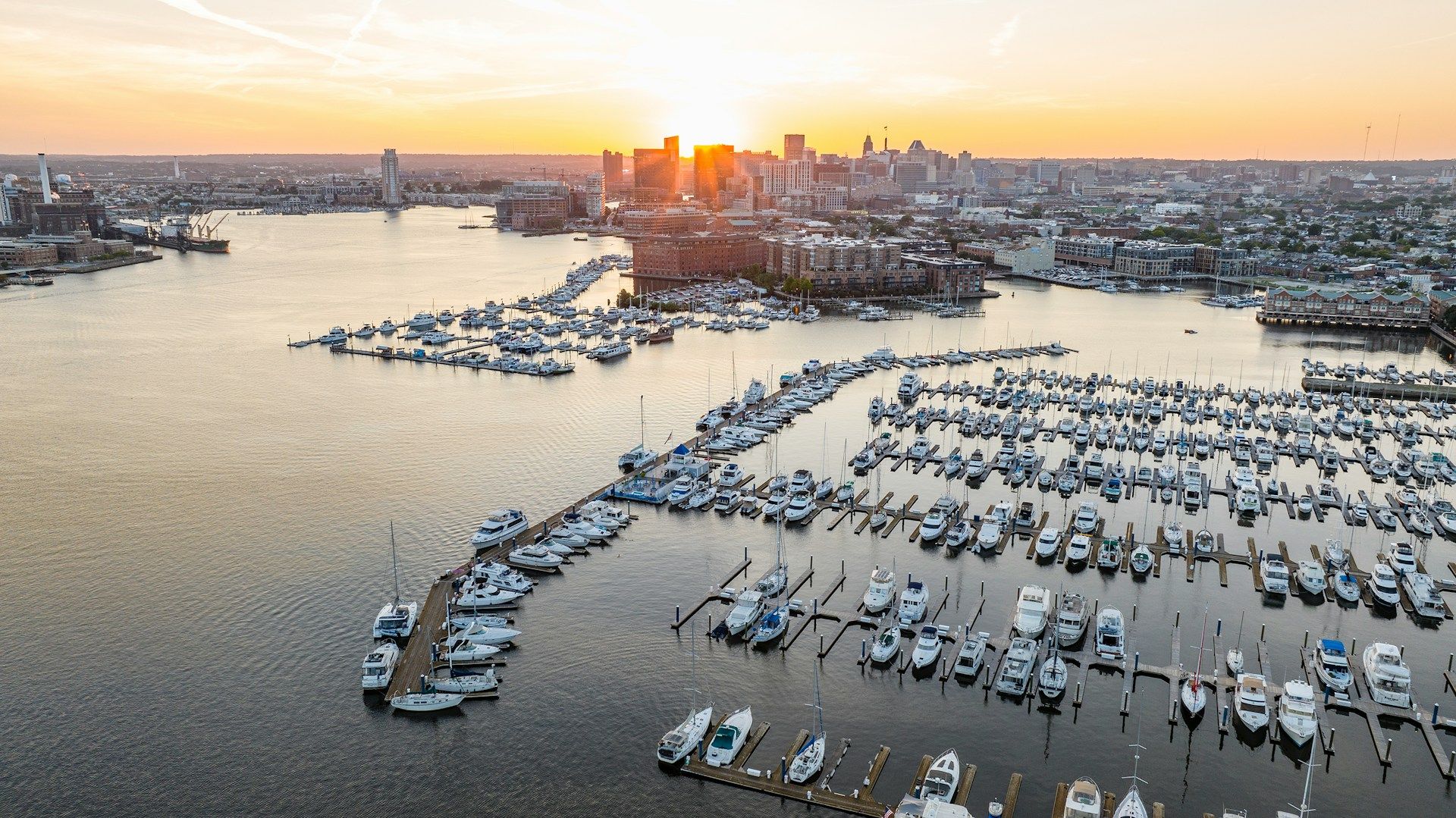
Only about a third of this market's listings sit inside Baltimore City. A slightly larger share sits in Anne Arundel County to the south, wrapped around Annapolis and the Chesapeake shoreline, while Baltimore County holds the biggest piece of what's left and Cecil, Harford and Howard counties pick up the edges. That outside two-thirds earns the higher median and answers to different rules, so the city's own neighborhoods come first, for anyone who'd live in the house, then the places around it, each on its own map.
Inside Baltimore City
That first list runs on Baltimore's own map of 279 official neighborhood statistical areas: I placed each city listing inside the area that contains it, then kept the twelve best by median annual revenue among the areas with enough listings to measure.
| Rank | Neighborhood | Median annual revenue | Median nightly rate | Median occupancy | 75th-percentile revenue |
|---|---|---|---|---|---|
| 1 | Riverside | $37,271 | $287 | 31% | $40,687 |
| 2 | Canton | $31,225 | $271 | 32% | $44,030 |
| 3 | Little Italy | $29,049 | $246 | 32% | $41,896 |
| 4 | Patterson Park Neighborhood | $28,349 | $260 | 33% | $39,508 |
| 5 | CARE | $27,935 | $240 | 35% | $35,883 |
| 6 | Fells Point | $27,655 | $247 | 34% | $41,526 |
| 7 | Hollins Market | $26,473 | $241 | 34% | $34,493 |
| 8 | Upper Fells Point | $25,200 | $200 | 33% | $35,449 |
| 9 | Downtown | $22,443 | $236 | 28% | $29,143 |
| 10 | Reservoir Hill | $21,941 | $176 | 31% | $29,944 |
| 11 | Federal Hill | $21,897 | $212 | 30% | $28,589 |
| 12 | Hampden | $20,630 | $153 | 40% | $23,836 |
BNBCalc 2026 listing data placed inside Baltimore City's official neighborhood statistical area boundaries, trailing twelve months. Revenue, rate and occupancy are medians, and the last column is the 75th percentile, the point where an area's top quarter of listings begins. Each column is worked out separately, so they don't multiply together, and areas with too little data to measure are left out. Patterson Park Neighborhood is the city's name for the streets around the park, which it maps separately from the park itself.
That's the top of a list rather than a cross-section, since it ranks only the twelve best of the areas with enough listings to measure, which is why the city-wide median of $21,410 lands near the bottom of it. The occupancy column measures something different from the monthly table too: each number belongs to one listing, the middle one in its area, across a whole year, so it's only good for holding areas up against each other.
The top six all cluster around the harbor, with Riverside facing it from the south, Little Italy running east into Fells Point and Canton along the water, and Patterson Park and CARE, a small East Baltimore neighborhood just northwest of the park, a few blocks inland from them. That pattern breaks at Hollins Market, in seventh, out west past downtown.
Riverside leads on median revenue at $37,271, though half its listings have three bedrooms or more, where most of the table's medians sit at two, so part of that lead is floor space rather than address.
For upside I'd look hardest at Canton, whose top quarter of listings begins at $44,030, the highest number in that column, against a $31,225 median. Since you'll be living in whatever you buy, that top quarter isn't a portfolio you assemble, it's a standard you work one house up to.
If you'd rather trust a big sample, Fells Point rests on the deepest one in the city and fills 34% of its nights at the median, within a point of the busiest in the top half of the table, which is what you'd hope for from the neighborhood most visitors have already heard of.
Hampden is the outlier worth noticing. It charges the lowest median rate in the table, $153, yet it books 40% of its nights, the fullest calendar of the twelve, on a median home of one bedroom. That's a different business from a three-bedroom on the water: a smaller ticket, turning over more often.
None of it tells you what living in any of these places actually feels like, which matters more in Baltimore than almost anywhere, since the license insists that you do. The best Baltimore neighborhoods for Airbnb takes that side of the question.
The Rest of the Baltimore Market
So do the suburbs pay better? These are the places around the city with enough listings to measure, sorted by census place and ranked the same way.
| Rank | City or area | Median annual revenue | Median nightly rate | Median occupancy | 75th-percentile revenue |
|---|---|---|---|---|---|
| 1 | Arnold | $49,769 | $485 | 31% | $67,392 |
| 2 | Mayo | $40,593 | $364 | 32% | $57,722 |
| 3 | Annapolis | $39,084 | $454 | 27% | $59,428 |
| 4 | Pasadena | $38,475 | $330 | 31% | $45,311 |
| 5 | Edgewater | $37,500 | $343 | 32% | $43,278 |
| 6 | Annapolis Neck | $35,898 | $402 | 27% | $62,483 |
| 7 | Cape St. Claire | $35,842 | $464 | 26% | $47,985 |
| 8 | Catonsville | $32,328 | $312 | 31% | $40,677 |
| 9 | Parole | $32,287 | $284 | 32% | $52,132 |
| 10 | Severna Park | $30,665 | $324 | 29% | $54,895 |
| 11 | Havre de Grace | $29,016 | $276 | 28% | $35,213 |
| 12 | Towson | $28,024 | $270 | 29% | $37,168 |
| 20 | Baltimore | $21,526 | $202 | 32% | $32,524 |
BNBCalc 2026 listing data placed inside US Census place boundaries, trailing twelve months: the twelve highest by median annual revenue, plus Baltimore itself, which comes twentieth of the twenty-two places with enough listings to measure. Columns are medians apart from the 75th percentile, each worked out separately. Smaller places rest on thin samples and move between refreshes, so read them as directional. Baltimore's row uses the Census boundary for the city, which takes in a few more listings than the city's own neighborhood map, so its median sits slightly above the $21,410 quoted elsewhere. Arnold, Mayo, Annapolis, Pasadena, Edgewater, Annapolis Neck, Cape St. Claire, Parole and Severna Park are in Anne Arundel County, Catonsville and Towson are in Baltimore County, and Havre de Grace is in Harford County.
So nine of the twelve places in that table are in Anne Arundel County, and most of them sit on the water. Before you take that as a judgment on the city, though, check the house sizes: median listings run to three bedrooms in Arnold, Annapolis and Edgewater, four in Cape St. Claire and Catonsville, and two in Baltimore, so much of that gap is simply more house.
Parole won't explain away so easily, since its median home has two bedrooms, exactly like Baltimore's, and it still posts $32,287 against the city's $21,526. Arnold leads the top end as well as the middle, with a top quarter that starts at $67,392, the highest in either table, while Annapolis Neck shows the widest gap between middle and top, from a $35,898 median to $62,483.
The bigger difference is legal, though, because Maryland leaves short-term rental rules to each county and to Baltimore City. The state's new fire-safety law says as much outright: nothing in it requires a jurisdiction to allow short-term rentals, and nothing stops one from adding rules of its own on top. Anne Arundel County will register a whole house you don't live in, for $100 across two years and up to two units per host, which is a different proposition from a hosted-only license. Annapolis, inside that county, runs its own license, one per person and renewed every year with an inspection each time. It also caps licenses for homes their owners don't live in at 10% of the homes on any one side of a block.
Make sure to read BNBCalc's guide to Anne Arundel County short-term rentals before treating a county address as the workaround, since Baltimore County next door is a separate government again.
So the decision splits cleanly. If you're going to live in Baltimore, the stretch that runs from Riverside around the harbor to Canton is where a home you'd actually want and a workable median overlap, with the bigger houses at the Riverside end and the two-bedrooms through Fells Point and Canton. If you won't live there, the city isn't your vehicle at all, and I'd look south: Anne Arundel County holds more of this market than the city does and registers whole houses, two per host, while Annapolis inside it rations licenses for houses their owners don't live in block by block.
Which Amenities Make the Most Money in Baltimore?
Wherever the address lands, a few fittings do more for revenue inside a house than anything else you could add.
BNBCalc's current amenity model values a pool at about 19% more revenue on a Baltimore listing when every size is averaged together, though the answer changes once you split the market by bedroom count. At four or more bedrooms a pool is worth about 24%, which fits a market whose biggest earners are waterfront houses rather than city rowhouses, while at one, two and three bedrooms a hot tub leads instead, worth about 18%, 16% and 20% in turn. For studios the model finds almost nothing worth adding.
A gym, a sauna, a barbecue, bikes, an EV charger and allowing pets all come in below the leader from one bedroom up, and BNBCalc Markets holds their Baltimore figures for when you're choosing what to put in a particular house. A handful of things every guest takes for granted are excluded on purpose, since they're the price of opening the door rather than an investment decision.
The cleaning fee is a different kind of lever. As of September 2026 a little under half of Baltimore listings charged one, averaging about $129 where they did, so counted across the whole market, free-cleaning listings too, cleaning revenue comes to roughly $2,032 a year. My guess is most of that goes straight back out to whoever does the cleaning, so if you want more money without more cost, your Saturday rate is the better place to look.
Is Airbnb Legal in Baltimore?
Yes, provided you live in the house, and for an investor the living-there part settles whether any of those numbers describe something you could legally do.
As of September 2026, Baltimore City Code Article 15, Subtitle 48 counts a platform-booked stay as a short-term rental whenever it runs fewer than 90 consecutive days, and each one needs a license from the Housing Commissioner. That license goes to your permanent residence. The code defines it as the home you live in for at least 180 days a year and come back to, and you prove that with a driver's license, voter registration or a Homestead Tax Credit designation.
You only get one permanent residence, though, and the deed has to be in your name rather than a company's. The license isn't a property right either, so it doesn't pass to a buyer when you sell.
New licenses are hosted only. The city's own definition of a hosted unit is one where the owner remains on site during the rental, apart from daytime and working hours, so what's on offer is renting out a room, a floor or a basement in a house you're living in.
Unhosted licenses, the whole-house kind, stopped being issued on March 31, 2020. A few survive, because the code let owners who'd taken a booking between August 2017 and the end of 2018, and who owned the place by the end of 2018, apply within 90 days of the ordinance taking effect. Those get renewed, and nobody gets a new one.
The cap follows from that. It's one hosted license per person, and the only way to hold two at once is to be renewing one of those grandfathered unhosted units and add a hosted one alongside it. Two hosted units aren't allowed, and neither are two unhosted ones, so building a portfolio inside the city limits under your own name isn't on the table.
For anyone who does qualify, the costs are light. The license runs $200 per unit, it lasts two years from the day it's issued, and you renew at least 30 days before it expires. For now your hosted unit doesn't need a city inspection, although it does have to stay clear of building, fire, health and zoning violations, and one left unfixed for 120 days is grounds to revoke the license. You'll also need a Maryland sales and use tax number from the Comptroller before the city will license you at all.
While guests are in the house, the city asks for a few more things: your license number in every listing and advertisement, a prominently displayed sign saying the unit is licensed, and emergency contact details, posted where guests can easily find them, for a representative who lives within 15 miles and can be reached for the whole stay. Don't forget to keep a record of every booking too, since the Housing Commissioner can ask to see it.
Lodging taxes are charged to the guest rather than deducted from your own rate, though someone still has to hand them over.
Baltimore's hotel room tax is 9.5%, and the city's code applies it directly to money paid to a hosting platform for booking a short-term rental and to money paid to a host for providing one. The code then makes whoever the tax applies to collect it and pay it to the Director of Finance by the 25th of each month, which can mean you, the platform or both, so settle which before your first guest checks in. Maryland's 6% sales and use tax sits on top of that, and since state law counts a short-term rental platform as the vendor, Airbnb and Vrbo collect it. Together that's 15.5% on what the guest pays, and BNBCalc's Maryland tax guide for short-term rentals sets out how you file with the state.
Enforcement runs through the platforms, which is what gives it teeth. A hosting platform can't list a Baltimore unit until it has checked with the Housing Commissioner that the license is valid and the address matches, and once the city says a unit can't lawfully operate, the platform has three days to remove the listing and can't collect a fee on it after that. Run one without a license and you're committing a misdemeanor, which carries a fine of up to $500. Since each day counts as its own offense, a listing that keeps taking bookings after the city has flagged it racks up penalties fast. The city can also deny, suspend or revoke a license after ten days' notice and a hearing, or immediately where it decides somebody's in danger.
One more thing lands this fall, and it reaches the counties as much as the city, because Maryland's Jillian and Lindsay Wiener Short-Term Rental Fire Safety Act takes effect on October 1, 2026 for any unit rented for less than 30 consecutive days. Signed in April 2026, it says you must post an evacuation diagram showing the exits from the unit and from the building, along with a list of emergency numbers for police and fire rescue, both where guests can't miss them, and keep a working fire extinguisher. You'll also need working smoke and carbon monoxide alarms, installed to state and local fire codes and clearly audible in every sleeping room and sleeping area, even with the doors closed. Where more than one smoke alarm is required, they have to be interconnected so that one going off sets off the rest, unless the State Fire Marshal approves another way. Replace any alarm that's stopped working, is more than ten years old, or has no production date on the back, since all three of those are grounds for swapping it under the new rules.
Booking services have to tell hosts about these rules and collect each unit's proof of inspection from them, so expect to hear from Airbnb whether or not you've read the statute. That proof comes from the last piece, since by July 1, 2028 Baltimore City and every Maryland county that allows short-term rentals have to require an annual inspection against these rules, hosted units included, and report the results to the State Fire Marshal, and each of them can charge a fee to cover the visit.
The application itself, the documents, the portal and the offices to call are laid out in the Baltimore short-term rental regulation guide.
Where Do These Baltimore Airbnb Numbers Come From?
Paperwork aside, the numbers you've just read were all pulled from BNBCalc Markets, where BNBCalc sets short-term rental markets against one another. It also lets you build a set of the listings you'd genuinely be bidding against and read that set on its own terms, apart from the market around it. Baltimore is a place where that matters, because a licensed room inside your own rowhouse and a whole waterfront place over the county line are two different businesses, and one market-wide average quietly blends them.
How Do You Estimate Airbnb Revenue for a Baltimore Property?
All of that describes a market, though, and turning it into a number for one house takes a few more steps.
Start at the Baltimore market page for today's revenue, occupancy and seasonality.
If Baltimore isn't settled yet, the best Maryland markets by gross yield places Baltimore among the rest of them. When you've got a specific address, put its purchase price, the loan you'd take on it and what it costs to run through BNBCalc, then read the result.
Hold whatever comes back against a few Baltimore realities before you believe it. Whether you'd live in the house decides everything after it, because if you wouldn't, the city's nightly figures describe a business you aren't allowed to run there, and your options narrow to a rental of at least 90 days in the city or a county address instead. Winter is the next problem, since January books under a quarter of its nights and an annual average will badly flatter your first quarter. Remember that the 15.5% is added to the guest's bill above your rate and your cleaning fee, which matters when they're weighing you against a hotel room. And don't budget on rates repeating a 29% year, because that's a large move anywhere and occupancy slipped while it happened.
The wider lesson isn't really about Baltimore. Anywhere a city ties the license to the person instead of the building, a market's averages and your own ceiling can sit a long way apart, so it pays to work out which of the two you've been reading.
Frequently Asked Questions
What Is the Average Airbnb Income in Baltimore?
The median Airbnb listing inside Baltimore City earned $21,410 over the twelve months ending in August 2026, and the median outside the city, across the rest of the Baltimore market, earned $30,302. The top quarter of listings starts at $32,183 inside the city and $46,424 outside it. Income varies widely within a single size, and BNBCalc's market data has a well-run one-bedroom beating a middling three-bedroom.
Is Airbnb Still Profitable in Baltimore in 2026?
Yes for hosts who qualify, and only for them, because Baltimore City grants short-term rental licenses at a host's permanent residence and on a hosted basis alone. Over the past year the competition thinned and prices rose: active supply fell about 9% and the average nightly rate gained about 29%, although occupancy slipped about 5%. Whether a specific home turns a profit still depends on its price and running costs.
What Is the Best Month for Airbnb in Baltimore?
Market-wide, July 2026 was the busiest month, with 43% occupancy and a $316 average nightly rate. January was the quietest, at 23% occupancy and a $280 rate. Occupancy across May through July stayed between 38% and 43%, at average rates of $303 to $317. Friday and Saturday carry the week, running about 28% and 33% above an ordinary day.
Do You Need a License to Run an Airbnb in Baltimore?
Yes. Any stay of fewer than 90 consecutive days booked through a platform needs a short-term rental license from Baltimore City's Housing Commissioner. It costs $200 per dwelling unit and runs for two years, renewed at least 30 days before it expires. The property must be the owner's permanent residence, deeded to an individual rather than a company, free of code violations, and registered with the Maryland Comptroller for sales and use tax.
Can You Buy an Investment Property in Baltimore and Run It as an Airbnb?
Not inside Baltimore City. The city issues new short-term rental licenses only for a hosted unit, meaning the owner's permanent residence with the owner on site during the stay. Unhosted whole-house licenses stopped being issued on March 31, 2020, and the small grandfathered pool that remains can only be renewed. Surrounding jurisdictions run their own schemes: Anne Arundel County, for instance, registers up to two whole-house rentals per host with no residency requirement.
Which Baltimore Neighborhood Is Best for Short-Term Rentals?
It depends on the home. Riverside posts the city's highest median revenue at $37,271, though half its listings have three bedrooms or more. Canton, Little Italy, Patterson Park, CARE in East Baltimore and Fells Point sit between roughly $27,000 and $32,000, and Canton's top quarter of listings starts at $44,030. Hampden fills the most nights, at 40%. Those figures are BNBCalc listing-data medians for 2026, worked out inside Baltimore's own neighborhood statistical areas.
How Much Is the Airbnb Tax in Baltimore?
Guests on a Baltimore short-term rental pay 15.5% on top of the booking: Baltimore City's 9.5% hotel room tax plus Maryland's 6% sales and use tax. The city's code applies the hotel room tax directly to money paid to a hosting platform for booking a short-term rental and to money paid to a host for one, and it's due to the Director of Finance by the 25th of each month. State law treats a short-term rental platform as the vendor for the 6%.
Is Baltimore County the Same as Baltimore City for Airbnb Rules?
No. Baltimore City is an independent city and isn't part of Baltimore County, and the two are separate county-level jurisdictions in federal data. Maryland leaves short-term rental rules to each county and to Baltimore City, so Baltimore County, Harford County and the rest are each free to write their own: Anne Arundel County registers whole houses for $100 over two years, and the City of Annapolis, inside it, licenses and inspects short-term rentals every year under its own code. Statewide rules such as the 6% sales and use tax and the fire-safety requirements taking effect on October 1, 2026 are written once for all of them.
Airbnb Tax Deduction Calculator
Paying too much in taxes? We have the perfect solution. Simulate an Airbnb home purchase below.
Purchase Price
$450K
Structure Value
70%
Apply Trump's Tax Cut (Bonus Depreciation)
Depreciation
$117,695
Interest
$21,600
Tax
$6,750
Year 1 Deduction
$146,045
Want to claim this deduction? Get a free cost segregation benefit analysis from CSA Partners — no obligation.
Get Full Analysis