
Kostenlose Sofortanalyse
Airbnb-Umsatz für jede Adresse oder Stadt anzeigen
Most Airbnb hosts set their nightly rate once, maybe tweak it before peak season, and wonder why the property down the street is consistently booked at rates 20% higher. The answer is almost always the same: they're using a real pricing tool, and you're not.
Picking the best pricing tool for Airbnb isn't just a software decision — it's one of the highest-leverage choices you'll make as a host. Get it right and you're compounding revenue every single night. Get it wrong (or skip it entirely) and you're leaving real money on the table while your competitors automate their way to better returns.
Here's what the data actually shows, and which tools are worth your money in 2026.
Best Pricing Tool for Airbnb: What the Data Says
The best pricing tool for Airbnb depends on your portfolio size, how much control you want, and which market you operate in. For most hosts, PriceLabs delivers the strongest combination of customization, market data depth, and revenue lift. For operators who want a more hands-off setup, Beyond and Wheelhouse are legitimate alternatives with different trade-offs.
Short-term rental pricing software works by pulling demand signals — search volume, competitor rates, local events, booking pace — and adjusting your nightly rate automatically. The difference between a well-configured tool and Airbnb's native pricing is significant enough that most experienced investors refuse to run a property without one.
Why Airbnb's Built-In Smart Pricing Falls Short
Airbnb's Smart Pricing consistently underprices listings. The platform's incentive is occupancy and bookings volume — not your revenue per available night. It fills your calendar fast, often at rates below what demand would actually support.
Smart Pricing also lacks local market nuance. It doesn't know that your specific block in Nashville commands a 15% premium during CMA Fest, or that Thursday check-ins in your market book 30% better than Monday arrivals. Airbnb dynamic pricing tools built specifically for revenue management use far more granular data inputs.
Smart Pricing gives you a floor and ceiling — and that's essentially the extent of your control. Professional short-term rental pricing software gives you multi-layered customization: minimum stays, gap-night rules, last-minute discount curves, and lead-time-based adjustments all working in tandem.
How Dynamic Pricing Tools Work for STR Investors
Every Airbnb dynamic pricing tool uses a base price plus a series of adjustment layers. The base price is calibrated to your market's median comp set; from there, the algorithm applies demand multipliers tied to local booking pace, seasonality, and competitor availability.
The best tools also incorporate forward-looking data. If a major conference is announced six months out and bookings start accelerating, the algorithm catches the demand signal early and begins lifting your rates before the market peaks. Understanding the vacation rental pricing factors that actually drive nightly rate variance helps you evaluate whether a tool is reading those signals accurately.
Revenue management for Airbnb isn't just about charging more — it's about charging the right amount at the right time. The most effective STR revenue optimization comes from tools that treat your listing as a yield-managed asset, not a static rental.
The Top Airbnb Pricing Tools Compared
The market for short-term rental pricing software has consolidated around four main players. Here's how each one performs in practice.
1. PriceLabs
PriceLabs is the most widely used pricing tool among professional STR investors, and for good reason. Its customization depth is unmatched — you can build portfolio-level rules, set hyper-specific minimum price floors by season, and create gap-night logic that automatically discounts orphaned days between bookings.
The Market Dashboard feature gives you real visibility into your comp set: occupancy rates, average daily rates, and revenue per available night across your market. The learning curve is real, but hosts who invest two to three hours in setup consistently report 10–25% revenue increases within the first 90 days. A detailed breakdown of how the tool performs in practice is covered in the PriceLabs Airbnb review from our team of superhosts.
Pricing starts at $19.99/month for a single listing and scales by portfolio size. At that price point for most markets, it pays for itself in a single booking.
2. Beyond (formerly Beyond Pricing)
Beyond is built for hosts who want strong revenue performance without spending hours configuring rules. The onboarding is smoother than PriceLabs, and the interface is cleaner — which matters when you're managing multiple properties and don't want pricing to become a part-time job.
Beyond's signal-layer includes booking lead time, historical performance by day of week, and proximity-based competitor data. It also integrates with most major property management systems, making it a natural fit for operators scaling past five units. The best dynamic pricing tools for Airbnb all offer PMS integration at this point, but Beyond's is particularly reliable.
The trade-off: less granular control compared to PriceLabs. For hosts who want to set tight minimum prices on specific date ranges without building workarounds, that limitation shows up quickly.
3. Wheelhouse
Wheelhouse differentiates on data breadth and a philosophy of conservative rate optimization. It leans toward protecting occupancy first, then pushing rate — a strategy that suits markets with high supply and thinner demand windows.
The Wheelhouse "performance score" benchmarks your listing against local comps in real time, which helps you spot pricing gaps without manually pulling competitor data. It's also competitively priced, with a percentage-of-revenue model (typically 1%) that aligns the platform's incentives with yours. Hosts evaluating both options can dig into a side-by-side PriceLabs vs Wheelhouse comparison to see where each tool excels.
The downside: minimum price controls aren't as flexible as PriceLabs, and the algorithm can underperform in high-demand markets where aggressive rate pushes during peak windows generate outsized revenue.
4. Rankbreeze
Rankbreeze solves a different problem than the other three — it focuses on Airbnb search ranking, not just rate optimization. If your listing visibility is low, the best pricing in the world won't save you. Rankbreeze monitors how your listing ranks for specific search queries and helps you understand what's dragging down your position.
Where it adds pricing value is in the correlation between rank changes and booking pace. Hosts use it alongside a primary pricing tool rather than as a standalone solution. Pair it with PriceLabs or Beyond, and you have both rate intelligence and visibility intelligence working together. Strong Airbnb listing optimization and smart pricing work as a multiplier — ranking higher means more eyes on rates that are already calibrated for maximum revenue.
Key Features to Evaluate in a Pricing Tool
Not every tool performs equally in every market. Three features separate the tools that actually move revenue from the ones that just feel sophisticated.
Data Sources and Market Coverage
The best pricing tools pull from multiple data sources: Airbnb and Vrbo listing data, local event calendars, booking pace signals, and historical STR performance. Tools that rely on a single platform's data have blind spots that cost you money on high-demand nights.
Market coverage depth matters more in secondary and tertiary markets. A tool calibrated for Miami or Nashville will have dense comp data — a tool analyzing a rural mountain market with 30 comparable listings needs different weighting logic. Before committing, check how many comps the tool identifies in your specific market.
Customization and Minimum Price Controls
Minimum price controls are non-negotiable. Any Airbnb pricing strategy that doesn't include a hard floor on what you'll accept is a liability — algorithms occasionally misprice in thin-data periods, and without a floor, you can end up with a $65 booking on a night that should have cleared $200.
Beyond minimum prices, look for: gap-night rules, last-minute booking discounts with configurable curves, day-of-week adjustments, and the ability to create date-specific overrides for holidays and local events. The difference between a 3-star and 5-star configuration is usually in these layers.
Integration with Your PMS or Airbnb Account
Direct Airbnb API integration is the baseline requirement — if a tool updates your calendar through a workaround rather than native integration, sync delays will create double-booking risk. For hosts managing multiple listings, PMS integration (Hostaway, Guesty, Lodgify, etc.) is equally important.
As you scale, the time cost of managing pricing manually across platforms compounds fast. Investors evaluating rental estimate calculators for acquisition analysis need that same integration efficiency reflected in their live operations once the property is active.
What the Data Says: Real Performance Differences
Average Revenue Lift by Tool
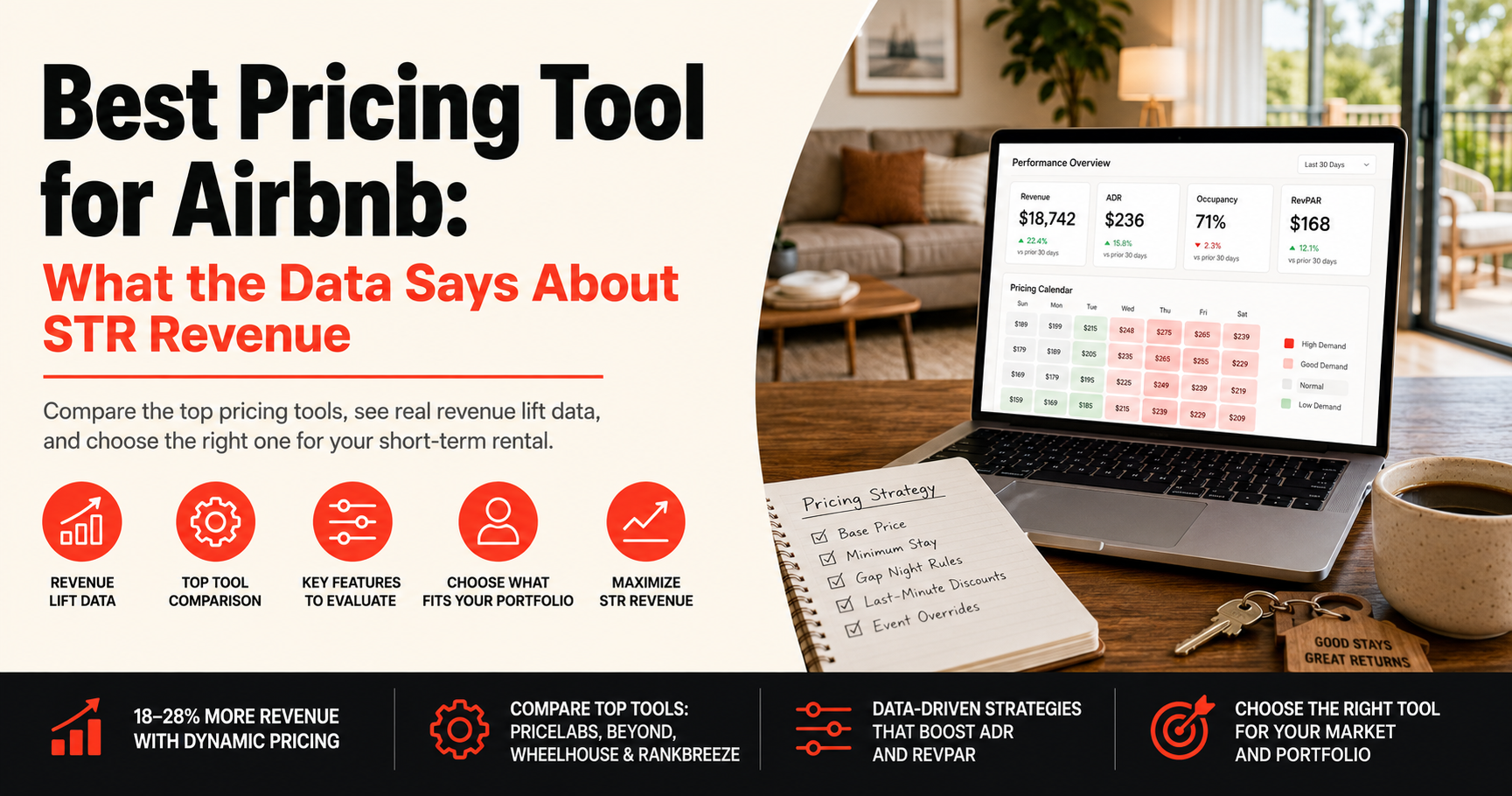
According to a 2025 STR industry report analyzing host revenue before and after adopting dynamic pricing tools, hosts who switched from Airbnb's native pricing to third-party software averaged 18–28% more annual revenue. The range varies by market, property type, and how well the tool was configured.
PriceLabs users in high-competition urban markets reported the top end of that range. Beyond users reported more consistent (if slightly lower) gains with less configuration time. Wheelhouse outperformed in markets where occupancy rates were the primary constraint rather than ADR.
How Pricing Tools Affect Occupancy vs. ADR
The most common misconception is that dynamic pricing tools just push rates higher. The reality is more nuanced: well-configured tools often lower rates on slow nights to prevent vacancy while pushing rates aggressively during high-demand windows. The net result is higher revenue, but the mechanism is better rate distribution, not just higher prices.
Recent market data shows that hosts using dynamic pricing tools see ADR increase by 12–18% on average, while occupancy drops slightly (2–5 percentage points) — a trade-off that almost always results in higher RevPAR. Understanding this occupancy-vs-ADR dynamic is critical when you're underwriting new acquisitions in the best cities for Airbnb investing in 2026.
How to Choose the Right Tool for Your Portfolio
Single Property Hosts vs. Multi-Unit Investors
Single-property hosts with limited time should start with Beyond or Wheelhouse. Both offer faster setup, cleaner interfaces, and reliable performance without requiring deep configuration expertise. The revenue ceiling is slightly lower than PriceLabs, but the time investment is 60–70% lower.
Multi-unit investors running five or more properties should default to PriceLabs. The portfolio-level rules and bulk override features pay back the extra setup time quickly. Hosts scaling into new markets benefit from tools that support proactive underwriting — BNBCalc's revenue projections and the best states for Airbnb investing in 2026 data pair well with any of these tools for pre-acquisition modeling.
When to Override Automated Pricing
Override automated pricing when you have local knowledge the algorithm doesn't. A new restaurant opening near your property, a venue booking you saw on social media, or a competitor taking their listing off-platform for renovations — these are all signals that justify manual intervention.
Set a calendar review cadence: 90 days out for seasonal adjustments, 30 days out for event-driven overrides, and 7 days out for last-minute demand checks. The best Airbnb pricing strategy uses automation for the baseline and human judgment for the edges.
Bottom Line: Which Airbnb Pricing Tool Is Worth It
Every serious STR operator should be running one of these tools. The revenue difference between optimized and unoptimized pricing in most markets is large enough that the software pays for itself within the first month — often the first week.
The short version:
| Tool | Best For | Customization | Price Model |
|---|---|---|---|
| PriceLabs | Serious investors, multi-unit | Highest | Flat monthly |
| Beyond | Operators wanting low-maintenance | Medium | Flat monthly |
| Wheelhouse | Occupancy-first markets | Medium | % of revenue |
| Rankbreeze | Ranking + visibility intel | N/A (supplement) | Flat monthly |
If you're starting with one property and want a quick win, Beyond gets you to optimized pricing fastest. If you're building a portfolio and want full control over your Airbnb pricing strategy, PriceLabs is the tool you'll eventually end up using anyway — so starting there makes sense.
The best pricing tool for Airbnb is the one you'll actually configure properly and monitor consistently. A well-tuned Wheelhouse setup outperforms a neglected PriceLabs account every time.
Frequently Asked Questions
What is the best pricing tool for Airbnb in 2026? PriceLabs is the top choice for most serious hosts and investors as of 2026, offering the deepest customization, strong market data, and consistent revenue lift of 18–28% over Airbnb's native pricing. Beyond is the best alternative for hosts who prioritize ease of setup over maximum control.
Is Airbnb's Smart Pricing good enough? Airbnb's Smart Pricing optimizes for booking volume, not host revenue — it consistently underprices listings, especially during high-demand windows. Dedicated short-term rental pricing software almost always generates significantly higher annual revenue than Smart Pricing alone.
How much does dynamic pricing software cost? Most Airbnb dynamic pricing tools cost between $20–$30/month per listing for flat-rate plans, or roughly 1% of monthly revenue for percentage-based models like Wheelhouse. At average STR revenue levels, these tools typically return 10–20x their monthly cost.
Can I use multiple pricing tools at once? Running two dynamic pricing tools simultaneously creates sync conflicts and rate instability — use one primary tool. The exception is Rankbreeze, which focuses on listing visibility rather than rate-setting and pairs cleanly with PriceLabs, Beyond, or Wheelhouse.
How long does it take to see results from a pricing tool? Most hosts see measurable revenue improvement within 30–60 days of proper setup. The first two weeks are typically a calibration period where the algorithm learns your booking pace — results accelerate after that initial window closes.
Airbnb Tax Deduction Calculator
Paying too much in taxes? We have the perfect solution. Simulate an Airbnb home purchase below.
Purchase Price
$450K
Structure Value
70%
Apply Trump's Tax Cut (Bonus Depreciation)
Depreciation
$117,695
Interest
$21,600
Tax
$6,750
Year 1 Deduction
$146,045
Want to claim this deduction? Get a free cost segregation benefit analysis from CSA Partners — no obligation.
Get Full Analysis