Free instant analysis
Reveal Airbnb revenue for any address or city
Quick Summary
Leo's been in short-term rentals since 2011, back when he was working for onefinestay in London, and his verdict is blunt: try to serve everyone and you serve no one. Pick the guest you're best at, then build pricing, amenities and marketing around that one person.
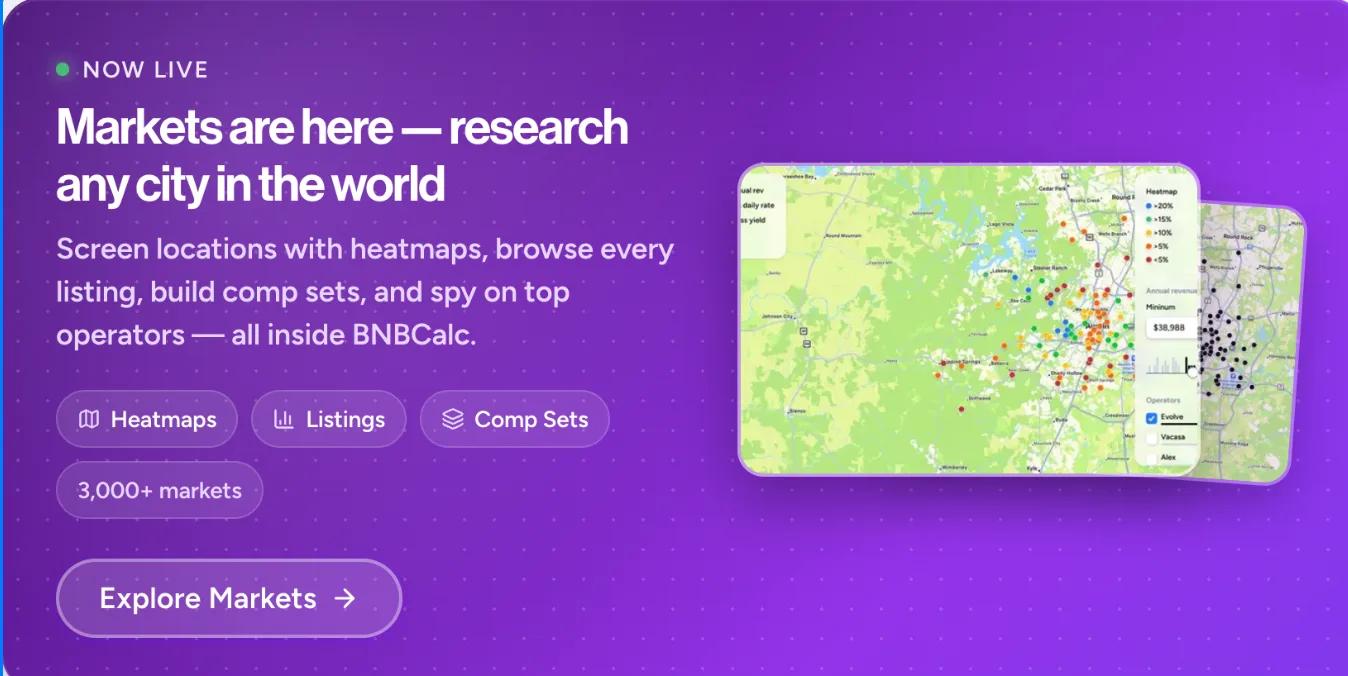
Jeremy works the same idea through his clients' portfolios, from a $20,000 kids' play area that was set to add about $30,000 in revenue, to a sleeps-37 house with an indoor pool booking October through December at $3,000-plus a night. If you want to see which amenities carry a market before you buy, BNBCalc Markets breaks them out.
Key Points
- Leo's been in short-term rentals since 2011, starting at onefinestay in London, where they found most guest phone calls came 30 minutes to an hour after check-in. Now it's a door code and a wifi password, so the check-in has to explain itself with no human in the room.
- Try to serve everyone and you serve no one, as Leo puts it, and Jeremy's living it: he's letting go of the properties that aren't family reunion compounds, even though they were doing fine.
- A two-bedroom cabin in Gatlinburg was priced and managed well and still landed at the market average, until Jeremy read the reviews and saw that guests were booking for the little play area. The owners spent $20,000 leaning into it with a ninja structure and kids' adventure gear, and the property was set to make about $30,000 more.
- The amenity worth building is the one your competitors physically can't copy: a pickleball court in a hilly market, or an indoor pool in the Northeast, where an outdoor pool only works four months of the year. Jeremy has a client two hours from New York whose sleeps-37 house with an indoor pool is taking October through December reservations at $3,000-plus a night.
- Redundancy is Jeremy's default at setup: two water heaters, two washer and dryer sets, a second fridge on new houses. After three upstairs HVAC systems went out this summer, he bought window units for every bedroom in those houses and left them there until the end of the season.
- One operator in Jeremy's program runs 14 houses across 14 markets with no density anywhere, which means no HVAC vendor picks up at 11pm on a Friday. Jeremy's answer is to block the houses twice a year and send crews and an HVAC tech through every one before something breaks.
- Leo's case for going direct: work out exactly who your guest is and why they're coming, and the direct booking follows. Once you're off the platform, a tool like Truvi screens the guest contactlessly in the background and covers you if they damage something.
Full Transcript
Listen to the full episode on Apple Podcasts, Spotify, or YouTube.
Jeremy: We are self-filming and recording today. No Zoom, no, what's it called? StreamYard. But we are back.
Leo: Are we live?
Jeremy: We are live, yeah. We're in person too. Last minute. Tell me, why are you in America? Obviously, you don't sound very American.
Leo: It's a good point, actually, isn't it? I don't even know, actually. I was trying to pass for a local, but you called it.
First time in New York for me, which is exciting, but I'm here: partners, clients, all of the usual stuff, like having meetings. I come to the US four or five times a year, sometimes six if I'm lucky, and it was New York's turn to host me, so here you go. I didn't expect to be hosted all the way in the podcast studio. That's a treat. But yeah, this is a business trip with a bit of fun as well.
Jeremy: You told me you missed the pod. I came in, I said, oh yeah, I haven't filmed the pod in a while. But people have been, actually, I've gotten a few messages from people listening to it as if I've been recording it this week or last week. A couple of people reached out, and I was like, oh, people actually, they listen to this. And then, yeah, you came in, you said, oh, yo, what's up with the pod? What's up?
Leo: I'm a fan of the show, right? And you were telling me it's been how many months?
Jeremy: I think like 17. I did actually record one last week. I need to get that live. We're working on it, guys. We're working on it.
Leo: But I can be the first one out after the hiatus, right? I can be the relaunch.
Jeremy: I did. You'll be second.
Leo: Okay. Okay. I'll take it. I'll take it. Hopefully this makes it up there.
Jeremy: But yeah, I think we had you on probably two years ago at this point. Fill in everyone. Give a little bit of your background.
Leo: It's been a busy two years. I can't quite believe, because you feel like our friendship is new. We've only just met each other, but we have, we've been around the block. We've known each other a while now. You definitely weren't married and all those things when I first met you.
Jeremy: What are you trying to say? What do you mean, you definitely weren't married? Whoa, whoa.
Leo: I don't think... You're a young man. You're a young man.
Jeremy: At conferences, man, they get wild. I don't think I was married, actually. Anyway, enough of that. Enough of that.
Leo: They don't get wild in any way anybody's thinking right now.
Jeremy: Well, not for us. Not for us at that time.
Leo: Don't book a ticket thinking you're going to get something that you're not. That's not going to be the experience you get.
But yeah, time flies, right? I mean, we've just been in the bunker. We've been building. It's the usual: serving the industry, growing massively in the US.
Jeremy: Massively?
Leo: Well, the US is a really important market for us.
Jeremy: Yeah, yeah.
Leo: You've known that. It always has been.
Jeremy: I don't know. I'm an American. Is there another market? What? Are these other markets? Do they exist?
Leo: You're right. It's like the World Series, isn't it? There's no non-US teams in that, but it's still the world.
Jeremy: Yeah. Oh, yeah. The world champions. Now we have some Canadian teams.
Leo: Oh, okay. Right. Yeah, yeah. Well, that'll do. I think they've been talking about getting London involved in some professional sports. We will come over to anything that the Americans host. I'm living proof of that, right?
Jeremy: You come to the World Cup? Or is that your trip corresponds? You catch a game?
Leo: That is complete coincidence. Everyone keeps saying, am I here? Everyone assumes I don't work very hard, because everyone I've met is like, oh, you're here for the football. I'm like, no.
You went to the bronze. You went to the bronze game where, hey, what's his name? I mean, they beat France, what, 6-4?
Jeremy: Yeah.
Leo: I mean, that was the best game of the tournament, right? It was a lot more entertaining than, well, okay.
Jeremy: I went to the final.
Leo: Yeah, you went, right?
Jeremy: Yeah. And it was super entertaining. I mean, it was incredible, but it was 1-0, so it was a low-scoring game. However, I can't say it wasn't one of the coolest things that I've ever...
Leo: Yeah, it's bucket list sort of stuff.
Jeremy: Yeah, exactly. Glad I did it, in hindsight. We sent it last minute. We were in New York. It was an hour. We actually clocked it from our seat on the way back to our apartment. It was an hour, seat to door.
Leo: Love that.
Jeremy: So it wasn't like we flew across the world to Qatar, is where the last one was. Obviously, that's a real...
Leo: That's a journey. That's a send. That's a send and a half.
Jeremy: The day before, we were with somebody who pretty much was like, I sent the Super Bowl and all these good things have came from it. So we were like, all right, well, yikes, the World Cup's here tomorrow. Based off what you've said, I guess we got to.
And there was a lot of, flights were canceled too. Sorry, I know this podcast is not about the World Cup, but...
Leo: I could do half an hour on the World Cup.
Jeremy: Yeah, this is great. So many.
Leo: And this is maybe for travel, for hospitality folk.
Jeremy: Yeah, there were a ton of, last minute, the weather was bad. My parents were actually, I have a newborn baby and scheduled to come up five weeks ago. Or sorry, baby was born five weeks ago, scheduled to come up last week, and their flight got canceled. And I think a lot of people's flights got canceled.
So it wasn't like we looked and there was two tickets. There was probably 1,200 tickets available to the World Cup. And the prices, I'm not going to say it was cheap, but they went down from the crazy headlines from a week prior, when Jay Beebs announced that he was coming.
Leo: Well, it's one of those, isn't it? The whole game around supply and demand as well, because as a fan, you don't know if your team's going to get there, right? So everyone's scrambling to work out, because I think you might be having more of a handle on this than me, I think the bronze game was in Miami, right? So suddenly you're like, Miami and New Jersey, they're not close together, right? That's a flight, isn't it? It's an internal flight. So people are scrambling.
That's part of the fun of the World Cup, right? You've got fans going all over trying to work it out. And being a host city or a host country, it's amazing, all the fans coming through. I remember, I'm old enough to remember when Euro 96 was in the UK. And it was amazing, because we had these Dutch fans, German fans, French fans, everyone was coming through. And there was a complete party atmosphere.
And then it's complete chaos, because again, no one knows where they're going to go. So actually you can pick up tickets for these things, or you get fans that are like, oh, I got my tickets, okay, it's still a World Cup final, let's go. If England had got there, I don't think you'd have found tickets.
Jeremy: Oh, for sure. And I think that's also geography. So I know it was a whole thing the year before the World Cup: oh, X market's going to get it, Airbnb prices are going to go crazy. And I think then there was a lot of headlines: oh, Airbnbs aren't booked last minute, people are slashing their prices. And I think a lot of it had to do with what team is actually...
Some markets, I think, won the lottery. I think it's also affluent travelers. I think I saw, if Norway was playing in your market, it was really good, because Norwegians have a lot of disposable income. They're a relatively wealthy country.
Leo: Very much so. Very much so. As a country, they're extraordinarily wealthy.
Jeremy: And I think on average they're very wealthy, have a massive sovereign wealth fund. But I think if they were in your market, then it was good. Whereas some teams, some countries, A, maybe they aren't as passionate of fans. That's probably part of it. But also, they just don't have the cash.
Leo: It's why I think our industry is so fun, because we can just flex up and down accordingly. You build a hotel, you build a hotel. Whereas a mass sporting event comes to your town, you can react. Suddenly, if it's profitable for you, or at least in some way lucrative for you, to get out of town and put your home on Airbnb, you're going to do it. And you're right, there's a lottery system there.
But let alone the Airbnbs, the housing and the hospitality element of it, what about if you own a bar or a restaurant and you get the English fans, the Scottish fans, the Irish fans? Boston did so well out of the Scottish fans.
Jeremy: That's a good point.
Leo: They drink all day. And they can drink all day.
Jeremy: I think I saw it. Was it Samuel Adams or some sort of lager that...
Leo: They drank it. Yeah. They drank all of it. They ran out of beer.
Jeremy: What do you mean you ran out of beer? I don't know if that was like, oh, we ran out of beer, whatever, artificial supply and demand.
Leo: Well, I like it. There's something in that. We fell out in Boston initially, right? Our two great nations fell out initially over tea, right? Tea and taxes in Boston.
Jeremy: You're salty about this stuff?
Leo: Well, and here we are making amends.
Jeremy: You regret some of the things you said to us?
Leo: Would we like to get back together? I mean, it's a yes from me. It's partly why I'm here.
Jeremy: I think at this point, I think that ship has sailed. Out of Boston Harbor and never to return.
Leo: But yeah, I mean, like I say, 250 years later, we were back drinking the place dry, fueling your economy. So good things can come back.
Jeremy: I think it also helped that, I mean, Boston is geographically close to Ireland, UK. Whereas if you guys were playing in California, you look at that, another four hours of flight, another, I don't know, $800.
Leo: 100%. Yeah, 100%. And I think as well, what also matters is how you host in those, like the atmosphere in those places. And I've never been to Boston, so you'll have to sort of correct me if I'm getting it wrong. But a nice, older city, which is maybe a bit more walkable, and the bars, and there's the atmosphere, versus...
Jeremy: Boston is rowdy.
Leo: Yeah. Versus California, where maybe everyone's driving to different, you know, like...
Jeremy: It's also sports culture. Boston has such an incredible, I love, like, I grew up a Yankees fan, but I love going to Fenway. At this point, whatever, baseball is, I'm a basketball fan. But if I'm in like Atlanta, no offense Atlanta, I don't want to go to a Braves game. I've been to the Braves games, it's kind of like a suburban stadium. But also just, they don't have that energy that you go to Fenway. It's a 150-year-old stadium. You walk in through green underground tunnels and you can just tell everyone cares so much. The energy is just...
And at the World Cup, the energy, I mean, all these Argentinian fans, and not as many Spain fans, honestly. I don't know why that is, but you'd think that Spain, it's a bigger country, right? Than Argentina.
Leo: I guess though, it's the price, right? It's harder to get there. There's less direct flights.
Jeremy: From Spain?
Leo: I'd say, you probably go via London a lot. Like, less purchasing power.
Jeremy: I don't know. I mean, I think Argentina just has a lot of fans. I think Messi is just the most popular person in the world, because we were asking people around us, oh, are you from Argentina? And no, we're from Paraguay. We're from Seattle. Like Argentina, I don't know if it's Messi and/or Argentina. I think it's just like the most popular fandom team in the world.
Leo: Yeah. I think you're probably right. And he plays in Miami too.
Jeremy: Yeah. It's the Messi factor.
Leo: And you think that he's 39, right?
Jeremy: Yeah.
Leo: His last World Cup, potentially. I mean, I don't know, who knows? Ronaldo's 41, although he didn't cover himself in glory, let's say. But it's the fact that his legend grows with each tournament. So yeah, he is bigger. He's bigger than the team, effectively, at this point.
Whereas you look at the England guys and you go, well, they're all kind of, with maybe the exception of Harry Kane, who's been around quite a long time, these are all young lads, like earning their trade, playing very well.
Jeremy: Bellingham.
Leo: There you go. That guy's [inaudible].
Jeremy: Yeah, he's good.
Leo: What a player, right? 22.
Jeremy: I wanted Norway to win, but he balled, I must say.
Leo: Yeah. Of course you want Norway to win. Come on, come on. How could you be so disloyal to me? You knew I was coming to do this podcast.
Jeremy: I'm 25% Norwegian. I've been to my ancestral, my great-great-grandpa built a house in Isfjorden, like literally the north of Norway, Northern Lights type location. And I stayed there, and I felt that sense of Viking pride. I saw the fjords.
Leo: I'm seeing it. I'm seeing the Viking energy.
Jeremy: I know. I'm like 25% Northern Norway, like Viking. My cousins there are like six foot five, like skinny, strong, like Haalands. And then I'm 75% like New York Jew. Like the opposite of that. So I think fortunately...
Leo: You got the height.
Jeremy: I think I got a little bit more of the Viking stature. Hopefully I got Jewish other things. No, I would say the Jewish component, there are things that, I know right now Jewishness is like a contested topic and has been historically, but I think we can all say that Jews seem to have certain things going for them.
Leo: Well, you would know, I wouldn't.
Jeremy: I don't know. I'm not implying anything. I just lost half my listeners. You guys have stuck around for a year, a year and a half. You're going to stick around.
Leo: You brought it back for this.
Jeremy: I just taped it. Yeah. Next thing I know, I look at the RSS downloads and it's gone right then.
Leo: I mean, I'm going to say, so a big reason why I feel like New York's a homecoming for me. I'm going to say this. I'm going to say it. It's like, this guy's never been here before, what's he talking about?
So my mom's Irish. So 50% of my ancestry is Irish. So I feel like this is more of an Irish city than anywhere else I've even been to in Ireland. There's so much history here. And so I always kind of wanted to come for that reason. So I do feel partly like I belong in New York. You can let me have that.
Jeremy: He's thinking about it. I think, I mean, New York's a melting pot of everywhere. So that's what's cool about New York. Like, if I leave the apartment, I could be having a conversation with a French person.
Leo: Yeah.
Jeremy: Like our babysitter's Jamaican.
Leo: Yeah.
Jeremy: Like, you get every diaspora here. Some people from the upper, I mean, in our building, we have so many people have like lived here their whole life. And then, but that's like the authentic New Yorker too, who was like their own personality. So yeah, New York's great, because you get everything.
Leo: You're right, actually, that's a really good point. And I've only been here a few days, but this is more, I guess I'm talking from popular culture, and I am joking about feeling like a New Yorker. I was just trying to get a rise out of you.
Jeremy: I mean, you're as much a New Yorker as I am.
Leo: I mean, that's the thing. But there is that, you're right, there's that subculture of, yeah, sure, everyone's come from somewhere else, right? Everyone's an immigrant. But there is also a subculture of what a New Yorker is. And that's fascinating as a tourist, to see that.
You say 75% Jewish New Yorker, so you're, I mean, like Eastern European Ashkenazi Jew. And as we've spoken about before, I always want to pronounce your surname Verden.
Jeremy: German. That's not Eastern Europe.
Leo: I don't want to do Werden. I want to pronounce it Verden. But it irritates me that by coming across, the V pronunciation just became the W pronunciation. What's that about?
Jeremy: Assimilation. And then I grew up in North Carolina, so it was a Werden.
Leo: Yeah. Okay. There you go. All right.
Jeremy: And then New Jersey was Werden.
Leo: Yeah. North Carolina, Werden.
Jeremy: I think, Werden, yeah. I mean, that's slow it down a little bit.
Leo: Yeah.
Jeremy: Then we get back to New York, we speed it back up.
Leo: Yeah. But tell me that experience of, what's it like to grow up in New York? Because it seems like a hectic place to be a young...
Jeremy: That's my baby. Don't ask me, I don't know. I mean, she's been, I mean, it's crazy. Her walks, we took her to walk this morning around in Central Park. Her babysitter took her on a walk maybe to like Riverside Park, I don't know where they went. I hope they're okay. Yeah, I'm an anxious parent. I've learned, I don't know, maybe it's your first kid. I guess you have a few. Is that what happens?
Leo: Two. So you're saying you are an anxious parent.
Jeremy: I'm an anxious parent. I'm like worried about that all the time.
Leo: Yeah. I was too.
Jeremy: And I think it's more about, I woke up, we had someone help, like a night nurse, last night, which we tried to do it ourselves. And you know, we work, my wife just got back to work. So if you don't sleep, you can't work. It's just how it works. But I woke up three times, like just to walk out and be like, is everything okay?
Leo: Oh, so you did that? You just checked.
Jeremy: Yeah, I did. I'm an anxious parent. I'm anxious right now.
Leo: No, I get it. No, no, I get it. And I think the way we spoke about this from when your wife was pregnant, I think we got together and when we were chatting at a VRMA conference, and you were saying, I think you were talking about, so we spoke about it at VRMA, and I remember you saying to me about how you were already thinking about the birth and all the stuff that comes next.
And I remember that I really related to that, because that's how I felt with my first, my daughter Sadie, who's now four. And then she was born, and as is very, very normal, she got an infection and we ended up staying in hospital for four or five days. It was all routine stuff, right? So it was all like, she was born and she caught an infection. And it almost just compounded this feeling of terror in me. And it took me three weeks to relax. Like for three weeks, I was like, what am I going to do?
Jeremy: That's scary. I mean, I didn't deal with that.
Leo: But it wasn't serious. Like none of it was serious, it was all routine. She wasn't on a monitor, it was all like the doctors, the nurses, we were there. It was all routine. We were in the hospital with loads of people who were stuck in the same situation and we were like getting through it. But I was just nervous as anything. And it's because you're doing stuff for the first time and it all feels really precious and delicate.
And then when my son came along, I was like, oh yeah, fine. I know the drill, and I wasn't as nervous and I was able to relax and enjoy it more. And then you've got to break the mindset of, as a parent, you've got to break the mindset of, oh my God, every time the older kid does something, I'm nervous about it, and every time the younger kid does something, I'm not nervous. Because it's not fair on either of them. So my daughter's starting school. Don't freak out, dad. Don't freak out. Be cool about it, because you're going to make her more anxious and more nervous about it ultimately. And also then when your son gets through, he's maybe going to feel like his experience is not as important as the older kid's experience.
So it's a tough balancing act. But when they're super small and you're a few weeks into it, it's very, very hard not to be freaked out by everything, because you're seeing it all for the first time. Like, if you looked at the data. Let's talk about data. Ah, I could work like that, didn't I? If you look at the data.
Jeremy: Yeah. So [inaudible] we've been the whole time. This is sponsored to you by BNBCalc data.
Leo: The longest segue in history. On that note, if you look at the data.
Jeremy: The show is sponsored.
Leo: You would see that.
Jeremy: I'm sure the data would show that parents go to the emergency room like tenfold more times with their first than the second. Because again, hopefully we don't have that. But yeah.
Leo: Who knows? Who knows? Yeah. No, that's a good point.
Jeremy: Yeah. I try not to, well, my daughter's five weeks old, so I don't know how much of a read she's getting on me, but I try to be cool. I try not to let her know. But yeah, that first night, when she's well at the hospital, you kind of give them and they take the baby and help you sleep a little bit. But the first night on the night shift, I'm just like, I hear like a little breath, I'm like, what's this breath? Is she like, what's going on? So now, but at least five weeks in, she feels less fragile. She's gained three pounds.
Leo: Nice.
Jeremy: She's a big girl.
Leo: I love that.
Jeremy: But yeah, back to, all right, I guess should probably get into...
Leo: Let's do it.
Jeremy: Another thing that you said, I don't know if you're trying to gas me up or butter me up a little bit, you said, oh, I've been hearing good things about you guys. I guess I'm curious, like conferences, how's it get brought up? And we've been working really hard, so that's good to hear stuff like that.
Leo: Kudos, right? I think good news, and good businesses, the word gets out. And I think people talk about products that are good value for money, that do what they say they're going to do, and teams that are interested in innovating and improving. I've been here like half an hour or whatever and you've already showed me all the things you're shipping. [inaudible]. It's awesome, right?
And that's being connected to what your customer wants, because in many ways you're your own ICP, right? You and how you run your business, your hosting side of your business, you're kind of the ICP for yourself. Not all the ICPs, but you're one ICP, and then you can expand from that.
Jeremy: Well, and also, while showing you that, I've personally gone into revenue management a little bit. I've been doing it for myself for six years, and I have a couple properties that I'm a partner on that are part of a bigger portfolio. Because I'm a partner on them, I'm like, all right, I want to do the pricing. And then I'm like, well, if I'm doing the pricing for the ones I'm a partner on, I have a feel for the entire portfolio. I look at the portfolio as a whole and I kind of base the pricing off of all the other properties. So I'm like, well, at that point then I can also do the other properties.
However, I don't feel like there's a good, it's one thing if a bunch of properties are in the same market. I feel like the pricing tools are pretty good about, you're basing this off that, they have automatic triggers. But the difficulty with this portfolio is there's properties in different markets. They come through like the same direct booking, direct marketing, like Instagram Reel channel. So there is commonalities amongst them, and they also are the same customer avatar from the same cities. The guests come from midwestern cities and they get in their minivans.
And I guess this kind of relates to what we're talking about with the World Cup, like being thoughtful about where are people coming from. Like, okay, the World Cup is happening here, but yeah, sure, that's part of it, but it's like, which teams are playing, where are they coming from? So that kind of translates to a property, whether you're doing pricing, whether you're doing property management, whether you're getting your next property. It's like, okay, I'm buying this property. Where are people actually coming from? How do I hit them where they're at?
So in terms of pricing, okay, I see the seasonality of these 14 properties. Is there a relation? Because the tools themselves are going to look at the seasonality within the specific markets. They're not going to tie the seasonality of these 14 homes in different markets together. So, okay, can I draw parallels to the seasonality? Where can I draw parallels effectively? I don't see a tool for that. Like, okay, well, I guess I'll build one.
And yeah, sure, that's a unique use case. I'm not going to say everybody has 14, 15 properties in like 15 different places. But all right, if I'm doing that, okay, well, maybe I'll, oh wait, I might as well do this. Oh, there's something I can pull from this and do for my other property. I don't know, I just get going and then I'm like, all right, well, I'm just going to push it and see if other people will use it too.
Leo: Yeah, well, it's really interesting. But if you've got that use case, other people will have that use case. Maybe not 14, but maybe they're spread across three markets, and because of regulation in certain areas, you might live in a town and not be able to invest in that town anymore. So you may be invested once and then the rules are changing, but you want it, you've got money in your pocket, you want to invest again. Well, then why wouldn't you look further afield? But you need to then understand that market further afield. Then, well, before you know it, you've worked out how to remote manage in four different locations. Hey, now you're at the races, because you're not necessarily tied to...
I imagine there's something psychologically important, you have to get over that hurdle of being like, I can't just run to the unit if shit hits the fan. I've got to have my team or my individuals on the ground that can do that. Once you crack that and you can be in all these different markets, great. It's all about the investment then, right?
Jeremy: Yeah. And I'm trying to, well, this is like, so I guess tying in, like you talked about when you build products for yourself. And first of all, I want to give a shout out to Truvi. I use it through one of my PMs. I don't know, what are we allowed to do? Yeah, everything's white labeled, so I don't know what you can say or can't say.
Leo: Yeah, I'm not even sure either, but...
Jeremy: Oh yeah, and I was like, I don't know, actually I'm a user and it helps. The way I get direct bookings, the back-end claims process, something breaks, is powered by Truvi.
Leo: That's a good way of putting it, powered by. And it again goes back to wanting to meet our customer wherever they are and the tools they're using. That's super important to us.
And I do think for lots of people the jumping off point for a product like ours is when you're starting to treat it a bit more like a business. So you're going multi-channel, you're maybe taking on a few extra properties, maybe you're managing a few as well as owning a few. Although really we have lots of owner operators on our books who are multi-channel and doing direct as well. And you're realizing that there's a bit of an ecosystem outside of Airbnb, and the best thing you can do to capitalize on it is make sure you've got the tools in place to be protected.
So I always talk about risk management strategies. We've spoken about this before, and I know one of the things that you like to talk about is direct distribution, right? You were veering in that direction earlier when you're talking about, be obsessed about who your guest is and where they're coming from, why they're coming. So if you pinpoint and focus in on that, then it stands to reason that the next thing that's going to happen is that you're going to find ways to get that booking direct very often. If you really understand your market and who's coming, cool.
If that's the case, then suddenly you're outside of the platform and you might feel a bit nervous about that. Tools like ours are a really good solution, right? Because you can screen the guest contactlessly, without them engaging with it. It's just happening in the background. And then if the worst happens and they damage something in the property, you're protected. All that good stuff, peace of mind. There you go.
Jeremy: That's what a lot of hosts, a lot of anxious people. I'm an anxious parent.
Leo: Me too.
Jeremy: At this point, I don't know if I'm an anxious host, like at all. Like, people, I mean, I've seen it all, to be honest.
Like, I have not, at all. Knock on wood. Jeez Louise. There's definitely things I haven't seen.
Leo: There's always something else, right? The hosting horrors.
Jeremy: Yeah, but I've definitely had, I mean, I've had hosting horrors that I've experienced, like referenced in like Wall Street Journal articles.
Leo: Wow.
Jeremy: Which I don't know if I can, it wasn't that bad, but I'm actually working on something. It wasn't that bad. I do want to clarify, there was things in that Wall Street Journal article that weren't related to what I'm talking about, and those were much worse. So let's be very clear.
But I think bad things do happen, like we jump on them and deal with them. But your normal, like, bad guests left the place dirty, that's what, 95%? And then, oh, they damaged something. Okay, does not stress me at all at this point. It's okay, all right, what'd they do? Okay, they punched a hole in the wall, which rarely happens.
But when you've got, I don't know, I think I've done four thousand guest stays or something, I don't know, three, two, that could be, making up another number, I don't even know. But when you've done thousands, yeah, it happens, whatever, point four percent of the time. Which, if you're doing a couple hundred reservations over a month, means you're going to have like one or two things that happen. But okay, our team knows, all right, get in, we need to get in a handyman for that.
Or right now, I have a leak, apparently there's water coming through the ceiling at one of the properties. All right, you've called our first plumber, they can only get there tomorrow. All right, call our second plumber. Okay, they're coming, beautiful. Inform the guest, make sure everyone knows what's going on. Deal with it, pay him out quickly, bang, dealt with. We might need to get a painter in later to do some touch-up paint, but I don't think the guest today really cares for that.
Leo: Yeah, but someone's in-stay right now.
Jeremy: Yeah, I mean, even right now, today, right now it's mid-July, this is like every house is occupied. 100% occupancy near it. Everybody's using all the amenities. My thing, we're family reunion compounds largely.
Leo: So it's like, you've told me that before, so that's very specific then, isn't it? So that's your avatar.
Jeremy: Yeah, I mean, I've had properties that aren't that and I'm letting them go. And it's not because they weren't doing fine or whatever, it was just really like, yeah, I want to just lean in on what my thing is.
And I'm talking about revenue management, like I'm not going to do that for any property. But it's like, okay, properties that maybe make like 300k plus a year and are like massive family reunion compounds, I don't think that the software does them justice, because they're not subject to the supply and demand of their market.
So I actually have a guy who reached out yesterday, he's got two properties that make like half a mil a year apiece, and he reached out to me asking if I knew anybody or someone could help. And I was like, actually this is a particular niche that I might want, I'm focusing on, and I want to build services around this niche.
So like right now, I'm building a tool that I can look through the houses and see, okay, these three have pools. Oh wait, their summers, their July, August should be priced significantly higher than the three massive houses that don't have pools. Just trying to figure out how to, all right.
My point being is like, yeah, being very specific of like, what is the type of business? If you're doing corporate, I think a common one is like the corporate traveler, doing an apartment for somebody going somewhere for a month, or a travel nurse. Okay, so if that's what you're doing, you should be building relationships with all the people who hire nurses and all the insurance claims. Like, that should be your thing. That is what you are going to be the best at. Whereas if you're doing that, and then you're doing large family reunion compounds, and then you're doing houses in urban areas, it's just like, you're doing so many different things, it's hard to really be the best at what you are doing.
Leo: Well, how do you, yeah, if you're trying to serve everyone, you're serving no one. That's the truth. And so how do you prioritize your time? So like you said about the traveling doctors and nurses, cool, that's a full-time job trying to build those relationships. So until you've built those relationships, you can't move past that stage. And it's all about moving out of the stage you're in to get up to the next stage of your business, which might be, okay, great, I've got the demand now, I need to go and get more supply. So then you're going off to landlords, you're looking at real estate investing, you're looking at co-hosting, and you're going, look, I've got the supply to back this up.
So it's super important. And I feel like it's important to play the market you're in, have the strategy for growth, and again, like I talk about, and we don't go into it too much, I've already talked about Truvi, but have the strategy for risk.
So what is it in your market that happens in family reunion properties? What happens? Is it red wine stains, because people are having family get-togethers and the wine's being cracked? Okay, cool. If that's the case, no glasses. There you go. You're a family reunion compound. No glass by the pool.
Jeremy: Yeah, there you go.
Leo: That must be an expensive one, right?
Jeremy: Yeah, I haven't actually had that myself, and I think it's because we do plastic wine glasses. But I do have a client here, in our program, he was hosting a seven, eight thousand square foot DC area mansion. He had a client there, one of his first properties, and he hosted some sort of, it was either a wedding or, I don't know, he did some event where he was actually there, like making sure it went well. Which I also don't recommend, ever being there, because I feel like there's some extra liability when you're somewhere. I digress.
But he was like, oh, everything went well. But then they left the glasses outside overnight, and it was a windy night. The house was on the water. I don't know, 20 glasses shattered, went into the pool.
Leo: And that's a huge...
Jeremy: Yeah, yeah, you got to drain the pool, you've got to like vacuum it. So fortunately, knock on wood. I bet I say that, next thing you know, tomorrow.
But yeah, being thoughtful about what can happen here is the point. And like literally playing, people are like, oh, do you go to your house? I'm like, well, I do like to go the week before I launch them. I'll get them designed, I'll get them largely set up, but I do like to go the week and just literally walk around and just think, walk through the front door.
Well, first of all, get out of the car. All right, where do I go? Is it obvious for me where the door is? Okay, if it's not obvious, how do we make it obvious? Okay, bang, get to the front door, open the door. Well, first of all, make sure the key works. Open the door. Then just literally simulate everything.
And for example, the last house I launched, I was there, and the night before I left I was like, okay, I'm trying everything. Oh, I'm staying in the master bedroom. What do I want to do? Oh, I'm going to take a bath. I'm going to put the candles out, I'm going to take a bubble bath in the jacuzzi. So I turned the jacuzzi on. All right, let it go, turn the jets on. Water went through the kitchen ceiling.
I guess the previous owner had disconnected, they just didn't use it. So I think at some point, I mean, I don't know, they literally disconnected the jet. Maybe they didn't use the jet, maybe they didn't use the tub, I don't know. But turned it on, water shot through the ceiling. And turned it off, dealt with it, it was fine. Took whatever, dried it out for two or three days. I left, I called somebody, got them to patch it, deal with it.
But the point is, I literally did everything that I could think of doing. And even that, you're going to have the first guests who are doing everything at the same time. You have to know that, all right, everyone's going to come and then they're going to do everything at the same time. So I do everything one thing at a time, test this, test this. And really it's not that crazy, like I use the bath. It's not like I'm doing electrical tests or anything.
Leo: But yeah, but it's so important, isn't it? Because my history in the short-term rental industry goes back to 2011 when I was working for onefinestay in London. When I was working at onefinestay, we'd look at, we'd analyze it, and most of the phone calls would come 30 minutes to an hour after their check-in.
And back in those days you would meet everyone in person. Now people don't want to be met in person. It's a door code, it's give me the wifi, set me up as quickly as possible. So it's almost maybe even more straightforward, because you're building a check-in process where the human can't be involved. So you are trying to lay things out for people.
But back then we would meet these people, we'd try and meet everybody, and they'd be jet lagged and they wouldn't be listening. And then you leave, and what do they do? Maybe they have a shower, maybe they turn the TV on, and that's when these things start to mount, right?
And I think one of the challenges of our space has always been, and I assume will always be, that hotel rooms and hotels are like super straightforward to use. You walk into a hotel room, it's super straightforward. Homes have quirks. Every home is different. Maybe there's a different, like, you're in New York versus London. London homes don't have air conditioning, right, as standard. Maybe that pisses you off. There's so many quirks in a home. We're laughing about the window units.
Jeremy: Yeah, you pointed it out. Classic Europeans.
Leo: There you go. This window, this is what I need. I need one of these at my house.
Jeremy: And then, I don't know, the World Cup, there was some memes going around of when they were being handed the gold medals, they were handed window units instead. And I know it's a, I think there were some unfortunate, the heat wave is nothing to joke about.
Leo: It's a good point, and we're dealing with heat that we're not used to dealing with in the UK. But wow, I mean, if you come as a guest from let's say Dubai or Saudi Arabia, and you arrive in heat wave London in August and there's no air conditioning, that's a service failure to you, based on your view and your experience of staying in hotels. That's a service failure. And so things like that have to be reconciled and have to be thought about.
Jeremy: We have a challenge this summer, I think we've had three upstairs HVACs go out, because it's been really hot like everywhere, so the systems are cranking extra hard.
Leo: Okay.
Jeremy: And we just, for those houses, I think we ordered parts that took, I don't know, a week to get in. In the interim we just bought window units for every bedroom.
Leo: Okay.
Jeremy: And I just said, let's just keep them until the end of the summer. And honestly at this point, because I could take them out, and let's say the HVAC stops working again, all right, well then we need someone to go bring in the window units again and put them back in. So I'm like, I might as well.
Leo: Yeah, redundancy.
Jeremy: I talk about redundancy. Like, what are problems that you can have? Well, obviously, yeah, having a window unit in London and having people come from Dubai. But having a backup too, like, oh, if this HVAC, it's all central air, goes out, do we have, I mean, fans are good, but do we have window units?
So I like to think about, because I want my management, everything, to be as smooth as possible. So it's like, how can you build in redundancy? So that might mean two water heaters. If you're setting up a house, all right, can we do two water heaters? Because the water heater goes out, people are mad. Maybe we can put in two, let's just put in two at the beginning. So if one's not working, the other one works. Washers, dryers, we just have two sets of washer dryers. That also helps with turnovers, because you can do them quicker.
Leo: It's clever. HVAC, you've got the space, right, which you will do in a home that big. Yeah, turn that home, that's a perfect example of it. If you've got room for two units, get them, because it'll help with your turnovers. But also, yeah, one's not working, great, we'll send a handyman in to look at it. It might take three days, but you've got the other one. That's great.
Jeremy: I've always done one fridge, because I think honestly cleaners are like, oh, I have to clean two fridges. But we've been getting, I think I replaced three fridges this year. I don't know if that has anything to do with heat, I don't feel like it should. I've literally replaced actually maybe four fridges this summer. But I'm like, all right, now on a new house I'm just making sure there's a second fridge.
Leo: Yeah, there you go.
Jeremy: Because we got, we have coolers there too. Like, we have coolers at the houses in case fridges go out. We would order same day Walmart.com, or order coolers over to, hey, we'll reimburse if you go get ice.
Leo: But you could just say, oh, we've got another fridge.
Jeremy: So we'll replace this one, but in the meantime. So I'm like, what can go wrong? What can you do proactively to make sure that those don't go wrong?
I was talking with someone in our program who, so I'm doing the pricing, but he manages a lot of these houses, 14 different markets, 14 different houses. And he's been like, yo, it's been a huge pain lately, because I don't have enough density. So when you're growing a management business, everybody talks about density, density, density. It's just so much easier to have more houses in one place, there's economies of scale. But really it's like, if it's 11pm on a Friday and the HVAC goes out, do you have an HVAC vendor who will pick up the phone and go out? Because you give them enough business where they know that it's worth my time to go out.
Leo: Yeah, because otherwise they're going to call somebody else and they're going to give that person a lot of business.
Jeremy: And you don't have scale on market, you're not going to get that. But I told him, I was like, yeah, that's just going to happen. Like, you only have one house there.
Leo: Yeah, it's going to be hard to get somebody out on a Friday night at 11pm.
Jeremy: But what can you do proactively? And my opinion was, twice a year you block out the houses. What you don't have is those last minute vendors, but you do have crews who are setting up new houses all the time. Weeks, they drive to each house, they paint the whole thing again, they touch up every little thing in the entire house, they check all the furniture. If furniture is not good, replace the furniture. You just essentially redo the house, because when you set up for the first time things are new, they smell fresh. They just go and they do that again, three, four guys a week.
You have somebody check the HVAC. Maybe you have one HVAC technician who goes to 15 houses twice a year and goes through the HVAC and says, yeah, this one isn't going to make it through the summer, we got to replace this now. You have a plumber check everything. So it's like, things don't happen.
Leo: Yeah, you try to catch as much issues before they actually happen.
Jeremy: Yeah.
Leo: It's so important. I love that, it's a great example. That's the mindset you need to have, especially if you're going to remote manage as well. I want the guest to feel like they're stepping into a really slick, beautiful property, because you know what doesn't age is the photos you've put on the listing.
Jeremy: People always go, these don't match, they don't match.
Leo: Yeah, and that's the problem. They don't age, you don't age, right? But your house does.
Jeremy: You see a lot of people also get in this game, you probably see it on social media, oh, I got the house, the first year it did this. And I've been at this game long enough, and just crazy, think like, oh, I've been like an old man in this game at this point. Which is, you know, cool that I could be.
Leo: A dad now, come on.
Jeremy: Yeah.
Leo: It's nice.
Jeremy: Well, it's fine. I say like, this industry, short-term rentals, why it's cool is, when I started I was like a 22 year old who was considered like a leader of the industry, or 23. I'm like, what? And it's kind of finance adjacent, like industry, right? Like, you're hospitality. I was like, what, like finance, hospitality industry, could you be actually someone people take credible as? Like a, maybe like AI or tech, but not real estate, right? Like that's kind of like an old man's.
Leo: But you hit the wave, didn't you, at the right time? And you were doing...
Jeremy: But you see people who have, like, they're not around anymore, or maybe they're around but you look at their stuff and you're kind of like, yeah. And it's because maybe they did really well at first and they got so excited, and they're talking about it, and maybe they're doing other things, they have ulterior motives as well. But then you look, it's like five years in, and their houses are kicked off the platform, and the reviews have gone to trash.
It's a property management game. Like, if you're co-hosting or arbitraging, you have to push on somebody else to do the maintenance. That's hard. I hit that. That's why I'm out of that particular game.
Leo: They're going, well, I did a hundred K last year. And you go, yeah, and you're not going to do that this year if you don't reinvest some money in the property.
Jeremy: It's the hardest thing. I think like, the HVAC's broken, and hey, we need you to bring in window units tonight. And we're not bringing in, we're not buying five window units.
Leo: Exactly.
Jeremy: Well, otherwise I have to, the people are going to leave.
Leo: Well, your rent's still due next week, sorry buddy.
Yeah, but you get like onefinestay, we were all co-hosting, right? It was all managing properties, wealthy Londoners. We're not talking like up and coming areas of like young families, we're talking like wealthy, I don't use this property very much.
Jeremy: That was your guest, or that was your owner?
Leo: Host, yeah. Host avatar, right? Owner avatar.
Jeremy: Yeah.
Leo: I live in West Central London, I spend my summers out in the country. It's a pied-a-terre, whatever, right? And then saying to them, by the way, you'll probably do more business if you get air conditioning. They're like, no, I'm not going to invest in that. But the ones that would, great, that's an amazing host.
And I always thought to myself, really from day one, we should have been saying to people, hey, this is how much we're going to make you, but this is how much you're going to need to keep back for maintenance, because you're going to need to paint the walls more often.
Jeremy: Or property improvements. Yeah.
When a tool like BNBCalc, and our amenities feature in our new Markets, so a new Markets feature that you can go and you can see which amenities in a market, and it says air conditioning, you'd actually be surprised, in certain markets certain people don't actually have air conditioning. Obviously if you're going to like Atlanta, like Georgia, I think at this point everybody has air conditioning. But even in the US, I think West Coast, it's a thing, it's not a given.
Leo: In your, I'm interested in the properties that you have, what is the killer amenity that you need to have? Is it the pool?
Jeremy: I would say it's whatever can be a differentiator within that particular market. So like for example, I have a house in Western NC, and we have the hot tub, we have the views, but it's not doing that well. I mean, it's doing fine, we got it at 429K, first year made a hundred, now it's maybe down to like 70 something. So it's not doing terrible.
But to me, I look at it and I'm like, what can we do to this house that would make it crush? I mean, yeah, we could redesign the whole thing top to bottom and I'm sure that would help, that might help for like a few years. But really, to be honest, nothing. Like, yeah, I do think that given the view we could put a sauna the right angle and we can make it do better, but there's really nothing we can do to make it do extraordinarily well.
The thing we would, if we had, honestly, a pickleball court there. And it's because it's a very mountainous area, and in a mountainous area it's hard to get a pickleball court, it's just physically hard. So that would be something in that market where it's like, this is a unique differentiator, you can't do this.
This is why I like pickleball courts, because I like mountainous, like hilly markets where you can find a house that can do a pickleball court whereas other properties can't do a pickleball court. Like, that's a good one. You need a house that's big enough, a yard that's big enough where you can do this, and in that town or whatever there's not a lot of houses for sale, not for sale, that can even do that to begin with. Does that make sense?
Leo: A hundred percent.
Jeremy: Because, like, indoor pools in the Northeast is huge. To build, I mean, unless you're, to get, like, indoor pools are very rare. But you see, like, Northeast, it's only warm enough four months of the year for an outdoor pool, but the houses with indoor pools seem to crush year-round.
I have a client who launched a hot property two hours from New York. I mean, he, mad man, he put a crazy, like [inaudible] type deal, it has an indoor pool, and he's starting to get reservations for October, November, December at three thousand dollars plus a night.
Leo: There you go.
Jeremy: And I told, I looked, I was like, I think you get this up to like honestly five thousand a night on the weekends. And the point is, because it's unique, it's a house that sleeps 37 people with an indoor pool.
Leo: Yeah, it's a micro resort, right? Going up with their families and having a weekend out of the city when the weather's miserable and everyone's just trying to escape the grind of winter. Cool, indoor pool, we're in the mountains. Suddenly, like, I was amazed.
Jeremy: Outdoor pool, there's kind of a lot of houses with outdoor pools. People have actually been doing enclosures, I've been seeing that of late, because then you extend the pool, you make it seem like an indoor pool. I don't know, I've never actually stayed at a house with an enclosure, so I don't know what that experience is like, but that might make an indoor pool less relevant.
Leo: Yeah, we'll take on the pod today, this enclosure thing is something to watch out for. And I think that's, yeah, you've given me, you've answered it eventually.
I think what it takes me to as well is, if you want to make money, it's often that you're looking for the trend, right? So you're looking for the unusual, something that you think is undervalued, and some improvement that you can make to improve the value of it, right? So again, something that might be overlooked. I like your pickleball point. It's like someone's overlooking a property because they're like, I don't see potential in it, and you're going, cool, mountainous area, flat lawn, I can do something with this. So yeah, I find it, I find it very [inaudible].
Jeremy: Yeah, I have a client in like Gatlinburg, Pigeon Forge, who has like a two-bedroom cabin, which is like, there's, I don't even, five thousand two-bedroom cabins. And we were looking at their property, and it was very like doing the exact average of what you should do as a two-bedroom cabin. I mean, they were managing it well, they were pricing it well, they had done as much as they could, it looked good, the views were good.
But I looked at it and I looked at the reviews, and I didn't even really see it in the pictures, I just looked at the reviews, and people were like, oh, the playground area is like why we booked this place. And I was like, the playground area? And I go, there's one photo of like a little play structure on a flat area. And I go, wait, what's up there? And they go, oh yeah, I guess.
Leo: Love that.
Jeremy: You know, this is the area, it's actually like this big. And I was like, lean into that. And they did a ninja, a ninja structure. They just leaned into, kind of like if you're like a six-year-old kid. And the moms want to sit on the porch and drink their wine and just know that their kids are occupied and having fun. So they put all these, as much like exterior, like adventure fun stuff that they could put in. And they didn't do a pickle, they didn't do adult stuff, they did all fun kids stuff, like six, eight year old kid.
And that's in a market where there's literally always people going there. So it's like, if you are the best, like that property is the best for two moms, two sets of parents with like their three kids or whatever, just being able to let their kids get occupied, know they're safe, and sit on the back porch and drink their wine.
Leo: Yeah.
Jeremy: And I asked her, I was like, what was the year-over-year increase? This is a market, Gatlinburg, Pigeon Forge, where everyone's like, year-over-year everything's going down. I think at this point it's stabilized, but there was a few years of like, things were great, things kind of fell off. I was like, how much did you spend? They spent 20 grand on the space, and that property was set to make like 30,000 more.
Leo: There you go.
Jeremy: But the point was, they leaned in, they knew what was unique. And it wasn't just they used the flatland, they leaned into kids playing here whether moms are sitting on the back porch.
Leo: Yeah, and that's worth its weight in gold.
Jeremy: Exactly. So you have to be like, and not every market has unlimited people coming to it where you can kind of niche into something random. But regardless of what it is, it's, what's the property avatar, what's the guest avatar? If you're doing property management, what's the owner avatar? Like, who are the owners you want to work with? Just being always thoughtful of the type of business you have.
Leo: Yeah.
Jeremy: So thank you for coming all the way.
Leo: Thanks for having me. This has been a treat. It was well worth the flight to New York.
Jeremy: And you know, all my guests fly in on their own dime too, and they show up.
Leo: Pretty much.
Jeremy: Yeah, pretty much how it was.
Leo: It was so important me to be here. Of course I paid my own flight. And plus as well, like I said, I feel like I'm partially a New Yorker, right?
Jeremy: Yeah, yeah. Now there he goes. Now you are.
Leo: Very good. This is what I need to do. This is my initiation into New York society: do the podcast.
Jeremy: Well, welcome. And welcome everyone back for today, and stay tuned for the next episode of the Short Term Rental Pros Podcast.
Airbnb Tax Deduction Calculator
Paying too much in taxes? We have the perfect solution. Simulate an Airbnb home purchase below.
Purchase Price
$450K
Structure Value
70%
Apply Trump's Tax Cut (Bonus Depreciation)
Depreciation
$117,695
Interest
$21,600
Tax
$6,750
Year 1 Deduction
$146,045
Want to claim this deduction? Get a free cost segregation benefit analysis from CSA Partners — no obligation.
Get Full Analysis