Free instant analysis
Reveal Airbnb revenue for any address or city
Quick Summary
If your property is truly one of a kind, a pricing tool that reads the local market can't really tell you what a night there is worth. So Jeremy built his own tooling, compares his high-grossing properties with each other, and tracks each one's pacing against its own previous years, flagged green, orange or red.
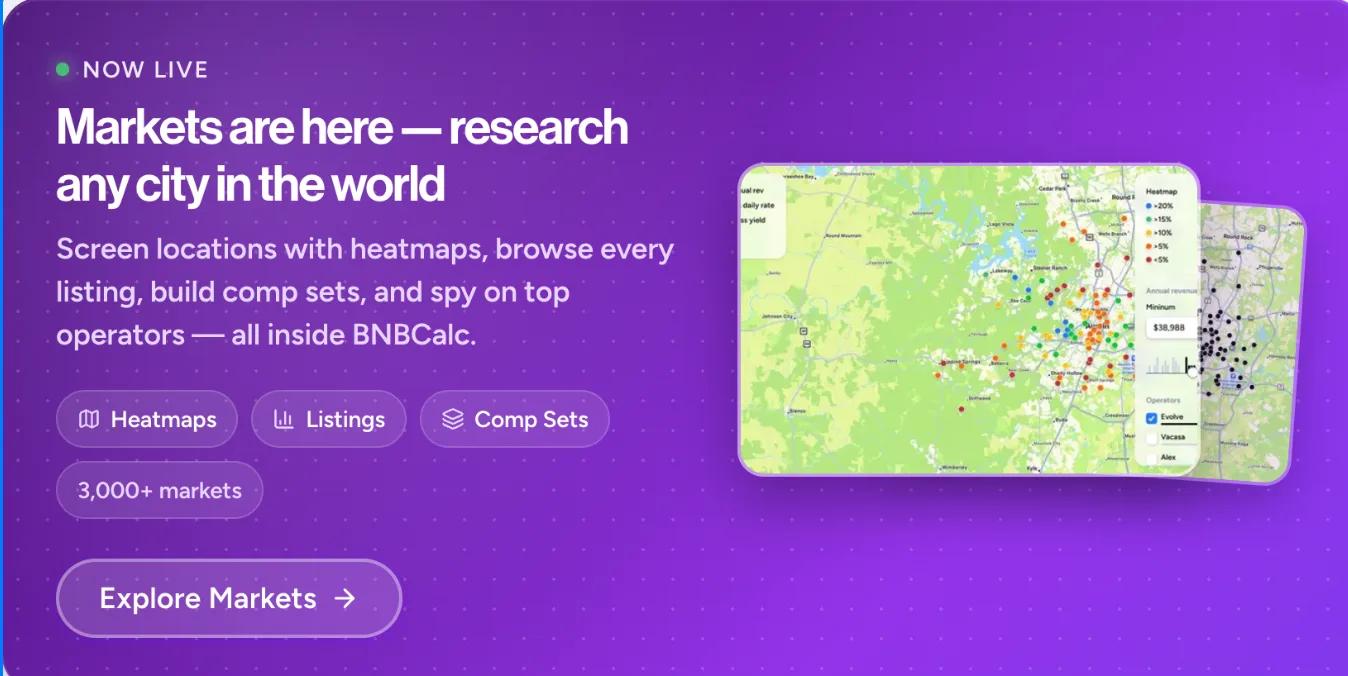
He built those apps with BNBCalc and Claude, pulling booking data, pricing data and BNBCalc projections into one place. He also covers what BNBCalc has launched since he last recorded, including BNBCalc Markets for town and city data and Operators, which shows you who the biggest property manager in a market is.
Key Points
- His last episode went out in November 2024. Since then he's got married, become a father and stopped growing unit count, letting go of every apartment he had in 2025 to focus on high-grossing homes, and he's sold his Florida properties.
- Big Sky Lake House in Kentucky cost $735,000. It's a four-acre private lake on a 10-acre parcel, with an indoor basketball and pickleball court, a rock climbing wall and five slides, and as of September it had $200,000 on the calendar for this year, with about $240,000 expected by year end.
- They put about $60,000 into that house and it appraised at $1 million, $270,000 over what they paid. Two of his last four purchases have been refinanced and both appraised significantly higher, which he says isn't common for STRs. His best bets are buying well up front and adding bedrooms, bathrooms and finished square footage.
- He now runs revenue for 16 properties that he guesses do four to $5 million a year between them. His pacing check compares each house with itself, so if one had $30,000 booked for next July at this point last year and has $2,000 or nothing now, you'll know to ask whether it's priced above or below last year.
- When a property's winter looks empty, the lever he reaches for is seasonal marketing: reorder the photos, add winter shots, put the nearby ski area up front, or run Instagram Reels for bigger or more unique portfolios.
- On a 12-bedroom property a couple of hours outside New York that sleeps 40-plus, he redid the listing and photos and recently took a booking at about $6,000 a night. The gap between a $3,000 and a $6,000 booking is why he thinks revenue management pays on homes like this.
- He sold his first lake house, bought at $585,000, to one of its own investors for $790,000 when a five-year balloon mortgage came due. He puts the return at probably around a 20% IRR, with investors more than doubling their money over the five years.
Full Transcript
Listen to the full episode on Apple Podcasts, Spotify, or YouTube.
Jeremy: Hello, everyone. Welcome to the Short-Term Rental Pros Podcast. It is your co-host, Jeremy Werden. Today, we're going to talk about two things. I might break this into two specific episodes, because on one of them I want to give you guys, definitely for our long-term listeners, a little bit of context into the past couple of years.
We have recently started re-recording the Short-Term Rental Pros Podcast, but there was a little bit of a lull. So I think I owe it to you guys to explain what happened during that lull, why we stopped recording, and then why we've started recording again, and what has happened in that time period, both personally as well as professionally.
And then I want to get into a new business unit that I've started growing recently. Just to give you a little bit of a hint, it is along the lines of revenue management, specifically for high-grossing properties. So not for properties that are making like $40K, $50K a year, but ones where people are booking for thousands of dollars.
Jeremy: But first I want to get into the personal stuff. And yeah, a lot has changed. So before the hiatus, the last time I had recorded or posted an episode was back in November of 2024. So you guys know who you are, if you listened back in those days. I appreciate you guys. The podcast was growing. Everything was doing great.
Really, the decision for not recording was honestly a couple of things. One, the podcast for me was a way to share everything that I knew, all my learnings in the short-term rental industry, but also to network with people and talk to people who I wanted to talk to, where if I just hit them up for a virtual coffee hour, they might not have been as interested. But instead, "Hey, I have a podcast. Would you like to be on?" Generally, that was a more compelling pitch. So for that purpose, it was great. I got to have interesting conversations with people I wanted to have conversations with, but I kind of hit a point where there weren't really that many. I mean, there were definitely more interesting people out there, but I don't know. I wasn't dying to talk to another hundred people in the industry. So that was one.
Second, honestly, life happened back at this portion of 2024. I was engaged. We were planning our wedding. I was growing several businesses. BNBCalc was taking off, and I kind of put aside the Jeremy Werden personal brand, real estate brand, to focus on some other things.
My wife had just signed a deal to actually have an iHeartRadio podcast, which was a pretty big deal. The guests that she was getting on were very interesting, and it made sense to allocate our podcast attention and resources to the conversations she was having with folks. I mean, she's had Olympic athletes, authors, you name it. Everybody from reality stars, actors, musicians, country stars, pop stars. She's just had the full gambit. So really interesting, and that's been a fun thing to be a part of.
But now, I want to get behind the microphone myself, and I feel like the way we look at things is differentiated, and a lot of people have reached out and have done things based off what they've heard on this podcast. That kind of motivated me to get back behind the microphone, along with Ryan Shapiro, who initially reached out because he was a listener of this podcast, who has a 35-unit portfolio, co-hosting portfolio, that grosses millions of dollars a year. He has so kindly come along with me to help make sure that we're getting consistent, high-value content, interviews and solo pods out for you guys.
Jeremy: So, the end of 2024, end of 2025, I got married. 2026, had a kid. I had my daughter three months ago. So definitely new learnings. It got me thinking back to why I even got into short-term rentals in the first place.
And really, the reason for me was pretty simple. I realized that these houses can make more than my job. And it was pretty enjoyable. I really got into things during COVID. The whole world was going virtual, and it was cool that you can make money creating experiences for people. I also, at that time, started a boat rental business, and that was along the same lines. Like, all right, my friends are getting into crypto. That doesn't really feel very tangible. I want to create real-world experiences.
So I started with the boats. The houses came from there. People were renting boats. I started managing their houses, created branded materials for them, and had to give them estimates of how much the houses were going to make. And that is where BNBCalc came from, which was easily generated reports. Initially, it was property reports. And now, recently, we've launched Markets. So now you can put in a town or city and see all the market data. We're creating submarkets. Right now we cover pretty big regions, but soon you'll be able to put in your town or get more granular-level data.
But that kind of took off on its own. It started with myself and my co-founder, Parker, and now it's a legit team, a legit business. So that certainly required more of my effort. And it was at a point where a podcast necessarily wasn't going to move the needle for that business. We had to have partnerships, and different people other than myself needed to evangelize the product. So that became more important.
But now, with BNBCalc, our goal is really to empower our users to be successful, frankly. It was initially built as a tool that helped me be successful, a tool that was helping my friends be successful. And really it was just like, all right, there's a lot of data out there. How do we help people make sense of it? And how do we help people actually create things that can help them?
So data is one thing, but when you're talking to a client, the client doesn't want to just hear numbers. They want to see it. They want to visualize it. They want to understand it. So that was the high-level goal behind easily generated, branded reports, P&Ls. But now it's really taken on a world of its own. And we just launched Operators. So if you're a property manager and you want to see who the biggest property manager in your market or another market is, and get an idea of where their properties are and how they're doing, you can do that.
So it's more than just property reports at this point. It's market reports. It's property manager reports. And we're really excited. Hopefully we're going to have a very big update in probably the next month or two that I can't speak to yet, but we've got some exciting things in the works.
So essentially: that business, frankly my wife's media podcast business, my personal life, getting married, having a kid. It got to the point where, if I wanted to have work-life balance and weigh things the right way, I couldn't do everything.
So that being said, we are back and we are excited. I want to go through what my business, or businesses, look like today, and then explain the goals moving forward.
Jeremy: So back to my earliest business, which is the boat rental business. We still have it. It's very much a complementary business to our property management business at that lake. At this point, it's not really a growth vector. However, this year I'm actually looking at buying a couple more boats because of the tax benefits. If I have profit under my boat business, yes, I could pay myself personally and do a cost seg, or I could just upgrade the fleet and then pay that back through boat rental profits over the next year or two. So I'm thinking about buying one or two new boats.
But the property management business, I have really not been growing in unit count the last couple of years. I've actually been shedding lower-revenue properties. I let go, I believe in 2025, of every apartment I had, just because frankly they weren't really moving the needle, and I was becoming more and more focused and specialized in high-grossing properties.
So for instance, the ones that I invested in: in 2025 I bought two properties, one myself, and one with a business partner who actually reached out to me through being a listener of this podcast. One of those, bought for about 500 grand, in its first 12 months pulled in, I believe, like $150,000 in revenue, which is pretty good.
And then the one that's part of the Big Sky Barnhouse portfolio, Big Sky Lake House, was bought in Kentucky for $735,000. And we have $200,000 on the calendar for this year, and we're expecting to probably get to about $240,000 by the end of the year, as of recording this in September. So we've got some availability left.
So both those investments were very good and really furthered the idea of being really intentional about the experience you're creating. I mean, we did a private lake in Kentucky. It's a four-acre lake on a 10-acre parcel of land. It had a warehouse that we turned into an indoor basketball and pickleball court, and we put in a rock climbing wall. The property's in the rolling hills of Kentucky, so we put five slides on the property, four on the hills and one from the second floor to the first floor. We created a putt-putt island, so you can stand on a dock and play putt-putt. Kayaks, paddle boards, a huge hexagonal fire pit.
So again, that one was really in the middle of nowhere, but the idea was build it and they will come. Movie theater, Nerf garage, a war room. It has a social media distribution strategy. I think already next July we have like 33,000 on the books. So yeah, if anything I've learned, it's lean into the experience and do something unique, and it generally pays off.
The other property was, I think, kind of a unicorn property within a more urban market. I've been trying to find something similar since, and it's been very difficult.
Jeremy: That being said, since 2024, we talked about this all the time, but it's only rung more and more true. And with people that I've helped buy things, I don't just help people buy a house. People who reach out to me or want my help generally are trying to do something more experiential and unique. And frankly, everybody who's followed that process of, how do we make something really cool, really fun, really lean into who the guest is, really know the avatar, has done well.
A few of these clients I've helped buy very high-grossing, unique properties, ones that are so unique that they're hard to price. I mean, frankly, the problem with PriceLabs and Wheelhouse, or whatever pricing tool, is that a lot of times they're based off the local market. But if the property is truly one of one, you can't really look at the local market and compare it. So what do you do? And the answer is I've had to build some custom tooling to price these properties.
So on the barn portfolio, where I'm a partner on a few properties, I built the tooling for the properties that I was a partner on. And what I realized was like, hey, these properties might be all over the place. It's better to compare them to each other than to compare them to the market. So you really have to use the pricing tools as a starting point, but really have a pricing strategy and triggers off one another more so than the market.
I did that for the properties I was a partner on. And then when I showed my partner, Kyle, who may or may not be listening, he has 15 of them, he was kind of like, "Hey, I want to get you involved in doing this for all of them," not just the ones I'm a partner on. At that point, it was honestly, it did take a lot of time to really dial in every property on the upfront, but given I had already been doing the pricing for a couple, it was a much smaller learning curve than had I completely started from scratch.
So now I'm doing it for those 15 properties, which probably on average do maybe almost a quarter mil a year. I'm in charge of, or run, the revenue, so to speak.
Jeremy: So what does that mean? Well, A, that means pricing. Figuring out how do you price a property next week? How do you price it in July? Seeing how it's comparing to itself in previous years, the pacing. So having a really good feel for, is this property doing better this year than last year? If it's doing worse, why is that?
But also, all right, what are the levers that we can pull to increase the marketing? So it's not my responsibility, but saying, all right, these three properties in the same market have bad winters. Their winters are not looking good. What can we do? What levers can we pull to increase their winter occupancy?
So one of the findings has been seasonal-specific marketing. Let's say your fall is empty. Can you change your photos and change your listing to appeal to a guest who's looking for a stay in October, November, December? Same for the winter. Are there winter attractions? If you're near a ski area, maybe you put pictures of the ski area up front.
But essentially it's looking at things on a seasonal basis and saying, all right, we're good in the summer. The summer has a lot of bookings, but the winter doesn't. Okay, let's focus our energy and resources on marketing for the winter. And that could be, for one property, changing the order of the photos, putting in some winter photos, maybe doing some AI to get some snow out there. Or for bigger portfolios, or more unique portfolios, it might be Instagram Reels or direct marketing.
So that was the start of the, quote unquote, revenue management side of things. It wasn't something I was looking to do. It was just something where I was intellectually curious about doing it for properties I was a partner on. Like, how would I do this, and do it well?
Jeremy: I built some custom applications with BNBCalc and Claude. At some point I would like to release them to everybody, but right now I'm working on some other things. But essentially they pull Hospitable data, pull PriceLabs data, pull BNBCalc projections, and put it all in one place in order to help forecast and figure out where things just aren't lining up.
Let's say a house, this time last year, was booked already for next summer, next July, at 30,000 in revenue. And now this year it's like 2,000, or maybe zero. Okay, why is that? Are we priced higher than last year? Are we priced lower than last year? What exactly is going on?
For one property, you can get a feel for it. But at this point I'm doing almost 30 properties. You need a way to easily spot that. So you need to be able to quickly look and identify the gaps and figure out essentially what I call green, orange, or red. Green means we're good. We're pacing better than previous years. We're getting bookings at higher dollar amounts. Orange, we're pacing below last year. Red, we are pacing way below last year. It's not even close. Things are just off.
So again, for one property, you might have a good feel yourself, but if you're doing a bigger portfolio, you need to be able to easily spot the issues and then see the patterns and recognize how to fill the gaps.
Jeremy: So back to that Kentucky property. Again, I know we have investors listening. We have property managers. We have people in the short-term rental software space. But from an investing standpoint, two of the last four properties I've bought, I have refinanced, and they both came in at a significantly higher appraisal value.
That is not commonplace. A lot of people, when they buy short-term rentals, might spend 200, 300 grand setting them up and amenitizing them, but then they don't actually increase in value. If anything, they go up maybe a little bit in value. But the ones that we've refinanced have gone up pretty significantly.
So we bought the Big Sky Lake House at 735. It just appraised for $1 million. We put like 60K into the property, and it appraised for 270K higher than what we got it for, which was good. It means when we're putting dollars into the property, we're making the property nicer.
And also, we're getting good deals upfront. If you pay too much at the beginning, it's harder to justify a better appraisal. We finish out unfinished square footage. That's something that's always helpful. We added a bedroom. We took a hallway and walled off a bedroom, put in a closet, so it became a legal bedroom. So stuff like that helps. There are no guarantees, but generally adding a bedroom, adding a bathroom, finishing unfinished square footage, taking out carpet and putting in LVP, stuff like that generally is the best bet for increasing a property's value.
Jeremy: Speaking of which, I've been refinancing some properties and pulling out value that way, and I've sold a couple others. I'm trying to remember the exact dates, but I think at the end of the year, or the beginning of 2025, we sold a property in Florida, and then in the middle of the year we sold another. I may be slightly off here, sorry. But the point is, in the last two years, we got rid of our Florida properties.
Why is that? Why did we sell? I could probably do an episode. Yeah, actually, you know what? I'm going to do that. I'm going to do an episode on why we sold a couple of properties, what the considerations were, and things you should think about if you're thinking about selling.
And guys, I want to just say that I think a lot of people think that selling is failure, and that's just not true. That's part of being an investor.
We also sold another one, one of the original lake houses, actually the first property that I was a buyer of, the one that started my investing journey. And that one had completely different considerations than the other ones. So your considerations are not going to be the same every time.
I'll explain for this one. We had a five-year balloon mortgage, meaning we needed to pay off the debt in full and refinance, or they would call the loan. We didn't get anywhere close. We knew what we were doing. So one of the investors on the property actually bought out everybody. For them, it was beneficial to buy out everybody and get a tax benefit. We hadn't cost segged the property yet, so it made sense for them to just buy everyone out.
And then for everyone else, it made sense because the property had gone up in value. We'd bought it at 585. We agreed on selling it at 790. If you're curious, we based that on looking at the market and giving a little bit of a discount for doing things direct, not needing to go through a realtor or anything like that. It was a friendly transaction. Essentially we just made it a win-win. Everybody won. Easy transaction. Everybody realized their investment.
For the passive investors on the deal (I was an active investor; I managed the property), our initial pool of investment was [inaudible]. And then the payout to everybody was over 400. And we had done distributions over the years. So it was a good investment, probably like a 20% internal rate of return. Folks had more than doubled their money in a five-year period.
So that consideration was entirely different than the Florida properties' considerations, which I owe it to you guys to break down.
So while I've bought properties since we've been here last, I have also sold properties. I've lost property management clients, and I've taken on new property management clients. I've started a revenue management side of the business, just because I've seen that there's kind of a gap for these high-earning properties. It's just hard to price them, to be honest.
Jeremy: The one that I just recently took on, it was initially a client I advised, who bought a couple hours outside of New York. The property was bought for like 700 grand, a 12,000-square-foot mansion. They put a lot of money into rehabbing and renovating it. I'll just say a lot, like seven figures. They did refinance it and got a lot of that money back, but it's a massive one-of-a-kind property: indoor pool, movie theater. It has a detached barn structure that's going to become like a Pilates studio. It has a sauna, rooms for massages. Crazy property. 12 bedrooms, probably like 20-something beds, can sleep 40-plus people.
And yeah, I just got a booking the other day at like $6,000 a night. So the difference between getting a $3,000 and a $6,000 booking is a pretty big deal, right? That moves the needle a little bit more.
And the pricing, in my opinion, was a little off. It was a little all over the place. I helped connect the owner to a contact who made some viral social media content, and the content went crazy, hundreds of thousands of views. A lot of people reached out, but the pricing just wasn't dialed, or wasn't at that equilibrium.
So now when I just run revenue, it's kind of great, because I don't have to deal with the day-to-day guests. Even though I have VAs, I do involve myself, at least for the properties I manage, in the guest experience. Mostly when things get escalated, they escalate to me. But at this point, dealing with guests is not necessarily my favorite part of the business.
So I don't mind if I can just focus on making the properties money, which means, A, again, figuring out how to price them, but then B, figuring out how to communicate and market the property to the guest avatar.
So for this property, I redid the listing. I just took it and redid it, and used some Photoshop and some AI to help improve the photos. For properties like this that make 200,000-plus (I think this one has potential to make like 400 or 500K), doing Instagram Reels really makes sense. So I'm working on some through my contacts. And if you're following me on Instagram, you may see some videos of me helping to promote the space. I may or may not be hosting my 30th birthday there. We'll see.
And really tell the story. For properties like that that are very unique and sleep 40 people, you want to tell the story of, hey, you and 30 of your colleagues or friends can get on a bus in New York, drive over and have the time of your life. Everything can be provided for you. A lot of people just want to know definitively what an experience looks like when they're paying five, six, $7,000 a night. And sometimes Airbnb doesn't really do it justice. So we're trying to do it justice and help tell that story.
Jeremy: So yeah, between the 16 properties that I'm doing revenue management for, they might cumulatively do, I don't know, like four to $5 million a year of revenue, which is obviously a significant amount. Obviously, managing something like that would be a serious business, managing four to $5 million in revenue. Revenue management is still a good business if you're good at it.
The reason I'm doing it is because I know I'm good at it and I know I can be helpful. I'm not trying to bite off more than I can chew. Obviously, I've got a good bit on my plate, as I can hear my baby crying in the background. I hope she's okay. I'm going to go check on her in a second. But yeah, the new business line I referenced earlier was revenue management.
In the meantime, I just made a hire, kind of a head of ops role, whose job really is to make sure I can focus on what I'm good at, and also give me more time to create content and create podcasts for you guys.
I have him on site with a property that we're launching for a management client. It's actually a client that I helped find the property for, and I helped with the setup, connecting him to a local GC and to one of our designers. The property is going to do very well. I think it'll be the top performer in its market, potentially a multi-six-figure revenue-earning property.
And traditionally, I would have had to be there to get things from 95% to 100%. I call it the last five yards. They're always the hardest. So fortunately, I made a hire and he's there. It's new for him, so I'm definitely involved with helping make sure that he does it and does it right. But that expands my capacity and capabilities if I have someone who can do things, or even project manage himself, for our client properties.
Jeremy: I'm not putting the foot to the pedal in that regard by any means, but I want to buy something. What's held me back from buying personally this year was that I had a baby. I get really passionate about these projects, to the point where they absorb my mind. And I didn't want to have either the stress, or honestly even the excitement, when I had something so exciting in my personal life, having my daughter. Even though she's crying right now, I don't know if you guys can hear, but she's awesome. I didn't want that distraction.
And also, we did have some health things that I think are very common nowadays. She's okay, she's healthy, but the doctors definitely gave us a little bit of a shake. So I didn't want any unnecessary stressors. Again, I enjoy these properties, so calling it a stressor is perhaps not the right word, but maybe a distraction, I don't know. I didn't want anything competing with my attention during the birth of my daughter.
So with that, I haven't personally bought a property this year. I've done refinances, I've sold, but I'm looking to try to buy one by the end of the year, and having someone who can help be on site and get properties through the finish line is something that I find hugely valuable. So hopefully it works out.
I've got to get going. I've been helping some people buy, but I've got to get going and get one done for myself. I've had a decent year income-wise, and obviously the tax benefits are huge. And then these properties also make money for me. So it's a good thing for me to do, and to have help is helpful.
Jeremy: So what's in the near future? Well, Ryan, myself, Patrick Switek from the co-host company, and Rajan, who's been on this podcast, are hosting a retreat at the lake in North Carolina where I have the boat business and the properties I manage. We're having, I think, about 35 folks coming in. A lot of listeners of this podcast are coming in, folks in our property management and co-hosting Mastermind.
And yeah, that's going to be a lot of fun. Frankly, the idea is just to get the right people in the right room, and good things happen. People get motivated, they get excited. You really only need to pick up one thing from somebody to potentially change the course of your year, or in some cases, your life. People who have been at events we've hosted before have hired one another full-time. Folks have left their jobs to work with other folks full-time.
So we'll see what comes. But I've got the boats, we've got the houses. Several of them are ours, but we have six houses reserved. I'm reserving several of the boats to chauffeur people to and from the venue. So it should be fun. If someone says it's not fun, I did not do a good job.
So that's coming up this upcoming week. I intend to do some podcasts while there. I want to make sure, if I say, "Oh, this person's going to be there, it's going to be an exciting podcast," and then they don't come, I'll feel bad. So I'm not going to say who's going to be there, but we will definitely be recording some podcasts, with people who are, in my opinion, some of the most influential, but also intelligent and successful people in the vacation rental industry. So yeah, guys, be on the lookout for those.
And then the BNBCalc team will be there. It'll be a great time to get our products, the product we have live but also some of the things we're testing, in front of our users to get their feedback in real time. We have our partners coming. Can't say who quite yet, but we've got some fun things coming up. So that'll be a good place to build relationships with people that we're building products with. So make sure that you stay tuned for those.
Jeremy: I hope today was helpful, giving you guys some context on where I'm at with things. And if I'm going to really name the three biggest learnings since we've been with you guys last: life's crazy. I didn't think I'd be a father before I was 30 years old.
My goal was to quit my job. I think I touched on this earlier. What was my why initially? Well, I wanted to quit my job. I wanted to live and die by my own sword. That was one of my big whys, why I initially got into this.
And then second, something that maybe was more in the back of my head was I wanted to be able to be present with my daughter or son. My dad, I love him a lot. He's the man. I'm very grateful for him, and his hard work gave us opportunities in education that I don't take for granted. But he was gone as a traveling consultant a hundred-plus days a year.
I don't know. I think I said he was gone half the year, and he was like, "Oh, I was only gone 126 days," or whatever. I don't remember exactly how many, but I just remember as a kid, he would leave Monday and come back Friday. And frankly, he was tired, because he would do a red-eye flight, and he'd be asleep at my baseball games. When I say that to him, he'll be like, "Well, baseball was boring," which is valid, but he slept at other games too. It wasn't just baseball.
So I want to be present. I want to be here. Even if I'm working in my office, I want to be able to, in the middle of the day, walk over to my daughter, hang out with her, take her on walks. Fortunately, I've been blessed that we've been able to do that. Maybe that wasn't the most pressing why when I got into this, but I think it's probably the most pressing why today, and why I try not to bite off more than I can chew. It's really about why I'm trying to hire and be able to grow things, but do things in a way where it's not all on my back. That's been a learning.
Jeremy: Learning number two is you need a team and you need to align incentives. That's usually important too. If you have partners, how do you align incentives where they do what they're good at, you're empowering them, but you're also focusing on what you're good at, and everybody feels the right type of way about it?
So yeah, I'd say lesson one: know your whys. Two, it takes a team. Growing anything, you're going to need to hire people and you're going to need to align incentives. I could double-click into how to align incentives, if that's helpful.
Jeremy: And then lesson three is, frankly, people have been scared about "Airbnb dying, Airbnb dying" since I got into this game. But the properties we're launching today are the best ones we've ever launched. Definitely there are challenges out there, but vacation rental demand seems to have been going up. People have been growing their portfolios. So I think it's as good a time as any to lock in and really focus on creating cool experiences, whether they're ones you manage or ones that you're buying.
People crave, in this AI world... I guess I could double-click into AI too, how we're leveraging AI, Claude Code, Codex, MCP, blah, blah, blah. Jeez, there's a lot to talk about, guys, sorry. I could probably rant for five hours here. I know I've already said I'm wrapping up. Yeah, I'm going to need to do a conversation on just AI. I like to think that I use the tools pretty well, but there are probably people out there who are doing things that I couldn't even think of doing.
But in a world of AI and social media, people crave real-world experiences. I don't think that's going to change. And I think people also want to trust that you can provide good experiences for them. Whether it's looking at an Airbnb listing or watching an Instagram Reel, whatever it might be, if they see something and they're like, "Oh, the reviews are good, the photos look good. I trust that this is going to be worthwhile."
Time is a finite thing, guys. We only have so many vacation days. There are only 365 days in the year. "I trust that this is going to be worth my time. This is going to be a worthwhile experience. I'm going to put my credit card down and pay what it costs." So I don't see that changing, and I don't think it ever will change, frankly. You guys are in the right place if you're looking to curate, manage, or build a business around real-world experiences.
And with that, guys, I'm excited to head down to North Carolina, and we'll make sure to, hopefully next week, but within the next few weeks, start rolling out those conversations. So stay tuned for those in the next episodes of the Short-Term Rental Pros Podcast. Comment and share this with someone you know that wants to invest in short-term rentals.
Airbnb Tax Deduction Calculator
Paying too much in taxes? We have the perfect solution. Simulate an Airbnb home purchase below.
Purchase Price
$450K
Structure Value
70%
Apply Trump's Tax Cut (Bonus Depreciation)
Depreciation
$117,695
Interest
$21,600
Tax
$6,750
Year 1 Deduction
$146,045
Want to claim this deduction? Get a free cost segregation benefit analysis from CSA Partners — no obligation.
Get Full Analysis