Free instant analysis
Reveal Airbnb revenue for any address or city
Quick Summary
Jay and Sam built the portfolio on rental arbitrage first, then leaned toward co-hosting once competition tightened. Around 13 units were still arbitrage at the time of this conversation, and one building where Sonder pulled out of its contract handed them 16 more at once.
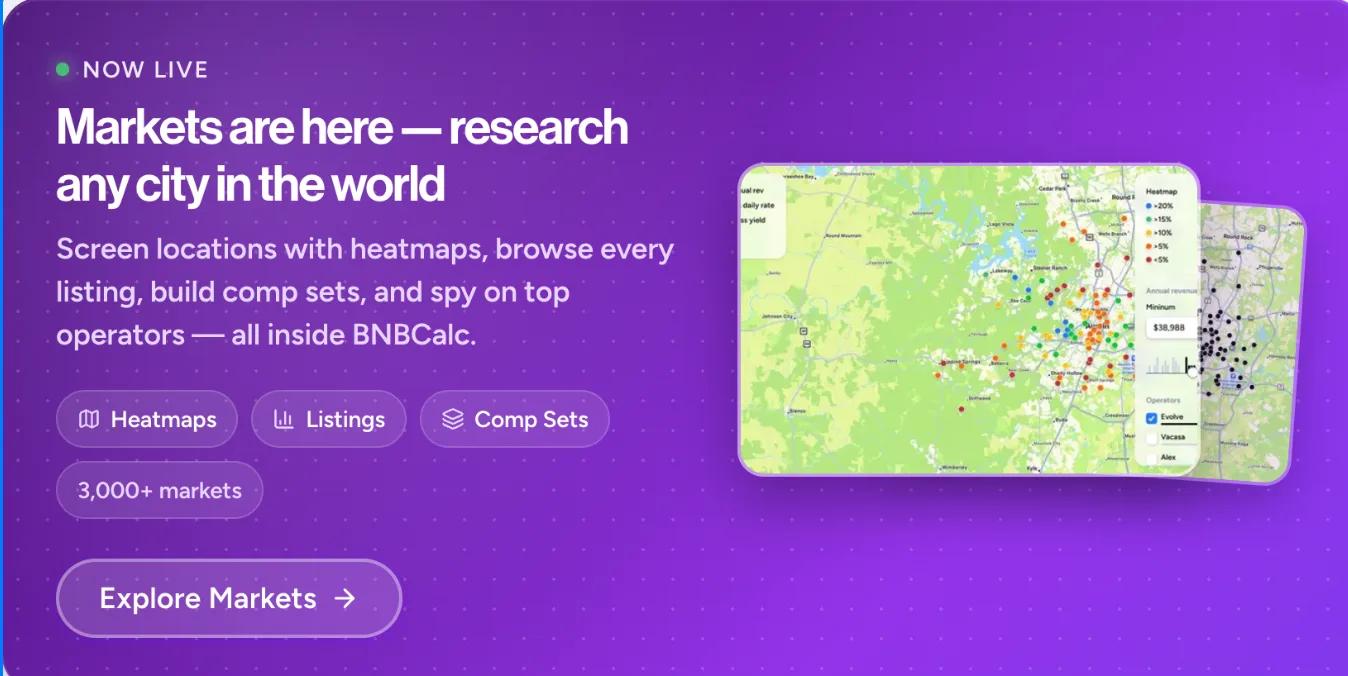
He's candid about the ceiling on a one-bedroom apartment in a city where owners keep adding pickleball courts and pools. If you want to see which amenities pay before you sign anything, that's what BNBCalc Markets is for.
Key Points
- Jay hedges his own portfolio count on the recording, landing on 36 or 37 properties while Jeremy jokes about rounding it up to 100. Roughly 13 of those were rental arbitrage and the rest sat on management or co-hosting deals. He and Sam had quit their jobs by the end of 2021 with nine under management.
- The biggest single jump came in early 2023, when Sonder pulled out of a six story building of roughly 30 to 35 units. Jay's team assumed 16 of those contracts along with the one to two year old furnishings the owners had bought, and took another seven around the same time on their first master lease, which put 23 one-bedroom apartments on the books.
- He prefers co-hosting because the owner carries both the improvements and the license. He puts the San Diego license at over $1,000 per unit every two years where nobody is owner occupying, so a portfolio in the twenties runs $20,000 to $30,000 a cycle, which falls on the operator under arbitrage and on the owner under a co-hosting contract.
- The two of them disagree on the permit math and never settle it. Jay says the city counted 16,000 to 17,000 Airbnbs and wanted to cap them at 1% of the housing stock, which he works out to about 5,000, calling that a cut of over a third. Jeremy corrects him to over two-thirds on the spot. Jay adds that licenses go by lottery, that only a few thousand people applied, and that he believes a few hundred were still unclaimed under a seven year sunset clause.
- HostBuddy AI, the guest messaging product Jay co-founded in September 2023 with Sam and a developer named Michael, is split three ways and had taken no outside capital. They ran it inside their own operation from around January or February before releasing it publicly that May, and Jay put a few hundred properties on the platform at the time. He described it as a supplement to a PMS such as Guesty or Hospitable, quoting an average of $5 per property per month.
- Jay describes the review side in the most concrete terms. The system scores guest sentiment and skips the review request when a guest has been complaining, while a separate tool reads a bad review against Airbnb's review policy and drafts the letter you copy into a support ticket. He also cites his own team's communication score rising from about 4.89 to 4.93 across roughly 100 days, a figure he offers with a hedge.
- On showing owners the numbers, Jay says they historically pulled AirDNA and compared listings by hand, working out why one place clears $200K a year and a similar one clears $150K, usually down to something like a hot tub or a pickleball court. He mentions that Sam has since run their last two or three deals through BNBCalc and sent the reports to prospective partners.
Full Transcript
Listen to the full episode on Apple Podcasts, Spotify, or YouTube.
Jeremy: And we are live with the Short-Term Pros Podcast today. I'm with my buddy Jay, who is not only an operator with, what, like 40-ish properties now?
Jay: Yep, correct. 36, 37 around now.
Jeremy: All right, we're rounding to 40, so we're also rounding to 50, so we're rounding to 100. We are with Jay, who has 100 properties, and not only is an operator, but is also a software founder in the space. So it's going to be a great episode. We're going to dive into all things operations, scaling a property management company, but then we're going to geek out on some software and learn about Jay and what he's got going on in the AI realm.
So Jay, man, thank you so much for joining. Tell us about yourself. What did you do before short-term rentals and how did you get into it?
Jay: Yeah, absolutely. First off, Jeremy, thanks for having me. I really appreciate it. I'm excited to dive into the tech space a little bit. It's been really nice connecting with you in the past just about how we can benefit our current hosts in 2024 going into the future, and I'm excited to see what both of our companies can do here pretty soon.
But to start off, getting into the STR space, I was initially a civil engineer. Actually, I went to school for civil engineering.
Jeremy: And you're a young whippersnapper. You look pretty young. I guess I've never asked you your age.
Jay: Yeah, I'm 27 now.
Jeremy: We're the same age.
Jay: Yeah. So I graduated in 2019 with a civil engineering degree from Cal Poly SLO. I thought that was what I wanted to do with my life. I enjoyed it, but I always had an entrepreneurial spirit and always had these little side ventures that I was doing to try to make some money and start up businesses. And I think truly that's what I really wanted.
I found Airbnb as a way out of the corporate world, as most people in our space do, and saw the opportunity to scale it. And within San Diego, which is where I live now, it's such a perfect place to do it. I decided to partner up with my business partner, Sam, and we were able to quit our jobs within about 10 months. That was at the beginning of, I think it was 2021. Is it 2021? Yeah. When we started our business, by the end of 2021, we completely quit our jobs and went STR full-time. I think we were only managing nine properties at the time, so not really making any money from a sustenance standpoint, but we were able to really scale that over the next year. And now I think we're at 37 properties and still running.
So last year we were looking for AI tools for our business to really implement the newest technology. There's a lot of really, really great AI applications as the new models have progressed recently. And we saw a need in the space for a really powerful AI messaging solution to just really start taking over messaging for hosts and let them gain back their time and their money and allow them to earn a lot more than what they're earning with a lot less effort. So that's been our mission, and we have accomplished that. And we're every week releasing new features with our software called HostBuddy AI.
So we founded that back in September of last year, 2023, and bringing us to today, September of 2024. It's crazy. It's already been a year. The year's flown by. But yeah, we got a bunch of really happy users, and like I said, releasing new features every day that are going to be able to help hosts. So excited to see what the future holds.
Jeremy: And let's take a step back further. I want to hear, you seem like you're an entrepreneurial guy, technical engineer, went to Cal Poly. But what's your why? Why did you want to quit your job? Why do you want to work for yourself? Is that something from childhood? Is there anything you can attribute that desire for you and Sam?
Jay: Yeah, that's a good question. I think there's a lot of qualities within certain people that can't necessarily be taught. And when you go through school, a lot of times people lay it out for you: these are your options, these are the things that you seem to be good at, and these are your options for how you can get a job after college, after high school, wherever you're at.
And for me, I found that I had these other qualities, that I had a drive to create something of my own. And I take a lot of pride in a lot of little things that you're not able to apply when you're in school. So there's a lot of creativity that I don't get to express as an engineer. There's an overall desire for me to just make an impact in the world that's bigger than just being a small part of a company. And I wanted to be my own boss, to be able to create my own schedule, work on my own hours, create my own life, and ultimately just be in control of that.
I had several other businesses that I tried to start. I got into photography, videography. I started a drone business, basically taking commercial videos for real estate agents and things like that. That one never really took off. But amidst that venture, I found short-term rentals. And I wouldn't say I'm a master of hospitality, but I have business skills that I was never able to practice when I was in school, studying as a civil engineer. So applying those into the real world, I was able to at least find an opportunity to scale up. But I think I've always just had that desire to run my own business and have something.
And I think when you look at it from the outside in, sometimes it looks like, oh, you have to have this brand new idea of a new app or product that no one's ever come up with, or this new invention. When I was a kid, I used to watch Shark Tank all the time. So this is the coolest thing, and seeing all these entrepreneurs go up there and just pitch their ideas is really cool. And seeing all these new things that people come up with, it can be really overwhelming. And taking a step into the STR space, into a whole realm of business that people have already done, it's been tested and shown that short-term rentals can produce the most revenue for a rental property. And if I can be a part of that and build my business off of that, then there was a great opportunity. And that's kind of where it started.
Jeremy: And what informed you? So I think there's a few parallels we got here. But first, I think we both saw that short-term rentals was a way that we could, quote unquote, get freedom, time and location freedom. And then I think we both had that same desire of, oh, we're not just going to get that so we can go hang out on the beach somewhere. We actually were more ambitious. We have different ideas and things that we want to do. Both actually happened to be software companies. For me at the time, I didn't know it was going to be a software company, but I had more ambition than just houses by themselves, and saw short-term rentals as a very high likelihood success way to create a business that could sustain itself in cash flow and allow me to do other things.
So I guess, A, would you kind of agree with that characterization, is that a similar thought process you had getting into it? That's first question. And second is, you said you saw short-term rentals, you saw people doing it. What inspired you to get into short-term rentals in particular?
Jay: Yeah, I'll answer the second question first, because people ask me that a lot. It's like, how did you even start doing this? It's kind of random.
Honestly, I think I saw a big desire for tourism in the San Diego area. In particular, I saw a lot of Airbnbs just in my area. When people would come to visit me, they'd be like, where can I stay? And I would always look on Airbnb, because I've always liked Airbnb, and the idea of having a unique stay is really cool. So I've always been interested in that.
But honestly, I came across some sort of article, or just a post on Facebook, I can't remember exactly what it was. But this was late, was it 2020? And it was just an article about how you can make money on Airbnb without owning. And that was a big thing, is like, I don't have all this money to put into a new business. And that's a really easy way to get in, is just, I don't have some savings that I can put in to get it going.
And if I see that the numbers run, and I'm a big back of the napkin type of guy, I don't go super deep into detail about numbers, and I'm an engineer, but I don't necessarily do a whole lot of finance work. So if I see that you can buy something for this much and you could resell it for that much, it's arbitrage. That's what works for me. And I was like, this is a great idea.
So I started looking into it. It's really easy to start because all you have to do is just cold call people, cold email people and be like, I'm running a short-term rental business, and would I be able to come in and operate with the lease that you have available?
Jeremy: So [inaudible] started with arbitrage.
Jay: Yeah. And that's, I say that's one of the easiest ways to get started. Because if you're pitching to a landlord, like, you're going to get 20% of what I make here, but you have no experience, it's a pretty hard sell.
Jeremy: Yeah, I would caveat that unless you work with other people. If you're in like a mastermind, or you have a friend or someone who can lend their portfolio creatively to you. Obviously, I don't recommend anybody lie. But if you say, hey, I'm working with so-and-so, and this is his portfolio, and you have that person hop on a call with you and them. Just to caveat that so no one feels discouraged that, oh, you can't do something because you have no portfolio. You just have to be a little creative and leverage relationships around you. But yeah, keep going. I do agree that arbitrage is a great way to build a portfolio, because effectively, you're bribing landlords to let you Airbnb out their place.
Jay: Yeah. And I think there's other ways that you can approach it too. My only issue when I started was that I wasn't very knowledgeable about the space. And so I couldn't go in with, here are some projections of what I think that you could make on this. I just didn't know enough. I didn't have people to study off of necessarily besides occasional YouTube videos. There wasn't a lot of resources out there, like what you're doing with your mastermind group now. I think back in 2021, there really wasn't a whole lot of people doing that. And so for me, the resources were pretty minimal.
And I was like, this is a risk for me. I don't want to put that on the owner, because I think that it's going to work, but I'm not 100% sure because I haven't tested this. I don't see the data. I don't have the tools, right?
So then I just jumped into it and ran the numbers. And we went on Facebook Marketplace and found a bunch of furniture and threw everything in there and learned a lot. And over the next nine months, it was really about the relationships for us, as how we developed it, just maintaining those relationships with the owners and making sure that they're happy, and they'll start recommending you and all that. But I'm sure we can get into that as far as how we scaled. But that's how I found it.
And that's the thing that I think is great about it, is that there's so much space in the short-term rental world. Yeah, there's competition. It's not like this brand new idea. Airbnb is just a platform for you to make money. And if you can use the right tools and learn from the right people and learn from your mistakes, then you can be successful in it.
Moving back to your first question, can you repeat what you asked again?
Jeremy: So I asked, so it seems like your goal wasn't, I want to have a thousand Airbnbs or whatnot. It wasn't, I need to make ten million dollars a year off a real estate portfolio. It was, I first need the quickest and most accessible and high likelihood of success way to buy myself freedom, time freedom. I hate saying financial freedom. I just hate saying it. I feel weird when I say it. But I will say time freedom, like, you need to get out of your job, be able to do what you want with your time.
And then what you have decided to do with your time is build software tools that help a problem that you see firsthand, or help solve a problem you see firsthand, I guess. Is that a fair characterization of what your goal was? And now, with your software company, you're seeing that goal come to realization.
Jay: Yeah, 100%. I think honestly, even when I started, it wasn't even about reaching that time freedom, or creating an entire business around it. I just really wanted to start because I heard that it was a passive way to make money potentially, which is really not a passive business when you look at it. But I was like, if I can automate these systems in a certain way to where I can earn my time back, while also earning money on the side, that's great. I didn't really have a vision for how it was going to develop.
And then once we started getting more properties, we're like, holy crap, we're actually making enough money where if we scale this five times more, we're going to be happy and comfortable. And we have to keep it under control as we're scaling. But that's kind of where I was at when I started. And I think that my intention was just to have a little bit of passive income.
We've reached 30, I want to say like 35 properties or so, 34 properties last year. And we just kind of took a second to make sure all of our systems were correct, we're using the right automation tools, and the people that are on our team were understanding the right SOPs, and the job was getting done, our reviews were maintained.
And at that time, when we discovered the potential for an AI solution in the short-term rental space, we kind of, I wouldn't say we put our business on hold, but at this point, if we were solely focusing on STR and building that specific business with our rental portfolio, we'd probably have a lot more properties now. We've grown slowly and kind of organically over the last year, but we completely pivoted and we were like, okay, there's a perfect opportunity here where we can benefit our own company by creating this tool. Not only us, though. We can extend this to the entire STR space because there's millions of hosts now. I think there's like seven or eight million hosts worldwide. So it's pretty wild.
And so that was just the opportunity for us. We're 100% focusing on that right now. We put the right people on our team in order to basically automate our short-term rental business, and so that's running really efficiently. And now we're completely focusing on the software, which has been great. And just learning about all of hosts' different issues that they encounter during the day, different pain points that we can solve. It's been really cool to be able to connect with people. We've been going to a lot of conferences and just talking with hosts face-to-face to figure out what other issues can we solve related to AI, or related to your short-term rental that we can solve with AI. And we have great developers in our team that have been able to put new tools into place almost every week. And it's really developed into something really special.
Jeremy: Yeah, that's amazing. And what I want to do, so I want to understand what is the breakdown at this point of arbitrage. So you have 40, 46, not 50, not 100, 46 properties under management. What is the current split, arbitrage, co-hosting?
Jay: I think we have 13 rental arbitrage units and then, let's say, what is it, 20, 23 management. Because we have 36, 37.
Jeremy: Okay. The rest of them are, yeah.
Jay: Management or co-hosting.
Jeremy: Got it. And is there one you like better, or can you explain, I guess, the nuances or differences or maybe some things to consider between one and the other?
Jay: Yeah. I mean, I love the co-hosting model. I think it's the best. For us, we more or less legitimized our business through growing through rental arbitrage. And then we got to a point where we have this nice portfolio, we have really good reviews, and everything looks really solidified. And now we want to pitch ourselves to landlords in a different way.
And the co-hosting model allows us to really never lose money. But we also found that we're able to connect with the owners and be able to basically decide how we can make the most money. I like being involved in that process and thinking, if we shoot for this amenity level at your property, we can make you this much money.
If you do a rental arbitrage, it's a little bit hard because you have to be that person to put in a lot of those investments for furnishings and things like that, typically when you're first starting out. Not saying that's how it is across the board. A lot of times you could work with the owner still. But co-hosting allows you that flexibility to really reach that max potential.
And with the increased competition in the market, it's sort of a necessary thing. If you're stuck with arbitrage units where the owner is completely detached and they just want you to run it, but you know that the unit itself, or the home or the apartment, whatever it is, it just hasn't been renovated in a long time, it's super old. You're not going to be the one to go in there and put in new cabinets and new flooring and new appliances. Those are the things that should be taken care of by the owner, but those aren't expenses that you can necessarily take on and still make money by doing arbitrage. So it gets to a point where it's a little bit tough, and the co-hosting model allows us to just really work with our owners and maximize profits that way.
Jeremy: Gotcha. Yeah. And I've definitely seen that. And that's something I vocalize, is that with arbitrage, you don't own the property. So two things that come with that. One, the owner has to be on top of maintenance. If the HVAC goes out and you have a guest staying for two weeks, you can't wait until they leave. Someone has to get in there that day, get the air conditioning back on, or you have to give a huge refund. So it's really important that your owner and you are aligned on that front. Second, if more competition comes, there's very little you can really do to improve the property.
I largely focus on big houses. That's something I've been a proponent on for a long time, because to me, they're the most defensible. If you have a big house with a big yard, you can make it better. You can improve it.
I actually have three, so I have three two-bedroom apartments that up until this past week, I rented and re-rented. I did arbitrage. There are three small apartments, and the issue when I underwrote these deals initially a year and a half ago, the numbers worked. They penciled out. They looked good. And the issue we ran into was that there's been a lot of multifamily construction in that area and a lot of inventory. And that's pretty universal around the nation. There's been a lot of multifamily starts, got completions in the last couple of years. There hasn't been a lot of single family homes that have been completed, but there's been a lot of multifamily. And multifamily means apartment.
So there was a 16 unit apartment building down the street that got finished, and then the entire building got rented to someone else doing rental arbitrage. So all of a sudden it went from like four on the block to [inaudible]. And our margins were cut.
And we looked at it and we're like, all right, we can get our cleaning costs down a little bit, we can play with our pricing, but really, there's not that much we can do to improve things. I mean, we weren't losing money, but it was just like, all right, there are things we're doing that are working so well. There are properties in our portfolio that are just absolutely crushing it. That's what we do. We're going to lean into that and not focus on this business segment.
Granted, a couple of years ago, I was thinking, do I do small apartments? And do I scale, scale, scale, scale, scale, scale? Do I rent 60, 70, 80 small apartments and go for glory? And I took a step back and thought, well, what's the worst that could happen? And I thought, I don't know. I mean, people are feeling this out there, but I think I made the right choice there.
But that being said, it's an illustration that you kind of pointed out with the downside of arbitrage. Yeah, sure, maybe the landlord could have taken the backyard and built a grill and fire pit area, fenced it in so dogs could be there or something. The property could have been improved. But how am I supposed to tell the landlord, hey, can you spend an extra $30,000, $40,000 on your parking lot and backyard area? It just wasn't even worth having that conversation to me.
Granted, I still have the same landlord. I have a six-bedroom house with him that I've had for three years, and I'm going to keep as long as that keeps performing, which again, I think that's very defensible. A six-bedroom house, they're not making too many of those. I actually worked with him while it was being constructed to build a large fenced-in backyard, so it would be defensible over time.
So I don't know, just a little bit of insights there. But let's keep going here. So you got that mix, mostly co-hosting at this point. Tell me, I guess, you got 36 properties. What is the mixture of them? Are they apartments? Are they homes? Combination of the two?
Jay: Yeah. So actually the majority is, where are they right now, [inaudible]? I think the majority of them are one-bedroom apartments. And so that's what we found with our business that was working really well when we first started, and we just decided to scale that as much as we could. We made that more or less our specialty.
And we got a really good opportunity in 2023, I guess just last year, early 2023, for basically acquiring, taking up management after a failed property management company. So the building that we ended up acquiring was essentially six stories, and I want to say there's like 30 to 35 units. And Sonder was managing those units, which is a larger short-term rental property management company. They weren't doing too well, and they decided to basically pull out of that contract. And we came in right after them with basically like one to two-year-old furnishings that they left there that the owners bought from them. And we were able to basically assume all of those contracts. And it was a really, really good opportunity for us because we ended up managing 16 of those units.
Around the same time, we also got another opportunity to do seven units, which those ones were an arbitrage deal, actually. It's basically a master lease. That was our first master lease, which that was basically the only way that the owner wanted it to work. So we were like, that's a fine opportunity. We ran the numbers. We're like, this is going to work. It's still worth to do an arbitrage deal for these units because they're brand new.
But essentially, at that point, that's 23 units total that are just basically one-bedroom apartments, and they all looked great. I think the first year, so all of 2023, they absolutely crushed. They did really well. Our margins are down slightly this year, and I think that's just because, like what you mentioned, the added competition. There's only so much you can add to a one-bedroom apartment in the city to make it really stand out from the rest of the competition.
So most of our units now at this point are apartment units. But we're also moving into that model of being able to work with single-family homeowners who have larger properties in desirable areas to rent out their units on a co-hosting management type deal. And we're slowly organically growing that way. We just had one that we listed. I think our first guest just stayed last week, and that one's doing really well.
So I definitely really like those deals, especially working with homeowners who are willing to put in the money to improve their property. If we say, this is how much more money you can make adding this certain amenity, they totally understand. And they're like, that sounds great to me. Let's do it. Our ROI sounds really great on that. So it's been really great working with people like that and maintaining those relationships. They'll talk to their friends who have properties as well.
Our main form of scaling has been just working really well with our homeowners and then having them refer us to other people. I've talked to a lot of real estate agents who have investors that are trying to buy in San Diego, and they'll come to us to basically bring together all the pieces to make sure that their property can make the most money. So it's been really great being a part of that.
And I think in the future, we'll for the most part scale with those single-family homes in San Diego. As competition grows, inevitably, it's probably the best move for us and anyone in like a high tourism area. I would say it's always a great bet to go for those deals where you have a lot of influence on the competition in the market. Or I guess that you have a lot of influence in how it's going to perform and what you're providing into the home itself.
Jeremy: Yeah. So I want to break that down into two things. One, relationships. I think you hit on a key point. You focused really heavily on how can I help these owners, landlords, be successful. And that is ultimately what this game is. If you're leveraging other people's properties, they're going to do business with folk they know, like, and trust. And then the investors ultimately are about brass tacks.
Second thing, communicating the numbers. Question for you. You can answer this honestly. I'm not putting any pressure on you to preach to the choir here or court favor. But do you use any particular tools to highlight how different properties are doing, and how if amenities are added, how the revenue slider can go up, and share reports with clients on anything like this?
Jay: Yeah. So historically, we've tried to use AirDNA and just manually gone through and seen what's the difference between this property that's making $200K a year versus this property that's making $150K. And we can see these are the main differences, regardless of the way it's managed. Maybe the reviews are pretty similar, but this one has a hot tub or this one has a pickleball court or something like that. So we've done that historically. We've tried to use certain tools. I know after...
And actually, Sam, my business partner, told me to tell you that he's been using BNBCalc and he really likes it.
Jeremy: Let's go.
Jay: He's like our finance guy.
Jeremy: We're good. All right. We're good. We can keep talking now. Otherwise, it looks like the StreamYard doesn't work anymore. Sorry, Jay. Maybe another time.
Jay: Yeah. Jeremy's not paying me to say this.
Jeremy: No.
Jay: Yeah, Sam. Because after we met Jeremy at the STR Nation Conference, we started looking into BNBCalc, and Sam has used it the last two or three deals that we've been analyzing. He's been actually sending reports to some of our potential partners. So it's been super cool. He's been showing me some of the stuff. I'm not the big finance guy or data guy, so Sam freaking loves that stuff. And it's been useful for us so far. But yeah, historically, honestly, we just didn't...
Jeremy: Looks like Jay's getting booted. Sam's in the waiting room, everybody. All right. Sam's coming in. I'm just joshing.
Jay: Yeah. He would give you some actual testimonials on the data and all that. But yeah, that's for the most part what I can say we've used in the past.
Jeremy: Cool. Very cool. Okay. So I'm going to break this down. So yeah, we met in person, Jay, Sam, and I. We kicked it in San Diego. We had a lot of fun. There seems to be a lot of 25-ish listing portfolio property managers in the San Diego area. They're young. They're cool. They're ambitious. You all talk and hang out. I just felt like, I was like, there are so many people here who are crushing it in this area and all doing the same thing.
Jay: Yeah. That's a good point that you bring up. I felt like before I went to that conference earlier this year, I hadn't really associated with any of the other operators in the area. And I always felt like everybody's in competition with each other. And I realized that there are so many people like me, and there's so many people that I can learn from. It's crazy.
I've had several people on my podcast, The Rental Realm, recently who have been able to share their stories about how they've developed their portfolio within San Diego. And every single story is different. People have properties in Mexico. They branch south, or they're only doing big single family homes. Some people are just specializing in more rural development, I guess, outside of San Diego. But regardless, a lot of people started in San Diego. They found an opportunity. And it's been really great talking to a lot of people about these stories.
I try to go to as many meetups as I can just to learn from a lot of people. I'm surprised every day I hear a new person in San Diego who is a short-term rental operator who's just crushing it. And I think that's great. I think switching the mindset from feeling like everyone's in competition with one another to, we're in this together, we can learn from each other, we are the best hosts in San Diego, and we can benefit the travelers that are coming into our city. It's a really cool mindset.
Also, the idea that us compared to those bigger property management companies who are not providing a good experience for the Airbnb travelers, the short-term rental travelers. It's cool to look at the differences between our own businesses and separate ourselves from some of those issues that can be posed with companies who scaled way too fast. They've taken over a market in a certain area. So yeah, it's been fun meeting people. But it's really been over the past few months that I've been able to connect with people in my area. And I love it.
Jeremy: Yeah. And it's cool because in New York, I meet people here and usually it's like, oh, I have a handful in Gatlinburg, or I have some in Philly. People who live in New York have properties all over. The rules in New York are as ridiculous as it gets. There are people who do month-long, 30-day minimum rentals here and have success. Some folk that I work with in our mastermind have seven, eight 30-day rentals in New York.
But I was like, wow, San Diego. I was at that conference. Everyone I met was like, hey, I'm from San Diego. I used to work in tech sales. Now I have 25 properties. I quit my job last year. And I was like, didn't I just talk to you? I swear I just talked to you. And they're like, oh no, that's not me. And I was like, oh, okay. There just happens to be 10% of this conference is people with pretty much that same exact story. So I was like, this must be a freaking good place.
Why is San Diego a good place to... Not that we're recommending anybody go into San Diego and launch a property management business, but why is there opportunity there?
Jay: Yeah. I think San Diego is positioned really uniquely in that it's right on the border of Mexico and the United States. So it's positioned along the coast, and then you're blocked out by the mountains on the east that pushes a lot of the development inward.
And then, to start off, it's just one of the most beautiful cities ever. I love San Diego. I think I'm going to stay here for a while. And there's a lot of desire for people to come and travel just because of how beautiful it naturally is. I think the home prices have increased a ton because the development area is decreasing. And I think that pushes a lot of the competition to create these really unique stays. So now there's a ton of houses with, one of the big things now is pickleball courts. A lot of people are making pickleball courts and in-ground pools. And a lot of the coastal areas just have really, really unique stays.
And I think when I started renting in San Diego, we could have gotten away with renting a little bit outside of the city. And at this point, it's like you have to be in a really desirable area to make it work really well. And we're only focusing on those deals. We get a lot of referrals. A lot of people that come to us like, can you rent out our home and make us money? And we're like, we could, and it just wouldn't make enough money for you. It wouldn't be the best idea to go into business and rent as a short-term rental. Keep it as a long-term, do it as a midterm. There's a lot of options, but you have to target those really specific special areas in San Diego.
It's really cool because the downtown of San Diego is not really the heart of San Diego. It's just a side area. And I think you explored the downtown area a little bit. It's one of the smaller downtown corporate areas that you'd find in a large city, because I think San Diego has over 2 million people, 2.5 million people, but the downtown is relatively small. So you have these other pockets of La Jolla, Pacific Beach, Ocean Beach, all these different beach towns that are just really great for not only business, but to live and to stay.
And San Diego has been regulating a lot of the short-term rental licenses. So we're kind of dwindling on the quantity that's left for us.
Jeremy: Yeah. Isn't there a certain number of permits, but they thought that they would all be gone and they're not going away? There's thousands of permits left or something?
Jay: Yeah. So they estimated that it was about, I want to say they said 16,000 to 17,000 Airbnbs in San Diego City. And so they wanted to bring it down to 1% of the total housing population is Airbnbs. So I think when they calculated that out, it would have turned out to be about 5,000. So they were cutting it down by over a third.
Jeremy: Over two-thirds. 16,000 to 5,000. Cutting it down to a third.
Jay: Yeah. I mean, it's a lot. And they're basically saying, in order to secure your license, there's going to be a lottery process. And a lot of people were either like, I'm not even going to be able to afford this license because it's over $1,000. If you're not owner occupying, or if the owner isn't on the same property, it's $1,000 or more. And then some other people, I think, just tried to do it under the table and either got caught by now or whatever.
But at the end of the day, only a few thousand people actually applied for these licenses. And so they had a ton left over. I think there's still a few hundred left over. And it's great for people like me who are doing it by the books and getting our licenses and making sure that we're operating properly. But I know that there are people out there who have tried to do it under the table just without a license and they've gotten caught.
Jeremy: Why don't they just get a license? Why would they not just get a license if they're available?
Jay: It's either it's too expensive or they just don't want to deal with it.
Jeremy: How much does it cost to get a license?
Jay: It's like $1,000.
Jeremy: So that is, because I've paid a couple hundred dollars. I've never paid $1,000 for...
Jay: Yeah, it's a lot. If you have a lot of units, I think it can be overwhelming, because I think we're in the 20s for our portfolio count, and then we had to get licenses for all of those. So if you are operating them by yourself and you're like, d*mn, now I have to pay $20,000 to $30,000 just to maintain this, it can be kind of deterring.
So for us, luckily, that's kind of where the co-hosting contracts come in, because you are able to work with the owners and say, this is something that you now have to do to operate as a short-term rental. And now the owner or the landlord pays for that instead of you.
Jeremy: I'm curious. Is it $1,000 a year or in perpetuity?
Jay: It's every two years. Yeah. So I think next year we'll have another round.
Jeremy: $500 a year.
Jay: Basically.
Jeremy: And you can keep renewing. They're not like, oh, we're going to take it away after two years.
Jay: Yeah. I think if you have bad standing or some bad reports from neighbors, then you might get it removed or something like that. But yeah, I think as long as you have the license now, you should be pretty much good. And I think there's a seven-year sunset clause where it's going to be like this for at least seven years before they change anything.
Jeremy: Okay. But it seems like there's always going to be demand in the San Diego area. There's always going to be some opportunity in the area with certain property types. So are you concerned? Let's say we run out of permits. What are you doing?
Jay: That's a good question. I would love to stay in San Diego. I think we're doing really well here. If they run out of licenses and we can't do any more, then we'll pick up our operation and start adding in property somewhere else. And that just is what it is. If they want to limit the amount of Airbnbs in San Diego, I think that's fine. I don't want every single house on the block to be an Airbnb. So I understand it. There's definitely a housing crisis in general. So I'm not really fighting that.
Jeremy: I mean, there's a housing crisis. San Diego, they're not building housing, I would say. They're building in Phoenix. They're building in Durham. That's why we had issues there. They're building so much housing. Too much of people... I mean, there's no one renting the apartments. Rents are going down in a lot of places because there's so many multifamily starts.
But San Diego and California as a whole, they're not building anything. It's really, really hard to build. And then they blame short-term rental hosts, when in reality, it's the lack of building. I digress. Unless you agree. If you agree with me, we don't have to get into an argument about California.
Jay: No, I think there's actually a piece of that that San Diego, I think, is doing well. And it's basically the ADU programs. Your homeowners are able to build ADUs and you can't short-term rent that. So now that's sort of helping to increase the housing population. So I like that. I think that's great. If they want to restrict that, I think that's totally fine.
Jeremy: Yeah. They want to increase housing. That's good. That's the issue. However many people coming in from our southern border, we have X amount of people being born. Our population is going up, but our housing inventory is not going up to match that. That is the core issue we're facing. I digress.
So let's get into software. So you have been building HostBuddy. First of all, it's sick. So I had Jay on. He first gave his backstory and demoed HostBuddy to our squadron. And I would say, I talked to you guys about it, I got it at a high level and I looked into it. But what I can tell is you guys are hyper-focused on providing actual use cases for hosts. For me, that's what the focus with BNBCalc is. How is this actually a helpful tool to help somebody grow their portfolio? Whether they're underwriting properties and sharing them with investors to get funding, sharing them with banks to get funding, whether they're sharing a co-host report with a potential client. That's an actual use case that helps someone like myself. [inaudible] the same thing.
And I thought it was really cool because I'm in a group chat with you guys for property managers with over 25 properties, and someone brought something up, something that they were doing manually. And then we hopped on the call a week later and you're like, oh yeah, so we created an automated way to, yeah, the review thing. So tell me about that. What is your guys' product roadmap? What does HostBuddy do? And then how has your growth been?
Jay: Yeah, yeah. So I'll start by saying, as a host, I find that I provide a lot of value in creating this tool because I know firsthand whether or not it's useful or not, with all these different features.
So initially, our primary goal is to create the most effective AI messaging solution for a short-term rental host. There's been other tools, other AI tools that have been created since we founded our business, who have been trying to do something similar. And their thing was like, okay, let's just call ourselves an AI messaging tool and let's help hosts create messages instead of having to type them out manually. But now let's put in all these other random features that sort of work and sort of don't, and all these little things. So they kind of get customers in the door in a way, but there's no actual performance as far as the AI messaging goes.
And our primary goal was to make sure that the AI messaging is perfected. So we spent a ton of time just making sure that when our system's plugged in, you don't need a host to respond unless there's a major issue. Our system is going to completely take over messaging for you, and it'll tell you when there's an issue. It'll tell you when you need to step in. It'll make a list for you of all these action items if there's guest needs and things like that.
All the other tools that we've seen have only been like suggested replies, where we're like, we're going to generate a suggested reply for you. And it's really generic response, versus us who have, we have used our knowledge as hosts to tweak. We've partnered with software developers who have done an insane job at making it respond really well, but we've given so much feedback to them that now our product, it sounds like a Superhost. It'll respond better than anyone on our team sometimes. And it'll respond way faster because it's AI and it can respond within a minute versus us typing up this entire message.
So it's crazy. Our goal is that we wanted to win back our time as hosts and make sure that we don't have to spend time during the day messaging back and forth with all of our guests. And we have VAs who are very knowledgeable and they can do a lot, but there's a lot of problems that come up. And if they can't remember certain things about a certain property and they can't solve a problem very efficiently, then that's an issue. And AI can actually do that. It's going to know all of the knowledge about your property, all your property details, reservation details, every guest that's staying at your property, all the issues that have ever happened in your property. So the options are limitless with AI at this point. And to implement that into short-term rentals, it's very, very powerful.
So that was our initial goal. We totally nailed that as far as making sure that our company, first of all, was taken care of, because we plugged it into our company back in, I want to say like February or January. And we've been testing it ever since, until May, when we actually released the product to public, because we didn't want to release a product that didn't work. We saw other companies do that and fail. And we were like, we want to make sure this works.
So that's where we're at. Since then, we've implemented a ton of different features that basically will help hosts earn money, simplify all of their tasks. There's a long list of things that we've added, so I'm sure we can get into that as well.
But as far as what you mentioned about actual use cases, it's like, if a feature doesn't make sense to us as hosts for our company, we're not going to put it into the software. And if we do create a feature, we want to make sure that it works and it works really well. We share that with our entire team and we're like, hey, let's test this for a week and make sure it's working really well. I'm thankful that I have a team that's very STR and hospitality focused and not just another software company that is trying to fit into a space that they don't necessarily belong in. So it's a very natural position for me to be in. And I feel like we've really started to make a big change in host lives with this tool.
Jeremy: Yeah, definitely. I'm just thinking through the specific use cases. One was, if a guest has communicated that they've had a good time, like positive sentiment, then send them a request for a review. Explain the review system to them too if they've had a negative time. But sentiment analysis and then an action. Hey, put in a five star review. That was one of the recent things that you added, correct?
Jay: Yeah. So what we've done is, we've created the entire AI behind our product. So it's very knowledgeable about everything that's going on with your company. Therefore, it can decide whether or not a guest is having a good time, a bad time. If they've reported issues, it's going to come out as a negative sentiment. Basically, all these records are being generated on our back end. And then we're able to use that information to increase reviews, increase profits.
There's a lot of features like you just mentioned. So for review requests, if a guest isn't having a very good time and they had all these complaints and there are obvious issues, you don't want to send them a message a day later asking them to submit a review, because they're probably going to give you a bad one. HostBuddy is going to know that and decide whether or not to send that review request.
We can also basically read all of the reviews that have been posted, which actually, this is a feature that we just released this week that I'm really excited about. It's a review removal tool. So a lot of times you'll get guests who stay at your property that will submit reviews and they'll be really angry about something, but it's completely irrelevant to the stay. They'll give you a one or two star review and you want to get it removed. As hosts, we've had experiences with this where we actually have like a record of scripts, or reports, that we've submitted to Airbnb to get certain reviews removed. And we've used that to create prompting behind the AI in order to generate reports that will get your review removed. And so we don't have necessarily...
Jeremy: When you say generate reports, what do you mean by generate reports? Like, I know messages, but what else?
Jay: If you're going to ask Airbnb to remove a review, you need to provide them all the information about the stay and then the reasons for the removal. So there's an Airbnb review policy, and it states that Airbnb reviews from guests can't be biased. They have to be legitimate and based on the actual experience. They can't be based on extortion. Like if someone's like, hey, I need an extra towel or else I'm going to give you a bad review, or something like that. There's a lot of little things like that.
So we've included all these different options within our database to basically allow HostBuddy to read the review and then analyze the conversation, cross-reference both of those things, and decide whether or not it could be potentially removed. So at that point, if it does qualify, it'll generate a report for you. And we call it a report or a script, but basically it's just a body of text. That's like a letter that you're going to write to Airbnb. Here are my reasons why this should be removed. Here's what they said. Here's why it's inaccurate. All these things. You just copy that and send it to Airbnb support.
And then you can basically track your review removal through there and ultimately increase your average review. Because obviously we're all shooting for five stars, but that doesn't always happen. And for situations that are a little bit out of our control, it's really great to have that option for HostBuddy to recognize that and be able to remove those reviews.
Jeremy: Awesome. I'm curious, did you act on this, the request for a Google review? If someone leaves you a five-star review, then send them a request for a Google review as well?
Jay: Yeah. So that one hasn't been released yet, but that's one that I'm finding is becoming really necessary for short-term rental companies in any market, as far as legitimizing your business and solidifying your portfolio, your website, your online presence. A lot of people are looking to increase their Google profile reviews.
And so what we've done is, we've been able to allow HostBuddy to copy and paste the review that a guest has already posted, say it's a five-star review, and you want them to basically post that review onto your Google business profile. You can pull in a template that will basically send the guest, hey, thank you so much for giving us a five-star review. Here's your review. If you don't mind copying, pasting it and just posting it on this Google business profile, that would help our business a lot.
And there's little things like that. As far as templated messages, we call them smart templates. And there's a ton of ideas that we have to really improve short-term rental businesses in general and improve your company, not just AI messaging. It goes beyond that. And AI messaging is the core of it, because we're able to generate these really well-done responses. But at the end of the day, there's all these different features that we're finding can help improve the experience of a short-term rental host. So that's where we're at.
Jeremy: Have you guys done, so let's say someone stayed at the house five months ago and they had a great time. Hey, do you want to stay again? We just opened up our calendar, whatever, nine months in advance, wanted for you to be the first one to know so you could book with us for next year.
Jay: Yeah, I think that's definitely a great application.
Jeremy: I'm coming up with ideas. I come up with ideas. That's why I'm here. I want to get some live product feedback.
Jay: Yeah, you had one of the ideas that we'd already been discussing on that last call. So maybe we got to have a call on the side to figure out what's going to work for you and the host. But yeah, no, all that stuff, it's definitely in the pipeline. And we're working on, basically, we're making a list of priorities for what's the best thing, the best direction to take it for our hosts. And we're taking a lot of that feedback and making sure we can improve our products.
Jeremy: Did you guys raise outside capital to fund HostBuddy?
Jay: We have not raised a single dollar. Besides, we have our three co-founders. So it's me, Sam, who's my business partner with my short-term rental business, and then Michael, who is our main software developer.
So it was a really convenient situation where Michael was trying to quit his software development job. And we came to him with this idea and we were like, dude, this is a perfect opportunity in this business, or in this industry, to create a business around this. And he decided to partner up with us. And we own the business split three ways, basically. And we're all putting in as much as we can to make the business grow.
I think maybe in the future, if we grow a little bit more, we're going to look for more sales members and technical support and all those things. And we might need some additional funding. But it's all been bootstrapped so far.
Jeremy: Got it. Okay, very cool. So have you guys, if you mind sharing bootstraps, are you guys cashflow positive? How many customers do you guys have? This is kind of not short-term. This is more the software side of things. But yeah, anything. How's the growth looking?
Jay: Yeah. So at this point, we paid a lot to get the site developed. And basically, we spent a lot of money to perfect the product and make sure that the core functionality was there. And so once we released in May, we were like, we need to find a way to get in front of the right people. Because if there's any sort of hesitation right now with AI, it's like hosts might not feel like they want to be able to give away the control of messaging.
And so we wanted to make our products so sound that you can test this. And you can actually go to our website, and there's a tab called Meet HostBuddy, and our AI technology is actually on there where you can go and message with it. And we've put our product on the face of our website because we want people to know that we're not afraid to show you exactly how this works. And that's been the big thing for us, is developing our product as much as we can.
After that, we launched in May. And I think we have a few hundred properties that are on our platform right now. We're growing every month. And as we go to these new conferences and connect with the right people and have those right discussions, we've been seeing a lot of really good growth within our company. So I'm excited to see where it goes. I think it comes down to just the marketing. And if nobody knows about our product, then no one can use it. So that's why I'm on podcasts like this. And I'm just trying to get our product out as far as we can get it.
Jeremy: Beautiful. Sweet. So yeah, what does HostBuddy currently cost? And where can hosts find you?
Jay: HostBuddy right now, we say it costs an average of $5 per property per month. So typically a lot less than what a property management system would cost. And just to be clear about the function of it, it's more so a supplement to your property management system. So the way it accesses your messages is through a PMS, property management system, like Guesty, Lodgify, Hospitable, Hostfully, Hostify. There's a ton of them, and we connect with quite a few. So if you're ever curious, you can always go to our website, hostbuddy.ai. We have a list on there. You can contact us directly.
Essentially, the pricing breaks down to around $5 per property per month. So super affordable, especially if you're going to replace the actual virtual assistants, if you want to cut down their hours or replace them entirely. This is a very, very affordable way to do that when you compare paying somebody to be there per hour, $10 per hour or whatever you want to pay them. It's saved us a ton of money, and it's actually going to boost your profits and your reviews a ton just with all these tools that we're implementing.
We actually went into our metrics and we saw our overall communication score. It was an average of 4, I want to say 4.89, but it's increased to like 4.93 over the past 100 days, which is basically when we implemented HostBuddy until now. So it's been cool to see that actual review increase when people feel like they have that additional communication coverage.
So yeah, like I said, super affordable. We have a few different plans that actually start at $3.50 per property for like a 12-hour max. So a lot of people like just that nighttime coverage, which is honestly really great. We've had lockouts prevented. Our technology fails, or like a keypad goes out, and we're able to have HostBuddy go and give it a backup lockbox and have the guests get in, versus having to refund an entire reservation. So it's things like that that AI can really capitalize on and be able to provide your guests a truly tremendous experience. So that was our goal, and I believe we've done that.
Jeremy: Yeah. And I think the overnight support is cool because my VAs go 7 to 10, which is honestly like my personal human being hours too. And there's really not a lot that happens overnight. There might be like one message here and there, but oftentimes guests are sleeping too. And I have had like one instance where a guest was locked out. They actually, yeah, they were locked out. So I'm in a little bit of shell shock from that. I was waking up to like five voicemails to our team about that. It was not great. So I was like, oh yeah, overnight, this is perfect. You don't have to hire another VA. That's awesome.
So I really liked that particular use case. Because if you're paying a VA to work overnight, that's what, like 10 PM to 7 AM, that's going to be nine hours times whatever, I don't know, several dollars an hour. That comes out to whatever, a thousand bucks a month. And for like four messages, it's probably the most expensive messages you could ever send. So it makes sense to have AI doing it for you.
Jay: Yeah.
Jeremy: Awesome. Well, this has been great.
Jay: Yeah, thanks.
Jeremy: So again, where can folk, if they want to follow your journey, where can they do that?
Jay: So you can find me on Instagram. It's J-A-Y-T Ulrich. I'm sure if you type it in, you'll find me. You can also find us at HostBuddy. HostBuddy AI, I think, is the tag on Instagram. But yeah, you'll find us on social media if you want to look and follow our journey. We're always posting new content as far as our features.
And then go to hostbuddy.ai just to explore our products. You can set up a free demo with us to see how it can get implemented into your business. And we have a free trial of 14 days for anyone who signs up. So there's really no harm in setting it up and seeing what it can do for you. There's a ton of new features that I haven't even discussed on this call. So I'm excited for everybody to start using those and to make a real huge impact in the STR space.
Jeremy: Beautiful. Awesome. Well, thank you, Jay, for coming today. And thanks to everybody listening and tuning in, as always, to the Short-Term Rental Pros Podcast.
Jay: Thanks, Jeremy. Appreciate it.
Airbnb Tax Deduction Calculator
Paying too much in taxes? We have the perfect solution. Simulate an Airbnb home purchase below.
Purchase Price
$450K
Structure Value
70%
Apply Trump's Tax Cut (Bonus Depreciation)
Depreciation
$117,695
Interest
$21,600
Tax
$6,750
Year 1 Deduction
$146,045
Want to claim this deduction? Get a free cost segregation benefit analysis from CSA Partners — no obligation.
Get Full Analysis