Free instant analysis
Reveal Airbnb revenue for any address or city
Quick Summary
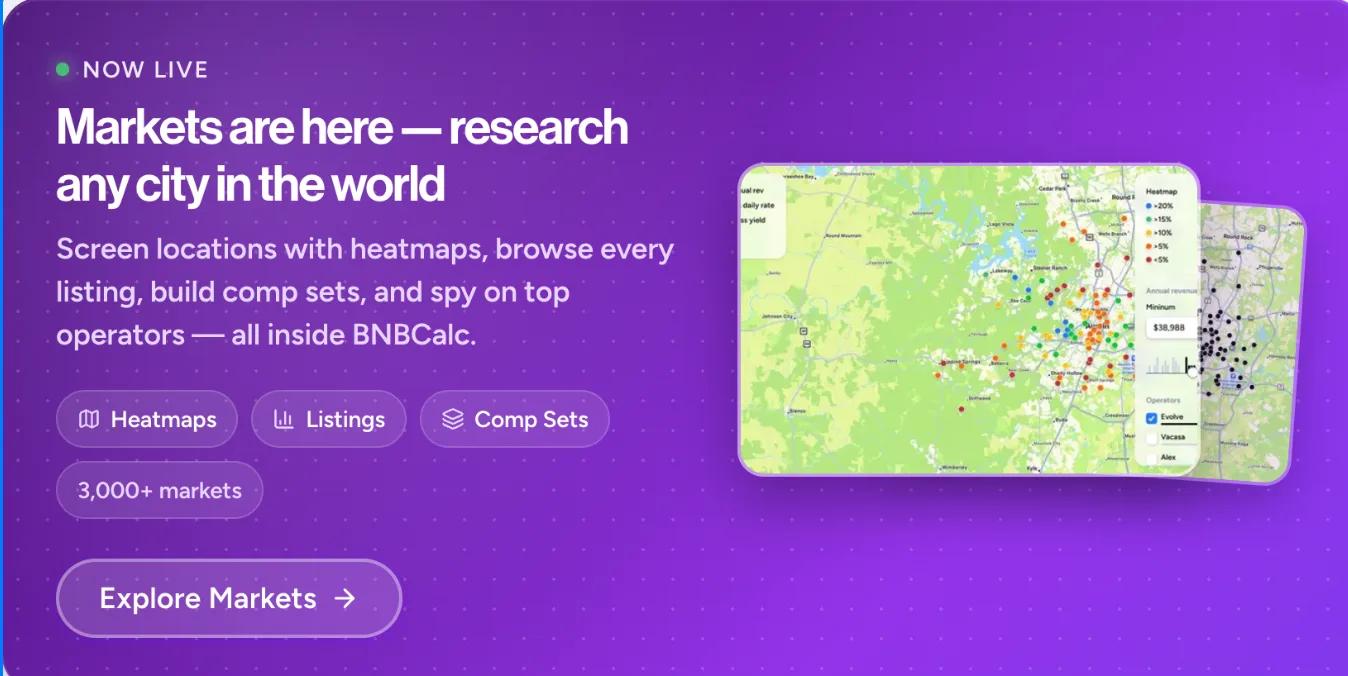
Blake's first deal was a house he and Jeremy bought together in May 2021, and the two of them renovated it themselves. Neither knew how to paint. They painted the countertops, rebuilt part of the dock, and cut down trees at two in the morning. From there he went into co-hosting, then hard into rental arbitrage, and then into 30-day medium-term rentals in cities that restrict nightly stays. Before you copy any of it, check what a market actually supports in BNBCalc Markets.
Key Points
- Blake's first job out of college paid $45,000. He'd already run a vending machine business and a computer science tutoring program looking for extra income, and he found short term rentals by watching what Jeremy was posting on social media, then reaching out to ask how he could get involved.
- That first deal, in May 2021, was a house he and Jeremy bought with other investors and then renovated themselves. There were holes in every wall and neither of them knew how to paint. They painted the countertops and the bathroom vanities, partially rebuilt the deck and the dock, and cut down trees at two in the morning. Jeremy says the two of them were on site for about three weeks.
- In Asheville, the strict rules are the reason the deal works. The city won't let you rent a whole house short term, and private bedrooms are capped at two with someone on the permit living there full time. Blake slept in the living room while they walled off the second bedroom, put the basement on a 30-day minimum, and later gave their gym manager discounted rent so the live-in requirement stayed satisfied. Because so few operators bother with all that, he says a private bedroom there can match what a New York City studio rents for, and the property does close to $100K in revenue.
- One arbitrage unit, a two bedroom that's really a bedroom plus a loft, rents at about $5,100. Blake put $10,000 to $13,000 into furnishing it, maybe less, and says it pulls in monthly revenue around the $12,000 mark. Renovations stay minimal on a leased place, so the spend is mostly furniture.
- Medium-term guests pay upfront, so the cash can land about two months before the stay. That cuts both ways. Rent starts the day the lease does, and Jeremy walks through the two weeks or so it takes to get a unit furnished and live, so you're covering rent before anything comes in. Blake calls it a game of cashflow and says you can get caught out if you spend too hard on the next unit.
- The high risk deals sit at 5 to 10% of the portfolio, the way Blake says a financial advisor would frame it, while the rest is purchased units and arbitrage on solid leases. Those ones run in the cities with the toughest regulation, all on 30-day minimums, which are legal. He says a deal like that might pay back the furniture investment in seven days, and he's fine losing one occasionally, since the worst case on arbitrage once you've made your money back is getting kicked out.
- Where medium-term demand comes from depends on the city. In big markets with tough regulation, brokers hired by restaurants bringing in a visiting chef, or by companies sending employees in for a project, will pay a premium and come find you. In cheaper markets it's Furnished Finder, Airbnb and VRBO, and Blake says the photos matter more than the reviews on those.
Full Transcript
Listen to the full episode on Apple Podcasts, Spotify, or YouTube.
Jeremy: We are live with the Short-Term Rental Pro podcast. Super excited today to be here with my good friend, business partner, Blake Holden.
Blake, for those who don't know you, tell us about yourself and kind of walk us through where you were when you started your short-term rental journey, and give us the high level of what you've been able to do in the last few years.
Blake: Yeah, so my short-term rental journey started about three years ago. By that time, I was just working my first job out of college and was making like $45,000, not that much, and was looking for different side hustles.
I started doing a couple of different things. I had a vending machine business. I had a computer science tutoring program, a bunch of different things, but I was looking for an avenue of creating some additional income. That's how I stumbled across short-term rentals, which coincidentally was because of you.
Jeremy: Interesting. Okay, so you graduated. Let's just get this timeline going. You graduated college in 2019, which is also when I graduated college. Go Heels, throw that out there.
Blake: Go Heels.
Jeremy: So got that first job, that $45,000 a year. I guess, what was that realization? Like, this isn't enough, I got to do something else.
Blake: Yeah. I mean, I wasn't making that much. I had a lot of friends that were making a whole lot more money when I first graduated. I'm sure you saw that as well. I was like, I have to make some additional income, because with the current pace of how my job is going, I'm just not going to be in a position where I want to be in the future.
So I graduated. I first started doing Airbnb because of you. I was seeing what you were doing via social media. I reached out, and you were the inspiration actually behind me getting started in this business.
Since then, I've really grown, and I think I'm up to like 16 or 17 different listings in New York and North Carolina. And now my main job has progressed, but I'm almost outpacing it. I think I probably am outpacing it with the income I get from short-term rentals versus my W-2.
Jeremy: And your W-2, just for context, it has gone up significantly. When you're saying you're about to hit it, it's not like you're past that 45 already. So you're shooting well up beyond maybe what you even thought was feasible a couple of years ago.
Blake: Yeah, 100%. I mean, my goal, I guess like two years ago, was just to get 10K of income from my short-term rentals. And thankfully, I was able to surpass that. And now it's just kind of taken on a life of its own.
I love having the W-2, and it's great for banks and stuff like that, showing that credit history. But at the same time, I've just got tons of cash flow coming in from the properties. And also, I love to actually be a part of these projects. So for me, it's a lot of fun.
I also love the community. I think we've got some really interesting people involved. And because of that, it's just really been a joy these past couple of years.
Jeremy: Yeah, definitely. It's been a joy seeing your progression. And Blake's done, if I think I've done a lot of strategies, Blake has probably done pretty much everything I've done at this point. And he's even done an additional, we're going to call this the mystery strategy. We'll get into that later, but you guys are going to have to stay tuned, because Blake found a very unique new strategy that I'll admit he has some cojones, some conviction to go after this strategy, but it's been doing very well for him.
So reason to stay tuned to the end, because we're going to go through his full progression and kind of get into how he's scaling, and a large part of how he's scaling today with not needing to do that much initial investment, pretty high cash-on-cash and quick return on investment.
Let's go back a couple of years ago. So Blake, we were friends from college, but as college goes, you're not necessarily talking all the time or texting, and then you graduate and go do your thing. I think this was the beginning of COVID. I was mostly doing boats. I think I was managing a couple Airbnbs, but I was just kind of like at the lake, just shooting sh*t, like posting random stuff about some houses.
Blake: The country lake, the country lake. I remember that specifically. I was like, I'm familiar with where he was operating, where you were operating, Jeremy. And I was like, I've never even heard of this lake. And somehow I'm seeing that you're building this crazy little empire on this lake. But yeah, that was a crazy thing to view from the outside.
Jeremy: And then you hit me up. We talked, and I think what was really special, because I'm fortunate where I get hit up a lot from different people, especially over the years. But Blake hit me up and he was like, what can I do? What can I do? How can I get involved? I see what you're doing. I think it's cool. I think it's awesome. And I think we can take it to another level. And I'd love to just learn and participate in any way possible.
And at that time, I didn't have really much figured out. I was on to something. I was like, d*mn, these houses are doing really well, but this is new for me too. So that first deal we did together, which was May of 2021. And at that time, you weren't making a lot. You didn't maybe have that much economic resources to invest, but you had time. You didn't have necessarily the knowledge.
And it's crazy, because Blake is so freaking good at setting up houses now. Honestly, he may have even surpassed me at capabilities of setting up houses. You are very good at that. But that being said, you were just like, hey, I want to see this, I want to help. And you invested a little bit, put a little bit of skin in the game for that first property. But then he showed up and he put in as much effort as me into actually transforming that first property into, I mean, at this point, it's pretty much been a cashflow machine for the most part. Obviously, there's always some ups and downs with different houses.
So talk about that, I guess, your attitude and approach, and I'm going to reach out to someone and I want to be involved in what they're doing. So people listening, if they see someone online and they want to do that, how do you do it?
Blake: Yeah. I mean, I always had this idea that partnerships are the best way to progress. And I still very much have that idea, that with partnerships you're able to leverage other people's knowledge, networks, resources, things like that.
So when I reached out to you, I'd reached out to other people for other reasons, trying to learn more about their businesses. So when I reached out to you, and I definitely knew you a lot better than some of the other people I was reaching out to, the math just made sense for the investments that you were making, and the returns were a huge part of that.
So reached out, we got that first house together, which I'm sure if people go back from your story, they're able to see some pictures and videos and stuff of that time.
Jeremy: Yeah. Let's throw some up on the screen or something. I don't know. I think there's even an episode you made like...
Blake: Oh, the YouTube.
Jeremy: Yeah, yeah. YouTube series.
Blake: That time I didn't know how to do video production at all.
Jeremy: Yeah, yeah. Still learning. That's an OG video, if anyone goes and sees that, where that was like your first introduction to filmmaking.
And we were literally out there, just set the scene. It was Blake and I, there were a couple other investors on the project who would come in and out for like two or three days maybe at a time. But it was Blake and I for like three weeks at a house in like middle of nowhere, North Carolina. We both probably put like every cent we had really into the deal. So we were eating like frozen gas station meals.
Blake: Popeyes, a lot of Popeyes.
Jeremy: [inaudible] fast food, and [inaudible] or whatever is out there.
And we needed, so I think we bought the house May 19th, 2021. We raised some money, we had other investors on the deal. And then it was like, hey, we need to get this house up and running as quick as possible. Which I remember at the time I was like, I think we can do this in one week. And we didn't even know how to fix a wall, like how to put spackle on and fix a hole in a wall.
Blake: Yeah. We came in with no knowledge.
Jeremy: No knowledge. We've used a screwdriver before. We didn't know how to paint.
Blake: Yeah. We had no idea how to paint.
Jeremy: We had no skills or knowledge. And actually, our friend's girlfriend was...
Blake: She took control.
Jeremy: She took control. And she was telling us how to do these basic things. But we quickly fixed and learned how to do these repairs. But at the very onset, we had no experience.
Blake: It was a bit of an older house, like maybe from the 1980s, that really needed some work. So it was like things...
Jeremy: You did a lot of work in hindsight, like...
Blake: Yeah.
Jeremy: List off all the projects that we did.
Blake: I mean, the first thing we did, there were holes in every wall. So spackle, paint, we painted all. There was like old blue colored countertops, as well as bathroom vanities.
Jeremy: Yeah. We painted the countertops. That's crazy. We painted the bathroom vanities.
Blake: And we wanted to do everything ourselves, because we didn't want to have to pay contractors at that time.
It was even like, we chopped down so many trees, like nuts. I don't know. We weren't supporting. We did that like two in the morning, don't tell anybody. In the morning we were cutting down some trees, and Jeremy looks at me and is like, oh crap. And last thing, there's a possum right next to my head with like things and crazy [inaudible].
Jeremy: Could have taken Blake out right there.
Blake: Yeah. That could have been the end of it.
But also deck boards, the dock had to be partially rebuilt. The deck had to be partially rebuilt. We demoed, there was like closets and dividers, we just demoed on the inside and put in new shelves and stuff. Like 90 feet of a pathway.
Jeremy: Still got to work on that path.
Blake: Yeah. Plumbing to add additional washer and dryer in the garage.
Jeremy: We didn't do the plumbing. We just...
Blake: Yeah. We didn't do the plumbing. And then there was like 10,000 other things.
Jeremy: Yeah. A bunch of little things.
I remember like the day we closed, and everyone's kind of looking at me. And to that point...
Blake: We thought you knew so much more, because at that time you did, you just had all the knowledge. But you didn't have that much.
Jeremy: I knew, so I had done relatively turnkey properties, more like co-hosting. So it's like someone else sets it up, and I don't have to really do anything other than the marketing and management aspect. But the houses I had done, the furniture came with the house. Like maybe added a fire pit, but overpaid someone to do the fire pit, because I didn't know you could just pour some gravel and put a couple Adirondacks and it would practically do the same job.
So I did have some experience, but a full house renovation, I remember they were all like, all right, Jeremy, what's the plan? And I'm like, look, I'm going to try to build this walkway in the back. That's the project I need to figure out how to do. Just go around the house, pick some project, figure out how to do it. And which I didn't really tell them at the time, I was like, we'll figure it out, guys. Come on. We're smart enough. I'm sure we'll figure it out. Other people have renovated houses before. I think we can figure out how to do it.
But Blake was so eager to learn, you know? And I would say from there, he probably knows the ins and outs of how to renovate houses better than anyone else who was there, or very, very proficient at this point. So your eagerness to learn how to do it, and literally from the smallest of little tidy tasks to complicated engineering of how to plumb gas into the house to do a second washer dryer, how to configure, how to look at the panel to figure out how much electrical is on there so you can do a hot comb, kind of more engineering tasks you're now to do.
But all right. So that first house, I guess, so it was a good experience to learn.
Blake: That was a great experience. I loved it. It was really funny. Even on the weekends, me and you would just go to the local bar and get some Coronas, that closed at like 9pm. But that was like our life for a while. And that was the introduction. It was a fantastic experience.
And I think just being eager, keeping a positive attitude, and then just looking to build with other people was like primary motivation, [inaudible] reason why it worked out so well.
Jeremy: Yeah. And in hindsight, so one of those investors in that property, you have now done a bunch of deals with.
Blake: Yeah.
Jeremy: And then also one of our friends who just came by the house to hang out is now one of your investors.
Blake: Yeah.
Jeremy: Your newest property.
Blake: Yeah.
Jeremy: So just that first house, what happened since then?
Blake: Yeah. So right after I did that first house, I think I went and bought, I did basically like two more group deals.
Jeremy: And these were buying initially.
Blake: Yeah. They were buying initially. And then a few months later, I did a renovation of a house, and then started co-hosting. And then from there, I just really went heavy into rental arbitrage. But that's kind of been the build up. And ever since then, it's been pretty fast paced, I would say.
Jeremy: Got it. So at this point, you are part, or you're an owner of one, two, three, four. Now your fifth property.
Blake: Yep.
Jeremy: Is under contract. And I think one of the deals I want to highlight that Blake did, and Blake has taken a very unique approach and kind of used regulations to his advantage. And one of those places he's done that is in Asheville, North Carolina.
Blake: Yeah.
Jeremy: So that's the funniest property. Tell them about that property.
Blake: Yeah. So in Asheville, North Carolina, there's some strict regulations. It's a red state, but a very blue city, about as blue as it can get. It's the most blue there is. It's drum circles like every other street corner, and it's Asheville, North Carolina. I'm sure many people have heard of it. It's in the Smokies near a ton of national parks. But yeah, went and bought a multifamily unit.
Jeremy: And when you say multifamily, you literally mean a house that just, the basement happens to not have a stairwell into the house.
Blake: Exactly. Exactly. So it's viewed as a duplex. And for that reason, you may have to get a special loan or things like that.
But the thing that's interesting about Asheville is they have extremely strict regulations. And that's where that blue city comes into play. And I typically try to stay out of those, but recently I've been running into it. But they have strict regulation in the sense that you can't rent out your house as a short-term rental. You can do private bedrooms, but you have a limit of two. And if you do rent private bedrooms, one of the people on the permit has to live there full time.
So that's very nuanced, and it stops a lot of people from entering the market. Because other people don't enter the market, that private bedroom rents the same as a cabin would, like a regular house would. So your average daily rate is really high. Your revenue is high. And even for the private bedrooms, they can match up to what a studio apartment in New York City would in terms of price, like $2,000, $2,500 per month.
And so what we did there is we went to the house. We did some renovations, things like that. We rented the base...
Jeremy: You live there. You live there.
Blake: I live there. I live there. And I'll tell you about the grid that it took to live there.
But we got the basement rented out, and it's like a 30 day minimal medium-term rental. And that satisfied all the requirements because it was 30 day plus. And then we went there, we renovated the first bedroom and then the second bedroom, and we were living there. And as soon as we finished one of the bedrooms, we started renting as a short-term rental. And I was living in the living room because it wasn't a bedroom yet. So it was me and another business partner. And eventually we added a wall, and that was the bedroom we used as our second permitted short-term rental.
After that, we needed to find a solution with somebody staying there full time, because me and my business partner, we didn't want to live in Asheville like the rest of our lives. So we actually approached our gym manager if he would be interested in this living situation, we'll give you discounted rent and he'll satisfy the requirements of the city for being a short-term rental. And he said, yeah. And his name is Dustin. He's...
Jeremy: Shout out to Dustin.
Blake: Shout out to Dustin. Dustin's listening today. He's holding down the port. Yeah, he never wants to move ever.
The property does like close to 100K in revenue. So it's a pretty solid property. We got a low interest rate. It's went up a lot in value.
Jeremy: Yeah. It's gone up a ton in value. Because he locked against it.
Blake: Yeah. Well, he locked against it. So we took money out on a line of credit against the house, and we were able to use that for doing...
Jeremy: The arbitrage properties.
Blake: Yeah. Doing arbitrage, what have you. I don't even know how it went out, but...
Jeremy: Check the books on that one.
Blake: Yeah. I'll check the books on where it went to, but...
Jeremy: From a crypto loan to...
Blake: Oh, yeah.
Jeremy: Just for context, that first investment Blake did in the house was kind of a deal that I led. It was a crypto loan, right? That's how you financed it?
Blake: I told you I was doing all sorts of businesses. So I was trying to find ways to earn better money. And I saw that you could bet on the presidential election by state. So I was like, oh, okay, that's a pretty much guaranteed return on Alabama voting Republican and Massachusetts voting Democrat. So I was doing that, I was setting it all up. I put all my money into crypto to bet on these betting sites. And it just happened that way.
Jeremy: So you weren't doing businesses, you were gambling?
Blake: Yeah. Yeah.
Jeremy: Literally, you were in a desperate place for making money.
Blake: I was in a desperate place, and I put it in at the right time and the Bitcoin just shot up. And so I took that money and I put it into the first house that we did.
Jeremy: I'm glad. I'm glad you took it out of Bitcoin. Probably wouldn't have been too good if you...
Blake: I sold at the high, dude. I sold at the high. So I wasn't making that much. So I had to find a fund somehow. It was risky. I don't recommend it, especially with NFTs and stuff like that. I'm totally out of cryptocurrency, but it was a good place at the right time.
Jeremy: Got it. So you got that Asheville property. You led a deal outside of Asheville for a cabin, and you also then helped. And Blake, again, just wanted to take action, wanted to do stuff, wanted to learn.
I bought a house near when Blake bought the one in the mountains. I invested some in that one and then got another cabin. And then Blake already had the infrastructure there. He set it up. He led the setup, obviously got compensated for that, and then has been helping to manage it for the last year and a half.
So you got your Smokies portfolio. And then tell us about, I guess, where'd you go after the Smokies initially?
Blake: I went to Central North Carolina.
Jeremy: Then you went to the Triangle region.
Blake: Triangle, then the Triad. Yeah, pretty much everywhere in North Carolina except for the beach.
Jeremy: The beach. Okay. So when you were in the Triangle and Triad, that's where you really started your arbitrage.
Blake: Yeah, that's right. It really started. I did a couple of apartments, and it was interesting there. We could line up the different resources and stuff just because all the apartments were the same. It was the first experience doing three different units at the same time. Yeah, the same week, three different, being able to put on the address, different apartments, make sure that it goes to everyone.
Ran into some problems with that. Didn't set it up right on the listings, and sent some people, sent some guests even to the wrong apartments, because I forgot to put the apartment numbers. There's only like four apartments. But yeah, I mean, there was a learning curve for that.
Jeremy: Okay, so you did the apartments. And did that help you then lead to, I guess, what's your newest business line?
Blake: So I did some more deals after that, but now my new business line is really going up against cities that have very strict short-term rental regulations, finding ways to work within those regulations, and then charging a premium.
Jeremy: Yeah, I don't know how much we can get into this.
Blake: I can't get into all of them. We may or may not currently be in the city with the strictest regulations. And I will admit this, I'm not going to paint a target on my back. We may or may not be doing rentals and being creative to do rentals. And because it's so strict, I do not do that. So we're thinking purely...
Jeremy: Theoretically.
Blake: Theoretical right now.
Jeremy: If you happen to operate in a city where the cops will literally show up at your door.
Blake: Yeah, and they delist all of the units. Yeah, I'd never spill the beans on that. But there's opportunity. There's tons of opportunity there.
And remember, I have a portfolio where there's a bunch of stable units that they're purchased units. So the rental arbitrage, you have good lease agreements. So these are my moonshot deals. They are high risk, high reward. You might pay back your furniture investment in seven days.
Jeremy: Yeah. Like crazy stuff like that.
Blake: Yeah, and as a financial advisor would tell you, you can put like five to 10% of your portfolio towards those moonshot deals. And that's what I've kind of done. And they've grown super quickly. Tons of cash flow. But there's that risk.
Jeremy: Yeah. Well, as long as you make back your initial cash investment, with arbitrage in particular. If you're buying, there's other variables at play, obviously. But really for arbitrage, it's making your money back. Once you've made your money back, what's the worst that can happen? Like you get kicked out.
Blake: Yeah, yeah.
Jeremy: And you've made your money back. There's no harm done. Is that the way you see it?
Blake: Yeah, that's exactly the way I see it. So I'm okay if I lose one. That's just like the cost of doing business. And you should be okay with that. If you go into kind of a higher risk short-term rental area, you should be okay with a potential, your empire crumbling a little bit.
Jeremy: And just to be very clear, this is all through 30-day medium-term rentals.
Blake: Yes.
Jeremy: Right. Just to be completely clear there. I love the medium-term rental game. I think that there's a lot of...
Blake: Which are completely legal.
Jeremy: Completely legal.
Blake: Yeah. I mean, you're not subject to having the guests really need a lot. Because once they get into a unit and they're there for a month, they really don't reach out to you. Also, if you're listing on Furnished Finder, if you're listing on Facebook, if you're listing on these other sites, the reviews aren't so critical. More of the pictures are more important.
Jeremy: Yeah. The pictures are massive. Location, location, location.
Blake: And the design of the property is pretty key. And if you can hit those criteria and it's a good market, there's people looking for that 30-day minimum, then you can do a really solid job.
Jeremy: So let's just kind of give a hypothetical, or maybe if you want to share the numbers of one of your recent rental units. How much did it cost? Was it a studio? Was it a one-bedroom? How much did it cost to furnish? And then have you been getting bookings? And if so, how much were they for?
Blake: Yep. And once you start doing a bunch of properties, you kind of lose track of the exact dollar amount of how much it costs to do the furnishing, because you kind of realize you're going to get back that return.
But the most recent two-bedroom, really a bedroom and a loft apartment that I did, the rent was, I think it's $5,100. I probably spent $10,000 to $13,000 on furnishing, maybe even less. And furnishing and any renovations I wanted to do, which are pretty minimal for rental arbitrage. And then it pulls in monthly revenue is, I think, around the $12,000 mark.
Jeremy: Wow.
Blake: Yeah.
Jeremy: So that is, let's just say $5,000 cashflow per month. And these are monthly rentals. So a lot of times you get paid upfront for them, right?
Blake: Yeah. Yeah, you get paid upfront. So it's great to have that cash on hand, like two months before you actually have the reservation.
Jeremy: So then it might, let's say your lease starts right now. It's September 20th. Let's say your lease started August 15th. You would get that up and running probably, what, about two weeks?
Blake: Yeah. September 1st.
Jeremy: And then oftentimes they're getting bookings for what, four months, where they're paying that 10K a month. So they prompt you that 40K, which essentially means you're getting your initial cash investment back in three weeks. Is that like...
Blake: Yeah, yeah. So actually the most recent one, the day we had it ready, it was already rented. But yeah, you get the cash upfront, and it really is a game of cashflow, and you can get caught with your pants down. As soon as the tide goes out, we all see who's not wearing anything underneath, sort of deal.
Yeah. And so you have to make sure that your cashflow is in the right position to pay rent, but also that you're not spending too much on getting new units. And with rental arbitrage, you get that money up front. So you do have that ability to invest it elsewhere while you're waiting for that time to come up. But you have to be careful. It's a dangerous game for playing with your cashflow.
Jeremy: And just to be very clear, with rental arbitrage, you don't necessarily get that money upfront, because let's say if you're doing short-term rentals, over the next four months you have 30 different rentals from Airbnb. That means you're getting paid out after each booking. So you're not getting instantaneously played doing medium-term rentals.
And I actually want to kind of position this conversation more towards medium-term rentals in a second. Because you're doing these longer duration leases, and you're making them essentially prepay it as you're allowed to do, or like most of it's probably paid early. Because you're doing that, your return on investment is so much quicker, because you don't have to wait for 30 rentals. You just do one. And as soon as they come in, you've already made it back, and you have that money to then redeploy elsewhere.
So is that kind of like one of the cool aspects of medium-term rentals that you've discovered?
Blake: Yeah, I mean, that's certainly one of the cooler aspects. I think it's just like a facet of it. I do like that I don't have to rely as much on my virtual assistants to actually do the messaging and so forth, because guests don't really message you.
Jeremy: Yeah, there's like no property manager involved compared to short-term rentals where I'm getting [inaudible] a day, you know?
Blake: Instead with medium-term rentals, they check in once, you snooze and forget. And so the property management aspect is like really increased. And since I've been growing my business so quickly, it's a huge headache if you have so many units and you're communicating with so many guests.
So finding an avenue where there's less property management, but basically the same or better returns, I mean, that's a Goldilocks sort of space, you know? That's where you can kind of live your own life. And that's why I'm able to maintain my W-2 job. My units don't take too much time to operate. And the ones that do, I have virtual assistants.
Jeremy: Got it. So let's get into that. So everybody probably hears all the time, oh, short-term rental regulations, short-term rental regulations. Again, Blake started an arbitrage business in the city with the strictest short-term rental regulations humanly possible.
Jeremy: He then pivoted to medium-term rentals, found that his returns were maybe not as good, but not that far off as good as it could be. He found that from a management standpoint, operational standpoint, it was a lot easier, a lot less of a headache. It allows him to do other things with his time, such as be an effective W-2 employee.
So I guess for those thinking, what's the worst that can happen, especially again, in these highly regulated cities, 30-day minimum is the worst that can happen. And in a lot of markets, I guess, have you looked at other kind of short-term, medium-term rental markets, and what are indicators that it's going to be a good place for your model?
Blake: Yeah, I mean, so I actually have looked at a lot of them. San Diego being one of them, Miami, of course. The most recent one I was looking at was Honolulu, Hawaii, just because it's a beautiful place and wouldn't mind having a place there.
But when looking at these other markets, you really have to see, how strict are the regulations? What are the 30-day properties? How are the medium-term rentals currently doing? What do you see that they're charging on Furnished Finder or Airbnb? And then you just go and look and see, are there apartments or houses available for sale that are, if you project it out, are they like half, if the rent is like half as much as what your revenue is, does it make sense for you to do that deal? So that's kind of how I look at it currently.
I'm in like one major, major city, but I am looking to kind of expand that this next year, maybe even go internationally. I used to live in Spain. So one of the people I'm connected to, they have units across Europe. And so I'm thinking to make the move there and San Diego.
Jeremy: Wow, world, you're going from Hawaii to Europe.
Blake: Yeah.
Jeremy: We're talking about managing in different time zones.
Blake: Yeah, yeah. So that would be like the toughest thing. As I think you say this a lot, it's best to just do it on one time. Time's up.
Jeremy: Blake of recent, maybe hasn't been meeting. Because when he told me that he was going into a place where there was going to soon likely be high regulations, I was like, dude, I don't know, man. Like, I don't know, man. But he's done it. So all I can say is kudos, kudos for that.
Blake: And yeah, the house is still standing right now.
Jeremy: If it isn't a couple of months.
Blake: Yeah.
Jeremy: And if you want to go to Hawaii and then also go to Europe, and I know VAs can be awake at all these different times.
Blake: Yeah. But yeah, well, I would love to. I'm curious to see.
Jeremy: But yeah, so what I want to get into, so while he's been doing this, and I want to touch on people getting investors. Again, early on in that first project, we had a friend of ours literally just come by, check in. At the time he was a mortgage broker. So he was interested in also potentially doing business with us. And we just hung out, we had a really fun time.
Blake: Yeah, that was a great night, great day, great night.
Jeremy: But flash forward a couple of years later and he is now fulfilling his dream of being a...
Blake: Yeah, a month ago, like two deep into it.
Jeremy: Yeah, he's crushing it, he's crushing it. He's doing a great job.
Blake: He's doing a great job and...
Jeremy: I don't want to just bleep out who it is.
Blake: Yeah, he's doing a good job, sure.
Jeremy: But the point is, is like you were hanging out, you were showing him what you were doing early. And now he's seen it firsthand.
Blake: Yeah.
Jeremy: And he had confidence to work with you and invest with you. So my point here is showing people the work ethic and that you're doing something, and if they see you, maybe nothing comes from it today. But five years from now, relationships can evolve with us.
I guess how important is it for you to network, to work with others, and what's your outlook on that?
Blake: Yeah, I mean, even like the first group deal that I led, I made sure to get into that deal people that had a lot of upside, meaning they can invest in this deal, but if I prove myself in this deal, they had a lot more appetite for doing more. So that was really crucial.
And we got like one investor that is definitely in a position to just invest in some more moonshot deals, is what I would call like investing into Airbnb for some. And so we got him involved. And now we also have an ability to get him invested in so many other deals. And he's already offered to do a ton with us. We just haven't taken him up on it that much.
But it's really important, back to your question, it's really important to get investors, have a pipeline for people that you can call on your Rolodex and invest in potential deals, because you don't know when certain deals are going to pop up. And when they do pop up, you need to be ready to act.
And yeah, like that one friend that we were talking about that came and saw us at the lake a couple of years ago, he just came out of the blue and said, hey, can we do a deal together? And I was in a position where I was ready. I had some dry gunpowder ready to deploy and moved quickly. I think within two weeks, we had a house number contract.
Jeremy: And I was like, wow, this was, it's an [inaudible], and it's also pretty, I don't want to use the word speculative because I don't think that's the right word.
Blake: No, I wouldn't call it speculative actually, because we have a property nearby that's very similar. And so we have some of the best numbers for a property like that. Maybe if you look at the property or the region as a whole, maybe you could say speculative, but when you have comps nearby, that's going to serve as your best ability to determine if it's a good deal. Especially, I think in that city, we've got two arbitrage properties there. And then I've got a ton of friends with arbitrage units in the area.
Jeremy: Scott, well, let me backtrack and just say, you have, I guess, several times, like when you told me about the Asheville one and you guys showed me the PowerPoint presentation of what's considered a...
Blake: Oh yeah, the regulation.
Jeremy: Yeah, the regulation.
Blake: The regulation tried to...
Jeremy: And it was so complicated. And I was like, all right, y'all got some, this is an interesting approach here. I don't know how this is going to play out. I think you guys asked me to underwrite it and I gave my best attempt.
Blake: Yeah, we were like, what do you think of this?
Jeremy: And I did a little spreadsheet. I added up the separate units and I don't think I was that far off, like how you guys were. But I was like, this is, and then I guess these new apartments, I'm like, again, these are the things where I can't even really put an exact calculus or point on it, but they've worked.
Blake: You start off with one and that's the big thing. You start off with one in an area. You start off with one, like in the big city where we have a lot of regulation, we start off with one and we did it for a year. It paid itself off and then we were able to scale it from there.
But yeah, you should use caution. Don't buy off too much that you can't handle, especially if you're low on funds, like low on cash.
Jeremy: Got it. Okay, so I want to get back into, again, I'm seeing more and more online about medium-term rentals. And I feel like, to be honest, and correct me if I'm wrong, people are making it look more complicated than it really is. They're like, oh, you have to connect with all these people and build out some crazy network. But really it just happens.
I mean, correct me if I'm wrong, but it seems on this, and we have properties that we've rented out for months at a time. Maybe they're also short-term rentals, but we've had the whole travel nursing. We've had the whole traveling business professional. But really it's like over time, they find you. If you build a property, you furnish it the right way, you offer it for a month or two at a time. Yes, you can put it on Furnished Finder. You can put it on Airbnb with 30 minimums. But there are people whose entire job it is, is to place people, travel, like travel agents four months at a time.
Blake: Oh yeah.
Jeremy: Especially like, let's say you represent a company. It's your job to place the employees for temporary projects. Like they find you, they're looking too. So it's not like you have to really find them.
Blake: Yeah, I mean, it just depends on the market. Some big cities with tough regulation, there's an extreme demand because the city has basically not allowed transient people to get apartments. Maybe they can rent a hotel, but people don't want to stay in a hotel for like 30 days. That's just brutal.
So in those cities with low supply of apartments to rent for like 30 days or more on that short timeframe, yeah, brokers do come into play. Brokers are hired sometimes by restaurants that are having a visiting chef, companies that are having employees visit that city to maybe build, do some construction, or have meetings or set up a new office, X, Y, Z, and they'll pay a premium. And so they work through those brokers. I mean, yeah, they'll reach out to you.
And other times, other cities that don't have really that demand that drive a very high revenue, a lot of times it's like Furnished Finder and they'll reach out to you from there, more of like the budget friendly cities.
Jeremy: Got it. So I guess, would you recommend to folk trying to reach out and find, let's say, people who staff travel nurses.
Blake: Yeah.
Jeremy: And stuff like that. I guess is building the network more important for medium-term rentals relative to short-term rentals?
Blake: I would say it's only really in those big cities that it's really worthwhile to find those brokers. I think in the smaller cities, no, it's probably not worth it. Just stick to Furnished Finder and Airbnb, VRBO. But the big cities, yeah, they'll find you, and just make those connections and say, hey, when you have your next client, remember me. Pay me up, I'll give you a little bit of a kickback.
Jeremy: Yeah.
Blake: Yeah. Kickback, of course.
Jeremy: Which is totally fine. This isn't corruption. It's business. They're a broker.
Blake: No, no, it's not. It's like their job. They're getting paid actually from the client too. The client pays them a finder's fee, like sort of deal. And then yeah, you can work it into your deal as well that you give them a portion. So everyone's winning and they want to scale with you.
I mean, we're getting approached a lot now, for brokers, for us to get a unit for them specifically, so they can only rent to their clients. And then we would structure a deal so they get a commission off every time it's rented per month, or if it's a certain dollar amount. So yeah, I'm probably playing in very different medium-term rental spaces. And because of that, there's different strategies for them.
Jeremy: Got it. Okay. So you have built these relationships, but I want to kind of talk about just relationships as a whole, as well as working with others and masterminding. Blake hit me up initially. I had experience, but I've definitely learned things from him. He's tried different strategies. He's got properties in different areas before I've gone properties. I've gone properties in areas before he's gone properties, where I've shared my data. I've shared my...
Blake: Yeah. It's very collaborative.
Jeremy: Yeah. What is the benefit of just having a community of others?
Blake: Yeah. Well, the cool thing is, which people probably realize, but you just know so many people in the short-term rental space. So whenever I have some idea or I'm hearing rumblings of some certain strategy, I can just go to you and you're like, oh yeah, I know somebody that has like 50 units doing it that way. And so for me, relationships are huge, because I just hear about these new things way, way ahead of other people that normally, if you just have your friend group, they wouldn't know about.
So yeah, I think it's really important to have relationships, especially in short-term rentals, so you can get better as a host, so you're driving the highest revenue, and so that you can kind of go up with others, because you will grow together. And that's also really cool to see. It's great to see you have an Airbnb Luxe property, for example. That's pretty awesome.
Jeremy: You can get, I have a Luxe connect now. If you want to do a Luxe property, I'll connect you with her. That took me a while to be able to get connected with her, but I'm happy to keep that door open.
Blake: Should that be one of the new strategies that we go.
Jeremy: It'll come, it'll come, probably. One thing, let's talk about studio apartments that cost a few thousand to furnish, and then six bedroom houses to 20 bedroom Luxes.
Blake: Studio apartments cost nothing to furnish. When you compare it to some of the houses we do, like six bedrooms, it's like six X, plus the outdoor areas, plus the basketball court, plus the fire pit, hot tub, heated pool.
Jeremy: Yeah. We'll be jinxed.
Blake: But yeah, it's pretty crazy to see how there's all these different types of strategies, and how you apply it and how you learn about these strategies, how you leverage your relationships. And now we've been helping people get started in Airbnb, and it's crazy because we've been coaching people and now they're even finding new strategies. So we're always...
Jeremy: And they're data points for us.
Blake: Yeah. Yeah. Yeah. They're like, oh yeah, let me update your PriceLabs for you.
Jeremy: Yeah. And when we see it we're like, wow, these people are crushing it in this market, which I knew was good, but now I really don't. And we're helping them crush it too. But yeah, it's just more, and that's really like this gains data. And that's like any sort of business, seeing how different people in different properties are doing in different areas, helping them maximize earnings potential through. And Blake has done an insanely good job with building out a design infrastructure.
So yeah, talk us through, I guess, how you kind of design toolkits, and how you quickly just are within five, six days getting these properties up and running and getting them furnished.
Blake: Yeah.
Jeremy: I mean, getting them furnished extremely well where you can charge a premium on a monthly basis.
Blake: Yeah. Yeah. I mean, I would say like my design for my college apartment, if you saw my bedroom, no bed frame, just like the same white sheets, mattress on the ground.
Jeremy: Mattress on the ground. Of course.
Blake: I'm in there. And so then I go from like a year later, designing an Airbnb where I want people to stay, and they just looked awful. They were terrible. I wouldn't stay there even today. So don't look back at those old properties.
So we kind of organically grew it over time. We just saw other people designing these great Airbnbs and we're like, okay, we want to do that. And so we really kind of leveraged our personal relationships and going to people that kind of had that experience, sometimes in fashion, sometimes in other aspects, or just having great design skills. And yeah, so it happened organically. It started out, our Airbnbs looked like crap and we wanted to drive a higher nightly rate. So by...
Jeremy: And when we say our Airbnbs looked like crap, you'd probably look at them and be like, oh, they look solid. But to the point today where they're extremely good, they're like popping the game good.
Blake: Yeah. Like 95th percentile in the market.
Jeremy: Yeah. And you're not paying 95th percentile rent. You're not paying 95th percentile mortgages, but you're commanding 95th percentile average daily rates and pushing occupancy.
And I think doing a good job of setting up so many properties so quickly, you can't start from scratch each time. You need to rinse and repeat. You need to kind of build out design toolkits, like templates, I guess. And Blake's done a very good job of just getting that process very standardized. But if you look at the pictures, it doesn't look standardized. Everything also looks unique and has that personalized touch as well.
Blake: Yeah. I mean, a lake house in Illinois is going to look different from a Tampa. But it's that same foundational...
Jeremy: Yeah. Yeah. We have the same approach, and things like that. How are those designs looking? So Blake is helping one of those in our community, our mastermind, set up a lakefront property in rural Illinois that he got for...
Blake: Decatur, Illinois. Shout out to Matt Beck.
Jeremy: Yeah. Shout out to Matt Beck. He got the house for a very good price, steal, total steal. Real estate is not a, you know, if you have more access to brokers, you jump on a property. You're the first one to see it.
Blake: Yeah. Like you build a relationship with the seller, you see what they need, so what's important to them, and you match that. You can get a very good deal.
Jeremy: So I always, I mean, he's paying 185 for a property that might, it could do a wide range, but can do very well.
Blake: Yeah. Yeah. I mean, and there's other Airbnbs doing pretty well and their design is bad.
Jeremy: So what's the process of helping him? I haven't seen the design.
Blake: Yeah. So basically he reached out, he wanted some design help. Basically we get our in-house designer, and she takes about two weeks to develop the design. She goes off the pictures you get, the dimensions, she does the interior exterior. She creates first a mood board. The mood board is like a little taste. So she'll send that over and be like, all right, this is the mood board I'm going with. It kind of gives you some snapshots of what it could look like.
And then from there, she built out the whole property according to that mood board. And it takes a place that maybe wouldn't look that good with normal furniture, and just takes it to the absolute next level where you're really dramatically increasing percentage wise your revenue.
Jeremy: Got it. So yeah, we're excited to see that one, and maybe we'll have him on later. But yeah, we're also going to have, he's with us today, it won't get released this week, but next week, Dylan, who is, he's actually another, he was our friend initially, kind of similar situation to Blake where he reached out and wanted to get in.
Blake: Yeah. It's funny because he comes from the construction world where he [inaudible], like different banks, things like that. He has that engineering background, but he didn't have the real estate transaction background.
Jeremy: Well, he also didn't have firsthand experience of friends who were doing something outside of the normal nine to five and who were having success with it.
Blake: Yeah.
Jeremy: But he, well, I don't say then he met us, he already knew us, but then he gave it to us, say, hey, please help me. That's part of the game.
I think people, you see your friends online and maybe they're crushing it. I mean, I have different people who are doing different things and you're like, all right, I have a little bit of pride and confidence, I don't want to reach out and say, tap me in, or help me out, or show me, or let me help you so then you can help me. That does take courage. And not everybody has that courage. But it's something that I know I need to even get better at. There's people doing things that I want to learn about and I want to be a part of.
So I guess, what is your pro tip for anyone listening today?
Blake: Yeah, I would say, first of all, don't be afraid to reach out and leverage your connections, and ask for advice and get mentored. But also have the right people around you, have the right friends, because your network is your net worth. I think that's a really common phrase.
Jeremy: And at this point, how many of our friends do Airbnb?
Blake: A lot, a lot.
Jeremy: I feel a big burden, honestly, that everybody's starting to go to Airbnb, like everybody's got to get booked.
Blake: I mean, it's incredible. I think there's like eight or 10 of us and we're friends, we're friends first and we all do Airbnb. It's phenomenal. It's funny, we're all in different parts of the world operating our Airbnbs in different ways with different strategies, and with different returns, of course, but it's so cool to see everyone just level up.
Jeremy: It is cool. You do have to kind of put the disclaimer to people that they can't text you to ask like the most simple question ever.
Blake: Hit the discord.
Jeremy: Like, come on guys. I know you're a friend, but do not expect to ask me like, what client toilet paper should I get?
Blake: Yeah. I get so many questions like that. I'm like, oh man, just get a normal, I don't know. What are your issues? Why are you texting me? It's like a $2 difference.
Jeremy: Yeah. No, we kid. We kid. We love helping everybody out.
And yeah. So what can folk look forward to, or how can they follow your journey, and what should they be expecting from you, or what are you excited for moving forward?
Blake: Yeah. You can follow me on Instagram. I'm Nick Holden with the one as the L, the first L. And looking forward, I'm just going to be leveling up my arbitrage and continue buying, and also hitting up co-hosting. Those are my three strategies.
Jeremy: I think those are the three main strategies anyway. Picture him glamping.
Blake: Yeah.
Jeremy: Yeah. He's learned from my experience on that one.
Blake: Yeah. Yeah. So glamping as well. Like there's...
Jeremy: The logistical headaches.
Blake: Yeah. Toilets are crazy. All that stuff.
Jeremy: Yeah. I know way too much about these things, I think. And he knows these things from me. So he didn't have to face it himself.
Blake: No. And vice versa in different ways.
So what to expect from me? You can just follow me on Instagram and I'm just going to be building up my portfolio. If you have any questions, always happy to help others.
Jeremy: Awesome. Well, Blake, thanks so much for coming to hang out today.
Blake: Yeah.
Jeremy: And yeah, guys, Blake is just prime example of someone who was willing to, was excited for the journey, was willing to put in the work, wanting to learn and get better every day. Didn't see it as a get rich quick. I mean, you have probably at this point amplified your wealth by pretty high magnitude in a pretty short time.
Blake: I think I went, yeah. I mean, one thing to even notice, I went from like 60K in available credit, and your credit's really a lot based off your W-2 income. And I think I checked and it tripled and quadrupled or something like that. So you could pull out. I wasn't even realizing that it was happening. It was just like the banks now just keep upping your credit level.
Jeremy: Yeah, their W-2 income. And they just treat you different. They're like, take a quarter million dollars.
Blake: They treat you different. It's absolutely wild. And then you realize, oh, banking is just a relationship thing, you know?
Jeremy: Well, it's also, they can see that you're spending money.
Blake: Yeah.
Jeremy: So you're buying all this furniture and you're paying it back. That's really what credit is, is do you have history spending money and then paying it back? I mean, at this point, if you've done 20 properties in the last two years, you've probably spent several hundred thousand dollars on furniture.
Blake: 100%. Yeah, 1000%.
Jeremy: And you've paid it back.
Blake: I've paid it back.
Jeremy: Paid it back. So they're like, sure. Take a couple hundred thousand dollars more. Why don't you? Yeah. We trust you.
And he's been good at actually speaking about relationships with banks. Blake has even helped connect me with bankers that have given us good relationship based terms. So I think when we did our first deal, he called like 10 banks.
Blake: Every bank. No, no, no. It was like a hundred banks.
Jeremy: Oh, d*mn.
Blake: I called every bank in the state, in the state of North Carolina, and said, can you beat this loan option?
Jeremy: And speaking of, we were 23 year olds with very little track record.
Blake: Yeah.
Jeremy: But you don't tell them that part. You just say, oh yeah, we've got tons of experience, and we kind of did without really too much.
Blake: Just stretch the truth. Granted, we...
Jeremy: You did.
Blake: I did leverage your experience to benefit me.
Jeremy: Yeah. And that's the thing about masterminding. You can lend one of your colleagues credibility as long as you can back it up. Obviously you don't want to lie and say, oh, I'm the expert on Hawaii beach houses, beachfront properties. Nah. But you could say, I mean, if I wanted to do a medium term in a highly restricted place and was talking to a landlord about that, I would say, oh, we have successfully done this same model in this city.
Blake: Yeah.
Jeremy: And if he wants to look into it, I'll send him the example, Blake will hop on a phone call.
Blake: Yeah. Vice versa. I'll hop on a phone call with somebody just to lend our credibility. So that's something that's super important too, is just having business partners where you can lend each other's credibility to new situations.
So yes. Okay. So yeah, I want to shout out to Ryan Shapiro, because I was on a presentation yesterday for getting 19 units in Montreal, Quebec. Obviously I'm not the main person running that, but that's the type of thing where he leveraged my credibility on the phone call. Yeah. It was an in-person meeting even.
Jeremy: And you were on the in-person meeting.
Blake: Yeah. I mean, I was just there, silent, but I just provided my support and said, I'm going to be the person giving him guidance.
Jeremy: Exactly. Exactly. Hopefully it went well, Ryan.
Blake: Yeah. We'll see. I think it did.
Jeremy: So we'll keep you guys posted. We'll have Blake back, because obviously you have a lot to learn from his experiences. I guess anything else you want to share with folk before?
Blake: No. I mean, thank you for having me on. This is great. I love your new apartment. It's beautiful. I can't believe I haven't been over here before, and can't wait for the next time I'm on here. Yeah. Thank you for being a great host.
Jeremy: Yeah. Thank you for coming. I've appreciated growing and learning with you. And it's awesome to see, you're also just a natural teacher too at some point.
Blake: Right. I was in Spain.
Jeremy: So you were in Spain. So he's a natural communicator with others and showing them how to do what he's doing. So it's been awesome to see folk learn from you as well. And it's cool that I've kind of taught you things and then you teach others. It's like it just go with people.
Blake: Yeah, exactly.
Jeremy: Just amplifies everything and impact and all that jazz too.
Blake: So thank you so much for being along for my journey.
Jeremy: Yeah. Let's keep it going. That was good.
All right. Well, that's it with Short-Term Rental Pros podcast. Stay tuned for the next one, because that one will be awesome too. And as always, appreciate you guys. Give us a five star review, share this with someone you think can get some value. And if you guys want any help with anything, hit us up. We're here to help you all out. And enjoy the rest of y'all's week.
Airbnb Tax Deduction Calculator
Paying too much in taxes? We have the perfect solution. Simulate an Airbnb home purchase below.
Purchase Price
$450K
Structure Value
70%
Apply Trump's Tax Cut (Bonus Depreciation)
Depreciation
$117,695
Interest
$21,600
Tax
$6,750
Year 1 Deduction
$146,045
Want to claim this deduction? Get a free cost segregation benefit analysis from CSA Partners — no obligation.
Get Full Analysis