Free instant analysis
Reveal Airbnb revenue for any address or city
Quick Summary
Rabbu grew out of a 200 square foot room above Emir's garage that ended up covering his mortgage. It became a 400 door management company, and the data tool that fed it was something Emir built for his own sales team. His co-founder James put it on the site one night to see if anyone outside would use it.
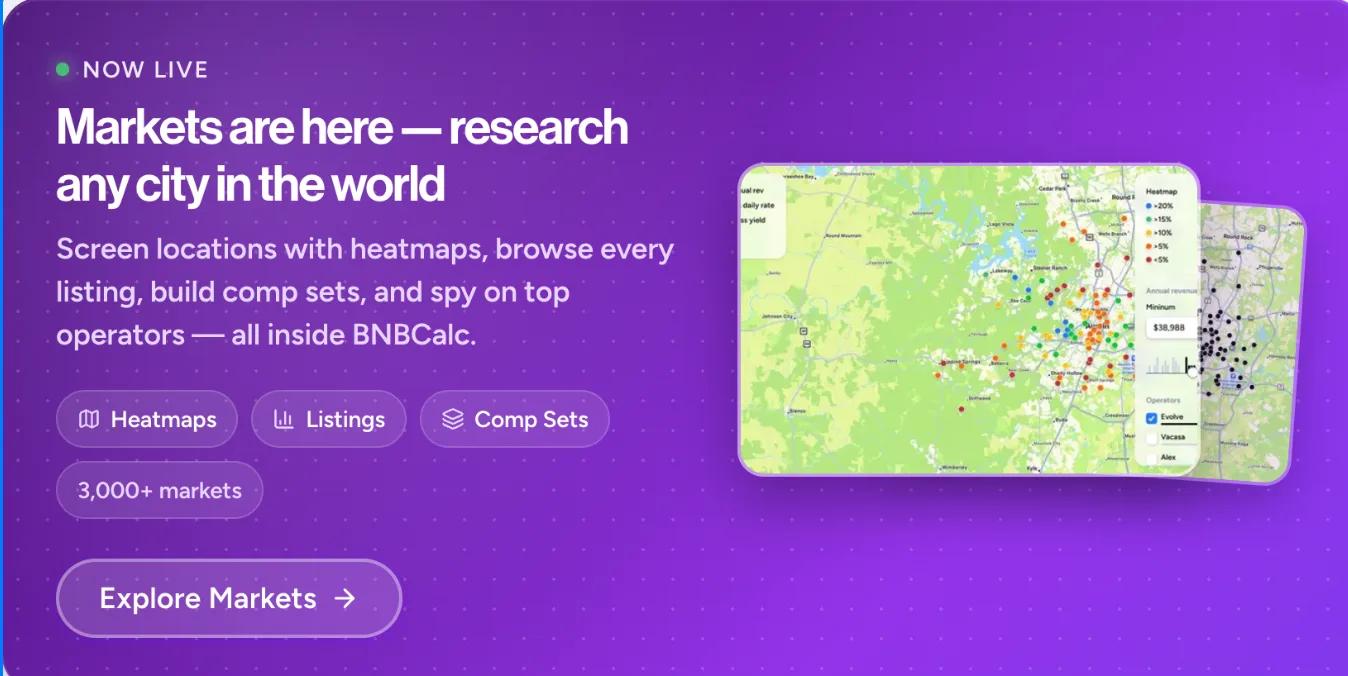
People did, though the management business underneath it never turned a profit. Rabbu wound that portfolio down in May 2023 and rebuilt around free estimates plus introductions to agents and lenders. If you'd rather run the comps yourself before you buy, that's what BNBCalc Markets is for.
Key Points
- The management arm ran more than 400 properties nationwide, including a hotel in Miami Beach, mansions in Malibu and multifamily buildings in Seattle, on a team of about 30. Emir puts that at roughly one employee per 14 properties, where Jeremy says five to one is more typical.
- About $8.5 million of venture capital went into that side of the business, and it still never got profitable. Emir points to 2022 into 2023, when interest rates climbed and the management side stalled.
- The wind down took roughly a month. Emir made the call at the end of April 2023 and executed that May, giving owners a choice between self managing on a recommended tech stack or moving to another operator, while staff could take severance or get paid to help with the transition.
- Headcount went from about 30 to four: Emir, technical co-founder James, product co-founder Trent, and a developer named Justin.
- The free data tool had 40,000 to 50,000 monthly active users when the board weighed its options at the start of 2023. Emir says they deliberately skipped a subscription because AirDNA already dominates that business, and chose to monetize partners instead.
- The replacement model is agent and lender lead generation. Emir names Tyler Coon in Asheville and Avery Carl of The Short Term Shop as examples of agents working only in short term rentals, and admits he didn't know what a DSCR loan was 18 months before this conversation.
- On the Airbnb bust talk, Emir calls it way overblown, arguing demand has grown up and to the right since the early 2000s and citing his own published data showing short term rentals scoring higher than hotels on net promoter score. He still concedes the zero interest rate upside is unlikely to come back.
Full Transcript
Listen to the full episode on Apple Podcasts, Spotify, or YouTube.
Jeremy: We are live with the Short-Term Rental Pros Podcast. Today, I'm here with Emir, who seems like he has done the full short-term rental gambit. Again, another guy who has an operator background who has also ventured into the world of software.
I've heard so much about Emir. I've probably talked to a handful of guys who have just been like, yo, you got to talk to Emir. Like y'all got to brain dump and connect. So we're doing that live for you guys today. So Emir, man, thank you so much for joining. What do you do now? And then how did you get into short-term rentals?
Emir: Yeah, well, first of all, Jeremy, thanks for having me. I appreciate the intro. A lot of great things about you and BNBCalc and everything you're working on. I've been following you guys for a while, so a fan as well. So thanks for having me. It's honestly a surprise it's taken this long for us to actually connect. So glad we're finally able to do it in this format. It's going to be good because it's kind of streamlined and we're going to get to the point of things.
But yeah, let's start with what I'm doing now. I'm the CEO of Rabbu. We're based in Charlotte, North Carolina, but we're building a marketplace for short-term rentals. Basically we're taking properties that are for sale on the market and off market that people come to us with, put short-term rental data on top of it, and allow you to find the best Airbnb or short-term rental to buy. As part of that experience, we connect them to agents and lenders that can help them with the purchase themselves, and really want to become the Zillow of short-term rentals. So if you want to find a property to buy or sell a property, you want Rabbu to be your go-to destination. So that's what we're building.
And the story of [inaudible] how we got here, honestly, you kind of alluded to it. It's been a rollercoaster, but it's kind of par for the course to have a startup, right? So the company originally started, you want to kind of go way back when we started?
Jeremy: Go all the way back. Yeah, I want to hear. Where were you born?
Emir: Where I was born?
Jeremy: Yeah, that far back.
Emir: Oh man. Okay, cool. Yeah. So I was actually born in what at that point was Yugoslavia, ex-Yugoslavia, in the state of Bosnia, which now is its own country. So I was born in Bosnia, lived there until I was six. Unfortunately, there was a civil war that broke out in Yugoslavia. It actually started in the city that I was born in, and my family and I fled when I was six years old, left to Germany, lived in Germany for six years. And then we got the opportunity through a sponsorship from a church in Lexington, North Carolina to move to the United States. And we did. So I moved here when I was 12.
And to say that was a culture shock would be an understatement. And the funny thing is, it was a culture shock in the opposite way that what you'd think, right? So you'd think like, hey, this Bosnian kid that lived a few years in Germany moved to the United States. He's like this big, great country with these big buildings everywhere. It's what you'd imagine, somebody having a culture shock from the grand United States. The initial culture shock was honestly the opposite.
Love it here. Let me preface by saying I love it in the United States. Great place to be, raise my family here. But we moved from a town in Germany that was like 300,000 people to a town here in the States that was 25, 30,000 people, that the thing it was most known for is barbecue. So we had pig statues everywhere. And the tallest building was like four or five stories, right? Which...
Jeremy: Is this North Carolina?
Emir: Yeah. In Lexington, North Carolina. So you're from North Carolina too. So you've at least heard of the city, right?
Jeremy: Yeah. High school basketball games, all the random barbecue destinations there were.
Emir: Yep. Exactly right. But I was 12. This was like in the late nineties. Everything I'd known about the United States at 12 years was what I'd seen on TV. So it was LA, New York, Chicago. I was a big Chicago Bulls fan because I'm a tall basketball player like yourself. So I was excited about moving to the big United States, to these grand cities, and then moved to Lexington, North Carolina. Like I mentioned, the tallest building was like five or six stories, pig statues everywhere. And I'm like, what the heck is going on? How did I end up here? In this little city that was much smaller than the city that I was used to, very different kind of culture than I was expecting from what I'd seen on TV. So long story short, at my first opportunity to move to a real city or bigger city, I did want to do it.
Jeremy: Lexington. I think Lexington counts as the triad, right?
Emir: It does. But when I wanted to go shopping, I'd go to Greensboro or Winston-Salem, right? I wanted to hang out, make that 30 minute car ride to go to the mall in Winston-Salem or to Greensboro versus anything in Lexington. It's just what it was.
Regardless, I don't want to crap on Lexington anymore. I'm obviously very, very fortunate to have been sponsored by the church in Lexington and to move to the United States. I always will be thankful for it. But the second I got a chance to go to a bigger city like Charlotte, I did. So I moved to Charlotte for college. I got a civil engineering degree here and did the engineering thing for a handful of years. And to be frank, absolutely hated it. I just wasn't meant to be a civil engineer. I had the degree, I had some initial licenses. I just wasn't happy being an engineer. I saw a pretty flat career path where I was going to be 40 and bald and 500 pounds. It just wasn't for me. It didn't complete what I wanted to do.
Jeremy: How old are you now?
Emir: I am, way to put me on the spot. I was born in 86, so 38.
Jeremy: Well, you still got a head of hair.
Emir: So to clarify, fact check, y'all. I'm balding for different reasons, not because I'm unhappy. It's just because building a company is tough, I have stress and everything going on. In fact, [inaudible] I would have been bald by now.
So I ended up joining a tech startup here in town that was called KYCK. And what KYCK was, initially it was built, and this was in like the early 2010s, it was built as a social media platform just to talk about soccer. Being from Europe originally, growing up playing soccer every day and basketball, it was just the thing, right? Soccer. And there was a tech startup in Charlotte of all places that was all about talking about soccer. I was in.
So I joined this tech startup, actually for free initially, and ended up being brought on to the company as a business analyst and worked my way up to be the VP of operations of KYCK when it was acquired by NBCUniversal. So I joined NBC as part of the acquisition for a year, but the whole idea at that point was, this is going to be a stepping stone so I can figure out what I want to start myself.
So right at that time period, my wife and I bought a home here in Charlotte that had a detached garage behind our main house, and above that garage originally was like a studio, art studio and a bathroom. Decided to turn that into an Airbnb, hoping just for some discretionary income, maybe offset some of our childcare costs or whatever, right? And next thing we know, it's paying the mortgage. This little 200 square foot room above our garage, it's paying the mortgage on our house. And we're like, holy smokes, what is happening here? There's a big opportunity of short-term rentals. How do we go about building a business in this space?
So that's kind of my initial steps in short-term rentals: hey, I just got done with another business, trying to figure out what I want to do next, garage apartment, it's paying the mortgage, okay, let me see where I can take this. So that's really kind of the origin story of how we got into short-term rentals to begin with. Now, what it is now is very different, but that was how it started.
Jeremy: Got it. And then you had the garage apartment, you had maybe that aha moment. And I think a lot of people in this space, especially those who started a while ago, it was through their experience that they noticed. I think nowadays people promote their experiences online and it kind of gives people the insights into what's going on. But tell me what happened. You had that aha moment. Was that like, all right, I'm going in, I'm leaning in on this and I'm going all in? Or did you take things slower? Once you saw that 200 square foot apartment was paying your mortgage, what'd you do?
Emir: Yeah, it's a good question. And honestly, at that point, I still wasn't 100% sure. It was definitely an aha moment about, okay, there's something here. I was working full-time at NBC. I was playing around with, hey, how do I kind of scale this short-term rental thing out? And I had another couple of business ideas that I was playing around with on the side just to see which one had the most opportunity. Another one's like a drone videography business. And there was another couple of things we were kind of playing around with.
I'm a big, like, don't build a huge, long business plan, take steps and then learn and iterate, right? Like do one thing, learn from it and then do another thing and then see which one compounds the most, creates the biggest opportunity. And as I was doing that, it became very apparent that the short-term rental space was kind of the biggest opportunity at hand.
Because what we started doing next is my wife and I went and got more properties for ourselves. And we got one in an apartment building close to where we lived. That first one was like an arbitrage setup, and this was early days. This was like 2014, 2015, where arbitrage was still relatively early on. We're making two to three X what our lease payment was, right? So we were like, okay, well, there's definitely more opportunity here.
So we got to the point where we got to a handful of apartments that we were managing some, we were arbitraging some, some which we owned. We decided, okay, this Airbnb thing has the biggest opportunity for us. So let's put everything else to the side and let's really focus only on building out the short-term rental business.
And at that point, the initial idea was, let's do what Sonder and Stay Alfred and some of these other guys were doing, or attempted to do, which is build a short-term rental brand. Anytime I stay at a Rabbu property, I would have the same experience. So that was kind of the initial idea, primarily through lease arbitrage, which again, I know it's been replicated many times since now, and through some other managers. We were like, okay, how can we grow our portfolio, our own Rabbu themed and branded short-term rental buildings, listings, right? So that was the initial idea of what we were going to do with the business.
But to be frank, that didn't last very long because as we started kind of talking to people that we would buy an asset from or that we would eventually arbitrage an asset from, we kept being asked, hey, instead of you leasing it for me or buying it for me, would you be interested in managing it on my behalf instead? Because I want part of the upside. Okay, that's interesting, because there's a lot less upfront cost in doing that than having to furnish it yourself and, whether you're buying it or you're leasing it, there's a lot more upfront costs. So we're like, okay, sure, let's go in that direction. Let's try to become more of a management company versus an arbitrage company.
This is also around the time that I brought in my co-founder, James, who was with me at KYCK and then also at NBC after we got acquired, to start building out the backend infrastructure of how we would operate these units. Because once you get to about five, you need to start building out some backend operations and automating as much as possible in order to be successful. So I brought James on, who's a full stack developer. I said, James, hey, this is what I'm working on. Can you help me make this as seamless, as easy as possible? So that's when he joined.
And we really kind of, honestly, I kicked my wife out actually at that point. I said, babe, I love you, but I want to separate business and home. You keep doing your nursing thing. I'll be the risk taker. And then when I come home, we don't have to talk shop. It's hard to separate business and personal, but when you're together all day, every day, working on both.
Jeremy: Yeah, I believe it. It's hard.
Emir: So that was kind of the first iteration of the company. We were doing that, kind of growing the business side of things more on the management side. And we started running into roadblocks or challenges through that process.
The first one was, what property management system do you use? So we started off with Guesty and we ended up building software on top of Guesty to serve our use case, including at one point, we built our own IoT platform. So what Lynx does now, or an Operto, there's a few groups that do IoT automations. We ended up building our own. We actually took that to market as well to see what the opportunity was there. And we quickly realized that that wasn't for us because selling a property manager hardware, and then trying to automate that and all the challenges that came with hardware, we just didn't think was the right opportunity for us.
The one thing that always was working though, was the management side. And as part of the management side, there were two questions that we always had to answer. And they were, how much money can an existing property make? And can you help me find a property to buy? Those were kind of the two questions that we always answered.
And to equip our sales team, and to also be frugal and economical, we didn't want to pay for the data subscriptions that were out there at that time period. So we decided to build our own because we're technology guys, we build everything ourselves. So we decided to build our own kind of data tool initially to be used just for us, for our sales team on the back end. But one night, James, my technical co-founder, decided to put it on our site just to see if people would use it themselves. And that was kind of the origination of our data tools. We put it out there and it was this estimate of short-term rentals, completely free to use.
And that kind of really helped us blow up both from a user perspective, but then also from a property management perspective, because now we used that data tool to upsell our property management services. So people would come to our site, type in an address, get an estimate, eventually refine their comps, and then we could upsell them on property management services.
So when we were doing property management, that was our kind of unlock for sales: the data tool and enabling it to answer those two questions for people, which we then would say, hey, by the way, you're looking for property in Hoboken, right, in Jersey. You also need a property manager because we can do that for you. And it really kind of helped us go from a few dozen properties that we were managing primarily in Charlotte and a couple of markets around here to having over 400 properties under management all across the country, including like a hotel in Miami Beach, mansions in Malibu, multifamily buildings in Seattle. We had nationwide coverage of properties we were managing.
And all that was being done through our own property management system that we had built, our own pricing. We basically built everything ourselves. It was just in our DNA to kind of operate it and make it as efficient as possible. So that was really kind of the big foray for us into property management: using the data tool to grow property management doors and growing the property management business.
As part of that, we did end up raising about, at that point, eight and a half or so million dollars of venture capital to kind of fund that activity. And that property management was going strong up until May of last year when we decided to transition it elsewhere and focus primarily on the data side.
Jeremy: I think I had a, now that you mention it, it's reminded me, I think like four years ago, maybe I was on the site, I don't know how it came to be, but I got either a demo or I saw, I don't know, a YouTube video or something. But you guys had like your own owner dashboard through your software. And honestly, it was probably the most comprehensive owner dashboard that I'd ever seen. And honestly, to this point, that I've still ever seen. So you guys built out some very sophisticated stuff.
Emir: We did. I mean, it was kind of bonkers. So think about it. Any tool that you can imagine that was out there, we built it ourselves. And the reason we built it ourselves, one, it was in my DNA, it's in James' DNA, it's in our other co-founder's DNA, is to build the technology ourselves. Two, we just could never afford a use case that we were solving, which was nationwide coverage of short-term rentals primarily being used as investment properties. There just wasn't a good use case of software that we could kind of pull together that would solve it the way we wanted to solve it. And again, we just believed in what we were doing on the backend side and technology side. So we built it ourselves and honestly, it worked. We had 400 plus properties that we were managing across the country, but only 30 people to manage that, which is pretty impressive.
Jeremy: Yeah. Comparing people to properties, usually it's closer to like five to one. Ten to one is like the best you've seen.
Emir: We were close to like 13, 14 to one, one employee per 14 properties. And a lot of the people that we were employing weren't even ops people. They were engineers and developers and product people. So it was a very different setup, to say the least.
But at the end of the day, it didn't work out because we couldn't get it profitable. And what the public markets were doing with groups like Vacasa, those short term vacation rental management companies just weren't being valued very highly, right? Like Vacasa had seen around that time period, Vacasa had seen their value drop 90 plus percent, right? Sonder was struggling. And we just couldn't figure out how to get that side of the business profitable and efficient, even with a small team, just because the short-term rental space was a bit unpredictable at that point. And this was, I guess, 2022 to 2023 when this was happening, when things were really starting to slow down, interest rates went up, everything just kind of reached a halt on the management side.
Jeremy: Got it. So what did you do? So you built out this 400 listing unit PM business all over the country, did it with a very lean team. Seems like a lean, but A-level player team of engineers, not quite the offshore virtual assistant route that a lot of folk, inclusive of myself, frankly, do. But yeah, what'd you do? So you had a couple of things going on. You had the data side of the business, what folks probably know as Rabbu today. And then you had your operations arm. Do you sell the PM business? Do you wind it down? And then yeah, how did you...
Emir: Yeah, it's a great question. It's interesting. It was the beginning of 2023, we got together as a board and we're like, okay, what's the best play? We have both the data tool that we had, that at this point had like 40,000, 50,000 monthly active users, and then property management, which is bringing in good money, but just wasn't profitable, right?
And we kind of decided, let's see if we can get it profitable. If we can't, then we're going to have to figure out an alternative for it, whether it's sell it or shut it down or whatever needs to happen. So the first thing we tried to do is make it profitable. We couldn't get there. Transparently, we just couldn't. That's because we were also doing two things at once. We were trying to run the data business and then the property management business, which is hard to do at the same time, but we couldn't get it profitable without distracting from the data business. So that was the first realization.
Then we did look at options to sell it, but our portfolio was so unique in that, a lot of times when you're selling a property management portfolio, you have buyers that are only looking for single family homes or only looking for multifamily buildings, or they're only looking in vacation destinations, or they're only looking in more urban destinations. We had a mixture of hotels, of single family homes, of multifamily buildings, of small multifamily, large multifamily, really a myriad of things that we built that we knew we could manage, but there wasn't a perfect acquirer of the portfolio directly.
So what we ended up doing was we did find somebody who wanted the portfolio and we partnered with them in a way that we went to our owners, let's call them owners, the groups that we manage properties for. We gave them an option. We said, you can, one, take this over yourself and self manage it, or you can transition over to this other group. And we really gave them an option versus trying to kind of get every penny out of it that we could. And we tried to be the best partners possible and give them the option to transition to yourself, and here's our recommended tech stack and resources that you can use to continue running yourself, or transition to this other operator who can continue running it as if you were with Rabbu or close to our old property management services.
So that's what we ended up doing in May of last year. And the crazy thing is, we did all that in a month. We basically decided at the end of April that this is the best way to go. And then we ripped the band-aid off. And May of last year was not the greatest month, but it was an experience worth doing because it was the right thing to do for the shareholders in the company, for the team, for our partners, the owners that we work for. It was just the right thing to do.
And based on everything I've seen, things have worked out really well. A lot of our employees transitioned over to some of these other companies that took over our portfolio. So all in all, it worked out okay, but it was a stressful month or so, winding down a portfolio of 400 plus doors. It's doable, but stressful.
Jeremy: That you've built over several years too. It takes several years to build it, and then you've got to wind it down over the period of several weeks. And actually, I'm familiar with like Awning to RedAwning, but I think they had a similar transition themselves, probably about the same time or maybe before, maybe after. That was just when I talked to their head of PM operations, and he was telling me about, yeah, that transition process.
Okay. So you went from, I mean, massive PM, frankly, probably millions in revenue a year and whatnot. You're getting tons of hits online with your free data tool. So I guess with that, I'm curious as a startup founder, how do you focus the business from there? What is that conversation like with your team members, your employees? Put us in your chair or your shoes. I know you're 6'5", so we want to be in your shoes because you might be able to dunk.
Emir: I can only dunk on a good day. Yeah, I used to. In high school and early college days, I could dunk. Now, I'm happy when I can grab rim and hold onto the rim and act like I can dunk.
Jeremy: I'm with you on that.
Emir: Yeah. It still impresses me. I'm 38 or whatever now. You hear about Michael Jordan losing his ups in his late 30s too. So you're like, okay, it happens to all of us. This happens to Michael, it happens to me too. It's okay.
But yeah, I mean, it was a tough decision. So obviously, when I made the call and said, okay, we need to shut down property management, really need to focus on the data tool, I went to my co-founders first and told them. And one was like, makes sense. The other one was like, this is the most irresponsible thing I've ever heard. And you want to do it in a month, this is crazy. I'm like, I hear you, but I think this is the best way to do it. Otherwise, it's just slow, slow and slow death. So we pulled the trigger.
The first focus was how do we do right by our owner partners, transition them to the best setup possible. Then the second one was how do we make sure that the team, our property management team, had a good landing spot and they were in a spot that they were comfortable. And it was a pretty amazing experience. We were frank with them. One of our big core values of the company is transparency. So when we made this call, we went to the team, we said, I'm sorry, guys, this is what we're doing. This is not the news we wanted to share, but this is what has to be done. There's really no other option. And you guys, you have two options. You can get paid severance and never work for us again, and we'll do our best to help you land somewhere else. Or you can help us with the transition, get paid, and we'll still help you kind of transition somewhere else.
And it was really amazing to see most of the team come together and say, yep, we'll help you do a transition. It's the right thing to do. It sucks, but it's the right place to go and do it. So that was one of those kind of moments where you were like, holy smokes, this is the right thing to do. And we're treating people the right way.
So the initial focus was do right by the owners, transition properties to elsewhere, and then help the team that we had to let go land on their feet. And then from there it was, okay, this is done. We're now kind of starting from scratch. What do we do? How do we now monetize this data? What do we do with it?
And really went from 30-ish people at the company to four people: myself, James, my technical co-founder, Trent, who was a product co-founder, and then Justin, another developer. It went down to four of us. And we're like, okay, well, we know we have 40-ish thousand active users on the site. We know we've been able to sell those users property management services. There's got to be other things that this user base wants. Because we didn't want to, and we had tried this too, we didn't necessarily think charging for monthly access to the data was the right call. Not that we couldn't sell it. I think there's a business there.
Obviously, AirDNA dominates and owns that business. We just thought that for us to really kind of have an impact in the industry, we need to make this free and find other ways to monetize the users versus on a subscription basis. Because in our mind, the space, the market needed access to free data in order for it to continue to grow. So we made the call of keeping the tools free and figuring out how to monetize partners who want to get in front of our users.
So to be frank, we tried everything. We tried having people put banner ads on our site, working with furnishing companies, with property management companies, with software companies, with insurance companies, with really anything you can imagine of companies that see short-term rental buyers and investors as an audience.
And as we spent basically Q3 of last year kind of thinking through that and looking through that, what became apparent to us is that for where in the journey our users were, so people that were using Rabbu, for where they were in their kind of investor journey of owning and operating a short-term rental, the two things that they needed the most were agents and lenders to help them acquire the asset. So we decided to really shift our focus on becoming a lead gen platform for agents and lenders.
So most of Q4 of last year was all about building out the process and the kind of user journey on how somebody willingly and with implicit kind of mindset becomes a lead for one of our partners. But that was kind of the thing that we focused on in Q4 of last year, is how do we take this user base and not turn them, give them what they want, which is access to agents and lenders, and do that in a way that is most organic to the way they're using their site. And also that they know that they're asking for these agent and lender connections, because the only way that's successful is if they know they're getting connected to agents and lenders, otherwise nobody wants to.
Like the worst experience anybody's ever had as a consumer is that they're like thinking about getting a loan or get cold called by, like you go to like Credit Karma, you press one wrong button and you get like 20 text messages. Like nobody wants that, right? Like that's not the right way to do it. Those leads have incredibly low conversion rates, which is also not sustainable. So we really focused on trying to make that as much of an organic and also really implicit, like these leads know what they're asking for, journey as possible. And we're still working on that, but that was kind of the first iteration of where we spent most of our time and effort in Q4 after deciding that that was the route to go.
Jeremy: Got it. So yeah, I'm curious. So you started leaning into the software tool saying, all right, we've got these users, they're looking for short-term rentals. All right, if you're looking for a short-term rental to buy, what do you need? You need financing. You need to see the place. Like unfortunately you can't just show up and knock on the door. You got to actually get inside. So, all right, let's make that introduction. How has it been since leaning into that, frankly, is a Zillow approach, right? I mean, you say Zillow as a reference, pretty sure that's exactly what they do as well. That is their business model.
Emir: That is kind of exactly their business model. And we kind of joke around, our initial revenue estimate tool was like this estimate for short-term rentals, right? So if you're going to copy somebody, copy Zillow, because they're good at what they do and they are kind of the brand name. But very few people actually have become leads of Zillow. It's much more known as a place, the research tools, research properties, versus get connected to agents, but they still do really well. They make, I think, almost like a buck 50 per user on their site. So they've figured out the model and kind of where we're going. [inaudible], but yeah.
So, I mean, really that's what the focus has been. It was all about the user journey. And then finding the right partners to work with as well, right? And I think there's some great short-term rental agents that only focus on short-term rentals. So I think one of our mutual connections is Tyler Coon. He's based here in North Carolina out of Asheville. I know he's going through a lot with what's happening up in the mountains here with Helene coming through, but him and his company, they're great short-term rental agents. There's Avery Carl with The Short Term Shop. So we started partnering with some of the best agents all across the country.
And then started doing the same thing with lenders, started realizing, okay, what is actually a good short-term rental loan? Can you go to like a local Wells Fargo branch and get a short-term rental loan, especially if it's an investment property? The most likely answer is no, unless you have some great relationships there. So how can we get the right lenders onto the platform that actually provide loan products that are suited for short-term rentals and short-term rentals only?
So we started talking to more of those groups, trying to figure out what their loan product is and how to best describe what a debt service coverage ratio loan is to our users. Because transparently it was foreign to me 18 months ago, what a DSCR loan is. So it was really a lot of educating ourselves and then figuring out a way to take that same information to our users and then to turn our users into leads for our partners. And that was the experience that we've been working on for the last nine months or so now.
Jeremy: So how has that been? Or how has this experiment, the pivot? I think the pivot's probably the smartest part.
Emir: It's so far so good, honestly. I mean, it's going well. We're seeing a lot of demand from agents and from lenders to be on the platform. Now it's all about continuing to unlock the user growth on our site. We've more than doubled our traffic in the last 12 months, which is great, but there's plenty of upside still to be had on our platform. So that's kind of what we're trying to think through. What are some levers that we can pull to make Rabbu more of that household name that we want it to be when it comes to short-term rental investing? So we're exploring SEO strategies, paid ads strategies, some guerrilla marketing strategies to get ourselves out there more so that we grow awareness of the brand and what we're doing more.
We're also getting to the point where it's time for us to bring on more team members to the team. And transparently, that's hard. There's some PTSD now from having gone through what we went through in May of last year where we had to move on from some great team members. And now you're like, oh wow, I just posted a job post the other day. I'm like, man, this just feels weird to be doing this again. And I'm like, oh man, I wonder how my old employees feel. They're going to see it. And the ones I've seen have been incredibly, incredibly supportive.
It's the entrepreneur journey. A lot of like almost imposter syndrome, right? Like, oh man, is this really right? Is this the thing to do? And we've made mistakes doing this before. It's just that kind of rollercoaster of feelings that we're going through. But knock on wood, it's all for the right reasons. So now with the interest rates coming down, some things starting to stabilize a little bit. There's still a lot of unknowns with the economy and where things stand in the market. But we're starting to see the light at the end of the tunnel.
And we also just recently introduced a brand new product as well on the platform, which is the ability for anybody to list a property for sale on Rabbu and advertise it or market it to our users, which is something that has been requested for years, for years. And we used to do it like strategically through some emails to our user base. But as of last month, you can now list your property for sale on Rabbu and get exposure to our audience directly yourself, which...
Jeremy: I actually think I'm a client of that service.
Emir: Oh, nice.
Jeremy: So we're selling one place in Florida and the house has done well. We have a track record with it. I have a couple of partners. Ironically, I got called by the Wall Street Journal a couple of weeks ago and I talked to this guy for two hours about my investing experience. We'll get back on target in a second, but I think you might find this funny.
So I talked to this guy for two hours. Seems like a nice guy. I love the Wall Street Journal. I talked to him through like every property that I've invested in, what the process looked like, raising money, how it's done. And I told him, yeah, there's two, he asked, have you sold any? Yeah, we sold one in Western NC. It was a small cabin, price has appreciated, we sold it. Like, it made sense to sell it. We're selling one in Florida. Homes have done well. Insurance has gone up a lot. And they're just like, price has gone up, we're selling it.
And then pretty much after two hours of talking, he only uses like the examples of selling it as kind of the... but I took a picture, I sent them over, of myself smiling in front of the house. And I read the article. Next thing you know, all right, of course, I guess we'll never talk about...
Emir: Yeah, you're a distressed seller.
Jeremy: Yeah, because that was like what the article was about, was like friends who bought houses together and like regretted it, which I would be nowhere if I hadn't done that. I don't regret that I've done that. Obviously, it's just business. You got to roll with the punches. Sell something, buy something else. It is what it is. That's how you do it. But my point, I guess I just wanted to vent that out there maybe.
Emir: No, it's okay, buddy. I'm pretty sure that same guy reached out to me. And we talked for probably not too long, probably 30 to 45 minutes. And he was trying to kind of probe in all of the short-term rental markets on anybody...
Jeremy: I fell for the bait.
Emir: In these places, places that was like, you know, was distressed. And it's like a [inaudible] or like Airbnb bust. I'm like, I mean, it's real estate, right? There's ups and downs to every market. If you bought right, if you're managing it right, if you're doing things the right way, then you will be fine. I was trying to paint, I wouldn't say a rosy picture, but a more realistic picture.
Jeremy: The truth, the truth.
Emir: The truth, right. And again, I never heard again from him. And I guess I wasn't featured in the article because I would have probably heard about it. So he probably didn't like what I had to say. And he was nitpicking with you, the one thing you're like, oh, my insurance is up, so I didn't sell.
Jeremy: I mean, I did say, I was like, you could probably put like 40 grand into it and then put a putt-putt in the backyard and add a tiny bowling and add some more amenities. Just frankly, I own the house with two other people, they wouldn't want to do it. So if they don't want to do it, I'm not going to force the issue. Let's just sell it, take the funds. I'm looking at a place Thursday, like off-market deal around here. So I'm still making moves. But yeah, he took that and made it like partnership-ish.
And I digress, but my point was that particular, and frankly, it is a good house, Taylor Jones, actually. So we just listed it like three or four weeks ago, but I told Taylor Jones who, I don't know, I know you're on Twitter.
Emir: Yeah. I know Taylor really well.
Jeremy: Yeah. Taylor's a character for sure. I was actually talking to him Friday, and actually the conversation we had kind of led to, I guess indirectly, why I'm going to look at houses on Thursday. So very influential guy. But yeah, I had him on the podcast where we actually went over that specific property and I told him, hey, we plan to sell it, this is why. He said what you can do to like make more money out of the property. I showed my exact numbers on it.
And then I saw one of your guys' emails like a month ago. And it does seem like the buyer's market, frankly, in Florida. I mean, right now there's literally a hurricane coming through. So things have kind of gone, like, I thought we priced it right. I thought, we have had tours, but it just seems like in Florida as a whole right now, people are kind of just like wait and see mode. I think also the election's coming up. But I saw one of your guys' emails and I was like, oh, I think our house would make a lot of sense. So I forwarded it over to our realtor and then he showed me that he had transacted with you guys. So I'm a client of that service.
Emir: Awesome. Awesome. Well, I'll check it out. I'll make sure we get you promoted even more so. You'll be happy.
Jeremy: What's usually included? I guess I'll be happy. No, for sure. I mean, it is kind of interesting. I was just telling the team earlier today, just right now, it's not a great time for North Florida, with what's happened with the second hurricane coming through. It is Southeast Florida, so it hasn't been affected at all by the hurricane. If anything, we have guests there who are hurricane refugees. I know you have some assets in Asheville still. I think I saw one.
Emir: We do. Yeah. Yep. We're in Asheville. We have a whole building in Asheville now.
Jeremy: Yeah. So I'm sure we could talk about this hurricane, probably have its own episode, just the stuff we've had to deal with with this hurricane the last couple of weeks.
Emir: Yeah. It's been, luckily for us, let's just quickly hit on that. Luckily for us, the building is intact. No major damage to it. Some minor issues, some very minor flooding, but there's no power. Sorry, there's no water. There's power and there's AC and there's no water.
And it really kind of reminded me, I'm not sure, were you a host back right before COVID hit, but right as COVID hit in 2020?
Jeremy: One property heading into COVID.
Emir: Yeah. So when that happened, we had like 30 or 40 properties, somewhere in that range. And they all canceled right away. They all canceled. And it was all about how do you fill this back up? And this is really what this feels like again. So all our reservations are canceled now through October because we don't know when we'll get water back there.
The one thing we are able to do though, is we're able to house first responders there, which we're doing now. And obviously we're not going to make any money off this, which is fine. It's the best thing you can do in a situation like this. It's just tough. It's tough all around. So that's the good thing about short-term rental assets, that they can be used for situations like this, when things are dire. These first responders are going from sleeping on the ground to now at least having a real bed and mattress and some power and some AC. They'll make their lives easier while they're dealing with some massive destruction up there in the mountains.
Jeremy: Yeah. I mean, to touch on my experience quickly, keeping everybody up to date, listening to the show. So I have one in Western NC and frankly that property, very often the driveway leading to the house washes out. If there's a bad rain, it'll wash out. And somehow I have no idea how, this storm, like the nearby town of Dillsboro flooded because it's on a river, and Asheville River Arts District, that flooded because it's on a river. So it seemed to be that towns in Western NC that were on rivers flooded. The rivers became like seven rivers in one day, like the East River turned into the Hudson, or frankly, maybe more akin to turning into an ocean. It was crazy. I'm sure you guys have seen the footage.
But the driveway, we didn't have any issues. The power didn't even go out at the house. However, Airbnb let people cancel, even though we had guests during the storm, we had guests after the storm who even booked for tourism reasons. The day I was like, did you know there's a hurricane? And they booked the house to go to the Smoky Mountain Railroad in Bryson City, which apparently was open the day after the hurricane hit. But yeah, we've had people canceling, which is fine. It is what it is.
And then our houses in like Eastern North Carolina, they've just been a lot of people from Asheville coming in because they haven't had power, water. So we've been doing not first responder housing, but a lot of, frankly, I don't know if refugee is the right word. It doesn't sound [inaudible].
Emir: I mean, right. It does, but it's kind of what it is, right? They're escaping due to natural circumstances in their home.
Jeremy: Yeah. I mean, it's tough. And the unintended, not, I don't want to say unintended because obviously none of this was intended. And frankly, when Helene hit rural Florida, I was like, oh, sweet. Like I'd been watching, obviously when I look at storms, I'm like, I hope this hits an area that people don't live. And it went into the Big Bend area. It didn't hit Tampa as bad. And I'm like, sweet, let's go. All right, I'm going to enjoy my weekend.
And then I didn't even realize, because our guests didn't say anything for days, that Western NC had gotten frankly smoked. And there hadn't been a lot, no one had internet, no one had service. So the footage hadn't really gone out while it was happening. It took a few days to start seeing what was happening. And it took us probably like 10 or 11 days to get in touch with all our service providers, not even only in Western NC, but a lot of our service providers in central North Carolina just went to Western NC to like help out their families. So then they lost service. So we just didn't hear from them. Our pools are green at a few of our houses in the Greensboro area. It is what it is.
But at times like this, you got to be a human being over a host, and roll with the punches, but also help out where you can. When I saw this storm was hitting Florida, it was obvious there's going to be mandatory evacuations. You can definitely raise your prices if you want to, but we're not doing that. We keep them as is, don't touch them, whatever, we'll get the last minute bookings at good rates. That's what you do. You don't try to take advantage of the situation. So anybody listening, I know it might seem opportunistic, but don't do it. It's just not good karma. Be a good person.
So back to you. We can talk about the house later, I'd love to like learn about what y'all are doing there. So this transition, what's it been like? And then I guess, what do you think the future is as a whole for short-term rentals, the industry, and then what part do you see yourself playing in it?
Emir: Yeah. I mean, first of all, I think some of the kind of conversation you hear about short-term rentals and Airbnb bust, I think it's way overblown. If you were to kind of follow the growth curves, or the growth, the linear curve of short-term rentals and the demand in the space, the demand for short-term rentals has, if you kind of even take a step back and somewhat ignore the craziness that happened during COVID years, the demand for short-term rentals has continued to grow up and to the right.
During COVID, we saw some extremes where it fell significantly in COVID, versus you were kind of alluding to when things got shut down, but then demand skyrocketed when people were allowed to travel, but were doing so with social distancing in place. But if you take a step back, dating back to early 2000s, short-term rental demand has been kind of growing up and to the right consistently. So we're not seeing any kind of change. There's no data that tells us people aren't staying in short-term rentals anymore. There's no data saying that people aren't willing to pay more to stay at a short-term rental.
There's some data I published the other day that shows that the net promoter score for short-term rentals is higher than hotels, significantly higher than hotels, even though if you follow social media and are in the short-term rental kind of market, you'd think that all of a sudden everybody thinks hotels are...
Jeremy: I'm not staying at an Airbnb ever again.
Emir: Yes. They made me put my sheets in the washer. Right. I didn't realize, a lot of times they make you put the sheets in the washer so that your cleaning fee is lower. Don't get me wrong, I understand paying the cleaning fee sucks. Nobody wants to pay a cleaning fee. But if you didn't want to do anything, cleaning fee would even be higher because you're hiring. You got to realize there's other people on the other side who have to do the cleaning and they're not cheap to hire, because you want them to do a good job, because they're not doing a quick, low touch cleaning where they just kind of glance over things. They have to do a deep clean basically every single time because they've got to keep guests happy. So there's a lot involved in cleaning.
So if a guest asks you or a host asks you to throw the laundry into the washer, it's because they're trying to keep your costs down, not because they're trying to give you a to-do list. Let's just be frank. Like I understand how it can be annoying. And of course there's people that go overboard, but that's really not 95% of hosts, that they're trying to do. They're really just trying to keep costs down. I know when we managed properties, cleaning for us was at best a pass-through, but most of the time we lost money on cleaning, even though we charged what some people would say was a high cleaning cost. It was still pass-through at best just because of all that's involved with cleaning a property.
But I digress. My point being is that short-term rentals aren't going anywhere. There are continuous kind of performance records that Airbnb is setting. There's continuous kind of reviews and positive net promoter scores that short-term rentals are getting. So are they going through the boom that they were going through during the latter part of COVID? No, of course not. That has stabilized now, but I think there's going to continue being demand for short-term rentals. There's going to continue being investors who are investing into short-term rentals. There's going to continue being individuals who are buying second homes, vacation homes that they rent out.
That demand is not going to diminish because me, I have three kids and I'm happily married. Staying in a hotel is probably the worst experience possible when we're traveling because it's so confining to what we can do, right? Like we have to go to bed when the kids go to bed. Can't like hang out in the living room and watch something together or hang out. It's just not a good experience.
So short-term rentals aren't going anywhere. The demand's going to continue growing. The upside that was probably existing during a zero interest rate environment during COVID is probably unlikely to return, but it still can be a very attractive asset class if you find the right asset, if you set it up appropriately, and if you utilize the resources available to you to make sure that it's operating to the best of its ability, whether it's finding the right way to buy a property, it's the right pricing strategies using tools like PriceLabs or whatever else the case may be, set you up for success.
I think it's an asset class that is only going to continue to get professionalized and that'll become better. And that's where we kind of want to, that's the role that we want to play. We want to be a big part in the professionalization of this asset class and find people with the data and the resources to buy the right property so that they have a good experience and so that it meets their goals. So as I mentioned earlier, we want to be the Zillow of short-term rentals. So if you're looking to buy or sell, we want you to come to Rabbu. We want you to use our tools and our partners to do so. So that's kind of what we see as our place and what we're hoping to accomplish as a company.
Jeremy: So everybody check out Rabbu. I mean, I'm sure most people listening probably know Rabbu already, but beautiful UI, great way to browse for properties, really good. You can see the photos and you can also at the same time see the data, which a lot of times you got to go through a bunch of different places for that. So they've made that experience real nice. So folks who want to stay in tune with your experience, your journey, how can they do so?
Emir: Yeah. I mean, probably the best way is to obviously check out Rabbu.com and check out the properties that we feature on a continuous basis, including yours.
Jeremy: It's a good property for sale. Someone wants to buy the house, I'll show you the full numbers. I'll literally, you can watch the episode with Taylor. Like I've got nothing to hide. I will tell you insurance costs in Florida have gone up, but they don't seem to be going up that much anymore. However, I don't know if maybe this week could change that. I don't know how that works. I'm not sure.
Emir: There's a reason for insurance to go up, I'm sure they'll find it. But yeah, follow me on Twitter at Emir Dukic, E-M-I-R-D-U-K-I-C. That's probably where I'm most active. You might see me more on LinkedIn going forward as well, but the most authentic and real me is probably on Twitter. So if you ever want to interact with me, you can find me there as well.
Jeremy: I follow Emir. He does like, this is happening this week in short term. I don't follow that many people on Twitter. Admittedly, it's kind of unhealthy when I go on. I start following. Twitter has a lot of crazy stuff going on there. So I start going into some of those wormholes personally. I got to stop doing that. But Emir puts out really good stuff. So make sure to check him out there. Emir, thank you so much for coming on today. And yeah, everybody stay tuned to the next episode of the Short Term Rental Pros Podcast.
Airbnb Tax Deduction Calculator
Paying too much in taxes? We have the perfect solution. Simulate an Airbnb home purchase below.
Purchase Price
$450K
Structure Value
70%
Apply Trump's Tax Cut (Bonus Depreciation)
Depreciation
$117,695
Interest
$21,600
Tax
$6,750
Year 1 Deduction
$146,045
Want to claim this deduction? Get a free cost segregation benefit analysis from CSA Partners — no obligation.
Get Full Analysis