
Free instant analysis
Reveal Airbnb revenue for any address or city
Quick Summary
The Poconos runs on proximity. Mark points out that the region sits three hours from 47 million people and pulls about 30 million visitors a year, mostly on drive-up weekends that get booked around ten days before arrival.
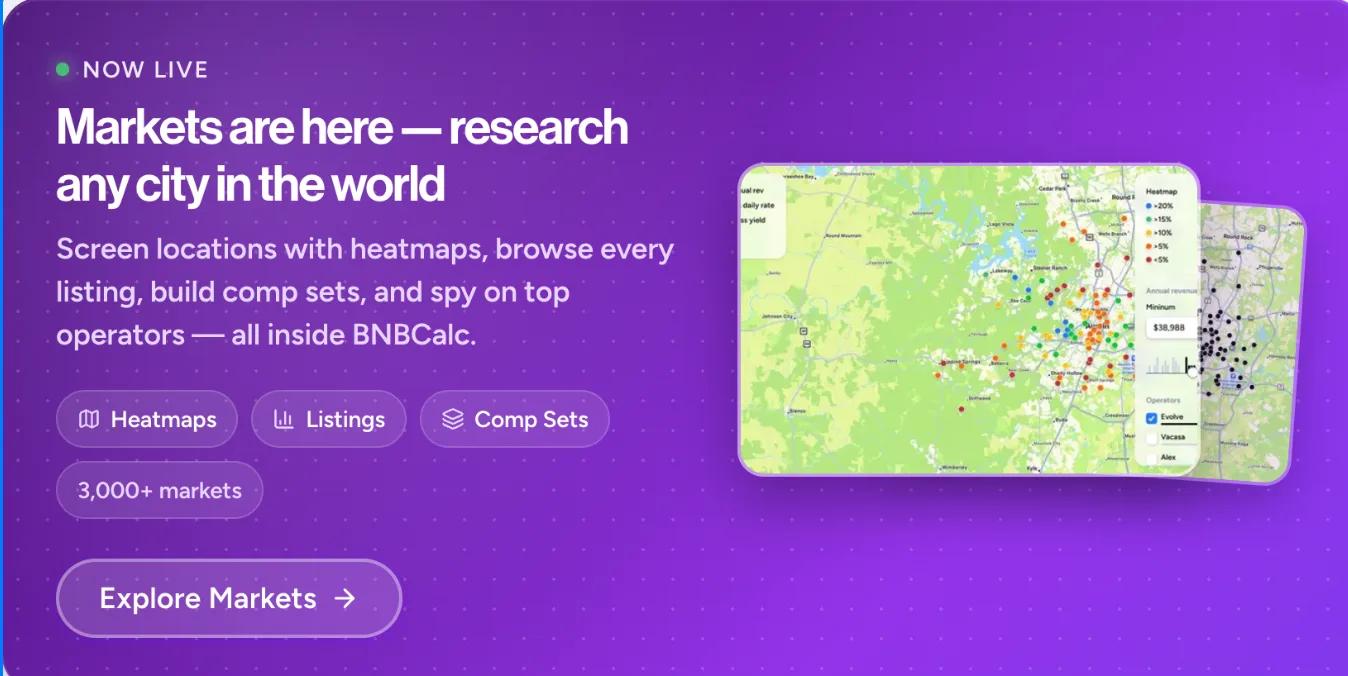
That volume doesn't spread evenly, though. Xander sees 20% of the homes taking 80% of the revenue, so the gap between a house pulling close to $100,000 a year and one that sits comes down to bedroom count, a fenced yard, a game room where the garage was, and an operator who cares. If you're sizing up a drive-to market like this one, BNBCalc Markets is where I'd start.
Key Points
- Mark counts about 6,800 licensed short-term rentals across the Poconos, spread over dozens of communities and towns, and the rules shift enough between them that his blog of regulation scorecards became his lead source.
- Asked what a $500,000 purchase with $150,000 to $200,000 all in can do, Mark names a four bed two bath in Emerald Lakes or Pocono Farms earning close to $100,000 a year. Xander agrees, with the caveat that you have to work for it, and Mark says that means amenitizing the backyard.
- Xander reads the market as an 80-20 split, with 20% of the homes generating 80% of the revenue, and says the way in is bedroom count, pools and real upgrades rather than a light cosmetic pass.
- Booking windows are short. Mark sees reservations landing about 10 days before arrival, and watches owners panic at the 30 day mark and drop to $129 when holding would have gotten them $250 or $300 a night.
- On amenities, Mark wants a second kitchen, more bedrooms, a game room where the garage was and a fenced yard for dogs, while Xander rates fire pits done properly, saunas for the Eastern European travelers, and the trampoline that won his own family's booking.
- Mark's caution on third party estimates comes from one listing he looked at where AirDNA's number was $97,000 and the owner was pulling $150,000 as a hobby, partly on one-night stays that went for $1,500 on a Saturday.
- Winter follows the New York City school calendar, per Xander, with Martin Luther King and Presidents Day weekends among the biggest. Mark's slow stretch is the six weeks from mid-March to Easter, which is when he tells owners to do their capital improvements.
Full Transcript
Listen to the full episode on Apple Podcasts, Spotify, or YouTube.
Jeremy: We are live with the Short-Term Rental Pros Podcast. Today, you guys are in for a treat. I'm joined by two gents who drove in from the Poconos. They together are Poconos power brokers and have sold over nine figures worth of real estate, a lot of that being short-term rentals.
So, Xander, Mark, first of all, thank you guys so much for coming. And how did y'all get into the STR world?
Mark: Wow. To start out, I became a real estate salesperson back during the pandemic. I needed to pivot. My business got blown up by COVID. So we had, just before that, converted our vacation home to a rental property, had it on VRBO. It was doing great. Took the opportunity during the lockdowns to go get my real estate license, pass the test, and started to focus on things that I could understand up in the Pocono market.
Really, vacation homes are a big thing. And my experience being a host started to resonate with clients. I stumbled across, or trying to figure out, all the regulations, and put together a list on a blog post that I called scorecards. And next thing you know, everybody's calling me saying, well, what do you know about this rule? And what do you know about this rule? And started to kind of emerge as the guy who knows all the rules.
Jeremy: And that's an important thing, because the Poconos has a lot. I mean, I've looked at a lot of markets. I consider myself kind of a junkie of just looking at properties, looking at deals, trying to see how much a property can make in a specific place. And also, once you find a property, all right, what are the rules here?
Poconos, that is the one place where I'm like, you just got to talk to a local realtor. You can't Google, you can't call the city. It literally makes no sense. So there you go.
Xander: He's the SEO guy.
Jeremy: Yeah. So we're going to get into the nuances of the Poconos. But Xander.
Xander: I was a real estate agent since 2011, a family independent company. Pandemic hit. I was like, oh man, I'm never going to sell a house again. I was hanging out, and all of a sudden it was like, oh no, the phone's ringing all the time. And I realized that short-term rentals are going to be a thing during the pandemic.
And I had also gotten into like BiggerPockets, because I was like, oh man, what am I going to do? I better start getting investment properties, because I'm never going to sell a house again. And I posted something on the BiggerPockets podcast, or like on their forum, about where you can find short-term rentals. And then my phone started to blow up from that. And I got so many clients off that one stupid thing.
I've joined like the Facebook groups, and I was like, comment on other people's posts with informational stuff. And then someone from that post will reach out to me and be like, hey, you seem like you're talking about, like, let's do something. So I mean, from the STR side, I guess that's how I got it, kind of fell into it, just by buying and selling houses.
Jeremy: Gotcha. So it seems like both of you guys got into this specific niche just by talking about it. And it seems like Mark, for you, kind of stumbled into it. Xander, you did a little bit more research on the deep web and maybe saw more of an opportunity. I mean, you literally just responded to a BiggerPockets post.
But take me through. So what happened? 2020 hit, the world slowed down. But then interest rates went down and things got hot, right? You guys just started getting blasted. And yeah, how was 2020, 2021 for you guys?
Mark: Well, I guess going back a little bit more, look at the Poconos as a whole. Market was mainly developed, as far as the housing inventory, 60s, 70s, early 80s, where developers took advantage of kind of changing demographics in the US and started building these manmade communities. So manmade like communities where a typical Pocono getaway was 1500 square feet, three bedroom, two bath, little summer cottage on a manmade lake. And these things start popping up like weeds all over the place.
And you could see some of the old ads from the 60s and 70s is like nine thousand dollars, you can get your own house on the lake. You might cry if you look at that, right?
And so that brought a lot of people that were looking for a place, because now they had a second car, because they had some wealth. And let's go up for the weekend. So our advantage in the Poconos is proximity, right? We are three hours from 47 million people. It's a drive destination. And it was always this idea that it's a second home.
As COVID hit, and I think coming out of that, there was this BiggerPockets movement. There was a lot of sort of individual investor movement. And it's like, oh, let's see if we can just not come from a perspective of it being our vacation home, but let's come from a perspective, I can go make some money. And we started seeing all of a sudden the clientele start to shift, and the demand start driving for, I can buy a place, make it a whole lot nicer, get rid of grandma's couch, get grandma's old china, make it more modern and build a new kind of guest, rather than just three generations of the same family coming up in the old minivan.
Jeremy: Yeah. And just for some context, Mark and I, last week... And I saw Mark on my friend John Bianchi, the Airbnb data guy. He's been on this podcast several times. He's actually coming to speak at our mastermind here in this office in New York City on Saturday. So quick plug for John.
But me and Mark went out and had a day. I've been hearing about Poconos largely through John, through Techvestor, is actually one of Xander's clients. We'll get into that in a little bit here. But he's been telling me about it.
And I live in New York City. I'm from North Carolina. Most of my portfolio is in North Carolina, have some in Florida, some in the Smokies. But I live here now. So it actually is appealing to me, the idea of, oh, I could actually get in a car and drive over and see.
But that gets dangerous, guys. That gets dangerous when you're able to go to a property. Like, let's say there's an issue at it. Oh, there's an electrical, plumbing issue, I don't know. I'm like, oh, I could just go there. It's dangerous. Don't do it. Don't do it. You need a local team. Doesn't matter if you're 20 minutes away. You should not get in your car and go to the property.
But it was appealing to me. The idea still is appealing to me, the idea of having a property that I could actually go to, check in on and stay in.
Mark: Yeah. Other things, too. If you're not running this weekend, which rarely do they not run on weekends, they're staying, they're skiing, they're going to the lake, they're kayaking, they're having fun. That's why the houses are there.
Jeremy: I drove up Camelback. I drove along because I was like, all right, how long is this little ski run here? And I got out and I started walking down and looking around. But there's a lot of stuff to do in the Poconos. There's tons of like water parks, ski resorts, little towns.
And then there's also these neighborhoods. A lot of these houses are in little HOAs. And I thought that was interesting, as it was literally like, this HOA here allows short-term rentals, this HOA here does not allow short-term rentals. And it's not even HOA rules, but you told me it was actually codified into the city or county regulations.
Mark: So there's some of that, like Penn Estates.
Jeremy: Yeah, Penn Estates. Yeah, sure. Okay, well, I guess that's a one-off scenario.
Mark: But there's others where they're either grandfathered in or they're covered under different little quirks in the zoning rules.
Jeremy: Yeah. So question for you guys is, what type of investors do you work with?
Mark: So I'll jump in, I think, because we're here in New York. A lot of my clients, maybe a third of my clients, are less than 40. They are first-time homebuyers. They work here in the city, get really nice W2s. Some come from a motivation that, look, I'm just trying to offset some income, and it's okay if I lose money. I just want a place that I can, you know, cost segregation. They've got all these different schemes to use the investment in real estate as a way to cut their taxes.
But most of them are looking to say, I'm building wealth and I want to spread my portfolio. I want to buy real estate, and I want to buy real estate in a market I can understand. Hard to understand this market in New York, right? So going to a place which is filled with traditional single family homes that have utility as a full-time residence, have utility as a long-time rental investment, or have utility as a vacation property, makes sense.
And so I think that brings a lot of people to me, is that, where does it make sense for me for my own use? Where does it make sense for me as an investor? Or can this really turn profit, as the kind of work that you do? And you really start looking at how can we profit.
Jeremy: But we'll get into that, because that's the question people have, is how do you profit. So it seems like you work with a lot of New Yorkers.
Mark: At least a third of them.
Jeremy: A third of them are New Yorkers. What would you say their ages are?
Mark: Less than 40, more than 28. And again, first-time homebuyers.
Jeremy: And Mark, do you mind me asking what your age is?
Mark: 62.
Jeremy: See, but Mark, he's got a youthful energy about him.
Mark: That's how I get grandkids.
Xander: Yeah. And he's got SEO.
Jeremy: What are the 22-year-olds doing? They're Googling, Mark's scorecards show up.
Mark: And I don't have an AOL account.
Jeremy: Look at that. He's got a website. Look at him. Wow. You are, you are.
Mark: I blog.
Jeremy: So, Xander, what type of clients are you working with?
Xander: So a lot of my clients in general are more larger scale investors, and/or funds or real estate investment groups. So for me, I own my brokerage. I have a bunch of agents. We have a team. We have like some infrastructure. And I just don't have time to go out with kind of 300, $400,000 buyer sides. Like I won't provide them a service, because I don't have time to be on top of what they're looking for.
So typically I do sell some one-off or maybe first-time STR properties, but typically those clients that would come to me are usually they're trying to buy the super property there. They have a household income maybe closer to 800 and $900 million plus, and they're ready to drop 300, $400,000 into a property to make it like a wow, wow, wow.
I do a lot of the listing side. I work with a lot of funds. You mentioned Techvestor. Obviously they're a big client of mine. I do a lot of stuff with them. But even on the selling side, I do a lot of like real estate wholesaling, clients who are wholesaling deals or buying direct from seller, and then I'm evaluating them and helping them get them on the market.
I love working with that type of client because the objective is completely different than with an individual investor. There is very little personal attachment to the property, and it's kind of, hey, what can we do with this deal? We have this deal, or in the sense of a fund, we have this money, we have to buy something, we have to deploy this capital. Or, we have this deal, we have to do something with this deal. How do we make it work? How do we optimize it? How do we find the best spot to put that money, or the best way to sell that deal and yield us the most profit?
And that's the kind of thing that gets me off, is, hey, I'm making one phone call to one guy, or maybe two guys depending on the situation, and it's boom, boom, boom, this is how we're doing it. So that kind of systematic approach to real estate I've kind of fallen into, just because I got too busy, honestly is the truth.
But I have certainly worked with a lot of investors in that 300, $400,000 price range, back what used to be a 250,000, $200,000 price range. And I think the thing there is, if you have, let's say, a hundred to $150,000 to invest in a property, down payment, closing costs, improvements, you really have to make sure that you're going to add some elbow grease and really do a great job, because our market has gotten very, not necessarily saturated, but saturated on the sh*tty houses.
So if you're just going to take the property and put some stuff into it, you're going to be dead. And going back to the COVID thing, when COVID happened, the reason everyone got into it, candidly, is because people started putting their houses up on Airbnb and they were making a killing. Terrible houses. I mean, I had a guy, a six bedroom house, split level, like 1700 square feet, and he was like, I made $200,000 this year, like in Saw Creek, because everyone wanted to go there and they just had to get out of the city, and there was this rush.
And I don't like to see my investor clients fail. And that's part of the challenge I have with working with an investor client that maybe doesn't have the capital to deploy, because I'm fearful that they won't do all the right things to be successful. And I've definitely seen some properties that I've sold to someone who didn't roll up their sleeves and didn't put money into the property, and after a few years of this hasn't seen a good return, thought it was going to be passive income, and now has that place listed for sale.
And so we see, I wouldn't say lots of people who are dropping out, but there's definitely been a move for like an 80-20, where 20% of the homes are going to be generating 80% of the revenue. And so that's bumping bedroom count, putting pools in, doing something to make your property stand out.
Jeremy: Yeah. And I saw, Mark, when we were together, we literally saw these properties. The ones who were putting in the elbow grease were, I wrote it down, making the wow, wow, wow properties. And it was cool.
I mean, some of these institutions, they have a lot of data, right? They have 10, 20, 30 properties. So they really know what works. And it was interesting to see these properties firsthand. Granted, I've seen the listings before, but really seen them like, wow, they've got a machine here. They're just coming in, they're doing the landscape, and they're putting in these six amenities. They're setting up a certain way.
And I feel like there really is a textbook for succeeding in the Poconos. And there's really a textbook for failing. And so if you go in...
Mark: Some of it's marketing, too. And I think we run into this with the destination, right? So the destination, when I first got going, one of the investors I had talked to was laughing, almost calling it, oh, we call it the poor man's Smokies. Right? It's like, yeah.
But okay, now you see people who want to put money into the homes. And all of a sudden you look at a town like Lake Harmony, where people have come into Lake Harmony, they've taken small little cottages, they've turned them into a 12 bedroom. They've become mini little hospitality resorts.
Now there's chefs that will come in, or a DJ that comes in, or I want a bartender because it's a landmark birthday or it's a landmark event. And the operator now is competing with the Berkshires and the Catskills and maybe even the Hamptons to say, I'm going to get your event, but come to my place. And my place is cool, and it happens to be in the Poconos.
So we've got some... That marketing, I think, is developing and giving that, those 20 percent of those homes, not just counting on inherent visitors to the Poconos, because we got those, right? They steadily come. We have 30 million people a year, almost like clockwork, because of proximity and because Poconos has a reputation for being like a second choice destination.
Jeremy: There's so much. I mean, there is so much to do.
Mark: There's so much to do, and people come and they enjoy it. But I don't think it's like, next year we're going to the Poconos. I think it's the mini vacation.
Jeremy: Yeah. It's a drive destination. What are we doing this weekend?
Mark: But with a different outcome. What are we doing this weekend, so we can get in our minivan, pack it up, drive 45 minutes, an hour 15, to the Poconos. We have activities for days.
And at the properties themselves, the ones that are succeeding, there's activities to do, there's amenities. If you look at calendars, there's a lot of times where you'll see the calendars and reservations come 10 days before arrival.
Xander: Last minute or less, dude.
Mark: Right. I mean, they'll come the weekend. Some of where these folks who haven't been doing as well, they don't keep their prices high. So they think they're smart, they're going to put PriceLabs in, they're going to set it all up, and then 30 days out they panic. It's like, I don't have a booking in 30 days, so I'm going to go $129. Where if they would have held their gun, they would have gotten their $250, $300 a night.
Because knowing that a lot of just being available and being decent looking will get you booked. You will rent every Saturday night. You want to rent at $129? You want to rent at $250 or $500? Some of that's going to be how you outfit your place, and in some ways, how brave you are waiting toward the last minute.
Xander: There's another interesting, it's just kind of a one-off, but it's something interesting, I think, that's kind of particular to the Poconos. We get a lot of our travelers from New York, New Jersey, and we very much follow the New York City school schedule, especially in the winter months. So New York has, I think, a spring break for school and I think a winter break for school, and we kill it at those times. All the long weekends, like the Martin Luther King and President's Day, those are big money-making weekends. Whenever you get a long weekend from the city.
Mark: It's also like the first weekend in November, that's teacher's convention.
Xander: Sure.
Mark: Or some crazy week where it's like, where does this spike come from? And it's because New Jersey's shut down for four days.
Xander: Yeah. So you get a lot of that. And I think understanding, talking to the calendar management, understanding what your schedule is, understanding what your unique selling proposition is of your property relative to who's going to stay there and what their calendar might look like, is a nice way to drive that additional revenue. Maybe keep something open, charge a little bit more.
Maybe that even goes... I'm not that familiar with PriceLabs. It maybe even goes beyond what they anticipate, because they might not know that nuance of that specific market. Because I don't know if they have enough data going back enough years. Maybe they do. I don't know.
Jeremy: Got it. So going into how to stand out, how to succeed, I like to talk about amenities. What amenities? So Mark, you have a pickleball court. You have a pickleball court?
Mark: Yeah, a pickleball court. Personal house.
Jeremy: Have you seen that drive bookings for you? Or do you just like getting out there yourself?
Mark: I don't know that it's driven bookings, but I definitely see it on the reviews.
Jeremy: Got it. And so I think...
Xander: You got to put a form in there. What made you guys book this property?
Mark: Yeah. If we can get the dogs to play pickleball, then I've got it won. Because right now we get dog friendly, because I've got a lot of land and trails, and then they can just let the dogs run wild. And then pickleball. So the two together maybe gives me the unique.
Jeremy: Got it. But what are the amenities? I saw some of them firsthand, but tell me. I like to call it checklist amenities and standout amenities. Like certain markets, there are things you just need at this point. A hot tub would probably be an example of that. Maybe that used to be something that made you stand out, now it's something you need.
Do you have a list or an idea of what are things you need? But then also, what are things that you can do to really, really stand out?
Mark: So I'll jump in. I think things that are family oriented, still pretty much a family destination. So if your house can be big enough to handle two families or more, then a second food prep area, second kitchen. Having multiple floors, people on multiple floors, so that they can come together, have a great meal, but then they can split off. So I think a second kitchen goes well.
Certainly bedroom count. Anything you can do to raise bedroom count. Game rooms. Nobody needs a garage for a vacation rental property. Must have game room. Yeah, so take the garage, turn it into a game room. Pet friendly. Everybody loves pets.
Jeremy: Everybody loves pets. And I've heard not just that you're pet-friendly and allow them, but that you literally give them a place to play. So fence in an area, so that dogs can be part of the fun and the kids can be part of the fun chasing the dogs.
Mark: Fenced-in area.
Jeremy: I want to break that one down. So I saw, or I was told from John, that one of the properties that had, it was like a three or four bedroom, that had a fenced-in backyard, was actually doing crazy well. Like best three, like even better than some five bedrooms.
Mark: Has an above-ground pool too.
Jeremy: So above-ground pool plus fenced-in backyard equals standout.
Mark: Right, because also supply. You get some neighborhoods that don't allow the pools.
Jeremy: Sure.
Xander: Well, I think, like to me, the fenced-in yard I think is actually a nice low-hanging fruit if you want to go pet-friendly. And if you want to go kid-friendly, I went away for Father's Day. I have two girls under three, and I rented a house. They're looking at these really cool houses, had a reasonable budget for the trip, and the house that I rented had a trampoline, because I don't have one in my house. And my daughter was going to get tired out and I'd be able to go sleep with my wife. And for me, that was reason enough to book that house.
So I think sometimes those little interesting things that you can drop in can really carry the day. And you wouldn't believe how many reviews about this trampoline. It wasn't even that sweet. It was fine, but it was a trampoline.
But back to your original question, which I think was the must-have checklist. I mean, everyone knows you can go online and find all these lists of like the linens and things like that. But I guess having some games, having people to have things to do when they're at your house, I think is very, very important. That's where people make their memories.
I think the outdoor space, especially for the Poconos, is huge. We do have a very large, candidly, Eastern European population that travels to the Poconos. So I personally think that saunas do very well. I rented a house with my buddies and we hung out in the sauna for a while, and it was nice.
I think fire pits are an easy, again, low-hanging fruit. And not just a fire pit where you have four rocks in a circle, but something where you actually have a pathway to it, and you have nice chairs, and you can really... maybe you have a s'mores kit. You have to kind of think, it's not just like, hey, I have this thing, but then how do I take it to the next level?
Mark: Lighters and firewood.
Xander: Lighters and firewood. And kindling and all that stuff.
And if you take it to that expression, and you think about how the people are going to make a memory in your house. Because I have clients that are maybe more on the, not just Techvestor, but more like the smaller investment groups, and that's what they do. They make these killer, unreal experiences, and that's what makes them stand out. Even if maybe their house or some other thing is not like the best, best, best, you can still stand out if you do all the right little things and make those little memory creation spaces.
Mark: And focus on the moments.
Jeremy: Focus on the moments.
Mark: That's what I like to say. We're in a game of hospitality. We're in a game of real estate. You're in the game of hospitality. But we are in the game of creating moments and conveying those moments.
Jeremy: A big way to convey those moments is first five photos. You literally need to walk around your house and you need to... You guys can't see what I'm doing if you're all listening, but I have my hands out right now in a little square. You need to look around and say, what are the moments we're optimizing for? And photos convey those moments.
So if you're going to provide s'mores, where's the s'mores kit? How do we show them that that's a moment they're going to have, and we're going to make it as easy for them as possible to enjoy that moment?
Mark: And I think there's all kinds of unique amenities that you can put on the property that become the thing that people remember. So if you try to build a brand, or if you try to build repeat business, what was it that we had fun with?
One of my clients put in one of those bar-style shuffleboard. And I have a client who we were talking about it, and it turned out that he had rented that place and remembered four years later that we stayed up all night playing shuffleboard. We had a shuffleboard tournament. It was like he remembers that property more than he remembered where it was. And he was like, where was that place? I love that place.
So I think finding something that you can add to the property that makes it so unique, that gives you that special thing, rather than trying to be like everybody and just say, oh, we need a hot tub. You don't need a hot tub. And a hot tub has a whole lot of operational challenges.
Jeremy: I won't go in a hot tub if I don't know the water's been changed.
Mark: Do you really know that the cleaning company dumped the water, put new water in? That takes hours to put. And who's paying for it, right? So am I paying the cleaner 200 bucks to service it, or am I trusting that they did it, or am I just winging it?
Jeremy: Is it hard to get service providers in the Poconos? Is that a challenge?
Mark: It's gotten better. Well, cleaners for sure are everywhere, right? And the one thing, cleaners just don't like to drive. So I think if...
Jeremy: We met one of the...
Mark: Yeah, we met one, right? A 20-year-old.
Jeremy: Shout out to Daniel. If Daniel's listening, I might send him some links. The guy was doing great, right?
Mark: Oh, he was all over the place.
Jeremy: He was a young hustler.
Mark: And there's room for that, which is part of the fun I think we're seeing now.
Jeremy: Should we give some Daniel story time here?
Mark: Go for it.
Jeremy: So we show up at this house, and I think it was the first...
Mark: In Penn Estates.
Jeremy: Yeah, in the neighborhood that has like 270 short-term rentals.
Mark: There's a lot of those neighborhoods.
Jeremy: Yeah, a few of them apparently. But we show up, and he walks in, this young kid, just opens the door. We're there, and he starts going around taking photos of things.
Mark: I'm trying to show him the house, and all of a sudden he's like, hello.
Jeremy: Yeah, he's like, I'm just here to take photos, document things, and head out. And we get talking. He's the cleaner. He's 20 years old. He is responsible for cleaning what, like 30 properties?
Mark: Easily, yeah. 30 easily.
Jeremy: He actually works with one of your clients. While we were there, he was offered three more of your client's properties to clean. And there was those five-bed, two-bath, five-bed, three-bed, five-bed, three-bath. I'm just like, oh my goodness. He was telling us this story. I'm 16. I'm in high school.
And I get this text: I've got to clean this house. I'm like, I'm in class. At the end of the day, I'm in school.
Xander: That's awesome. Good for him.
Jeremy: I've got to get out there and clean the house. Young hustler.
Xander: Total.
Jeremy: I love to see it. Young hustler. It was honestly pretty... not to say anything. I've got my cousin over there. She's 18. So I don't know, is she a Gen Alpha? Are you a Gen Alpha? Oh, ew. She said ew. Sorry.
I guess I'm technically a Gen Z. Am I a Gen Z? I'm a cusp of Gen, whatever. I'm not a Gen Z.
Mark: These Gen Z-ers, you don't know. You don't know if COVID really did some things to them. But Daniel, it didn't do anything to Daniel. He was spot on.
And we've got a fair amount of cleaners who, it's like a family business. We'll do gender stereotype, but the husband does the maintenance and the outdoors, and the wife does the cleanings and the indoors. Right? And what works when you get that is then you've got somebody checking the filament bulbs are all working. If there's a drip or something like that, then somebody's there to pay attention to it.
Sometimes if you just get big conglomerate cleaning companies come in, they'll do what they're supposed to do. They don't care. And they're not doing any kind of quality control. They just don't care. And that's the big thing with short-term rentals, is getting a team that actually cares. You get a five-star review, you're happy, they're happy.
We have 6,800 short-term, licensed short-term rentals in the Poconos, and spread out across dozens of communities and dozens of towns. So there's a lot of little innovation, a lot of little great little service providers. And I think it's just like in any market. You've got to matchmake and you've got to find the one that works for you.
If you use a third-party property manager, do you want the big national guys that can give you some clout?
Jeremy: No.
Mark: Or you want the little mom and pop?
Jeremy: Mom and pop.
Question for you guys. Let's say someone has a $500,000 purchase price, but let's say all in $150,000 to $200,000. What can they expect? What's possible?
Mark: Four bed, two bath, Emerald Lakes, Dalmatian Trails, Pocono Farms, earning close to $100,000 a year.
Xander: Yes. Sure. You've got the 20%.
Mark: Yeah. Sort of.
Xander: But you've got to work for it.
Mark: Yeah. You've got to amenitize the backyard and do the things.
Xander: Or upgrade.
Mark: But I think you can get that product, especially if you're trying to use it as a vacation home, put 10% down. I think you can get that product with $150,000 budget and do okay and make your $9,500 gross with reasonable skill, but not everything perfect.
Part of the challenge is winter. We're a great winter destination. We've got four, five, depending on who you talk to, nice ski resorts. They're scattered around the region, so they're not all concentrated in one spot. So you as an owner can say, no matter where in the region you are, you could say, I'm a half an hour from a ski resort, or I'm 40 minutes from Whitewater Rafting. But with the winter, the ones that are super close to the ski resorts will get strong occupancy through the winter months.
And then you go right at the mountain and there you got condos and trailside townhomes, and those seem to flub in the summer. Right? So they'll do fantastic through the winter as a townhome. People get it. They go outside, they do something, they come in, they got the fire and they're inside. But it's the summer part where you don't want to be in a townhome. You want to be in the yard and want the dog to run. Those at the current price point are almost unbuyable for short-term rental use.
Jeremy: Which is kind of just this weird little quirk, where you're trying to figure, oh, if I get the closest I can get to the mountain, the better. But you get sometimes too close.
Mark: Too expensive.
Jeremy: Too expensive, and then just not really that great for summer.
Xander: I think you do. I think there are people who have the skill set or have the time and can win on design.
So when I get a short-term rental, this kind of goes back to a question before, but if I get someone who wants to buy a short-term rental, I ask them three things, and I don't know them and they're like, hey. Do you own short-term rentals elsewhere? Do you own a short-term rental in the Poconos? Or are you a real estate investor, do you have a hospitality or real estate investment background? And if they don't answer yes to any of those questions, I hate to say this, they're going to my team. They're not going to me. Maybe they'll go to me.
But I think there are ways to win on the margin in the short-term rental space. So I just go back to this vacation I had, because I never go away. I went to the Catskills. I stayed at this short-term rental house.
Jeremy: You're like Daniel. You keep working.
Xander: What?
Mark: I'm glad that he doesn't go on vacation.
Jeremy: We were with Daniel for like two and a half hours.
Xander: Oh, Daniel. Yeah, yeah, yeah.
Jeremy: He doesn't go on vacation. I was like, oh, you got to come to the city at some point. He was like, I don't leave here.
Xander: And they had like an old style turntable at the house. And they had Sergeant Pepper's Lonely Hearts Club Band, was one of the albums that they had. And my dad passed away a couple of years ago and I used to listen to that album with him on vacation. And for me, that made like this crazy cool memory. I would have paid, if I had known that was... I knew it had a turntable, but I would have paid extra, booked just because of that.
And I think there are opportunities, if someone gets a short-term rental stuff, it doesn't necessarily cost a lot of money, but ways to make their property stand out amongst, let's say, the Techvestor or the large scale model of, hey, this is what we're going to do in our houses. If they do those little niche things and they're able to grab it, you said what we have, how many million people come to the Poconos?
Mark: 30 million.
Xander: 30 million people. Like there's enough people that, oh, if you have that one thing or this cool thing, I think you can do well. It's just figuring that out and being in the... you have enough to do it.
Mark: Pinpoint a demographic is part of that. Here's some of the other podcasters talk about building, creating a guest avatar and then building to it.
And I think nothing demonstrates that better as, I came across a guy and his property was, he was in Locust Lake Village, and he was doing so well, like twice as good as everybody else. And there's something, either you're lying about your numbers or there's something we're missing. And then discovered that his wife's in the healthcare business and they came across kind of the immunocompromised folks. So he goes through and he does a sterile clean of like eight hours. Right? Because if these people get sick, they die.
So it's not just that he made the property super sterile, but they know how to market to those guests. And those people then will pay anything, essentially well above market, to come and make sure that there's no risk.
Jeremy: To make sure they don't die.
Mark: Right.
Jeremy: Wow.
Xander: It's really bad for reviews.
Jeremy: Yeah. That's about, you're looking at the hierarchy of needs when booking a place.
Mark: Yeah. So I think there's all these, I've had clients talk to me, well, we want a place for our special needs kid. He's autistic or handicapped, and all the houses don't seem to have what we need. It's like, build it. Right? Because there's a whole lot of people that you network, that you hang out with, share that same kind of need. And if you can build it, they will...
Xander: And market it.
Mark: They will come.
And it's that using your own personal network so that you don't rely on Airbnb, because I think there's a big push to break from Airbnb and not be dependent on just being in a giant search mechanism with 6,800 different listings. But if you can communicate to folks that my place is unique, almost, we don't care where it is. And just so happens you're coming to a really nice place called the Poconos.
Jeremy: So we talked about Techvestor. I've had pretty much the whole team on, John talked about earlier. I've had C, Sabrina, Taylor. I think there's some other people, I probably should have them on at some point. But what's it like? Suzanne. What's it like working with, I guess, the institutions? And you have buyers who are doing other types of real estate too, not just short-term rentals.
Xander: Sure. Buyers and sellers.
Jeremy: Yeah. Buyers and sellers. I guess what are we seeing right now, like in other assets? I mean, Mark, you've niched in on short-term rentals. But I know you said earlier, like the Poconos has a historical long-term rental and short-term rental place. But have you seen our investors doing commercial and office? Like, I just tell them at a high level, what's going on in the real estate market.
Xander: So I mean, the Poconos is still a relatively rural place, and I don't know how to say this in maybe a slightly nicer way, but there are people who get into financial trouble, and, or it was some relative's house who lived in this random place called the Poconos, and then that relative died, and they will sell the property at a discount to off market investors. So direct to seller buyers. So they get phone calls.
I mean, the amount of, back in the day, investors would buy properties. I work with a lot of flippers. I always have. And back in the day, my flipper clients would buy the properties at tax sale, sheriff sale and/or foreclosure sale. Now they don't buy any of those places anymore, because the houses never go there. A lot of people are in high equity positions because the price has gone up 95% since 2020.
So instead they go to the person, they say, oh, okay, you got back HOA dues of $18,000 and you got this. Hey, I'll buy your house for 90 grand. And sometimes the people will take it. Now, I don't get involved in that aspect of it, but I represent the client who already has that deal locked in.
Jeremy: So they have it under contract.
Xander: So they have it under contract. And then typically my clients take it down. We come out with a formula of, hey, we're going to close on this property, and then this is what we're going to do. A lot of times, nothing. And just relisted at a profit. I mean, we clean it out, we clean it up, we maybe do some light landscaping, and we put it on the market at a margin and everyone moves on. So that's like a really big space.
There's other clients who will do that same model, but then do more of a full rehab. I have a client like that who flips properties. Actually, Techvestor's bought a bunch of his properties. He has a couple of great properties. That'll be in that four to five range. If you want to penetrate.
Jeremy: I think I've heard about him from, I don't know if you've... Skylar, project manager.
Xander: Oh yeah. Skylar.
Jeremy: He's like, yeah, this guy, he's like flipping properties to us, and then we then flip them again to turn them into a short-term rental. And he's like, yeah, he crushes it. Like I see what he buys for, I see what he sells for.
Xander: Oh yeah. Yeah. He does know Skylar.
So like that's a big model. And then in the long-term multifamily investment space, that is a super limited inventory space in the Poconos. We don't have a lot of it, but because the rental rates have gone up so much, you can get a nice margin. So like I have a seven unit building right now that can be eight units, maybe nine units one day if you do all the right things, and people are going nuts for it. We sold a 14 unit earlier this year, and I listed it for a price that I thought was fair and we sold it for full price plus, immediately. So there is definitely demand for that sort of thing.
What I will call, these particular properties are class C on a good day, but they're cash flowing. They're eight and a half caps right now. And then someone says, oh, I can improve this and I can make this a 10 cap and 11 cap. You buy it for a million dollars and you're making 110, $120,000 net income year over year.
Mark: And one of the things I think we see also in the Poconos is, if you, that proximity...
Xander: Well, for sure. Yeah. And that buyer was... Sorry about that, I cut you off. But like that buyer's coming like heavy from New York, Wall Street, Eastern New Jersey. Not Wall Street. Do not say Brooklyn.
Jeremy: Brooklyn. Hey, let's go.
Xander: You're out here, you're buying something for a one cap. You're getting no return, hoping on appreciation. There they can find cashflow and do it with 200, $250,000 out of their pocket. And it's a play.
Mark: Right. There's one census definition of the New York Metro area. It's 22 counties and includes Pike and Monroe.
Xander: Right. Only right now. I think Monroe too.
Mark: They got it in there. Yeah, they made the cut. Well, because Route 80. And you've said yourself, you made it out there in an hour and a half.
Jeremy: And it was nice. I was driving and I saw the Delaware River, some sort of river, part of my geography. And there was like, I don't know if the road was cut into like stone or rocks, but you had the river on one side, you had like mountains on the other side. I don't know if you call the Poconos mountains or hills, but for that second, it appeared like I was in the mountains.
Mark: You are in the Pocono Mountains.
Jeremy: I was like, dang, this is actually... I like this drive.
Mark: You know, they've announced Amtrak is coming in, in a couple of years.
Jeremy: Daniel said they've been saying that his whole life.
Mark: Yeah, they have. Well, there's some pretty good sources that say 2028, it might come.
Jeremy: Got it.
Mark: But we have Marts and Transbridge and these bus companies that run one stop and nonstop service every 15, 20 minutes from Stroudsburg to Port Authority. So the idea that you can commute from the Metro area, is into the Metro area, is still very plausible. And that's one of the things that's boosted and kept our prices up. So it's this residential vacation mix that I think gives us uniqueness over mountain markets that are traditionally just vacation.
Jeremy: Got it. So it's not even as much of like short-term rental opportunity, but just geographic arbitrage.
Mark: You can't. It's a fail safe. Right? You can get a house in the Poconos for half of what you can an hour east.
Jeremy: Got it. Very cool. So what are your guys' pro tips for those looking to crush it in short-term rentals in 2024 and onwards?
Xander: I guess a big thing is make sure that it's something that you want to do. Make sure that you're like, hey, this is what I want to do, and I'm going to devote the necessary time to do it. And that means it's not, to me, short-term rental is not a passive space. But if you want to be an active investor and really make a return and build equity, you just have to really go out and do it and think through what you're doing and follow guys like Jeremy, follow all the resources that are out there online, and really do it the right way and invest the time.
And I think if you do that, it's just like any business. If you're going to be successful on Wall Street, you will work all the time. You can go be successful in the short-term rental space too, if you're going to work all the time at it. That's how I view it.
Jeremy: I'm going to caveat that and say you don't have to work all the time at it. You got to work pretty hard to set it up. Which, there are services and people who can help you set up the property the right way. So I don't physically go set up my properties. I don't even pay. I have team members in my locations who I've trained on how to do what I do when I was setting up properties three years ago.
Xander: Well, let me... okay, let me make a caveat to what I said. It's a very active investment unless you're going to approach it maybe like how you have, Jeremy, where you saw the opportunity, you learned a ton of stuff, and then went out and took the risk to do it. Because it sounds like, if I'm not misunderstanding, you're like, hey, I knew that I didn't want to be the dude in the weeds setting up the property and doing all this weird stuff, but you probably spent a hell of a lot of time learning how to do it the right way.
Jeremy: Yeah, I mean, at first, literally the first property I bought was actually an existing Airbnb. And the reason for that was, well, I don't know, I have no idea how to set up this thing. I was literally like, I have no clue. So I need to buy something that's literally an existing Airbnb, otherwise it's impossible. I wouldn't know what to do. The house is doing fine. But in hindsight, I wish, as I learned, it's like, the opportunity is being a value-add investor.
But yeah, the first property I did that was hands-on, I was there for a month. I was literally wiping the tiles down with a sponge. I was pressure washing. I was doing all the little nitty-gritty stuff. I did hire, painting cabinets we tried to do, and I was like, yeah, you can't. You're not painting cabinets. I'm not painting cabinets. That's literally the most complicated thing in the world. You've got to sand it 1,000 times. And then you've got to, the house has so much dust in the air, you need all this ventilation and stuff. I digress.
But yeah, I started that way. And that made it so I could kind of do things with my eyes closed. Like I could just tell somebody how to do it, which made things a lot easier definitely. But I also can help someone else who's doing it now, and I can do it with my eyes closed. So I just tell them, hey, this is what you need to do.
It's not rocket science. It's just an order of operations. That's really, I think, what confuses people when they're setting up a property, is they don't know the order of how things work, and it just overwhelms them. It's like, oh, you want a hot tub. Okay, well, first you need to know what electrical do you have. Do you have enough power for a hot tub? You don't just put a hot tub there. Like, oh, they're bringing a hot tub on Tuesday, and I have a spot that's like flat on grass. Well, no, you actually can't put it on grass. You have to put it on some sort of foundation, gravel, easy pad, cement, whatever it may be. And you need to make sure there's electrical that's going to run to it, and it needs to be the right electrical. You don't just plug into a power outlet. There actually are hot tubs you can plug into a power outlet.
But it's just like an order of operations. So, all right, what do we do first? Probably should paint the house first, before all your furniture and crap's like everywhere in it. Probably should paint it. Don't put out all your furniture and then paint the house.
Mark: Well, it's an evolution, too. I think one of the things, because we've got not necessarily four solid seasons, right? We do have a down season. The slowest period is end of ski season. So that's mid-March to Easter, whenever Easter is. But say late April. So you've got this six-week window every year where it's slow. And that's a great time to have upgrades to the property, make your capital improvements. But you don't have to make your capital improvements all at once.
And this is one of the struggle I see with some people, because they come in and they're like, I'm going to set this up so it's an eternal winner, right? And it's like, learn the property. Go in step by step. Take it bites at a time. It's that old Indian saying, how do you eat an elephant, one bite at a time, right? You've got a challenge, okay? You've got to make your property a winner. It's not going to happen overnight.
And you're going to have to keep eyes on your competitors. And things like AirDNA are good indicators, but you can't count on them, right? The real estate market is quirky enough that their numbers skew crazy. I've got one, the listing we looked at, AirDNA comes in at $97,000. The guy pulls $150,000, and he's doing it as a hobby. He has a hot tub in his garage with a tent over it.
Yeah, but you know what? He's also doing one-night rentals. And you'd say never do one-night rentals. And he said to me, well, I don't necessarily next Saturday want to do an open house. He says, well, I can rent it. I'm like, one night? What are you going to rent it for? And he goes, well, I just got $1,500 for one Saturday night.
Jeremy: Oh. Fair enough. Touche. I mean, that breaks the model.
Mark: Now, is it just coincidence? Or there's a lot of opportunities to break the model if you got the right price and if you dig in.
So we see this with the pricing. I can tell you a lot of communities that people would say, oh, well, the occupancy rate is only going to be 45%. Okay, big best lake, right? But the houses there are 30% cheaper than Emerald Lakes. So if I'm netting the same amount of money, and I can just shut the place down for winter because you're not near a ski area, I'm still going to do okay. And that house is only going to cost me $300 to get in, not $400 to get in.
Jeremy: That's an interesting point.
Mark: So there's all these different ways. I think the market's done a great job of pricing the properties based on earning potential. And then you go and try to do a third-party data analysis, and that could reinforce it or challenge it. But half the success, in my opinion, half the success of the business is the property itself, and half the success is the operator.
Jeremy: The operator, for sure.
Mark: And so you see a five-star hotel. If it's terribly run and dirty, it's not going to be a five-star hotel for long, because people are going to give it bad reviews and it's going to tumble. But at surface, it seems just this is what we need.
Xander: That's one thing that I really enjoy. I enjoy a lot of things about working with like Techvestor in that space. But one thing that I really, really enjoy is I know what they're going to do to a property, and I know what the property is going to earn them before they do it.
And a lot of times, one challenge that I have is I hate to give people data numbers on Airbnbs, because I do think it's so much about the operator. And yeah, you can say, okay, here's comps that do this. But if they don't do it in the same way, they could be totally off. And I think there's, like you said, that property that you're speaking about that has an in-ground pool, that has privacy, that has a lot of things, I think it should do better than 150, honestly. So to say like, oh, I'm going to buy this based on rev, but the rev's not that great because the guy's not that good. Maybe it's not the best operated property as it could be, strictly from an income perspective.
It's challenging. And I've always struggled with that in the short-term rental space. I have competitors, people in the space on the real estate side, that will give out numbers and data and sell based off numbers and data. And I've always struggled with that. It's more for me about pointing out the right property, giving them a rough range of what I think they can do, and then be like, but you got to kick a*s at it. You got to make it awesome. Because there's a whole round of flippers.
Jeremy: And I think the important part, because we talked yesterday, Xander, before he came, we chopped it up a little bit. And I told you about BNBCalc. And you're like, oh yeah, I stay away from like giving exact...
Xander: Very cool, by the way. BNBCalc, very cool. Everyone should get it.
Jeremy: Download it now.
Xander: Download it now.
Jeremy: When I told him about it, he was like, oh, I don't like giving people like the numbers. And I was like, no, really, we try to give... you said a range. Like that is really how we try to convey it, is this is a range. And there are better properties that are better operated, that have better marketing, and they're doing better. And there are ones that are doing worse. And you can fall along this range. And then hope that people get that.
Because that's like the most important thing, I think, for like investors, is they just... because I do think people want exact. You look on any chat forum online, it's like, oh, AirDNA said 92,000, I'm actually doing 102,000, thus AirDNA is 10% wrong. Like, guys, you got to look at everything with like nuance. Like this game is so nuanced.
But that nuance creates the opportunity. That nuance makes this game fun, that you can win. I don't know any other type of investing where you can win. Real estate. Or, sorry, stock market. How do you win? I don't know. I can't win. Crypto. My friend Kane who sits over there, he can win at crypto. But that's another story. I'm in his crypto VC fund. That's a story for another day. But short-term rentals, you can win by just being good, by being attentive, and being just a good host.
Mark: And caring.
Jeremy: Sure.
Mark: And that's what people want. I mean, the guests want. They could stay in a hotel. But for our market especially, there's more rooms in Airbnbs than there are in hotels. And so people come to the area because we've got homes that are fun places to vacation. And they can play outside in the private yard. And when you come from this, playing outside in the private yard with your kids is money.
Xander: And your dog.
Mark: And your dog.
Jeremy: Well, thank you guys for coming to play in Brooklyn today.
Mark: Thanks for having us. Now we're not leaving the city to go to the Poconos. We're coming in. We're commuting in.
Jeremy: But yeah, where can folk find you guys? It seems like Google, you guys just own Poconos Real Estate Google. But where can folk find you if they want to reach out directly?
Mark: The scorecards are in PoconoVacationHomeSales.com. Or you do a Google search on STR scorecards, Poconos. And you'll find me.
Jeremy: Cool.
Xander: Yeah, I'm at Redstone Run Realty for everything. And Xander Wiedenbaum is my name. If you Google that, it will come right out.
Jeremy: Yeah, we got to get BNBCalc. We just launched an embed feature. So for property managers who are listening, or realtors, someone can put in their address on the site and they'll be sent back a report. And they need to put in their address, their phone number, their email, and they'll run an analysis and get kind of the revenue range as well as seasonality, a little bit of a seasonality outline. But the realtor or property manager will get their information as well as the property they were looking at.
So if you guys are listening and you're interested in that, hit my line. If y'all are interested, we could just show you after this.
And yeah, thank you guys so much for coming today. And as always, thanks, everyone, for listening. And stay tuned for the next episode of the Short-Term Rental Pros Podcast.
Airbnb Tax Deduction Calculator
Paying too much in taxes? We have the perfect solution. Simulate an Airbnb home purchase below.
Purchase Price
$450K
Structure Value
70%
Apply Trump's Tax Cut (Bonus Depreciation)
Depreciation
$117,695
Interest
$21,600
Tax
$6,750
Year 1 Deduction
$146,045
Want to claim this deduction? Get a free cost segregation benefit analysis from CSA Partners — no obligation.
Get Full Analysis