
Free instant analysis
Reveal Airbnb revenue for any address or city
Quick Summary
Jordan's case is that your photos are the main marketing tool for your Airbnb, so the design has to start with data rather than a Target run. Her team pulls comps and market research first, names the guest they're designing for, then picks the amenities around that person.
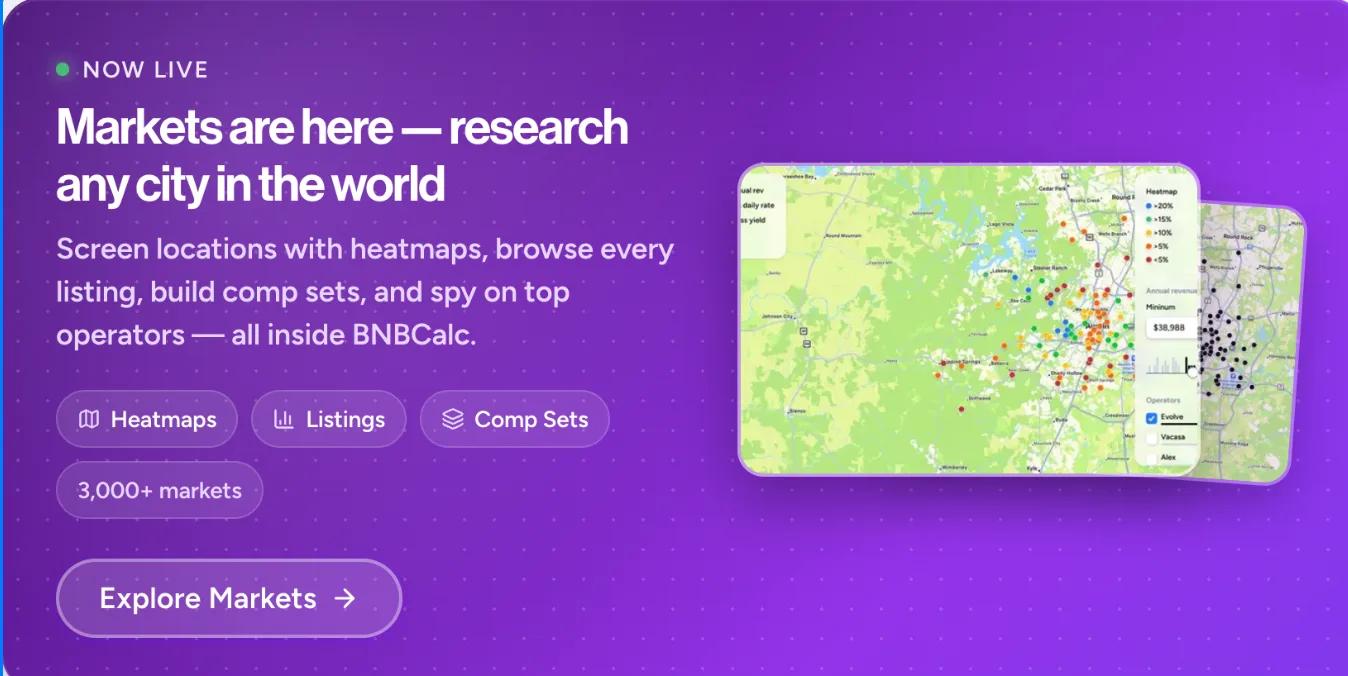
Skip that step and you get what she calls the Home Goods special, where the house fills up with usable stuff and you leave money on the table. If you want the same comp and amenity data before you buy, BNBCalc Markets is built for it.
Key Points
- Somerled runs four design teams, one manager to five designers, and every team takes five projects per two-week design slot. That's the structure behind 40 design projects a month, staffed by roughly 60 people two years in.
- Roughly 10 of those become full installs. Two Somerled people fly out, a designer and a project manager, while the wallpaper installers, painters and furniture builders all get hired locally.
- Nothing starts without a Matterport scan. Jordan recommends getting one even if you never hire a designer, since plenty of investors buy sight unseen and still need real measurements.
- Her favorite proof is redesigning a place that was already an Airbnb, because the management and often the listing stay put and only the design changes. One in Nashville was up about 20% within roughly six months.
- Almost everything Somerled touches stays cosmetic: paint, wallpaper, light fixtures, popping out old drop ceiling tiles. No permits, no walls coming down.
- Nashville, Scottsdale, the Poconos and Florida were the early markets, though the trend she's watching now is drivable weekend country three or four hours outside a big metro, plus college towns. Stowe, Vermont is on her own list.
Full Transcript
Listen to the full episode on Apple Podcasts, Spotify, or YouTube.
Jeremy: We're rolling now. We're live with the Short-Term Rental Pros Podcast. Jordan is a superstar entrepreneur and designer in the space. I've had her help on one of my projects before. Absolutely crushed it. Has, at this point, designed how many houses?
Jordan: Oh, man. Well, this year we're going to be a little bit over 300.
Jeremy: Got it.
Jordan: Yeah. So overall, I mean, shoot, probably close to 500 at this point.
Jeremy: So how did Somerled start? How did you and Brie get hooked up? Walk us from the first one to now. I feel like it's been two years since you all started.
Jordan: Yeah, we just hit two years this month. So, the origin story. I love it. Brie and I actually got connected because our husbands were friends in college. They were in the dorms together. And so we got connected when I was dating my now-husband. And her and her husband kind of did the sales route for a little bit. And then they found someone on TikTok.
Jeremy: Was that BYU?
Jordan: BYU, yeah.
Jeremy: BYU connect.
Jordan: Yep, exactly. So yeah, we all got connected at BYU. And then a few years later, after meeting them, they found Michael Elefante on TikTok talking about Airbnb investment. And they just kind of took the leap of faith, started investing, following his step-by-step process, and just fell in love with being investors in that capacity.
And so Brie, being a good friend of mine, and she also coming from the marketing background, she has a really great extensive background in marketing. She did website design, worked with lots of different clients and things like that. And so they wanted to approach Airbnbs in a very different way, definitely as a business. And this is about five years ago, so definitely before the curve of how we see the Airbnb industry right now.
Jeremy: So, 2019?
Jordan: Yes.
Jeremy: Pre-COVID.
Jordan: Yeah, pre-COVID. And so that's when they invested in their first few rental properties. And then their first real investment into a very competitive market was in the Phoenix, Scottsdale area. And so that's when she was really looking at the competition in the area and just saw, okay, the ones that are really standing out are the ones that have really cool intentional design.
And so, since she doesn't really have a background in interior design, and at the time I was working in the interior design industry, she just called me up and was like, hey, I would love to work with you on this project that I have coming up. It's going to be one of my short-term rental properties and I really want to blow it out of the park and just make it incredible and really fun and be very Scottsdale specific.
And so, started with her first property and then a second property. And then people just kind of started taking notice. And we're just like, okay, the design portion of my investment is not very fun. It's really time consuming. And so then we just started offering our service to other people. So that was about two years ago-ish. And then here we are today with kind of a full-blown business of just doing...
Jeremy: Y'all have a machine.
Jordan: It's a machine. It's a well-oiled machine. At least we're getting there. And yeah, now we're able to pump out about 40 projects per month. We do about 10 installs per month where our team goes out and does the whole project management. And yeah, it's been a blast. So much fun just to be in that niche of Airbnbs and short-term rental, interior design, and kind of like a marketing strategy and service alongside that.
Jeremy: Would you guys ever... so, the install service, you guys go out there, you project manage furniture assemblers, painting, some minor cosmetic renovations. Would you turn... let's say I'm in Alaska. Let's say I'm in the middle of nowhere, Alaska, and I'm like, hey Jordan, can you guys come do an install? Are there projects you guys have to turn down?
Jordan: Yeah. So we will do everything in the continental US.
Jeremy: Okay. So Alaska, that's the one.
Jordan: So Alaska might... okay, maybe someday, but yeah, we'll say continental US. So anywhere in the US, we've done. We've touched a lot of markets here already. But we've done a few virtual clients internationally where they will kind of coordinate the shipping and stuff for themselves. But that's a goal. We will get international and outside, maybe into Alaska, Hawaii, someday.
Jeremy: So how many... if you guys are doing 10 in-person installs a month, how many team members is that? Because I know I've been in person doing the installs myself, and I know it's a lot of work. And also, making everything line up perfectly is challenging. Maybe it's less challenging now because shipping times have, I feel like, gone pretty back to normal, or pretty good.
Jordan: Yeah, pretty good now.
Jeremy: There was a couple years ago where you order something, and no, it doesn't show up. And you order it again, and it still doesn't show up.
Jordan: Yeah, no, exactly. We're very strategic with our shipping times. We make sure that everything says it's going to ship within three to four weeks. So that's kind of what we do. Every once in a while, there's going to be something canceled that we'll have to just work with once we're there on site, or work with our virtual clients to make sure everything is good to go. But yeah, shipment times are a little crazy.
But actually being out there on site, we have two team members that are from the Somerled team that will actually be out there. It'll be a designer and a project manager, and then we hire out the rest. So we'll hire out locally for wallpaper installers, painters, furniture builders, everyone like that, who would actually help us with the full implementation of the project. And so our team size and all, we're at about 60 internal people right now.
Jeremy: Yeah, I was going to say, because you've got two people on site you're doing in a month. I mean, how many can one duo do in a month?
Jordan: Yeah. Usually our project managers go out about twice a month, so one to two times. And we have a good, big design team. And so designers kind of rotate through a little bit less frequently.
Jeremy: I think last time we talked, I don't want to butcher numbers.
Jordan: No, that's okay.
Jeremy: You guys had three different teams of five with a manager.
Jordan: Yeah, exactly. No, you have a great memory.
Jeremy: Numbers. I remember numbers.
Jordan: You remember numbers.
Jeremy: I know. Anything else, I don't remember. The name of your team members, I couldn't tell you, but if it could be a number, I'll remember that.
Jordan: Yeah. No, before we came and started the podcast, I'm like, I know Jeremy's going to ask me about numbers. I'm like, I hope I get the numbers right, because that's not my forte. But I'm like, okay, team members, I can do that.
But the way that we have it structured is we have one design manager to five designers. And so that's how we structure it: each team gets five design projects per two-week period. And so we just kind of replicate that. Right now we have four design teams, and that's how we're able to pump out the 20 design projects per design period, which is 40 projects a month.
Jeremy: And just some things that impressed me with you guys. I mean, I've worked with designers, I've designed myself, which I definitely don't do that anymore. I feel like 2020 and, lesser, 2021, lesser competitive markets, I can kind of, all right, some blues, some grays, some blacks, put it together, it looks okay, call it a day. But that's definitely not the case nowadays.
But just kind of go through your guys' process, or what I found was impressive. Off the bat, you needed a Matterport. You weren't going to touch it unless you had someone come out there who could do the 3D scan and find all the wall outlets and all the doors. You guys weren't going to trust me hand drawing, like the door opens this way. I'm sure you guys have had times early on where you did things that way, and you learn from your experiences.
Jordan: Exactly. Yeah. We got Matterport onboarded onto our whole process pretty early on, because that's how we started. We're like, okay, go out to the property, take some videos, get a tape measure. It was pretty crazy.
So Matterport is an amazing resource and a solution for anyone. Whether you use a designer or not, so many investors are purchasing these properties sight unseen. So get a Matterport scan and you will get a full sense of what the interior looks like. You can take measurements, and that's been a really great solution for our team.
Jeremy: Yeah, absolutely. I think you guys also, you had an investor... you made it clear early on that you guys were looking at things from an investor perspective. It wasn't, oh, our opinion is you should do this. It was, we looked at the market and we looked at the comps and the way that, yeah, you should do it, essentially.
So I guess now that you've had a couple of years, and I'm happy to talk about the project we did together, but do you have numbers of people we worked with early on, were able to do X and then Y? Those who were successful, let's reverse engineer what success looks like.
Jordan: Yeah. No, I think that's a great question. It's really interesting to see historically now, because I think two years is a good amount of time to really see, but it is really surprising that sometimes just within a first few months, we're able to see incredible success with really intentional design.
So like you said, we always start with market research. And I think that's something that we are continually improving on with our processes, is making sure that our team is really well-equipped before we even make any design decisions. And so we're jumping into the comps, the market research, the data. We love AirDNA and just other resources to really dive into all of that that is already out there.
And so that's how we start, and then jumping into the design, it's really informed. So we know exactly who the target audience is, what amenities are going to increase the ROI. And so with that strategy going into it, again, we're able to see a pretty quick return on investment.
My personal favorites are properties that used to be Airbnbs, and then we come in, do a redesign or refresh, and then we're able to kind of compare just like apples to apples, where it's the same property management a lot of the time, it's the same service renderings, sometimes even the same listing on the Airbnb platforms, but the only thing that's changed is the design. And we've just been able to see people really exponentially increase their overall ROI. Like one example is we did one in Nashville this past year, and just within, I would say, about six months, it was like an increase of about 20%.
Jeremy: Got it. And I like how you said the apples to apples comparison, because that's where I think a lot of people get bogged down in short-term rentals: they look for apples to apples answers.
Jordan: Yeah, that's not usually the case.
Jeremy: Yeah. This comp down the street is doing this amount. Does that mean I'm going to make exactly this amount of money? It's just not at all the case.
Jordan: Yeah. I mean, you can have two properties that even, like two identical properties, even with the same property manager, and they could even have significantly different performance. And when you break it down, it's just like, oh, you know, we price...
Jeremy: Well, if you have the same property manager, you're probably pricing the same way. But even for me, okay, I'll give an example. I have very similar properties in the same market and I'll have different pricing strategies for each of them. So if I manage eight lake houses, I might be like, all right, for half of them, I'm going to test out this pricing strategy. And the other half I'm going to test out this one. I'm going to give it a year or two. I'm going to see which one plays out better. And then I'm going to do that one moving forward.
Jordan: Yeah.
Jeremy: So this game, it's not like a commoditized, right answer, wrong answer game. It's roll with the punches and improve over time, which creates opportunity. But also I'm sure you guys, 300 clients, and I'm sure clients are looking for exact answers.
Jordan: Yeah. And that sometimes is tough, because we can't say exactly like, okay, you are going to increase your ROI 50% if you use it somewhere else.
Jeremy: You might suck at pricing. You might suck at management.
Jordan: Yeah, exactly. So it's like, we have to bring in those considerations for sure.
Jeremy: But the way that we start with a question: have you guys ever handed designs off to people, and then, like the virtual design clients, they just did not execute on it somehow? Like they just messed up the paint. I would imagine that it happened. I feel like with us, because I want things done so quickly, I did most, like I did 98% of everything.
Jordan: Confession. You're like, actually...
Jeremy: There was like 2% where I was like, well, sometimes wallpaper people take forever and eventually get it done. But at first, just, okay, we got to get this up. I'm not waiting for wallpaper people.
So has that ever happened, where you guys... and you guys do literally give the perfect blueprint. You give the several resources, a spreadsheet that says everything, everywhere it goes, dimensions, the link to it, you give the PowerPoint presentation that shows it visually. But has there been cases where you've handed everything off and then they're like, oh, we got photos taken, and you're looking at it just like, oh my goodness.
Jordan: Yes, I mean, it does happen. We do a lot of work up front, but I guess that's kind of the beauty of the virtual design as well. I think a lot of investors think like, okay, I totally can handle this. And a lot of investors who do virtual design with us first, they come back, they're like, we are never doing that again. You are for sure project managing our next one.
And so yes, every once in a while. And then they'll send us their photos back and we give some pointers. I really love it when clients come to us during the installation process and they ask us questions. I'm like, yeah, please reach out to us. We want to be a resource to you so you feel well equipped to be successful on your own. So it's kind of balancing what fits best for an investor, because the virtual doesn't always fit their needs, but then the project management side and the design doesn't always fit everyone's needs.
Jeremy: And the lifestyle photos. Tell us about these lifestyle photos. I'm curious, how long have you been doing the lifestyle? That's why I follow you guys on Instagram, and I feel like 50% of the content now is the Jordan lifestyle.
Jordan: I know, I know. Luckily I'm not in every single one. It is just when it makes sense. And obviously, me being the owner, I'm like, that's the cheap option.
Jeremy: You're flying around everywhere. How many installs are you going to? Do you just go for the lifestyle photos or do you go for the whole thing?
Jordan: Sometimes. Yeah. I'll usually kind of show up like last kind of portion of the install.
Jeremy: And if you guys are doing 10 a month, are you looking at 10 a month?
Jordan: I'm not. No way.
Jeremy: I mean, on Instagram it looks like you are.
Jordan: I know. I'm there. I probably average about one a month. So I usually am going out for... I mean, like, why I'm out in New York, there's usually a few other reasons. And so I'm able to kind of plan things around where I'm like, okay, I'm going for X, Y, and Z. Yes, we have an install going on right now. Yeah, I'll be able to kind of align to that.
Jeremy: So you'll go to the end. So then you can partake in the, or, or be...
Jordan: The lifestyle.
Jeremy: The lifestyle and the lifestyle photos.
Jordan: Yeah. Sometimes.
Jeremy: Do you have... I know I don't want to throw numbers at you, I'm not trying to get up and running, but have you seen what the ROI on lifestyle photos are? Are they worth doing? Not worth doing?
Jordan: Yeah. I think it's definitely worth doing for a very niche target audience. So I think girl groups, families, things where people are going to be booking on kind of like an emotional level. I think lifestyle photos are really great because people are able to look at those photos and then envision themselves there with their group of friends or their family members, and then also kind of see the amenities in action. I think for amenity sell it's really, really important.
And I believe it was Kenny from STR Insights.
Jeremy: Yes.
Jordan: We chatted with him, I think at the San Diego conference as well. And he was saying, oh, every single listing needs lifestyle photos. And we're like, okay, we're not there yet. But I do think that...
Jeremy: I need them. I don't have them. I need to at least... I've done a... so the most recent investment I've done, we haven't done lifestyle photos, but we've done more direct marketing.
Jordan: Oh yeah.
Jeremy: So we bought a massive barndominium in Wisconsin.
Jordan: Oh, cool.
Jeremy: And it was actually an existing Airbnb where we really haven't done anything other than take higher, better photos. We're going to add a mini putt and all this stuff once the winter comes around. But we've done Instagram reels where we've had models come in and wear the cowboy hats. So we've done the lifestyle reels, but we haven't done the lifestyle photos. So I'd love to hear... yeah, you're [inaudible]. Kenny says that everyone needs to do them?
Jordan: Yeah, that's what he was saying. And we're like, okay. I think that's really what got us thinking. We had integrated it a little bit. And I'm sure Kenny actually has better numbers than I do at this point, just since this is so early on that we're introducing this to our clients.
And so we are able to offer with our project management service, hey, we will manage lifestyle photos as well. It's kind of like an add-on, if they want to pay for it. We'll look again at the market research, look at what their competitors are doing. If there's a really big lack of lifestyle photos with their competitors and it's a really competitive market, then we would usually recommend it and say, okay, this is one way that we can really separate your listing from others: integrate lifestyle into it.
I think it's a good balance. You don't want to have your listing have only lifestyle photos. I think it's nice to sprinkled in, especially around the amenities, like the pool, the get ready station, things like that. So again, it's more of an emotional buy.
Jeremy: Get ready station. Those are... we love those. Are you kidding? It's just kind of like a bar with a bunch of mirrors.
Jordan: Yeah, I know. I know. But so that's kind of like our take on lifestyle. I think it's a little early to tell for sure, but I think it's a great way to differentiate because it's so saturated. So we always are thinking through ways in which you can just be more competitive.
Jeremy: Got it. It's all about being competitive and winning.
So I don't know if I shared, I think I did an Instagram story where I was like, hey, it's been a year since we got this house. But yeah, the house, and this is actually something I'm curious your thought on. So we got the place last year in December, so it's November right now, for 640. I thought we got a good deal on the front end and that it was undervalued, but we just refinanced it. We timed the rates perfectly.
And I didn't do this at any of our... I had a partner on that house who was so on it, because when you do a refi, you gotta do all our paperwork and everyone's got to sign whatever documents and whatnot. So we had a few houses where we just didn't get it done, where I was like, guys, I really think we got to time the rates here. But for that one, we timed it perfectly. So shout out to my... no, no shade on anybody else that we didn't get it, but special shout out to the one where we did, we executed. We got it like 5.875, and then it shot back up like a point. Now it's like 6.7, like two months later, a month later.
But my point on that is we got it refinanced and they appraised it at 820.
Jordan: Wow.
Jeremy: And I was like, what a jump. And we did finish out the basement, we added a movie theater. But I was like, maybe the design, having the appraiser walking around and being like, damn, this is nice, maybe that has something to do with the appraisal, because the market definitely did not go up 15%, 20% value. Actually, what's even more than that? 640 to 820? No math.
But have you guys seen, or have you had refis that people have done where they've came out a lot higher? And do you think that's attributed to design, good design?
Jordan: I think so, yes. And I will say that most of the time, we're only making cosmetic upgrades to any design that we touch. We're not knocking down walls. We're not doing massive remodels. It's just paint, wallpaper, light fixtures, things that you don't necessarily need permits for. And so even just little things like that can exponentially help your property as a full.
I can't say exactly like, okay, this is the exact percentage that you're going to get reappraisal value at. But I think it definitely helps just with having a cohesive design, having stuff that is very intentional. It definitely helps. And so I'm thinking of one other instance where a refinance really, really paid off after the full design. And again, nothing super extensive. Just a little bit, just some paint here and there can really go a long way. So that's awesome to hear. Congrats.
Jeremy: Thank you. And I'll say the house where we didn't, we self-designed in a market. So we did one in Western NC. We got it right at the end of when interest rates shot up. So we actually didn't refi it, but we went from 10% to 20%. So you owe PMI: if you're under 20% equity in the house, you have to pay a couple extra hundred bucks a month. So we wanted to get rid of that. But in order to get rid of that, we needed an appraisal.
And in that house, we really did not design it that well. We actually finished out the basement. We added square footage. At the time, I may have thought it looked good, but now I look at it and I'm just like, ah, golly, what did I do? I'm mad at myself.
Jordan: Time to do a redesign.
Jeremy: Yeah, maybe. We got it. Oh my goodness. But when we re-appraised that one, even though the market in that specific area had shot up, we bought at $429. It re-appraised a year later at $530. So there was a jump, but the one I did with y'all definitely, the market didn't go up and it shot up a lot.
Jordan: No, definitely.
Jeremy: I don't know. I guess this is maybe an apples-ish to apples. So that's a thing to think about with design: okay, sure, you're going to increase the revenue, but also the asset itself.
Jordan: Exactly. Yes. And especially when you're going to be adding more amenities. Remind me, did you add a pickleball court or anything else?
Jeremy: We didn't even do that yet.
Jordan: Okay.
Jeremy: So we've waited. We kind of got it up. We let it ride at some point. I like to tier things, and I'm sure the people recommend just do it all up front. I don't do it that way. I'm like, all right, how much cash do we need today? And then let's wait until the next winter and add some more stuff to it.
Jordan: Makes sense. Yeah, for sure. Kind of like a one really easy change that I think we did to your property as well was that dropdown ceiling.
Jeremy: Yeah. So that is like that, like high school.
Jordan: Yes. Like the white, with like the speckles in it. I mean, that is like such an easy upgrade to any dropdown ceiling. You can just get those tiles and pop them out and either...
Jeremy: Is that what we did?
Jordan: We did, yeah.
Jeremy: I have another house where it has the high school tile.
Jordan: Yeah.
Jeremy: And we did that. I'm like, dang, all right, we're ordering all the way through. We're getting all these swapped out.
Jordan: Yeah. It makes it look so bad.
Jeremy: It makes it look like you're in like an old fashioned movie theater. It's really cool.
Jordan: Exactly. And it's such an easy, cost effective way to make it look so much better than actually drywalling and doing like a real ceiling.
Jeremy: Yeah. So tell us the hacks. Do you have like three... I said, what's your biggest short term rental pro tips? I want tips. What are, like, 300 clients? What separates those who overachieve?
Jordan: Yeah. So, first question.
Jeremy: Yeah. What separates those who overachieve?
Jordan: Okay. So those who overachieve, I think it's just having a strategy. If people go into a property, they're like, okay, I can for sure design it myself. We call it the Home Goods special. You're running to Target, you're running to Home Goods. You're just trying to fill the space with usable items.
Jeremy: I've been there. Craigslist.
Jordan: Yes. Yeah. And it's like, no shame there. I mean, I think everyone's investment journey has to start there. And I think you just have to learn along the way. I think we've learned a lot at Somerled over the last few years. And we've changed a lot of processes and made sure that we are continually leveling up.
So yeah, we call it the Home Goods special. And so that is, you're essentially leaving money on the table, because even if you have a beautiful home, it has five bedrooms, the exact same amenities as your competitor, if you don't have strategic design, then you're never going to get to where your competitors are, or exceed what your competitors are doing. And so having a strategy first is, I think, the main way in which you can really differentiate yourself from the get go. And you're still going to be spending essentially the same amount at the end of the day, but it's actually going to have strategy and intention behind it instead of just kind of throwing things together.
So that's why we started off with market research. I mean, anyone can do that. Just look at your competitors, look at what amenities there are, and just come up with your target audience. It's not too, too hard. We have AI now. It's so easy to just type into ChatGPT: okay, who is traveling to Nashville, Tennessee? Why are they traveling here? What are the draws? Honky tonks all the way, girl groups, bachelorette groups, and then you just find that niche market. And in some markets, like obviously like Nashville, there's enough data to show there are so many girl groups coming, but then in like a market where it is a little bit more, I don't know, like, let's say just like a big metropolitan city.
Jeremy: Do you see... well, quick question. Like in Nashville, where maybe if you look two, three years ago, it's like, oh, it's so obvious that all these girl groups are coming. And if you do a honky tonk, all the mirrors everywhere with the get ready stations. And then do people come in and, like, all of a sudden there's like 50 more get ready stations and there's one at every house? And then it's like, ooh, all right, we've no more bachelorette themed parties. Or have you seen that? I guess, has it happened where it's like an oversaturation of a certain theme?
Jordan: Yeah. You know what? Nashville is interesting, because although there's so many Airbnbs that are doing the same thing, there's still so many girl groups who are still going. And so if you do it right, if you really are, again, intentional about it, have really fun photo moments and other things that you're integrating into your design, then it's still going to outperform even your competitors.
And so I think we are strategic, especially about markets that are becoming very, very saturated, of having things that are a little bit different here and there too. And they're able to still perform really well too. So I think that it's not too much of a good thing if you do it at the top tier. Be the best.
Jeremy: Be the best. And that starts on the upfront, doing the research, understanding who the guest avatar is, who's coming to your area, why are they coming to your area.
Jordan: Exactly. Yeah. So that would be my biggest hack of telling anyone, whether you use a professional designer or not: just do your research, and then build a Pinterest board and really determine who your target audience is. Because then that will just set you up for success. You'll be thinking of that individual or that group of people as you're designing or as you're sourcing products, and everything will just feel way more cohesive.
So when you're looking at a listing and you see all the photos together, it feels so much better when it's cohesive, when you know exactly who it's for. And then that's your marketing tool. Your photos, the design, that is your main marketing tool for your Airbnb. And so make sure that it is correct and it's in line with what your investment goals are, with your overall ROI, because design really will, it'll increase it. I mean, every single client of ours, there's not been one instance where it's decreased over time or they didn't see any change. It's always an increase no matter what for design.
Jeremy: Super. It's crucial.
Jordan: It's crucial. Yeah. Design and amenities.
Jeremy: Exactly. So have you seen any particular amenities that just haven't worked across markets? Because I know the market we work together in, there really isn't... it's not a Scottsdale where you can be very clear-eyed. In Scottsdale, you've got all these golf people and you've got all these pickleball people. So what we did is, all right, let's look at some similar-ish markets and try to pull things people are doing there and bring them here. But are there specific amenities that you've seen, like, damn, these are crushing it everywhere, we recommend these to all of our clients?
Jordan: Yeah. So that would be my second: take a look at your amenities before you even look at the interior of your home, and just think like, okay, what are we going to put here and here? Think instead of like amenity strategy. And I think that's going to be just a huge selling point for no matter what market you're in. I think hot tubs across the board, everyone loves a hot tub if you're able to do it.
We've been doing a ton of like cold plunges and saunas. I mean, I think it's a little bit trendy right now, but it's still such a great amenity to add that you're not going to have in a normal residential home. So anything that you can kind of level up to make it so it doesn't feel just like your day-to-day home, I think that's just like a great one.
Jeremy: You guys started doing the saunas. I've seen them recently where they have the glass in the back.
Jordan: Yeah.
Jeremy: Because I feel like a sauna at this point, the shot of like a closed sauna is not that cool.
Jordan: It's not.
Jeremy: But if you do the sauna with the glass in the back and you point it at the view, then all of a sudden it's like cha-ching. And then you bring lifestyle photos in there.
Jordan: Yeah.
Jeremy: Then you really sell the experience.
Jordan: Yes, exactly. Even like a hot tub, you can't just take a picture of a hot tub sitting there. It's like, okay, that's just like a big square rectangle with water in it. And so you design around it, you bring in some towels and even lifestyle and other things to really sell the experience. It's the experience that you're selling at the end of the day, and the design just really kind of helps you get there.
So yeah, we actually did this really cool sauna. I forget where exactly it was. It was out in the Poconos. Beautiful view out on this property.
Jeremy: Are you all doing a lot in the Poconos?
Jordan: So many in the Poconos.
Jeremy: Poconos is, yeah. I mean, I live... I'll explain kind of where I'm at, or different markets. I live an hour and a half from the Poconos. It's easy to get there, which is an attractive thing. As far as, I do manage everything remotely, and honestly there are benefits not being close, because then you don't even think about trying to, oh, there's an issue, I'm going to go fix it.
But it is cool, like during the setup process, I do enjoy creating the experience. It's something I do like. I don't want to be there the whole time, but I want to go there at the beginning, have a feel for it, and then come back towards the end and make sure everything, attention to detail, is there.
But yeah, question: are you guys doing a lot in the Poconos? Because for me, there's a lot of revenue there, but there's also a lot of your guys and all these other people I know designed homes there.
Jordan: Yeah. I would say a trend, like about two years ago when we started, it was like Nashville, Scottsdale, Poconos. Those are like the top areas in which we designed in. And everywhere in Florida. Can't forget Florida. I mean, Florida really is still such a great market.
Jeremy: Even now? Even like the last few months, have you had a Florida slowdown?
Jordan: A little bit of a slowdown just with the hurricanes, I would say. But yeah, I think Florida will always be good.
Jeremy: Like Clearwater, Seminole, Largo, like those areas?
Jordan: Yeah, those areas got hit a little bit. We were supposed to go out and do a few installs that have been postponed, that we're probably going to be doing now in January.
But the thing is, people are always going to be traveling to Florida. So I think you can look at historic data of, okay, where are areas that people have historically traveled to for generations? And it's like, okay, the Poconos is definitely a place like that. I think Florida is definitely a place like that.
Jeremy: Like Gatlinburg.
Jordan: Yeah, exactly. Where it's like, okay, your parents, your grandparents, that's just like a meeting spot that people feel nostalgic about. So I think those are always markets that are great to invest in, even if they do tend to be a little bit more saturated.
But just trends that we've been noticing recently is taking a look at kind of larger metropolitan areas and then going about three or four hours outside of that, that are drivable, weekend trips, people who want to get out of the city or out of just like normal day-to-day life, and invest in those areas.
Jeremy: And it's generally more rural areas.
Jordan: Yeah, a little bit more rural, or less competition.
Jeremy: Less competition.
Jordan: I think those are going to be the areas that are definitely going to become like a Scottsdale, a Nashville, let's say like five years from now, because it is saturated, it is competitive. And so you kind of have to think through, okay, what are trends that we're seeing people investing in, and where are they traveling to?
And I like how you brought up looking at other markets, compared to the market that you're investing in now, of, okay, where is another market that maybe looks like my market maybe two or three years ago? And okay, what can I add into my market now, or into my property, that will help me outperform people who are going to be investing in here over the next five years?
Jeremy: Yeah. And I would add something to that, and this is something I talk about a lot: natural scarcity. What about my property is something that can't be recreated? Because there are certain places where you're in there today, but, and I do think this is less of a risk than it was the last few years, because interest rates were so low, house prices were so low, that places like Gatlinburg, Pigeon Forge just absolutely blew up. Maybe wasn't quote unquote competition, or you were competing against [inaudible]. You're just competing against disgusting listings that families have had in their generations for 40, 50 years, in early 2020. But now you're competing against hundreds of Somerled properties that are immaculate.
I don't think there's that same risk of, if you get into one of these markets that is lesser known, which I would say Gatlinburg was not known in 2019, 2020. I do think there's less risk of that, like 2027. I mean, if you look at AirDNA or whatever, and the supply of short-term rentals across the US, it's decelerating. It's not like there's a deluge of new properties hitting the market.
Jordan: Yeah.
Jeremy: Is that... I guess a question for you guys. So there are less... I think, maybe correct me if I'm wrong, I think you guys have the tailwind where people understand the importance of design more now than ever.
Jordan: I think so, yeah.
Jeremy: But you might have the headwind of, there's just less people buying properties. Or is that correct or not correct?
Jordan: Yeah, it's interesting, because I could see both sides in a way. Because I did read this stat recently where there's over 14,000 new hosts joining the Airbnb platform every single day. And that could be decelerating, and people just aren't investing as frequently as we saw. I definitely think we saw such a huge surge during COVID.
Jeremy: I mean, it was like a one-time phenomena.
Jordan: Yeah, I mean, it was insane. But I think what really differentiates, it's slowly weeding out kind of the mom and pops who are just throwing up their basement or just their casita or something like that, that isn't intentionally designed, it's not run as a business. And so I think what the platform is going to be turning into is people who are serious about running a business.
And I think design has such a huge part of that, because you're thinking of it as an overall investment instead of just, okay, just like a quick buck here and there. So although it may be decelerating in terms of more hosts joining the platform or more people buying properties, I think it's actually going to become even better, not only for a user experience, who's going to be booking Airbnbs, but also for individuals who are hosts too, because it's going to become a more lucrative business, if you're actually serious about doing it right and doing it in a way that will set you up for success in the long run.
Jeremy: Definitely. So if I'm looking in the Poconos, who's having... I'm just curious, picking your brains is what we have a podcast for, so I can pick people's brains. What does success in the Poconos, for example, look like? That's kind of like a mountain-ish market. What are you doing with your clients there to help them outperform?
Jordan: Yeah. So the Poconos is great because it's exactly that market that I was talking about, that people come for generations. And so we still see those Airbnb listings that have the buffalo plaid and they have the rustic wood bed frames. It's just a little bit dated.
And so you have to think about that target audience, but also who's actually going to be booking it. So most of the time it's women, it's the mom, it's the grandma, it's someone who cares about their group of people that are going to be traveling. I say Poconos is definitely a family oriented place that people are traveling to. But think of that kind of maybe older millennial mom, and what is she looking for in that listing?
And so we are definitely taking the Poconos in a little bit more of a, I would say, cozier mountain modern kind of vibe. That's a design style that I think works really well. It feels elevated. It feels new and current.
Jeremy: Would that be what we'd classify Mike Chang's property as?
Jordan: Yeah, exactly. So his is...
Jeremy: I went out to the property, by the way, a few weeks ago.
Jordan: Okay, awesome. How's it looking?
Jeremy: He wanted feedback and I was like, yeah, inside, I can't really give any feedback. This is pretty perfect. Obviously I'd give feedback to you if I thought there was any feedback. I mean, I did say, and outside there's things that, and I know he knows that and expects that, like over time, outside you could probably do more to it and add new amenities.
So I actually recommended building like, because he has a view of the Hunter or Windham mountain ski slope in the corner. I mean, I love the property. I told him, I was like, this actually is my personal... like, I live in New York City. This would be like my dream. Like I grew up, I've got, like my great uncle has a place in the Hamptons, and I get the whole allure of the Hamptons. I've gone out there, the beach, but it's just like so freaking crowded. You have like no cell phone service, the restaurants, it's so seedy. You got to get a reservation everywhere. Personally, I like chiller places where you can do outdoorsy things. And also skiing in the winter is definitely appealing. So a massive three floor cabin with views of the ski slopes, to me that's like personal goals.
But that notwithstanding, I was like, you need to capture that moment of the view. You just don't really have... so if you did a little bit of an elevated deck with not just a sauna, well, he has the sauna, but a sauna with that view of the ski slopes behind it. Or you could do a stargazing dome. That would serve the same purpose.
He was like, I don't want to move the sauna. I had to pay three thousand, $4,000 to put the cement pad. I'm not moving the sauna. I'm like, all right, well, just something. You can't just have a deck with nothing on it. You could, I guess, but just something really cool with that behind it. That moment, no one else would have that.
Jordan: Oh, exactly. I'm so happy you brought up that project, because that was [inaudible]. Michael and Liz, they're awesome. We're actually talking with them, I think, in a few weeks, just about that project. I think we'll do a recording as well.
Definitely went with a mountain modern aesthetic, but we know that people, again, have been traveling here for generations. We still want it to feel nostalgic and cozy. Whereas, I'm still in the Poconos with my family, it feels like growing up, but it's just the elevated, level-ups version.
Jeremy: Bachelorette, like Austin, Texas, like yeehaw.
Jordan: Exactly. Yeah, we don't only have to do that.
Jeremy: Classier New York, like New York City, more elite.
Jordan: Yes. It's like knowing that you're essentially the target audience for them, because it's people coming from the city, wanting to escape, and so we need to appeal to that level of taste, essentially.
Jeremy: I don't think I have that much taste. I think Kate definitely has taste, if you can tell by this podcast that we're in.
Jordan: Well, she would probably be the one booking the property, right? So it's like we want to appeal to her taste and what your goals are for that weekend, or ski weekend, or ski trip, whatever it may be. So yeah, that view is insane. We redid the living room space planning for them multiple times to really try to maximize that view.
Jeremy: Yeah, I do think from the inside, it's not as important. Because really, photos from the inside of a house showing a view, in my opinion, don't really...
Jordan: Don't translate as well.
Jeremy: Yeah, I think he had his first set of photos, and I was like, dude, these photos are awful. You got to redo these.
Jordan: I don't even think I saw them.
Jeremy: Yeah, well, he redid it. He was like, I thought that too, but I needed someone just to tell me how bad they sucked for me to push me over the edge. And then he got new photos, and he was like, yeah, they actually did help. Because I was like, dude, there's just shadows everywhere.
Jordan: Oh, totally.
Jeremy: Yeah, so you got to get it, I guess, the right time of day, or at least edit them so you don't see massive tree shadows on the back of your house.
But my point being is, yeah, exterior photos in a place where you have a view, you need to not just... and this is one of the houses I have. It has a view, but I'm like, you got to put something. People got to imagine themselves sitting there looking at the view. You've got to orient it where it's like, this is...
Jordan: Yeah, it's like, look at this. Amazing.
Jeremy: Yeah, no, I totally agree.
Jordan: It's like, we've designed the experience this way. When you're outside, everything is pointing that way.
Jeremy: Yes, exactly.
Jordan: No, and that's all part of the strategy. It's like that experiential design.
Jeremy: Basically writing the itinerary for the guests for the weekend.
Jordan: It's like, hey, you tell them exactly what to do, where to go, take the photo. And it's very intentional behind the scenes. But when they're experiencing it, they may not be like, oh, wow, they purposely put this fire pit around this area because it's a perfect view. But we know, being the designers, we come in...
Jeremy: It's intentionality.
Jordan: It's intentional, exactly. And I would say that is something that guests do pick up on.
Jeremy: I think they do. That it's hard to scale intentionality.
Jordan: Yeah.
Jeremy: Because guests are like, damn, every little thing is kind of thought about.
Jordan: Exactly. And I mean, that's what's going to lead to those five star ratings and reviews. That's going to lead to further bookings in advance. If they love the experience that you're providing for them, they're going to come back or tell their friends about it. I mean, it's the best when you have free marketing, when people just word of mouth post about your property on their own socials. I mean, that's the goal.
Jeremy: It's easy.
Jordan: Exactly.
Jeremy: Okay. So I think you've laid a very clear picture of what it takes to succeed as an operator. But I'm curious. So you're a business owner in this space and you don't... I know we talked about this last time. You don't have a property yourself.
Jordan: I don't. Currently.
Jeremy: You and John Bianchi. John, I've had on this podcast like three times. I think he sat... well, I think we had different chairs at the time. Well, we actually got a chair on the street that was... I think he sat on that one.
Jordan: Oh, so I get the new chair.
Jeremy: You got the new chair. Yeah. That's a Kate chair versus Jeremy chair.
Jordan: Thank you, Kate.
Jeremy: I went downstairs and it was like, oh, we found one on the street. Like, perfect. Looks like it's fine.
But he doesn't design, but he's helped, I mean, hundreds of properties at this point, but he doesn't have one himself. And I know it burns him a little bit. I'm curious for you, do you have that feel? You're like, I've got enough short term rentals, I don't need to be dealing with guests now, given I'm dealing with clients.
Jordan: Yeah. You've outed me. I kind of keep it on the down low.
Jeremy: Exposed.
Jordan: I know, exactly.
Jeremy: See all the photos of her with the cowboy hat on and at the pools and stuff.
Jordan: Yeah, I know. Luckily, the way that we've kind of built our business is Brie comes from marketing and investment, and then I come in with the creative direction, interior design. And so we're kind of like that balance.
And so, yeah, I feel like being in the space for so long, I have like all the tools for it. It's just, yeah, I need the time. I'm running the business. But no, it's definitely a goal of mine and my husband's. We definitely want to invest.
Jeremy: You need the tax savings.
Jordan: The tax savings, like all of it. So yeah, it's definitely a goal of ours and we want to be able to invest. And again, I feel like I have all the tools for it.
Jeremy: If you were going to invest, where would you? If you don't, you don't have to say. But ours, and it could be a personal...
Jordan: We want to invest in Utah, because we're...
Jeremy: I think you went to college there.
Jordan: Yeah.
Jeremy: I don't know if you're from California.
Jordan: I am from California. Yeah. So we won't invest in our own state. And I mean, you're here in New York, you get it. It just doesn't really make sense.
A trend that I've seen recently too is college towns. And I think that's really appealing to us.
Jeremy: You guys brought Texas A&M one.
Jordan: Yeah, exactly.
Jeremy: Down in College Station.
Jordan: Yeah. So I think determining that.
Jeremy: Don't invest in Chapel Hill, North Carolina. That is a college town I'm from. We're like, just don't do it. Well, it's kind of like a New Yorker, California, like super annoying. I do have an Airbnb there. It is a camper.
Jordan: Oh, okay. There you go.
But yeah, I don't know. So that was something that we've been kind of playing with. My husband's a big college football fan, so he's like, somewhere in like the SEC would be a boss. So that's, I don't know, someplace that we've kind of been playing with. But again, we're not so much like, oh, we want to be personally connected to a place. We would a hundred percent go into it as with an investment mindset and run numbers and see what would really make sense at the end of the day.
A place that's kind of been top of mind for me, I just did like a Northeast, or sorry, a New England trip, like just a few weeks ago. We were leaf peeping. I think that's like the cutest term. But yeah, we went up to Stowe, Vermont.
Jeremy: Apple picking too.
Jordan: Yeah. We didn't even apple pick. It was super quick, but we did go look at all the leaves, and like, hey, this is a really beautiful location. Again, it fits that kind of formula of really close, about like two to three hours, but outside of big metropolitan areas. So we flew into Boston, drove to Stowe. I'm like, this is definitely a place that I feel like would be a good investment area, or somewhere around there. So that's another big trend in the New England area.
Jeremy: Yeah. And that is, yeah, I got one in Wisconsin and it's not a city itself, or a known town. I don't even know the name of the town, honestly. But it is in between, or two or three hours from, Chicago and maybe Minneapolis. Don't quiz me on my Midwestern geography.
Jordan: I wouldn't know either. Sorry.
But yeah, so I mean, that's the thing. We'd love to invest. It's just, we're doing such a big push for Somerled right now. We've seen such exponential growth that that's definitely taken a lot of time.
Jeremy: When we talked, y'all were at like 40. Or I think you didn't tell me the number. I think I was like, all right, I'm doing the math here. You got how many designers, how many project managers. So you guys are still growing. What do you want to head... kind of to be at a hundred?
And yeah, this is my question. I was just like, a boss in the space, or a startup entrepreneur. What's the growth look like? What's your goals for Somerled? And then what tidbits do you have growing that business?
Jordan: Yeah. Well, I guess for year two, it was a little bit tough to compare with just like our year one, because we're like, hey, year one was so scrappy. We were just trying to build anything. And then year two has been really exciting to see. We've been getting a lot of operations in place, all of our SOPs, some really strategic hires.
And so year three, we're really excited, because we now have everything in place where we have that perfect structure for the design teams. We have a great structure for like the project management team, where we can essentially just continue to replicate it. And so growth, I think we're setting ourselves up for more growth, and it's going to be a little bit smoother sailing moving forward. So I don't know exactly what 2025 is going to bring, but we are hoping to grow exponentially.
Jeremy: I think when we talked, you guys were looking for like a COO type person. Did you make that hire?
Jordan: We actually did, yes. And she's incredible. She's actually in the space. We got connected actually through Skylar and Maddie.
Jeremy: Oh, sweet.
Jordan: Yeah, Skylar and Maddie, they have given us some amazing referrals. So yeah, they're awesome. And so this individual, she was kind of in their community. Maddie sent over her information and it's been an amazing fit. So she actually had grown a few of her own property management as well as cleaning companies, and was in the process of selling it, still wanted to be in the space. And so she's now over here at Somerled and it's just incredible.
So I think hiring is such a strategic move for up and coming businesses. I mean, I'm okay not being the smartest person in the room. I want to be surrounded by people who are way smarter than me and will help me grow the business to where we want it to be. So it's humbling. And I love to learn from our team.
Jeremy: Got it. So it's not like your goal isn't like... do you have any quant... not to, I don't want to throw numbers at you, but is there like quantifiable goals you guys have? Is it like, we want to do, we're doing 300 properties so far this year, we want to do like 600 next year?
So like next time you're randomly last minute in New York and I ping you guys, you guys don't give me the heads up, so that we last minute throw together the podcast. I want to hold your feet to the fire. Give me some goals.
Jordan: Yeah. So right now, like I said, I'll remember the numbers.
Jeremy: I know you will. I know you will.
Jordan: I know. So right now we're doing 40, but...
Jeremy: You'll remember the numbers.
Jordan: So yeah, right now I would say we're doing 40 projects per month, and that's still pretty easy leads, I'm not going to lie. It is such a demand for investors to make sure that the design is done correctly. And so we basically just have a little bit of a cap with our team, because we only have so many people, but if our sales team was working at full capacity, I think we would easily be able to do at least 60 per month. And so I think that's definitely like a Q1 goal, is to continue to ramp and get to that point. And I think it's important for us to not grow too fast.
Jeremy: Yeah. Well, I think you would have, let's say you had a month where you got to a hundred and you hired head count to satisfy, I mean, that's a lot of head count, but then the next month you did 50, which is still like a great number. That might be kind of hard. You don't want to take on team members and not have stuff for them to do the next month.
Jordan: Yeah. So we're very strategic about kind of like the steady growth, because we want to have work for people. We don't want it to be like, oh, we have like a great month and then going down. We want it to kind of be like a steady state. And so I think, just because we have those, okay, five design slots per design team, we're going to kind of grow in those increments. So about five to 10.
Jeremy: Does that mean like putting people on a wait list, saying, sorry, we can't do your project this month, but we can do it in like the next month? Has that been something that's been happening?
Jordan: It has, yeah. A little bit more of late. I think a lot of people are trying to get in right now before end of year for tax season. And so I think we're definitely seeing a huge surge.
But yeah, I mean, waitlist, we do try to get people into our design slots as soon as possible, just because we know time is of the essence. And so when people are under contract, ready to move forward, we're like, okay, let's get you on our calendar, or either on a waitlist for the next design slot. So usually we're able to book people about two weeks in advance, and that's pretty consistent.
Jeremy: Got it. Okay. So it's not like you guys are like, all right, we can only do 40 a month, we have to push you like two months from now because we're already backed up.
Jordan: Yeah, luckily not. So I think we've been just strategic in our growth, so we can be able to support the people who are coming through our door. And especially for the project management piece, that usually gets booked up first, because people don't want to do it themselves, which I totally get. It's a lot of work. And so that is what fills up first. And then the virtual clients, those ones we're able to usually fit in.
Jeremy: And are those the people who you guys do it for, generally like higher income earners, higher net worth, I would imagine?
Jordan: Yeah, usually. It's usually serious investors where they're building their portfolio. It's usually like their full time job, or they're like a high up individual at a different company and they just don't have the time or means to manage it themselves.
Jeremy: Or they know the value.
Jordan: Yeah, they know the value of their own time, and definitely want to make sure that they leave the job [inaudible] someone like us.
Jeremy: So what advice would you have? Let's say someone who's an operator of a short-term rental adjacent business. What advice would you have, or just honestly, any young entrepreneur out there who's looking to build a service business of any sort?
Jordan: Yeah, I think definitely getting operations in place. I think it's so fun and exciting just to jump in and just start going, going, going. But one thing that we've realized just over this past year is we can't just operate with everything in our head. We actually have to have operations in place, SOPs. And even like our managers, they might be doing things completely different ways. And so just standardizing things and making sure that it's repeatable and growable. And I think that's something that's been a little bit of a growing pain this year, as we've been able to figure that out. But as we are figuring it out, it's like, oh my gosh, why didn't we do this from day one?
I think another big thing is getting finances in place too, just making sure like, hey, where's your budget going? And how much are you going to be paying in payroll? And just kind of all those organizational things.
Jeremy: Like a lot.
Jordan: Yeah, exactly. I'm like, ooh. Yeah, I'm so happy it's like, I don't have to be the one responsible for that. And I feel confident being like, okay, every month, we're good. We have it budgeted correctly and we know what we're working with. So yeah, I would say organizational things like that. So not like a very fun or like sexy response, but that's just something that we've really discovered.
Jeremy: Numbers and SOPs.
Jordan: Yes, I know. That's so boring, but I know. Exactly.
But I think also just niching down into exactly who your client is. I think that's been something that really has served us well since day one, is like, hey, we're only working with investors. We're only working with investors in the hospitality space, whether it be vacation rentals or boutique hotels. It needs to be super niched. We got to know your avatar. And I think that's like the best thing that we can do, is knowing who they are and how to market to them, how to get them to work with us. And I think that's been what has served our success, I would say.
Jeremy: So folk who want to work with you, or just follow your journey, where can they stay up to date?
Jordan: Yeah. Easiest way is just on our Instagram. It's just at somerled.designs. It's S-O-M-E-R-L-E-D dot designs, with an S. And then feel free to schedule a free consultation with us. It's super easy. We just have our link in bio. Our website is just somerleddesigns.com.
And that free consultation is pretty awesome. I know you've gone through it too, with Allie, our sales rep. And we do a full underwriting of your property. We take a look at furniture budget, contractor costs, and then just look at your projections if you were to use us as a service. And we are able to hit and exceed those goals and numbers that we run with you. So yeah, free consultation call, get on with us when you are under contract on a property. That's the best way to get in touch with us and get started.
Jeremy: Awesome. Well, I hope you guys enjoyed today's episode. I appreciate you coming over and having you on.
Jordan: No, thank you. I've been looking forward to it, and I'm happy we were able to make it happen so last minute. So thanks, Jeremy.
Jeremy: Awesome. No problem. All right, guys, stay tuned for the next episode of the Short-Term Rental Pros Podcast.
Airbnb Tax Deduction Calculator
Paying too much in taxes? We have the perfect solution. Simulate an Airbnb home purchase below.
Purchase Price
$450K
Structure Value
70%
Apply Trump's Tax Cut (Bonus Depreciation)
Depreciation
$117,695
Interest
$21,600
Tax
$6,750
Year 1 Deduction
$146,045
Want to claim this deduction? Get a free cost segregation benefit analysis from CSA Partners — no obligation.
Get Full Analysis