Free instant analysis
Reveal Airbnb revenue for any address or city
Quick Summary
Marcus didn't start with ads. He started with a phone, a script and eight units in year one, and he's blunt about the order: if you haven't made a thousand cold calls, don't ask him how to run ads, because the leads will land and you won't close them.
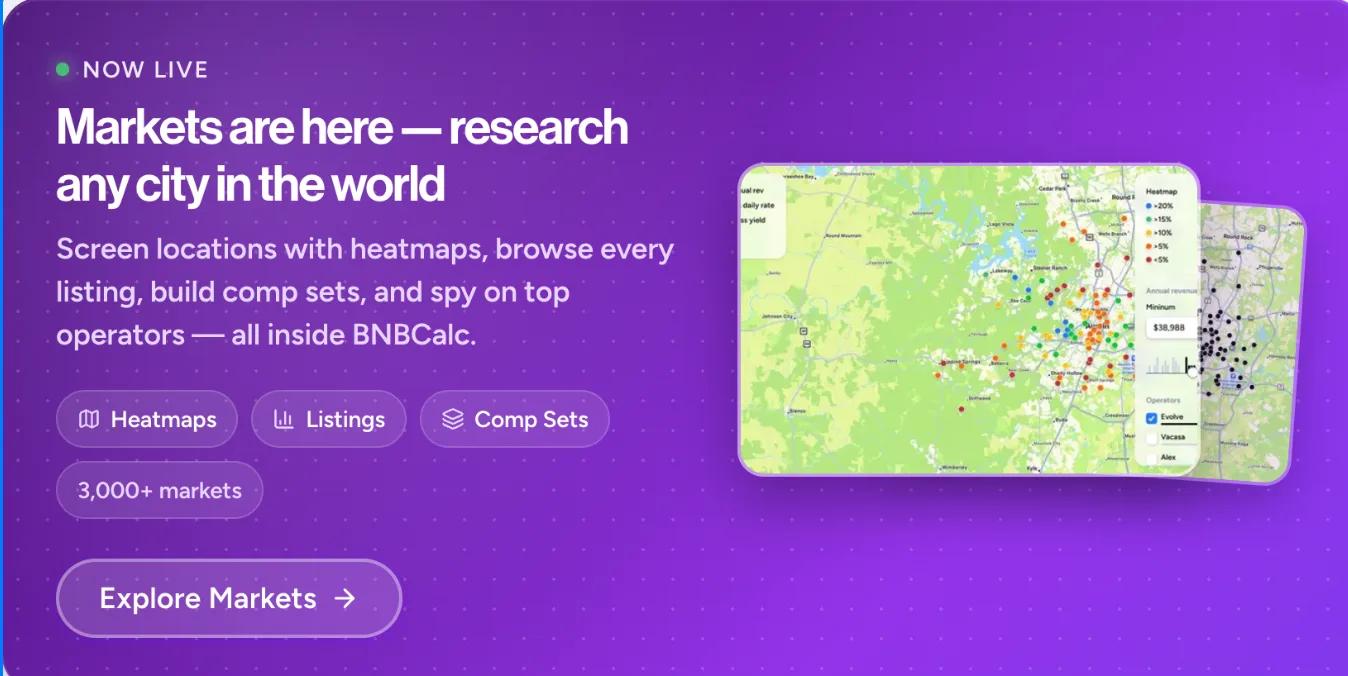
The math is what justifies the spend. He runs a $100,000 property at 20% management against a 15% churn rate and gets a client worth $130,000 over their life. Revenue projections are the hook on every one of those calls, and BNBCalc Markets is where you'd pull yours.
Key Points
- Cold calls got him to eight units in year one. Year two he expects to finish over 50 against a target of 75, on an average of $52,000 revenue per unit and a profit margin he puts at 47%, run by two W2 employees and a virtual assistant.
- The script opens like a missed connection: is this the Airbnb on 123 Main Street, I've been trying to get a hold of you guys. Then he names the bad reviews and the photos that seemed off, and offers a quick revenue projection behind a line he took from Jeremy Miner, if it wouldn't be a bad idea. He keeps that call to five minutes or less, because its only job is booking the next one.
- Cold call, then discovery, then a closing call, and he puts his own conversion on that last one at 60 to 70%. A short confirmation call the day before clears the questions everyone asks, and the closing call follows Alex Hormozi's CLOSER framework.
- The offer barely changes: first month managed free, a 90 day money back guarantee, $0 onboarding fee. He says they've lost one client since running it. GoHighLevel sends the contract with the management, tech and onboarding fees already populated, which used to cost him 30 to 45 minutes by hand, then texts for five days and puts a human on the phone on day five.
- His first Facebook ad was a black screen with the offer written on it, ten variations built in about ten minutes with AI through Canva, running at $50 a day. Forty eight hours later he had a booked appointment in Destin, Florida, on a property doing $55,000 a year. He's at $100 a day now, refreshes the creative monthly, and wants to push it to $200 or $300.
- Meta instant forms cost him about $150 per booked call, and he'd still start there rather than a landing page because the form fills itself in. Roughly 10% of leads book themselves through an AI bot, the rest get 14 days of SMS before anyone dials them, and he says year one will come in at over 900 leads.
- Every one of his top properties came through a realtor referral. He built a skip tracing tool, pulled around 9,000 realtors from the counties near him, and cold texted them at 150 a day without pausing for Christmas. About 200 wrote back, and he says owners now ask him for revenue projections every week.
Full Transcript
Listen to the full episode on Apple Podcasts, Spotify, or YouTube.
Ryan: Ryan Shapiro, along with my co-host Jeremy, who's not here at the moment. We will be focusing today on property management, acquisitions, how to find clients, how to get your business started, with one of my boys, Marcus.
Welcome, Marcus, to the Short-Term Rental Pros Podcast. How are you doing today?
Marcus: Thanks for having me, brother. Really, really good. Very busy, just like you, but happy to hop on here with you, man.
Ryan: Hell yeah. So we actually got connected randomly by, it was Boosley's guy that was just like, hey, I know you're using the CRM system for doing cold outreach. There's this guy, Marcus, I know, that's doing a lot of similar things. You guys should connect. I'm like, sweet.
Reached out to him right away, and then turns out he's like, hold on, I'm on a call with Raj. I got to go. And I'm like, oh, Raj? I know Raj. I'm hanging out with him this weekend. And then you realize that the short-term rental world is so small, even though everybody's all over the world. It's kind of crazy.
So yeah, we got to talk a little bit and wanted to bring him on. He seems like he's a G at getting clients, growing a business. But take it away, Marcus. Let me know a little bit about your story.
Marcus: Hell yeah, dude. So I'm 28 right now. I'm an active duty Air Force guy. I started this business two years ago because I always wanted to get into short terms, and I ended up partnering with my dad. We built a luxury cabin in Broken Bow, and I was like, man, all these property managers suck. They're charging 30%. I don't trust them with our asset. So I was like, let me just build something.
So like everyone else, I bought a course. I've heard a lot of really good things about your course. I wish I heard about it before I got into it, but I went through three different ones. They all sucked, and I basically just taught myself, man, using AI and kind of taking nuggets from that.
Year one, I started with obviously my property, and then one of my buddies, basically, he did a flip. He was like, man, I want to do this as a short-term rental. So I was like, dude, I'll teach you. He got really annoyed with setting up a listing, PriceLabs. I got videos. We were like a freaking eight hour session in a dark office, like watching PriceLabs videos. Can you just do this for me, bro? I was like, hell yeah.
So then after that, I'm a very savvy dude, and I'm kind of a cheapskate. So basically what I did to start is I was like, all right, how are all these people getting clients? What are they doing? Okay, I don't want to pay for that. Let's reverse engineer it, which is something that I think has helped me a lot, looking at what people are doing and then just reverse engineering it for myself.
So I start with cold calling. Have a background in sales, did door-to-door sales, sold solar, beach lifeguard. I was like a valet at Hilton, too. So just got really good at the soft skills of talking to people and just providing value. And I took that to doing sales on the phone.
I came up with a really, really creative cold call script that I've happily shared with people, because it's a competitive industry, but the people that are dogs and they want to eat, they're going to eat. So there's room for all of us. So I was just like, dude, I'll tell you what I do. I don't care, man. I found so much abundance in this industry where people are always willing to help each other.
So year one, I scaled to eight with cold calls. I kind of dialed it back a little bit, because for me, being full-time military, my time is super, super limited. So I had to systemize heavily and invest in VAs and operations people very early on, which has now helped me to where I'm comfortable doing a 32-unit acquisition as well as a 24-unit coming in Q4, hopefully, and then actively onboarding like three to four clients every single month. So it's transitioned from cold calling to now email, SMS, direct mail, Facebook ads, still cold calling, referrals, like all of it.
Ryan: That's awesome, man. Yeah, so a lot to unpack there. Military guy, not a lot of time, background in sales, getting into cold calling, getting into starting up your own business. So many things to unpack there, which is awesome.
So let's kind of break it down one piece at a time from what you discussed. The main thing, it seems like you obviously understood the cold calling scripts and everything, which is something we'll get into. But actually, I'd say the first thing I'd love to hear more is, you said you went through some programs and they were all just not good or didn't really live up. What kind of happened? What do you feel like they weren't offering in those situations that allowed you to grow?
Marcus: Yeah, so from the courses that I did, I won't say exactly which ones they were because I don't like bashing on people. But basically, it was very halfway done. They would go over more motivational and inspirational and mindset kind of thing, which is good for some people. But at the end of the day, the tactical knowledge to get things done wasn't there.
And then the communities there just weren't strong. So I got zero support. If I would try to reach out, it's just very delayed, same kind of answers, not tactical. So I really had to spend in my off days, haven't had a weekend for two years, just grinding all the time. That's the biggest piece that's missing, man.
Ryan: Yeah, okay. That makes sense. It's obviously hard always keeping the community going and everybody. We like to focus heavy on just what's important, what's in front of you right away. So you get a lot of people that want to take it like a class at a course in a school. But I'm sure, as you know, at the end of the day, it's about just getting on the phones, talking to people, learning as you go. And it's not about that, as we say, mental masturbation and learning about it all. It's really just getting out there and getting after it. So that's something I try to focus on with anybody coming in.
Like you said, there's so much room for people in this industry, which I love. And everybody's open to sharing. And I think like you're doing right now with acquisitions, the way I view it is like, hey, man, if you're a county above me, county below me or somewhere around me, I help you scale. Maybe one day we end up buying you out or you buy me out or who knows what happens in that future, which is really cool.
So let's break down into that script, what you did to get your first clients. I'd love to hear what the secret is.
Marcus: There's a lot of good sales guys on YouTube, but Jeremy Miner and Alex Hormozi are like two ones that I drew a ton of inspiration from. So mine is kind of unique. A lot of people will cold call, and I mean, I could just do it with you if you want.
Ryan: Yeah, let's do it. I'm down.
Marcus: All right. Ring ring.
Ryan: Hello.
Marcus: Hey, is this the Airbnb on one, two, three Main Street? I'm not sure if I have the right number. I've been trying to get a hold of you guys.
Ryan: Yeah. Yeah. Who's this?
Marcus: Yeah, I'm Marcus. Sorry to bug you, man. It's just been really hard to get a hold of you. I own a local vacation rental management company and I just came across your listing. A couple of things caught my eye. I just kind of want to share them if you had a couple of minutes.
Ryan: Yeah, for sure. What's this about?
Marcus: Yeah, I just saw a couple of bad reviews. The photos, they just seemed a little off. It just kind of made me wonder, were you guys trying to improve performance or were you guys pretty dialed right now?
Ryan: You know, it's been okay so far. I feel like it's not getting us booked as much as we wanted to, but we've been good.
Marcus: Yeah. I mean, dude, that makes sense. A lot of people we talk to, they're just kind of curious where their place sits. If it wouldn't be a bad idea, I could pull a quick revenue projection, just send that over, see what you guys should be earning.
Ryan: Yeah. Yeah. It sounds good. I'd love to see.
Marcus: Yeah. And then it just goes from there. So that's like a quick one. I try to keep that short. I had a discovery call and I took that last part from Jeremy Miner where it's like, if it wouldn't be a bad idea, and it kind of frames it as like, if they say no, they're still saying yes.
Ryan: Yeah. It wouldn't be a bad idea.
Marcus: So then you set the appointment like that. And then obviously you've done a lot of cold calls, so you get a million objections. I like to just keep going. A lot of people get butthurt about, oh, they're not interested. Dude, they're never going to be interested. Just move on. Take the lick, get hyped up real quick, and then just move on.
Ryan: Yeah.
Marcus: It's like, oh, yeah, we're not interested. I'm like, yeah, no worries. Sounds good. So tell me a little bit about you.
Ryan: Yeah. It's like, okay.
Marcus: Yeah, literally. It's like 95% of the time people just want to have control. That's what the no is. The no is just to keep control of that conversation, right? So I say it to, I now have a sales rep as well, too. I was teaching him my whole thing. So we got similar lines there.
Ryan: I'm definitely going to steal some of those lines you got. Since we target a lot of other companies that have property managers, we use that line, like, where you ask your first question. I typically try to get them to be like, how thrilled are you with your current management? This is a line from my buddy Jackson that does boat rentals. And the thing is, it's such an over-exaggeration that nobody's typically thrilled with their property management company that it kind of forces them to open the door.
I'd be like, yeah, they're good. And then you can kind of be like, okay, just good? What's good to you? What do they do well? What do they not do wrong? Your manager should be excellent. It's like, these are the things I'm seeing that's keeping them at just good. Are you noticing that as well, too?
I love that. I love the revenue projections. So you do the same thing, right? The cadence of the sales cycle is, the whole value of that initial call is to just get them to book a discovery call with you.
Marcus: Yeah. And then we've transitioned. So basically what we have is the first cold call, I try to keep it like five minutes or less. And I think the difference that people don't talk about a lot is, once you get really, really good at the sales, you don't even need your script anymore. You just go off the dome and you can respond to objections. And the difference between a complete noob and someone that's done a thousand cold calls is, someone that's not interested, I have a much higher chance of getting them interested by saying the right stuff.
But almost everyone that I have converted, they're willing to hop on a quick call. So I go cold call and then discovery call. Sometimes it's like a hybrid. And then I'll set up another one for like a closing call. That way it's just much better for converting them. And then on that final closing call, if I get them there, it's like a 60 to 70% conversion rate.
Ryan: That's awesome, man. What do you go through in that closing call? Sometimes I tell people it's not worth sending the contract until you actually review it with them together. Do you have any tidbits to make sure that that final call is going the correct way?
Marcus: Yeah. So before you have that final call, I forget the acronym, but there's like a mini call you can do before. It helps your conversion rate a lot. Obviously appointment reminders and having products, we've developed them, sending them before. And it basically gets rid of all of their questions before, because people have the same questions every time. So it's getting those objections out of the way, presenting yourself as professional, and then the call you do before.
So you're just like, hey, Ryan, what's up, man? I know we're meeting tomorrow. I just wanted to make sure you got the link and you were set up. Is everything still good to go there? You can kind of pre-qualify even more and see if there's any extra pain points, or just keep it short. So then it keeps you top of mind. You get on the call, they're already expecting you. They've heard your name if you have a setter.
And then on that call, you just follow the CLOSER framework that Alex Hormozi talks about, which is clarify why they showed up, label the problem, overview their pains, sell the vacation, not the flight, explain their concerns, reinforce the decision, and then it's done.
Ryan: Yeah. No, 100%. I love that. Do you find you have a simple contract, more complex? I find I'm looking at maybe transitioning a little bit, that I might overload being too transparent in information that confuses people. Sometimes it works where it forces them to know that they have to sit down and chat with us if I send the contract beforehand, because it's like, you won't understand what you're seeing without speaking to us. Other times it may shy people away. How does your process work with that contract?
Marcus: I'm really, really savvy with GoHighLevel. So I built a ton of automations. I could bore you for freaking hours. But basically I have an automation of, they're in the pipeline for the closing call. I either tag them or drag them to the next step, automatically sends them next steps, like a professional PDF with our photos, what to expect, and then also automatically sends them the contract that's like a DocuSign. And there's custom fields. So it'll automatically populate whatever their management fee is, tech fee, onboarding fees, all that stuff.
I like just sending it to them because the people that, they're ready to go. Because we advertise a 96 hour, like, we first walked it live. So I'm very hard on my team about getting that fast, and we track those KPIs. So I like doing it that way. Our contract is much more detailed and we can go over it with them. I prefer them to just look at it, sign it, good to go. If they want to review it with me, I'll just walk them through it. I'm actually looking at maybe making a video.
But from what I've found, because we've had a couple owners turn, it's kind of helped the very savvy owners. They point holes in the contract. So send it back to our lawyer and get the certain stuff set up. Because I'm sure, are you charging any extra fees or anything to guests and stuff like that?
Ryan: We charge an insurance fee extra to guests that we cover $2,500 in damage coverage. I think that's for an extra fee. And then we do try to do onboarding fees to the owners as well, too, for us. So we go through, walk every single property, do video intakes, inventory intakes, have an order sheet set up for them and kind of go through that process. So we do try to capture a bit of an onboarding fee as well, too, to cover that cost.
Marcus: Yeah. So our offer right now, it's super simple. And it's so good for running paid ads. So we're like, hey, we'll manage your first month for free, 90-day money-back guarantee, $0 onboarding fee. If you're unhappy with anything, if you think my breath smells bad in the first 90 days, cancel. No questions asked. We just sell it like that, and it converts. And we've only lost one client from that so far.
But it's like you said. You don't have everything figured out. Just start selling. Alex Hormozi talks about step two of his scaling framework, rule of 100. That's what I tell people all the time now. I wish I heard this in the beginning. Just freaking sell every single day until you get overloaded, break your systems, and then figure it out from there.
Ryan: 100%. Yeah. I agree. So you've done cold calls. That's how you started, kind of went through that whole process. So you're pretty much a three-meeting type of situation, trying to keep that sales cycle as short as possible so you're not losing people as you go through, which is totally understandable.
What I also force on people as well, too, I always explain is, if you don't have that backstop, if you don't have that next step, you will lose that whole process as you go. So the discovery call needs to have the next step, the reason for the next step, what you're going to go through in each process of it. And your goal as a salesperson is to explain to them that process. You can't let them control it. Otherwise they don't know what you actually want to do.
So sometimes you'll have somebody that's a bit controlling in their conversation. So they'll be like, okay, well, yeah, just send me that email. And you're like, well, no, actually, what we do is we set up a call and do that, because who wants an email at the end of the day?
Yeah, I love that. So let's jump into, obviously, we're going to go heavy into how to capture clients for this, and then we can go into a bit of operations, GoHighLevel after that. But something I have not done at all is ads. So would love your master class on ads, how you run them, what you try to do.
Marcus: It's so much easier. One last thing, though, on that final call. We send that contract automatically, which is super helpful, because before it would take me like 30 to 45 minutes to put all their stuff in there. With that, we have an onboarding questionnaire that answers all the questions we need for onboarding, which helps a ton.
But the follow-up, just send them that. And then you have automations that text them for like five days in a row. And if they haven't signed by day five, it's way lower chance they're going to sign them. So literally, phone call day five. Having the money is totally in the follow-up with that part, because if they didn't sign, they have an objection that you need to overcome.
Ryan: Yeah, 100%. I couldn't agree more. We keep it pretty open as well for our contracts since we're still on that. Maybe I'm a little too relaxed in that sense. But as we're still growing, like you said, and learning as we go, I do like to leave the floor a little bit open for people to, if they don't like a line or something bothers them about the contract, because I'm still trying to perfect it. And hopefully create it in a way where those questions that keep coming up are just gone. We just make it as fair as possible for them and for us as well, too.
Marcus: Yeah. And with that, the things that we've added, I've found that you don't want to take on every property at a certain point. You want to have a minimum threshold. I know a lot of people are like, oh, luxury only. That's cool. But dude, you just started short-term rentals. Why the hell would I give you my $2 million asset to manage? People have that mindset. I'm like, so you're telling me you're going to only go for luxury properties with zero experience for five years, and then you're going to have a tiny business, no employees, no scale? It's not how it works. You need experience or connections.
What we've done is, the owners that are always picky about the contract, we just have standard stuff in the short-term rental industry. And I pitch it as like, hey, this is the stuff that helps us operate. You told me you wanted to be hands-off. Is that not the case anymore? And just say it super straightforward like that. And it's like, I'm not here to bullsh*t you. I'm going to give you this result, and this is the result we promised through our system. If you want to be hands in the pot, more involved, all these changes, we're probably not the right fit for you. But what we can promise is when we take care of your property, we're going to pay for ourselves with the amount of revenue increase that we get you, and you're going to be very happy.
Ryan: Yeah, 100%.
Marcus: I'm close. Where's the line? Where's the line? Send me the DocuSign. All right, Ryan, so what I'm going to do next is, yeah, it's like...
Ryan: Dude, I love that. And I think one of the strongest tidbits of what you were saying in there is, you brought up an objection as if you had that conversation. You need to write down all the discovery. Everything else is great and all, but that initial discovery, that's what brings you back to that situation in that sense where you're like, hey, man, I want to change. Well, you said these are the things you want to focus on going this route. Now it seems like you're off track.
So having that discovery call, you may not always get the actual reason they're there, and you might have to dive deeper, but typically if somebody does fall off on the contract side, like you said, it's because of that discovery section of it. The real roots of why they were there and what the problems are were not discovered. And you might find new ones along the way, but I typically will ignore the new ones to some degree. Not ignore, but be like, hey, you made this call because you were p*ssed off about your company managing your maintenance of it, but now you're saying the revenue is fine. But it's like, you came to this call because the maintenance was an issue. So let's focus on that.
Marcus: Yeah, exactly. And then another thing that I learned very quickly is that you always ask if they're the only decision maker. Because a lot of times they'll be like, oh, tell my wife about it. It's like, you know what? We'll reschedule. I'll wait till, what's your wife's name? And then I always write it down.
And call recording is huge. The time we're in with AI, call recording on GoHighLevel is so easy to set up. You can plug that into your own system, analyze your calls, get better. And then I have it automatically transcribed into notes, like how to close them with 10 different sales books. It's crazy, dude. It's so easy to do, too.
Ryan: We're going to get into that. We're going to get into that. I definitely, maybe I'm a little bit self-sufficient, I want to know about the ads. A lot of people love, I love the automations. I'm definitely starting it. We're trying to build out our own GoHighLevel for this business. So we could definitely chat about that after as well, too. I think it'd be fun to go deep.
Ads. I think this is one where, first, I still say this to everybody. Do not start with freaking ads. But some people just, so ads do work if you've got money, at least that's my thought process. Maybe that's a limiting belief, but yeah. Tell me what's the source for that.
Marcus: So I'm completely self-taught, and I always say, I'm so lucky when I got in, the amount of AI, you can learn anything if you just ask. People are like, how'd you set that up? I just asked Claude. How'd you ask it? In the dumbest way possible. Crayon eating, knuckle dragging idiot. I'm so not tech savvy. I just figured it out, and I'm so lazy, I don't even type anymore. I just voice to talk.
Ryan: Oh yeah. I'm actually going to build my own because I'm tired of paying for it.
Marcus: Oh yeah. I haven't even paid for it yet, but now that I do get capped, I'm like, oh man, it hurts a little bit. I had just a funny story with Raj. I joined his Discord group and I Whisper Flowed the intro to myself, and it sent a referral for Whisper Flow. And they're like, that's savage, just sending a link in your intro call. That's crazy.
Ryan: It's so funny.
Marcus: Dude, so Facebook ads. How did I get started? So cold calling is great, and the thing, you hit the nail on the head. You have to get good before you can start running ads. So that's the number one thing. Don't even think about it. If you haven't done a thousand cold calls, don't even ask me how to run ads. It's a waste of time. You're going to get leads. You're not going to know how to close them.
So I think the first step is setting up your backend. There's very easy videos. I've actually been thinking about making videos on it, but your Facebook lead forms or your funnel. If you can't take a link from someone's funnel, put it in Claude and ask it how to make it, what are you doing? That's the first step. So getting your instant form set up for Facebook, or a landing page. Start with the instant form. It's easier, but you get lower quality leads.
And then setting up the backend to have an AI conversation bot book these appointments. So I have about 10% of leads that come in to automatically book through AI. The other ones, we have an SMS follow up for 14 days. And then after that, it's a manual call. So I let those sit in there. Because Harvard study back in, I want to say 2012, if you respond to someone when they reach out in the first two minutes, you're like a hundred times more likely to convert them than if you call them a day later.
So that's the biggest thing with that, but that's step number one. Get your backend set up. There's tons of ways to figure it out. Just use AI, use YouTube or Facebook. So man, it would take like probably a couple hours to really dive through, but I'll talk at a high level. So YouTube, there's some very good guys on how to run Facebook ads with AI.
Marcus: Now simplicity is winning. So all you need to do, find five competitors that are absolutely crushing, go to Meta Ads Library, and then start building examples. So literally my first ad was a black screen with an offer on it. And I did 10 different variations of that. It took like 10 minutes to make with AI through Canva, put that up there and just started running it for $50 a day. And I was mind blown, dude.
And in 48 hours, I got a booked appointment in Destin, Florida, and that property makes $55K a year. And he is such a low maintenance client. He's freaking awesome. I've talked to him twice in the last six months. Super sick.
And then after that, that's where you can level it up. So now you tweak your copy, you tweak what works, you keep researching, and then you start making videos. Start with your iPhone, make authentic. Everyone's like, oh, AI ads, AI social media. You and me both know that doesn't resonate. Everyone knows what AI slop is. You see something, you're like, no, scroll. Right?
So look at people's examples, recreate them, take a little bit of time. I spent about 20 hours down the rabbit hole on YouTube. And after that, I've gotten this, like in year one, I'm going to get over 900 leads, you know?
Ryan: Are you targeting a market specific, like a specific geolocation, or what's kind of your...
Marcus: Yeah. So Facebook ads has changed a lot. So before, you had to do crazy detailed targeting. Now it's all about your creative. So getting more and more creative. And you can look at like Hormozi, look at the amount of ads he pumps out. They're all different variations. So use AI, switch different hooks up, but make completely different videos. So you really have to spend the time.
And the thing that's weird when you research it, so like CPG guys, so consumer packaged goods, like beverages, chips, that kind of stuff, that's what a lot of the ads are tailored towards, them and e-commerce. There's really no good ones for like management companies. So I kind of looked at videos about service based companies and how those ads work, and I took inspiration from different industries as well.
I refresh my ads about every month. That's how I do it, because you got to think about your budget. So people want to pay ads companies. If they charge $1,500 and you're spending a hundred dollars a day or 3000 a month, why the hell would I spend half my budget? Just spend the time. It's so much more worth it, because they're going to do a crap job. Like if you look at how that industry works, right?
So I spend a hundred dollars a day right now. I'm trying to actively scale that to like two to $300 a day. Now that we have the backend system to actually onboard a lot, like 12 to 15 properties a month, I'm comfortable doing that. But you can start smaller. You can start 10, $20 a day and you'll still get leads if you just refresh the creative. So that's number one.
And then also with that is having a strong offer. So if you're scrolling on Facebook and someone's like, hey, I'll manage your property for free. If you think we suck, you get all your money back. Risk-free.
Ryan: Yeah.
Marcus: [inaudible] lame offer. So that's kind of the sauce on Facebook ads right now.
Ryan: So deep diving into that a little bit more, you started off doing more photo ads. It sounded like you had a black screen just writing on it. Now it sounds like you've moved into video content ads, if I'm not mistaken. Where are you? Just doing Facebook? Are you pushing it into Instagram as well too? What's converting, what's working for you?
Marcus: Yeah. So if you run ads through Meta, it runs them on both, on Facebook, Threads and Instagram, which is really cool. I think Meta ads are the best for like service-based businesses right now.
But Google ads also work. The only thing with Google ads is it's a lot more expensive. So it's very high intent, but you're going to be paying $150 to $300, $400, and then depending on what market you're in, you got to compete with the big dogs. So we've experimented with that, but right now we're not actively running as much Google ads.
But a really cool thing, a promotion you can get: if you sign up, spend 6,000 in three months, or I'm sorry, 3,000 in 60 days, I believe, and then you get like $6,000 free credit. So it just depends, but it's a really cool offer that you get from them. And then you can just take the risk and learn.
Ryan: That's so cool. Yeah. I love that. I'm definitely down. I try to get into the Meta ads world for sure. I think that that would be like my main focus as well too.
Marcus: Yeah, dude. I'm totally down to help you. We can hop on a separate call and I can walk you through it. I've done it for a couple of dudes.
Ryan: That'd be so cool. Yeah. I'd love that. What I did, instead of going the Google ads route and like SEO enrichment, we've been pumping out, like asking guests for five-star reviews on Google, which has turned out to be pretty good. We have about 50 reviews.
And then one of my first meetings, like a few weeks ago, I was in person and she was like, yeah, I found you on ChatGPT. And I was like, we made it, we made it to the AI. It's going good. I was so happy to hear it. And it seems like a lot of our other buddies too in our group are getting ChatGPT recommendations, which is crazy.
So yeah, I definitely feel it on the Google ad side of not wanting to spend that money there. And plus, doing content. So yeah, I'm excited to kind of hear about the ads. So my question I always had about the ad flow is, do you send them to your website, or did you create a landing page specific to have people go through that funnel?
Marcus: So I tested both. So we're switching now to do more, once you get more established and you have a good subset that comes in, you want to start switching to a landing page. But it's really kind of case dependent, because instant leads, basically how it works for all your listeners, not sure if you know, but I scroll, click on it, it automatically populates my info and it's like an instant submission. It's super easy for people.
Whereas the landing page, basically it's usually like a two-step. So it's a video, to unlock the video, it's like a value add video, then they put their email in, and then we have it to book an appointment. So that's like a whole art in itself.
I think starting with instant forms is like the best way to go, but you definitely want to transition. With the instant forms you get, it's about $150 or so per booked call. Once you go to the landing pages, it's more so like [inaudible] per booked call, if you go that route.
Ryan: Wow.
Marcus: But like the thing I've explained to people is you have to be consistent with it, first off. And then also you got to break down the math. So are you familiar with like lifetime value, client acquisition costs, kind of thing?
Ryan: Little bit. I've definitely never deep dived into it, but yeah, I definitely know like your CAC, your lifetime value and so on and so forth.
Marcus: So the quick math on it. It's basically your annual management revenue divided by your churn rate. So let's say a hundred thousand dollar property, 20% management, that's 20,000. Industry average churn rate is 15%. You get that by the amount of owners divided by how many you lose every year. If you do that math, that means people are going to stay with you for about six to seven years. So divided by 0.15, that means the lifetime value is 130 grand.
So that's how you got to look at it. Usually like big companies, it costs about 1500 to get a new client. So when you're smaller, you can actually get them for a lot cheaper because you have more time. But I mean, then you're talking about, worst case scenario, spending two grand to get a client that you can make 130 grand for.
Ryan: Yeah. It's crazy how long people do last. That's why I love the property management world, of how sticky it really is. I personally have a theory that it's changing to a lower amount of years that people are sticking with you, but just because there's just so much more garbage out there.
The person I went to go meet with, she was paying a co-host 20%. She didn't even know that there's permits and taxes that they have to submit for her client and/or herself. Didn't guide her on any of that. And it's like, man, it's crazy. Anybody could just show up and charge 20% nowadays.
Do you find with that being the case, like lower barriers to entry of some sort? How do you feel about this industry yourself?
Marcus: Yeah, I think it's honestly the easiest time ever to start, because there's so much software compared to back in the day. But the thing is, Airbnb started in 2008. That's like the short-term rental boom. 2021 was like the most recent peak. And now we're kind of slowly coming back up.
What I see on the market is a lot of crap, and on the owner's side, people still have crap properties. So you kind of have to sift through that. But if you stay consistent, like year one, I was at eight. Now year two, we're going to be like, just over year two, we're going to be at over 50, and then hopefully by the end of year, target 75. So it's very exponential if you just stick with it. You got to crawl through the sh*t, you know, to reach the pot of gold.
Ryan: I agree. Yeah. I mean, year one, I got to about 15, lost a few on the way. And then year two, we're at 30. So we're pretty much a hundred percent every single year. Now, hopefully we could scale even faster, where I want to finish this year off at like 50 as well, to onboard at least 20 more houses by the end of 2026, mostly through cold calls.
Referrals have been huge. I don't know if you guys push for referrals as well from realtors, that kind of stuff. Do you have a program for that as well too?
Marcus: Yeah, actually all of our top properties are realtor referrals. So that is like the gold in this industry, realtor referrals. And I had a really unique way, excuse me, I reached out to them. I basically made like a skip tracing tool to pull every realtor in all the counties around me. It was like 9,000 people. And I just cold SMS'd them. And I got about 200 people got back, and people ask me for revenue projections every single week now.
Ryan: That's crazy. See, I definitely must've went the wrong route, because I did the same thing. Well, I didn't pull nine, I pulled like 900, or I tried to go that route, threw it into GoHighLevel, sent them like our offering of what we were trying to do. And I just got stop, stop, stop, stop. I'm like, man, I must've did something wrong.
Marcus: Oh man. I had like three distinct ones. So I basically did a drip, because I was like, I can't send 9,000 texts in one day. So I did like 150 per day, and it went for a while to get through all of those. And I didn't turn it off for Christmas, because I didn't want to figure out how to do it. The texts I got from people, like they got texting on holidays. What the hell is wrong with you? Like, text me on a holiday. And they were all like boomer Karens. Like I looked at them, they did like zero real estate sales, and I'm just like, whatever, dude.
Ryan: Yeah. But I mean, I say that the people that are complaining are usually the people that don't understand what you're trying to do. Those are the people you don't want to work with anyways. Let them go. It's all good. They're usually energy suckers anyways.
Well, we've been chatting for a while. I'd love to get into just the last bit of things, just the operational end. Obviously huge on the sales side. So right now you're trying to acquire, which I think once you go through the acquisition process, I'd love to have you back on. We could chat about that process as well too, because that's another great way to start this business.
But let's chat a bit about, you said you're onboarding, you have that pretty much automated. And let's go from onboarding to what sets you apart, or what you feel like sets you apart from your competitors.
Marcus: Yeah. So what sets me apart operationally?
Ryan: Yeah.
Marcus: Okay. Yeah. So a lot of people get stuck in, I've heard it referred to as the cemetery of short-term rental companies. So it's like 15 to 50 units. People just go there to die, because at that point, once you get past like 10, you really have to start having a lot of systems.
And what I've seen fall apart universally from every person that we've taken from another company is communication and transparency. People just don't know how to respond to their phone. They don't know how to get back to owners. Which it literally just comes down to, we have a clear standard with our team. I have weekly EOS, so entrepreneur operating system meetings weekly with my leadership team, and then every month, with clear KPIs, things like that.
So it comes down to leadership at the end of the day. How are you going to run your business? How are you going to manage and lead your team? And what systems do you give them?
Ryan: Yeah, that's nice. Great call there. And then I guess going a bit more deeper in that, what does your team look like?
Marcus: Yeah, so right now we got two W2 employees, one virtual assistant, and we did have one other virtual assistant we just let go. So we're actually actively bringing another one on right now. We're trying to stay as lean as possible, because right now we're at a 47% profit margin, which is pretty high for this industry.
Ryan: Yeah, that's really good. So are all your properties doing pretty good revenue then, I'm guessing?
Marcus: Yeah, so our average revenue is actually $52,000 right now, if you average out all of the units. The minimum we'll take on, we're kind of reworking that right now, but it's $35,000, just because we operate in some smaller markets down here in the panhandle. But we're trying to get that up to like $60,000 or $70,000.
But with all the systems and stuff, that 24-7 guest communication with AI that doesn't suck, if you learn how to set it up, setting up preventative maintenance, having good vendors, dude, you can take on these properties that still make you money and they don't add to your bottom line, as long as you have the systems, you know.
Ryan: A hundred percent. So you're doing AI messaging?
Marcus: Yep.
Ryan: HostBuddy, or are you using the PMS systems?
Marcus: No, yeah. All the PMS systems ones are awful. We're actually transitioning to Enso. We use HostBuddy right now, but the team at Enso is really awesome. They're one of the companies that's always innovating, always on the moving, leading edge. Francois over there, good buddy, he's freaking a killer. I bring something up to him, he's like, we'll get it done.
Ryan: Love that. Shout out to Enso and the team over there. I've tried to bring on AI. We've stuck to the VAs being more of the messengers right now. So just our team, for example, we've got one kind of lead operator and then two VAs under him that are helping out. So they all do pretty much the same stuff. We have one guy that's kind of trying to replace me as the overviewer, where I have meetings with him and he's kind of handling, making sure that they're doing their jobs as well, and creating all the SOPs and backend.
So yeah, we're pretty lean with like [inaudible] people. I don't see us needing to go any bigger. I know a lot of people that have hired 10, 12 VAs and stuff right away from the beginning with like 15 homes. And you're like, guys, simplicity is key. You just need good people, not more people, is my biggest thing.
And then, so you said to simplify that onboarding process for you there, what do you do? Is it all just AI now, or what's kind of your process?
Marcus: Yeah, man. So I learned about Claude Code and something called Visual Studio Code. And I basically built an app, a web app that integrates every single tool. Like I kid you not, every single tool that we use: Slack, GoHighLevel, PMS, PriceLabs, literally everything, QuickBooks, everything.
And essentially when I drag someone from like Contract Sent, they're automatically populated in that Kanban board. And then it goes over to onboarding. It automatically creates a Slack thread, automatically creates our project management checklist, automatically creates a Google Drive for them, or for the team automatically, automatically messages the team and gets a bunch of stuff done.
And then basically after that, how we do it for our onboarding is my operations or our onboarding person will go into property, take a video, upload it. I have like five different saved skills inside there. They upload the script through Loom, and then I have like a card for them to follow so they don't miss anything. It literally automatically pushes all the property details for our AI messaging, automatically creates any gaps, scores it, and gives them things to go back and reshoot. And then we'll automatically create the listing. And these listings don't suck, too. They're super good. It's crazy. It's insane.
And then after that, they can drag the photos in, and I could show you another time, but they drag however many photos in, it automatically scores the photos, selects the hero shot in the top five, and then automatically writes the description for everyone, pushes all of that to the PMS from our app.
Ryan: Wow. That's sick. That's crazy. I was like, I thought I was getting somewhere. That's a whole other level. We just do, I still am pretty much handling the e-signs, and then I'm still manually creating their drive. Then we have it in a shared file, so that automatically goes out to our onboarding team as well too. And then we have our files that the owners have to fill out, and then that's automated straight into our Notion backend for all our houses as well too. So that's kind of where we're at.
Marcus: But no, that's how we used to do it.
Ryan: Yeah.
Marcus: It's like, oh yeah, it was out of necessity, man. Because we were running ads and I was like, dude, holy crap, our freaking onboarding pipeline. We have like 15 people in our onboarding pipeline right now.
But man, it was crazy, because I was like, we can't onboard all these people, people are going to want to leave. So I spent like 200 hours, man, no kidding. Just late nights, lots and lots of Zyn, lots of [inaudible], and just getting after it, like talking to the computer. Dude, you don't understand how happy my virtual assistant and operations manager are now, because it went down from 20 hours of admin work to, I kid you not, one hour. It's so fast now. They're just so happy with how it is.
Ryan: I love that. I think that's the coolest thing about this industry that keeps me excited. I used to not be an operations guy at all. I was very much a sales dude. And I've just been, thank God for AI. Like you said, you're a sales guy as well too. It gets fun to do operations nowadays, more than I ever thought it would.
Marcus: Yeah. And you get caught doing it.
Ryan: But I always remind people, you've still got to do what's most important. You only built that because you had a problem to solve. Some people solve a problem before they even have that problem. So it's like, if you don't have an overload, like you said, if you don't have the calling getting down, if you're not onboarding five to ten properties a month, you do not need that system. You only need those systems when you need to be spending time doing something else.
Marcus: Exactly. I'll show you this thing right here.
Ryan: Yeah, yeah.
Marcus: That's right here. I got this above my freaking desk. So this is the Alex Hormozi Scaling Roadmap. Most people we're at, it literally talks about your constraints and then what you need to do to graduate.
The biggest takeaway, I think, from this is rule of 100. 100 minutes a day of outreach, 100 minutes a day of content, whatever you can do to tell people about what you do. And then split your day into thirds. Spend the first third telling people about what you do. Spend the second third delivering on that. And then the third building.
Ryan: I love that. That's it. I got to put that up on my wall too, because I tend to get distracted for sure. So this is a good reminder. That's why I love doing these conversations and just chatting with people, because you forget the simple things are what at the end of the day is the most important to get back in.
And I feel like I'm in the same boat as you. I do a little bit of content, I do cold outreach, and I still handle a lot of the operations stuff. And you can easily get caught going too deep into one of those one day and not be able to just continuously do all of them every single day.
Marcus: You should take 30 days off from touching anything operations and just do a one-hour meeting every week, and don't touch anything and just see what breaks. If you lose a client, who cares? You'll get to see what breaks.
Ryan: Yeah. I mean, my biggest bottleneck was making sure that right now, obviously I just hired a new operations manager, but stepping away from the conversations with the owners. If they want a calendar blocked or they need something done, just text the group chat with me in it so they feel better. But you don't need to be the person responding. So I'm trying to move them all, until you have a question, you have something, you want to say something, put it in this group chat specifically and somebody will get back to you.
Marcus: Yeah, dude, I'll send you our, so it's called our hosting services overview, that we send. And basically what we did now is I don't do any owner, very minimal owner communications now across all of our owners. We have a dedicated email, a dedicated owner phone number, and then a dedicated person that they reach out to. So it even sounds cool. You're like, yeah, you're going to have a dedicated customer success manager. It sounds great, right? But you're still able to deliver.
And then what I realized is that you need to have them go through email. You need to be clear on your timelines of like, this is going to be our turnaround. And then the biggest thing I'm actually working on right now is giving my team the systems to actually operate. Because in the beginning it's just bootstrapping things together, trying to have people figure it out.
And what I realized is, in business there's integrators and visionaries, and then there's people that just execute, like your lowest level admin people. You can't give those people a task that is designed for the business owner. You can't just go say, hey, develop our owner relations program. They're going to be like, okay. And they give "develop me an owner relations program" prompt to ChatGPT or Claude, and it's awful. So just take the freaking time, build something good, and then get your team to execute.
And the biggest thing with that is, don't just tell someone a task. If I give you a task, like I'm like, hey, Ryan, I want you to communicate with all our owners. How do I hold you accountable? Hey, Ryan, every single owner that you communicate with, I want them to be responded to in under 24 hours. If there's an issue, I want that to be escalated to me in the same day. And I want you to do it right here. Now there's two KPIs there, the time to respond and how many issues come up in the past 30 days, right?
Ryan: Yeah, 100%. Do you do a lot of bonus structures with your team to make sure that they're more incentivized to follow those KPIs?
Marcus: Yeah. So for all our VAs, we pay for health insurance. We pay for a password manager. We upgrade their desk setup after their first year with us. And then in month 12, we actually give them like a bonus month to pay, which it's not that bad.
Ryan: That's awesome. I love that. Yeah, that's cool. I'm thinking definitely, we're in the process of looking at hiring more people and whatnot as well too. So all those things are, yeah, that's cool to see. I love that.
Well, dude, it's been almost an hour. We could probably go for 10 more hours chatting about this, but I definitely love talking to you. I'd love to have you come speak to the group as well too. I think it would be really cool. We do like biweekly group meetings. So we do biweekly for co-hosting, and then we do biweekly for just the whole group itself. We've got people that are owners, purchasers, people trying to do cost segs, and then people trying to grow their property management business as well too. So I think this one's going to be awesome, and would love to have you and introduce you to the whole team.
Marcus: Heck yeah, dude. I'd be honored. It was really good chatting with you too, man. Love to help you out as well.
Ryan: Thanks. Appreciate it. Yeah, looking forward. We'll share all your links if you want to shout yourself out as well too. Company name we didn't even really get into, so shout yourself out to everybody watching, and then the areas you've serviced as well too, to see if anybody could use a property manager.
Marcus: Yeah, my company is evolve.com. No, I'm kidding. Coastal Sunrises is our company. You can look us up. We're in Broken Bow, Oklahoma, and then all of the Panhandle, Florida, from Gulf Shores to, I know it's Alabama, but Gulf Shores, Alabama to Panama City, Florida. MarcusJ26 on Instagram. Happy to chat with anyone that watches us.
Ryan: Oh, yeah, man. Well, we'll link everything. I'll get all your socials. We'll make sure to add them in the descriptions below everything. And yeah, thank you so much for being on the Short-Term Rental Pros Podcast.
Thank you, everybody, for listening, and we'll see you on the next episode of the Short-Term Rental Pros Podcast.
Airbnb Tax Deduction Calculator
Paying too much in taxes? We have the perfect solution. Simulate an Airbnb home purchase below.
Purchase Price
$450K
Structure Value
70%
Apply Trump's Tax Cut (Bonus Depreciation)
Depreciation
$117,695
Interest
$21,600
Tax
$6,750
Year 1 Deduction
$146,045
Want to claim this deduction? Get a free cost segregation benefit analysis from CSA Partners — no obligation.
Get Full Analysis