
Free instant analysis
Reveal Airbnb revenue for any address or city
Quick Summary
If you're deciding whether design is worth paying for, this panel gives you real numbers to test that against. Ashita turned a four-bedroom house into a seven-bedroom one with a pool, theater and game room, while Blue took an Austin four-bedroom to $265,000 in its first year against an area average of about $130,000.
Blue's rule is to see what the top 10%, 5% and 1% earn and, if you're pioneering, aim 30% to 50% above that, so start by checking where the top of your area sits on BNBCalc Markets. Recorded live at the STR Pros retreat, with Jeremy Werden and Patrick Swiatek hosting.
Key Points
- Ashita's client bought a 5,700-square-foot house for $1.3 million and took it from four bedrooms to seven, adding a game room, theater, yoga studio and pool. Renovation came to $600,000, or $800,000 all in with holding costs and down payment. It appraised for $2.75 million, the client is under contract to sell at that, and it's on pace for about $400,000 gross in year one.
- On another existing rental doing around $140,000 to $160,000 a year, Ashita's team used the landscape and a 900-square-foot garage, put in $300,000, and the house is doing $350,000 in year one, plus appreciation.
- Blue's Austin four-bedroom cost $680,000 and did $265,000 in its first year, against an area average of about $130,000. When a full pickleball court didn't fit the budget or the space, his answer was a 30-by-30 half basketball, half pickleball court.
- Virtual design runs $5 to $7 a square foot at both firms. Blue puts Funk It's install service at $8 to $12 a square foot, though they've just changed their pricing, while Ashita's white glove tier, which 80% of her clients choose, is $18 to $20 a square foot and only offered within two hours of Asheville and in the Panhandle.
- With $60,000 for a flat backyard, Ashita would start with a good fire pit, an outdoor movie theater and a spa deck with a hot tub and sauna. Pools are now one of the biggest amenities she sees in Asheville, and all seven projects she's working on are getting one.
- Plan the whole site up front so a $2,000 fire pit doesn't block the pickleball court you add later, and place amenities so they photograph with the house. Ashita designs around the first five photos in the Airbnb grid.
- Patrick runs 140 units in Joshua Tree at a 4.92 average review score and says guests decide on their review in the first 10 minutes. Ashita's fixes are functional: closets that open, luggage racks, good bedding and a fully stocked kitchen, which she puts at $4,500.
Full Transcript
Listen to the full episode on Apple Podcasts, Spotify, or YouTube.
Jeremy: Today we have a very special episode of the Short-Term Rental Pros Podcast. It was a live recording at our Hiko Lake, North Carolina retreat. We had 35 investors come out from all over the country. We actually had someone from Germany, so all over the world, and several from Canada, international. We stayed in six lakefront houses. Every room was full. Took boats to the venue and spent three days, two-and-a-half-ish days, having fun. Responsible fun, productive fun, sharing ideas.
We had property managers, investors, designers, some of the savviest minds in the STR game gathering in one space, and our mastermind as well. So everybody networks, got a lot of value, and had a lot of fun.
We started off with a bang with this short-term rental design panel. What do I mean by panel? Well, we had two folks, Blue, as well as Ashita. Ashita from Ashita Interiors, Blue from Funk It Design, co-founders of their respective businesses. Two of the largest, most successful short-term rental design companies. They're also investors themselves, and their portfolios do amazing.
So they shared what makes properties do well, how they help their clients win, the underlying fundamentals of their business, which helps property managers understand how to work with designers, how to work with their clients, how to set up properties on behalf of their clients. Also investors: how to think about what you need to do in 2026 for your property to stand out and do better than the rest of the pack.
So we kind of did it like a battle, like a High School Musical-style battle. You'll hear that reference. We had them walk out to High School Musical. It was pretty funny. So the idea was we wanted fun-loving conversation, maybe a little bit of competition.
Patrick co-hosted the conference with me. Patrick Swiatek of the Cohost Company, 140 units under management. He was a great, great partner, not only on this panel, but on the retreat, the second retreat we've done together. We are going to do another one, so we'll make sure to give you guys details on that. I'll let you guys know early because these events are pretty intimate. We stay at houses. The idea is we don't have too many people, where you don't get to actually meet everybody, learn from everybody. And then we have enough people where you're always having fun and new conversations.
So with that, I'm going to get into our live design panel.
All right. We are in for quite a treat today. Well, first of all, thanks, everyone, for making it this morning. Looks like last night wasn't too late of a night, so we all have energy for today. Yes, right?
Audience: Yes. Woo!
Jeremy: We've got another night out today, okay, guys? Today's going to be a long day. It's going to be a long night, too.
We are here with two of the best short-term rental designers in the world ever. In human history, there have never been as great short-term rental designers as Ashita Interiors and Funk It Design. Ashita and Blue are co-founders of their respective businesses. And today, we are going to have a design battle on who is better.
Audience: Woo!
Jeremy: Wow. High School Musical style. Get your head in the game, all right? Let's do it.
But they have both built incredible, I mean, A, portfolios themselves, but also extremely impressive businesses. And they work with a ton of property managers to help their clients. Properties with them drive a lot of revenue. So if they drive a lot of revenue for the client, they drive a lot of revenue for the property manager.
But yeah, today we're going to get into essentially everything they have learned getting into the game. And then we're also making this a live podcast. This will be on Patrick and I and Ryan's podcast. Cool. All right, with that. So you guys are going to be part of the podcast. You're going to see how a podcast gets created from start to finish, two in one.
So, Patrick, we have to move close because our mics are recording.
Patrick: Yes. So we're moving really close to you. Blue, I'm going to get really close to you, man. I've been wanting this for years.
Jeremy: All right. So yeah, I think we should start. Ashita, we'd love to hear about your investing journey and then, I guess, how many properties you've designed and kind of what you specialize in.
Ashita: Hello, everyone. I'm Ashita. I'm a founder and principal designer at Ashita Interiors. We started this business back in 2019, 2020. To date, we have designed over 400 properties.
What we specialize in is value-add renovations, which is all interiors and outside, like landscape projects as well. So basically, very short-term rental-driven, hospitality-driven. We look for opportunities where we can add square footage, that is unfinished spaces, where there is enough backyard space where we can add amenities. So two things that we maximize: occupancy and amenity stack.
Jeremy: Why are you better than Funk It? Be careful.
Ashita: We just don't do, like, lipstick on the pig, you know?
Jeremy: Oh! You're right. Well, hold on. Hold on. Wait, I want to ask Blue. Blue, what does Funk It do better than Ashita Designs?
Blue: Yeah. Before we get started, I just want to make sure that we congratulate Jeremy and Patrick for putting us together. So I just want to give them a round of applause, because this is great, y'all. Very excited to be here. Thanks so much. And I'm so excited to just roast on Ashita Interiors after that one.
Jeremy: They have a lot of meat. Yeah. Now we have beef.
Ashita: We just made a video of beef, so.
Blue: Yeah, we did. We did. Anyway, what's the question?
Jeremy: What makes you better than Ashita Designs? Like, what makes you different? What's your value proposition?
Blue: We're both great. Ashita's amazing. Funk It's amazing. You know, I can't. I can't [inaudible] on Ashita.
Jeremy: Come on, now. You feel bad now? She's running right at you.
Blue: I'm just going to give it to her, you know? It's okay.
Anyway, my name is Blue Delgado. I'm a co-founder at Funk It. I'm head of ops. I still do landscape directing, so I'm not going to talk too much today about the interior. But Funk It has launched over 300 properties pretty much a year over the last two years. And yeah, we're really just looking forward to maximizing the potential of our short-term rental operators.
I think it brings us so much joy when we see our clients reach out to us and say, holy sh*t, we just did $150,000 in pre-bookings in two months. And some of the properties that we've done. So we're both short-term rental investors as well. We have a couple. And yeah, we've seen that success. And I think both of us are just really trying to get everyone else to that level and that success, the clients, and also property managers. So you guys are going to see that come on your end as well.
So anyway, that's a little bit about me. And I hope that's a good start there.
Jeremy: All right. So let's compare some numbers. So Ashita mentioned that they do value-add projects. Do you have examples of a project, what you bought it for, what year you bought it, where you bought it? And ideally, we'd have this up on the screen, but we're not that tech-savvy, all right? When you bought it, how much you put in, in renovation? And then, A, how much did it make in revenue? And then what did it appraise for, if you did an appraisal?
Patrick: Yeah. I think give your best case study. I think that would be really great, just to hear the impact that design can have from a revenue perspective on the short-term rental, but also from an appraisal perspective, how much value-add you can do by doing design.
Ashita: So yeah, we had a client who bought a property from Tyler, who's right here, who's the CEO of Family Realty. It starts with him, and then it comes to us. The client bought the property for $1.3 million. It was 5,700 square feet with 900 square feet of garage space. And it had a small landscape area, not as extensive as we're used to. But there were a lot of opportunities in the basement, because a lot of open spaces that we could divide and add walls and add theater rooms, yoga studio, and whatnot.
So we planned the entire house in a way that it ended up being from four-bedroom to seven, and three-and-a-half baths to five-and-a-half baths. So we added three more bedrooms, two baths, and we added game room, theater, yoga studio, and we added a pool in the backyard.
So all in, renovation costs for us with design and staging and everything was 600K. With holding costs of the client and down payment, he was all in at 800. So 1.3 purchase price, $800,000 in renovation and holding costs. The property appraised for $2.75 million. It's just going to complete year one, and it's running to make like $400,000 in gross revenue.
Jeremy: Wow.
Ashita: And the client is literally on the contract, right, Tyler? He's selling it for $2.75. So now he's sitting on a lot of equity, and he bought two more properties, one for $1.4, another one for $1.3, in Asheville, that we're doing the same thing again. Rinse and repeat.
Jeremy: Beautiful. So that's a burster.
Patrick: Burster. Yep. I love that. That's awesome. And Blue, what's a case study maybe on Funk It that you guys have done where the value of the design kind of showed through on maybe the value, the appraisal, and also on the revenue side?
Blue: So we have a follow-through on the appraisal side on both our properties or also the client's side. They're buying it right from the start. They're not going to go through the appraisal process through us. I think you kind of maybe see that end with Tyler a lot, maybe. But just a case study on my end. You know, Austin, Texas.
Jeremy: So get your hand off the top of the mic.
Blue: Good call. Yeah, bought a property in Austin, Texas, $680,000, and it's a four-bedroom, two-bath. The average in the area was about $130,000. And we were just really trying to push this thing to the limit. One thing that we like to do is just be the pioneer in the industry. A lot of times as investors, we are taking a calculated choice and decision to pioneer the industry.
But long story short, we ended up doing $265,000 the first year, so 125% more than the average in the area. And pretty much all our clients are doing that. So that margin, that pioneering, is the difference between a property that's not designed.
Jeremy: What did you get it for?
Blue: $680,000.
Jeremy: $680,000.
Blue: Yeah, $680,000, and it's a really great part of town. We haven't done a refinance, but yeah, that was a huge success in our portfolio.
Jeremy: So when you say it was pioneering, was it new amenities, or what did you do to front-run the wave?
Blue: Yeah, so I do a lot of the landscape design at Funk It. And actually Patrick reached out to me, and he said, "Dude, that's not going to work, bro."
Basically, all of us have a limited amount of funds, and we wanted to do a pickleball court. At the end of the day, it didn't fit in the budget, and it didn't fit in the space. So I wanted to do a half basketball court and a half pickleball court. And then I posted it, and Patrick was like, "No, dude. No, it's not going to work."
Patrick: We love our pickleball.
Jeremy: Hater. Patrick's a hater.
Blue: I know.
Ashita: Eww, Patrick. Eww.
Blue: Yeah, anyway, basically, when you're pioneering the industry, you're basically saying, what's working in the market? Let's look at the data, obviously. What makes sense to add in that market to test, right? And if our investors are down to get into the exploratory area, usually they're going to see some exploratory revenue, just like we have. So it depends on the amenities, really.
Jeremy: So a half pickleball court. Yeah, we had that up on the screen. What's a half pickleball court?
Blue: It's basically 30 by 30. You still put the pickleball lines, and you put a net. It's not going to be competitive. At the end of the day, though, it's an Airbnb. We don't need it to be 100% super competitive. People are there for the experience, but also to go out and about. So if there's kids, kids are going to love to just paddle over that thing. So it's just going to add an extra level of amenity.
Jeremy: Interest.
Blue: Yeah, interest. So just trying to talk to multiple people, right?
Jeremy: I got it. Okay, and then so I'm curious. So you guys both have, obviously, client testimonials, but your guys' businesses, I think maybe some folks here today are curious about the business of a designer.
How many people here have worked with a designer themselves? How many people have had a client and helped the client in the design process? And how many have had the conversation where it's like, how do I charge for this? Like, do I charge? Do I not charge?
That's always a question that we get: how do we help? How do we do the setup process? Like, do we charge for that? Do we bring in another designer? Do we design ourselves? So yeah, whatever you're comfortable sharing on kind of the business fundamentals of a design business.
Blue: Yeah, I think we're pretty straightforward. So for pricing, on average, it's like $5 to $7 a square foot just for the virtual design service. And it can range lower and higher than that. And yeah, I think it's pretty straightforward, and it's kind of what we do on just the design side.
There's a lot of companies that do PM. So we have PM. We also have an install project management side that is priced in a specific way depending on the scope. So that one's a little harder to answer, because every project is so different. The question is revolved around, what does it look like to work with a designer on the pricing side?
Jeremy: Yeah, so I guess pricing, and then how many designs are you guys doing a month? How many installs are you doing a month?
Blue: Yeah, so we're doing anywhere between 20 to 30 projects a month. And about 10% of those right now are installs. About to get into 20% of those are going to be installs.
And when I say that, one thing that touches me is, we are just one company doing 20 to 30 a month. There's multiple companies, right? Like, you guys are doing quite a few. There's a couple other companies. So every property is getting designed now to the tenths and maybe the twelfths. So design is really something that has to get done now, from my perspective. Of course, I'm biased.
Jeremy: And how much more is the install than just pure design? So design is $5 a square foot on average. What is install per square foot, or how do you charge for that?
Blue: Yeah, so we are just shifting pricing on our end. We usually go price per square foot. It should be anywhere between $8 to $12 a square foot. We've just recently changed the pricing. So stay tuned. Schedule a call. Talk about it.
Jeremy: Yeah, so I feel like a lot of folks here, maybe you work with a designer, but then you do the install. And it's good to say, "Oh, I know design services charge like $10 a square foot for install. But work with Ashita or Blue on the design, and then we'll do the install at $5 a square foot." I think that's a way everybody wins, right?
Ashita: For us, there are three different kinds of tiers that we offer. 80% of our clients go for tier three, which is white glove, which is what we are known for in the industry. In that, it's from design board to guest-ready. Like, your guests can walk in. We have had clients where we have got the keys from the realtor's office, and the guests have walked in first, and the clients have.
So in that, because we do renovation value-add projects, it's not only the design board time, but we are also introducing them to a GC, coordinating with the GC for permits, contractors, all the vendors, right? Construction, pool vendors. And then when the construction gets done, it's staging, install, and then coordinating with a photographer to get it completely guest-ready. So that's on the higher end, which is $18, $20 a square foot, is what we charge for our design services.
Tier two is where it's staging, which is install service with virtual design. In that, we don't deal with the GC, but we do answer the design intent questions if they have.
And then tier one is very similar to what Blue said, which is virtual design, which ranges from $5 to $7 a square foot, which is our drawing board time. We deliver, and the execution is completely on them.
Jeremy: Got it. And given 80% are white glove is what I just heard. Did I hear that wrong? Wow. Okay. So you're like 80% white glove, and then you're like 20% your version of white glove.
Patrick: Yeah. Can we clarify, maybe just for people that are listening, the ranges of design that you can do? I know you're talking about virtual design versus white glove.
Blue: Yeah.
Patrick: Do you mind just clarifying what that scope encompasses?
Blue: The project management side?
Patrick: Yeah. Yeah. Like, what are the design tiers? Like, you can have the virtual design, then you have the installs. Like you explained that whole thing.
Blue: Yeah. So basically there's two buckets. It's basically a virtual design. If you feel confident in putting this thing together, you have subcontractors in the area, you want to save money, but you can't do the hundreds of hours it takes to compose a very curated space, the virtual service is really where it's going to be great for you. You can get in, get out, get it done with the contractors you trust.
The project management side and the white glove, kind of how we call it, is an extended service of that. And it's for people who don't have the time, that do have the money, and do prioritize their time and the opportunity cost of where they spend their time. So it is 200-plus hours of talking to people and getting multiple bids for the client and things of that nature. So it is a tremendous value-add, obviously more expensive, but it depends on where you are in your journey.
In my personal journey, I did everything, right? Obviously we did the design, but you could definitely do that piece. But y'all, if you get it done with someone else, it's going to feel good, because you're going to be out of it and you're just going to show up to a guest-ready space.
Ashita: Yeah, but just to clarify, we don't offer white glove services beyond Asheville, North Carolina, in a two-hour radius, which is where my team can easily travel to. It's not easy to deal with contractors we don't know. And so the two areas that we are comfortable giving white glove services are North Carolina, a two-hour radius around Asheville, and the Panhandle. And probably we'll collaborate with Blue when we get a project in Texas.
Blue: Yeah, for sure. Like, d*mn it, I think we're three hours. Are we three hours from you, getting in right here? What are we, four hours?
Ashita: Yeah.
Blue: Shoot.
Jeremy: All right. This is her zone. Okay.
And then we talk about amenities all the time. I feel like that's the big thing: which amenities drive the most revenue? Is there a universal answer? Does it depend? Or how do you decide? All right, the client has 100K, let's just say.
The house, maybe half the folks here have been to the house that you guys are staying at, but the backyard is empty. Back in the day when we launched that one, I didn't think about the landscaping. Thought about it a little bit, but didn't do anything beyond a fire pit. I guess some of you guys have properties where, a few years after you launch, you're like, oh, dang, I've got to go back to the drawing board and make this better, if I knew what I know now.
So, I don't know. Let's say a house on this lake has a...
Patrick: I knew this.
Jeremy: Just a random house.
Patrick: Yeah. Random house.
Jeremy: It's a pre-designed. It still happens to be mine. But yeah, I mean, it's a house I think half the people here are familiar with, but relatively flat backyard. Say you're going to put 60K back there. How do you prioritize, and what should you do with it?
Ashita: The way we start is market research, right? We are literally studying the target avatar. So you took a boat ride. You took a boat ride on the lake earlier, so you know the market.
Jeremy: Yeah.
Ashita: Target avatar. Like, your home has five bedrooms. So a multi-generational family coming in for a lake getaway. What would they like to enjoy? So a fire pit is essential. I mean, if I had the budget, then I would even prioritize putting a pool in the backyard, right? Like, if people don't want to get in the lake, they have to.
Jeremy: No, we don't have the budget for that.
Ashita: So the short-term rental industry evolves every year. Not about that specific house, but talking about Asheville as a market: three years ago, we used to deck out landscape resorts with pickleball courts, fire pits, mini pubs, spa decks. Today I'm working on seven projects. All are getting pools. So now a pool is one of the biggest amenities that we are seeing Asheville getting. So every year there's a new thing that we are introducing, and we are seeing pool properties doing way better than just decked-out landscape.
So it just depends on the target avatar, who's coming, and it depends on the budget. And then we kind of downsize. Okay, if $60,000 is about it, I would definitely put in a good fire pit, and an outdoor movie theater. It's a very nice, economical way to add an amenity, but it would be a nice amenity to give. And a spa deck, like a nice hot tub and a sauna, would be great as well.
Blue: Yeah. Same thing with the data. Something that we've been doing is integrating some AI within our data, understanding the concept, dialing that in, reverse engineering: X of these properties have this, what is the revenue that it's projecting? And we basically reverse engineer the revenue difference, the gap between the two.
And the thing with data, it's a story. So even though this one property has [inaudible], and it's saying that it's going to make $60,000 more, that $60,000 that we're pulling and seeing in the gap isn't necessarily saying that you're going to make $60,000, right? It's a story. You have to look at the property, understand: does it have a view? Is it an A-frame? Is there something crazy going on? So data is just a story. We're all making our strategic bets on all of these things, but at the end of the day, they all work.
And the way that we kind of design, the way our design team works, is we really try to maximize your house no matter what. No matter what. So 100%. So all of these amenities that we always talk about, that you see everywhere, when we give you a design, we're going to give you everything.
Because the thing that I actually dislike so much is when I see a fire pit in the middle of a yard that was placed, and yeah, it's a $2,000 thing and you can maybe rip it out for $1,000, but why spend the effort? Let's place that fire pit in a very strategic spot so that we can add that pickleball later. So when you get a design, it is fully maxed out. You've got everything, because we want to plan for the future.
Ideally, if you have the money, go all in. A lot of us don't like going back and reinvesting in the property. It sucks. It's annoying. However, it happens. We all have limited resources. So yeah, that's how we go about it. We understand what's the gap in the revenue, and let's maximize to the fullest.
And going back to it, every market is so different, because we design nationwide. When we maximize it to the fullest, obviously, the contractors are going to be the ones that are going to be bidding this out and then bring the client and us to reality. And they're going to say, that's too much.
But anyway, for your property, I know you were talking about a pickleball court.
Jeremy: Hypothetical property.
Blue: Yeah, hypothetical property. Yeah. I feel like a pickleball court would be great, man. Basketball hoop.
Jeremy: Yeah.
Blue: And then obviously, I think families are probably coming out here. Yeah. Maybe like a play set in that corner. We put a play set in San Diego. San Diego is a very family market, and we continue to follow up with that client, and they say every single person mentions the play set. Simple $2,000 addition that changed the game for them. They're fully booked in San Diego.
Patrick: I have a question just in general. For instance, I think an example here is Lake Hiko, right? I don't see many pickleball courts out here. Are there any at all?
Jeremy: There's one. There's one.
Patrick: Okay. So it's very sparse and few and far between. Maybe there's a few pools as well. But there's really not that much. That kind of stuff doesn't exist.
But also, if you spend the money to do those things, how do you know that it's going to justify your investment? That's the big question. Has there ever been a time where a client spent too much money and realized, shoot, I'm actually not getting a return in terms of revenue, because the comps say that the revenue is not there? But there's also the idea of, can this place do better numbers than anything that exists in that market? How do you know when it's too much, right? For both of you guys.
Blue: On my end, we obviously even look at the top 10%, top 5%, top 1%. What are those properties doing? At the end of the day, too, though, AirDNA is data, and I have properties on AirDNA that are wrong. It says we did $300-something thousand dollars, and I actually only did $200,000.
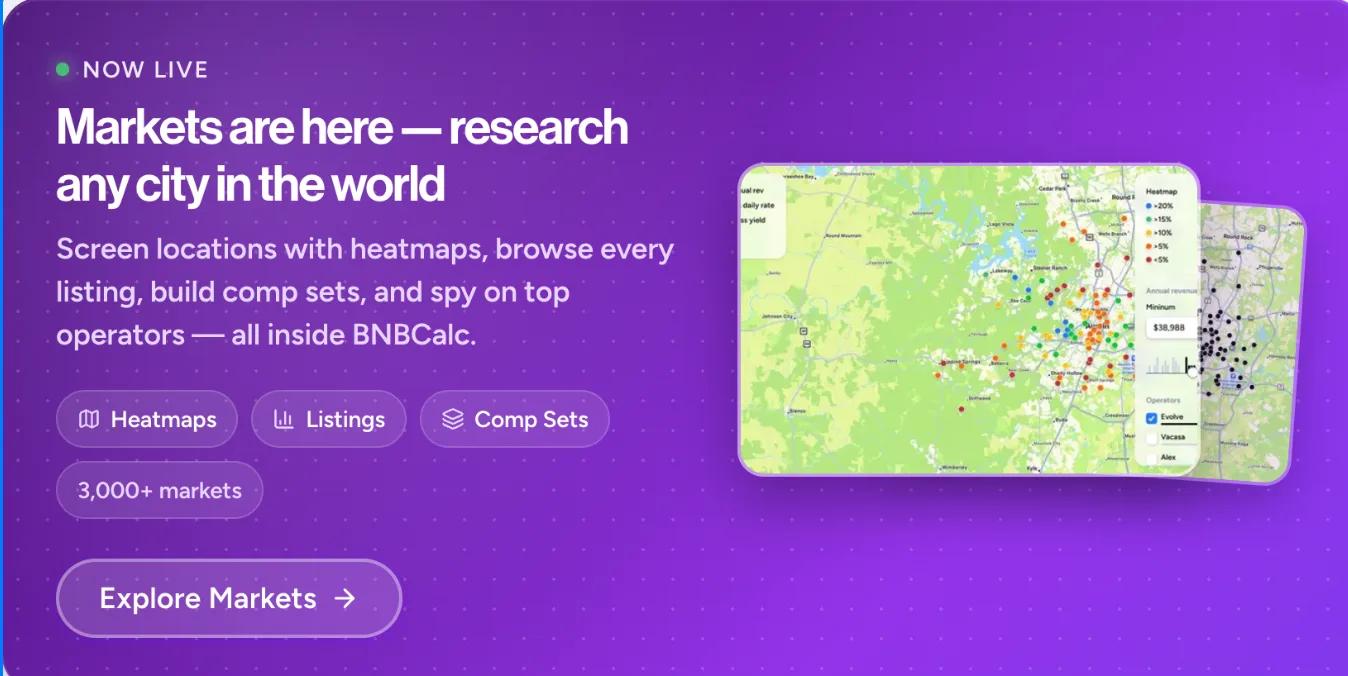
Jeremy: There's another data thing. There is another data thing, which is why I'm bringing this up, if you guys don't know. BNBCalc is a very legit place to go.
Blue: So I'm going to go check my property out now.
So when you guys are seeing the top of the market, at the end of the day, it's subjective data. I like to say we can push the market 30% to 50%, conservatively. So when we're looking at the top of the market, let's try to drive that number up by 30% to 50% if we're trying to pioneer the industry. At the end of the day, we're investors.
Blue: We're taking a shot in the dark if no one's done it. But going back to that, we took a shot in the dark and we did 100% to 125% more than everyone else, because we did take that shot in the dark.
So for clients, I like to say, look what the top of the market's doing. And if we do this, this, this, this, then 30% to 50% more, and let's reverse engineer that return on investment if we can hit those. So hopefully that answers the question on how much we spend, or that's the thought process.
Jeremy: Ashita, you have anything to say?
Ashita: Yeah. For me, we all plan vacations. Time is such an essential resource that we all... It's limited, right? So when we are planning vacations, we are going to compare all the Airbnbs, and if you see amenities, you're going to get drawn. That's like that hero shot, scroll-stopping Airbnb listing that you want to create, that helps you get the bookings.
And secondly, we are stuck on this cash flow, which is important. But when you work on landscape and you add hardscape to any property, there is appreciation attached to the property, right? It's not for nothing. There is appreciation attached to the property. Second, the tax benefit. Like, literally year one, you can write off all the dollars that you've spent on that landscape.
So you're just not looking at cash flow alone, but you're looking at all these three buckets, and then you add it up and then you see what is your return on your investment. That's how I would look at it as an investor.
Jeremy, I think you might have to invest a lot more than you're thinking. Let's do a case study. How about that?
Jeremy: Yeah. I mean, this is an example where I'm like, yeah, the most the property makes on this particular lake is our property. Not the one... the South Landing, I guess, who's staying at South? I think that is like the highest-earning property on the lake, which [inaudible] for 400, and I think 140 or 150 its best year, which is pretty good. Not bad.
And no design, too. And we used the sh*t furniture that the old owner had. I think we painted it. I pulled weeds out of the dock, rolled up the sleeves.
But it's like, yeah, how do I... This house, I think you're saying, I think it does like 100. I think it did 120 its best first year. If the most houses on the lake are doing 140, can something get to 200? You think so? Let's hear her. You think you can?
Ashita: Yeah. I mean, we have seen so many case studies where the property was doing 140 and it was an existing rental. And we went in, looked at the opportunity interior-wise. We didn't have enough budget. So again, looking at opportunities.
So when we studied that house, it had a massive landscape that we could work on. It had 900 square feet of garage that we could add amenities to, and rearrange the interior spaces to maximize heads and beds. I think that property was performing around 140 to 160 when we started designing it. We put in $300,000 in that particular property, and year one, it's doing 350,000. And plus appreciation.
Jeremy: Was any other house doing near that in the area?
Ashita: Not near in that area, but yeah, in Asheville, there were homes that were doing it, but they did not have landscape and whatnot. There were properties that were doing 300, but not a whole lot.
And plus the property that happens to be Tyler's property. He bought it for 850. Year one, he invested probably 80,000 in just doing it himself, because there were not very many six-bedroom homes back then. I think year one, he did 200 or 280,000, and then it kept on dropping because competition started increasing in that market.
And then he told me that, hey, we are telling all these clients to put in all these amenities and do all this stuff. I need to really put in where my mouth is. We went in, invested the money. 300K all in. He was all in at 1.1. That property appraised for 2.1. And plus doing $350,000 a year. That's a great ROI. And plus the tax benefit that we got from cost seg.
We've seen those case studies, and that's why cash flow is one thing, but there's this appreciation that I keep on pressing on, looking through that lens rather than just cash flow.
Jeremy: Yeah. So I think Ashita, and something I've taken note of, I'm going to take a note, probably partially from her, is, yeah, if you're looking to invest yourself, but either if you have a client who's looking to buy, there's a lot of wealthy investors who are looking for the tax benefits. I mean, there's so many Facebook ads being run at these people right now for it.
Patrick: Cost seg, easy.
Jeremy: Yeah. Cost seg, yeah. And there's a lot of people with money. I mean, we all provide services to those people. And when they look at investment, yeah, the tax is one thing, but if you're able to communicate to them, hey, you want a great total ROI. You don't just want the taxes. You want everything.
One of the best things is unfinished square footage. I have a client who bought a property recently and had an attic, an 800-square-foot attic, and we're finishing it out for like 90K, and it should be like 220 a square foot. So it should be worth like 200K. So it's like 200K of added value for 90K.
Honestly, me, I'm a little bit, you know, do I want to spend 100K, 150K? Honestly, when I started, no, absolutely not. I was putting lipstick on the pig and getting that thing up and running. Shout out to the St. George property across the water here. Who's staying at St. George? That is primo lipstick on a pig. That house was a pig when we got it. It's a nice house, don't [inaudible]. It's a good house.
But the point is, unfinished square footage is an easy one. Like, you have a garage, you have a three-car garage thing. That's what, 900 square feet? You can easily add amenities to it. And it's so easy to convert to heated square footage. Yeah. You just frame over it, put in a mini split. You don't even need to do a whole HVAC system, but it's one big room. So a big rectangular room is amazing. Small curved rooms or weird shapes are more challenging to work with.
And I guess this leads to my next question. I think you guys mentioned, you know, first year a house did 300, second year it did 270, third year it did 240. Is that something you guys are seeing? And then what do you do on the front end to make that not happen?
I mean, I'd say for me, I like to do something where I'm like, I know it would be really challenging in this market to do this again. Maybe you could do it, but you'd be buying a more expensive house and you'd be spending more money on it than I would be able to. That's how I look at it. It's like, what's something that's truly...
You know, the house in Kentucky has a four-acre private lake, and it had a fully insulated barn that was bigger than this. And I was like, yeah, that's just like, well, good luck finding that. I'll scream it from the rooftops, because you're not going to get that. That's something that can't be recreated.
So that's how I look at it. And it's done better year over year. It hasn't fallen off, because 50 other private lake properties haven't shown up there with a barn, with an indoor basketball court. So how do you guys look at it? And is it a problem? Like, is it a challenge?
Ashita: Well, as investors, we are always underwriting the deals for five to seven years, right? But yeah, you have to think about exit strategy, right? And short-term rentals, it's growing at rapid speed, right? We all know that amenities... because we're literally making mini resorts in our residences. So competition is going through the roof.
What I have seen is there are always investors out there. If not private investors like ourselves, there are institutional investors who are ready to buy these properties and park their money for an 8% return, who are not looking for a 20, 25% return. So there are people who are looking at these deals, wanting to buy a bigger portfolio. So there's always an exit strategy attached to it. So I don't think that's a risk.
Jeremy: Yeah. You have to sell it and move to the next market, where you can rinse and repeat the same thing that you've done. So pioneer a market, gas it to the moon, provide services to a ton of clients during that time, and then sell that thing to somebody who's okay with a lesser return. Right.
Blue: I'd say, yeah, every property. So we were kind of just talking about this, that as properties are hitting the market, there's more and more supply of well-designed properties, so you have to be unique. And there's a few ways to be unique. One is theme. Who are you speaking to?
Some of the things that we do, obviously, you've seen maybe some bachelorette houses, some bachelor houses. Bachelorettes continue to go on. They're not going to stop [inaudible], because they want to do them. But what we'd like to do is really niche down on, who are you talking to? Who are you speaking to? What theme is going to drive someone home? Because what we've noticed is, we'd love to have and host people that are 100% "F yeah, I want to stay there," as opposed to marketing to the masses.
So one thing: niche down, try to create a very unique experience. Some of the things that we've done on a couple of clients' properties: we put a pirate ship. A contractor built a full pirate ship in the backyard. And yeah, Tony. So that's an amenity that is harder to create, right? A lot of people [inaudible]: "I can do that too with 30 grand."
So just trying to think outside the box, try to figure out how do we go above and beyond to the next level to try to avoid that. But at the end of the day, like I said, we're two of many, many companies that are putting out some really, really great properties. So just be on top of it and get a property done.
Patrick: I want to kind of talk about this concept. So in Joshua Tree, right, we manage 140 units, for the people that don't know, in Joshua Tree, and we see our clients, they're all invested in design in some way, shape or form.
With amenities specifically, what we've seen, and I'm curious if you guys have seen this too, is an example of knowing not just to do the amenity, but to do it right. Right? So the example of, okay, you hear pool homes make you more money. So you make the cheapest pool that you can, and then you just leave the landscaping around it all dirt, and it looks ugly and it doesn't photograph well, and it doesn't make money, or as much money as it would if you just spent the extra $5,000 to make the landscaping around it look really good.
So that's an example of these investors that come in and they're like, well, if I get a 30% ROI on this, I'm going to invest this, but they don't do it correctly. Or they place it in the wrong place, like putting a pool or putting a pickleball court further away from the house, and therefore you can't photograph the house and the pickleball court in one photo. So then the revenue on that house is lower, but we can't figure out why until we look at it and we're like, well, the amenities and where things are, are in an awkward place, and it just doesn't photograph well.
When you guys go into a design, do you guys think about the photos as well? When you guys are doing the design, do you guys see this with clients that are doing the right things, but not doing it the right way?
Blue: Yeah. A hundred percent. Go back to putting the fire pit in the middle of the yard. And it's like, why did you do that? You can maximize the space way greater.
But yeah, if you're putting the pickleball court far away, maybe in Joshua Tree, you're probably trying to go for that picturesque moment where you're out with your friends in the desert and you're trying to capture that moment. That moment is captured when the guest is there. What we're trying to do is capture the guests when they're booking, and give them all the reasons to book.
So how we do that is we're thinking about the photo right up front, and I literally do this with every single one of my properties. When I do the landscape design, I know exactly where the house is going to be, where the sun's going to set, where are we going to put this, the amenity, for what reason? Because the photo will come out this way. And I know where the pool is going to be, right here.
You're holding the bummer. Oh my God. But anyway, yeah, it's very important to think through the photo.
Ashita: Yeah. For us, I call it the first five. So when you see the Airbnb grid, that's the first five pictures that you see. And I really focus on that. So we identify, the minute we start working on the property, what are the first five hero shots that we really want to maximize. So it could be landscape. It could be some theater rooms, some amenities, to really increase the marketability of that property.
But I go a step further than that. Photos are obviously the scroll stop for them to book. What happens when the guests walk in? Are you really thinking about the functional aspect of the overall flow of the entire house? I have seen many Airbnbs that don't think about luggage racks.
I have seen basic amenities... a fully stocked kitchen. Stocking the kitchen is the most basic and the most important amenity, and the most luxurious amenity that you can give any group of your guests coming in. It's $4,500 worth to completely stock your kitchen. But if a family can have a holiday meal, that is a memory that they take away, right?
Bedrooms, when I see beds that are close to the closets, and you can barely open the closets, I'm like, you've not talked to the flow of people walking in, those experiences when guests walk in. And that will reflect in reviews. So even if your property gets booked on the first five photos, if the functionality is not proper, that reflects in your reviews, and that's significantly going to drop your reviews and bookings. I would really make sure form follows function. Please work on the floor plan.
Blue: Yeah, something else I'm going to add, and why this is important to a lot of you guys here: a lot of us are managers, right? Raise your hand if you guys manage properties. Pretty much [inaudible] the room, right?
So if you guys design right, when you're thinking about the photo and you're thinking about how the guests are actually going to interact with the space, they're going to have an amazing time, you're going to have a better time, and there should be fewer troubles or problems, right? You don't want that four-star review because you forgot a broom or the closet wasn't ideal. And we've seen that a couple of times, where a guest just gives us a four-star review for no reason. We're like, what are you doing? But anyway, just thinking through it so you guys can have a happier time continuing to scale and grow.
Jeremy: I would say stocking the kitchen, practical note: restocking the kitchen. I mean, for example, the forks and knives here last night came from a couple of the houses. I don't know where they went. So yeah, restocking, because people always somehow lose cups, knives, forks, and guests aren't happy.
Patrick: This is maybe a philosophy that I've developed over time. Who here has experienced that four-star review where they're like, "the stay was great"? Raise your hand. Okay. It's probably the most frustrating thing you can get. Honestly, I'd rather you just give me a two-star at that point. And you can't fight it, right? It's that weird thing where it's harder to get it removed than a one-star or two-star, right?
But the thing I've realized through... we have an average of 4.92 average review score across 140 units, which is really hard to do. But the way we've thought about it, we obsess over reviews.
The thing that I learned is that when you think that your place is great and they said that it was great, but they gave you a four-star, there's a reason they gave you that four-star. And sometimes they don't want to tell you. They'll tell you a reason that doesn't make sense, but it's everything leading up to that experience. The things that we talked about, what you guys call in the design world functional design. There's something functional that was weird about the house. Maybe they don't know. And it just impacted their experience, and they don't put it into words, and it reflects in the review.
Because within the first 10 minutes, the guest has already decided whether they're going to write you a five-star review, or a four-star review, or a one-star review. It's either a bad review or a good review, because it's all confirmation bias. They come in, and in the first 10, they're confirming their bias the whole time of their stay, like saying, wow, of course it's bad, because of this one bad thing happening functionally at the property.
But that's what I've learned. And I don't know if you guys have seen the same thing, but I just want to note that that's so important. Stocking a kitchen. It's going to reflect in reviews, and lower reviews means lower revenue. So just get it done right.
Ashita: Bedding is another one. Make sure you get the right mattresses, good bed sheets, duvets. Think about what location you're in. Think about the turnover as well for your cleaners. So you're not only thinking from your guest's perspective, but from the property manager's and cleaners' perspective as well. So yeah.
Jeremy: Yeah. I think one of the takeaways I'm having from this conversation is also the importance, when you're doing things really well, of density. Patrick is able to have a hundred, how many? A hundred, whatever.
Patrick: 140.
Jeremy: A hundred. Who's counting? 140 properties, and keep a 4.92. I mean, that's impressive. I don't have that with fewer properties, but that's because I'm in more locations, frankly.
When you have density, Ashita is able to do a white glove, soup-to-nuts service where she's building pools for clients. I mean, do you want to talk to a random pool contractor in Idaho (I'm not throwing shade at Idaho) and trust that they're actually going to do a great job and that pool is not going to have issues?
And so yeah, I talk to a lot of people here: should I go into a new market, or how do I pick a market? Which market should I pick? And I always say, yeah, density. You want one place you can grow in, and you can be the best in that place. Because we've seen so many case studies, examples of folks who maybe get to 50, 60, 70 properties, but they're in four locations.
Ashita talked about exit options. Maybe we might talk about that from a property management business standpoint later. We may, right? Maybe, maybe not. We'll see. But they weren't able to sell that co-hosting portfolio. Or maybe they sold it, but they didn't sell it for a crazy EBITDA multiple.
Be the best. Be the best at what you do, but also, in this physical industry, be the best at what you do in a good market. If you guys disagree, you can say that.
And Blue, I mean, you're an example too. You invest in Austin. You obviously design everywhere, but your own portfolio, to my knowledge, is all in the same place currently.
Blue: Correct. Yeah. It's way easier, obviously, to scale. Scaling is hard when you're managing properties across the country, but people do it.
Jeremy: So speaking of functional design, right? We've talked a little bit about that. I want to hear some examples of where somebody didn't really think about functional design and it kind of drove you crazy. Just want to hear some things that people did wrong, and some things that you should do right or you should think about when you think about the flow of how your home gets used as a guest property.
Blue: I do a lot of the landscape. So on the interior side, the whole interior team does it. There's many examples of how clients, or people that aren't clients, don't do it the right way.
But landscape, just talking in that sector, is when someone is going to put something and they don't think about the conversations that could be had at the same spot, right? So for example, a fire pit being in a location where they can maybe talk to people, or get close to people, or they can see the pickleball action going on. So as I walk through the landscape and as I'm thinking through the landscape design, you want to think about the conversations that could be had because of proximity.
You also want to think about how parents feel. If you have a play set around the corner or around a bend, and you know that parents won't be able to see their kids, they're going to be stressed and not relaxed. So you really want to think through your target audience and what they're feeling. That's an example, right? Seeing a play set around the bend, knowing that parents are probably going to be concerned. Seeing a pool that doesn't have an opportunity for a fence, because, you know, if it's a family market, they're going to be stressed. That's how I think through it. I think about the emotions and the conversations that could be had.
Ashita: Well, for me, I'll take the example of garage spaces, because that's the easiest square footage that you can add to any home. I think one of my biggest pet peeves is when I walk into the garage and the converted garage looks like a garage. I mean, that's not an experience that your guests want to have, right?
So I know there are locations that do not allow you to add a wall in front of your garage door, and it's mandatory to keep a garage door intact, but you can add a mural. You can paint the garage door a different color and make it intentional. Resurface the floor, epoxy it, or just add LVP flooring, which is inexpensive, and a mini split, make it temperature controlled.
So for us, because we are not super highly regulated, we add a faux wall in front of the garage door. So it's not a super expensive expense, a big expense, for us. We have to [inaudible] exterior facade and all that, but we're adding a faux wall. We're adding electrical to it. We are resurfacing the flooring and adding a mini split. These three things completely transform that garage and make it intentional, as if you're entering a room instead of a garage. And then you can make it into a bedroom, a theater or a game room, whatever you want to do.
Jeremy: I'll make it so. I know it's probably not questionable, but do you need to get permits for that always, for garages, or can you just outfit the garage?
Ashita: We wanted to make sure that the county records that as extra square footage that we are adding to the house. So we do get permits for that.
Jeremy: She's thinking about exit. So when you sell it on Zillow, it's 4,000 square feet instead of 3,200 square feet. And people don't care when you sell it without having a garage.
Ashita: You know what we are seeing, that all short-term rentals that you've converted, only investors are buying them. Not very many primary home people are buying it, but we do think about it, right? If a primary homeowner ends up buying that house, all they have to do is demo that one wall.
Jeremy: Yeah.
Ashita: And then they have the garage space to themselves.
Jeremy: Yeah. So the house that she's staying in has a garage where there was no fake wall put over it, and it wasn't painted at all. So thanks. I see why that's a relevant example today. Okay.
Blue: To add to the garage and the permitting, we had a client in Denver that was so thankful that we went through the permitting process, because the county started actually going and auditing certain things. And she was so thankful, because she would have had to pull the listing down and re-permit the whole structure. So even though it took an extra month or two to get the permit, y'all, just try your best to do it right the first time, because the worst thing is getting pulled off, or the county changing and licensing changing, things like that.
And going back to your question, a whiff that I see all the time, as an example: went to Thailand, was staying in this Thailand place, and there was the Eiffel Tower photo. There was an art print with an Eiffel Tower. And I was like, where am I? I'm not in Thailand. Give me something else. I don't know what they want to give me, but they're going to give me an Eiffel Tower. So art prints tell a story. Give people the energy they want to feel.
Jeremy: That's a great point. Yeah. That's awesome. Well, we're going to just wrap this up here, because we've got to keep going with the sessions. But can we do a round of applause for our wonderful presenters today?
Blue: Thanks again. Appreciate it, guys.
Airbnb Tax Deduction Calculator
Paying too much in taxes? We have the perfect solution. Simulate an Airbnb home purchase below.
Purchase Price
$450K
Structure Value
70%
Apply Trump's Tax Cut (Bonus Depreciation)
Depreciation
$117,695
Interest
$21,600
Tax
$6,750
Year 1 Deduction
$146,045
Want to claim this deduction? Get a free cost segregation benefit analysis from CSA Partners — no obligation.
Get Full Analysis