
Free instant analysis
Reveal Airbnb revenue for any address or city
Quick Summary
Jeremy hands over his own listings and asks Taylor to rip them apart, which is the reverse of how these conversations usually go. Taylor works through photo order, photo captions, a backyard with too much empty green space and a dining table too small for the sleeping capacity, then quotes what each amenity would cost to add.
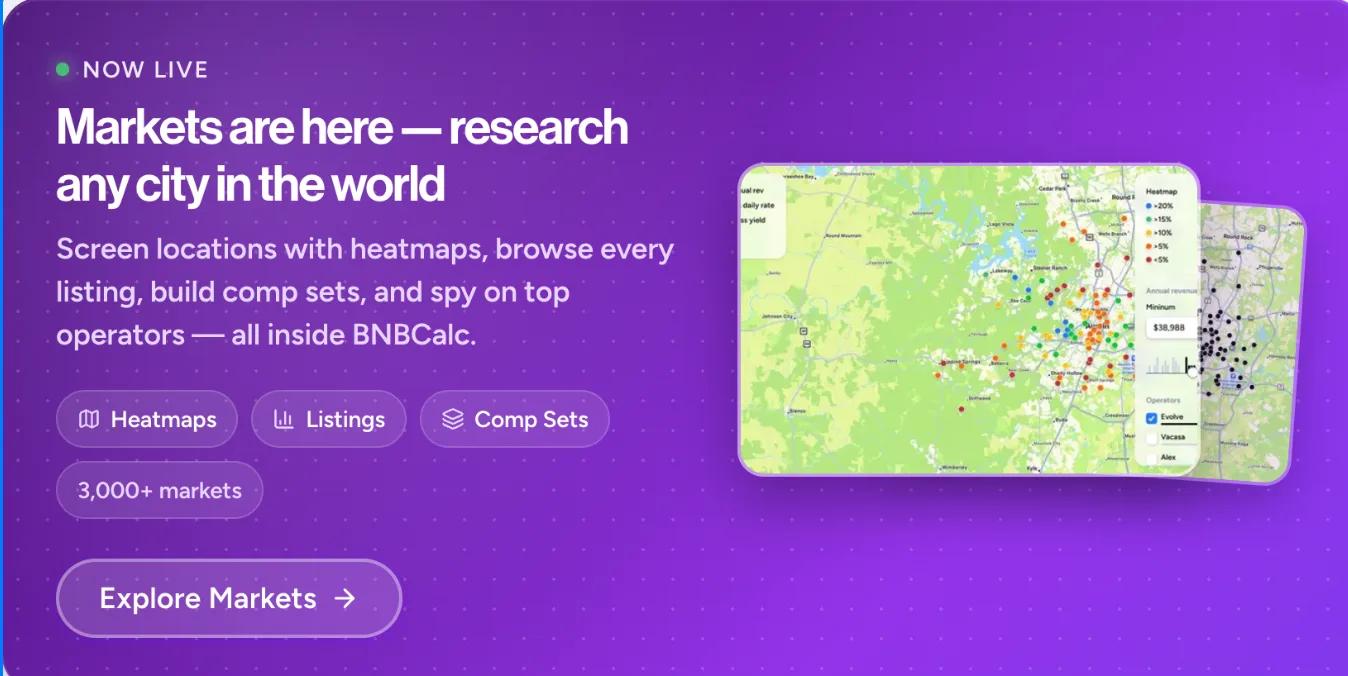
His through line is that filling yard space and lifting average length of stay both defend revenue when demand softens. If you want to know which amenities earn in your own market, that's what BNBCalc Markets tracks.
Key Points
- Taylor put costs on the amenities he'd add, and these were his quotes at the time. Mini golf ran $8,000 to $12,000 depending on size, a playground $3,000 to $4,000, a dog run under $7,000, outdoor bowling roughly $4,000, and a horseshoe pit or giant chess about $1,000 each.
- Skip the $1,000 to $2,000 playground sets, because they get beaten up and don't hold up. A pickleball court he'd expect to be quoted at 22 to 28 grand, poured as cured concrete with paint and a seal rather than a sport court, since guests don't love the bounce and the surface separates.
- The turnover math. At 70% occupancy, or 255 nights, a 3.2 average length of stay gives you 80 turnovers, and at $200 a clean that's a $16,000 cleaning bill. Divide those same 255 nights by 4.49 instead and you're at 57 turnovers, which Taylor puts at about $4,500 back to the bottom line.
- The cheapest fixes barely cost anything. Don't let Airbnb group your photos by room, or the money shots end up buried at the bottom. Write a caption on every photo, get four or more amenities into the title, and buy the $15 cord cover. Fiverr editors ran about five or six bucks a photo.
- Size the dining table to how many the place sleeps, because six chairs in a house that sleeps 10 means guests eat in shifts, and family markets punish it. Two tables at $1,200 each pushed together are his cheaper answer to one 14-seater at four grand.
- Jeremy's lake went from about four Airbnbs to a hundred in a few years, and he now owns roughly four of the top five by revenue and manages about eight of the top 14. Across his portfolio, RevPAR was up $8.86 year over year with average length of stay up almost half a day, which Taylor flagged as the two metrics that tell you what a year did for your pocketbook.
Full Transcript
Listen to the full episode on Apple Podcasts, Spotify, or YouTube.
Jeremy: Just had an amazing conversation with Taylor Jones, who has acquired 160 short-term rental properties, which is crazy. He actually went through my listings and gave me some room for improvement, some constructive feedback, as some would say. And it was super insightful for me, and I think it's going to be super insightful for you. You're going to want to stay tuned to the end because he drops a ton of knowledge bombs. So with that, let's get into today's episode of the Short-Term Rental Pros Podcast.
All right. We are live with the Short-Term Rental Pros Podcast in person. Taylor, got him to come to New York. Well, he probably came for other reasons, but I'm going to say I got him to come to New York to the office for the first in-person episode at the new Short-Term Rental Pro Production Studios in Dumbo, New York City. Taylor, man, I'm so excited for you to join us today. And why actually are you in New York?
Taylor: Here for another real estate event, but it was great to connect and happy to come out in person and kind of break the office in.
Jeremy: Yeah. So since we've had you on several months ago, what's new, man, for those who want to know what's up with Mr. Jones?
Taylor: Yeah, we've been plugging away and really expanding our done for you service. So what we've built over the last couple of years with our track record, our success, is, okay, we clearly know how to find, acquire, underwrite, scale short-term rentals, but how can we help everyday people? We can help big institutions. How can we help retail everyday investors?
And so what we've been doing now is me, our head of data, John Bianchi, who I know you've had on before. What we're doing is we're helping investors find their own short-term rental, that pain point of analysis paralysis. I don't know where to look, or what's the best thing to buy in a given market. How do I design it? How do I amenitize it? We've been helping investors with a full done for you service. So STR Search is the name of that company. And we've been absolutely crazy busy, which is great, in helping people identify, hey, here's my budget, here's my buy box. Ultimately the two things you can control. What are your preferences? How much cash do you have?
And for us, what we're doing is, okay, let's find you the best available short-term rental based on those two factors, because not everybody has an unlimited budget to just spend on any size home with any size amenities. You might be limited. So how do we get the best ROI out of your budget and your preferences?
We always kind of do the ice cream reference. Do you like chocolate or do you like vanilla? Do you like nuts or do you like sprinkles? Do you like hot fudge or cherry? And so not everybody's in like the same thing when it comes to owning their short-term rental. Do you like appreciation or cashflow? Do you like the Southeast? Do you like the West? Do you like mountain? Do you like lake? All those little nuances we individualize with each customer, and then also align with, okay, how do we maximize your budget? Can you afford six amenities at this property? Can you only afford three? Okay, well, what are the best three to strategically help you drive the most revenue?
Jeremy: Okay. And let's take a step back. And I think for those who haven't heard episode one, just give your background to begin with. So Taylor, what makes you able to tell somebody, this is a good property? This is a chocolate. I don't know if chocolate is good or whose preferences is what, but like why?
Taylor: We've done this over 150 times the last two years. So we've helped investors acquire over 150 short-term rentals the last two years. So being a part of that many transactions, and the track record, the history, the success that we've had.
Jeremy: Part of Techvestor. And we've had, I think, Sief's episode has gone up. So at this point, we've had John Bianchi, who's the head of data. We've had Sabrina, the head of operations, managing the properties. We've had Sief, who's kind of CEO vision, big picture guy. We've had Taylor, head of acquisition. So this property is a good property for, this is what you do to it. You change, you add these five amenities and you should pull in about this much money. So we've really had the full, I don't know if there's anyone I'm missing. Well, we've had Mark Lumpkin. I know he's not, he's affiliated in terms of, because he works with you guys on...
Taylor: Yeah, construction and design, absolutely.
Jeremy: So like actually physically setting up the property. So I feel like we've had pretty much the full...
Taylor: The full spectrum, yeah, absolutely.
Jeremy: I think Austin is the one I've been recommending. I haven't hit him up because he's like revenue management.
Taylor: Yeah, absolutely. But yeah, I mean, so being a part of those transactions from the acquiring phase, which I always kind of say, that's kind of like the top of funnel. And if you can buy it right and get it at the right price, and it's the right property for the area, you have way more kind of room to screw up on the backend. Not that we want you to not get the best amenities or not get the best design, or even if you're just a below average operator, but you have such an enormous hill to climb if you don't buy it at the right price, you don't buy in the right market, or you don't buy the right product for that market.
And that I think is why so many people are struggling, is you have to almost be perfect in operations. You have no room for error if you can't get it right up top. And so being at that very first stage, I think it's so critical and important that if you can buy it right, you kind of have room to screw up, or you have buffer room. And that's a super important thing, especially as a brand new investor, this is your first short-term rental and purchase. You want to have that buffer room to grow into. And if you're an elite operator, all that margin means is profit in your pocket.
Jeremy: Got it. So we're thinking about things from the context of buying a new property. And that seems to be kind of what's new with you is you're helping, before you were helping investors, but essentially saying, hey, give us cash, let us do our thing, we'll send you the quarterly reports and your dividends and whatnot. But now you're like kind of one-on-one helping specific people from the get-go.
But what I want to get at, which probably honestly, probably a lot of my listeners are people who have existing portfolios, maybe they manage other people's properties, is how do you improve existing properties? And I'm going to use this time to, I mean, A, I know I'm going to get ripped here. So this won't all be fun and games, but I want to go through my properties, or a couple of them.
Taylor: Let's go.
Jeremy: And just see, rip them apart. Let's see how we can improve them. First, I want to show you the property, maybe get your opinion on how you think it is doing, and it's current state. And then I'll match that with the real data.
Taylor: Perfect.
Jeremy: And then from there, how do we get this better? And then maybe next time Taylor's on, hopefully I've put action and have the results to show.
So, bang, have one of my listings here. This is a property that was launched in November of last... Wait, what year are we in right now?
Taylor: 24.
Jeremy: 24. So it was end of Q4, 2022. We got it up for Christmas. Didn't fully finish the renovation probably until May of this last summer, but now it's pretty much fully running. So his first thing he's doing is diving into the description.
Taylor: Yes. I'm always curious how people... So big thing here, what I love is you've got the bullet points set up. It's hard to read. Naturally, people, you've got to look at human and human behavior. When you have these huge, long paragraphs, it turns people off, they skip things. So being able to truly do this.
One quick call out I always like to say is Airbnb continues to talk about our use of AI, we're growing AI, we're using AI more. Well, whatever municipality you're in, so it's like, okay, here I am in Samoa. Am I saying that right? I don't even know.
Jeremy: Yeah, I think so. I think so. No one's corrected me.
Taylor: First thing I'd be like, hey, this is the perfect lake house for your family or bonding romantic getaway in Samoa. And so any of our listings, we're always dropping that in as often as we can. And then where you also want to correlate that is in your photos. So if we go to our listing...
Jeremy: And this is a quick... So I actually got the feedback from someone that don't organize their photos, because Airbnb gives you the option to put them in each room.
Taylor: Do not. Do not.
Jeremy: And I think I just did that, where you went in and now we're looking at the living room.
Taylor: No. Which is, we've got to scroll all the way down to find the money shots.
Jeremy: Yeah.
Taylor: No, terrible. Definitely do not let them be assembled. But other thing I was going to say is your photo descriptions. So definitely want to add those in, A number one. And in a photo like this, you're not just going to put back of house or backyard. You got to tell a story there. We provide tons of games and blah, blah, blah. A great space to hang out with the family here in Samoara. Now, you don't need to put the city in every single one. But the other key thing is spend time in our amazing hot tub.
So the other thing they're going to start doing is using AI. So when you look at which categories do you show up at? So some people are like, man, I've got four categories, because Airbnb was big with the category release. I think it was like six months or nine months ago now. Well, all that's picked up is by AI. So whether it's amazing pools, game room, cabin, all these things, it's a lot of AI triggers. There's 1.8 million listings in the US and four or five million across the world. They don't have anybody manually opening every listing and counting, well, which box does it go in? Again, they're using AI. So the more you can, quote unquote, hack the system. Again, it's not like you're lying and saying you have all these features when you really don't. So to me, that's what I would really be after is adding those things in. So great fireplace.
Jeremy: I'll put it back. Sorry, we're both controlling the mouse here. I wanted to take notes. I guess I can't do that. I'll have to listen and take notes after.
Taylor: That's fine. So I do love, I always tell people is four or more amenities is always the goal in the title. So paradise, the hikos.
Jeremy: That's the lake.
Taylor: That's the lake. So that is, quote unquote, an amenity, is the lake, the hot tub. You are lakefront, large dock. Like you always, your listing shouldn't be, I tell people, is opinionated adjectives, luxurious, beautiful place, all this stuff. Get rid of adjectives. Your opinion doesn't freaking matter. What you need to do is you're a presenter of facts.
I like the word haven. Like if you're going to add one of those kind of opinion things, you want to make it one word. So like haven is just, if you're going to say something, just consolidate it into a single word.
Jeremy: Yeah.
Taylor: So you definitely want to make sure like four or more amenities is always the goal. I know you run out of, we run out of characters. So I do love though that, let's go to the exterior photos here. I do love that hero photo. What I'd be curious is, well, lakefront's the selling point. I'd be curious to, especially if there was more amenities here, is how this photo would run, especially if this was number one. And then number two was the actual lake itself. It's actually a pretty cool photo too. Is this on your property?
Jeremy: Yeah, it is. And the thing that's unique, or why I bought this property, was because it just has an insanely flat backyard at this particular lake. And I could show you our other houses. They're all cool because they have great views, but the backyard is just so slanted that you can't really do anything. And this is like the whole lake. It's not just the houses in our portfolio.
So I was like, this thing, what I tell people is like, if you want a house that is going to have longevity and, no matter what, is going to win, it has to have some like distinguishing characteristic that can't be recreated. So this house, I got a 750, which to me was about as high as I'd probably, more like higher than I'd be comfortable with. But I know this house over the long run is going to be a good investment.
Taylor: Yeah. You've got a competitive advantages or moats that we always talk about, that somebody can't clone this. You can clone design, you can clone amenities, and ensure you still need to execute, but flat backyard, you can't clone.
Jeremy: Exactly.
Taylor: Way front, you can't clone, you know? So there's things like that are competitive advantages.
Yeah. I mean, off the cuff too, I'd almost wonder, you've got a sweet photo here. I don't know if this is real or edited. Again, you can always edit your photos. I'd be curious what an edited sunset photo here would do. So yeah, a little trick. I don't know if it faces west, but does it matter? You don't want to over-exaggerate it, but I do still, there is great sky opportunity.
Jeremy: I think it's south facing.
Taylor: Yeah. I mean, if you did a cool sky thing, we've done that before. And I know there's great people on Fiverr who, it's like five bucks or six bucks a photo. I'll do a great editing. I'll tell you, it's really worth it.
Jeremy: I usually edit the grass. That's like a big thing. Like this photo, the grass is definitely highly edited. Now the grass actually looks good.
Taylor: Yeah. But sometimes based on season, you can get a little browning.
Jeremy: Totally get it. Yeah.
Taylor: You know, you don't want to lie to guests, but it's also like, hey, could it be this way at some point? Yeah, it could. There could be a good sky. There could be good editing there. People don't need to think about, okay, where does the sun rise and fall? No, none of that.
Jeremy: It was a weird day. It was a solstice.
Taylor: Yeah. So little nuances here. Big fan of the cord, the cord cover, it's like 15 bucks. Photoshop it out. One of the two.
Jeremy: Yep.
Taylor: A hundred percent. That's what I'd be looking at there, is get the cord cover to match. So going through here, each photo on that front.
Jeremy: We designed this like ourself. We didn't use a third party designer. And at this time I was like, I'm on a place with focus on the exterior features, inside just has to be good enough.
Taylor: Yep.
Jeremy: Now in hindsight, I'm like, d*mn, I wish I would've done some accent walls, not just make it clean and modern.
Taylor: Yeah. The other cool thing about editing, you can edit out, so you can see the reflection and glare on the TV. So that'd be like something on an editing spot to you, you would want to get done, or put some Netflix on there or something like that. Other good solid photos though. Again, showing the space, it's a good photo to kind of really show people the high vaulted ceiling. Something you can edit out a lot of this stuff there.
Let's see here. What do we got? Three, six, eight, nine, 10, 11, 12, 13, 14, 15, 16. Okay. I'm always kind of the big, our team will tell them that the dining room Nazi here is, can you sit enough to eat, or do you have to eat in shifts? So the most frustrating thing I see is a dining table that has six chairs and the property sleeps 10 people. I go, well, or four people just like eating in the second rotation. So it's a huge thing. And in some markets you actually get punished for it more. In a lot of very family, multi-generational travel destinations, you will get crushed and people don't realize it.
So big thing we've been making a push for is just more eight, 10, 12, 14 person dining room tables. Sometimes you got to put two together, cause you might just do the math and be like, okay, it's like four grand for this huge 14 person one. Or I just stick two together for 1,200 bucks each and go, okay, let's do that. But you can still make up for it in this long thing here. So I won't completely get you on that one. We'll give it a B. No, there is at least the room to all eat together in one service. So a lot of good stuff in that regard.
Jeremy: Yes.
Taylor: The bedrooms, like you said, you could have more accents here. What I'd be curious is, is how much.
Jeremy: Could have a slide on the...
Taylor: Yeah, but what does that do from the total market competition? Does winning with amenities and location like going to drive you more, or can location push it over without fully studying this market? Those are things that you always look for. Yes, of course it'll help, but how much is truly based on your market. So of course, better interior design would help you in your bedrooms, but it's like, by how much would it know? So we studied the market.
Same thing on the bedroom here, edit, edit, or drop down. Again, all solid, could be updated, but does the trick. I love the high occupancy, again, coming out to the lake. Great exterior shot. I really liked that last one.
Jeremy: I used to, that used to be the, this used to be the cover up until like last week when I put on LinkedIn, I said, what are you like, one or two? And people said sorry. I listened to LinkedIn.
Taylor: No, this is a, I mean, this one isn't bad either. And I think what you can do is just kind of ride the hot hand. That's what we say. If the booking slow down and long, you just flip it to the other, kind of A/B test, go in there.
Instant call out is, and again, unless there's like a burn notice in the area, is the, you had a fire pit location. Where's that one at, pushed off to the side.
Jeremy: Yeah. So it's over there, but we actually moved it. The neighbor over here wasn't too happy with people at the fire that night. So we just moved it. The other house is an Airbnb on the other side. So we just put it on that side. They obviously aren't going to complain about it. And that actually, another house on the other side of this guy's also an Airbnb. So he's like triple sandwich. We built a privacy fence for him just to help ease his concerns.
Taylor: Yeah. I mean, things I look at here where you could add some really great value would be a miniature golf area. I think a great kids playground would be super huge too. So if we're looking at a miniature golf area, we're probably talking to eight to 12 grand. A nice playground, that isn't the ranking inequality, is probably three to four. And I think little things like that, that's just great ROI from a like, cool, how can we help more kids, appeal to those families more. Those are, I think, really great things.
You've got the cornhole. You could also even mix in like ring toss. People don't realize it's like super cheap, because you're building in this, the sand pit with the wood box behind it, and then boom, the steel stake. So we got horseshoes going there. It's a pretty easy, affordable amenity that you could probably DIY it for like 600 bucks, or hire labor for a grand to install it, cause there's two sand pits with some wood and a metal stake, and then ultimately buy your tools and you're good to go.
So those are things I think from, how do we fill the yard? That's kind of a big thing that we've kind of learned is if there's too much green space, we should get punished for it, cause it's not filled completely. So I think what I wonder here is how much are you being punished by not having more in that yard? And that's where I look at easy things.
Jeremy: Like I'm saying, oh, it's a positive that we have a big flat back yard, but you're like, well, however, the flip side of that is it looks just empty and weird.
Taylor: Yep. And that does, we found, hurt the ROI. And so filling that space is truly a better use of it, which is why I look at, if you did three holes, so here I wouldn't do the like rectangle miniature golf. I would actually do holes, because then you're just going to fill more space. Even though it might be the same square footage on paper, it's going to look like it's more full. If you did three holes that are kind of crooked shape like that, you put a playground in, we always love accenting it with a border, not just dropping it on, but spending that extra money to maybe put in a gravel and or mulch base, then it's accented. And when it looks like it's an intentional amenity rather than, hey, I just threw the playground set here, it's a big ROI.
Other thing you could do that's super affordable that I think would be great here is a fenced in dog area. So people love their pets. Are you pet friendly?
Jeremy: Oh, of course.
Taylor: Okay. Okay.
Jeremy: Yeah. I managed properties for homeowners on the lake and they're not pet friendly.
Taylor: And they're probably struggling.
Jeremy: Well, yeah. And then they all were like February. Every single one who wasn't pet friendly came to me in like February, March. And they said, hey, we don't have a lot of bookings. What's up? And I said, there's a hundred Airbnbs on the lake. I showed him, I said, the occupancy for February, March is like 10%. Of that 10%, majority of it is bringing pets. So the only people are coming here pretty much are bringing pets, and your property is not pet friendly. Like that's off the bat why you're not, I mean, they were actually pretty book.
Like it's funny, like this lake, I show them there's a hundred Airbnbs on the lake. When we were, the first house that I managed was like number four. So within a few years, it's gone from like four to 100. And if you look at the list from revenue, it's literally the properties we own are like four of the top five, and the properties we manage are like eight of the top like 14.
Taylor: Yep.
Jeremy: So.
Taylor: Yeah, but I think a really cool thing would be a dog run, and you'd be filling the space without. So you would almost go with the four-foot white picket fence is probably easiest, or that four-foot low. You don't need to go get a big six-foot, it's gonna block the view.
Jeremy: So just like a white picket fence.
Taylor: Yeah, or a small wood or something like that, or you could do the black metal, but you have out there.
Jeremy: That would also help, because that was one issue. We're very responsive to our neighbors. Like we go above and beyond.
Taylor: Yeah.
Jeremy: And we built a privacy fence, so one of the reasons for that was like dogs. Like let the homeowners know their dogs can't go past a certain point. But it would honestly have been cheaper just to do a white little dog fence.
Taylor: So I look at, you could build in whatever the space will give you, a 20 by 12, or a 30 by 20, whatever. You put the fence up, but then at that little entrance, you could get, I'm sure they sell them online, those little dog welcome signs. So that you make it intentional. If you just fenced it off and said, hey, this is a dog area, again, it doesn't do it as much as just dropping the playground set. But if you intentionally put that border in there, you intentionally put like a dog thing, and if you've ever been to some like public dog parks, sometimes there's like little things the dogs can crawl through. So you could get creative and see what you could find, maybe on Facebook Marketplace or something. And they got like the little tire or the ramp you can put in there.
And again, as long as it's easy for your mow guy to get in, get out, do all those things, I think you have a huge opportunity to fill that, and definitely reshoot it with like a drone shot. I think you could be like, wow, look at this aerial shot. That would be super huge, too.
Jeremy: Yeah, and that'd be because there's an area, like the septic fields in the back. So there's like an area that we can't really, and I wanted to get your input on an idea. So like part of me, I always want to do another property. Like I always want to do another one. Like I want to do another one, but limited by resources.
Taylor: Of course.
Jeremy: There's only so much I can do. And like with this, I looked at pretty much like every lake in not even North Carolina, but pretty much just Southeast. Like there is only a couple lake houses that have a pickleball court in their backyard. There is like several, there's probably like 12 that have them, but maybe they're in like the side or the front or indoor. Like there's some, like Norman and Charlotte are just behemoth houses that have indoor basketball courts and indoor pickleball. But there's very few that on the lake has a pickleball court.
And this house, I actually was in North Carolina the other day. I went into like the lake authority and talked to them. It actually can have a pickleball court in the backyard. There's like just enough space that works.
Taylor: Yeah, I mean, I would for sure explore it. My gut is you're probably gonna get quoted 22 to 28 grand. That's like pretty much par for the course there to get the base, the cured concrete, the painted, everything looking good. Go bright colors.
Jeremy: Do you do sport courts?
Taylor: No. So what we just found is, yes, it's cheaper, but it doesn't give you the same feel. It doesn't hold up as well. So we'll do a nice, really good cured concrete with a paint and then a seal on it. Less ongoing maintenance. Yes, more upfront, but it's kind of one of those you spend more today to save more down the road. And you save yourself operational headache, and it's gonna be more true to performance. So kind of checks all those boxes after it's installed, rather than the sport court, where they're like, doesn't quite bounce the same. The guests don't love it. It gets torn up easier. It gets separation, versus the cured concrete. You know, you just get the really good stuff and then paint, seal it, everything like that. So that's really what I'd be targeting from that front.
Jeremy: Oh, interesting. Okay. That was, cause I was actually looking, I was looking at the sport courts, but.
Taylor: We already done it. And it's, you're gonna regret it as soon as you're done. So we've done enough of them to know that it's a big issue.
So yeah, I mean, that's kind of all the changes that I could see here, and especially if you're holding this asset, you could just continue to improve. That's what I think people can realize is, you do the most you can with your budget on day one, and you launch, and then you always look for, can I always add more to it?
And so we're even helping clients with our, a lot of our STR Search clients says, hey, okay, this is your budget. We're gonna buy you the best available property. That also might mean that, hey, you have room in your backyard to add five amenities, but your budget today only allows for two. But we know you can grow into this, and next year you can add $20,000 more worth of amenities, and the year after that, you can add that pickleball court, but you can grow into that property. It's, hey, can you add enough amenities today to drive revenue, cover your debt service, be happy? And then you'll just continue to increase your ROI over the next two, three years, the next 24, 36 months as you add more, recycle your cashflow, or save more from your W-2.
Taylor: And that, I think this is a perfect example of a property you could always grow into, which you're already doing.
Jeremy: Yeah, and that was initially did not have the hot tub because we wanted it up by Christmas. So did whatever it took to get it up then, and then after Christmas was like, all right, I want the hot tub. The deck, that deck you see over there, which is this, I would normally not recommend folk to build a deck. I would say focus on amenities. I just thought for this particular house, it needed it. It looked naked without it. It looked weird. So built both of the decks on the side of the property, were put in after the fact, got them fully permitted, which meant took months to do, but didn't have like what you see right now until probably like June.
So the booking, or the lead time for this lake is three months for like June, July, August for the summer, which is probably pretty common for like a summer peak season. So last summer we didn't do as well because it just, the listing was not as good. But this summer we're starting to get like filled up at the rates I want.
But I guess the question I'm like, what would you, if I'm telling you I bought this like 750, I guess, what would you estimate revenue on something like this? And then I'll fill in the actual, and then I'll say, all right, based off, if I make the changes that you said, what would you ballpark?
Taylor: Yeah, I mean, I'm guessing you gotta be doing some decent six figures here. Without like truly seeing what the top ROI is and what people are willing to spend in the area, it's a little tough to throw out, but I would figure you could at least push good healthy six figures here, even as a three bedroom in a given market. I feel like it's definitely possible that it can be done here.
Jeremy: Gotcha, so I'm gonna pull up Mr. PriceLabs, just so I don't wanna be wrong. I admittedly did not write down the numbers ahead of time.
Taylor: A lot of times live stuff is the best here.
Jeremy: Yeah, so we got this property live. It's showing us, yeah, December of 2022. So pretty much just for Christmas. So you can see December 2022 did 1.4 K. Then with January, February, March, as I mentioned last, I guess last winter did all right. I think we had some longer term bookings while we were doing construction. And then the summer did all right. 17,000 June, 16,000 July, 15,000 August. But I thought we could, I thought those should be like 25, like almost 30 K months, like $1,000 a night. That's when I underwrote the place. I was like, this is a $1,000 night July home, or it should be.
So we got the place, as I said, I think May or June got the marketing. But this year we have the full marketing. So you can already see, what are you seeing like the difference with April, May?
Taylor: Yeah, you're already like almost about 40 to 70% greater. So you've got a shot that if you could continue to push June, July, August, like you said, that, hey, 15, 16, 17 was last year, that 20 plus is in range, no doubt.
Jeremy: So let's look. So last year we did 107 K.
Taylor: I figured it did low six figures. It kind of perfect.
Jeremy: And then this year.
Taylor: Really the back half of that year, it's truly where you can really cut your teeth and make some money. If you can get those good holiday bookings too, especially because, hey, we've got more amenities. There's more family gathering stuff here. We improved. No, there's good opportunities here, man. So love, love that.
Jeremy: Yeah, we're seeing the ADRs. So the ADRs for this summer, last year, we were up six, $700 a night.
Taylor: Beautiful.
Jeremy: Now we're pushing eight, 900.
Taylor: Love it.
Jeremy: So, but based off what you said, so should do about 125 K this year. I would say the one variable is September. I don't know about, there was a music festival and like a big, there's a big raceway around there that had its nationals the last three years. It doesn't look like they're having it this year. So September was the best month of the year. Second best month of the year last year. Not so sure this year, but assuming September's roughly the same, should do 125.
But if I do those things you talked about, let's say, let's ignore the pickleball, but fenced in dog backyard, fill that space better with the little games, and take new drone photos. What do you think I could push to?
Taylor: Man, I feel like it's a two-pronged approach of not only could you potentially probably push, call it 135, 140, but you also, and this is something me and John Bianchi have started talking about is, how do you start hedging yourself in the downturn?
Jeremy: Yeah.
Taylor: And at some point we will see a slowdown, that's worth noting. We're not gonna see a stoppage. Like that's just delusional to think that. But how do you hedge yourself? And what you're looking at is, how do I gobble all the other bookings? So from all the other lakefront homes, when people, let's say there's a hundred, and there's a hundred people are booking for the July, everybody's fully booked. Let's say in a recession now, 20% fall off. So now 20 aren't gonna get booked.
You're like, okay, how do I make sure I'm in the top 80? Now, are you probably in the top 80 now? Yes, but how do you make sure you're booked by the people spending the most money? Some of those 80, the bottom 20 we know are just vacant, but now how do we make sure that you're pulling in those? And that's where a lot of the amenities is, juice your revenue when times are good, but also keep you like either flat so you don't drop during the recession. That I think is the critical point.
Jeremy: Absolutely. And I think, yeah, it's funny you say that, for this particular property and kind of, I know you guys have a lot of properties in your markets. So you guys are like, all right, we're within the 60th to 90th percentile. Whereas like I shoot, this particular property is like number one or number two. So yeah, the prices I'm getting are, I'm pricing peak season above the 90th percentile.
Taylor: I love it.
Jeremy: But it's funny, I like to look at like the last year bookings versus this year and just like really compete against myself and be like, what did I get booked out last year? Like, am I beating it this year? And yeah, when times are bad, that's where it's like, you really look at your year over year data and you're like, how do I keep or sustain?
Taylor: Yep, exactly. And that's what some of these additions are, is just not getting complacent so that you can still, people still see the value, and the affluent travelers. So again, let's just use that 100 example. Only 80 go this year, 20 sit vacant. How do you get those top one, two or three to still spend the same amount of money, even though quote unquote, it is a recessionary environment? And the more value you can offer them, that's the critical thing.
They're looking at that $1,000 a night ADR and saying, is it worth it? Well, I've got the fenced in dog area. We're gonna bring the two family dogs, little Frodo and whatever, or Fido, whatever the hell the dog's name is. So that I think is a critical thing, is having that, having the horseshoe pit area, having the miniature golf, where they can just look and be like, man, my kids are so occupied. There's so much of value here, that critical word. That's how people are justifying prices. Am I getting the value for this property?
Now you can still command that same high ADRs regardless of the recessionary environment. Then when things are good, now you've got multiple people willing to pay $1,000 a night, and you're like, sweet, we're cooking up.
Jeremy: Yeah, and also people then quit. That's when the times are bad. That's when people get out. Those bottom 20, yeah, maybe not all 20 drop off, but maybe 10 of them do. We're not even seeing a recessionary environment right now, but people are dropping off, which is good.
Taylor: Yeah.
Jeremy: That's, and I think that, yeah, 80, I mean, I think like this last quarter wasn't like the first time that demand went up higher than supply.
Taylor: Yeah.
Jeremy: Like the first time in four years. I saw in February, yeah, February, that there was a first time ever. So that was a huge win.
Taylor: Which we love that.
Jeremy: If you guys are listening and can say, well, I guess let's transition now to, I guess someone who's looking at dropping a list.
Taylor: Yeah, let's do it, let's do it.
Jeremy: So just for context, I have a property for sale. I actually did sell one of our properties back in December. The property we sold was a partnership property. I was like very, like it was people who had invested in my, like a deal I led before. And it was the first, they led a deal and I'd put in the smallest amount I could. So I wasn't really like emotionally attached to it. And when we got it, I thought it was like an okay deal, but it wasn't like my thesis. My thesis was big houses, multiple families. It was a small cabin. So I didn't really think there was room for it to run. And the market had appreciated, and we happened to have a five-year loan term that was gonna, it was a balloon. So it was like, we either had to sell or refi, and just made sense to sell. This is a different story. So yeah, we sold, we bought that house 433, completely furnished, sold it at like 545 a year and a half later. Nothing to write home about, but a good investment.
This property we bought, so this is me and two partners. We're all a third, a third, a third. We bought this in May of 2022. So, or March of 2022. So what are we in, 2024 now? So about two years ago, we bought it for 575. Initially when we bought this house, it was because we bought another one in the area that I thought was like a home run. We bought a house for 515, the first year did 130. So then the guys were seeing that, like we had the winter bookings for that. And they're like, sh*t, like we gotta get another one. And in that like four or five month time period, like prices had ballooned in Florida. They shot up. So we got this one at 575. I underwrote initially like 100 out of 575 purchase. I think we did, we'll look at the actual data. I don't wanna be wrong, but.
Taylor: So a couple of call-outs here on this listing is, it's got the bones to be successful, but like initial easy addition. So I'm gonna approach this one from, if I'm buying this, how can I spend the least to get the most in new revenue out of this property?
So first one is this entryway. In this market, Florida, especially bright colors. Yeah, you need to pop. And I look here and I'm like, this is a sea of brown and like depression.
Jeremy: I got that off Facebook, that couch off Facebook Marketplace for like $200.
Taylor: Beautiful, yeah. So that I think is like instantly maybe a huge accent wall here. It definitely needs repainted white, but like some sort of pop of bright colors, brighter rug. I'd even consider repainting the door here on the inside. Your kitchen cabinets can stay, like I'm not a big fan of throwing money in the kitchen in particular. So you've got this here, but I think you need like, again, more color around it.
Jeremy: Just for context, we're looking at the for sale listing right now.
Taylor: Yes, yes.
Jeremy: We're on Zillow, we're not on Airbnb.
Taylor: Yes, we are. This is not the photo where I would have went with on Airbnb. Yes, guys, just so we all are aware, good call out.
Yeah, so again, you can do furniture, like brighter colored chairs, accent walls here, a rug with more color to it. Instantly going to elevate this listing to stand out, because there's a ton of listings that look like this. Kitchen's fine. Maybe you paint the cabinets white if you really wanted to drop four or five grand. Don't think it's necessary. Same thing in here. Too dark, too brown. We need pops of color in here, new drapes.
Jeremy: We did like a Bali themed out, like kind of casual.
Taylor: Yeah, it's not quite that design. Same thing, a brighter rug. Bathrooms are fine. Don't need to spend money. Again, maybe brighten these up here. I would do with some accents. So similar carry theme to this bedroom. This one's actually moving in the right direction. It just needs better on the back.
So continuing to scroll through here. This is where we start to get nice pops of color. I love this. Like, it's like, okay, we're finally starting to get to that where I think we can truly drive better revenue. Bright pops of color in the backyard with this whole tropical oasis.
Jeremy: But this is the photo that I like loved and cringed at the same time was, I have no amenities besides a pool. So I'm like, okay. And a tiki hut, but I don't know if you call that amenity.
Taylor: It's not like a game. It's a cool accent feature, but yeah, it's not like an amenity that people are gonna sort out.
Jeremy: So on Airbnb, the listing, we do have like the big Connect Four or the cornhole. But this is, so this was recent photos. The games weren't. We're in the garage.
Taylor: Yep. So things I look at here that could be great additions is having a miniature golf area. So you could do like something in here. This is my first thing. It's South Florida. It's Florida in general. Easily eight to 12 grand. You get great little mini golf setups. So that was number one.
Number two, and I know this photo doesn't quite show it, but if we go back to here, there is room which you could drop in. It's like a playground set or something like that. So that's number two that I was looking at from an addition.
Now you have this long skinny area. So it's like, how can I use a good ROI here? And one thing I thought is like outdoor bowling.
Jeremy: Would be great.
Taylor: Yeah, that'd be perfect. Just flat. Which is gonna be roughly around four grand to do that right. So if I instantly come in and say, okay, how much ROI can I drive in additional revenue versus what I'm spending? So if I look at, okay, outdoor bowling's gonna cost me about four grand. Let's just say miniature golf was 10. I'm up to 14. I get a $3,000 playground set. So I'm up to 17. Those interior fixes is probably 15. So if we round it up, even call another 3K buffer, and that's what I was commenting on social with you, is like, man, I think an extra 35 grand here probably drives an additional 15K plus in revenue to your top line.
And so you're looking at it like, man, how do I make sure I stand out so that this revenue number doesn't go down? But then also, how do I increase it? I think doing things like that are gonna instantly take you for wherever you did do, which we're gonna look up here in a second. And I think instantly adds a minimum $15,000 or more. So not only can you continue to collect when times are good, but it's also gonna stave you off from new supply, which unlike that North Carolina listing, this one's gonna definitely see here in South Florida far more.
Jeremy: You guys, yeah, I was showing, I was giving an example, I think, of this in our other house and showing like our first year data and the next year data, going over the supply and the market. And I was looking at random houses that like looked nice from their photos that popped up. And then one of them I clicked, they're like, oh, Sabrina.
Taylor: Yeah. That's why, that's.
Jeremy: Yeah. So new competition, having it be tougher. Which Sabrina is the head of the management and operations, which is why her face is the one on the listings. But essentially thinking, oh, Taylor, that too.
Taylor: Yes, yes. The whole team.
Jeremy: That's why, part of the reason this place isn't doing as well.
Taylor: Yeah.
Jeremy: Let's check out what the rev here.
Taylor: Sure.
Jeremy: On this property. And then to give context, we did, so that tiki hut you see, the one in our listing photos is technically a different tiki hut, because we, the city came in and they said we had an unpermitted tiki hut. So we had to rebuild it with Native Americans because they're the only ones allowed to build tiki huts, apparently. So there is like a two month period where we had to pull it offline.
And just for context, we're on PriceLabs. This is the software I use to not only price, but also see what the market's doing. PriceLabs is super powerful for those who...
Taylor: Yes, big fans of PriceLabs.
Jeremy: Got it. So we're going to go right here. So I'm going to go back. So what I'll show you is our first 365 days, which I believe was probably like May 2000. It shows me it was May 13th, and we'll go May 13th, 2023. I passed that.
Taylor: We blew past that, baby.
Jeremy: Yeah. So we did... Yeah, 110. 110, which, yeah, my underwriting when we got the property, I was like, I think it can do like 100 to 110.
Taylor: Yep, perfect.
Jeremy: Was what I thought. And then this past year, let's go last year, we did 92. However, the big drop-off, if you see, was this period I was talking about earlier.
Taylor: Yeah, I see that right there. Pulled it offline.
Jeremy: Yeah, we had to pull it offline. And so essentially, the city, you're supposed to get a business license. In order to get the business license, you have to have everything permitted. We, whatever, I didn't know the tiki huts had to be Native American built. So we had to pull up the listing and everything offline while we dealt with that situation. But we dealt with it. Our Christmas lean time was pretty sh*tty. So kind of screwed our November, December too. However, if you look, our February, March of this year is identical to what it was during its best February, March. So we're pretty much back to business as usual.
Taylor: Yep.
Jeremy: So we're probably back to about that 110.
Taylor: Yeah, and that's where I look at, like, I think those changes easily push this to a 125 plus property, like for the next buyer is...
Jeremy: Which if you're buying at a 745K...
Taylor: Gives you some room to start getting some good cash flow.
The other thing that I think is actually really strong that not a lot of people see, and this is next level stuff here, is average length of stay. So this is strong. In your first year, I actually looked at it and mental note it was like 4.1. You guys are doing 4.4. Typically, what people aren't realizing is that you have less turnovers now. So typically, I would have expected you to be around low threes.
Jeremy: And the length of stay. And I would say that's also my revenue management strategy along the board has been to do like longer length of stay discounts to make sure that my weeks are filled up and I'm not just being weekend sabotaged.
Taylor: Yeah. Which is a lot of times what happens to hosts is like they look at their calendar and you just see Friday, Saturday booked, like for the whole month, and then nothing else booked.
So this is what I'm going to tell people is, let's just do 70% occupied, that's 255 nights. So if I'm averaging, let's say 3.2 average length of stay, I have 80 turnovers. So if my cleaning charges me $200, I have a $16,000 cleaning bill that I have to pay for. Now, ultimately, yes, you're charging the guests, but it does still cost you.
Now, let's take that same 365 times 70% occupancy is 255 nights. But now instead of times 3.2, let's divide it by 4.49. We only have 57 turnovers now. And so you're saving on cleaning. So now that times $200, yeah, you just saved $4,500 to the bottom line. And I don't think what people realize is that's actually like going to significantly affect you. Anytime you can bring an additional $4,000 to $5,000.
So if you can achieve the same $110 or $125 but do it with less turnovers, you will statistically bring more to the bottom line, because you're going to have less expenses, less also turnover-related costs besides just cleaning and just turning the unit, the laundry, the utility waste, the water, all those things. So bringing an additional $4,500 to the bottom line, I don't think, like a lot of people probably don't even look at that and take two notes. But somebody who's been doing in this space very well and goes, wow, that's actually a really good number.
Jeremy: Yeah, and I think, yeah, I want to add to that. So I have three apartments, well, I have five apartments that I rent and re-rent. Three of them are in one building, and it's just two-bedroom, one-bath apartments, nothing special. We charge $100 per cleaning, and our average length of stay is like three nights.
Taylor: I'll hold.
Jeremy: Yeah, but I'm looking at the, or like two-point-something nights. So if you do that, we're charging on average $100-something a night. So our cleaning fee is like 25%, 30% of our revenue, which is high.
Taylor: Yeah, and you get eaten up.
Jeremy: Yeah, so I'm like, all right, we need to like somehow figure out, we got to cut this in half or we're just going to let go of these apartments. So first-order business is like cleaners, not $100. Can you do $70? All right, that didn't work. Can we hire one cleaner full-time who just pay them, whatever, $25 an hour, and does that save us money? So that's like the conversations we're having right now with our cleaners, is like how can we, like we're just not going to keep these unless we can get our cleaning expenditure lower. Which is, I know you guys have such scale that like little things like that really, really add up for you.
Taylor: Yeah, people don't realize that all the levers you can pull when you're truly doing everything, and little bits matter. So increasing length of stay, that's like one aspect of it. Yeah, I mean, trimming cost per booking, per lead, however you can do that, like super critical. So you guys are on the right track. But no, it's really impressive to see. So it's always great seeing other operators in the space and things like that. So, man, this was great.
Jeremy: Yeah, and I think, I know I follow you on Twitter, and there's a lot of people who are thought leaders in the space. We're just like they're not in the data like this. Like they don't have any idea like why their property is doing X, Y, or Z or anything like that. They don't frankly care.
Taylor: No.
Jeremy: But like I legitimately I'm like I'm on, like every month I'm looking. I'm like what's wrong here with this property? Like, oh, okay. Like what happened last year? What happened this year? I'm thinking about how can I improve things for the future, which seems like you're, same thing. You're always like where are things going? How can we get there?
Taylor: Yeah. No, absolutely. Absolutely.
Jeremy: Well, do you want to conclude here like with some last minute like little tips, tricks, nuggets or something?
Taylor: Yeah, yeah.
Jeremy: Taylor, man, let's give all the value.
Taylor: Yeah.
Jeremy: I'm taking notes. I've got the mouse again.
Taylor: Yeah.
Jeremy: I can take my notes.
Taylor: You've got control.
I mean surely I think when we're really looking at these opportunities, and we always say is, okay, when times are great, which is really what the majority of people are only thinking about, like cool, you're good, but...
Jeremy: Which is funny because you're saying right now times are great, but a lot of people are like right now times are terrible.
Taylor: Yeah.
Jeremy: But you're like times are great.
Taylor: But if it gets worse than times are now, I don't think people realize that if it dips below where times are now, you need to be able to account and hedge for that. And so all those things are super critical. And that's what we say is how do you differentiate? How do you build you a moat? Whether it's acquiring the new property or taking what you have and adding to it.
And I think if you're struggling, the key is improve operations, but sometimes that might be investing more in those assets. And that's where you really need to make sure it's like what are those things I can spend? How can I differentiate? Brighten up the colors. Revamp the photos. Add in certain amenities that are going to be in a high ROI.
And like we talked about today, like taking the pickleball court out of the big North Carolina one, none of those things were that crazy. The dog run can be done for under $7,000. The horseshoe pit is $1,000. Giant chess is another way to talk about what you can do for $1,000.
Jeremy: Oh, yeah. I did that. I did that the first time on...
Taylor: Yeah.
Jeremy: I won't show you this listing now because my newest listing, I think I did follow a lot of the best practices that you said I didn't follow in the previous listings. Sorry. Keep going. And while you're doing this, I want to show my overall portfolio stats so we can dive into those for a second. Just talking about times good, times bad, whatnot. But, yeah, what else we got?
Taylor: Yeah. So doing those great little things, like I said, miniature golf is always going to be $8,000 to $12,000 depending on size. Nice playground sets for $3,000 to $4,000. Again, please don't ever get the rinky-dink ones for $1,000 to $2,000. Like, they just don't hold up. They get beat up, and they're just not as, like, great for kids. So spend more. I mean, we've spent up to $5,000, $6,000, or $7,000. But there's some good options in that $3,000 to $4,000 grand range, and I think really that's what's going to help people differentiate, stay afloat, drive more revenue now.
But then ultimately, if we do enter a larger recessionary environment than maybe we are today, how do you stay flat versus going down, or potentially even bump up a little bit?
Jeremy: Absolutely. So those are all great. Write those down. Times are good. Maybe don't think about them as much, but if you do think about those when times are bad, you're setting yourself up the best way possible.
But, yeah, so right here, this is my year-over-year data.
Taylor: All right.
Jeremy: So we can see the revenue, the average length of stay, number of bookings, booking window, occupancy, revenue per available room, average daily rate, and the number of active listings. So I went up five listings this past year. However, I'm doing, I'm trying to think of the best way to extrapolate this, but essentially doing better with higher length of stays across the portfolio.
Taylor: Well, I think these two are your best as your RevPAR. So even though you have, obviously, more rooms available, your revenue per available room is up $8.86, so that's huge. So that's going to take into account whether you added 15 new listings or 50 or five. And then also you're adding almost half a day to your average length of stay, which is going to, at minimum, even if your RevPAR was flat, having that up half a night, I could tell your bottom line is going to be better, assuming everything else was equal there.
So those are, like, actually really great stats. So those first two right there, average length of stay and RevPAR, I think, are super critical in bringing more cash to your bottom line, in addition to just, hey, you grew the portfolio. Sure, growing top line with more listings, of course, but those are, I think, key metrics that are going to tell you year-over-year performance for your pocketbook.
Jeremy: Absolutely. Well, guys, this has been awesome. I'm excited to have Taylor back, so maybe look through things a year from now and see, all right, we took what he said. This is because of what he said. We made X, Y, and Z changes, and this is how it's affected our pocketbook.
So, Taylor, for those who maybe didn't listen to your last episode, where can they find you if they want to keep up with all the gems you're putting out daily?
Taylor: Yeah, sure. Hang out on Twitter, or X now, at Mr. Jones STRs. Follow me, Taylor Jones on LinkedIn, at Mr. Jones STRs on Instagram as well.
Jeremy: Awesome. All right, well, thanks, man, for coming today, and thanks for everybody tuning in to the Short-Term Rental Pros podcast.
Taylor: Thank you, guys.
Airbnb Tax Deduction Calculator
Paying too much in taxes? We have the perfect solution. Simulate an Airbnb home purchase below.
Purchase Price
$450K
Structure Value
70%
Apply Trump's Tax Cut (Bonus Depreciation)
Depreciation
$117,695
Interest
$21,600
Tax
$6,750
Year 1 Deduction
$146,045
Want to claim this deduction? Get a free cost segregation benefit analysis from CSA Partners — no obligation.
Get Full Analysis