Free instant analysis
Reveal Airbnb revenue for any address or city
Quick Summary
Call your property manager and ask what your property costs per day to operate. Sief says he'd be shocked if one of them answered, and that gap is his whole point. Expenses dictate most of Techvestor's acquisition strategy, not revenue, since the market already prices your nightly rate while costs are the part you can still work on.
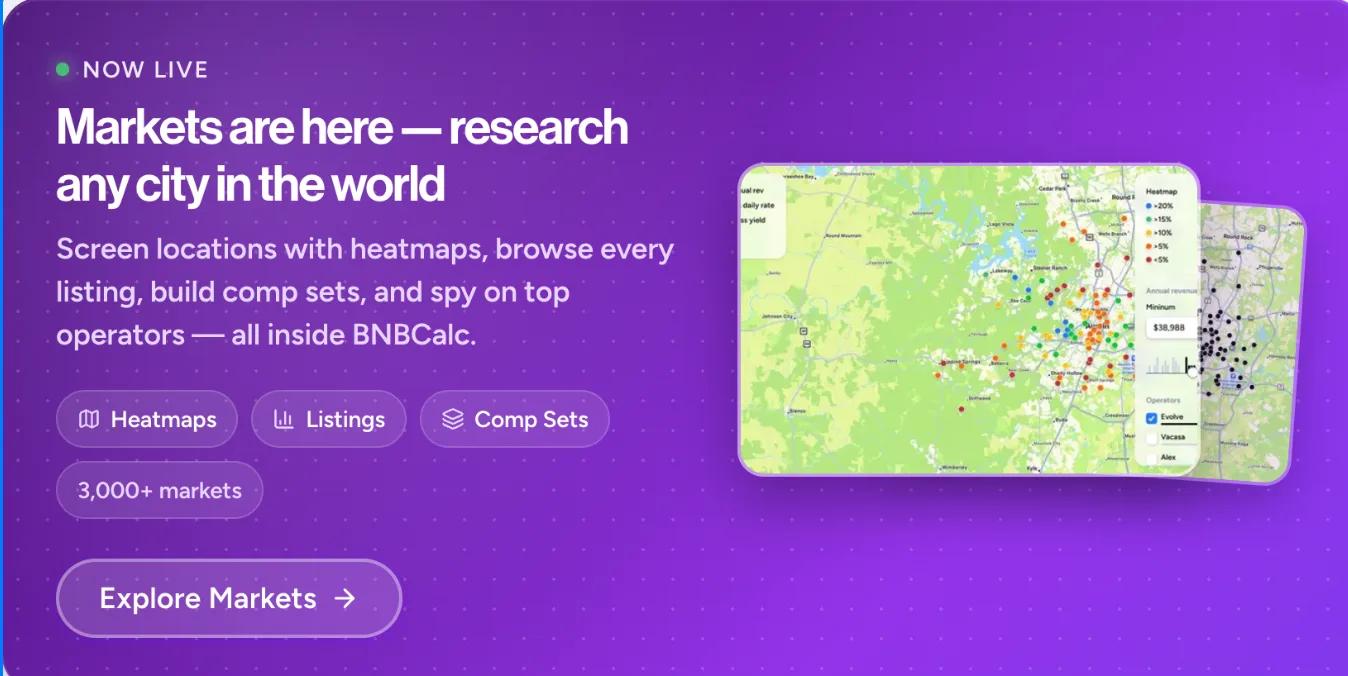
Shave a dollar off supplies per reservation, six reservations a month across 140 properties, and he rounds it up to about a thousand a month. Want to size up a market before you get to the cost side? BNBCalc Markets is built for that.
Key Points
- Sief tracks what he calls average daily cost, or what a property costs to run per day, and says most of Techvestor's acquisition strategy comes out of the expense column. His challenge to listeners is to call their own property manager and ask for that number, because he doubts a single one could produce it.
- Taking average supply cost from $7 a reservation down to $6 sounds like nothing per stay. He calls it a 16% increase in profitability on that one metric across 140 properties, and at about six reservations a month per property, he rounds the saving up to roughly a thousand bucks a month, which he values at eight to $12,000 on resale through the improved net operating income.
- Cutting utility costs in one market by about 40%, which he puts at roughly 50 grand a year, is what he describes as the equivalent of a half million to $600,000 of portfolio value. That's his own math on his own portfolio, spoken in 2024.
- Mail turned into a real line item. Thousands of pieces a month go to one central address and get scanned into an email inbox, and that setup runs about $700 a month before the labor of reading any of it, because municipalities still send the important things by post.
- In one of his markets, average daily cost came out the same across a three, four and five bedroom once you strip out the mortgage, while the five drives 40% more revenue than the three or the four. Why wouldn't you just buy the five, he asks.
- Density decides what you can staff and what you can negotiate. He'd argue for an in-house handyman in a market with three dozen homes though never in one with three, and says calling a service provider with 30 homes in a market, or 140 nationally, tends to get you treated as an enterprise account.
- Sief cites AirDNA's national average occupancy at 50 to 55% and says his own portfolio sits anywhere between 73 and 85 in any given month. That comparison is his, quoted in 2024, and he uses it to explain why some cleaning companies tell him Techvestor is their only client.
Full Transcript
Listen to the full episode on Apple Podcasts, Spotify, or YouTube.
Jeremy: We are live with the Short-Term Rental Pros Podcast. And today I am here with Sief, who, for those of you guys who have been listening, I have talked to several of his colleagues who he actually recruited to be a part of Techvestor. You guys are familiar with the show. Techvestor is a very, very impressive company. How many houses are you guys up to at this point?
Sief: I think somewhere between 130 and 140 we've done.
Jeremy: They have designed, built out, and managed 140 properties that pull in, what, $10 million, $20 million a year at this point?
Sief: We should be close to $20 million a year in revenue.
Jeremy: 20 big guys, 20 big guys a year, and they built it entirely from scratch. So super impressive what Sief and company have built, and super excited. It's going to be a really fun episode today. Sief, man, thank you so much for joining. Introduce yourself, and how did you get into short-term rentals?
Sief: Yeah, thanks for having me, Jeremy. First and foremost, super lucky and privileged to have a fantastic team that actually pulls this off every single day. And we should be well on our path to that 20 big number that you mentioned when all these properties actually launch and stabilize.
But a little bit of background. I kind of grew up through the ranks of tech, spent five years at Facebook building teams and infrastructure and recruiting people. Before that, I actually even built a small startup on campus back when I was in college, helping people break into big tech. So I had that entrepreneurial bug most of my life.
Family is first generation, so I was one of the first people to go to college. And the reason that I bring that up is my mom is the type to stuff her money under the blanket and under the mattress. We didn't grow up with a lot of investing and financial resources. But something that was really important to me that I saw, especially in big tech, was the value of investing early and often to begin with, and also trying to identify trends that you could maybe grab a little bit of a hold of before they become more mainstream, essentially pre-institutionalization of something.
And when I was at Facebook, we saw a lot of poor Airbnbs, especially ones that were geared towards families, or supposedly geared towards families, and just didn't seem to be geared towards families when you would stay in them. The quality, the amenities, the design, everything here and there.
And then I became a father in 2021. I have two boys today and they're my life, but they also allow me to see business super differently. Now when I travel, I can't book that hotel room the way I used to book it in the past. Now I'm looking at an Airbnb, I'm looking at certain amenities. And when we looked at the market for Airbnbs and short-term rentals, we didn't find enough good supply of the type of product we wish we had as parents and fathers and travelers ourselves, because a lot of our travelers are people like us. People with kids, people with families, larger groups. And those are things that we felt kind of didn't exist in the space.
And then we paired that with a traditional syndication model, which is essentially raise a bunch of money. That money's used for operations, acquisition of real estate. It's a pooled investment. So instead of owning your own Airbnb, you own 1% of 150 properties on however much investment you put in. And then someone else, aka us as a general partner, does all the work. We find it, design it, furnish it, renovate it, permit it, operate it, deal with the guests, deal with the toilets, deal with the broken roofs, deal with the neighbors, deal with everything.
And we had a couple of iterations in between then that I'm sure we'll talk about. But that's a little bit about Techvestor today. We've raised a little over $75 to $77 million over the last couple of years. And we're continuing to grow, and we'll see where this journey goes.
Jeremy: And I feel like I have had maybe not a front row seat, but like a fourth row seat to the Techvestor journey, and the different iterations that Sief talked about. I think we first initially talked, I remember our conversation, I was setting up our first Florida property. So this would have been October of 2021, the first time we talked. And I think you may have got my number through somebody, but I think you had seen me on social media.
And what I've learned through talking through your colleagues is you just reached out. I want to give Sief credit that he has built an incredible team, and I want to backtrack into the way he found the talent. So I've had Mr. Jones, Taylor, on the podcast. He has a big Twitter presence. John Bianchi, I've had him, the Airbnb data guy, a big YouTube, TikTok presence. Sabrina back, I think, early 2020 was posting a lot on social media.
So Sief, it seems like, really just found people who are talking about short-term rentals, passionate, and just hit them up and said, hey look, we're trying to build something here. Is this something you want to be a part of? Is that kind of how you went about it? And you hit me up, so I guess I fall in line with that as well.
Sief: Yeah. I mean, when I first met Jeremy, I think it was right around Q4 21, I think we had just raised our first $7 million. And we were kind of talking a little bit about, I think we were on our third pivot, coming or starting as a software product to where we were at that point.
But our recruiting strategy and growth of our team has been somewhat intentional, in that what we're building as a company has never been done before. So it's really difficult to find people who have done it before to recruit. So we've had to get creative in terms of who can add value to the journey ahead.
And when we talked to yourself, Taylor, John, some of these people that you mentioned, really what we looked for was who's deeply passionate about short-term rentals and who can, quote, figure sh*t out along the journey. And I think you know this just as much as I do, Jeremy. Short-term rentals aren't rocket science, but there's a lot of figuring it out along the way, especially if you haven't done it before.
And we knew we would have certain challenges at scale. So what kind of culture and team could we build? Who could we go recruit? And take Taylor as an example. When I met Taylor, he wanted to start his own fund, and I was like, well, let me kind of walk you through why you might want to reconsider that. It's not a one man job. There's a lot that goes into it. And we were lucky enough to have him join us. Same thing with John.
But we've been pretty intentional with who we reach out to and who we recruit and add to our team. We've had 100% retention in leadership, in terms of our core team, since day one. And that's a big thing that we pride ourselves on, is leading with the best talent to execute for our investors. I think that's the most important thing we can do for investors is have the right people here to solve the problems we're going to have. Like no business ever goes to plan, contrary to even having a business plan. And so having the right people who can solve those problems is critical, especially when you're doing things that are in uncharted territory day in and day out.
Jeremy: Yeah. And I remember our initial conversation, and now as we're talking, I'm rehashing or thinking about what we said. I went on a walk. I remember I went on a walk on a lake in Florida. I remember this. And I remember you saying like, we're going to buy hundreds of millions. And again, maybe I was similar to Taylor where I was like, yeah, people obviously, when you say you're buying these houses, like, oh, do you want to raise a fund? Do you want to raise a fund? And I think, yeah, maybe, it sounds interesting. Like I'm going to do a few houses, do it on a deal by deal basis, see how it is before I take on anything bigger than I can chew.
But I remember talking with you and we were kind of just spitballing like, yeah, what would it take to buy, I think we probably said like $200 million worth of single family homes. And we just started talking through what that would entail. And I was like, you know what, I'm not doing this, but I'm all for you doing this. Like, let me know how that goes. Yeah, I would take the setup on them. And we talked, I don't think we talked about the permitting, but we were just rehashing over some of the challenges that would have come from all that. Like my scale, not even close to your scale.
But that being said, I'm trying to remember what we had that initial conversation. Yeah, you were at $7 million worth of houses. Tell us, how did you get, so it's been three years from seven to 70 million worth of properties.
Sief: Yeah. I mean, it's been a lot of luck and a lot of right place, right time. But I think naturally it's just been a lot of adaptability. As the markets change, late 21 and 22, you had interest rates doubled between late 21 and late 22. No one underwrote for that. I don't care who you are, where you are in the world. If you underwrote for that, you would have never bought, right, to begin. And so that was challenging. We had to build our own operating infrastructure.
But I think what we did is we had a big vision. We had a great team. We told a great story, in my opinion, that I think was simple to understand. I think investing is often complicated and we tried to find ways to uncomplicate it. We related things to the user. We took a user journey approach. We were joking a little bit about software and the user journey a little earlier. We said, well, people understand short-term fundamentals. They stay in Airbnbs, they like the product. They can understand the value of having well-amenitized homes for families and groups and kids. Here's our thesis. Here's what we're going to do. And we kind of broke it down and told a narrative and a story over the next couple of years, and people really bought in.
It was a time post pandemic that travel was really booming in many ways. And we found investors in verticals that understood real estate, but had never invested in a short-term rental fund because it was never an option. So we essentially used what I like to call, forgetting the first exact words, like tangential marketing. It's like finding users where they already exist with something that they probably understand. It's not far off from their core understanding of things. And I think we were really lucky to find that from people who invested in apartments or self storage or other things in those lines, that this didn't feel that crazy to them. And that became a start.
And then we also do a great job of, I think today at least, sharing our journey on social media, on podcasts like this, and also just relating really well to individuals. Like if you're an individual and you have kids, and if you ever tried to book an Airbnb, you already know what I'm talking about. If this is someone that's you and you go and you try to find a property and then you see one of our properties, something we hear all the time is, quote, that's exactly what an Airbnb should look like. That type of validation is really easy to understand as an investor because you're like, I would book that. And if I would book that, I can put my money into this and hope that someone else would book that.
So a lot of that has happened. We brought on Sam as our head of capital markets as well. And just building the engine has been a journey, but it's been a rewarding one for sure.
Jeremy: Definitely. And I remember, you're like early, it's kind of funny how you said interest rates doubled, things got a little tighter. And I think we both probably got lucky in a way. It's kind of crazy that we're both relatively young, but we kind of hit this at the right time. I mean, granted, sure, if we would have bought houses in like 1970s, 1980s, that would have been a lot cheaper, but really like 2020, 2021, you buy in roughly the right place with the right bedroom count, you're going to do well. Like you're returning money to your investors.
Like I remember you were paying for like a, hey, if someone finds me a house that the numbers are good on and we close on it, we'll pay you a referral fee for that. And I remember looking for the right deals and I sent you a couple and you're like, this one's under contract. Like you sent it, but that was back then. That was kind of roughly what you could do. Like the house, right size, right area.
Now you guys have narrowed the crap, and I definitely have as well. Like there's still deals out there, but you just have to be very, very specific about the buy box for the properties you're looking after, and then just set them up extremely well. So yeah, break us through. So 2022, what works, like what could work? And now in 2024, what are you buying?
Sief: Yeah. When I look at 2022, we were still going primarily off of third-party data. Your AirDNA's, your Rabbu's. You're observing what's kind of going on in the market because you didn't have first level data of what was working.
And so our thesis at the beginning, when I look at our first portfolio, we had more smaller properties. Today in our second portfolio, we have almost no smaller properties. So primarily larger homes to begin with. And even some of the markets changed a little bit from portfolio one to portfolio two, but each market is so hyperlocal.
You take Scottsdale. You need a specific lot size to be able to do the right amenities that you do. And we tested it out buying in a couple of different areas of Scottsdale. And we found far and above one specific part of that market, in one specific product, excelled far and above everything else. And then we tested by bringing that type of design and amenity package to a market like Clearwater, right in the Tampa Metro. And that hadn't really been done before, and it worked. But it was a hypothesis at the time. We've bought in places like the Poconos and other areas.
But I think a big thing that we're very bullish on, and I think this is kind of like an overarching statement across our portfolio at least today, is larger homes, highly, highly amenitized, on generally larger lots, so you can fit the amenities that you want, that sleep typically 12 plus people on average. And you take that approach to most markets across the country today, you'll probably do better than average. In some markets, and some of the markets we're in, we do drastically better than average. But we've tested this in almost every market and it does well.
And again, no surprise, it pays to have things like a pool. You know this, I know this, the value of having a pool. And so in our first portfolio, we weren't building pools, because while we believed that to be the case, we didn't have pure data that that was the case. And then we had that data. So in our second portfolio, our renovation budgets are 30, 40, 50, $70,000 more expensive sometimes compared to 2022, for a couple of things. Cost of goods, cost of labor. We're also just doing more. Adding things like pools, adding fifth bedrooms to four bedroom homes, and adding legitimate real estate permitted square footage.
And we're doing a lot of work that I think we're making deals happen, not buying deals that exist, if that makes sense. Because we'll take a four bedroom that we're buying, we'll turn it into a five, we'll drop in our entire renovation package that we typically do for that type of market, drop 150 to $200,000 in renovations and furnishings and everything included. But your average operator of a short-term rental isn't doing that. They're looking for something that's on market, turnkey. They don't want to spend all that money. They're kind of going with the flow. They're like, how do I make this work with what I have? We're going in with like, no, we're going to make this property what we want it to be, because we expect to hold it for a conceivable amount of time. We want to continue to remain relevant, not just today, but eight years from now.
We literally have internally what we call an eight year North star. Anytime we buy a home and we're renovating, designing, we're asking ourselves, is this relevant eight years from now? If we're going to fix the roof today, because let's say you're in Florida and you're at year 14 on a roof, year 21 on a roof, year 12 on a roof, what decision do you make? It's a very different decision if you're in Scottsdale on your year 12 on a roof, in terms of those types of things.
So those are some of the things that we've seen have worked. We've tested out everything from golf simulators as amenities to pickleball courts, which the pickleball court one is one we hear often from folks, like, how did you learn about this one? And we bought a property that had a pickleball court, just happened to have one. And it was making so much more revenue than we ever expected. And we ingest data on a weekly basis and think like a word cloud, and so many of the reviews were talking about pickleball. And we were like, okay, let's test it out and build this at the next property in this market. And we did, and we saw repeatable success. So we continue to do those things and we continue to get better with the types of things that we launch and operate. But that's just one of the examples.
Jeremy: I think you guys' amenities there, they're hilarious. And yeah, I had Mark Lumpkin, who's writing a book called The Amenities Arms Race, and trying to dive into specific amenities. And yeah, the conversation with Taylor about play structures, and how it's not even, if you get a normal or the cheap play structure, you might as well not get one. Like you need to get one with at least like a slide and like three swings. It's not even the amenity, but it's how you do the amenity. Like it's not bunk beds, but it's bunk beds that are jazzed out.
Sief: One of the most interesting things I'll leave you with on the amenities journey is the style of your mini putt, your mini golf. It has a direct correlation to revenue based on our data sets that we've collected. So different shaped mini putts allow you to drive significantly more revenue, ironically.
Jeremy: Really? Like, is it, cause you know what, sometimes people have like the three holes, but they're like together in one circle. Like depending on how you design it.
Sief: Yeah.
Jeremy: Whereas like the ones that you kind of have steps between. So it's like you're walking around and going to different spaces for it.
Sief: Yep. But the answer is different depending on the market. And so it's like we geek out on these things on a daily basis. It's literally all we do every day. I mean, I think in March we did well over, or somewhere over, like a thousand checkouts a month. And so for us, that's all first level data that we can ingest. We gather, we observe what's working and what's not working. And we nerd out on the smallest of details to try to unlock and hypothesize and test, is this thing going to work or is this thing not going to work, as we think about growth and scale. And then, okay, can we take this from this market and apply it to this other market?
Jeremy: And that's, I mean, I look at you guys' portfolio all the time and I commend you guys. Sief and team have made their track record completely public. They have nothing to hide and they'll tell you what their properties are, how much they're making, which not a lot of people are doing. I mean, I'd say I'm pretty honest with myself, but I would say a lot of people like, yeah, sure, maybe the house is making 300K, but they bought it for 3 million. So they talk about that revenue number, but they don't talk about that monthly mortgage, those operating expenses.
Sief and I, before we hopped on today, we talked about expenses and how important they are in this game. Out of 140 properties, how do you manage OpEx? And what are like the funnier solves you guys have had to just the problems that you get at scale?
Sief: I mean, I don't even know where to start. This is our biggest problem, admittedly, and I'll speak about it publicly, and I'll be sharing this with our investors in our shareholder update later this month. We don't have a revenue problem. Our properties drive industry-leading revenue, but we believe we can continue to move the needle on expenses.
And so how do you manage labor? Do you hire an in-house handyman in a market where you have three dozen homes or not? That's a question. The argument would be yes, but you wouldn't hire one in a market where you have three homes. How do you get supply costs down? Is that a market dependent thing? And does it change between threes and fours, or fours and fives, as bedrooms?
Like fun fact, in one of our markets, and we just recently did this exercise earlier this week, our expense ratio, our what we call our average daily cost. People talk about average daily rate. We look at average daily cost. Of that property, between a three, four and a five bedroom, had no difference. Not including mortgage. I'm not looking at the cost of debt, but just actual costs. So, but then your five bedroom is driving 40% more revenue than your three or your four, as an example. Why wouldn't you just buy the five?
You ask yourself these questions and you start looking at expenses. Expenses actually dictate most of our acquisition strategies, not revenue. And people are often super surprised to hear that. People oftentimes go to tools like AirDNA and Rabbu and they're like, wow, this revenue is incredible. And yes, we play the game of sharing our revenue numbers publicly. But what we really look for in our portfolio composition meetings and in our insights is what markets are the most efficient to operate in. Because ultimately revenue means nothing without profit, and profit means everything after expenses.
So because we're owner operator, we have this really unique ability to compare revenue to expenses. Someone from Vacasa way back in the day told me a statement and a quote that sticks with me till this day. He said 40 to 60% of Vacasa's clients at some point restrict Vacasa to what they can and cannot do as a property manager. What I mean by that is, you can't allow pets, you can't charge less than this or more than this per night. So inherently you have an owner who's emotional or illogical or uneducated, or whatever the right word you want to use is, about their home. They're telling what is supposedly their expert partner in the space essentially how to do their job, and therefore they're limiting their ability to drive revenue. That is what we like to call an inefficiency in the marketplace.
And that's a big reason we drive inherently better revenue, is because we don't have any emotions in our property analysis. Everything is investment. Everything is logical. There's no restrictions. Let's do the right thing for the property.
And we also track expenses. Anyone listening to this, call your property manager, ask them, do you know what my property costs per day to operate? I would be shocked if a single person actually responded to you with the answer. They don't track it. They have no incentive to track it. They make money off of 10 grand a month that they're driving for.
Jeremy: I do not know my average daily costs. I can figure it out. Give me 20 minutes.
Sief: You can figure it out, but that influences so much. It influences acquisition strategy. It influences revenue strategy. It influences where you can actually drive potential impact. Like for example, and you and I both know this, you can't just price your property whatever you want in the market. The market prices your property to an extent. However, you can probably move the needle on expenses if you were tracking it.
Like we know how many paper rolls go through a reservation. We track that meticulously because that data is insight. Well, what does one cost us? If we're able to, and for us it's impactful at 140 doors, if we're able to take our average supply costs from $7 a reservation down to six, while that might not sound like huge, that's a 16% increase in profitability on that one metric across 140 properties. So the value to us is massive compared to the individual who might say, I don't really care about that buck. But for us, we really care about that buck, because that buck is one buck times 140 times 3000 things we can do like that, that really add to our NOI at the end of the day. So that's why we're so [inaudible].
Jeremy: Installing like the smart thermostats to keep temperatures regulated and things like that.
Sief: We installed in one of our markets, we install like a ton of mini splits, for example, and we disconnect all the baseboard heaters and those types of things in the cabin market. Yeah, they're a lot more efficient, but guess what? You also got to drop 25 grand to install them in the whole house on day one. So what's the ROI on that? And how do you measure that ROI?
And for us, because we have an eight year North star, we know that we're dropping our utility expense by X over an eight year period. Here's our payback period. We think that that's a good ROI, more efficient in this market compared to what the home typically comes with, which is not central. Yes, 100%. If the home has central, you wouldn't need to add any. This is specific to baseboard heating, not a...
Jeremy: What do you mean baseboard? What do you do? Like I have like a boiler room. Like what, what is...
Sief: Yeah. Some cabin markets have propane and oil and, you know, I don't know the efficiency of a home in these types of things.
Sief: And snowplow versus lawn care. And do you add a pool? Do you not add a pool? All of these things. And also, by adding a pool, you add revenue, but you also add expense. What is that expense? And it's not just expensive operating. It's like expensive insurance. It's expensive liability. There's a lot of things people don't factor in when they think about performance. They just think about this top line gross number. It's like a sexy number to chase. And again, we share our sexy number to chase just like everyone else does, but we're hyper focused on driving profitability at the end of the day, and net operating income, because that's what we're doing this for at the end of the journey.
Jeremy: And I would say though, as a co-host property manager, that's all stuff you don't really have to care about too much because, very true, owner's problem. And there's a lot of owners out there who don't really care about those things. They're buying and holding these properties for 20, 30, 40, 50 years. So they just want to maybe pay the mortgage, or maybe not even pay the mortgage. But when you have a fund and you're returning dollars to investors, or me, this is my livelihood. I rely on that income from the properties to pay for my cat's food, wherever my cat is. I thought it was behind me. It's super important.
But yeah, okay. This being said, so we're keeping costs down and we're being creative. What are some, I think one example you shared earlier, like a challenge you guys face is, how do you deal with mail for 140? I think you asked me the question and I said what I thought, but I didn't allow you to give the answer. So I want to [inaudible]. What is the answer to that? How do you deal with mail for 140 properties?
Sief: Yeah. That's not something we ever thought we'd ever have to solve, first and foremost. Today all our mail for all our homes goes to a central location and then gets scanned in as an email. Essentially it's virtually scanned, and we have an inbox that essentially is an email inbox. It's all our physical mail that's scanned.
And people ask like, why do you have that? And it's because a lot of municipalities and communication still happen via snail mail. And so how do you communicate and keep up on these types of things? And sometimes important things come through the mail, and it costs us.
Jeremy: They do. They do come through the mail. [inaudible] It doesn't make sense, but it still does. They show up again, and they show up again a month later. And if you're not there but once a year, and I mean your cleaners might grab it and put it in the closet for you, but do you want your cleaners like reading through the mail and being like, oh, this document here is important? They're not gonna know.
Sief: No. And you can't even really tell sometimes until you open up the thing. So we have thousands of pieces of mail a month across our portfolio, and we built an infrastructure, cost us about 700 bucks a month ish to run and operate, before the labor of actually reading the contents of that mail. But that's one thing we've had to solve for.
Like another one we were talking about is permitting. It's super important to make sure your permits are up to date at the state level, the city level, the township level. If you're in an HOA, HOA things, all those types of things are important to keep on top of. And again, a lot simpler to do if you own one property, but when you own 140, how do you need to build infrastructure for that, in order to keep tracking and, when do they renew, and if changes happen from a regulatory perspective, how are you informed of how that happens?
So there's a lot of challenges at scale that I don't expect operators typically to deal with, but these are some of the things that we've had to build infrastructure for. And I think our investors would appreciate the fact that we're building infrastructure for it, because it allows us to drive a significantly better return profile for them.
Jeremy: So that being said, all right, so 140 has its unique challenges. One question, do you guys have full-time cleaners? Or I'm assuming you probably need several services in each market if you have 20, 30 properties there?
Sief: We have several services. We don't have any cleaners who are full-time, and they're all contractors. So we pay them for clean and all those types of things. We have cleaning companies that tell us we are literally their only client, because of the volume we're at.
You know, I think you look at, I think AirDNA shared national average occupancy is like 50 to 55% in that range. Like our average national occupancy is anywhere between like 73 to 85 on any given month. And so we're usually higher occupied than most. We're keeping our cleaners busy.
And we do have dedicated resources in some of these markets, market managers, repairmen, all those types of things. We give them volume, and oftentimes they know our properties in and out because it's repeatable. It's like, do this at each of these properties.
Jeremy: Yeah. Go in, check. You have a clipboard, check off these things, look for wear and tear, look for scuffs, document, take a picture, upload it to this system, yada, yada.
Sief: Exactly. We built everything on top of things like Breezeway and Slack, and we have Jira and Atlassian tools, and we have our own technical infrastructure that speaks to one another. And then all of this feeds into our asset management infrastructure so we can track expenses.
Like we export our QuickBooks and other accounting things weekly, if not daily. And we know what our costs are on a rolling seven days. Like where are we spending money, and why are we spending money, and does something seem off? So those are the things that we spend a lot of time digging into and nerding out on.
Jeremy: Absolutely. So, but having fun. I think again, this goes to the point that there's so much to do, there's so much to look through, but having a group of people who is like interested in finding these things, like, hey guys, how do we lower our costs per month $1 for each property? Like whoever can figure that out gets a shout out or whatever. I'm sure, I'm sure, I don't know. You guys have a culture of like being excited to figure out or solve these problems.
Sief: Well, the impact is massive. It's not just a, you know, give you an example. If we're able to save a dollar on supplies across 140 properties per reservation, and we have six reservations per month per property on average, let's just round up and call it a thousand bucks that we're able to save. That thousand bucks may not seem massive. However, that thousand dollars is the equivalent of eight to $12,000 value on resale because of your improved net operating income. And that's off of a thousand bucks.
So for example, when we were able to reduce our utility costs in a market by 40%, which was the equivalent of about 50 grand a year in one of our markets, that right there is the equivalent of a half million to $600,000 improvement in portfolio value by making that change. Like making those phone calls helped add $600,000 of portfolio value. Your average individual probably isn't thinking about it like that, and you wouldn't expect them to.
These are the types of challenges we face, but we nerd out, we have fun on. And to your point, the fact that we have people who are deeply passionate about the space and just live, die, breathe everything in this industry day in and day out is an unfair advantage.
Jeremy: So did you call Alex from CanMonkey? You have enough scale with him to say, hey, we're not doing $50 a month anymore for Can. We're knocking that down. Each dollar we get you down is another hundred thousand dollars of portfolio value for us. So we're going to have to.
Sief: We know Alex pretty well from CanMonkey, and shout out to them. They have a great business model and a great business in general. And I believe we do use them in some of our markets that we're in. But yeah, people like Alex, yes, we would call them and say, hey. We also have a great advantage in negotiation because of scale. Most people are calling service providers and saying, I have 30 homes in this market, or 140 if they're a national provider. And generally they look to those as enterprise accounts, and those are a little bit more negotiable in terms of what can happen.
Jeremy: Absolutely. And one thing I want to touch on, and I think when we talked years ago this was also part of the vision, is that, I don't want to say the issue, but really the reality of single family residential homes is that when you sell them, you can only sell them off of appraisal value. So Sief's coming in, he's adding 150K, 200K's worth of amenities, pimping out the homes. However, when he goes to sell them, the neighbor down the street doesn't have all that cool stuff in the backyard. So the value of the home can be seen as less, even though he's added something that's really created value for the property.
However, there is a world that Sief shared with me, there is a world where you can sell these things at scale at a cap rate. And a lot of folk I've had on who are in the boutique hotels or landscape resorts, that's really where they've hit the nail on the head, is we can build these, we can stabilize these, and we can sell them at a cap rate. Which again, when Sief was saying earlier expenses are lower, the reason you get your expenses lower is so you can get your net operating income higher. If your NOI is higher and you sell at, you know, five, six, seven, 8% cap rate, you are drastically, or I don't want to say exponentially, but you are linearly increasing your sale price.
So what is that? Is that kind of how you think of, like, how do we increase NOI? And there is a world where NOI matters, because really for single family homes, NOI doesn't really matter. But for 140 single family homes, it might matter.
Sief: Yeah. And I think you hit it right on the head. And I would actually beg to argue that it is exponentially different. Selling between a five cap and an eight cap is very, very different. And so I'm not here saying that we're going to sell at a five cap. I don't think the market trades at a five cap or anywhere near a five cap. But I'd take a five cap tomorrow if anyone listening wants to offer that tomorrow. I think our investors would be very, very happy with that.
But I think the idea for us is, how do we improve value? And our thesis is that by building a portfolio, institutions, midsize or larger ones, and we've talked to several, would be interested in buying this portfolio. And our thesis starts with this. If I'm anyone like Starwood or Marriott or a midsize private equity group, and I have an interest in short-term rentals or a thesis around short-term rentals, and we've talked to a lot of groups that have a thesis around short-term rentals, they have two options. They can build a portfolio or they can buy it.
And if they build a portfolio, it's too slow, because they're used to deploying 50, 80, a hundred million dollars into a project and it just kind of happening. That doesn't work with short-term rentals. It's hyperlocal. I can't just go buy a community of short-term rentals in Scottsdale. They're not all going to be ideal product. And if they are, then you're going to oversupply the market very quickly.
So how do I actually buy the right supply? And it's honestly brick by brick. There is no speeding into this. You got to go do the work. Each design has to be different. The amenities have to look and feel different, even if they are the same. And one at a time, you do one, you accept it, you do the next one. Yeah, it's slow. Start 20 at the same time and have them be exactly the same, which, that's when you think of economies of scale, you think everything's exactly the same. You have to create different products. And institutions just don't have the patience for that. Like, they have a first world problem, which is I need to deploy all this money ASAP.
And so we believe there's a world where we can sell single family homes somewhere between the value of a single family home and that of a commercial product like an apartment building, based on revenue, because our assets will have been performing. They have track record. They have data. They drive more NOI. They drive more profitability. So the cap rate that we expect to sell for is between that of a single family home and that of a commercial asset. We don't know where that's going to be just yet.
Now if we're wrong and our thesis is wrong, maybe we hold on a little bit longer, and the good news is we can sell these properties back to the market as single family homes.
Jeremy: Which are still going up in value.
Sief: Which are theoretically still going up in value. We have long term fixed rate debt on all our homes. We're never going to be forced sellers. So we've hedged the risk as best as we can, from that perspective. And you and I can both agree that oftentimes it's about surviving in markets, not necessarily always thriving. And we've given ourselves the best chances of survival, and we're giving ourselves the best chances of thriving in those markets as well.
So it'll be interesting to see if we're able to actually pull this off. But this is the number one risk we tell investors. What we're trying to do has never been done before. I can't sit here and point you to another 20, 30, a hundred unit portfolio of single family homes that's done this. If we can do this, we'll be one of the first to set the market. And if we can't do this, then it'll feel like probably we hit a single or a double instead of a grand slam. And that's a risk profile we're totally okay to live with. And maybe we do this, but no one can ever do it again. Maybe that's the case. We'll find out. But either way, it'll be fun along the journey.
Jeremy: Well, either way, I'm excited to stay. Maybe I'm second row. I'll stay second row in the journey, because it's been fun.
Sief: You got backseat tickets, behind-the-scenes tickets anytime you want them, Jeremy.
Jeremy: I can go into the locker room. Let's go.
Sief: There we go.
Jeremy: I'll be in the locker room after the final four of the national championship when he's up there with his champagne. That's what I'm excited for.
Sief: The team's going to take us there.
Jeremy: The team's going to take us there. I'll probably be in the back being like, wow, that was one hell of a run. He'll be crying. Sief will be crying. He'll be holding his baby crying.
Sief: That sounds more in line.
Jeremy: What are you excited for? Obviously, building this portfolio, anything else on the horizon for Sief, for the team, or anything exciting you want to talk about? What are you excited for?
Sief: Yeah. I think the big thing for us is we're asking ourselves what's next at this point. And a couple of things of what we think could be next is obviously preparing our portfolios for exit and the most optimal exit we can get out of them.
But also, we have tons and tons and tons of people who reach out to us all the time looking for certain things that we've been able to forge some really great partnerships with for other services. I know you talked to John who leads STR Search, for anyone who's looking for a done-for-you Airbnb to be found for you, for acquisition as a service. I know you had Mark recently on from STR Cribs, from renovation and design. These are companies that not only do we use and recommend, but we're hoping to add value to the short-term rental ecosystem in the marketplace in general.
And we've been able to do some crazy good things, but we think we're just getting started with the things and the value we can add to the overall short-term rental ecosystem. And internally, we call it the STROS. We have a belief that we can add value to the onion of short-term rentals. And we started with solving this thing for passive investing in short-term rentals, but we don't know exactly what's next. It's something that we're continuously talking about.
Jeremy: And do you have a goal? So with the core fund, of being like, oh, in two years, we want X number of properties? Or do you have like a, we want $200 million worth, to own $200 million worth of homes? Is there anything like that, or no?
Sief: You know, we did have a goal and we blew past that goal. We never thought we'd actually get this big, to be quite honest with you. And I think we're at a point where we'll continue to grow sustainably. I think that's the most important thing. We have no outside venture funding or anything, those types of things, and we don't ever expect to really need it.
But for us, we're kind of at a place where we're comfortable and we're assessing, how can we improve what we have? Not necessarily how can we grow even further. Like we drive great revenue. We have great properties. It's how can we make it better, not how can we get more properties, I think is the number one goal today.
And if the capital continues to flow, I think the last three years, including this year, have been very, very weird for capital markets. You had the lowest interest rates ever to the highest interest rates ever, to the Fed, to the First Republic, the banks, you have an election this year. We can't control capital markets, and we'll continue to go with the flow of capital. But what we can kind of control is, how can we continue to get better at operating? And we think that's where we have the most value that we can add to our investors and our community.
Jeremy: And then also, I think something you guys have done is like, now that we have this team, how do we leverage our skills and add value to the entire ecosystem? Which I think is a really interesting way of saying we've done this ourselves. We've built a rockstar team. Our team has been exclusive, but now how can we open the gates and allow others to reap more based off what we have sown?
Sief: Yeah. And I think that's something that we have a responsibility to do. But it also, a rising tide lifts all boats, as they say. The better that the short-term rental industry does and performs, the more confidence folks like institutions have in the marketplace. And we see it every day when people reach out to us and like, oh, I'm copying you and doing this property. And we give them the best of luck. And we still drive 30, 40, 50% more revenue than they do, because we can have identical homes next to somebody, but operating is half the battle. Like you can move the needle significantly on operating. And that's where we have our biggest unfair advantages, is operating. It's not a pretty photo of an Airbnb. It's what we know. We know what to do with it, beyond that.
Jeremy: Yeah. And I think I tell people that, because BNBCalc, you look at like, we give a scale, like a revenue scale. And you could buy the same house as Sief, like the same exact house in the same market. You can even pimp it out the exact same way. You can say, oh, we need a pickleball court, we need XYZ, but then you're still going to have, yeah, 15, 20, 30% difference. And that's again where the inefficiency in the market is. That's why you can make money in short-term rentals, is because like random little things you do, whether it's from an operating standpoint, whether it's from a setting up the property standpoint, can make outsized return differences. Which is why we lean on team.
Sief: That's why we lean on team, right?
Jeremy: That's huge. So guys, that's the big takeaway. Team, team is big. And for those who want to build businesses that are not short-term rentals, team is huge. That's something, you know, Sief. Anyone I talked to in Sief's organization has said Sief built a great team. Would you say that's your superpower, is like building a team?
Sief: No doubt. Yeah, no doubt. I think my biggest skill set is trying to find the right people and getting the hell out of their way. And somehow finding a way to lead them to believe in what we're building, getting them to drink the Kool-Aid.
And I don't think a lot of leaders ever talk about this because it's almost like taboo. It is your job as a leader to make the d*mn Kool-Aid and get people to drink it. You are the host at dinner. You are not the person sitting down getting your drink filled by somebody else. You are the one making the drink and filling other people's cups as a leader. And I think that a lot of people oftentimes forget that. Like you don't sit at the head of the table. You're the last to sit down. You're the last to eat and you're the last to drink. And it's important that you continue to do that as a leader. And if you do that well, it's done well for me and other people here. Hopefully those people turn around and they start drinking their own Kool-Aid. And that's ultimately the downstream effect that you want to have.
Jeremy: Absolutely. We all love Kool-Aid. So yeah, what's your biggest tip for those who maybe are not trying to get to 140 properties and sell at cap rates, but for those trying to start with short-term rentals in 2024?
Sief: Yeah. I mean, I think the first thing I'll tell you is, use your resources. And if you're someone who's like a big DIYer, ask yourself, why are you DIYing everything? I find people get super cheap on the wrong things. I think back in 21 and 22, it was like getting cheap on design. I think in 22, 23 and early in 24, people are getting cheap on amenities. They don't really understand the value of things because there's no direct correlation. They can just go click on Google and be like, if I add a pickleball court, what's my increase in revenue? Like there is no direct understanding of that type of data yet.
Go talk to people who are experts in this space. We talked about John earlier from STR Search. We talked about Lumpkin and Mark from STR Cribs. These are people who, and companies that, do this for a living. They have insane amounts of data, and the numbers prove it themselves with the homes that they put out.
Go get help. If you're getting into this space, it is going to continue to get more competitive in the short-term rental space, not less competitive. And if you're one of the weaker properties, especially in today's world where cost of debt is and cost of property, you will be phased out far, far faster than you think you will. If you're not doing the right things upfront, everything you do upfront before you launch is the most important thing, not the launching itself.
Jeremy: Yeah, I would agree. I mean, I think that also in a way, things are like easier today than they've ever been. And I think if you're listening to this podcast, you're in the right place. Like what I know now, what Sief knows now, we had no idea three years ago. We maybe had like a hunch, but we didn't really have the data points to really say, yeah, I'm adding a pickleball court to this property, or I'm only buying, oh, this is the one property in this market.
I mean, we can probably go all day and I'll be mindful of your time here. But one thing I talk about is, if you're looking at a market, how do you think about defensibility? What are the things that you can do there that other people aren't going to be able to do? So I think John, I was talking to him yesterday, and he shared an example. I tell him things I'm seeing, he tells me things he's seeing, and that helps us stay sharp between the years and continue to do well.
But he was like, yeah, we bought this property in this market, and you can't really have a flat backyard. It's like a mountain market and other people just don't have flat backyards. And because of that, we think this house is going to absolutely crush. There's a couple other things, you converted a couple like extra living rooms into bedrooms, turned it into like a six bed, but really that was like, this has a big backyard that's flat, and we know this is defensible forever for that reason.
Sief: And what you're talking about is genetics. Like literally we look at genetics of the home.
Jeremy: Exactly. And that's something I look at. If I buy a house, I'm like, all right, this house, sure, pool, whatever, you can build a pool. But if you're in a city but you have a big enough lot to have a pickleball court, other people can't have pickleball courts. That is defensible. So it's like, what are things when you're looking at a property that are defensible about them? And there's going to be more competition, but you can only do so many houses, frankly. So I'll leave it at that.
Sief, any final remarks? Or how can folk find you if they're interested in staying in touch with you, with your journey?
Sief: Yeah. I mean, first of all, thank you for having me today. And thank you for taking care of my team, that's also been on the podcast with you. But if you're interested in checking out Techvestor, we're at Techvestor.com, always open and eager to chat with either new potential investors or people just curious about short-term rentals. And if you talk to us and end up wanting to do your own thing, we'll be happy to refer you somewhere else, and give you any advice we can, and good luck on that journey.
But thank you for the support in general, Jeremy, and the wise words. And I'll always regret not being able to bring you onto the team back in the day. Jeremy has been a tough cookie to bring on, but he's been uber successful in his own right. So congrats on your success thus far.
Jeremy: Hey, and I'd say success comes from having conversations with you and everybody. And I hope maybe a little bit of that goes both ways. So it has to be [inaudible]. Awesome. All right. Well, pleasure as always, man. And everybody stay tuned to the next episode of the Short-Term Rental Pros Podcast.
Airbnb Tax Deduction Calculator
Paying too much in taxes? We have the perfect solution. Simulate an Airbnb home purchase below.
Purchase Price
$450K
Structure Value
70%
Apply Trump's Tax Cut (Bonus Depreciation)
Depreciation
$117,695
Interest
$21,600
Tax
$6,750
Year 1 Deduction
$146,045
Want to claim this deduction? Get a free cost segregation benefit analysis from CSA Partners — no obligation.
Get Full Analysis