Free instant analysis
Reveal Airbnb revenue for any address or city
Quick Summary
Insurance is the line Jeremy pushed him on. Shahar says it used to run about 1% give and take, and that it had moved to around 3% or 2.5%, which he says changes the whole return equation on a property. A lot of carriers left Florida, though he says he'd found one pricing better.
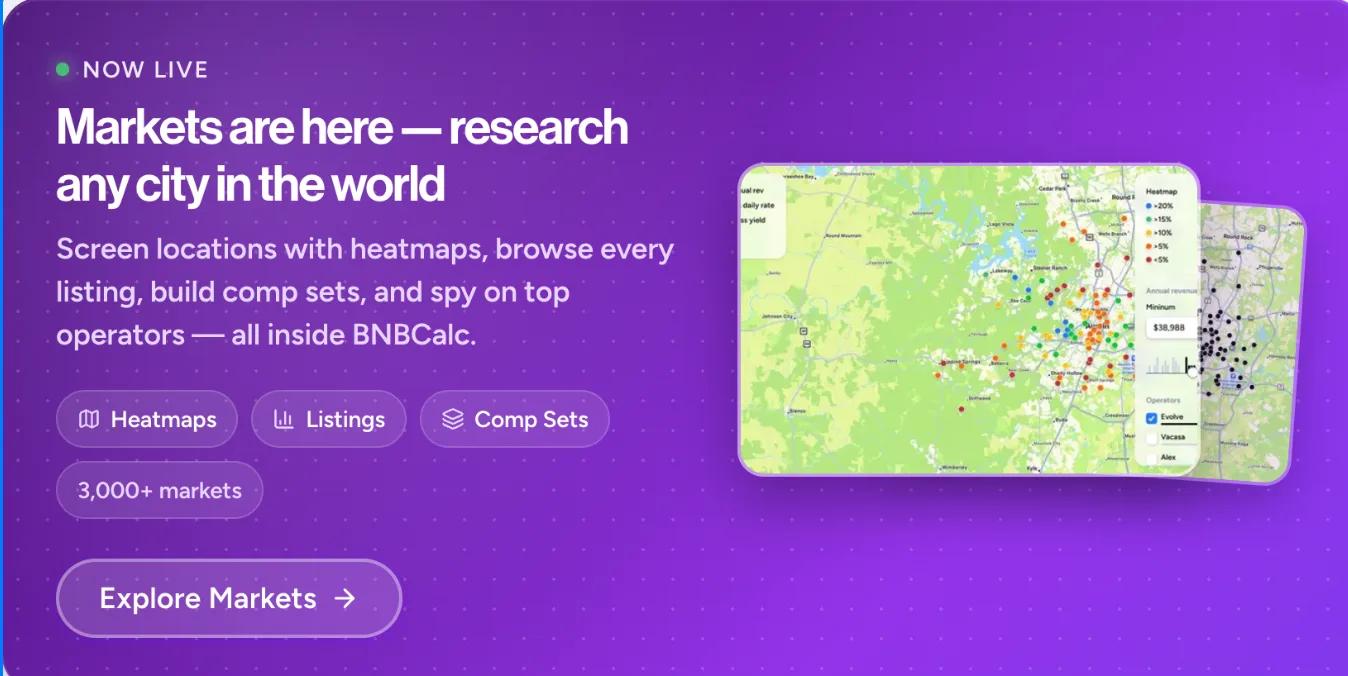
So if you're underwriting a Florida deal on old expense assumptions, that single line can eat the spread. Pull a real revenue number from BNBCalc Markets first, then price the insurance locally before you commit.
Key Points
- On insurance, Shahar says it used to be like 1% give and take and had gone to around 3% or 2.5% by the time of this conversation. He describes the bill as double, sometimes a time and a half, sometimes three times what you used to pay. A lot of companies went out of Florida and the few left raised prices, though he says he'd found one carrier pricing much better.
- Each area manager at his management company handles around 20 properties, the luxury and larger ones, and gets measured on four things: expense ratio, the review rate guests leave, how many refunds were given, and how quickly they get to the important jobs. Those four parameters are what the monthly bonus pays on, and his argument is that seeing the score is what creates accountability.
- His case for an AI agent is speed and stamina. It answers in under 30 seconds, works 365 days a year with no sick time and no benefits, argues on price up to the limits you set, and switches into Portuguese or Chinese depending on where the guest is from. He says answering something like an early check-in request means knowing whether a repair is still open, whether a late checkout was already allowed and whether cleaning is done, so Boom pulls all of that into one source of truth before the AI replies.
- Jeremy says the hot tub is about 50% of the questions his guests send, and he's been mailing out the PDF manual. Shahar's fix is video. Film the lock, the TV, the projector, then send the clip, since people react better to video than text and screening a house properly saves years of the same messages.
- Boom sits on top of a PMS rather than replacing it. Shahar says it had no direct API integration at that point, so it connects through the Guesty and Hostaway marketplaces with an API key, and the pricing is per property plus a charge for the AI pieces. He put his average customer at around 100 doors and says it makes sense above 25 properties.
- The customer he points to is one of the biggest developers in South Africa, which started with him at 20 properties and, by his account, wanted 500 by the end of that year and more than a thousand within two. That's his description of another company's plan rather than a result anyone has posted.
- Shahar isn't in day to day operations anymore, though he still does the soft opening on a new property himself and sleeps there with his family to catch what construction and design missed. Jeremy walks all 25 of his once a year and batches them by geography, knocking out eight around the lake in a single day.
Full Transcript
Listen to the full episode on Apple Podcasts, Spotify, or YouTube.
Jeremy: We are live with the Short-Term Rental Pros podcast. Today, I am here with a fellow co-founder, software co-founder space, but also property management business owner, Shahar. I got introduced to him through our friend, Fred, who does tree houses. Fred, I'm going to have you on a later episode. But he really thought Shahar had an amazing story and amazing software products. I wanted to get him on as quickly as possible and hear his story.
So first of all, Shahar, thank you so much for coming today. Where are you currently and how'd you get into short-term rentals?
Shahar: A lot of questions, Jeremy. So pleasure being over here, first of all. Fred is also a good friend and amazing entrepreneur. So anybody would like to hear, I think it will be a really good episode with Fred in the future.
As for me, I'm located in Miami. I got into the vacation rental actually almost by mistake. So I'm in real estate from 2008. In 2016, I did a startup to real estate. And in the end of 2016, a friend came to me and we purchased a property to his parents, like a $1.5 million property, a nice property came to me.
Jeremy: Where was it?
Shahar: In Eastern Shore, if you know, in Miami. It sits on the water. So he came to me, probably today it's a $3.5 million home. The back there, it was $1.5 million. So he came to me and was asking me, he wanted to do it in Airbnb. At the time I was doing the startup. So I told him, leave me alone. I have a lot on my plate. But at the time I was learning about the lean theory, which basically means how can I get to the maximum result with the minimum efforts in order to validate what I think.
So I told him, you know what, let me think about it for a night. And the day after I came back to him and I told him, you know what, I thought about something. I found a company in Australia that can actually implement interior design on top of an empty picture. Let's take the picture of the house. Let's advertise it on Airbnb with the interior design that we created with this company. Let's see the result and take it from there.
So we did the listing on Airbnb. As soon as we put it on, we started getting reservation after reservation. So my wife, she was a designer. So I told her, do you want to design a home? She was like, hell yeah. And this is how we started as a business.
Then I had a flip that we purchased that we couldn't move. So we changed that to an Airbnb. We bought a multifamily that we changed it into Airbnb. This is how I got basically into the space.
So when I got into the space, what I found out is that I had a lot of stuff that I didn't find a solution, meaning we were working with Guesty. I took Guesty as a PMS, but I didn't find a solution for owner portal for all of the expenses. So I asked my young brother that was with me also with the startup to the real estate. We didn't find a business concept over there. It was an amazing solution, but we didn't find. And we basically moved the angle into the vacation rental sector where we build a tech-enabled company. I said, you know what startup, let's put it to the side. Let's build a tech-enabled company. And that's what we've done with Design VR that up until 2023, we build a portfolio for around $150 million under management.
Jeremy: Got it. And what was Design VR? Was it a property management firm?
Shahar: First, let's not talk about it as a past. It still is.
Jeremy: Oh, okay. You said up until 2023. So I'm like, I don't know what happened in 2023.
Shahar: 2023, I actually divided the company into two. So I created a tech wing, which called Boom, which we're selling now technology all over the world. We have customers in South Africa, Greece, Portugal, Israel, United States, Mexico. And we have Design VR, which is a management company, which I'm not part of the day-to-day operation anymore. It's running by itself, but I'm chairman of the board.
And yeah, so we have Design VR. We also have Design VR Holdings, which we are functioning as a GP. We deployed around $40 million in the sector of mid-luxury vacation rental in Southeast Florida and West side of Florida.
Jeremy: Quick question. So I have two Florida properties and people listening may know that every episode I like to rip on Florida at least one time, one time per episode. I did just get back. I was in Miami yesterday. If you were there, maybe we could have done this in person under the sun. But your $40 million that you own, what's up with the insurance, man? Is that something you're dealing with? These insurance reduals?
Shahar: Yeah, we did 100%. It's crazy. So if it used to be like 1% give and take, now we're in around 3% or 2.5%. And it's really changing all of the equation of the return that you can make on a property.
Jeremy: You said 3% increases or 3%...?
Shahar: No, like when you calculate, okay, how much insurance will cost me? It went like double, sometimes time and a half, sometimes three times what you used to pay. And it's really, really changing the return, no doubt. And a lot of companies went out of Florida and the few that are here raised prices like crazy. Although we found one company that we see much better pricing right now.
Jeremy: Got it. I'm going to ping you for that one later because that's the situation we're dealing with with our Florida properties that I'm not dealing with elsewhere. When I underwrite the property, I usually write insurance as a fixed variable. I assume over time it can go up, but it's not going to be that material of a part of the investment. Assuming it's going to go up 2%, 3% a year doesn't really do anything.
However, doubling and tripling in one, two, three years, that has like a... And then the fact that it can do that moving forward, I'm like, well, if it just doubled or tripled in the last two years, can it double and triple again in the next two years?
Shahar: No doubt. And it's a big number. It's not a small number. It's a big number.
Jeremy: You've got $40 million of it worth because I've got $1.5 million of Florida properties. If you've got $40 million worth of Florida properties, I'm sure that's insuring a lot more worth of value right there.
Shahar: A hundred percent. Also, it's not that I own. I'm a GP, meaning I have ownership in it. We normally put 5% to 10% out of that, but it's definitely changing numbers.
Jeremy: Totally. I have so much to dive into here. Wow. Because I'm curious how you structure your GP LP partnership because I've also raised money. I feel like, honestly, I've done a lot of what you've done just on a much smaller scale. I know I just met you and started talking to you, but I definitely... I manage 25 properties. I have a management company of which 10 or so of those properties are properties where I'm kind of... or nine of them, the quote unquote GP. Each deal was different. Each syndication was different. So I didn't do it all under a fund. It was really the terms of the deal were dependent on that deal and the situation.
I have so much to dive into here. I'm going to take first.
Shahar: No, no. Go ahead.
Jeremy: How did you do your GP fund structure?
Shahar: Basically, we also did it as syndication, as deals, in order to build a history. You build it as an LLC. Each one as its own LLC. It depends. It can be two properties or three properties under one LLC as well.
Jeremy: Yeah, got it. In series.
Shahar: We do a 7% preferred to the LP. Above it, it's like 30-70 to the GP with a clawback of one year if we didn't get to the 7% and a sunset of five to seven years in that matter. What else? What kind of questions do you have?
Jeremy: Yeah, and then does your management company, Design VR, manage the properties as well and take the management fee?
Shahar: Yeah, yeah. 100%. So Design VR managed the property. We normally also own the real estate brokerage. So we do the brokerage deal as well. We find the deals. We analyze the deals.
Jeremy: And you're a mortgage lender too, right? Didn't you say you also...
Shahar: No, no, no. Not yet. No mortgage we are not. Not big.
Jeremy: All you Florida people, you guys are all GCs, you're realtors, you're mortgage brokers. You all are everything.
Shahar: You know what? That was a big lesson that I actually had. So I used to have also a construction company and also a cleaning company, which I closed these departments because I realized is that you can be master of all. And actually, we lost a lot of money on the construction side, because when I'm telling you a price is going to be a certain price, I will stand by what I told you. And it caused me a lot of losses, if to be honest.
So you get to understand what is your DNA, what you're really good at and what you're not good at. So I hired a GC and I hired an inspector, but in the end, we found out that if we move the work with a good contract to a GC to do the work, we are more efficient this way. As for the design, for example, we kept it in house and we're doing amazing design work in really amazing prices to people that use that. So it's really what your DNA is and how good you are and how understanding you are to the small level about everything that's going on to that question.
Jeremy: And focus. Yeah. And that's something I constantly have to remind myself and something that I'm making an active effort on, not just talking the talk, but showing it because I, like you, property management business, software business. I actually started with boat rentals, initially got into short-term rentals through having a fleet now of seven pontoon boats.
And on a day-by-day basis, if you get distracted, your head goes to one thing. You really got to be thinking about what's the highest and best use of my time? And then how can I either delegate responsibilities for everything else or just outsource it?
So I think that's just being a leader or an entrepreneur, getting to a certain point. People think, oh, it's like, I want to do something new all the time, yada, yada, yada. Yeah, sure. You want to do something new, but you really got to think about how do I systematize what I have and then what am I uniquely good at?
So let's get Shahar. What are you uniquely good at, man? I know, Boom, you were excited to talk about Boom. So we're going to save the meat of this pod to get into that. But what do you want to do on a daily basis and what are you doing?
Shahar: I think the biggest point for me is being a problem solver and to create value to the people that are using us in all manner, if it's through the management.
Jeremy: So what is Boom? Sorry, I don't mean to cut you off, but for those listening who have no idea what it is, which you guys will, people will know who you are very soon, but what is Boom?
Shahar: So Boom is a moderate solution sitting on top of your PMS, allowing you, because every PMS has its own problems, right? One doesn't have a good owner dashboard. One doesn't have a good CRM. One doesn't have a good mobile. So it's a moderate solution to sit on top of your PMS, giving you like the optimized PMS solution with task management, owner portal, guest portal, a website builder, accounting, like we have everything. So when we sit on the PMS, we create an amazing one.
And then on top of that, we give you business intelligence and artificial intelligence. So we are moving away as a day-to-day mission that you have, like in customer support, in sales, and give you business analytics in order to understand.
For example, Jeremy, if I will ask you, who is your best cleaner? Is it getting the best scores? Can you answer that?
Jeremy: Well, you have to define best. What is best?
Shahar: The cleaner that cleans the fastest and gets the best reviews on the cleaning that you have done. Can you tell me who is it?
Jeremy: No, I couldn't. Personally, I like the cleaners who tell you the problems with your property. That's like the cleaners I like.
Shahar: I used to like the cleaner when I'm coming to the house and she was like, hey, Mr. Shahar, how are you doing? With a big smile. But in reality, you don't know who is good and who is not good. And that's what Boom does. It's creating KPIs for you to understand that.
If I will ask you how much time it's taking you to answer a chat with your best salesperson, where your customers are coming from? All of this answer needs to create visualizations. That's what we do with the business intelligence in order to give you an opportunity to make a better operation.
For example, we take the area manager. Area manager, I'm not sure how you do it, but in Design VR, for example, we have many others. We have around 20 properties like luxury, big properties that each area manager manage and we measure them. How do we measure them? We measure them on expense ratio because we want the expense ratio to be as low as it can in order to provide income. We measure them on the review rate that the guests basically leave, how many refunds were given and how quick they are to get into important missions.
And based upon these four parameters, they're getting bonus on a monthly basis. So they have a visualization to their work and by that you create accountability. And that one part that Boom is actually bringing from understanding operation in a really good way.
Jeremy: Can you do how quickly is your team responding to messages? Is that something you can quickly figure out?
Shahar: Yeah.
Jeremy: Oh, interesting.
Shahar: And I can tell you with your best salesperson who is converting the market to sell and then you can trigger and I can tell you with your best handyman and it's really giving you an ability to control your company and using data and not stuff from your stomach. Oh, I feel this way. Because like you want to work with people with numbers and you want to run after numbers and you want to create this understanding of what is important to you.
Jeremy: So yeah, so you establish KPIs and you're able to track them. So how do you, you said you work on top of the property management systems? So I have Hospitable, for example, how would I plug into Boom or put Boom on top?
Shahar: We don't have API integration as of yet. But if you work with Guesty, if you work with Hostaway, if you work with Track, we are on their marketplace. So we get the API key and we are connecting.
Jeremy: Got it. So you don't and your goal isn't to replace property management systems. It's to really be a bit like a complementary tool.
Shahar: I would say that we are focusing on your workforce. We are want to change your workforce. We want to take your cost of operation down. So we started with customer support as a sales agent. I want to be able to give you a bookkeeper dispatcher and basically move all of the online operation to be done by AI agent and the ability of you to run a company with much smaller amount of people where you can actually focus on the guest experience.
Because as you said, as a property manager, you need to be a master of a lot of missions, a lot of stuff happening, right? You're in charge of the maintenance, sales, marketing, like so many facets. And our point is how I can create the best experience to the guest. Because when the guest will have the best experience, you will make ADRs that will be higher. You will have a higher occupancy. And how can I give you the ability to take the day-to-day missions that you're doing and doing by AI in order for you to be focusing on the guest and create much better P&L to your company?
Jeremy: Okay, so you said replacing, like, lowering costs, replacing employees using AI. So, for example, you said customer support representatives, sales representatives. For me, virtual assistants is kind of what I call them. Are you able to... Their big responsibility is guest communication. So, responding quickly, responding well, showing empathy. Is it a chatbot that can replace them or... I don't want to say replace, but is it a chatbot that can do that same job? And how is it done? How does Boom replace them?
Shahar: Okay. So, first of all, when I come into your company, we understand all of your history of conversation. One way to understand all of your conversation, we understand your policies, we understand your vibe, and we want to answer by the way you're answering. And then it's also creating videos and information of the house. So, when a guest is asking, hey, how do I turn on the projector? We will be able to send him... The AI will send him a link to how to use it. So, it's understanding the whole.
And the way that we are building our software is like one source of truth. So, if you were asking me if you can do an early check-in, for example, right? So, if you want to do an early check-in, I need to go into the task management, see if I have like a work that needs to be done in order to fix the toilet or in order to fix the shower. Then I need to see that we didn't allow any late checkout. Then I need to see if cleaning was done or any other thing that needs to be done. Meaning, I need to go over different systems in order to give you the answer. And that's the beautiful thing about Boom, creating that layer that allows the AI to give you like a really answer that will be good to what you're asking.
Jeremy: So, on this pod, I like to give really tangible tips to people. And I think you just brought an interesting point that I want to dive deep into. So, essentially, you have to feed your database with things that can then be sent to the guests. For example, I think you used how to turn the projector on movie theater, whatever. So, first thing you need to do is just really record videos of everything, right, at your house. You need to go around and you need to turn on the projector. You need to turn on...
Shahar: The ether, like the key is there. Do you use a lock key? How do you use a TV? So, people are reacting much better into videos than text because then I have visual and it's much easier. That's why YouTube became so successful, right? It's your ability to transfer it in such a way. And once you do screening to a house in a really good way, then you're saving so much time on communication for years ahead.
Jeremy: Hot tub. I could just think the hot tub is like 50% of our questions. Oh, the hot tub is too cold. It's too hot. It's yada, yada, yada. And I was like, yeah, we actually send over the thing. What's the thing called? I don't know. God, I'm blinking right now. Sorry. This coffee needs to kick. Oh, the manual. We send over the PDF version of the manual, but I'm like, wait a minute. Why don't I just send over a video?
Shahar: Exactly. Exactly. Video is so much faster, so much better. You can understand so quickly like stuff. It's big.
Jeremy: Yeah. So next time I'm at my properties, which I'm curious how often, so you're not going to these properties very often. You have so many of them. They are geographically in Florida, which is where you are, but how often do you make it out to them?
Shahar: So currently not so much. The reason because I'm not involved in the day-to-day operation, what I do do when we have like a new property, sometime I will be the first one to check it. And we do like a soft opening in order to see if stuff are wrong, if construction was done right, like all of the little stuff that you don't know. It's like, unless you're living in a place. So a lot of time we will be the one that would take my family and we'll be the one to do the soft opening. Otherwise, like other employees get bonuses.
Jeremy: Do you sleep there overnight?
Shahar: Yeah.
Jeremy: So you really, you soft open it. So you party or you enjoy the properties first.
Shahar: It's not opening, you're right. But at the end of the day, you also find like difficulties, right? It's a way to really check stuff to see if everything coming with fresh eyes into a property after construction, after design, basically finish it. I think it's really important.
Jeremy: Yeah. And also, yeah, I tell people that at night, like you got to be there at night because a lot of times the lights outside don't make any sense. So yeah, sleep there. Like that's, again, another tangible thing. Shahar, who at this point has so many properties and a lot going on, he knows the value of walking the property, experiencing the property.
And I recommend to people, and I just did this when I was in Florida. I went by both of the houses. I actually didn't stay there. But that was mostly because my fiance was working with the Miami Open and doing like interviews with the players. So we were staying down in Miami. But I went to the property and I walked in. Like the way I think about it is like, all right, I'm a guest. I'm entering the home. Like you just want to think of it like I've never been here before. I'm going into every room. I'm touching everything. I'm opening every drawer. Like what would my reaction be?
And a lot of times like cleaners, for whatever reason, like they just don't have that mindset. Like they want to make sure it's clean, but they're not really thinking about like the little things of this should be put in this area. Like things kind of get disorganized no matter how much you tell them.
So once a year, like my rule is I want to be at the properties once a year and just to catch things that nobody else catches. I have 25. So it's doable. Like I can physically do it. A lot of them are in the same place. So I can knock out at the lake. I can knock out eight of them in the same day. So it doesn't mean I have to spend 25 days doing it. But I think that that's just like so important. You're a businessman. You've got a lot going on, but you're the one doing the soft openings of the properties and like feeling the experience yourself. It's high leverage.
Shahar: Yeah, a hundred percent. You check like the design. You want to give them like input. Like you want to check the construction level. Like yeah, there is nothing like experience the house like a guest.
Jeremy: Exactly. So how long have you been building Boom? Is that something you built for yourself and your company first before allowing others or what?
Shahar: Yeah, 2017. So from 2017, we built basically Boom on top. Like it was Design VR, right? So, and then we split the company into two around a year ago.
Jeremy: Got it. You split the company into two a year ago. And then how's that? How's it going? Do you have any like data points you can use on how many properties are powered by Boom? Powered by Boom sounds cool. How many or how many different property managers or anything like that?
The cool thing with Boom is that it's really fun to say. Powered by Boom.
Shahar: Yeah, writing a post or somebody will write Boom.
Jeremy: And I love that. I love the name.
Shahar: We have a really big growth right now. Like we are in, let's see how many continents. So we are in Africa, we're in Europe, US. Yeah. And Mexico as well.
Jeremy: Got it. And are you mostly, right now, the big property managers are the ones that you're working with? Like you're working to support the big guys or the people with one property?
Shahar: So one property, no, right now. Although with the AI solution that we are going to, like that we are bringing, the point is to give the level of like a high level company to somebody that even have one properties or two properties. But in reality, our average customer right now will have around 100 doors, which I think it's a set of mind. I think where you want to be.
So for example, one of the biggest developer in South Africa started working with us. So they have 20 properties, but they want to be in the end of the year, 500 properties. And by the end in two years, like more than a thousand properties. So it's really depends on where you want to take stuff, how you want to look at your company, and how professional you are. So I would say that if you have more than 25 properties, you can definitely work with us. You will feel how important the solution is. And with the right infrastructure, it's helping you really growing and scaling, right?
Jeremy: Exactly. So you guys can help anyone, but those who like, once you're at 100 properties, like you're looking for solutions that can help you. Even 25 properties, frankly, I'm always looking for solutions that can make my life easier, improve my team's productivity, lower costs. But obviously it makes sense for you to provide value to those who get the most value out of what you provide, which is the big guys. How do you, do you charge per property currently?
Shahar: Yeah, we charge for property. It depends on the model or solutions that you pick. And on top of that, we are charging for AI solutions that will take the amount of employees that you have.
Jeremy: God, so how big is your, you're building all this stuff. How big is your team?
Shahar: In between my companies, I have more than a hundred employees.
Jeremy: How many is Boom? How many on the AI team?
Shahar: We got AI doing everything at Boom.
Jeremy: So it's just you.
Shahar: So actually, no, in reality, it's also a big thing, what you just asked, right? Because in reality, AI will allow you to do much more with much smaller amount of people. So the solution that we build for Boom customers, it's also the solution that we use as Boom for the outside, if it makes sense.
Meaning in a few years from now, not now, but in a few years from now, you will have billion dollar companies that are running basically by a few people, probably C-level people. But that's the future that we're looking at.
Because think for example, who will be your best salesperson, right? So somebody that's answering less than 30 seconds, right? That will argue on a price up until you tell him stop. When you tell him stop, obviously in the parameters that you will let him to do, if you say no, he will give you a comparable that will be like matching, like something cheaper or something more expensive. And if you say, you know what, not this year, I went with somebody else next year, when it will come closer to the date, you won't forget to ask him, hey, are you coming again to visit your family?
And if it's somebody from Portugal, he will speak with him in Portuguese. If somebody from China will speak Chinese, he will speak to him in different habits. Because somebody from Portugal have different style of negotiating from somebody from United States. So you will the tone and the levels that you're answering, he will work 365 days a year, 24-7, no sick time, no benefits. So that's the huge benefit of an AI basically, compared to a human worker.
But what we are good is, how do I create growth? How to create strategy? How do I take the DNA of the company and giving the AI the ability to do it? How do I do the smaller modification that really can improve? So that's where we will get into it.
Jeremy: Yeah, I actually, thinking about that, I gave the task to one of my virtual assistants, customer support representatives, that, hey, reach out to all the previous guests at this property and inform them that the owner has opened up the summer calendar. It's March, the owner had just given me the green light for the summer. So we want to let the previous people know.
And that was a really manual process to click through every reservation and go in, hey, hope you've been doing well. Just a reminder, probably took them an hour and a half. I was like, this could take AI. I could have just literally that message I wrote, I could have just, whatever, boom, GDP'd it, and bang, it would have been done in three seconds. You know? Boom.
Shahar: Yeah. Boom. Exactly.
Jeremy: So yeah, so obviously you've got, I think it's really cool that, so you built, and what was your previous experience? I know you said you've been in real estate a while. Prior to that, $1.5 million house that turned into a three, whatever million dollar house. What were you doing before that?
Shahar: So I've done a lot. I had retail in 28 states in the United States. I had an e-commerce business, I had an SEO business, I had a laboratory of computers.
Jeremy: Shahar is a hustling Israeli. We had Asaf Karman on Turnover BNB?
Shahar: No.
Jeremy: No? Oh, we've had him on, he's Israeli too. He lives in Hawaii. You Israelis love your tropical American destination. You guys aren't going to call Hawaii, that would be New York. Come on. I know you like, we like it in New York too.
And I have Israeli relatives, but I always, I respect the living crap out of Israelis for a multitude of reasons, but one of them, just like the hustle. It seems like you have that in you that you've done a lot. So you happy that you got in the short-term rental? You seem to, you've been doing a lot of different things. Was that, and then someone listening, should they get into short-term rentals? And if so, do you have like a piece of advice for them?
Shahar: Yes. Love what you do. Find passion in what you do. If you love...
Jeremy: You're happy. You're happy. Short-term rentals was you did, you were doing retail, 28 states.
Shahar: I'm super happy. I love real estate. I love hosting. I love problem solving. So for me, it's answered a lot of my needs, to be honest, and I find a lot of passion in it. So I love what I do. By the way, in Boom, I have both of my brother in the company. So I love it. We have a lot of friends, a lot of family, and with the same core values and the same vision. And when you love what you do, that's when magic happens.
So if I have to give advice to somebody, love what you do, because we work so much time out of our life, and it's much better to do something that we love, that we don't feel like, oh my God, I have to do it again. So if that's the feeling, don't do it. If you love what you do, it makes all of the difference.
Jeremy: I couldn't agree more. And what tips, again, you have that management operator standpoint, you have that owner hat, and now you have that software provider hat. Someone looking to get into short-term rentals in 2024, what advice would you give them, other than love what you do?
Shahar: Find your niche. Find what you can bring to the industry that is a little bit different than others. Find how to create value, like people with the same values as you have, like the team that's surrounding you is really, really important in your ability to bring the dream into life.
And understand what the benefits that you can bring, if it's a second home, if it's for investment purposes, if it's for developers that need to move inventory, find how you can scale your operation and understand your P&L of your company in order to create a good wealthy life that you can really enjoy.
Jeremy: Amen. That's all we want. So what can we be, anyone who's curious about Boom, how can they learn more about you?
Shahar: Through LinkedIn, I'm posting on LinkedIn a lot, Shahar Goldboim, through the URL boomnow.com. And then demo with a team. I think it will be great to know the product.
Jeremy: Gotcha. Yeah. One question, not to backtrack a little bit before we cut off here. What also advice for those, I know you have, you built a property management business, piece of advice to get co-host clients. You manage $150 million worth of properties. That's a lot. These are properties, some of which you've raised money for, some of which, many of which you don't own. How do you get co-host clients?
Shahar: Co-host?
Jeremy: Property management. Sorry. It's an interchangeable word.
Shahar: Vacation rental management. With owners, you mean? How do you get basically listings?
Jeremy: Yeah. Someone who's listening, what would be your advice for them to get clients?
Shahar: To be honest, I was never so good at it. It was always word to mouth that kept us growing rather than the advertisement in order to get new clients. But if I would have to do it all over again without the connection of word to mouth, I would create more connection to realtors, to the community, and by that create a growth in developers. This is where I would focus my time in.
Jeremy: Got it. Referral partners. And that's initially one of the large channels that I use when I had zero track record was the realtors who wanted to sell houses or also they were that real estate experts in the area who wanted to refer someone who knew how to talk the talk. And that's why they connected people with me because just to have a conversation and be like a value add connection.
Shahar: 100%. And I think in general in businesses, how do I create a win-win situation? How do I create this win-win situation and know how to present it?
Jeremy: All about win-wins. Y'all heard it here first. So follow Shahar. Me and him are connected on LinkedIn. So connect to both of us. We'll make sure to post this podcast too when it's live. So I guess you wouldn't see that post because you'd... Sorry, I digress. But Shahar, man, anything else? Any other tidbits you want to leave us with today? And I appreciate you being on, man.
Shahar: I'm really happy. I enjoyed the conversation, Jeremy. I really enjoyed it.
Jeremy: Likewise. Well, I look forward to continuing to follow Boom's progress. And I need to get booming myself. Admittedly, I'm not booming currently, but I should be booming soon. So I'm going to check that out. And yeah, everybody, stay tuned for the next episode of the Short-Term Rental Pros podcast.
Airbnb Tax Deduction Calculator
Paying too much in taxes? We have the perfect solution. Simulate an Airbnb home purchase below.
Purchase Price
$450K
Structure Value
70%
Apply Trump's Tax Cut (Bonus Depreciation)
Depreciation
$117,695
Interest
$21,600
Tax
$6,750
Year 1 Deduction
$146,045
Want to claim this deduction? Get a free cost segregation benefit analysis from CSA Partners — no obligation.
Get Full Analysis