Free instant analysis
Reveal Airbnb revenue for any address or city
Quick Summary
Jeremy's first purchase was a $450,000 two bedroom in October 2020, already running as an Airbnb, and it was rented the day they bought it. The next came in March 2021. Then Florida in October 2021, where a three month booking landed at about $16,000 a month against a mortgage of roughly $2,300 to $2,500.
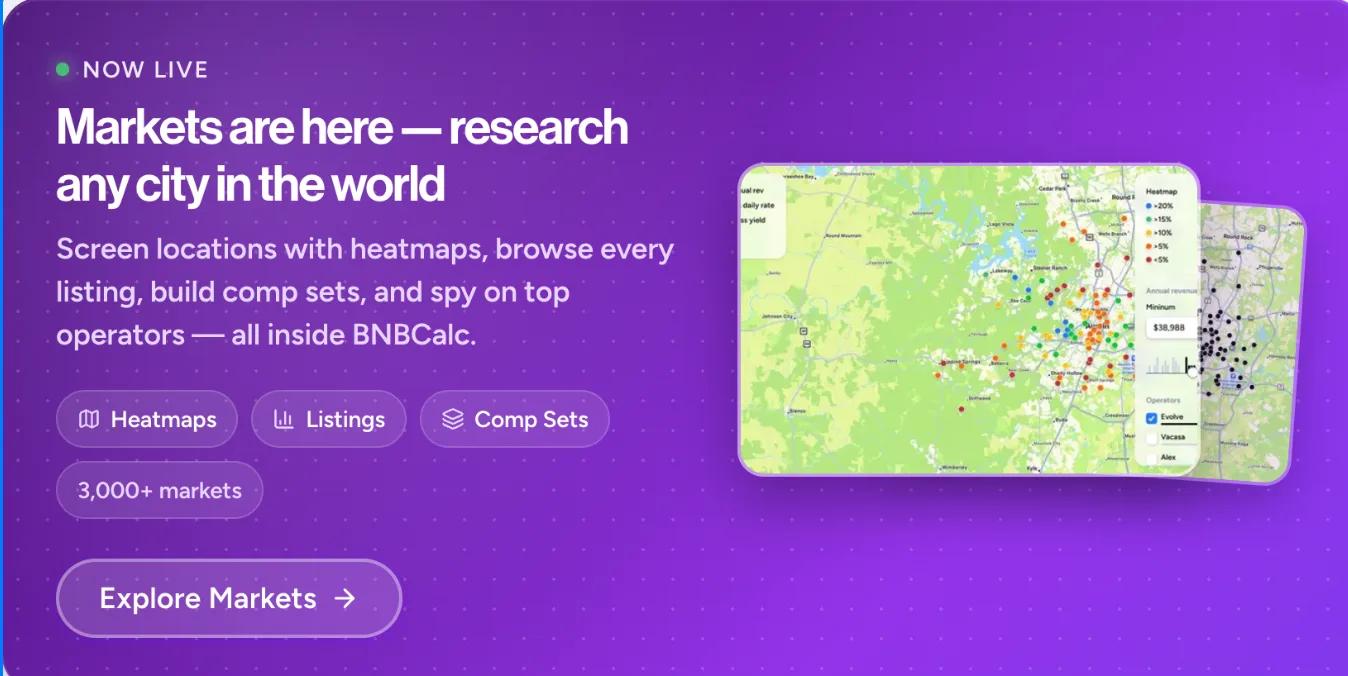
He scaled a lot of it through second home loans and DSCR commercial loans, including a Western North Carolina house at 429 grand with 40K down. If you're going to copy any of that, check what a market will pay first in BNBCalc Markets.
Key Points
- The whole thing starts with a lakefront house his family bought in 2015, after he pitched them on it with a PowerPoint. He walked them through a $300,000 house first, then a $400,000 one that looked far better, and they got the second about 25 grand under asking. He listed it on VRBO around 2018 with photos off his phone, and went out to hand the first guest the keys himself.
- Every guest canceled in March 2020, then the bookings came back four or five days later. So he raised the lake house from about $300 a night to about $550 and it still got hit. Houses he was managing for other owners went out at $600 a night against mortgages near $2,000 a month, which is the math that convinced him to buy.
- A guest asked about boat rentals and the local marina had shut down, so he threw up a website and ran Google ads to see whether the demand was real. Then he bought a $5,600 boat and rented it to those same guests for 10 days. Boat renters staying in houses around the lake are how he picked up his first management clients.
- His first purchase was a $450,000 two bedroom in October 2020, already operating as an Airbnb, and the second followed in March 2021. Florida came in October 2021, where a three month booking hit at about $16,000 a month against a $2,300 to $2,500 mortgage. Roughly $30,000 of that cash flow went into the next property in March.
- On financing, he leaned on second home loans and DSCR commercial loans, which meant a 429 grand Western North Carolina house took 40K down while the DSCR deals needed about 20%. Back in New York he funded arbitrage on a 0% APR credit card, six bedroom house included, and he underwrote the deal to pay itself back in six to eight months.
- He says the houses did about $1.2 million in revenue the year before this conversation, with another 200 grand from the boats, and that he was pacing toward roughly $1.4 million on the houses. BNBCalc grew out of the same work, since he digitized the spreadsheet and the investor presentation he was already using and wired them to online data sources.
- Asked what he'd do starting from scratch in 2024, he picks co-hosting over arbitrage, because you have no capital at risk if an owner fires you. He'd get to 10 co-hosted properties, funnel that cash flow into buying, and work toward 25 properties rather than the hundreds that he says keep imploding.
Full Transcript
Listen to the full episode on Apple Podcasts, Spotify, or YouTube.
Jeremy: And we are live with the Short-Term Rental Pros podcast. Guys, if you're watching on YouTube, check this out. This is not a Zoom background. This is Dumbo, New York, my new office. So excited to fill you in on why I have an office and how that's going to fit into the greater Short-Term Rental Pros landscape.
And today I'm going to talk about the entire landscape of my existence, how I built the short-term rental businesses that I have built, and the lessons I've learned along the way that I think you can implement in order to help you accomplish your goals.
So first of all, where do I come from? I was born in Princeton Junction, or Trenton, New Jersey. I grew up initially in Princeton Junction, New Jersey, before moving to North Carolina when I was nine years old.
Family for me is really important. Thinking back, a lot of why I am who I am is because of my siblings, of my parents. Just to start off the bat, my mom, very important.
And even before I get into this, I'm not trying to give you guys background and insights to really make you think that I'm speaking from like an Oracle Adelphi standpoint. I'm very much trying to figure my sh*t out on a day-to-day basis. I just want you guys to essentially take my last 27 years, have it consolidated, and give you guys the tidbits of lessons I've learned that I think are super important and impactful. And then explain, based off where I am now, where am I trying to go, and then give you guys a little bit of the inner thought behind the plan to get there. So I haven't figured it all out and I don't want to act like I have. I just want to preface that.
Jeremy: But back to my mom. She is, in my opinion, a very, very entrepreneurial spirit, that in another life she would have definitely been an entrepreneur, built her own businesses from a young age. However, she had another thing that's very important to her at a young age. She got pregnant to my sister at, I believe, 20 or 21 years old, and not anywhere but in Egypt. She got married to an Egyptian man and had my sister, Sandra, in Alexandria, Egypt.
My mom's a single mother. She moved to the US when my sister, I think, was two or three years old, moved back to the US, and her and her husband broke up. And my mom was the primary caregiver for my sister, very much a single mother. She was very young at the time, did not have a great career to fall back on given she was just starting, and she did not make a lot. And I've heard stories of times where my mom went to bed hungry so my sister could eat.
I've been to the apartment. When I was young, I went to the apartment that they lived in at this time. Definitely off the highway, a small apartment. It was very eye-opening to see the experience my mom and my sister had.
Jeremy: But I'm going to get into how her and my dad met. It was actually one day, kind of a crazy story, but it's what happened.
So my mom was driving my sister to school. She dropped my sister off, she was leaving, and a few minutes after dropping my sister off, got in a really bad car accident at an intersection. Someone just ran through it and hit her, knocked her out, completely unconscious, really messed up her face, broke different bones, knee issues came from it, knocked her out unconscious.
She was asked, hey, what do you remember from it? What she remembers is some blurry figure coming in. The way she says it, it's kind of like the figure of an angel running in and holding her hand and providing her comfort during when she was not doing well.
That man turned out, or that figure turned out to be my father. He was a couple cars behind her. He got out, rushed over, stabilized her neck, really took control of the situation. He actually had training as a paramedic. He was a volunteer paramedic prior to then, so he felt comfortable taking action there. And he stabilized her neck and then yelled at people to call the police. I believe this was before cell phones, so I think someone either had to drive to a police station, or maybe they had one of those like car phones or something. But someone got the police, and he stayed with her, took control of the situation and really, really helped her out when she needed it.
So when she woke up, the doctor told her, hey, this man was really a godsend for you, you might want to send him a thank you note or something. He left, my dad left his email, and my mom emailed him. She reached out and they went for a coffee walk.
And at the time, my dad was actually in a long term relationship. The way he prefaces it is he was engaged to be engaged. But I guess it was meant to be. So he left her for my mom, for a single mother with an eight year old daughter at the time. And pretty quickly he knew she was the one, and he helped her out, got her out of that apartment. They moved into a house and got married, started having babies pretty quick. The oldest one being my brother, myself, the middle one, and my younger one, my younger brother, Jacob. So Sandra, my sister, Alex, Jeremy, myself, and Jacob.
Jeremy: I believe our family, the traits that we all share is hard work and competitiveness. And thinking about the why behind that, when we grew up, my dad would travel five days a week as a consultant, like a technology consultant. He would leave Monday morning, would come back Friday evening. And growing up, I always felt that he was, frankly, tired. Even when he was home, he wasn't as present. He would still be working even over the weekend. For him, hard work was the trait that he valued most above anything else.
And I think the reason, kind of psychoanalyzing my dad and the why for him, why he worked so hard and is the man he is, is because my dad saw his father go bankrupt. And his health withered, and he eventually died.
So just to give context, my grandpa, my dad grew up in New York, my grandpa was a big corporate guy, worked for some of the biggest brands out there, Colgate, Palmolive, and some others. And he was a confident man, and had some disagreements with his colleagues. And he said, hey, I think I can build my own business. And he tried. He bought a steel galvanizing or ship parts plant in Connecticut, bet the house on it. When I say bet the house, he literally mortgaged my dad's childhood home on the business, and it flopped. And when it flopped, he went bankrupt, they had to give up the house.
My dad dropped out of college. He was responsible at that point for paying for his own Columbia education. And it was really, really hard on him. He dropped out of school, and years went by. And I think that really drove the fact that he just, above all, he saw that happen to his own dad, and he did not want that to happen to himself. So that's why he works as hard as he does, and that's why he cherishes the corporate stability. Good, great worker guy, who got tons of employee recognition awards. However, I don't really feel as if he was the best at company politics, climbing the corporate ladder. I think my dad's someone who is such a great man that he can be taken advantage of.
And he still works there. He's still extremely hard working. I mean, growing up, I would see him two or 3am still working, then he'd be up at five working. And he would oftentimes be in his chair, sleeping for two or three hours, which I definitely did not think was healthy. And it's something I don't think anyone should strive for, and it's something I definitely vocalized to him over my life. But to him, that was his assurance that he could take care of us, and he could provide us the life that he didn't feel that he had for himself.
Jeremy: So my siblings and I, again, that hard work, that work ethic was instilled in us. However, it wasn't necessarily like we need the best grades and we need straight A's. It was really just like, whatever we did, we had to really do. We couldn't half a*s anything, as well as just, don't sit there and do nothing.
I remember times after school, I'd get home, I'd be tired, I'd lie on the couch, I'd put on some TV, and I'd go brainless mode. And if my dad caught me, if he was actually home, which Monday through Friday he mainly wasn't, but if he was, he would get on me, he'd yell at me, he'd say do something. He didn't even really care good or bad what I did. I could go get in trouble, as long as I was doing something he'd be okay. Obviously, no one would get in trouble.
We didn't have allowances as kids, we needed to work to earn money. And that led into having a landscape business. When I was young, my dad supported that. If there were different landscaping tasks around the house, or different things to build, he would compensate for it.
So my brothers and I built a tree house, kind of trying to make use of those rules. One spring break, myself, my older brother, and my dad definitely loved seeing his kids do this and helped us out. But we built a tree house. So that was kind of how I got into home building, renovations. I really like landscape design nowadays.
And I think that was when I was young, is pulling weeds, putting in mulch, mowing lawns. When I was, I think, about 10, 11, I started making money doing this landscaping. And I started investing that money. Every time I looked online, or not even online at the time, on TV, you hear that the rich people out there are the ones who make money investing, and that you can get rich in the stock market. So I did some Googling of like, what stocks to buy. And I picked Dow Chemical.
I saw that, this was after '08, '09. I was born in 1996, so 2008, 2009, I would have been like 12, 13 years old around then. So the market crashed, and I hit it luckily at the right time where I could invest at least $600 in Dow Chemical, literally from a Google search of infrastructure companies are going to be big because of this recession and the government's stimulus packages. So 600 bucks in Dow Chemical, I believe, turned into like 2500 bucks in a year or two.
Jeremy: And my older brother, Alex. So sports were something that we all loved. Alex was a really good triathlete, like world. He was one of the top aquathletes. So aquathlons, when you run and swim, whereas triathlons, run, bike and swim. Alex was a very, very good swimmer and a good runner, not as good at the biking. So he's like one of the top aquathletes in the world.
And he got invited to World Championships in Budapest, Hungary. And I wanted to go. I was like, wow, that's so cool. I've never been out of the US, I would love to go see him, as well as just see Europe and see the outside world. My dad said, hey, if you're gonna go, you're gonna pay for yourself. I'm not paying for you to do that. So what did I do? I sold my Dow Chemical stock, and I bought flights to and from Europe to support my brother.
So early on, to me, making money was something that was kind of in the back of my head. But really, sports was my passion. My older sister played college lacrosse and soccer at Johns Hopkins. My older brother went to West Point, where he was a triathlete.
At this time, my brother going to West Point was pretty impactful. One of the main reasons being it's free. It's an entirely free school. Actually, you get paid to go to West Point. So when this happened, my family, I'm very blessed that growing up they said, hey, education is the most important thing. The college experience is something that we think you guys should have. We're saving money for your college, that's important. Or at least, maybe you'll have to take out some loans, but we're really trying to help you guys out.
My older brother went to college for free. I said, all right, well, if Alex goes to college for free, and I go to college and I get a scholarship, or I go in state tuition at UNC, which is very, very affordable, what are we going to do with that money? And my dad said, oh, I don't know, grad school, maybe you guys go to grad school. I said, yeah, I'm gonna go to grad school. I'm not going to grad school, Alex is not going to grad school. How about we take that?
Jeremy: And again, this was after 2009. I would look out and I would see, I mean, I'd be walking on Franklin Street in Chapel Hill, and I would just see signs for like houses. And at that time I was like, dang, these don't seem that expensive.
And I saw there was these lake houses about an hour north of where we're from. The reason I knew of the lake was because I had a friend who had not necessarily a house, but he had like land and a camper, and we'd go hang out on his dock. And there are houses on that lake for like a couple hundred grand. I'm like, wow, that's crazy. You need a lakefront property for like $200,000. This is in 2014, 2015. I was like, this has to be an incredible investment.
And I'd look up online. I was 14, 15 at the time, so I think I had a decent understanding of stuff. And I'd look up and learn about loans, and learn about, hey, a second home, you can get a second home, and it's only 10%. So it's a 300 grand house, it actually only costs you $30,000. And I'd do the math on what a year of college would cost.
And effectively, I made a PowerPoint presentation to my parents and said, I think it would be a really, really good investment to buy like a rental property. At the time, I actually underwrote it with how much we could rent it out for a year. I didn't even think about the whole Airbnb thing, short term rentals. I was like, we could buy it, we could fix it up, rent it out for 12 months at a time, and I think it would make money.
And it was a pretty, I guess, compelling pitch. My parents, they were very risk averse, but they're like, all right, well, what's a 300 grand house? What's that going to do? And we went to it, a 300k house. And then after, I strategically scheduled a 400 grand house tour, and I knew the 400 grand one looked just so much cooler. It looked a lot bigger, a lot nicer. When I say nice, I mean like it's just bigger. To me, that was what mattered.
And we went to the 400k one after the 300 grand one, and the 400 grand one was just so much better that it caused my dad to be like, yeah, d*mn, this is actually a really, really, I think this house is a really good deal. He saw the vision. And we bought that house, locked it down. I think got it on like 25 grand under asking or something. There was really no competition for it. It was a house that nobody had lived in for years, and there were weeds going through the dock. But it was nothing that looked that hard to fix. I remember being there with my younger brother the day we closed on it, and we literally had put gloves on and just grabbed for six or seven hours, just pulled weeds out of the dock.
Jeremy: And at this point, so now I was 14, 15. I think we got the house maybe a year or so later, I don't know, it was a long pitch. So I was a sophomore, junior in college. Now I was a senior in college. And then my older brother got cancer.
I was like, dang it, because he got cancer. And we didn't know what was going to happen. We actually didn't know if insurance was going to cover all of his treatment. It was a very, very, very stressful time. He got a very aggressive form of pediatric cancer called rhabdomyosarcoma.
And he got cancer. He went through a very aggressive chemotherapy, but he did not let it affect his mind. He went skydiving. He would run around the pediatric cancer ward at UNC dressed as a clown. He would joke around with all the kids. He really said, life is short, I don't know if I'm going to be alive next year, but I'm not going to let that affect me, and I'm going to enjoy this.
And we had a lot of people, a lot of kids who we built relationships with at that time who are going through the same thing. And Alex is just a really positive light to everybody. We would host different families, because we're from Chapel Hill, North Carolina, which is where UNC's Cancer Center is, which is one of the biggest cancer centers in the southeast. So we would host families whose kids were getting treatment. We'd even host the kids themselves while they're getting treatment.
I mean, it was an impactful point in my life, and it was definitely times that were sad. People died, which sucked. I mean, that was pretty horrifying, and just traumatic. But also at the same time, beautiful seeing how kids can be so positive, joke so much during really, really such painful times.
So my brother beat cancer. He was fortunate. There were three that had the same type of cancer as him that were getting treatment at the UNC Cancer Center. The other two, Emma, I believe Emma, and then I didn't know Jason as well, I believe that was his name. They both did not make it, but Alex did make it.
And to this day, he's still in the Army. He's currently in the Middle East serving his country. He finished, I didn't know if he was going to finish out at West Point, but he did. He toughed it out, finished at West Point, serving our country in the Middle East. Really an inspiration, and someone who really embodies that hard work, but also just service, service to others, service to your country. So Alex, if you're listening, you're the man.
Jeremy: Jacob, my younger brother. Admittedly, Alex was tough on me as a kid, and I was probably tough on my younger brother. And Jacob didn't really have someone younger than him to be tough on, but he would compete with us back. And his way of competing with us was academically. He was a bookworm, frankly. But that being said, it served him well.
He went to Georgetown. He was actually an athlete as well, long distance swimmer. And now he's an investment banker in New York, and he's been an investment banker for a few years. He's crushed it. He's been on major deals. He's in renewables, so like solar, solar energy, wind power, nuclear power, stuff like that. And he has tons of great job opportunities and private equity at his doorstep. So really proud of Jacob, grateful for him and his support as well.
So now to me. I played basketball growing up. I honestly, in hindsight, probably should have played another sport I could have been physically more competitive at. I did grow to 6'3", which helped, but I was not a tall kid growing up.
So I played junior varsity basketball at the University of North Carolina. I had the goal of making it to that varsity team. That goal unfortunately did not happen, and this was my sophomore year. I actually thought I had a pretty decent chance freshman year, and then this kid, Caleb, came. I don't know, Caleb, if you're listening here, but we were in my dream. I'm totally kidding. He was a good guy, but he could hit his head on the rim, was a high jumper. A high jumper in high school, I think second in the state, super athletic, and was training his butt off at basketball. So it made it pretty clear, the rim grazer I was myself, that he played the same position. If there's only one spot, it was going to go to him.
Jeremy: So I was like, all right, I got to do something else. Where should I spend my time? What should my next dream and goal be? Instantly it pivoted to getting a job, a career. I needed money, frankly. I was a college kid and I needed to make a living. I needed some means.
And so what do you do when you're looking for jobs? Well, I go, all right, who do I know who work at companies who have jobs, and do their companies have internships? Probably like a lot of people, you start off the bat, you look at your friends and family. My dad had worked at a company for my entire life, and I asked him. I said, hey, could I potentially get an internship there? He connected me with the recruiter. I applied. I had pretty good grades. I'm not going to say perfect grades, but solid grades. I was studying computer science, which was a natural fit for someone working at a tech company. And I applied. I think I made it pretty far in the process, which I don't think is that competitive of a process, but I didn't get it. I didn't get that internship.
Not only did I not get that one, I didn't get any of the ones I applied for. I literally got rejected from, it was crazy to me, like every internship I applied for. And I honestly didn't really feel necessarily defeated. I felt motivated. I used that as, all right, I feel like the corporate world is rejecting me. This might be a game I'm not very good at. And honestly, I don't know if it's one I even really want to play.
I remember when I was applying for those jobs, people I was talking to, they've been at the company for 10, 15 years. Obviously, I said, oh, this is so cool, doing this job is going to be the coolest thing, we're changing the world, yada, yada. But I didn't feel like they even felt that, the ones recruiting me. So it wasn't something that I, I didn't think, even if I would have got it, I think it was a blessing. Just in short, it was a blessing in disguise. I probably didn't get those internships, because I definitely would have taken a corporate job at one of these companies out of school.
Jeremy: But I started, so I connected with a few of my friends who were doing entrepreneurial things at the time at UNC and said, hey, let's build a company. I'm eager. And I was, and we did, we tried. We initially started this company, the Syllabus Organizer, built a website for that. That flopped, then pivoted that into a digital products agency for clients. And it actually, we started making money. We had different people who saw that first website we built, who thought it was impressive, and started getting paid to build other people's startups.
And I liked it, I loved it. Honestly, it was so cool having clients, making money, being in college, but working with different clients across the world. One of our clients was in Hong Kong. Another one was in Europe. We did some, during the crypto stuff, we consulted and helped do some projects for some blockchain companies, which I thought was like, this is so cool, oh my gosh.
But then, as businesses grow, you bring in people, you have to make decisions on the direction of the company. And it was myself and three co-founders. And anytime we had a big decision, I felt like it was three to one. I had an opinion on what we should do, one of the other guys had an opinion on what we should do, two of the other guys agreed with the first guy on what we should do. So every step of the way, I was like, all right, we got to lean in, keep building, build more and more sophisticated applications, get clients on retainers, servicing their products, really lean into web apps, web applications. They didn't want that. That was not the direction they wanted to go. And ultimately, we split ways. And I started building web applications for clients, doing it myself instead of doing it with three other guys.
That company today has 90, 100 employees, became a performance marketing agency, pivoted several times. But at this point, focus is largely on paid ads. And it was successful. I have a very, very small interest in the company. So it taught me a lot. I'm grateful for those guys. They taught me a lot of stuff that I did not know, and hope all is the best and hope it does well.
I mean, A, selfishly, I hope I get a check one day. B, it's cool to see a business grow, regardless. I've stayed in touch and I've learned along the way and talked to them and asked what they're learning, different insights they have. And they've done the same to me. So never spill bad blood and always keep relationships is one thing that I, even if it's a co-host client and I'm no longer managing their property.
Jeremy: If it's a landlord, I'm no longer renting their property from. If it's a business partner, an investor. Well, honestly, anyone who's invested in me, there's no bad blood at all. They've just frankly made money. But you get the point. Don't keep bad blood with anybody, especially those who are going to continue down their path, and you want to stay in tune with what they're doing and learn from what they're doing. So that was one big insight.
Second, I built web applications. I developed a skill. I was building web applications for clients. At the time, super grateful. My roommate was witnessing this. Honestly, I don't know if I cried, but I was pretty distraught during this whole process. I'd worked so, so hard to build that company. I'd given it my all. I'd sacrificed.
I said, after basketball, don't get me wrong, I had fun in college, but there was a period after basketball where I was hungry and lost. I was like, I got rejected from all these internships. I need to be successful. I need to grow something. I need to prove to the varsity team, which I did not make, that I didn't make it, but I'm doing something cool. I won.
Okay, don't get me wrong. I would give up anything to play UNC basketball. No matter what I did would not be cooler than actually making the varsity team. My buddy Kane, who works in the office with us, he made the varsity team. I'd tell him, pretty much, I was like, I should have kept my eligibility. I should have dropped out of school, kept my eligibility. So 20 years down the line, I still, 10 years down the line, I have a chance. I would honestly have preferred that way, kept that dream alive. I digress, though.
Jeremy: So one of my roommates at the time, his family had a lumber company. Nothing fancy, but they were looking for a new website. And I told him, I'm hungry. I want to do a big project, something important. And I'm willing. And he, without me knowing, brought it up to his dad. And his dad sent out an RFP, request for proposal, out to a bunch of people. And I was one of them. And I gave a bid to build a lumber company website.
And apparently, I've learned this after the fact, my bid was a factor of 10 lower than anybody else. So if other bids were like $200,000, mine was $20,000. My bid was actually lower than that. So I think I bid at like $13,000 or something to build a full web application, also like a product inventory system. So they have all this lumber. They want to send out reports on how much stock they have to their clients. I built a way for them to update the stock list every week and send it out.
So that was great, because I was a senior in college making, whatever, 15, 13 grand or something. Building a big web app ended up becoming more complicated, so it became a bigger project. But I was confident again. Like, I was confident I was in the driver's seat. I was doing something that was mine.
Jeremy: And one of my clients worked with my friend, Katie. She's awesome. Told her where I was at, gave her the background. She had different clients who had different needs, and she put me on several. She does like freelance sales, sales consulting. She put me on several of her clients to help them with different website stuff.
So essentially another learning is like, when you're down, when you're in the pit, I mean, it's not bad to tell people, hey, this is what I've been doing, this is where I'm at, I need help. Like, at the time I needed clients. I didn't want to have to go get a job. I wanted to be successful in business. And you tell people, you tell your friends who have been along with you for the journey, they'll think about who in their network might need your service. So super grateful for Eric and Katie.
Jeremy: And one of the clients. So Katie was in New York. I was with her helping out her clients. This would have been summer of 2018. One of the clients at the time, another one of my friends, a girl who actually later became my girlfriend, was out with her, and her friend was building a private equity startup. Thought that was super cool. Being in New York at the time, I was like, this is the world of finance. This is a world I don't personally know, but it's a world I do want to know.
So I started, and they needed my services building a website. So part-time, or just as a consulting engagement, built the website and was offered a more full-time position, actually while I was still in school. So I took that opportunity. Was at UNC finishing off my senior year while working for this New York-based startup. Thought that was super cool. And after college, was working full-time.
Then in March of 2020, COVID hit. And the funding landscape for startups, nevertheless a private equity startup, whose financial product was going through the SEC registration process, when at a time the SEC, Securities and Exchange Commission, said, we're not looking at new startups anymore. We're just not going to look at them. Or new products. We're only going to look at existing products for this foreseeable future.
So we had a company that didn't have a product yet, that essentially had a timetable for the product getting approved that could be as little as a year, as long as several years, and you had no certainty that the product would even be approved. So that being said, it was definitely a hard fundraising climate, because we were running out of money.
And we were looking, and I was involved in these conversations. It was a startup, so it wasn't like some faceless HR came to me one day and said, hey, Jeremy, your position has been terminated, or anything like that. But effectively, hey, we need to trim our monthly costs. And Jeremy's monthly cost was one of our bigger monthly costs. At the time, I wasn't even being paid much to begin with. Definitely had to take a hit on the, when you work for a startup and you're young, you probably get paid less, but you get upside in the form of equity, which I was getting. However, my salary got cut. If it was $3,500 a month on pretty much a stipend, being cut to like $2,000 a month. So to the point where, yeah, my monthly expenses were definitely going to be higher than how much I was earning.
So that was eye-opening, but really just put the ball again in my court of saying, I've really got to create my own thing this time. This time for good. I need my own business. No looking back.
Jeremy: And what did I decide to do? Well, I was thinking, what are the different opportunities out there? And I looked at, so that lake house that we had bought 2015, we had started renting. And I said, we, I had put it on actually VRBO in probably like 2018. And it was doing well. But honestly, at the time, I didn't really know. I didn't know anything. I didn't know how to price it or anything like that. So it's not doing as well as it could have been. The photos were photos I had taken on my phone. And the first guest we ever had, I literally went there and delivered keys to them.
But a lot of our guests were asking. And this summer, so this is summer, this is March of 2020. Sorry, I'm trying to think back to where we were. Everybody canceled. So, okay, first of all, there was this house. So I'm thinking about like, what are the business opportunities out here? And there was this, the house, the lake house I'd rented. And everyone canceled. So I was kind of freaking out. But then after four or five days, people started to book again. And someone booked for two weeks coming from Washington, D.C.
And they said, hey, we're looking, do you guys know of any boat options or boat rentals? So I'm thinking, they want a boat. Interesting. I called the marina, and the marina shut down for COVID. And actually they had sold, I think they had sold their boats even prior to COVID. So they just shut down irrelevant of COVID, but definitely had no plans of, maybe they had a plan to like get new boats, but that wasn't a priority at that time. So there was no boat rental options.
And I'd been watching the Ozarks on TV, where they're doing a bunch of business at Lake of the Ozarks in Missouri. And I kind of caught the bug of, hey, let's do a boat rental business. Let's do something fun at this lake. So asked that guest how much they'd be willing to pay for a boat, went on Google keyword planner, looked up if there was more demand for boats, threw up a website, given that was my background. I can make websites. Built a website, built a form for people to fill out if they wanted a boat, started getting inquiries and [inaudible] Google ads, started getting inquiries for boats. And it was clear there was demand.
So bought a boat initially, a 5,600 buck boat, rented it to those guests staying at that lake house for 10 days. They loved it. It was clear that there was demand from other people. So I was like, I got to get more boats, started figuring out how to acquire more boats.
And a lot of the renters who are renting these initial boats were staying at lake houses at different lake houses across the lake. I think that at the time there may have been like four or five Airbnbs that were at the lake. So I knew all of them, and they were staying at these houses. Some of them were like, oh, maybe we want to buy one of these houses. I think a couple of renters actually were like, hey, we're renting this boat because we're looking at a house to buy. And through conversation, they came to the conclusion that, hey, Jeremy, you seem to know a lot about this lake and know a lot about rentals. Can you maybe help us rent our house? And I obliged. So I started managing other people's Airbnb properties.
So I guess a lesson there is just like talk to people. So if you have a business, maybe you're in real estate in a certain area, just talk to them about Airbnbs, just talk to them about rentals, and it'll probably naturally come up in conversation. Maybe not today, maybe next month, maybe a few years from now. But if you just kind of talk to people, the right people, good things will happen.
Jeremy: Started renting out these other people's houses. Thought that maybe that first house was a blip, because it was doing pretty well. Because I realized everybody came back quickly. Like, everybody canceled, but then all of a sudden it was like one day I got like three reservations, and they were all like long reservations. So I said, all right, seems like there might be a lot of demand. And it was all people like, hey, we're in DC, we've been in our house for like two weeks at this point, we need somewhere else to go. Or, hey, we're looking towards the future, and please let us rent your house. Like, it wasn't people who are like asking questions. It was people who just booked. And that said to me, it looks like there might be a lot of demand for these houses.
So I raised the prices for our lake house, that one lake house, and started getting hit. What I would have been charging maybe $300 a night for, I was now charging like 550 a night for. So I was like, hmm, it seems like there might be more demand. And then I started managing these other people's houses, and I would do the same thing. I'd put it at $600 a night and it'd get hit. And I'd be like, oh my goodness, these houses. I mean, the boats are being rented for $400 a day, but the houses are being rented for $600 a day. And I can do the math on the mortgage of these houses. They cost me $2,000 a month. If someone's renting for four days for $600 a day, you've already profited on the house for the month. The other 26 days are going to be pure cash. So super eye-opening.
Jeremy: And I said, all right, for now I'm going to do the boats, I'm going to manage these houses, but I do want to buy houses. So I had to figure out how to do that. Didn't really have much cash, and put it all in the boats. So I needed other people's money. So started going out to friends and family. And when I say friends, at this time I'm 22, or maybe just turned 22, 23. So my friends are 22, 23 year olds. So had them out on the boats, showed them the Airbnb listings and the bookings from these houses at $600, $700 a day, kind of walked through, oh, that house over there, you see that house, it's for sale, and got their interest piqued.
So started buying properties with friends, and also family. So combination of the two. And first one we did October of 2020. That was like a two bedroom little house. That was an existing Airbnb at the time. I thought like, I want to buy a house that already is turnkey, because I don't know how to, I think setting it up is hard. Obviously now a couple of years later, I only want a house that you need to actually do work to improve, otherwise probably won't be a good deal. But at that time, that was my thought and consideration.
So 450K. So that first OG one was 400 grand. It's actually kind of crazy. I think that 400 grand home that we initially bought, I think today it's probably like 1.1 mil. So unfortunately buying it today, the numbers wouldn't make sense. But that 450 grand home, completely turnkey, we had it rented the day we bought it.
The next one was in March of 2021. And also just like take a step back. At this time, I had very clear goals, which was like, I need my own business, but I want to be able to go full time at this. I don't want to have to build websites. I don't want to have to do freelancing. I want this to be my thing. So I concluded that I need, I think, like six grand a month to be confident doing that. That was not that much. Today it would be a lot more than six grand. I have a fiance, I have a nicer living. She likes some nicer things. We can get into that later. I'm totally kidding. But for me, it was like, all right, I could probably live off five grand, four grand easy. Anything more than that will be good. So I had a milestone of, by next summer, I want to be in a place, so this is 2020, by 2021 I want to be in a good place where I can go full time at this.
Jeremy: And when we got the St. George, or what we call Heiko Haven property, that was the point where I was like, I'm going all in. This house requires a more complete renovation. We have summer coming around the corner. So that's the boat season. The boats and the houses do well, I'm confident, and this will be my point of no return.
So I stepped down from my job in April of 2020. We got the house, I think, April 20th. I had it listed not too long after. Worked extremely, I mean, this house was actually a pretty extensive renovation. And I was putting in 18, 19 hour days. Couple of my buddies, co-investors, were also part of it. They came to work on the properties too. So it was really, really fun at that time, and a really rewarding experience.
So another life lesson learned is like, be hands-on on your first one. Like, honestly, it feels great. Having that experience made me really feel more connected to these properties. In hindsight though, I mean, obviously I couldn't even do it. I couldn't paint. Like, I didn't know how to do anything. So learning the basics was cool.
So that house got launched, was doing extremely well, but unfortunately it was at a point where the lake had gone kind of expensive. And also, spending a month in Samoa, North Carolina, as great as that is, I thought maybe I can do the next one somewhere else that is more fun, frankly.
And also admittedly, my friends were pitching me different locations, and one of them really wanted South Florida. And at the time it was COVID. South Florida was open, was fun. The numbers made sense. I looked online, ran that analysis on properties, and we got our first one there in October of 2021. We got that up for Christmas. I think we got a three month booking as soon as we launched it at like $16,000 a month. Our mortgage was like $2,300, $2,500 or something. So I was like, all right, I think this Florida thing is pretty good.
Got another Florida property. We took like that $16,000 monthly booking. Like, I think they paid a lot of it up front. It may have been, comes out to probably like 10, 11K a month of cashflow. We took that like 30 grand and we just put that into another property that we got in March. Got that one up and running probably April or May.
Jeremy: At this time, another one of my business partners, from that early house we did the hands-on work on, was trying to do a property in the Smoky Mountains. I was not as inclined to do a property in the Smokies. I was in South Florida at the time. I just spent a month the previous year in Samoa, North Carolina. I didn't know how I felt about going out to like the Smokies, rural Western North Carolina towns, for a month or two. But he wanted to do it. So I was like, all right, you lead the deal, I'll just invest what I can in it, which wasn't a lot. Frankly, I invested like $10,000 into it. But it was also kind of like, all right, you supported me on my first deal, I want to support you and be in your corner here.
So Blake led the deal in Western NC. We actually later exited that property and made a pretty good return. I'll get to that later. But he did that, and then that house was doing really well off the bat.
And at this point, South Florida had like gone crazy. So we launched a second South Florida house. Just for context, we bought the first South Florida house for $515,000. The second one, we were under contract at $575,000, and the person selling made us put an appraisal gap. So they thought it wouldn't appraise for $575,000. So they made us put in like, I think like a $10,000 appraisal gap. They wanted like a $50,000 appraisal gap, and we were like, hell no. And I think we settled on maybe $10,000.
In that, even in that like one or two months under contract, prices had went up so much that the house appraised for $605,000. So it was a crazy time in Florida. So we actually got $30,000 of instant equity in that property, when we thought we were most likely under appraised by $30,000. Which in hindsight, if it under appraised, then they would have had to like suck up some of it. We would have had to suck up a little bit, but they would have had to suck up more of it. So kind of wish that it under appraised a lot, but it over appraised.
Jeremy: So home prices in Florida were so expensive at this time that I was like, all right, let's start looking somewhere else. And the property that I invested in Western NC was doing well. And I saw another property. This agent, Tyler Kuhn, who I connected with over the phone, was posting on Facebook different properties. He had posted about an off-market deal, a house that kind of hit my thesis of larger multi-generational travel family homes. And had it pretty good. It was like 429 grand for a 3,000 square foot house. I knew nothing about the area or the town, but I called him and we made it happen.
So because 429 grand, second home loan, you put 40K down. So that was kind of like the way I scaled a lot, was through second home loans or DSCR commercial loans. The DSCR commercial loans, you have to put like 20% down. We did a couple of those, but then we also did several second home loans where it was like my business partner would put down the loan, I would lead the deal, and we'd work it out.
But that Western NC one, Blake actually set that property up, so he got paid a setup fee, because I was in Florida setting up the second one. So we're kind of doing a lot. We were expanding. I thought that it was a good opportunity to grow the portfolio.
However, kind of after that second Florida house, was a little bit, frankly, burnt out of going to live in different places for a month at a time. I did actually go to Western NC and help a little bit with the project, well, not for like a month or two, but maybe for like a week or two. But I wanted at this time, me and Kate, we were kind of like, we were friends, but she would come stay at these houses. She would kind of help out in her own way. And we weren't technically boyfriend, girlfriend, but it's kind of like the writing was on the wall at this point. What, am I going to keep like traveling around different places? Like, she's not going to come stay. So she wanted me in New York. And me, I wanted at that point, COVID was kind of teetering, and I was like, all right, might as well go back to New York. So went back to New York a little bit at this time.
Jeremy: So now we were in like, I know we're going through a lot right now, so stay with me, bear with me. We're almost like 50 minutes in here. We're gonna get to the fun stuff in a little bit. But this would have been 2022, the latter half of the year. Kate had a knee surgery in December, of, yeah, it's actually December. Geez, Louise, sorry, I'm getting all my numbers mixed up here. But I'm back in New York in 2022. One of my previous roommates, my previous roommates had moved in with each other, and one of them was leaving, his lease was ending, so I decided to pick it up. It was like 1450 a month, which is crazy, how low that New York lease was at that time.
So back in New York, at this time I actually started really growing the portfolio through arbitrage, because I could just slap that on a 0% APR credit card. I didn't have to have any business partners. I could just fund the deal myself through credit. Which, disclaimer, there is risk when you just throw a six bedroom house on a credit card. But I'd run my numbers. I knew that I'd be able to pay back the deal in like six, seven, eight months, and then be profiting from then onwards.
Also, I had been creating presentations to share with investors, to fund these properties, and also to share with the banks to get the DSCR loans. So I had an itch to build again, back to my previous days of building web applications for clients. I had the itch to build a software product that would do a lot of what I was already doing. And I told my friend Parker, who's a software background guy I studied with in school, and we came to the idea of, all right, let's take a spreadsheet that I use, and also like a PowerPoint presentation I use, and digitize them and connect with online API data sources to create a tool that helps you quickly run the numbers, with an emphasis on then sharing these reports with your business partners. So that's where BNBCalc came from.
And at this time I was like, all right, I'm going to focus on the software. I'm going to do some more arbitrage deals. That was actually around then when I started coaching and working with other people. So I said, all right, I don't want to buy a house and then spend two months there anymore. I want to sit down and do some stuff from my computer. So yeah, this launched a coaching program, launched the software. And really the last year have been just having a great experience, but also ups and downs, trials and tribulations with digital products, more so than like screws and nails and hammers.
Jeremy: So going back into it, we've covered a lot here. What I want to think about, or what I like to think about, is what do I want to do on a daily basis? Kind of at a point where, blessed that in many ways my portfolio, my short-term rental portfolio, has given me the freedom to do what I want to do with my time. However, there's good and bad aspects of that. The good is you have choice. The bad is tyranny of choice.
So for me, what I've decided to do with my time is, A, give my time to others. So, frankly, help people. I mean, along the way, while I was building my boat business, my friend Andy came to me. He was making $12 an hour as a medical scribe, and he's like my childhood best friend. And he told me that he got passed up for a $1 raise for his medical scribe job at local hospital. And I was like, all right, Andy, these boats are making money, these houses are making money, let's get you into the game. So Andy helps lead our second boat rental operation at Jordan Lake early on. And then also he took his income from the boats and he started investing in short-term rental or furnished rental properties.
Jeremy: And in addition, he started managing other people's property. So really built a similar business to what I had at the time, and quit his job as medical scribe. It was not hard to replace his $12 an hour. Kind of funny in hindsight.
Ted and Blake, these are two college friends. Blake I met at orientation, kind of same thing. He hit me up during COVID, saw what was up with me. He wanted to do his own. I was super blessed to have him on our early deals. And he was there working these 18, 19, 20 hour days with me. We'd be out at 3am doing some heinous stuff at the lake. And now he has a super awesome ownership portfolio. He manages properties. He arbitrages properties.
Jeremy: So gave my time along the way, but also these are folk who did also help me. BNB pro coaching program, have an awesome community. Folk in it. Merit, for example, has been on the podcast. He came to me, I think he had made $40,000 total revenue, January to April, with his own properties. So this is the last year we met. We actually met in Los Angeles.
And in the last year, we were actually running the numbers on his portfolio the other day. Year to date so far, so it was like January 1st, April 30th, now we're in May. He had about a quarter million of revenue. So if last year he was 40,000 in revenue to the point, now this year he's a quarter million in revenue. We did a whole line equals line equation to figure out where he's tracking for year end. And he should do, I mean, he's going to come to New York and we're going to do further analysis into like his specific properties, as well as seasonality. But he could do potentially seven figures this year. So it's crazy. I mean, last year he probably finished the year at like 160K, maybe 200K, and now this year he's on pace for a million, which is totally nuts. But been an awesome guy to get to work with, and check out that pod. I definitely need to have him back on to update everybody.
Dylan, had Dylan on the pod. He did a couple of arbitrage deals where he paid back his initial investment in a few months and has been growing since. So we got to have Dylan back on.
Matt and Lori, couple out of Canada. They've been on the pod as well. I'm just bringing up people who have been on the pod, but we have amazing people that I get the opportunity to build relationships with. But they're out of Toronto area, and built an arbitrage slash co-hosting business in South Florida, and now they're also going to do some new co-hosting properties north of the border as well.
Thomas, he has not been on the podcast, but he will probably be the next episode, because he's coming into the office to film a live podcast with me next week. But Thomas is 21, 22 years old and has 14 co-hosting properties that include two that are making like $20,000 a month. So if his fees, 20% on a property makes 20 grand a month, that's $4,000. And in cash, so he's pretty happy. I don't think he'll be getting a job when he finishes school. So stay tuned to hear Thomas's story.
Kyle, the Barndominium guy, legend, a former college basketball player. I was actually talking to him today. I sent him, he got me looking for deals now, because his returns are so good and so juicy and so cool. He's built a really unique brand for his properties, and has a social media following. Big Sky Barnhouse is the name there.
But these are just to name a few of people who, by working with other people, I've been able to build a relationship with and also see their growth, which is just very rewarding.
Jeremy: So again, what do you want to do with your time? For me, I like working with other people. It's something I genuinely, I honestly get more, I might get more pleasure like seeing someone else succeed than my quote unquote successes. I don't know what that says about me, but it is what it is.
Again, BNBCalc, same thing. I'm working with someone else and we're doing something that's totally different than these houses. Software companies are their own beast. And I have learned so much, so much about software. And I credit that largely to Parker, because I mean, he loves SaaS. He loves digital pro, I mean, he loves software. He loves startups. Really, really cool to be able to build something with him.
So I'm building software, working with other people. I've grown my portfolio, but really at this point it's more quality than quantity. I bought a property last year. I bought another one earlier this year, towards the end of last year. And I'm still going to keep buying. A, there's still opportunities out there. You set up properties the right way and they can still do well.
Jeremy: Guys, can a single property set you financially free in 2024? Yeah. I think Kyle is a prime example of that. The first Barndominium he got last year is cash flowing like 200,000, even with like an 8% loan. And he's done two more since. So I need to have him back on the podcast, because he's been going at it. I know he's probably listening right now. So Kyle, let's schedule you out, or come to New York so we can film it in person.
And then, yeah, also tax benefits are still huge nowadays. So still great to buy if you know what you are doing.
But what do I believe is the best way to get into the game in 2024? Honestly, I strongly believe it's co-hosting. I will preface that with, what is your goal? To me, building a 25 listing short-term rental pro portfolio is a freaking epic place to be.
Yeah, there are people out there, there's companies out there who have scaled to hundreds of properties. There are a lot of these multi-hundred property property managers, or arbitrage folk, who have failed, are failing. I'm hearing about more and more every day. But what I'm not hearing about is those 25 property people. What I know about them is they have great quality of life. Their portfolios might pull in one, one and a half, $2 million a year. They have healthy margins on that seven figures, and those properties give them freedom to do what they want with their time.
That's where I want to be. I was never like, I need to get to, like, to me 500 properties just seems like, frankly, a headache to me. I'd rather, personally, I'd rather, in a perfect world, I own 25 amazing properties, and that is my short-term rental portfolio. I don't have any partners. I just have my assistants, my operations managers, running the day to days. I'm insulated from dealing with stuff. And I take that cashflow and income and use that to do what I want to do on a daily basis. Frankly, I already do that. I just, I still have partnerships, I still have co-hosting, I still have arbitrage. So it's like a combination of things. But to me, that's the goal. I don't need to have more properties. I'd rather just have amazing assets that are my assets. Or if I have a partner, someone who's amazing, which I do have amazing partners, but you get the point.
Jeremy: So right now I like co-hosting. Tailwinds are great. These big property managers, Vacasa, Evolve, they're shedding properties like the plague. These massive property managers, they're not giving the one-on-one attention that someone who has 25 clients is going to give. So again, I think it's a really good place to be, somewhere we have 25 clients. You can do a good job. You can maintain super hosts. You can make sure your properties are really well kept. You can make sure your owners are happy. I mean, yeah, there are people who have a hundred, 200, 300, 500, but I've seen a lot of situations where people scale and their quality suffers, and then their business kind of implodes.
So for me, 25 property play, really good timing. 25 property co-host portfolio, really good time to be. You can still do arbitrage, don't get me wrong. It's not to say don't do it, but there's risk. If you have zero properties, you have no experience, you jump into arbitrage, there is risk. Whereas there's no risk for co-hosting. If you have no properties yet, it's going to be hard to get your first client. But frankly, that's why people work with me, or are part of groups, masterminds, because they can creatively lend each other's portfolios to one another in order to lock down clients.
So arbitrage, there's upside, but there's also downside. Buying, honestly, I think there's less risk buying than arbitrage, because at least buying, you can improve the asset. You can invest in it. You can make it better. Whereas arbitrage, someone else owns the asset, so there's only so much you want to put into it, because ultimately it's someone else's. And they can just walk, the lease ends and they don't need to resign you. Co-hosting, sure, they can fire you, but you have no skin in the game, so it doesn't really matter.
And also there's just like a lot of people right now, in my opinion, who own five, six, seven, eight, 10 property. I mean, there's not a lot of them, but what we're seeing with guys like Thomas, for example, he has 14 properties. He's not 14 different owners. I believe he has three different owners who constitute that 14. So there are people with big portfolios who maybe are managing it themselves and aren't really doing the best job of it, and they're looking for young, motivated people to take the keys from them. So I think that's a trend that's only going to further exacerbate the next 10, 20 years, as people who own the properties get older.
So co-hosting, the way to go. Great timing. If I was starting over today, right now, I would build a co-hosting business. I'd get to 10 properties. And over time I would use that for cashflow, and I would funnel it into properties to buy, to add to my portfolio, and I would just rinse and repeat, get to 25 properties. And then from there. So that's what I would do if I had to start over today. That's what I would do.
Jeremy: But what am I doing in my situation that I currently have? Well, first, what do I want to do? Let's reverse engineer the life that you want.
Personally, I'm a sucker for love, and I love my fiance, so the next steps there are getting engaged. And we already did that. So sorry, it's not the next step, that is the step we just took. And our wedding is next September. After that, we're going to have kids. So I've got to be in a good position to financially be able to take care of these kids. Kate and I went over to a little, we were just walking around earlier and we stopped in at like a little daycare area, and I asked, how much does it cost a month? And they said like $2,000 per kid. So I'm like, all right, now we got to factor that into the equation. So it looks like we got to keep working right now, or work harder.
So I love playing sports. It gives me joy. I love engaging with other people competitively, and basketball and Padel. Why Padel? Well, there happens to be a Padel house downstairs. Why basketball? Well, I love basketball, and the lifetime is right a block away with a basketball court. So I've designed my life being between two things I love.
Also, motivation to me. I need to be motivated. I need to strive for things every day. Honestly, this office space has created motivation for me. It's expensive. I've invested in it. A, I've invested for myself. B, I've invested for folk in our mastermind to be able to come here. I've already had [inaudible] the other week. He came in, did his warmup call in person. Thomas will be here to film a podcast next week. So it's not only for myself. Kate also works here too. It's for other people.
And Kate, just an example, giving stuff out, helping out other people with your time. I mean, Kate has done a tremendous job and is now, she quit her job on her own, right, and it's now full time with her. She does the videos on TikTok. I don't know if you guys seen, how many miles you're running today. She did a collaboration with Jason Derulo the other week, with Barbara Corcoran. She did Jared Leto the other day, and I got to meet all of them.
And it was also super insightful meeting them, because you're like, all right, these people are super successful, what's the commonalities amongst them? And I didn't spend as much time with Leto, but I will say, like Barbara Corcoran and Derulo, it was curiosity. Like Derulo wanted the tidbits from Kate and myself, being a producer of her show. Barbara Corcoran, she was curious about us. So successful people, when they talk to somebody, they meet them, they want the download. They're like, all right, you spent 20 whatever years, 30, 40, 50 years on this world. You have some information that I can apply to be a better person and to accomplish my goals.
Jeremy: So back into that, what is my why? Well, I want to be motivated. This office is keeping me motivated. I want to be working with other people, building things with other people, seeing other people build and learning from them. My mastermind, my relationship with my fiance, my goal of having kids in a few years and being in a good position for them.
Also, thinking that my fiance, for me, she sacrificed for me when we weren't even dating, which is kind of crazy. She wanted to help me out. So that's someone who, they do that for you, you're inclined to do it for them. So that's another thing. Tidbit on, like, do things for other people without expecting anything in return, and they will help you. I know that personally, if someone helps me out with something, I feel so indebted. If someone gives me value, I just feel so freaking indebted to them that I want to pay them back any way I possibly can.
So my portfolio gave me, quote unquote, freedom. I mean, don't get me wrong, sure, things could happen, the market dynamics could change, but at least for the time being, and the way I set these properties up and set my business up, and the practices that I follow, and the dynamic pricing and the listing optimization, all that, I'm confident in the longevity of the portfolio.
But what do I want to do moving forward from a portfolio standpoint? I also do want to get into more commercial developments, like landscape resorts. One of the main reasons for that is you can value these things based off net operating income, whereas a primary house you really can't. It may cash flow, but the asset value itself won't increase as much when you drive revenue for it. So I've had Ben Wolf on, Isaac French, Hannon. Super insightful conversations with them that really piqued my interest in boutique hotels or glamping resorts.
Jeremy: Software wise, just things that you can learn from what I've learned. Software businesses, something you got to deal with with a SaaS product is churn. Like, people don't just sign up to your product and stay forever unless they actually like it and use it. So you have to figure out, you assume you launch something, you assume everyone's going to love it. Oftentimes you can't be stuck in your own opinions. You have to actually see what your users or your customers do, what they like, what they don't like. And you have to make your products better so they actually stay around and tell other people about it.
So, telling other people about it. Well, you have to encourage sharing. If someone's just doing something and doesn't tell anyone about it, there's no word of mouth, there's no shareability, then how are you going to get new customers? So we've definitely done a good job, encourage sharing. It helps that our product naturally, it was built to be something that you could send to investors, business partners, realtors, mortgage brokers.
Paid ads. Initially, we just used my social media for growth. That only got us so far. At some point we had to use other channels. So I've had to learn about paid ads and how to use Facebook and some TikTok in order to get in front of the right customers and have them use your product.
I had to figure out startup stuff. It's equity, cash flow. There's a fine line. We honestly have, we've had an interesting equation where it's like, hey, we could grow, but we'd run cash flow deficits. We've bootstrapped entirely. We haven't raised any outside money. So we've had to be very strategic about our cash and what we use it for. Also, it's like, all right, if we're growing, what's the point, is to grow? Do you grow to build cash flow? Do you grow to be at a good point where you can sell? These are questions we have to ask ourselves that I don't know if we necessarily have the exact answer for. But is the goal to sell, is the goal to build a lifestyle cash flowing business, these are definitely considerations.
Also, now that we actually have a user base. A lot of the early users were through social media, but now they're just word of mouth. Maybe they found us online. There are people who use our product who don't know who Jeremy Werden is, where in the early days the users, I'd say, largely did know who Jeremy Werden was. So now that we have these users, I want to build a relationship with them. So that's a new challenge I'm trying to figure out, is how do I build a relationship with these users who don't even know who I am, or like why we built the software to begin with?
So I want to introduce myself to the users, get them to know me, and also other companies in the space. I know this has allowed me to meet a lot of those founders in the short term rental space. We have different partnerships with different founders or different companies. So I want to continue with that and meet everybody in the space. So that's a goal of mine with this podcast. Just thing I've learned is it has really actually helped me meet other people in this space. The fact that I was able to learn so much from Ben Wolf, Isaac French, Hannon, have them on and literally be able to pick their minds for an hour, is awesome. So I recommend, if you're interested in a specific topic, there's no better way to learn about it than probably just having a podcast and reaching out to people. People love to share their stories, and podcasts are a great way to get in front of them.
Jeremy: All right, I have these different goals. So if we're able to accomplish our goals, what does that look like? How do you track success? What's the key? You got to establish KPIs and metrics and tangible things to accomplish, and then see if you're hitting them.
So my fiance, thinking about her. What's a sustainable goal? Like, yeah, she's meeting cool people, she's having different people on. But we want longevity. We want something that spans time beyond the next few years, and that can grow without her day to day necessarily. So we want to build a sustainable media company for her, or have her grow a sustainable media company. I'm not sure how we'll get there, but that's the goal. So stay tuned. I know it's not short term rentals, but that's one of the objectives.
I want to build more cool assets and ultimately create cool experiences. So got some things up my sleeves that I'll keep you guys posted with. I did a $1.2 million in revenue for the houses last year, and another 200 grand for the boats. This year I should probably be pacing like $1.4 million for the houses. I want to definitely keep growing that. I'm not too aggressive with my targets of like, oh, I need to do $1.8 million next year. I'm okay. I don't want decreasing year over year revenue. I want to increase my year over year revenue. But really, again, it's smooth operations. It's not being sucked into the day to day. But I also want more equity in all these houses, and then to increase my cash flow.
BNBCalc, we're going to keep growing it. We're going to look at different channels of how to grow, and we're going to figure out things as a scrappy bootstrap startup. But ultimately, there might be another owner who gets more value out of what we have than we do. There's a few examples of that. But if you think about the short term rental ecosystem, we're probably people, either investors who are looking for properties all the time, or someone who's new. But these people, there's one subscription. You pay for BNBCalc once. It doesn't matter if you have a thousand properties or you have zero. Whereas there's other services where every single listing you have, you pay for. So you might think there might be a way that these kind of like multi, the stickier services, so to speak, they probably get more value out of a tool like ours and our user base than we do, if that makes sense. So we're open, if someone gets more value from what we have and what we've built than we do, we're open to do a value exchange, or call it whatever you will.
Jeremy: Also, the mastermind. What's our goal there? Well, Milo, I want to build out a seven figure boardroom. So, I mean, I've built a seven figure short term rental business in a couple of years. I know we gave an example of Merit earlier, he's getting there in about a year and some change. Blake's well on his way there. Kyle's well on his way there. Sebastian, haven't had him on the podcast, need to have him on, he's on his way there. So we've got enough. Am I missing anybody? Matt, Lori. I know I'm missing folk. Thomas. I'm missing folk, sorry. We have other people who are on their way as well.
But I want to get to a point where we're building this group, a lot of people starting from scratch, and we're getting into the seven figure club. And getting into that club is fun. We can do some fun things once we're in there. And it's building a business from scratch is different than optimizing things when you're in seven figures. So it's like a different conversation.
So that's a goal of mine, to build out a seven figure boardroom, which I have right in front of me. There is a boardroom table that is just waiting for seven figure short term rental hosts in our mastermind to be seated at. So I want more people going full time, more people retiring their families. And I want us all to have fun in New York City at this place. I want our group to feel like this is theirs, because frankly, it's why I got it. And I like hanging out with people. So I'm lonely right now. No one else is in here.
Jeremy: I appreciate everyone listening. Many of our listeners have become real people in my life. I mean, example, Kyle. I never talked to him, he listened to the podcast on his own, just from the podcast, and also just from being a beast on his own. Right, started doing really, really cool properties that followed a lot of the thesis that I have and that I discuss, namely being, the best properties to buy are ones that are super highly amenitized within two hours driving distance from a major metro, and just being the best in an area that does not have comps that are going to suggest how well you're actually going to do. So he's an example of someone who listened to the pod, reached out, and is now, I was texting him earlier today, sharing deals. There's other people who listen to the pod and became like real people, important people in my life.
So for those of you guys listening, maybe been on the edge of listening. I mean, even if you want to just give me feedback on topics to talk about. So for future episodes, I want to get into, why? What are the specific reasons why now is a great time to build a business, as well as specific ways you can build. Like, how do you actually get clients? That's an episode I want to get into. I want to have one where I just talk about BNBCalc. It's a software business, but it's something that I've got passionate about and learned a lot about, so I want to do a specific episode on everything I've learned there.
But if there are any things you guys want to hear about, shoot me a DM at Jeremy Werden on Instagram. I love feedback. I love ideas. Also, just let me know you're listening. Just give me a shout. You guys are the reason I do this. So I appreciate you, and I want to know who you are. And, you know, all five star reviews, sharing this podcast with other people, that's how I grow, that's how I get better people on, and that's the motivation that keeps me moving forward and talking to you guys.
So love you guys. I appreciate you guys. Hope you found what I've shared today valuable. And as always, stay tuned to the next episode of the Short Term Rental Pros podcast.
Airbnb Tax Deduction Calculator
Paying too much in taxes? We have the perfect solution. Simulate an Airbnb home purchase below.
Purchase Price
$450K
Structure Value
70%
Apply Trump's Tax Cut (Bonus Depreciation)
Depreciation
$117,695
Interest
$21,600
Tax
$6,750
Year 1 Deduction
$146,045
Want to claim this deduction? Get a free cost segregation benefit analysis from CSA Partners — no obligation.
Get Full Analysis