Free instant analysis
Reveal Airbnb revenue for any address or city
Quick Summary
Alex's answer to fast growth is volume. Early on he'd call from about 11am or noon to 7pm, 150 to 200 dials a day, and while he thinks 30 or 40 a day will still grow you, he says it won't be as fast as most people want. Every call teaches you something, so each one makes the next easier.
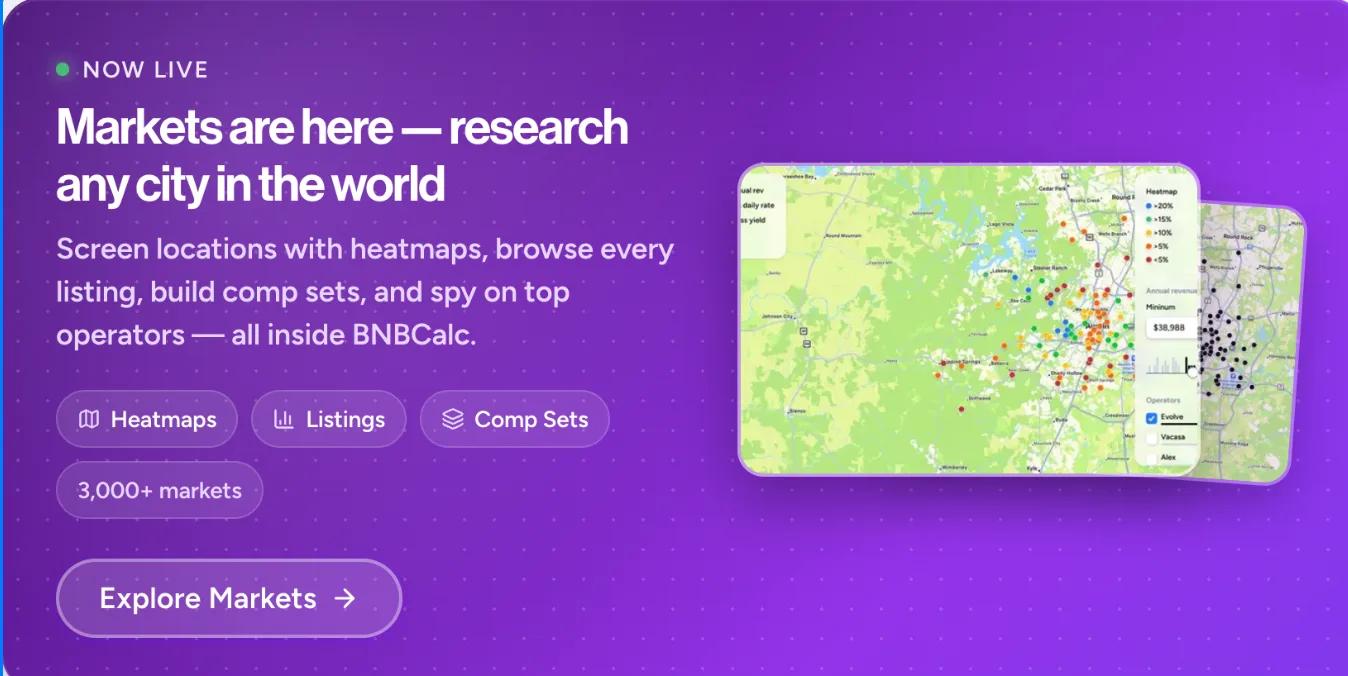
He also chose markets that won't cap him: Alex says each has 10,000-plus short-term rentals, so the list doesn't run dry. If you're picking a market to manage in, check how deep the supply runs on BNBCalc Markets first.
Key Points
- Vol Hosting has about 55 units in the Smoky Mountains and East Tennessee, and sister company Gulf Coast Hosting has about 25 on Florida's Gulf Coast. Alex splits his time 50-50 between the two.
- In the early months Alex called from about 11am or noon to 7pm, 150 to 200 calls a day. He admits he burned some good leads that way, but the reps taught him the market well enough that calling now feels easy.
- Open with "Hey, [first name], how are you?" as if you already know the owner, then ask them a question. Ryan's own opener is "How thrilled are you with your current property management?", because almost nobody says thrilled, and "good" lets you ask what good means to them.
- When an owner is happy with their manager, Zach asks what that manager does well, then tells them every great team needs a great backup quarterback. He doesn't expect pushback: at worst, the owner says they'll save his info.
- Instead of hiring VAs, Zach built the back office with Claude: more than eight AI agents that Alex says do the work of five to seven employees, personalized owner emails with a listing report attached, and every AI mistake logged so it doesn't happen twice.
- Many managers in their markets run around 500 properties, so Alex's pitch is that you're talking to the owner of the company, who'll care more, try harder and own it when something goes wrong.
Full Transcript
Listen to the full episode on Apple Podcasts, Spotify, or YouTube.
Ryan: Welcome to the Short-Term Rental Pros Podcast. I'm your host, Ryan Shapiro, and today I'm with one of my boys, Alex. How's it going, Alex?
Alex: It's going well. Thanks for having me.
Ryan: We're at the lake right now. Beautiful. Trying to catch some fish. No success so far, but hopefully we'll get some before the retreat is over.
Alex: Yeah, only lost lures so far.
Ryan: Yeah, only some money spent on tackle.
Alex: It's gone, but it's okay. It's part of it.
Ryan: Yeah, so we're at our retreat. We're doing a three-day mastermind with Jeremy Werden's group, as well as Patrick Swiatek. We've got a bunch of other awesome people out there, and Alex has been part of the community for, what, almost a year now?
Alex: Yeah, about a year.
Ryan: Yeah, exactly.
Alex: Almost a year to the day, I believe, from when I started.
Ryan: Yeah, which is crazy. Alex's trajectory is unheard of, some people would say. Maybe other people have done it faster, but he's the fastest we've seen grow from the beginning of the framework to where he's at today. So we're happy to have him on.
A lot of people ask me about his sales skills and what he's doing differently, and I think a lot of it might shock you, how simple it really is. We'll definitely get into it in this whole conversation, but just to give you guys the preface, this thing is all about sales strategies, how to grow from zero to... what are you at now, Alex?
Alex: We have like 80-something signs.
Ryan: In about, what, six months?
Alex: Well, we fully got going in January. So early January, we started, and I brought Zach on. He's trying to tie a knot on a fishing lure over there. I brought him into this in late January, so that's when I consider we really got things rolling to the highest max potential, and he's been helping.
That actually didn't make any sense, but I'll say January. I joined the program in September when I was playing tennis professionally full-time, and mid-Jan is when we kind of went full on it and wanted to see what we could do.
Ryan: Yeah, which is awesome. And we'll circle back on all that, because there's a lot that you mentioned there about yourself. So let's go into the past. You mentioned tennis, kind of where you guys are at today, but let's bring this full circle. Tell us a little bit about yourself.
Alex: Yeah, I mean, I grew up in New York City, born and raised in Manhattan until I was 13, moved to Jersey around 14, went to school there, was in Barcelona for a year at a tennis academy, and then went and played at Columbia in New York City again. So my whole life, born and raised around New York City, just kind of in cities, no real indication that we would be doing what we're doing now at all.
Both my brothers also played tennis at Columbia. One of them is a junior there now, the other one just graduated this past year. So all three of us played there, which is very cool. I'd always played tennis professionally in the summers, like I have a pro ranking, the whole thing.
And then after doing four years of college tennis, I knew the landscape pretty well. You can't do a fifth year in the Ivy. So I had to go into the portal, transfer, go somewhere. The goal was only to play pro and be as good as I could be, top hundred in the world. So that's why I went to Tennessee. The coach there was probably like 25, 30 in the world back in the day. Great coach, cared a lot. Nowadays you get paid a little bit too, which was cool. It was just a great kind of situation. And I loved it there. It was an awesome year.
And my only thoughts were, okay, we're going to play tennis professionally. That's it. No other real plans. But being out there, I wasn't necessarily understanding how someone could stay on tour for many years at the kind of level that I was starting out at, where you're not making any money. You're in fact losing money. I'm just like, I don't get how guys are doing this for years. I always felt like there was more out there.
And then once I started, I got injured pretty much right away. So I graduated in May of 2025 and then started playing, was playing really, really well, and broke my foot right away. So then I had like three months out, and tennis is a rolling, year-long system. So say I win a tournament this week. If I don't defend it the same week next year, then I lose all the points. So I lost all my points over the summer. I went from around 800 in the world to about 1700 and had to pretty much start over. Then by January, I was back at 900.
I was actually traveling with Zach, who just lost another lure because he can't tie them off.
Ryan: Yeah, he's learning. He's learning.
Alex: He's learning. Strength and conditioning coach. But then we were in Winston-Salem. I'd been talking to Jeremy, because I knew Jeremy from back when I was in and around New York City. I was friends with some of his friends. He was a bit older than me, but we used to go out, do things in the city, stuff like that. That's how I met Jeremy and Dylan, who I've both known for a while. People in the group would probably know them.
But yeah, that's how I saw what was going on. And it sounded interesting to me. I talked to Jeremy a bit more about it and was like, okay, let's join this group. So I was kind of learning while I was still traveling and playing. And you and I got on the phone to talk a little bit about strategies, things to do. And then in January, we started going full time on it.
Ryan: Yeah. So professional sports career switched over to business.
Alex: Yeah.
Ryan: As many of them do. Let's get into the business that you've started, go through that. And then I'd love to circle back, as a lot of people like to hear how life is converting from your professional career, all the skills you learned from that, into the business world. But like I said, first things first. So you joined the group. Where are you at today? What business did you start? And how's it going so far?
Alex: So far, it's been a lot of learning and continued learning. I don't think we're really close to where we could be, or our max. And it's nice that people think we've grown fast and everything. To me, I can only see the flaws and the gaps in all of our stuff, which is something that carries over from athletics, especially in tennis and especially Columbia tennis. I have to credit my coaches, parents, family. Everything that they've instilled is just like, it's never enough. You've got to keep pushing, pushing, pushing, pushing.
So that's what I kind of still feel. And I think that's why we've had the success that we've had. It's not rocket science, as we all know. It's kind of just about perseverance and pushing as hard as you can for an extended period. And that's what we've been able to do.
Our company is called Vol Hosting. We have about 55 or so units in Tennessee, in the Smoky Mountain area, and a little bit in East Tennessee, some Knoxville, stuff like that. And then we have about 25 units on the Gulf Coast of Florida, called Gulf Coast Hosting. It's the same parent company and entity. And I spend a lot of time in Florida and a lot of time in Tennessee, just splitting my time 50-50, undivided attention to both, and just making sure we do the best that we can in both places.
Ryan: Amazing. So we're here [inaudible]. Zach, come on in. Come talk a little bit about your role in the company as well.
Zach: Yeah. Hey, how's it going? I would say Alex is more of the communication guy, the sales guy, but I do my part as well.
Alex: [inaudible]
Zach: Yeah, I agree there. I'm more of the operations guy. I do a lot of the tech stuff, but each day I do have to hop on the calls, and that's really the only way you can grow. So I think it's important to have both sides. I feel like our personalities are kind of opposing, almost. So it's like a balance. It's a good balance.
Alex: Yeah. And to me, the biggest reason that we've been able to grow so fast is that we both trust each other and had a good relationship, and we'd known each other for a while before starting to work together. If I hadn't known Zach for a long time, known his character, and if we weren't friends initially, I don't think it would have worked the way it did. Because obviously when we started, I wasn't able to really take care of Zach or myself financially, so we were kind of just trusting in each other in terms of what we were going to be able to do. And to me, there was not really doubt. It was just a matter of time before it happened and before things started to grow and be as we'd hoped.
So yeah, Zach is great. He's built our systems extremely well. We can obviously get so much better, but from starting with nothing to what we have, I think that we do a really good job in terms of just being on everything that needs to happen, taking care of whatever it is. We were talking with some of the guys here last night: a little bit of firefighting. That's what we do.
Ryan: We're not in property management. We're firefighters.
Alex: That's literally a very good description. One of the most accurate I've heard about what you actually have to do. Because essentially, if you do a good job, in my opinion, running things, for the most part they'll run themselves and you don't need to have the most active role. You have to be checking on things, checking on houses, checking in with the team, but it shouldn't be in any way stressful.
But I would say about 5% to 8% of guests are extremely difficult. Even if you have everything set perfectly, there are going to be issues that come up. And then depending on the time of year, scheduling, and in our markets, sometimes there are big weekends, big events, and you have to be prepared.
Ryan: Let's just talk about the first thing. You brought a partner in right away. That's a difficult decision that a lot of people think about and make. I personally am running everything on my own, and I always think about having a right-hand man or somebody to join. What went through your head to grab somebody right away to bring into the business?
Alex: Yeah. I mean, I think that I, in some senses, know what I'm good at and what I'm not good at. And I do not love all of the minutiae. I don't love going through all the little details and things that I feel like are easy to just get done, that I don't want to do, that I don't want to keep track of.
I think that Zach is a very detail-oriented person. Warming up, doing stuff, and before matches, whatnot, he's always like, okay, we've got to hit this. We've got to hit that. You've got to do this. You've got to do that. This is what you're eating. You've got to do this. He was just very rigid and structured in terms of how he approaches things in general. He has a really cool and unique background as well.
And I just was like, I think this would make sense to do. Let's see what we can do. And I was like, hey man, if it doesn't work out, it doesn't work out, but let's just give it a shot and try it. And he saw the potential right away. It was just kind of a trust thing where I felt like it made sense. I think if it was a different situation, I might not have.
Ryan: Well, Zach, take the mic. You want to talk a little bit? How did he convince you, with zero money and zero homes yet, to join him in this journey?
Zach: Well, I think part of my background is that you almost have to dive in fully without expecting something right away. I saw what it was. It obviously wasn't where we're at today. I believe you have to earn your spot, so you have to make sacrifices. You've got to grind. You've got to build it yourself. I think that's very important to do. You don't have money right away. You can't build something great and have everything at the first moment.
Alex: And it's good to get someone that invested too. He's as invested and cares as much as I do. And I was talking to some of the guys last night about how they think we should hire various positions now, at this point. It's like, how am I going to hire someone if they don't care as much as we do? What would the point even be? And I know that they don't necessarily have to have the same level of care and investment. But to me, it's like my baby. I'm like, oh, I need it. So maybe letting go of that could be the next step.
Zach: Yeah. Also, I think when I saw it, I had that feeling of going all in. I wouldn't say that we were halfway doing it. I think from the very start, I was like, yeah, we should lock in. We should do this. We should grow. So hiring, yeah, now that's a little different.
But you have to start. You really have to trust someone. If you're going to start something and work with them, you can try and work with friends and someone that you really like, and it might not work out. You just need to see and understand that there's a certain level of commitment there before, I would say, getting involved. But look, don't take advice from me. At the same time, this is what's worked.
Ryan: Well, it's worked. So let's jump into what's been working. This is obviously what we're trying to focus on. We'll shy away from too much of the operational things, I think, on the deep end of the cleaners and turnovers. But let's go high level on how one gets from January with zero properties to, what are we at now? 80-something and...
Alex: 70 live.
Ryan: 70 live. And it's six months officially, technically, or four months officially?
Alex: It's like eight months.
Ryan: Eight months, about, which is a crazy trajectory. I mean, I'm two years in, or two and a half years in, and I'm at like 30 or so properties. So what were your strategies? What were your methods? Let's talk through how you guys went after it.
Alex: Yeah. I feel like I've been learning and kind of in this for longer than whenever I joined the mentor group. I'd been following and trying to learn about it when I was even playing, following different stuff, just so I had an idea of everything, for, I guess, kind of years, because I was always following Dylan and Jeremy's stuff.
But fully starting and getting things going, our strategy was: let's just try and grow, and let's genuinely care about what's going on and try and do the very best we can for our owners, for our cleaners, for our guests, for our maintenance people. Let's just take care of the people we work with. Let's be honest and upfront about everything, all parts of the business.
Whether it's a guest that's upset about something, calling them, talking them through exactly what's going on. Talking through things with owners, getting ahead of it. A maintenance issue might come up: calling the owner, being like, hey, this is what's happening. I know in our contract it says this, but I just wanted to keep you in the loop. How would you like to address it? Just really trying to do the right thing on all levels. Obviously, you don't just grow from doing the right thing, but I feel like that's an important piece and foundation.
And then in terms of actual growth, I think it's really important to have as many conversations as possible. I think that's the bottom line: you need to talk to as many people as possible. No one's going to care about your business, your brand, your whatever, as much as you do. Maybe your family. They might think you're crazy, for some people. My family was like, what are you doing? There's no point in this. You're wasting your time. So I totally get that aspect, and starting something is hard, but you really have to speak to as many people as you can.
Learn as much as you can. If you're doing this, you've got to learn about your market. You've got to learn about what people have been frustrated with, what people have really liked. It can be helpful to learn things about other companies. And even if it's someone who's self-managing (sometimes we call someone and it turns out that they're self-managing), I try and understand what they've been doing really well, what they've enjoyed about it, what they haven't. Just learning as much as you possibly can about the entire process is important.
And the only way we've grown is by having tons of conversations with a lot of people, whether it's owners who could potentially be interested, whether it's talking to maintenance people, talking to cleaners, different things like that. Just have as many conversations as you possibly can.
Ryan: Yeah. So how are you breaking that out? There's one part that you said that was really interesting, which is the learning aspect of it. When I tell people about sales, especially cold calling, which is what Alex does (I'll just put that out there: he's doing cold calling, and we'll dive into his strategy of cold calling), whenever we talk about cold calling, the number one thing about that initial call is to learn something from that call.
It's not about trying to pitch them an idea or go through, hey, you should book a time, your listing's not doing well, or this or whatever. As long as you're walking away with some sort of knowledge about your competitor, about them, about the whole situation, then odds are they're going to trust you more, and you're probably going to book them on the calendar and make your way to hopefully closing them. What's your take on that?
Alex: Yeah. I mean, a lot of it is going to depend on the market that you're in. To me, in some markets there are going to be way fewer potential leads, way less potential room for growth than in others. And I think that sometimes we're spoiled in our markets, where there are so many short-term rentals. There are 10,000-plus in each market that we're in. So we can pretty much have unlimited conversations with people.
And in every conversation, I position it as, and genuinely I do believe this, that's why I'm able to say it and have people resonate: I'm just trying to be helpful. We're just here to be helpful, here to learn about your experience, blah, blah, blah. And depending on the situation, we might say what we observe in their listing, in their bookings, or lack thereof, whatever it may be. Hey, I saw this, blah, blah, blah. I just wanted to learn a little bit about your experience, here to be as helpful as possible. Just stuff like that.
You've got to position it as you're there to help them. Not, hey, join me, for me, for me. No, it's about them. For them, for them, for them. It's not about you.
Ryan: Yeah.
Alex: Nobody cares about you. That's like one thing. People care about you. They don't know you. They know about their own scenario. They know about their situation. They want you to care about that and help them there. And if you genuinely do care and want to do a good job, it's so much easier to make things happen.
Ryan: Big time. So you use that method of showing that you care, and you're ripping dials. That's been your method of getting to about 80 properties in a span of eight months, right?
Alex: My method has just been calling as many people as I can. There have been days where from 11am or 12 to 7pm (not that much anymore), I was calling the whole entire time. Taking a break, walking outside, whatever. But you make 150, 200 calls in a day, just because I was like, I need to get this thing started, at the beginning. And I probably wasted a lot of good potential leads that way, because I didn't really know what I was doing.
Ryan: But you got the reps in, which is more important. You've got to learn that way.
Alex: Yeah. So I just learned, kept at it, kept at it. And I feel like as I learned more, and as we had more properties, and as I'm seeing what's actually going on, then calling is so easy, because I know every single thing about the market. I know about my properties, how they're comparable to theirs. I can tell what they might be unhappy with at another company, because I've had 15 people switch from that company, or I've had 25 people tell me about it, or I've had this realtor tell me about it. Cleaners tell me about it. So the longer you spend doing it, the longer you spend in the market, the easier things will become.
I think you just have to push really hard. To me, everyone was telling us, you've got to worry, well, not worry, but you've got to focus on doing the systems, you've got to do the VA. We don't have any VAs. You've got to do the VAs. You've got to do this. You've got to do that. I was like, why don't we just freaking get something? And then we'll just work hard enough that we'll respond to the guests if we need to. If I need to go out to the property, I'll go out there. At a certain point, I was like, we can't focus on all of our operations. We don't have anything.
And Zach got so, so good at Claude and just building these kind of insane systems for us that have been super helpful and allow us to not automate, but pretty much take... I mean, we have like eight agents working. So they're doing the work of five, six, seven employees at all times.
Zach: Yeah. It's a little more than eight. But I think it takes off of our plate the outreach, whether it's emails, whether it's organizing things and keeping everything on track. I think we had that so dialed in at a certain point that it was easy to focus on our own outreach.
Ryan: Yeah. But it wasn't always like that, you know?
Zach: Yeah. No, at the beginning, we had to learn a lot, the first couple of months. I think we were really trying to learn how to grow. And then once we figured it out, it's been so easy. I can tell you I didn't call nearly as much as he did at the start.
Alex: Yeah.
Zach: Because he just flies through these lists. It's crazy. I like to target them a little bit more. I'm particular. But as long as you're personable and can connect with them and can listen to them and not sound like a sales guy. I really don't like sounding that way. So if you can connect right away, it's very easy, even if you don't get them.
Ryan: And it's easy to not sound like a salesperson when you're genuinely curious about somebody's situation. And that's the thing that is always the secret sauce, so to speak, that everybody wants to hear: be curious, learn something (that's what it sounds like so far), and just actually do the volume that you need to do.
Alex: Yeah. I mean, I think that you literally have to think, how can I be helpful? How can I be most helpful? Looking forward to being helpful to you in any way we can, blah, blah, blah. You're not going to say that on the phone, but that's the kind of underlying feeling that you have to have going into a call.
And if someone gets mad or is frustrated, it's no worries. Like, look, if someone hangs up: hey, look, sorry, I lost you. I'm just here to be as helpful as possible. I want to learn. Call them right back. And if they get frustrated, so be it.
Alex: And you kind of continue moving on. And then you're going to build a good clientele of people who will then help refer you and talk to other people that they know about you. And it's just going to kind of turn into a big snowball and continue to grow.
But again, it's not rocket science. I think that if you have the work ethic and the care and the kind of drive to continue and continue and continue and continue, then you're going to be successful. It doesn't matter if you call 100 people and 100 people don't pick up the phone, or 100 people get mad at you. Eventually, you'll have a good conversation with someone. It might not lead to something right away, but you will. And then the next call, you'll get someone who wants to switch over, maybe. It's about continuing and persevering.
And again, I think that all the stuff that I spent years and years and years doing athletically, in terms of captains of teams, this and that, all of that led into this well, because to me, this is a lot, lot easier than that was. That stuff was difficult, and that was hard, and a lot of it was out of my control. There's someone actively trying to beat you. There are other teams actively trying to beat you. There are other coaches. There are referees. There are so many circumstances.
Here, it's literally just: you decide how much you do. You decide how disciplined you are. You decide what your goals are, and then you just go after them. And of course, at a certain point, people can get frustrated. People can try to block you. They can do this. They can do that. And that's just life. But it's not the same as every day actively... it's just different. I don't know. To me, it's limitless. There's limitless growth potential, depending on how you look at it, depending on how you approach it. And it's just a cool and exciting space. And I'm glad that I got into it. It's not what we would have thought or anticipated, any of my friends, family. But happy to be here.
Ryan: Yeah. That's awesome. And we're happy to see you grow and do exactly what we would expect somebody to be able to do who joins the community, once we show them the method of how to do the outreach. And I think you hit the nail on everything. Too many people get focused on systems. To me, it's just a form of procrastination, because the hardest thing at the end of the day is getting out there.
Everybody's got a different personality, as you mentioned. You are the person that wants to go out there, and you don't want to sit down and look at systems. I think we all get caught, like, oh, there's one small issue in your business. And then you just get hyper-fixated, like, I can't grow if I can't fix this. And like you said it, you don't have anything to build systems off of if you don't actually have a business that's making money, or existing. And five properties is not existing in this. 30 properties, maybe you could start really diving deeper. 10 properties, maybe you can get a VA, at least, to help.
But you guys, I think, did it in the best way. Well, you got your VA that is not a VA, that's a partner. You guys are getting after it together. So do remember that, if anybody's listening: that's the bonus of having a partnership. Doing it solo, it's like, oh, I'm building the systems and also making the calls. And you go back and forth between both, because they're both fun at the end of the day. Claude is... I have a blast doing Claude. I have a blast cold calling people, too.
Alex: Yeah. So it's crazy. But I think a lot of people make the mistake with cold calling of making 30 calls a day or 40 calls a day. That's not the volume that's going to get you to... potentially, depending on how fast you want to grow. I mean, I think if you do 40 calls a day every day (you can't really do Saturday, Sunday, but every day of the week) for a good amount of time, over time you will grow. It might not be as fast as you'd like. But I think that that'll definitely lead to something.
And when you actually get clients, and when you have people, you really want to do a great job for them. But also keep them in the loop. Check in with them. Become a really, really trusted person of theirs. And then good things will happen. You form great relationships with people. They can actually become friends, which sounds crazy. We've had some nuts experiences with owners, and just insane things happen in general. But it's a good thing. You can kind of build a community. People in the area, they'll start to know who you are, know a little bit about your company. They'll start to refer people to you. It'll just turn into something that's really great. But you have to treat people the right way.
But I mean, there are nuances, right? I'm obviously not going in depth into everything. We can a little bit more. But at the end of the day, I think the high-level stuff will take care of... you'll just learn it all, if you have the mindset and you genuinely want to do well and you're super, super driven. And it's not something that you can do for a week and be like, I'm done, I don't want to do it anymore.
There are times when I don't want to call. I don't want to deal with this crap, and I'm like, I'm done. But we do have goals, and we have to continue our growth. So you've got to just do it. And there are times when I'm like, I hate this. This sucks. But that's kind of with anything. But there's just so much opportunity and potential. You've got to kind of just keep going.
Ryan: Cold calling isn't the only way to grow this business, but it's a good way. How else are you going to meet or talk to these owners? How are you going to know about people's problems? Because you could do the other methods, right? You could do pay-per-click. You can do ads. You could do all that stuff. One, it's going to cost you some capital up front. So if you don't have that, good luck. But two, how do you find out what's actually a problem? So you're even saying you still speak to your guests, because you also want to know what the issues are that are going on with your property, so you can keep making them better?
Alex: Yeah.
Ryan: How do you market to people if you don't know what their actual problems are?
Alex: Yeah.
Ryan: So I think cold calling is still the best method possible, because also, no matter what, at the end of the day, if this business didn't work, you have a skill that you can go and do anything else with afterwards. It hones you down. You get a list of people, a cell phone, and an idea, and you could basically create anything. And that's the beauty of cold calling.
Alex: Yeah, exactly. And I think, again, to me it all leads back to the mindset and mentality. And like you're saying, that mindset and mentality can make you good at calling and selling, can make you good at doing operations. If you really want to do it, it can make you good at anything.
And that was the entire point of my time at Columbia playing tennis. All our coaches would say, it's not about forehands and backhands, it's not about serves and returns. It's about life. It's about being successful in life and being able to do whatever you put your mind to.
And that's why, I mean, look, a lot of the time when I'm meeting with owners, especially at some of our new beautiful homes, they're like, oh, who do you work for? And I'm like, no, this is mine.
Ryan: Happens all the time to me too. Young, and this and that. I'm like, yeah, blah, blah, blah. But it's an industry where you can be young, because you have that tech side as well, which is awesome. That allows us to be better than, I think, the older generation, because we're in this system. We understand what the new level of marketing is looking for, the new tech stuff.
Zach: Yeah, I had that too. I cold called a guy, and we're closing him, hopefully, next week. And he was just like, is this all yours? I was like, yeah. He's like, I thought you were a call center. I'm like, that's an insult, but thanks, man. I'm like, great, maybe I do sound too salesy. But yeah, it was a good story.
Alex: Yeah, it's cool. But also, a lot of these owners are super interesting people too. I like learning about them, their backgrounds. The other day we talked to this guy who was a big accountant for the FBI, who investigated internal fraud in the government. We talked for like an hour just about crazy random stuff and what he was doing.
And I've learned a lot from our owners about different things. I learned an insane amount about HVAC systems, about sewers, well water, city water, different systems. I didn't know anything about stuff in homes. And always continue to learn. I think it's important to be humble and know that you don't know everything in the world. Some people know so much more than you. It could be about specific things, could be in general. And just always be open.
And if you mess up or make a mistake, if you own it, if you get out ahead of it, people will appreciate that. It depends on the company, depends on who you're talking to, who this person was previously with. But a lot of people are frustrated because there have been issues. Management companies have messed things up. There's no accountability. There's no ownership. To me, that's in part because a lot of the people that are kind of the liaisons, the people that the owners are speaking to, aren't necessarily as incentivized as they could be.
Ryan: Yeah, it's like a standard hourly-pay person. They don't care if you're going to succeed or fail.
Alex: And so when something goes wrong, they're just like, look, it wasn't on me. They don't care as much as they could. And a good kind of underlying thing people feel is just: we care more, we'll try harder, we'll work harder, we'll make sure that you're successful. And if you're not, we'll own up to it and be honest and tell you what's going on. Just honesty, transparency, because it's someone's home. It's their asset. They invested a lot of time and money in it (not in all cases, but in most). And they genuinely care about the property.
So if you do too, people will gel with you and want you to succeed, want to help you, more so than just wanting you to do a good job with their property. It becomes a thing that's bigger than you. And to me, that's good. We're just trying to build something really, really big that a lot of people enjoy and resonate with, and that other people want to be a part of. To create a whole thing.
And right now it's myself and Zach, bringing on someone else, to hopefully bring my brothers on at some point, grow it to thousands of units, a thousand, two thousand, and then see where we go from there. But to me, we're just kind of getting started at 80 properties. It sounds like a lot, but again, I don't see it as a lot. I see it as, man, we're so far behind. We're just getting started.
And that's the only way that you can reach your goals: if you always feel like you're chasing, always feel like you're hunting and you're going after it. If you feel like you're protecting, you'll never get to where you want to go. At least I won't. Maybe other people will, but for me...
Ryan: There are some people that I speak to who are happy with 30 properties. And that creates a great living. And our biggest thing for the group, to bring it back up, is that at the end of the day, our goal is just to help you quit your job, or not have to go back into the corporate world, or not struggle and go learn all those lessons. And honestly, at 15, 30 properties, you're set. You've got a good business, you've got a good life, you've got processes that you could set in place.
But at the same time, the growth... we were speaking to Patrick about it. Once you get to 100, it actually gets easier, is what he was saying. Speaking to you makes me want to get back on the phones every day and be like, oh yeah, that's a good reminder that there's no secret sauce other than: speak to more people every day.
Alex: Yeah, just have as many conversations as you possibly can. You never know if the mechanic, or your plumber, actually has... maybe the plumber works on some unbelievably nice houses and knows that the owners are unhappy with what's going on at their homes, and they want someone to take more care of the house.
Sometimes for us, there have been situations where we take care of him, we communicate with him, we want to know what's going on. And he sees that and talks to other owners about us. And we will probably pay him for that and for the help, but we just want to make sure that you take care of the people. And when they see that you genuinely care and are doing a good job, people will talk about it. It might take time, but it will grow that way.
But again, a lot of this is market-dependent. We are in two markets that have 10,000-plus in each market, and there's a potential for them to have more and continue to grow. So I think that was intentional as well. We did that intentionally, because we didn't want to put a cap on our growth.
Ryan: And yeah, good way to pick a market, right? See how many there are in there, so you know that you can grow to a certain level. A lot of people ask us, where do you start? And your backyard is obviously the best. Tennessee, you were there, and it's definitely...
Alex: Yeah.
Ryan: So it's always recommended, your backyard. But I'm not saying that, like, hey, I live in Montreal, and I manage all mine. So picking a market is pretty simple. Go after the style that you want, whether it's luxury homes or volume, and find a market that has that. Ideally both. And then create a list of your competitors and/or local people that are self-managing, and just start having conversations, right?
Alex: Yeah, yeah.
Ryan: And then before you know it, you'll be at 80 properties like these two guys.
Alex: Come on, 80? We're just getting started. We're trying to maintain the quality.
Ryan: Yeah. So we'll circle back. We'll finish this off with your system, Zach. It sounds like you're working on some stuff to automate and to get to that higher level of thousands of properties, as Alex wants to get to.
Zach: So yeah, I think early on, when we didn't have as many, there were times I'd feel like, what am I doing? I need to come up with things. But it has actually gotten easier to make these systems as we've gotten more properties. We can build a website within an hour. We can have everything integrated owner-wise, owner statements. We have everything automated. At first it was a little bumpy, but I think it's just like the calling. You learn how to call.
Alex: Yeah.
Zach: You learn how to integrate these systems better. And then it just grows and grows and grows. So now we're trying to fine-tune these systems to speed up the growth, make our outreach better outside of calls, like the emails.
Alex: Yeah.
Zach: Sending owners automated emails that sound very personable. It sounds like I hand-typed it. I attach a report that goes over their listing.
Alex: Yeah.
Zach: And it's only gotten better. We're finding the data that we have.
Alex: Yeah.
Zach: At first, you have to double-check everything that is sent out, and we do that and go through it. But it makes stuff so much quicker. It makes time.
And it wasn't perfect at first. The way I had all of our AI set up, it would make mistakes. But then, diving into that a bit more, you have to set it up in a way where it verifies itself. It makes sure that it's correct and that it never misses something. Which, obviously, you don't want to send something that has the wrong info. It'll happen at first; it's inevitable. But if you just keep at it, it gets better and better.
Alex: Yeah. His systems have been great, and everything that he sends me and that these things pump out, we've got to look out. We've got to make sure, okay, this looks good. Whether that's looking at the first draft and just approving a copy-paste version of that, or looking at each individual thing, you've got to make sure that you're double-checking this stuff, because if you don't put in the perfect information, the perfect stuff, it won't spit out exactly what you want. And at first, I made some mistakes with that.
Zach's built some amazing systems, but with AI, you're able to scale and do the work of many people with much fewer. If you're hiring employees, you're training them, you're showing them how to do things. It's taking them four hours to do something. Okay, this AI can do that in two minutes. And it's a million times better.
Ryan: Way cheaper.
Zach: And what you could do... yeah. Anytime it makes a mistake, I've made sure that it logs that mistake so it doesn't happen again. You're going to make mistakes, but if you have it set up to where it tracks it, it logs it, it never happens again. And it can only improve. So it's going to grow with your business. The more information you feed it, the more knowledge it has, it grows and grows and gets better and better. And it's like unlimited. You have so many little agents. They're faster than humans, cheaper. I think us being younger, it helps, because we're so in tune with the technology, the data and everything. And then you mix in the calls. It's the perfect formula.
Ryan: It's the perfect formula.
Alex: Yeah, it works. It works well. But I mean, it gets hectic. The kind of ethos of the group, I believe, is not necessarily what we are doing and have done, in the sense that it's Friday night, people are checking in, and I am pretty actively working and doing things. It's Saturday or Sunday, people are checking out. I'm talking to cleaners. I'm talking to maintenance people, doing all this stuff that I don't necessarily want to be doing. That's firefighting. When most people are hanging out, chilling, relaxing, I feel like that's my peak firefighting.
Ryan: Yeah, we're kind of flipped. Your weekends are now the busiest days of your week. And then your Tuesday is like, oh, I can go play tennis at 12 o'clock in the afternoon.
Alex: It's not as bad on Monday morning. Yeah, it's different. But it's nice, though, because even right now, my computer is broken. Zach has such a good thing down that it's fine. I could go get it fixed. But at the same time, most of what I have to handle is just talking to owners, looking and making sure that the maintenance stuff is getting done, that that's good. Just catching people up on exactly what's going on, stuff like that. I don't feel like, oh, shoot, I don't have my computer, I'm done.
I think that if we hadn't set all this stuff up, I don't know, I think most people would be freaking out. I think that's why we've been able to do it without the VAs, without having to hire someone right away. And it could help with some of the messaging. But we're not overwhelmed. It will get to that point. I think once we get a little bit higher, we're going to be forced to do that. But at the moment, it's...
Ryan: Are you guys answering every guest question? Or do you have the AI filled out?
Zach: Yeah, it depends on what it is. Sometimes the AI can answer the question, but I have to check and make sure it's right, because I'm not 100% sure. But we have a Slack thing where, if there's an unanswered message, it says something like that.
Ryan: Yeah, I have that too.
Zach: Yeah. Check it in. Here's a recommended response, and you can just send it out.
Ryan: Yeah, yeah. Well, there's definitely a lot more to get into on the operational stuff. We might have to do another call for that, so that way we can keep everything here on the sales side of things.
If anybody's ever interested: like we said, we're here with the Mastermind group. There are about 30 of us coming out, doing a really awesome retreat, so to speak, in Heiko Lake. Even last night, we all just got here, and I think within 30 minutes I'm like, holy sh*t, there are like 20 things I just learned in the span of like 10 seconds. It was crazy. A 30-minute conversation, versus what I had in six months of doing things by myself.
Alex: You find what you're missing. You don't know what someone...
Ryan: Or even, you know how you want to implement. You want to implement something, but you don't really know the right method or how to go about it. Someone else takes a look at it, and it's like, just do this.
Alex: Yeah, you're right. Yeah. When you start every single call, the way you need to start it, you need to say hey, and then say their first name or their last name. People are like... you've got to be like, hey, Zach, how are you? Literally say, hey, Zach, how are you? As if you know them. They will respond, oh, I'm doing well. How about you?
Ryan: Yeah, and you're talking to someone that's your friend.
Alex: Yeah, that's great. Hey, Zach, how are you? They respond. I literally just go, Zach, yeah, how's it going, man? Hey, Zach, what's up?
Ryan: Yeah, yeah, yeah. But I agree. Never say, like, hey, is this your... If you do that, you're done. You cannot say that. What other secret? Yeah, go.
Alex: I like asking them that question to start. So I'm saying, hey, Zach, how are you? And then you ask them a question.
Ryan: Tell us the line. Tell us the line.
Alex: Yeah, you've got to share the line.
Zach: Well, I heard this somewhere a while back, but in the Smokies, it's the South. A lot of people like football, right?
Ryan: Yeah, yeah.
Zach: So a lot of times the owner might be happy with their current situation. They might not necessarily be like, I am actually looking for new management or something.
Ryan: Yeah.
Zach: But you still want to stay in their mind. You want to be nice to them. I'll be like, hey, every great team has a great backup quarterback. And so you can always still get that information to them. And if you can make them realize, hey, maybe I'm not great, let us take over. Get them laughing, get them happy. It eases that tension. It's like, oh, they're not trying to sell.
Alex: No, you call them a month after that. You ask them, how's the starting quarterback going? Is he injured yet?
Ryan: Yeah. Are you ready for [inaudible], coach?
Zach: Yeah, put him in.
Zach: Yeah, how's he starting? Honestly, in a lot of senses, it's like, I'm pretty happy with my management. I think things are going well. You're like, look, that's totally fair. What do they do well? What are your favorite things about their management? They tell you, and it's like, okay, that sounds great. We're always trying to do the best for our owners, so I really appreciate you talking us through that. But I will say that every great team needs a great backup quarterback. You never know what's going to happen. We're here to help in any way we can. We'd love to just send you a little bit of information about us, if that can be helpful at all.
Ryan: Gotten a negative response?
Zach: Yeah, no, I don't. Why would you? They wouldn't just hang up. And if anything, it's like, all right, perfect. I'll save your info.
Ryan: Yeah, I'll save your info.
Zach: Yeah. And you never know, maybe one of their friends, something happens, and they're like, oh, that kid was funny. They send the info.
Ryan: But that's it. As long as you walk away with a little bit of information in every call. Not everyone's a win. Not everyone's going to be like, yeah, forget about it, we hate these people, we're moving. Most of them are going to be protective of themselves.
Alex: Yeah.
Ryan: So they're always going to say it's good. And then it's just about uncovering some information, or sharing stuff with people. That's really all you're doing on sales calls, in my mind. One, you're cycling through the data. So you're getting phone numbers and people's names that actually exist. And you're like, cool. And now you're in this pocket of, I actually have your info. And then two, you're just following up with them until it's time.
And eventually you build that huge list of people that are one day either coming back to you, or you're reaching out every three months. What I used to do is, every three months or every month, every time I'd have an update, like, oh, we just signed a new client, I'd just blast out to those people: hey, new listing on the block. I saw your calendar is still a little bit open for this time. How are you guys doing? And it would just be a never-ending repeat.
Alex: Yeah. Email, text.
Ryan: I just send a text like, hey, we just signed another one, especially if it's from their management company.
Alex: Yeah.
Ryan: So any time it was from their management company, I'm like, oh, we just signed a new one from Vokasi. And they were having these issues. Were you guys experiencing any of that?
It's good. It's good. So the info thing is what's so important. Because, as you said, you start learning about the ins and outs of the other companies, about the whole scheme. Like you were saying, HVAC, for example. You could bring up an HVAC issue now: oh, how are they handling this issue? And they'll be like, I don't know, they don't, we do that. You're like, that's weird.
Alex: Yeah. You have to call the HVAC company for these situations? Oh, we handle that for every one of our owners. And they're like, that's interesting. We get those conversations all the time, owners not realizing how much they're actually involved in the day-to-day stuff, and are handling higher-end maintenance things that property managers are too scared to take on.
Ryan: My line is: how thrilled are you with your current property management? And the caveat behind it is that nobody's ever thrilled, necessarily. Or at least the people you're calling. So it's an over-exaggeration to force them to say they're okay, or they're doing fine.
Alex: Yeah.
Ryan: And then sometimes if you say thrilled, they'd be like, what do you mean? Are you being sarcastic? But no. Oh, how thrilled are you with your property management? It comes in where I'll be like, hey, I've noticed these things. Who are you guys currently using? And you know who they're using, but I always try to get them to say it, so they're forced to have that conversation. And then: how thrilled are you with them? Oh, they're good. And they say good, because they're not going to be like, we're thrilled, we're so entirely happy with them. You'd be like, oh, just good? What does good mean to you? And then that just opens up the door to start hitting them with fire.
Alex: If you can get someone, like you said, interested in that, where they're open enough to talk you through it... If someone's open enough to tell you who their management company is, that it's good, what good means to them, you need to call them back. And that needs to be a further conversation. If you don't close them, you don't get to send them a lot more info. Because anytime that they're giving up that much info, they're interested, and there's definitely potential there.
Ryan: Yeah. My other sneaky one is, maybe they don't want to sit down and have that conversation, or they're pushing back on doing that 20, 30-minute video call. And I just tell them, hey, listen, worst-case scenario from this call, you're going to walk away with information about how you could better your listing, whether you want that to be us that helps you with that, or you stick to what you're currently doing. At least you walk away with something.
Alex: Yeah.
Ryan: And they're like, yeah, it can't hurt. And then we jump on the call and I'm like, well, your photos are sh*t. The way it's structured doesn't make sense. You have five photos of your pool. Do you have anything else about your property that's worth promoting? And then they start getting deeper and deeper into it. And they're like, oh, wow, we didn't even know any of these things were important.
Alex: Yeah. So it's all about teaching them something and learning.
Ryan: Yeah. And that's it. Oh, yeah, exactly. Any other secret sauces you guys throw at them?
Zach: I think honestly, you just got to go out there and find your own secret formula.
Alex: Yeah. I think that's what we did. You've got to find your identity as a company, your identity as a person, in terms of how you want to be known by your owners, how you want things to go. Are you going to be someone that emails your owners? Are you going to be someone that texts them? Are you going to be someone that calls them? How are you going to be the contact? Or is it going to be someone that works for you as a point of contact? Figure out what you want that structure to be like. And then you can kind of...
Ryan: And there's no wrong answer. People ask that all the time. You just have to formulate your story behind it all. You just have to know the story that you're going to be telling these people. Whether it's, we're small and boutique, or, oh, we're large and we have account managers. They both have their benefits. And it's easy to explain one or the other. And it's easy to combat one or the other too. And it's always going to exist. But just having that storyline is what keeps the conversation going.
Alex: Yeah, exactly. You need to know who you are, how you're going to present.
Ryan: So how do you guys present?
Alex: Yeah. I mean, we're smaller in every market. In the markets that we're in, there are a lot of managers that have like 500 properties. So we are much, much smaller than them. And we care more. We'll try harder. And we'll have better returns for you all. We tell them, hey, you're talking to the owner of the company.
Ryan: Yeah. They're going to be there for you and develop that relationship. And not every house is going to perform the way you want it to, no matter what, if there's so much competition.
Alex: In our markets.
Ryan: But if you are going out of your way to do something for them...
Alex: And we do.
Ryan: Like you're personally handling an issue at their cabin.
Alex: Yeah.
Ryan: They're going to be like, wow. Even if another manager is like, oh, we can make more money, they're going to be like, well, I don't want to lose that relationship with the current guy, because I love him a lot.
Alex: Yeah. It's a higher chance...
Ryan: Relationship building is what, at the end of the day, keeps...
Alex: Obviously, you've got to do your job well. But there are some of our competitors that are doing an absolute atrocious job on revenue, but they take care of their houses. And they're like, we're not making as much money as we want.
Ryan: Yeah.
Alex: But it's just hard. Without having both of those problems, it makes it hard for people. Some people will make the jump, and you've got to push a little more for them. The line is like, hey, that's great. We'll be just as good on that end.
Ryan: Yeah.
Alex: But we're going to do the other end better. And that's why we're talking today. You're not going to lose what you currently have.
Ryan: Yeah. It's a challenge no matter what, for everybody that you speak to. But like you guys said...
Alex: Good cleaners and maintenance people, though. Because if you're going to say that you're going to take care of their house and you don't, people are going to be p*ssed.
Ryan: People are going to be p*ssed.
Alex: I'm like, we're going to be pulling up with a toolbox.
Zach: Yeah. We put all the locks on our doors. I put all the locks on the doors.
Alex: Zach puts all the locks on the doors.
Zach: So you can go on our TikTok. These guys are like... Alex put a lock on and struggled.
Alex: Got an app. And I'll put one on in about five minutes.
Ryan: You guys are turning it into a reality TV show. This is what happens when you have partnerships. You've got the old married couple style over here. You do this, you do that.
Alex: Yeah, it's good. Another thing, when you start managing and having a lot of owners, I honestly like to learn a little bit about the financials behind it. Because a lot of the time, when people aren't happy with their returns, you have to learn, okay, what are your monthly costs, roughly? So that then we know what numbers we need to hit. We go and look at our pricing and we adjust and make sure that it's aligning. And if it's not there yet, we know, hey, look, we were X amount short, or we're X amount over this month. Here's our strategy to fix it. So that they know that, okay, they care.
And then it comes to a point where, in some cases, people just bought at a bad time and there's a mortgage that's very high.
Ryan: Florida. You see that in Florida, I'm sure.
Alex: Yeah, I see that in Florida.
Ryan: I kind of see it. Yeah. A lot of our houses are maybe just breaking even. And it's just Florida for you. People have bought $1.5, $2 million beachfront properties thinking that just a house on a beach is going to generate enough revenue. And it's like, guys, I'm maxing the revenue. We're at 80, 90% occupancy. At a certain point, we've got to sit down and have a serious conversation about what the reality is of your home. And you have to have those conversations no matter what with people.
Alex: Yeah. And I think that in this business, you really have to take a holistic approach. You're not just looking at one aspect of the home, at one aspect of the listing. You're looking at everything that goes into it. You are their eyes and ears. You're the one that they're paying to take care of things. So even if something is not necessarily your job, do your best to take care of it, or let them know what's going on so that they can take care of it.
The other day I had a long conversation with one of our first owners, and they just bought at a very bad time. Their expenses are high. And we have like a 4.98 and 30 reviews, and it's top 5% of homes in the area. The reality is, in that area, there are a lot of homes that are very similar. And so while they're doing well, it's not hitting those numbers.
And in that case, they were worried about having the conversation that they're going to try to sell. And I'm like, look, we can help you sell. We'll put together a projection going through how your home could do a bit better, what adds you could make. We're literally going to do everything we can to help you get through this and make sure that your home sells. We're here to be helpful. And that's where our identity comes in, as we're here to be helpful. With someone selling the home, I think in a lot of cases, some of these larger companies would be very frustrated and p*ssed that they're losing it.
Ryan: Or just not even care.
Zach: Or be like, okay, whatever.
Ryan: Yeah. We'll just close off your book and go on.
Alex: Yeah. This is the contract, the realtor, whatever. Good luck getting out of this contract, whatever it may be. I see some of that sometimes, where it's some slimy, blah, blah, blah, and they have it in the contract that even after they sell, for six months, bookings have to stay on. And if someone buys it to live in... I see stuff like that. That's a joke to me.
Ryan: That's when you realize... People have that worry about hiring a property manager and losing their rights to their own house. And I have that conversation with owners about door locks. They put the lock on your door, and you don't even know your own code.
And I'm like, guys, I can pay for your lock, but I'd rather not own the lock to your house. That seems weird to me. That's like owning the land under you. You don't even have access to your own home.
So we, because we don't provide linens sometimes, we have the owners pay for their linens, and then we take care of it after that. And the main thing for me is, well, I don't want you guys to feel locked in. That's what all your competitors are doing. It all sounds good on the front end, but then on the back end, if you're not happy, you're now stuck with them. They have the lock to your door. They have all the sheets. They leave. You have nothing.
And people quickly are like, you know what? That actually makes a lot of sense. Okay, so I spent two grand, and now all of it's mine. These people are now just managing my house.
Alex: Yeah. Yeah. That makes sense. I think that we should probably do what you're doing and saying a lot of the time. We're like, look, we'll take care of that. We'll take care of this. And technically, I guess, yeah, we do own it. That's weird. But I know we have access to it.
Ryan: Yeah, it's no problem, but it's like, hey, I don't need to pay for it. You're the owner. You own your house. Everybody owns the lock. And that's no problem. I just think it's a way for me to save money and to give them peace of mind. But again, it's all about the story. Oh, we pay for it, you have nothing out of pocket. Or, hey, you pay for this, because I just don't feel comfortable owning the lock to your door. And they're like, yeah, that's fine.
Alex: But that's also a good selling point, where you're talking about a large company, the example that you used, where they own the lock. They own the sheets. They own the linens. That's a good way to understand that. And I think there's a huge lack of transparency in a lot of things. A lot of owners don't understand fees and what they actually are. They don't understand the Airbnb fee. They don't understand your percentage fee on top. They don't understand the markups. They don't understand how it all works.
And you have to break it down and go through it, and stuff like that. And that's totally fine. I think that you really need to be open and honest when you're going through stuff like that with owners, because it's something that comes up a lot. They're like, wait, why? I saw that there were so many bookings. Why are these the rates? Are our guests only paying $180 a night? No, they're paying like 350 bucks.
Ryan: Yeah, yeah. We have that all the time with ADRs. We have some beachfront properties: why is our average daily rate like $450? Well, that's because they're spending like $750. That's what it is. It's just part of the business.
So those are all tough things that we could dive into more. Is there anything to end this off? Any other sales things? And then the last thing I just want to chat about: you spoke a lot about your experience as a professional sports player. What's your take on this business model for people like you that are looking to maybe retire, not seeing the future in their sport?
Alex: I think it's good. I think that you can apply skills that you've learned in athletics to this. I think that a lot of people in sales in general like hiring athletes because of the competitive nature of most athletes: the fact that they've had success and had to overcome adversity, and a lot of accountability, self-reliance, things like that.
So to me, this is a good, interesting business. I think it depends on the sport, on the background, on the personality. I think becoming a part of an organization that does stuff like this would definitely be great for pretty much all athletes. And if you feel like you have the self-reliance and drive and ability to create something, to stick with it, for it to all be on you, then I think it's good. Because at the end of the day, it is all on you. There's no safety net.
You're not going and working at J.P. Morgan, where there are benefits, there's HR, there's the health care, there's all this, there's that. You're building everything. There's no one to turn to and be like, oh, it's not working out, can I get some help? It's like, no, it's on you.
Ryan: You've got us. You've got us always.
Alex: But it's helpful to be a part of people. I mean, we all woke up this morning, everybody's sitting there doing their work, and you're like, oh, yeah, okay, we're all in this together.
Ryan: Yeah. Which is nice. Except for Zach. Zach was fishing.
Zach: Losing, losing [inaudible].
Alex: Also, I don't know, this might not happen to other people in the group, but I get so lost in the day-to-day and exactly what we're doing that I am not as active as I could be.
Ryan: That's true.
Alex: So I think that having that resource is super valuable. And we obviously would not have learned what we've learned and gotten jump-started the way we did without being a part of it. It can really give you a big jump and kick-start, big time.
Ryan: Yeah. And I guess question number one would be: did either of you guys have any real-world corporate or work experience before this?
Alex: I think we were working. I mean, what were you... You talk about what you were doing a little bit.
Zach: I mean, not corporate. It was not corporate. No, I got my degree from Miami in applied physiology. So completely different. I was going to train professional athletes. I started my own private strength training business. So I dealt with people all the time. I was selling myself to my clients. So it's similar in that way.
And again, we always talk about relationships with owners, with guests and everything. So I think it doesn't necessarily have to be the same field, but being able to have the relationships, so close with my clients, just translates very easily.
Alex: Well, that's how we met.
Zach: Yeah. That's exactly how it was.
Ryan: Yeah. That's awesome.
Alex: I mean, Zach has a cool story. He has a rare blood disease, disorder.
Zach: I have severe hemophilia. So it was very challenging growing up as a kid. I've had 13 surgeries.
Ryan: Wow.
Zach: Typically, your body is very... it's hard. It's a lot of medication. I basically grew up in a hospital. I've had to overcome so much in my life. Doctors always telling me things I can't do. It's been very tough. If anyone knows what that is, you would fully understand it. That's something that would take a while to dive into, but yeah.
Ryan: [inaudible] the one-hour mark.
Zach: I've constantly had to overcome, my whole life. I've been flown around the country to speak at events, sort of like a motivational thing. So I think having that thought, of being able to live a normal life, also pushes me to want to grow a business. I feel like I always have to be overcoming something, doing something more. So it helps.
Alex: Not everyone's built that way, but we are. We learn about a lot of people, we hear about other people in the market, different things. I do not think that it's necessarily the same. So I think that's an advantage. But yeah, it's all about the work ethic. It's you. The great thing about anything is you can decide. It's all on you. No one's forcing you to do anything. You could always be like, oh, I don't want to work here anymore. Oh, I don't want to do this anymore. And you can do whatever you'd like. You have freedom. You have, what is it called?
Zach: Self-determination.
Alex: Yeah, self-determination. That's a good one.
Ryan: Yeah. Get out there, people, and get after it, basically.
Alex: I mean, there's no secret sauce. I wish there was one thing I could tell you. There's no one thing that's going to make you rich. It's like everyone tells you: it's just a combination of working, working, working, doing the right stuff, doing the right stuff for an extended period. And I think in this business, you can do the right stuff for a less long time period than in others and be successful.
Ryan: Yeah.
Zach: Yeah. So if you plan it out enough, you'll figure out a way.
Alex: Exactly.
Zach: Yeah. If you wanted to do it.
Alex: And setting the right goals too. Some people aspire too small, or they just...
Ryan: Like we said, just to recap it all: you want to start this business, you could do it with 40 calls a day. You could do it with 10 calls a day. It might take you more time. Just notice that if you really grind for a good six to eight months making dials, growing that reputation and those conversations, you could really have this thing explode.
This is the time. Property management is probably at one of its peaks, in the early stages of this business model. Getting after it, realizing that the corporate world is just not it for you personally. And a lot of our clients are not happy with those larger companies that just haven't structured themselves correctly.
Alex: Yeah. So that makes sense.
Ryan: Hell yeah. Well, thank you guys so much for this.
Alex: For having us.
Ryan: Yeah. No problem. No problem. And we'll plug your guys' Instagram, so you can see Alex trying to put a lock on the door. So you don't even need to be a handyman to be a property manager. You'll figure it out, though.
Zach: Yeah. There you go. Go get a tool. That's it.
Ryan: If anything else fails, when Alex grows too fast and it all crumbles, he'll...
Zach: I can be a handyman.
Ryan: There you go. You can be his coach. There you go. All right. Thank you, guys.
Airbnb Tax Deduction Calculator
Paying too much in taxes? We have the perfect solution. Simulate an Airbnb home purchase below.
Purchase Price
$450K
Structure Value
70%
Apply Trump's Tax Cut (Bonus Depreciation)
Depreciation
$117,695
Interest
$21,600
Tax
$6,750
Year 1 Deduction
$146,045
Want to claim this deduction? Get a free cost segregation benefit analysis from CSA Partners — no obligation.
Get Full Analysis