Free instant analysis
Reveal Airbnb revenue for any address or city
Quick Summary
The first five hotel deals closed inside 13 months, starting February 1, 2021 and ending in March 2022. Blake says commercial zoning is why South Lake Tahoe's Measure T helped him instead of hurting, since it cleared out residential listings while demand held.
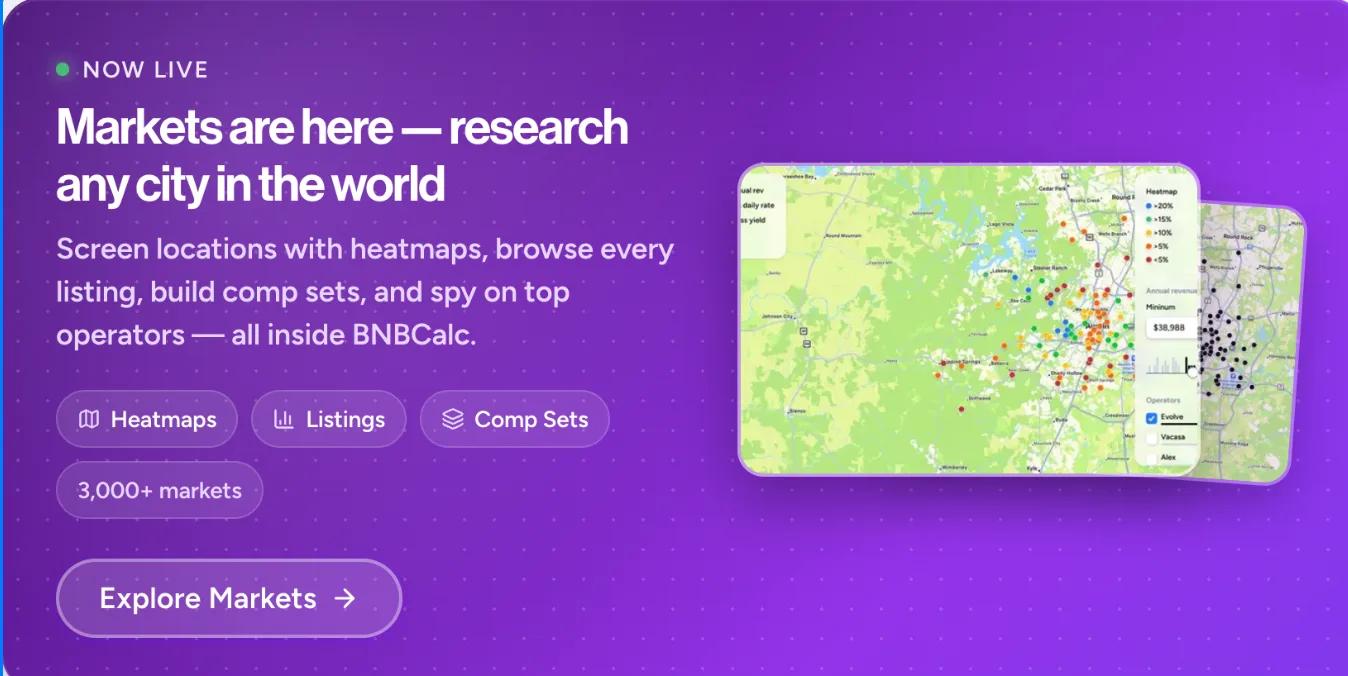
His buy box is narrow. Twenty units or under, two million or under, and an owner in the 55 to 60 range who's held the place anywhere from three to 18 years. Before you start calling owners like that, check what the market itself supports in BNBCalc Markets.
Key Points
- He bought his first house with a VA loan a week before reporting to his first duty station, then closed three deals in his first three months on zero down and low down strategies. The VA loan covers one to four units at zero percent down, and he points out you can use it more than once, which most people don't realize. By the end of that first year he had around 11 units, and the cash flow had passed his W-2.
- Five boutique hotel deals closed inside 13 months, the first on February 1, 2021 and the last in March 2022. He picked up 15 and 18 unit properties across from the beach in the Florida panhandle for a million and under each, plus an eight unit in Fort Walton Beach, and his partner brought the first Tahoe deal. That worked out to two full years of renovations on five hotels in three markets, all while he was still active duty.
- Zoning is the piece he says changed how he underwrites. South Lake Tahoe's Measure T took roughly a thousand residential listings out of the market, yet his properties are zoned commercial for nightly use, so none of it applied to them. Demand for the skiing and the lake held while supply dropped, and he says they beat their pro forma on that deal by a good margin.
- The script he gives brokers is 20 units or under, 2 million or under, value add, in a specific location, ideally with a seller open to creative terms. His typical seller is 55 to 60, has owned the property somewhere between three and 18 years, and does everything personally. Three of his six deals came with seller financing, and he says a seller carrying at 4% or 5% against commercial rates of 7% to 9% is where the spread lives.
- The Tennessee property is 130 units across eight buildings on 10 acres with three pools, bought at $7 million. Revenue at purchase was $1.6 million and NOI was around $680,000. Renovations were running about $2.25 million with another $1.15 million on design, and the plan he describes adds a pickleball court, an outdoor movie theater, a pavilion with an outdoor kitchen and a pool bar, spread across the acreage because group and wedding business drives a lot of the revenue.
- He financed that renovation with a bank loan plus an equity raise, syndicating it rather than taking a note, so as he puts it his investors aren't holding paper, they're in the deal with a share of the tax benefits and the appreciation. He also separates the property company from the operating company, and his own management company runs the hotel.
- Four of the earlier hotels sold in March 2023 when he and his partner split, before the properties were fully stabilized, so neither of them got the exit they'd pictured. The 15 unit and the 18 unit in Panama City Beach were hard to move individually because neither supports staff on its own, although together at 33 units they do. Revenue rather than unit count is what he says to look at.
Full Transcript
Listen to the full episode on Apple Podcasts, Spotify, or YouTube.
Jeremy: We are live with the Short-Term Rental Pros Podcast. Today, I'm super excited to be with a friend I met about what, three, four, a month ago at this point? That's T.R. Wolfgang.
Blake: Yeah, man.
Jeremy: Bumped into each other, got to know each other a little bit.
Blake: Yes, sir.
Jeremy: Down in Nashville. But that's actually not Blake's favorite part of Tennessee. He's got a boutique hotel that he's standing up right now while he's... I just learned actually prior to going live that he is finishing up his armed service, what did you say, nine days from now?
Blake: Nine days. Yep. It's coming.
Jeremy: Well, first of all, congratulations on that front. So super excited that we're talking to you now at the beginning of this new chapter in your life. But yeah, first of all, Blake, tell us about the chapters leading up to now. Where are you from? What got you going in this game? And yeah, man, what do you do?
Blake: Yeah. So from India and originally went into the Air Force. So left home at 18, went to the Air Force Academy on a football scholarship and majored in management there. So business classes, because I wanted to do something entrepreneurship. I didn't know what it was going to be.
And on one of those trips, going to Barnes and Noble because a big reader would go there pretty frequently, found that little purple Bible, Rich Dad Poor Dad. And I was like, oh man, this is what I'm going to be doing. It's going to be real estate, because I was figuring out what business it was going to be.
And after I got done playing football my senior year, I had all this time left, like six hours a day where I wasn't on the practice field or in the weight room, in the film room, not spending all that time playing football anymore. So I was like, I'm going to throw this all into real estate. I need something to take all this energy away from me. And then dove deep into it, bought our first house with a VA loan on our first duty station and closed three deals our first three months, all different zero down strategies and low down strategies, I guess. So we did a VA loan.
Zero percent, man. If you are listening to this and you have served in the military, you're currently in the military and you haven't used the VA loan, you absolutely need to do it. Buy something that has multiple units. You can buy one to four units, zero percent down, house hack and get started just like I did.
Jeremy: Yeah, exactly. My older brother, who I mentioned is in the armed service and who actually just deployed out to the Middle East. But yeah, he has two properties via VA loan. First one being a duplex house hack.
Blake: Yeah, I love it. We have two as well, which is a misconception that you can't use the VA loan more than once. You absolutely can. So use it. Use it again. You can refi and use it again. There's so many different ways that you can maximize that loan. Just got to know.
Jeremy: Just got to know the inner workings. So you use the VA loan, got your first few properties while serving. How long have you been in the Air Force, by the way?
Blake: Five years. Yep. So I bought my first house a week before I reported to my first duty station.
Jeremy: Does that mean we're like the same age? I graduated college in 2019.
Blake: So did you? Okay, so we're the same age.
Jeremy: Okay, cool.
Blake: Yeah, yeah.
Jeremy: How often do you get the stuff of, oh man, you're so young and you're doing this? I feel like when you are in it probably as much as we both are, it's like, I feel like I've been doing it for a decade plus, you know?
Blake: Yeah, no, I look at this and I'm like, d*mn, maybe I got a little bit more of a widow's peak. It's like if I could grow any version of a beard, it could maybe help my chances with, I don't know, raising capital or having brokers take me a little bit more seriously sometimes. But usually just keep it off the radar.
Jeremy: I do think one of the things I talk about is the cool thing about this space is it hasn't been around for 50 years.
Blake: Very true.
Jeremy: A lot of people are younger.
Blake: Yeah.
Jeremy: Yeah. Just because frankly, it's crazy to me that I'm like a veteran. I'm a veteran in this game.
Blake: It's weird to think, right? Yeah, we've been doing it since 2019, before probably the vast majority of people doing STRs today were doing it, you know? So yeah. So it's like I've got STR gray hair. But that's cool, because there's not a lot of industries you can walk into that are like massive. I mean, there's 1.6 or one, I don't know, between one and two million short-term rentals in the United States. There's an exploding amount of them around the world. So it's big.
Jeremy: It is a big industry. It is growing.
Blake: And yeah, you can be the most knowledgeable and the best at it in your 20s, which is cool. Not a lot of things, that's the case.
Jeremy: And also being young is like an advantage. So you got those first two properties, you were creative, used the VA loan, and then how did you further scale from there? Or how have you further scaled from there?
Blake: Yeah. So it wasn't all short-term rentals from the beginning. That was always kind of the staple of what we were doing. And I didn't even really know. It's like that first VA loan, we actually cash flowed that house and lived in it for free. So I was like, dude, we're living in this house for free, right? And we have this mother-in-law suite that's paying for it. Why don't we go buy more houses with guest houses?
So that's exactly what we did, because the main house would be essentially all cash flow minus the cleaning costs and incremental utility costs. So we kind of built this little niche in the beginning of buying houses with guest houses. I think we bought five or six in the first year. And all but one were short-term rentals, one was a long-term rental because the top bottom duplex and all the others were side-by-side or detached. And I was like, guests on top of each other, we'll just make a long-term rental.
Jeremy: And not to cut you up here, guys, if I didn't say this initially, we're going to talk boutique hotels today. I know that's like a sexy trending topic. So right now we're talking about...
Blake: We're getting there.
Jeremy: These small multi-families were the jumps here.
Blake: Yeah.
Jeremy: But that's where we're leading. We want to tell people that that's where we're going to. So don't discount this house hack strategy right now, because this is the foundation.
Blake: Part of the journey, yeah. I mean, I think without having the small multi-unit background of multi-family, right? Because we're buying multiple units, furnishing multiple units, and had multiple guests on each property. So we got exposed to it early, right? And then we had a portfolio of them. I think we had like 11 units in that first year, surpassed my W-2 with the cash flow from the real estate. So I was like, dude, this is awesome. We need to set higher goals and do bigger deals.
So that got me into the commercial real estate space where I syndicated an apartment complex, learned how to raise money, learned how to talk to investors, learned how to underwrite commercial deals, just learned how commercial real estate worked, right? Versus residential real estate. And then that's where I was like, all right, now I've got these two skills with commercial real estate and managing Airbnbs, buying, renovating, operating them.
And at the time, I wanted to do more multi-family, but it was during COVID where all this stimulus money was going into the market, cap rates were compressing. It was like commercial real estate, multi-family specifically, is really tough for a smaller investor to be competitive. It was just like the juice wasn't worth the squeeze. So that was the pivot point to then looking into hospitality assets and then looking how to maximize those.
And I was down in the panhandle of Florida market. Great STR, my earliest at the time. Now it's pretty oversaturated. But at the time, amazing STR market. And we picked up some pretty cheap, million and under properties right across from the beach, 15 and 18 units.
Jeremy: Oh, wow. That's crazy.
Blake: And it was more of that kind of roll, plus an eight unit in Fort Walton Beach that I guess was the first one that I bought, but not the first one that was live and open to guests. So did well in the panhandle.
And my partner at the time was in California and the Tahoe market was close to him. And I think he had a chip on his shoulder. He's like, he likes bringing all these deals. I got to go find something. I was like, do it, do it. Give us another one. And he found the first one in Tahoe. We jumped on that and then built a little foothold in the Tahoe market and had another one come to me through my network. So within the first 13 months, we had five boutique hotel deals.
Jeremy: Wow. Okay. And this is what, 2022 to 2023?
Blake: This was the turn of 2020 into 21. So I think we closed on February 1st of 2021 on the first one. And then we closed the last of that five in March of 22. So we spent two full years in renovations on five different hotels in three different markets, which was crazy, all while active duty with a busier job than what I'm in now.
And I learned everything just by trial and error, going through it, right? Because nobody's really doing boutique hotels in 2021. You probably saw it at STR WealthCon, just the level of interest in the market.
Jeremy: Oh, yeah. It's hot.
Blake: Just in the last year since last... I mean, there's like, who's in boutique hotels? And six people raised their hand. And now it's like 100 plus just in the breakout session, especially more in the room that we're doing it. So just in the last year, it's gained a lot of traction, but there's nobody doing it. So just how to learn by, I guess, trial and error and leveraging that experience from what I've done on the residential side. And you can absolutely do that, but there's easier ways I've learned.
Jeremy: Yeah. And I feel like I kind of joke about how... Well, I don't joke. I say that boutique hotels is A, the natural next step for a lot of short-term rental operators. Maybe you do three, four or five houses and you're like, all right, I've done houses. What's next? I've got to do something. I think there's like constant... If you go online, it's level up. You got to level up what you're doing. You got to do bigger. So boutique hotels is really that natural next step.
B, obviously talk about regulations. There's, oh, places are cracking down. How do you get around that, commercially zoned hotels? So with these properties, how do you put that short-term rental? Were these multifamily buildings or were they motels? What were they initially and then what did you turn them into?
Blake: So they were all zoned hospitality, hotel, motel. Out of the initial tranche, there was a multifamily that I converted into short-term rentals. It had the zoning use.
Jeremy: Yeah.
Blake: It had the appropriate zoning to also operate it as a multifamily or, excuse me, as a from multifamily to like a hotel use and operate them as short-term rentals. The other ones were zoned as hotels and motels. The one was operated as a long-term rental. So we did have to get some tenants out, but the rest were either like week to week, short-term, nightly rentals across from the beach or in the Tahoe market. So just kind of a mix.
But yeah, I think taking the experience of operating the short-term rentals, like I was in the panhandle of Florida and Panama City Beach where the regulation is pretty open. Now, I think just now you have to do registration requirements and different fire code things that you have to do, like post out of riptides and different things like that as of 2024. But in 2019, there was really none of that.
Jeremy: Back in the days of 2020.
Blake: Yeah. That's why there's so many more listings in the market now. We kind of got hit with that before the sale at the beginning of 2023. That Airbnb bust year was very real, because so many people bought STRs from like 22 to 23 and listing supply went up a bunch.
But in other markets like Tahoe, you mentioned the regulation. We bought and, because we're commercially zoned, they had regulation that took off like a thousand listings. Measure T just wiped out a lot of the residential short-term rentals in the Lake Tahoe or South Lake, specifically in South Lake Tahoe. But because we're commercially zoned, that helped us, because it didn't affect us at all. And all that demand, people are still going to want to go to Lake Tahoe for the skiing and for the lake in the summer, the hiking, everything that Tahoe has to offer. So demand didn't slow down at all, but the listing supply went down and that helped us. We beat our pro forma on that deal by a pretty good margin.
That's when it became pretty apparent. I was like, I like these hotels because of the regulation. At the beginning, we're just buying because they're great deals. But then you start to see through the operations, all the benefits of you're protected because you're zoned as a hotel or motel, whatever, for nightly use. So when all that regulation happens, it's for residentially zoned areas to protect housing, to protect the neighborhoods that people live in. But if you're commercially zoned, you got the green light.
Jeremy: I actually read a case study on South Lake Tahoe and what happened when they created this zoning. And essentially, there was all these findings, but the main takeaway or the reality of the situation was, it was just rich people bought second homes they didn't stay in. They got a marginally better deal on second homes that they still don't... Instead of renting out the people, they just don't stay in.
Blake: Yep.
Jeremy: And yeah, the appreciation of that market is still crazy, but you still like... Today, a normal STR investor isn't going to go to Tahoe and buy a $1.2 million home and be able to... Anyways.
Blake: Be able to cash on, or like going anyways, yeah.
Jeremy: That's the thing that's stupid. It's like, they wouldn't do it.
Blake: Different ballgame, different buyer pool, for sure. So there's a lot less competition and you can get into deals for better unit economics. The example I was given for the new one in Tennessee, we bought it at $53,000 per unit, like per door, and each unit will generate about $30,000 per year in revenue. So equate that to a house, right? Imagine buying a house for $100,000 and you're doing $80,000 a year in revenue. It's great unit economics.
And that's the thing you see in these markets where it's too expensive to buy homes. You can find these older, underutilized hospitality assets, put some love into them, renovate them, turn them into boutique hotels, and you have the high demand and high rates of what brings people to that market.
Jeremy: So that is a great strategy, man. I'm super fired up about what the next year is going to look like for boutique hotels.
Blake: Yeah.
Jeremy: So how do people find these boutique hotels? If you're telling me... Because generally for a house, I'm looking at 20%. I feel like generally speaking is the industry standard. If you buy a house that makes 500K, you want to make 100K per year. You're saying that the unit economics on a hotel deal, should it be something you buy for 50K makes 30K? Is that the high level?
Blake: I would say mine's a really good deal, but you can definitely find deals like that. I think my average is probably in the 33% to 50% range of revenue to purchase price.
Jeremy: Well, I mean, ultimately it's the same thing. You would just...
Blake: Yeah, yeah. Exactly. You just extrapolate it out.
So where you find these deals is... I would say it's better than... If anybody listening is familiar with commercial multifamily and how hard it's become to find a commercial multifamily deal, the debt for them is terrible right now. There's a lot of assets being lost back to the bank and cap rates are so low and interest rates are so high that other people can't sell at the price. So there's not a lot of trading volume.
But in the hotel space and multifamily, going back to the example, a lot of those are owned by investors from 2017, 2018 up until 21, 22. A lot of the mom and pop operators got purchased out by investors, because they've got so much demand into the investor side of that asset class. But in boutique hotels, most of them are owned by the mom and pop operator type people. So you can go directly to the seller. We've got seller financing and work directly with the seller on three out of the six deals that I've done.
You're talking Silver Tsunami?
Jeremy: What's the Silver Tsunami?
Blake: There's a $90 trillion transfer of wealth coming where 65-year-olds and older...
Jeremy: Yeah, the baby boomer retiring. Yeah, I haven't heard that. Is that the people you've been...
Blake: Yeah, exactly. I would say our demographic is probably in the 55 to 60 range.
Jeremy: In terms of the owner?
Blake: Yeah, the owner is 55 to 60, has owned the property for three up to 18 years. They manage and do everything themselves. The last deal I bought, just because it was so big, was the first one that actually had staff. The rest of the owners were doing everything themselves. So they're stuck in the business. They don't have the eye for the design. They don't know the operations. They don't know the marketing side of making these really good assets. And because they bought them years prior when that was great, they've got a lot of equity and you can get into seller financing really easy.
So that's one of the cool things about it is you don't have to go on the market and compete with everybody else. You can go directly to the seller, negotiate in seller financing, get really good deals for these. And really great financing too. If you can get seller financing at 4% or 5% compared to the industry average in the commercial space of 7% to 9%, you're making a really good spread there.
But I think a lot of times as well, when you're finding deals, even hotel deals trade with brokers. So the more relationships that you can make through networking, going to events, cold calling, picking up the phone, actually calling brokers and saying, hey, my name is Blake. I guess you want to say what I would say. I bought six hotels and look for my seventh kind of thing.
Jeremy: I'll say what you say. Hey, I'm Blake. I bought six hotels.
Blake: Everyone write down this script. You guys are copying after me.
Jeremy: Like I heard this guy, this is what I should say.
Blake: No, but you call and be like, hey, this is what I'm looking for. Something that's 20 units or under, 2 million bucks or under, that is value add in this kind of location and preferably like a seller that is open to a creative option. If not, we can get that for kind of thing. So the more you can call brokers, you get better at doing that and you'll get good deal flow from them. But you can also generate your own leads as well.
Jeremy: Got it. So when you say generate your own leads, am I just finding some motels? I mean, we'll call them motels. This is kind of more so that I said earlier, that a joke that I do with people when we talk about boutique hotels is that effectively just glorified motels. It's taking a motel and rebranding it as a boutique hotel. So are we calling motels? Is that kind of what we're doing and seeing if...
Blake: Essentially, yeah. I mean, you can use a service like PropStream or ListSource and pull a list of all the hotels in your zip code, or city, or area that you're looking for. And a lot of times, you're going to have a pretty small list. Like in our markets of Tahoe and Panama City Beach, and even more so like our sub-market in the Smokies, there's like 100 or less properties. So you're not working with a big list, right? You can be very intentional with calling those people, potentially going to the property.
And a lot of these are mom-and-pop operators. So if you go and talk to the person at the front office that's running the show, it's probably the owner, or ask if they're the owner to speak to the owner. Or driving for dollars. Any way you do it, you need to find your list, get a skip trace, right? I mean, we're real estate investors on this show. A lot of STR people might not be into skip tracing and finding their own deals. But a skip trace is essentially when you get a list of your leads, and then you're going to go get their information from a skip trace service. So it'll give you several different phone numbers, the address, and potentially emails as well, which are harder to get good emails for owners, because there's so many junk ones out there.
But you can get the list and mail them. You can get the numbers and call them. You can go to the properties yourself and talk to the owners. I've done all of them, and all of them have led to deals.
Blake: So it just depends on what is the best use for your time, or what you feel more comfortable doing. I'd say probably direct mail is the lowest barrier to entry, because most people don't want to pick up the phone. So you call, you build a relationship with these owners. You go there in person, you call them, you tell them...
Jeremy: Hey, what do you... like, how do you... I don't want to say convince them to sell to you, but let's say I'm an owner, and you've just called me. I've got a, what'd you say, I don't know, 15 unit, I'm going to call it a motel. You can call it a boutique hotel, but the way I think about it is I own a motel. Let's say it's in...
Blake: We'll call it glorified boutique hotels, how about that one? Somewhere in the middle.
Jeremy: Well, no, I'm the owner right now. So you're the one with the vision. You're the one who's turning into a boutique hotel. I just happen to own a motel, 15 unit motel. What do you... I know you said your script earlier, but what are you trying to... what are the pain points that you're going to help me solve for by taking over this property for me?
Blake: Yeah, good question. It's so dependent on the seller, but this is the stuff I love doing. I could talk to sellers and negotiate all day, but a lot of it's just questions.
I mean, it kind of starts with, hey, this is my name. I'm looking for something to buy in this area, or we've got some other properties, we're looking to buy something like this and kind of scale up our portfolio, and kind of get the conversation rolling to at least where they know what your intent is, right? But you don't ask like, hey, would you want to sell the property? Like, hey, we're looking for something like this. Would you ever consider selling? Or have you thought about selling? Do you have a retirement plan? There's a lot of different questions you could ask.
But then as the conversation starts going, it's a lot of targeted questions to kind of get, like you said, figure out the pain point. What is it that they are trying to solve, if they do express interest to sell and you guys are moving forward to that next step? Because a lot of times you're just asking me like, no, I don't want to sell, we're doing good. But for me, those are always follow-ups. I'll hit them in three months, or I'll send them another mail, or I'll call them and check in on them. Build that relationship, because it doesn't always happen at one time.
Jeremy: Tell them Merry Christmas, Happy New Year's, you know?
Blake: Exactly. I've had a guy literally, I think the last time I messaged him was Happy New Year. I think he actually messaged me Happy New Year this time. We've just had that going back and forth for like three years on this fourplex in Panama City Beach. I'm like, I'm not even buying fourplexes anymore, but I'll just keep texting him every holiday, because at some point he's going to think of me first. And there's another hotel owner that I've been talking to since we bought one from him in 2021. So it's been like three years running. And the last time I talked to him was in the fall and we're still like throwing back terms and getting closer and getting his expectations down a little bit more.
But when you're having these conversations, it's about asking the questions kind of like in an indirect way to find out what it is they're trying to solve by selling the property. Are they ready to retire? Are they trying to sell the property and go live RV life and do the whole boomer thing of bouncing around at campgrounds? Are they trying to move closer to their kids or their grandkids? Are they just sick and tired of the operations, right? Each one of those answers gives you a little bit different path that you can go down.
Maybe it's just they're sick of the operations. Awesome. What if I could still pay you for this deal but you don't have to operate it, right? Leads into seller financing. Is cash flow important for you? Is not paying taxes when you sell the property important to you? Is getting your purchase price in 30 days on the dot most important to you? So you can kind of start to decipher whether price or terms is more important.
And that's what led to three, half of my deals being seller finance. It's just multiple conversations, building a relationship, building rapport and asking questions like that to reveal that seller financing one is on the table, and then two, the terms around that that work for them and work for me.
Jeremy: So I think you mentioned in Nashville. So first of all, Blake and I met, we were at the Sommerled Design booth where I've recently... the newest property I've launched with them, they helped with. They crushed it, the property I launched.
Blake: Yup, yup. They're great.
Jeremy: So then they helped you on your... they are currently helping you. Because...
Blake: They are. Yeah, they're doing the 130 units. They've got a tall task ahead of them, but...
Jeremy: Sure, that's quite an engagement. Yeah, a hundred. I can only imagine 130.
Blake: Gonna be keeping them busy for the next six months.
Jeremy: Yeah, because they do everything. Like I'm assuming not all of them are the same exact design. They're keeping things fresh.
Blake: Yup. Yeah, I'll be like alternating designs. Like the big items will stay consistent across the property to keep like that common thread, and also like purchasing more bulk to get the cost savings there. But then we'll have different texture walls or paint colors, splash walls, or that kind of stuff to make each different building over the eight different buildings pop, so that everything fits in this integrated design, but also you get something unique if you come stay with us and then come back again.
So I think that'll be a really cool aspect that I haven't seen any other hotels do, because they're all like plain across the board. But if we're trying to appeal to that 50 plus community who's coming to the park, they like that slower side of the Smokies, which is what Townsend is. They call it the peaceful side of the Smokies. That's where a lot of the older people come to ride bikes or walk along the walkway into the National Park and go hiking. And then a lot of families come there as well because it's cheaper and they can get more bang for their buck and still be close to Gatlinburg to go do the touristy stuff. So we want to be able to appeal to those multiple different demographics, but also keep like a design thread that is representative of, I guess, what makes the Smokies the Smokies.
Jeremy: And I think you mentioned, or maybe it was, we follow each other on socials now. Pickleball court, you're adding a pickleball court to the...
Blake: We're adding a pickleball court, yeah. Pickleball, outdoor movie theater, a big pavilion with outdoor kitchen, a pool bar. It's going to be sick when it's done.
Jeremy: Was there previously a pool?
Blake: Yeah, there's three pools on site.
Jeremy: Oh, wow.
Blake: Indoor, so we're like spreading these amenities over the 10 acres so that we have like multiple gathering areas for the groups, because group business is a big part of the revenue stream there. And we have the wedding and event menu. So they come do a hundred person wedding, 50 people stay in the rooms, and they're all going to want to get together after the wedding. So we're creating different spaces around the property like that for people.
Jeremy: I'm assuming you think with this renovation, I mean, you wouldn't be doing it otherwise. What was the unit economics before? And then what are these upgrades and these new amenities that you're adding? How much do you think they can elevate the top line?
Blake: Yeah, so the revenue when we purchased it was 1.6 million. We should hit somewhere in between 2.4 and 2.6 this year. And we'll be like phasing up through the renovation and also phasing up the wedding and events as well, because those book six to 12 months in advance. We missed a lot of the 2024 weddings, but we're getting them booked for next year now. So in 2025, we'll do closer to 4 million in revenue, up to our kind of peak of once we're fully stabilized, ramp up period's done, we should be in like the 4.2 to 4.5 range of top line revenue.
Jeremy: And how much did the renovations and these new amenities cost?
Blake: I believe altogether renovations were like 2.25 million and the design is like 1.15 million. So 3.3 altogether.
Jeremy: Got it. So 3.3, so you're saying 1.6 to bring you to, let's just call it four, which you said is a little bit more than that. So that's 2.4 mil more revenue. So essentially spending three gets you two per year. Essentially like a pretty crazy, if you look at that again, we're just kind of doing that revenue to purchase price or revenue to renovation.
Blake: And the cool part about this is because it's commercial real estate, it's not a single family home, it's valued by the comp of other sales in the area. The NOI is going to be going up a million dollars. So by...
Jeremy: Can you apply, what would you say?
Blake: Yeah, but 10, 10 million dollars. We're at $10 million of value to this property over the next two to three years.
Jeremy: So yeah, by adding, so bought at 1.6 and essentially it's going to be valued at 11.6 by this $1 million increase in NOI. Is that math correct?
Blake: No, we purchased at 7 million.
Jeremy: Oh, 7. Wait, what did I say? What did we want to do? The income was 1.6.
Blake: Yes, we purchased at 7, it's going to be worth at 7.6.
Jeremy: Yeah, I was like, that just seems a little too good to be true. Okay, so you purchased at 7.6 and now you're taking, what was the NOI before?
Blake: I think 680,000, something like that.
Jeremy: So you are tripling, about tripling the NOI. So if you bought it at 7 mil and it was 600K in NOI, that means you bought it at like a not nine, 10 cap or something.
Blake: Yeah, not a 10 cap.
Jeremy: Yeah, 10 cap, and then now that it's going to do 1.6, if you keep it at that 10 cap, it is now a $16 million. Is my math off here? It's a $16 million hotel.
Blake: Yeah, actually NOI will be like 1.7, so that's where the 17 comes from. But yeah, we're adding just over a million bucks in revenue.
Jeremy: That's crazy. So that's, so that's...
Blake: So yeah, $10 million value add with a $3 million expenditure to get there, and we're making that much more every single year. And the cool thing is like, it's a big BRRRR. So we're going to be able to refinance in three years once it's fully stabilized, return all the investor capital so they have no principal left in the deal, but they continue to pump out 14% cash-on-cash a year every single year and have no money left in the deal.
Jeremy: And that's why I'm assuming Blake gets his payday.
Blake: Yep, that's right.
Jeremy: Once you return the investors their money first and then that's when, you know, if you're doing...
Blake: On the GP side, yeah, but the other side is that's just the PropCo. Then you've got the whole OpCo as well, the management company, which my management company also runs the deal. So there's another 10% of that top line that goes to the management company.
So as the investor on these deals, there's a lot of money to be made. You just got to be ready for that two to three year timeframe to purchase, renovate, stabilize, refi, and or sell if you're just trying to flip it. But yeah, I mean, compare that to buying the two, three, four STRs where maybe you make a hundred grand over a couple of years on each deal. You can make a lot more than that with hotels.
Jeremy: Yep, yep, and that is definitely why, if you guys, the Isaac French podcast was a really good one. I don't know, are you familiar with Isaac and...
Blake: Live Oak, yeah.
Jeremy: Yep, Live Oak. He spent two mil and created seven mil value with seven 500 square foot Scandinavian A-frames on a...
Blake: Wow, man, that is one of the next kind of projects I want to do. Live Oak is kind of the, man, it's such a good example of the experiential type stay. That's a commercial property that trades based on its income.
So yeah, I mean, there's Bolt Farm Treehouse, Onera in Austin area, like these properties like that, they absolutely crush. And the new hotel is 130 units, a little bit different, but operates the same, the same fundamentals make that all come together. So it's all about the experience you provide, which drives up the income, adds to the NOI, creates that value for you. So there's so much opportunity in this space and so many different markets that it works in too. I mean, I'm super excited about it, man. Boutique hotels are gonna be, I think gonna be a big trend over the next year for sure.
Jeremy: Yeah, I think boutique hotels, or what Isaac did, I would call it like a landscape hotel, would maybe be how I bucket that, but...
Blake: Yeah, I kind of grouped it all together. Like when I say boutique hotels, I kind of just referenced that asset class as a whole, like cabin communities, tiny home communities, glamping, hotels, motel conversions, like landscape hotels, like all these things kind of fit into this commercial short-term rental bucket, or boutique hotels, kind of whatever you wanna call it. But yeah, I mean, when you're able to rent by the night, drive up this crazy income, and then your value based on a percentage of your, or based on your value, based on your income, I mean, you're creating crazy value.
Jeremy: Yeah, and frankly, as someone who's done houses that do very well, and I predominantly look for big houses that can drive 600, 700, 1,000 bucks a night. But when you sell them, you have to sell them based off Sally down the street and whatever she sold her house for. So that's the downside.
The residential game, sure, financing's easy. You can find a lot, if you have a W-2 or you just have two years income history, it's really easy to finance a residential property, which is why so many people build wealth through it. And I also think that is why so many folks start in short-term rentals that way, because the financing component is easy. However, you can't drive millions in, or very, very rarely, very unlikely, can you create millions of dollars of value in a couple of years. So kudos for that.
And then, I think you mentioned, did you sell one or two, or did you exit, or?
Blake: Yeah, sold four of them at the beginning, about a year ago, March of 23, was kind of the cause of me and my partner at the time splitting up. So we didn't have these crazy exits because we had just got done with renovations and we hadn't fully stabilized. So it wasn't the big paydays that either one of us thought they would be. But we still got through the full cycle process, went trading them, see how the appraisals work and how sellers view them.
And my takeaway there was it definitely adds to the value when you have something that you're selling as a scalable business. Like we had a lot of trouble selling the 15 unit and 18 unit in Panama City Beach individually, because on their own, they don't really support the staff. But together, the 33 units, you then have enough revenue, which really is like the thing you should look for is the amount of revenue, not the amount of units. Because that revenue is what you pay staff out of, what you add in the systems and scale, so that you're not stuck in the business as the mom and pop operator and somebody like me comes in and buys it at a discount later.
Jeremy: Yeah, that's actually funny when I tell people, like, yeah, it's honestly in many ways easier to manage 25 properties for me than it is to manage like seven. And the reason for that is because of scale. I have people working around the clock. It's not just me checking my phone every two seconds.
So, okay, but I'm sure you got invaluable experience there and you're gonna use that and carry it forward. So yeah, what can folks, you know what, A, how can they follow your journey? And then B, what are you excited? I know you're obviously excited about this project you've got and about boutique hotels. But yeah, what can we expect from you in the next year or two from now when we have you back?
Blake: Yeah, so the first place to follow me and get ahold of me would be Instagram. You can shoot me a message there. I respond to all my DMs. So if you've got a question, I'd be happy to help, or just wanna talk boutique hotels. I could talk your ear off, talk all day.
Big next project that is coming is Boutique Hotel Con, and at the hotel and resort in Tennessee. So we're gonna be hosting the event in the venue and everybody's staying onsite. So all-inclusive ticket, get to see the hotel, see the before and after of the rooms and see how like...
Jeremy: Is the pool bar gonna be open?
Blake: Pool bar will be up and ready. The pavilion, yep, we'll be slinging drinks out there. It'll be great.
So yeah, you get to see how a property like this actually comes to fruition, how all the pieces fit together, and get to like put something tangible to what you'll actually be learning during the conference itself. So really trying to structure that time into it, and we're in the pre-planning stages right now, but if you go to boutiquehotelcon.com, you can sign up to be notified of when we do the launch and offer the ticket sales. It'll be September of 24, we're doing that. So boutiquehotelcon.com.
And then other than that, man, buying more hotels. We're moving to Tennessee to be closer to this one through the renovation phase because it's such a beast. And then probably starting a fund in May or June to go buy a couple more of these bad boys before the end of the year. So very bullish on the boutique hotel space. We've got a system that works for buying them and turning them around and making them really profitable and all those things. So just replicating what we've been doing and doing it at a bigger scale now that I'm getting out of the Air Force and have the time available to do it.
Jeremy: Yeah, beautiful. I'm excited. I actually do have one question now that I think about it. I'm kind of a numbers oriented guy. How'd you finance, that's a pretty substantial renovation there. I mean, that's several million dollars. How'd you finance, because you can't seller finance, or, I'm assuming you didn't seller finance the renovation.
Blake: We didn't seller finance this one, no.
Jeremy: That'd be a very, that'd be convincing.
Blake: Yeah, yeah, so this one we raised money from investors. So we brought in investors, we got a bank loan, brought in investors for the equity that we needed to close the deal, plus the renovations. So another good thing about it, right? You get to give other people passive income.
Jeremy: Got it, okay, gotcha. So you raised an investor, like debt financing through a private money for...
Blake: It was equity, so we syndicated it, so it's not like...
Jeremy: Oh, okay, so the money that came in...
Blake: They're not holding it, yeah, they're in the deal, they have ownership of it, percentage of the tax benefits, the appreciation, all that stuff.
Jeremy: Got it, okay, so it wasn't a note, it was a...
Blake: They came in and...
Jeremy: Okay, that makes sense. I was curious there. So guys, check out boutiquehotelcon.com. Blake, when did you say that was going to be?
Blake: Yeah, wait, should we change it? Should we change it to Glorified Motel?
Jeremy: Yeah, Glorified Motel. Hey, I'm not taking shots at anything.
Blake: No, I'm just kidding, I like it.
Jeremy: I mean, that's the art, Blake. That's the art there. That's the art of marketing, right? That's how you go from 150 ADR to 175. You change it from a motel to a boutique hotel.
Blake: Yeah, someone says, hey guys, we're going to go to Tennessee this weekend, we're going to stay in a motel. I go, what? Are you kidding me? No, they go, we're going to stay in a hotel, and check out these pictures of all these shared amenities that are the top five photos on the listing. They go...
Jeremy: This is bada*s, let's go.
Blake: Yeah, they're like, I'm sold. It's in what town? Oh, I don't care, whatever, let's do it. It's less expensive, but we're getting more for our dollar.
Jeremy: And there's pickleball courts. I mean, honestly, the pickleball courts. I talk a lot about pickleball courts and that's like the next amenity I want to add.
Blake: Do you have anything in the Smokies?
Jeremy: I have Western NC, so not the Tennessee side.
Blake: Close enough. I was going to say, next time you're there, or you just come to the conference and then we'll play some pickleball.
Jeremy: All right, we'll talk. Yeah, okay. Is pickleball, the court will be ready?
Blake: All right. It'll be ready.
Jeremy: I'll be there then.
Blake: Awesome.
Jeremy: Well, yeah, Blake, thank you so much for joining today.
Blake: Yeah, man, thanks for having me. This was fun.
Jeremy: Awesome. All righty, guys, that is a wrap. Stay tuned for the next episode of the Short-Term Rental Pros Podcast. See you guys.
Airbnb Tax Deduction Calculator
Paying too much in taxes? We have the perfect solution. Simulate an Airbnb home purchase below.
Purchase Price
$450K
Structure Value
70%
Apply Trump's Tax Cut (Bonus Depreciation)
Depreciation
$117,695
Interest
$21,600
Tax
$6,750
Year 1 Deduction
$146,045
Want to claim this deduction? Get a free cost segregation benefit analysis from CSA Partners — no obligation.
Get Full Analysis