Free instant analysis
Reveal Airbnb revenue for any address or city
Quick Summary
Ben's first development doubled as a test lab. Onera Fredericksburg opened with eight different unit types, about half of them soft sided, so he could see which ones held up. The geodesic dome became his worst maintenance problem, and at Onera Wimberley he cut down to two unit types instead of eight.
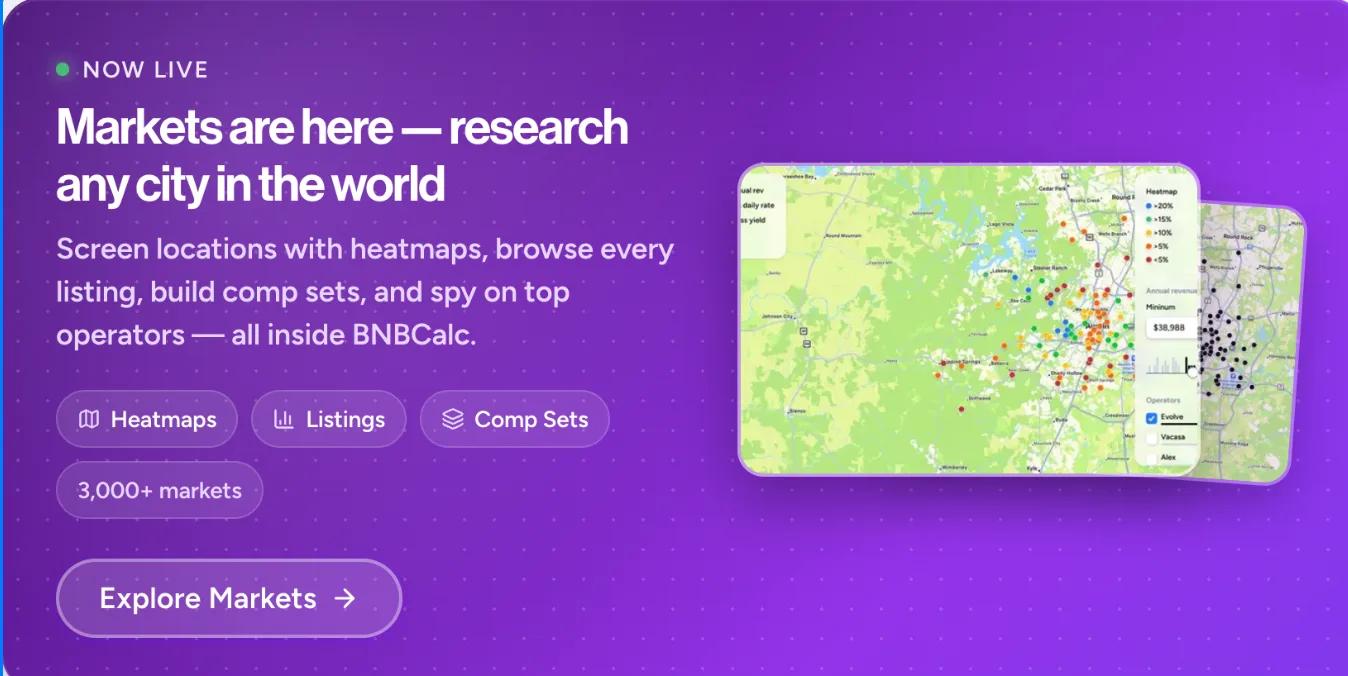
Ben's frame is revenue per square foot. His units run 300 to 550 square feet at a RevPAR close to $500, while Jeremy's 3,500 square foot houses sit in the $500s. Same rate, a tenth of the building. If you want to test that math where you're buying, BNBCalc Markets has the comps.
Key Points
- Onera Fredericksburg opened in November 2021 with eight units, added three more for 11 keys, and cost roughly $6.5 to $7 million to build.
- Out of the gate it ran above a $500 ADR at high 80s to low 90s occupancy, almost all of it through Airbnb before direct booking took over. Ben puts its NOI margin north of 50%, which he says is hard to do on an 11 unit hotel.
- A public REIT bought a 90% stake, closing in October 2022. Ben calls it a cap rate exit with a look back cap rate, or earn out, applied to the following year's NOI, and his team hit the maximum the deal allowed.
- The units run 300 to 550 square feet at a RevPAR close to $500, which Ben sets against about $245 at what he calls the best performing hotel in Texas.
- He talked to at least 20 banks on that first project and only needed one yes. His short term rental management company, 200 units under management, guaranteed the loan.
- Onera Wimberley, under construction when this was recorded, cuts from eight unit types to two across 28 units, with some elevated 35 to close to 40 feet off the ground on the back side.
- Ben also walks through how he structures an equity raise, a 506(c) offering open to accredited investors with a $100,000 minimum, for the project he was raising for at the time.
Full Transcript
Listen to the full episode on Apple Podcasts, Spotify, or YouTube.
Jeremy: We are live with the Short-Term Rental Pros Podcast. Today, I'm here with Ben who is doing absolutely crazy, crazy things in the short-term rental space. I've been wanting to talk to Ben for a while. I've been following him on social media. I've been following the projects that he's already done and the ones he's currently doing. And he's doing some pretty crazy things. So I'm just going to leave it at that. I'll let Ben tell you guys what he does for a living, and super excited to have this conversation. And thank you a lot, Ben, for coming on.
Ben: Thanks for having me on, Jeremy. I always love chatting with other industry folks and chopping it up.
Jeremy: Yes, sir. So yeah, Ben, what do you do?
Ben: So my companies, Oasi and Onera, our sort of mission vision is innovating hospitality for the modern traveler. So we create these one-of-a-kind landscape hotels, experiential STRs, whatever you want to call them, that speak to the modern traveler of today that cares about experience, that cares about shareability, and Instagrammability. And that's kind of how we design our spaces. And my company also manages and markets them. So we're kind of full service in the sense that we design, build, manage, and market these types of properties.
And we're really trying to innovate the world of hospitality. It's an industry that hasn't changed in decades in a lot of ways. Hotels have kind of innovated at the margins. Airbnb was a big innovation just in terms of a different type of supply. But even short-term rentals, Airbnbs have been commoditized in a lot of ways. And this whole experiential, Instagrammable movement of this new type of hotel and short-term rental is the future. And we're trying to be ahead of it.
Jeremy: Got it. So I like that you say that, that Airbnb itself was an innovation. And what you're doing is not Airbnb. Because I think a lot of people, they get short-term rentals and Airbnb, and they think of them synonymously. So yeah, what you're doing, and how is it not Airbnb?
Ben: So look, we do market on Airbnb. The majority of our bookings come through direct, actually, which I'll talk more about. And we built a brand and we market on social media. And we bring in our customers direct, which is amazing, right? We own the customer relationship from the beginning. We're speaking to them from an emotional standpoint, right? We're showing them video, they're connecting with our property and the experience, and then they come and book with us direct. And we're cutting out the massive OTA fees, the booking platform fees that folks like Airbnb charge.
So some people might think of us like an Airbnb or an STR, and you might think of us like an STR. I think of us more as a landscape hotel or experiential hotel. It's more unit density, right? We have 11 keys, 28 keys, Oasi Hill Country, my next property.
Jeremy: Let's take a step back and explain. First, what projects do you currently have live, and then what's under construction? And then after that, I want you to take a step farther back and go, why the hell are you doing this, man? But first thing, what's the current portfolio look like for those listening?
Ben: So we have Onera Fredericksburg, was the first landscape hotel that we developed. And that was after actually I had a portfolio of short-term rentals. So portfolio of Airbnbs that were more commodity products, that was pre-COVID. And when COVID hit, that portfolio really got hammered pretty good. It was mostly urban inventory. And that's kind of what pushed me to do something unique out of the box and ultimately build Onera Fredericksburg.
So Onera Fredericksburg is a landscape hotel in Texas Hill Country, might also be thought of as like a treehouse hotel. It was initially eight units. We expanded and built three more. And now we're actually expanding to 34 keys with the help of a public real estate investment trust that bought out a 90% stake in Onera. It was a nice exit for us and our investors. And they're partners with us in the expansion to the Fredericksburg property.
And we're also building a property in Wimberley, another Texas Hill Country town that has just incredible views. It's these 28 units perched on a hilltop, overlooking these dramatic west-facing Hill Country views. And that one is set to open by the end of the summer.
Jeremy: Sunset, like the west-facing. That attention to detail, I can already tell just based off that comment that Ben's got crazy attention to detail. And I initially heard about Ben through Isaac French, who I had on the podcast. You guys should check out that episode from a couple months ago. Isaac had seven Scandinavian A-frame hotels over a pond. You might call it a lake, but probably technically call it a little pond. And he sold those seven A-frames all combined, part of the same property resort, for $7 million. So a million dollars per key.
Sounds like you also, well, A, you have that same attention to detail, which we can get into a little bit. But B, you sold that, your first ever project, your first ever project, to the REIT?
Ben: We did. Yeah. First development project.
Jeremy: How'd that come to be? Tell me that story. Do you reach out to a REIT? Say that five times fast. Or do REITs reach out to you?
Ben: So we got connected through somebody in our network that had recently joined their executive team. And we started talking to them, I think it was pre-open. Before we opened, they came and toured and loved what we were doing. We're super interested in it. And we opened to amazing success out the gate. $500, even above $500 ADR, high 80s to low 90s percentage occupancy. So we were doing really well. And that was before we were even really booking direct. That was when we were doing all Airbnb primarily.
So they were interested at that point. They saw our progress and success and sustainable performance over the course of a year. And it took us a year to negotiate a deal with them. Big public companies take a while, and took a while to negotiate a deal that we were happy with and they were happy with. But we finally got it done in October of 22.
Jeremy: Got it. So you got that first deal done. You sold to a REIT. Given you had that year, did you guys look at net operating income and apply a cap rate to that? Was that ultimately how you came to that purchasing crisis decision?
Ben: So it was a cap rate exit, which was exciting for the space, especially of a landscape hotel, or some people think of it as a high-end glamping resort. I think we're more of a landscape hotel. But exiting at a cap rate for an 11-unit property was pretty exciting. So we did do that.
We had an initial tranche, an initial amount they paid us when we closed. And then we had a look back cap rate, or also called an earn out, over the next year. So they evaluated performance over the next year. And based on our NOI for that year, there was a cap rate applied and we got a second payout.
Jeremy: Guys, they're pretty much like, you guys got to keep it up. Don't leave and whatever secret sauce you had going on there, take it with you.
Ben: Totally. And we were the management company and we wanted to continue to manage the asset, and they wanted us to as well. So it was aligned incentives. I think it was actually a good structure. We performed extremely well in that next year. We hit our max. There was a max they applied in terms of NOI and ultimately value, and we hit it. So we knocked it out of the park.
Jeremy: And then do you still... So that was probably 2023, I guess, right? Or you started talking in 20...
Ben: Built it in 2021.
Jeremy: Yep. Started talking to them before you even launched it. So you launched in 2021?
Ben: We did. November.
Jeremy: And then a year from then. So around November 2022, had this agreement with them. And then I guess as of today's April 2nd, so five-ish months ago, you've hit that tranche, which congratulations on hitting that 10-foot rim, max performance. And then from there, do you guys still manage it to this day?
Ben: We do. Yeah. And that's a big piece of it. I mean, look, I think they look at this type of asset as... There's not a whole bunch of management companies to choose from that know how to manage these types of assets. We've proven to be able to do it and do it very effectively. So they want to work with us long term, and we want to continue to develop with them the Onera branded properties and manage for them.
So we have some special sauce on the marketing side of things. I alluded to it earlier where we have a team that's part of our management and social media marketing team that produces high quality content, turns it into reels that have the potential to go viral. And then we have a whole team that recruits influencers and works with them. So we have a pretty robust social media marketing offering.
And that drives high rate, it drives a high direct booking percentage, which most if not all of that direct booking... The direct bookings that we bring in aren't subject to booking platform fees, and that goes right to the bottom line. So it makes our hotels that much more profitable. Like our NOI margin at Onera Fredericksburg is over 50%. And that might sound kind of normal for a short-term rental. For a hotel, that's extremely high, right? A hotel is typically...
Jeremy: Yeah. At scale, that's extremely challenging to do.
Ben: Yeah. And an 11 unit hotel is considered very much subscale. So to have a 50, north of 50% margin on an 11 unit hotel is hard to do. But when you're getting like 12% to 14% margin through booking direct, and we have a model that emphasizes seclusion and privacy, which is very aligned with limited staff, it works out beautifully and we end up with a very high NOI margin for the industry.
Jeremy: I like that. That's actually a really, really interesting point. You just said that because I had a conversation with Hannon last week. She does boutique hotels. She has one... You would call it a landscape resort. She called it a boutique hotel. But again, there's so many different names for everything in this game. People use different words. But I was joking with her. People were essentially calling motels boutique hotels, or glorified motels boutique hotels.
And she was saying that at her... So she has treehouses in Western North Carolina. She's got 7 of them, I believe. And there, the folk don't expect not to have on-site staff. Whereas when they show up at a motel, even though you're calling it a boutique hotel, they expect on-site staff. So guests are p*ssed when they show up at what looks like a hotel and nobody's there to help them in. Or if they have an issue, there's someone they can't talk to.
So I think that's a really good point that you say. These landscape hotels, one of the things is people don't really expect to be coddled. Do you have someone on staff, or is it really just, here's the check-in code, here's your unit, here's how to get there, see you later?
Ben: We do have on-site staff. We actually have live on-site staff, which is something that we decided to do a year or two ago in order to be able to recruit from a wider pool of people, have somebody on-site at all times. So we still need staff to maintain the property, make sure everything's working like it should. If a guest needs extra towels or coffee or things like that, we can bring it to them. So we do still need on-site people.
With that said, I think not only is it not needed, it's actually viewed as a benefit to the experience, how we run things. So I think the modern traveler, which I talk about a lot, does not want to go through a clunky check-in experience in a lobby. They want their code, they want their app and remote check-in, super easy to get in. They don't have to wait in line at a front desk. They're not wasting time.
One thing we talk about a lot is that experience of checking into a hotel lobby feels very transactional. Somebody is asking, oh, how was your trip? But it's not authentic. It feels like it's part of a transaction. So if we can remove that and just allow you to get into your room seamlessly, you have a more intimate, private, secluded experience, which is part of what we do with the whole landscape hotel vibe. And you're not feeling like there's this transactional experience where somebody's paid to ask you how you're doing.
Jeremy: Absolutely. Yeah. You're not showing up at three in the morning. Someone's grumpy. There, you have to wait behind four people. You're tired. Your flight just got in. Your flight got delayed. You don't know. We don't got time for that. But plus I'm assuming your demographic is mostly millennials, younger people. Not geriatrics aren't the ones who are looking for this type of experience.
Ben: I mean, our target demo is anywhere from 25 to 65. So it is pretty broad. And we get quite a few baby boomers who come out and say this as well.
Jeremy: Some of them know how to use their phones.
Ben: Totally. Totally. And I think they're kind of getting hipper to modern hospitality as well. And it's not just the check-in desk. It's the daily cleanings. Like who wants the housekeeping, right? Who wants to deal with that? You have to wait for two hours. You're on a Zoom call.
Jeremy: You're on a Zoom call in the middle of the day working remote.
Ben: Yeah. It's like, I'm here for two days. I don't need my room cleaned. We'll live. We'll be all right. So, yeah, we really lean into the privacy and seclusion, as I said. And we want to maximize the time that you have to reconnect to nature with your partner or loved one and with yourself. And the more we can kind of remove friction and kind of a clunky staff heavy experience, the better.
Jeremy: Got it. OK, so we're talking about these experiences. So the first ones you did, which I stalked your portfolio, which, by the way, you guys should really check out what he's doing. What Ben's doing on social media is next level. Like he's just, the way that you can watch his videos, you can see that there's a different similar flow between them. Like he's really kind of cracked the code on viral content. But B, I mean, drones, photography, like really, really like high level experience crafting. So I want to give you kudos on that front.
But yeah, so tell me this. It seemed like the first one was like a bunch of different types of experiences, like treehouses, like I don't even know what to call the thing, but like that old fashioned, like camper van. I don't know what I mean. Yeah. Or not even the air. So I personally have an Airstream. Don't you have ones like the wagons, like the horse wagons?
Ben: Oh, no. There's other ones in Fredericksburg that are kind of stogo wagons. We don't have any of those, but there's other ones out there that are.
Jeremy: Yeah. Got it. So, yeah. What are the units that compose the, I'm going to call it, the first experience you created?
Ben: Yeah. So Onera Fredericksburg. In a lot of ways, we were testing a bunch of different unit types. We knew that we wanted something very unique and we wanted to see what does better, a container home, a safari tent, a treehouse, and what costs more, what's operationally better or worse. And so we have roughly half of the units are soft sided. So I have some tented component to them, and the other half are hard sided.
So we have a traditional kind of safari tent style unit. We have a cocoon tent style unit, which is kind of a cool, unique shape, which I haven't really seen anywhere else. We have a double peaked safari tent option that has a ton of glass and sort of metal cladding that makes it very modern and also just very easy to kind of look into the nature all around the unit.
Then we have two more treehouse style units, like much more elevated, one that's shaped like a monarch butterfly, kind of a modern take on that, which is our most Instagrammable, I would say, and popular unit, and the one that generates the highest revenue and has the highest occupancy. And then Spyglass is another elevated unit, which is kind of like a tube shaped treehouse, long and skinny, and has this really cool, comfy, cozy circular shape. So that's Spyglass.
We have a couple of container homes as well. One smaller, studio one bedroom, and then another one that's a two bedroom. So a wide variety of unit types that are near Fredericksburg.
And like I said, we wanted to see what were the operational challenges with the various types of units? What was the cost? What was the performance? And I will tell you hands down that I don't think I'll be building another soft sided tent structure again. The revenues aren't quite as good. We can't do as unique architecture and design with a tented structure. And operationally, it's challenging, right? It's harder to heat and cool. It's harder to keep things that you don't want inside a unit out. It's just it's not as energy efficient, which hurts our mission of being environmentally conscious. And I think more and more tented product is getting pumped into the market. So that'll become more and more commoditized.
Jeremy: Kind of like, yeah. So I feel like, because when I was in there, so I have one Airstream camper that's literally in my parents' backyard on a pond. And I wanted to just test kind of that thesis of like a landscape resort at a very small scale. I just wanted to try it out and see what would happen. But with the Airstream, what I realized is like this is different than everything else I have. And fixing an Airstream leak is not like a leak in a house. It's like for me, a leak in the house, it rains, it comes, it goes straight down the roof and you can find the issue. You just look up and maybe there's like a sink or something above, or maybe the roof's leaking. Airstream, it's like, where the hell is that thing coming from? Like that thing's curved, like it makes no sense. So there's just these different unique structures have unique challenges that come for them.
But one thing I want to, I was thinking about a dome. And I think back in like 2020, 2021, everyone was like geo domes were like the way to go. And I was heavily considering a dome. But then I feel like, yeah, a lot of those got pumped onto the market. And like after two years, you just need a new dome. Like those things, they kind of wither. They don't have insulation. Did you see the same thing with those soft... I think a dome is kind of like a quasi soft surface.
Ben: We do have a geodesic dome. I forgot to mention that unit type as we were talking about unit types, and it was our biggest operational and sort of replacement maintenance issue. So I'm glad that you brought it up.
Yeah. So it's a tented structure. It has a skylight. Ours has a skylight, which you'd think would be nice, but it gets really dirty. It's hard to clean. And the skylight's the first thing that ripped because it's not as strong of a robust, or as robust material, as the rest of the dome. So when that ripped and separated, we were getting water in the unit. We're trying to fix it. You can't re-adhere it with, let's say, heat, for example, because you'll just rip the rest of the tent. So if you want to try to attach it in any sort of way, you're risking compromising the rest of the tented structure. So it was really a big challenge.
Ultimately, we had to get an entire dome replacement and basically put it over the existing dome, because there was not a real way quickly, and without having the unit be down for over a month, to remove it, add a new one. And long-term, we may actually turn it into a hard-sided dome or another hard-sided circular structure just because it's been a pain. And we're probably going to have to deal with this in another year or two. So yeah, long-term value of the asset, hard-sided is definitely the way to go.
And the reality is, too, a lot of your costs you're incurring, whether it's a tent or something hard-sided, right?
Jeremy: And I would say rectangles. Rectangles are great shapes. Circular is just...
Ben: Well, so circular is challenging, for sure. My GC would tell you that it's a pain in the butt. We're doing a lot of more rounded structures at Onera Wimberley. And we do like rounded because it is so attractive and unique from a guest experience. When you shoot a circular structure, and I do think the dome, from a flow standpoint, it's really cool and different. I really like staying in the dome personally, as well as the Spyglass, which has a circular kind of rounded shape as well. It's just unique. It feels cozy. It feels like you're kind of getting a hug from the unit almost, right? It's really nice. But yeah, it's harder to build for sure. So we are doing hard-sided and we are still doing rounded. It's a challenge, but we think it's worth it from a marketing and design standpoint.
Jeremy: And when you say hard-sided, can you just clarify? Does that mean we're talking drywall, or what does that entail?
Ben: It could be a wide variety of different things, right? It could be tongue and groove wood cladding. It could be standing seam metal. It could be some sort of concrete type structure, if we were going more modern. We're considering that with some of our new developments. So yeah, anything impermeable, right? That's fully waterproofed and has a high insulation value and more traditional construction in terms of a wall section, if you will.
Jeremy: Got it. Okay. So that makes sense. So first one, you were testing things out. This is why we have these conversations. Ben spent months and probably hundreds of thousands of dollars and hours of stress. And within five minutes, he just shared what his biggest takeaways were from that experiment. So thank you for now not having to go through that experiment ourselves.
So using what you learned in number one, you sold to the REIT. What decisions did you make for the second resort?
Ben: From the learnings from the first?
Jeremy: Exactly. Yeah. And then I want to parlay that into what the hell is going on with this third one, because this third one is nutty. It looks absolutely insane. I'm going to have to leave a lot of time to talk about that one.
Ben: Yeah. Sounds good. So we've continued to push the envelope. And we're always trying to wow people, right? We're always trying to inspire people, blow them away. So I want my next project to be that much more inspiring and attractive from my last. And we're designing right now for shareability and virality.
So when we built Onera Fredericksburg, it was like, oh, let's build something cool, attractive, unique stay, glamping, like something that people would want to go to, thinking that we would mostly be advertising and distributing on Airbnb and other booking platforms. Come to find out that booking direct through Instagram was the way to go. And we've become really good at that. I think leaders in the space of that book direct, building a brand on social movement. We're pioneers and leaders in that space.
And we're now thinking every future landscape hotel, hospitality property that we build, we're thinking about how can this go viral? How is this going to be shareable? And when you think about shareability, it's evoking a strong emotion, right? It's evoking somebody saying, wow, or OMG, or holy, you know what? It evokes this kind of pop and spike and emotion and interest that pushes you to want to send it to somebody else. So that's what we're going for.
And I think we've kind of pushed the envelope with that, with Onera Wimberley. And we're going to even push it more with Oasi Hill Country, the next property that we're building. One thing that I'll say off the bat is we now have this internal metric in terms of identifying a property where if, when you go to that property, you don't have an autonomic response to whip out your phone and take a video or a photo, then it's not good enough, right? It's not viral and shareable enough if you don't feel compelled to do that without being told to.
So that's how we thought about Onera Wimberley. And it's definitely how we thought about Oasi Hill Country, which I think has the best views maybe in Texas. Certainly, everywhere outside of West Texas, which is like six or seven hours away.
Jeremy: God, that's actually so funny. So funny that you say that. Yeah. For the last two properties, I'm going to say this. I don't really watch cameras. I don't want to. Really, the only time we have to watch them is if there's an issue, or to check, did the Amazon guy come and stuff like that. But the last two properties, we're looking at early guests enter the property. What do they say right when they walk in? Because that's like three months for me. Three months of setting up a house, creating that experience. And yeah, they come in and one of them went on Instagram Live. And it was like, everybody needs to check this place out. It's got a movie theater. It's got a swimming pool. And I'm like, let's go. That's what I want.
Ben: Bingo.
Jeremy: We knocked that one out. So I think that's so interesting that you say that, that if people aren't showing up and immediately whipping out their phones to show people where they're at, then you haven't done your job. So you missed the mark.
Ben: Yeah, exactly.
Jeremy: So yeah, the last two, that's literally the first thing I do. I watch the first guests go in. Again, that's it. We're done with cameras on the outside. Airbnb's new thing. Only cameras on the outside, none on the inside.
So you got the Onera Wimberley. So that's a big thing. What type of units are the ones in Wimberley?
Ben: So that's one other thing that I learned. We went from eight different unit types to two different unit types.
Jeremy: I would imagine that getting the parts and all that for two things is a little bit easier than eight different things.
Ben: Yeah. It's a bit of an operational nightmare. So we do have two unit types, which helps with economies of scale and building, and certainly will help with operating and maintaining the units.
So there's 28 units perched atop this hilltop in the Hill Country, overlooking this incredible view that we get some of the best sunsets that I've seen in the region. And we have 12 that are elevated even higher at the topmost hilltop point, which are very similar to the Spyglass. So tubular, poking out from the tree canopy and sort of looking at this amazing view. And some of those are as high as 35, even close to 40 feet elevated off the ground on their backside. So there's a really steep drop off. Like you walk in on one side, some have a bridge or stairs, and then on the backside, it really drops off. And the hot tub is suspended up in the air by structural steel. So you have this kind of like floating hot tub moment where you're overlooking the whole Wimberley Valley and Texas Hill Country. So pretty special experience.
And on the lower level still has these incredible expansive views. We have this unit type called the greenhouse, which when we went to this property and I was first talking to my architects and designers about it, we were figuring out what to do. We didn't want to just litter the hillside with a bunch of units. So we decided to incorporate green roofs. So all 16 of the units that are more open have green roofs. So they kind of seamlessly blend into the hillside. And it was something we wanted to do for the community, for kind of the Wimberley aesthetic in general. And from a drone perspective and like photos and videos, et cetera, I think it's going to shoot incredibly well once they're grown out.
Jeremy: That sounds sick. I love you. You have the elevated ones. So then you can say, hey, these are elevated. We're charging you more for them. You got to create that scarcity.
Okay. So we've got, and then, so I was going to say, what have you done with the second one to learn for your third? But I guess they both haven't launched. One's launching this fall. The other one is a little bit earlier, but yeah. I mean, I'd say a lot of people, they do one thing, they do the next thing, they get that up, they get that stabilized, they go to the third thing. You're full sending it. So yeah. What's the third look like? And like, how do you deal with like two different massive projects at the same time?
Ben: Yeah. So they are at different stages. So Onera Wimberley will be delivered before we're even thinking about actually building Oasi Hill Country, which is the next property. The build for Oasi won't start until 2025, and closer to like the end of Q2 2025. So they are at different stages.
Right now I'm in full capital raising mode for Oasi, which is the next project. We're supposed to close on the land for that one in June. So we need capital commitments from investors that want to be a part of that project by mid-May. So if anybody's interested, hit me up. We're raising money right now. Happy to talk to anyone about that deal who is interested.
But yeah, in terms of delivering multiple properties at once and kind of always looking for the next opportunity and the next property, I mean, that's part of being a developer, right? These projects take years to do them right. Onera Fredericksburg, we got up and running in like a year. I would never do that again. It was ill-advised. We made a lot of mistakes. I kind of well-document the mistakes that we made and the money we wasted rushing that project, and just some of the choices we made that would have been different if we had more time to plan.
So now we always bake in close to a year of pre-construction planning where we don't have to outlay a ton of cash, but we're making sure that we're making all the right choices along the way. And we're really thoughtful about the design choices we're making, the guest experience choices we're making, and the long-term sustainability from an environmental standpoint. And also from the units themselves, right? Are these units going to last? Are we going to minimize maintenance costs and all the rest?
And in terms of delivering, it all comes down to the team, right? I've learned in my career, I went from being a hustler, doing a lot myself, hiring a bunch of offshore labor in the Philippines to help support me, but I was doing a lot of it myself. And now transitioning away from that to a true operator that can scale, it all comes down to team, right? And am I willing to pay an A player what they're worth to get them on board? And can I convey a vision that's exciting enough to them that they want to be a part of it?
And we've still missed on B and C players with my new org, but I've seen by moving off of them, even when I've been scared to move off of them, it's been addition by subtraction, right? Once we get them out of the way and it's all just only A players surrounding our org, everything just flows that much better. We get better decisions made, better strategy and innovation within the company. So it's all about the team. I have an amazing GC. I have an amazing internal team that we built with Oasi and Onera. So yeah, it all comes down to people.
Jeremy: Got it. So second property. So you partnered with the REIT. So you're raising money for the third property, which I'd love to get into the terms of that.
Jeremy: So the REIT, did they just come to you and they said, man, this is going pretty well. This first one, let's just do another one. Was that probably an oversimplification? But yeah, how did you structure things with the REIT the second time around? Because first time they bought you, granted, you were talking to them before you officially launched, but when you were in that pre-construction phase, they weren't in your head. But second time, they were there from the get-go. So how did that conversation go? And how did you structure things?
Ben: Yeah. So to your point before about always being a step ahead and always having something in the works and multiple projects going on at once, I actually found the land for Onera Wimberley before Onera Fredericksburg was even open. So I got it under contract. And then we closed on both parcels, actually in September of 21. So before Onera Fredericksburg was officially open, we had closed on both parcels and knew we were doing a second location there. So that was in the works. We were doing pre-construction and planning activities throughout 22.
And part of the deal with the REIT and the reason they were interested is because we had the ability to expand at Onera Fredericksburg. We own the lot next door and we're expanding that right now as well to open in mid-25. And we had the Onera Wimberley project. So it wasn't just this one, whatever, call it $6.5 to $7 million investment in Onera Fredericksburg. It was a broader play. We had $35 million worth of development across 50 keys that we were going to be doing with them in these two locations, future locations. My partner, John, is working on Onera locations in Joshua Tree and Zion. So they saw it as a broader play.
Now in terms of structure with the Onera Wimberley deal, that property is not built yet. And REITs don't typically invest equity into deals. Thankfully, we had equity from a real estate fund that we had raised. So the equity was in and the REIT really helped us on the debt side. So they provided what's called mezzanine debt, or junior debt to the senior. And then they helped us secure a $15 million construction loan from a bank with a letter of credit, basically, that they were able to provide to help backstop that. So we got the debt for that project and they had an option to purchase it at a premium. So that was their incentive to give us the mezz debt. They know they can buy it at X price once it's built.
Jeremy: Got it. Is that X price based, again, tied to the net operating income and the cap rate?
Ben: That one was a premium to cost on a percentage basis. And largely, it's because that project was way earlier. We couldn't realistically, with the debt crisis, we might not have been able to get the financing for it without the REIT.
Jeremy: With these landscape hotels, it can be hard to, especially when you're doing scale that really other people, I mean, yeah, there are the AutoCamps and the Under Canvas. But I would say those are, I don't want to call them simple models, but in a way they are. Whereas you're up in the trees, you're pushing the envelope. So is it hard to get a local commercial bank to give you a $35 million loan or a line of credit for something like that?
Ben: It certainly is, right? And especially without a track record, and Onera Fredericksburg was still very early when we were raising the debt for Onera Wimberley. Now with my next property, Oasi, I have a track record. We sold Onera Fredericksburg to the REIT. We're building over a $20 million project right now in the Wimberley property and we're working with the REIT. So we have some credibility and some operational history to point to. So it's easier to get debt today for me than it was when I started.
But yeah, it's a challenge to finance this kind of stuff. No two ways about it. And I mean, honestly, getting construction financing for hotels is not an easy feat in general. So when you introduce to it experiential, unique, something they haven't seen before, it becomes a little bit more challenging. But you only need one group to say yes. That's what I always say, right? I talked to at least 20 banks on Onera Fredericksburg and I only needed one to believe in it. A loan officer that loved the concept, knew the market, was willing to go to bat for us in loan committee. And yeah, ultimately, we were able to get it done just from that one bank, right?
Jeremy: I'd love to see what their presentation to the investment committee. Do they bring Instagram? Check out these Instagram reels. They just slide their phone open and people are like, oh d*mn, that's pretty cool. All right, let's do it.
Ben: Yeah. I mean, we help a lot with that. And at this point, our numbers speak for themselves. Our numbers are like eye-popping. And we could talk a little bit about that if you want. It's certainly a big part of our presentation with Oasi Hill Country, the next property we're building. I mean, our RevPAR is like double the best performing hotel in Texas. I was just looking this up. The Commodore Estate RevPAR is like $245.
For people that may not know what RevPAR is, it's basically just ADR times occupancy, right? Average nightly rate times occupancy. So it's effectively like how much each day, night per room is it worth for that hotel. And so theirs is like $245. Our RevPAR is close to $500.
Jeremy: Crazy. And these are like, I mean, for me, even my million dollar 3,500 square foot houses, that's about... Our RevPAR is in the $500s. So the fact that... I mean, what's the square footage on these things?
Ben: 300 to 550, depending on the unit.
Jeremy: Yeah. One-tenth the square foot, waterfront, and they're doing the similar RevPAR, which is absolutely nuts.
Ben: Yeah. We're looking for where can we maximize revenue per square foot. That's kind of how we think about it. And the best target demographic for that is couples, right? I mean, you just got engaged, right? So proposals, anniversaries, those sorts of celebrations, reconnecting with your loved one, you're willing to pay the most for almost any type of trip, way more than a family trip or something else. So that's who we cater to. And we're...
Jeremy: You guys have an on-staff real estate photographer, or not... Sorry, not real estate photographer. Proposal photographer. Have someone camp out in a tree.
Ben: We do have partner photographers that we'll refer for sure.
Jeremy: Do they have their own treehouse to get up? Because obviously, if they're there, then they know what's up. But you camp them out next door, perch them up in a tree, and nobody knows.
Ben: Yeah. I don't know that somebody's done that yet, but I think it's a good idea for sure.
Jeremy: You probably... Hey, if it happens, it happens. I don't need to know about it. For liability reasons, this is where our property line ends. So if you want to do it on the other side, that's on you.
But I want to take a step back. Really interesting point I think you're saying, on educating your loan officer on how to communicate your vision and what you're doing to their investment committee. Really, the game with real estate is getting debt. That's the most important thing. And the reason why a lot of people start with houses is because getting debt for houses is pretty simple. Especially if you have DTI, you don't need to provide anybody numbers or any investment committee.
However, when you start doing a commercial loan or a DSCR, that is when you do have to actually communicate things, which is actually literally the reason for my BNBCalc. That started as, how do I communicate to the loan officer I'm talking to this deal? That's really what it was. Initially, it was spreadsheets and a PowerPoint presentation. BNBCalc, it was just combining a spreadsheet and a PowerPoint presentation. That's really what it was in a nutshell at the beginning. And it was in order for them to then be able to go to their investment committee and be like, oh, check this out. Here's the projections. Here's the P&L breakdown. Here's some pictures of other properties.
So I think it's really interesting, the point you said earlier of like, how have you educated these loan officers to then go to the decision makers and say, hey, this guy, Ben, he wants to do six yurts and seven treehouses and yada, yada. How does that conversation go? I'm going to fly on the wall. Like, fill me in on that conversation.
Ben: Yeah. So early conversations before we had a track record, we were sort of grasping at straws to come up with comps, right? To say, hey, like, these are some of the comps in the area of unique style treehouse units or some other unique, say, type property. And these are the crazy numbers that they're doing. So it was pulling comps where we could. And there was a couple that allowed us to do that, especially during COVID when we built. Those numbers kind of went through the roof. So we were able to show some pretty good comps.
Pulling whatever comps we can. I had a management company. So I think I mentioned we had a short-term rental management company with 200 units under management. So we knew how to manage short-term rentals and hospitality product, which helped. And that company guarantored the loan. So there was income from that company that helped with the DTI ratio, right? So that's kind of how we got our first deal done. And then we had raised the equity capital from friends and family.
So yeah, it was comps, hey, we have this amazing piece of property very close to Main Street, which is the biggest draw in Fredericksburg. And look at our cool, sexy pictures, right, of the units that we're going to build. I mean, certainly that helps, right? And we've continued to try to evolve and get better renderings, better imagery, turn them into videos. So it's like that much more engaging for both investors and financiers, whether that's a bank or private debt fund or whatever else.
And then, I mean, the final thing too is like, get creative with your financing. It's not only about going to a bank. You could go to a debt fund, right? I mean, a group that's maybe higher interest, but this type of real estate is so efficient. It's mind boggling and it allows you to support higher interest debt, at least for a period of time. So like on Onera Fredericksburg, we're doing like 20% on cost, right? So and when you lever that up, the cash-on-cash return is like 40 or 50%. It's extremely high. So you're getting paid back in like two, two and a half years at most on your equity, which is pretty bonkers, right?
And then in terms of return on cost, that's also thought of as like a cap rate, right? So if we're, if Onera Fredericksburg is 20%, that's like a 20 cap, pretty much unheard of. And our future developments, even conservatively projecting, we're looking at like a 15 to 18 percentage return on cost, or 15 to 18 cap. And then if we can sell this at an eight, nine, 10 cap, there's a massive spread there. So we build it at a 15 to 20 cap, and then we sell it at a nine or a 10. So we're selling it for more than double what we built it for.
Jeremy: Got it. So I'm going to, I'm looking to deploy some capital. Do you have any opportunities for me? And what's that structure look like?
Ben: Yes. Yeah. Yeah. We definitely do. This is a project that we're in development on and that I'm currently raising for. So we're about half committed, soft committed, and we're finalizing docs right now. We only released that we're raising for this about a week or so ago, week, week and a half ago. And we actually have an investor video. We're trying to create as much of a media forward, engaging investor experience as we can, because that's how we treat our guests. So why treat investors any differently?
Jeremy: It's also what you guys are uniquely good at. So why not? Why do some boring 99 page quarterly report?
Ben: Yeah. So anybody who reaches out and is interested, we send that video first. It's like a five minute video. They can watch it. They get access to the deal site. They can poke around. And then when I hop on the phone with them, like typically they're already sold or they wouldn't be setting up a call. And it's more just about timeline, how much capital they want to put in, some questions around write-offs and tax deductions, things like that.
Jeremy: You get a short term loophole, the entire resort for everybody, pass on those tax savings to the...
Ben: Yeah. I mean, look, we'll do a cost seg study. We're trying to set it up so we can take 1031 money as well, because it's a single deal and not a fund. So we're doing whatever we can to be tax efficient for our investors and open up opportunities for capital.
But yeah, so Oasi Hill Country, I guess I'll just give a quick high level of what the property is. It's a $40 million build, 45 keys. It's a bit more catered to group travel as well as couples. So we have a 200 person event space. There's a subterranean gym and spa, which kind of sits underneath this waterfall feature and...
Jeremy: Waterfall. Oh my God.
Ben: Yeah. It's very cool. And like the main hotel is what we call the Earth Lodge and it's kind of terraced down the hillside, but it's a multi-story, one big structure with green roofs and floor to ceiling glass and these like private grottos and waterfalls that we're kind of building into as a feature for every unit. And then one big kind of natural pool area in the middle, there's going to be a cafe. So you'll have F&B on site. So way more amenities and kind of more of a destination resort type feel than we've done with the Onera properties, which are very amenity light, extremely staff light. We will have a bit more in terms of amenities and experience options with the Oasi property.
So that's kind of the high level of what it is. It's an hour from South of Austin, hour North of San Antonio, right by what's called Devil's Backbone, which is a beautiful, scenic area in Central Texas. And like I said before, I think it has the best views that I've seen in Central Texas, maybe in Texas in general, outside of maybe Big Bend National Park and out by Marfa. That's a very different kind of more desert mountain view. So yeah, that's the Oasi concept.
And in terms of deal structure, right now, we're raising $11.5 million in LP equity capital. So with that LP equity capital, I don't want to go into too much details and bore people with that. But effectively, we have a 10% preferred return. So LPs will get their money back plus a 10% annual compounded return. And then on an annual cash flow basis, we have an 80-20 split with LPs. So 80 to the LPs, 20% to the GP. And then on like the life of the deal, once we sell or refinance or something like that, once we return capital and provide a 10% annual compounded return, the split is 60-40. So it's 40 to GP, 60 to LPs once we hit those preferred return thresholds.
And once you bake all that in, it flows through the financial model we've built based on comps and cost data that we already have. It nets out to a 25% IRR, close to a three times multiple on invested capital over a seven-year term. So there's a two-and-a-half-year build term. And then four years after we operate, there's an assumed sale. And that's kind of how we get to our multiples.
When you think about cash flow distributions, once we're open, which will be early 2027, we should be in the rough neighborhood of like 20 to 25% cash-on-cash distributions after all fees. So if you invest a million bucks, something like 200 upwards of 250,000 annually distributed, which will be quarterly distributions.
Jeremy: Which is really, I mean, 25%, I think people talk online, oh, you can't get 25% cash-on-cash return in short-term rentals anymore, which you still can get that. Those aren't gone. You just, you do got to, you're probably not going to buy a turnkey property and get that. You're going to have to be a value-add investor. But here you don't really have to value-add anything. You just write the check. Ben, let Ben do the, figure out how the waterfalls work on the side of a hill and the subterranean gym.
And golly, that's, I mean, it just, I looked at the renderings and yeah, it literally, it looks like, it looks very futuristic. I don't think I have, I mean, is there something like that out there? Like, are you going to like Asia and staying somewhere to like for inspiration, or like, does this exist in the world?
Ben: I think there's elements of it that do exist, but the combination and how we formulated it, I think is one of a kind. I mean, I haven't seen anything exactly like that.
Jeremy: And it looks like an Avatar.
Ben: Yeah. Yeah. [inaudible] the renderings certainly kind of look like that, but look, I mean, we're trying to continue to push the envelope and become the future of travel. And just the response that we've gotten from guests, potential travelers and guests, and from prospective investors, I think we're hitting the mark, right? They're extremely inspired and intrigued. And even if they don't want to invest, they're like, I want to know when you're open because I'm going to come stay. So I think that for me, that is a validation and motivation to make sure that we get this thing built.
Jeremy: Got it. And do you guys, is there accredited investor criteria and a certain minimum, or how's the... Prior to short-term rentals, I worked for a private equity startup that like created private equity access vehicles. So I'm curious, what, yeah, is there, trying to think of the filing you have to do when it's like.
Ben: It's a C, 506C.
Jeremy: Okay. 506C.
Ben: Yeah. So it is a C, so it is accredited investors. And that allows us to also post more publicly about it, which is what we did on LinkedIn and Twitter. So we're able to post publicly.
Jeremy: 25K minimum.
Ben: 100K minimum, actually.
Jeremy: Got it.
Ben: Even with 100K minimum, most of our investors are coming in at like a three, four, 500K range. And then we even have a few that are a million plus, a couple that we're talking to that are two mil. So it's 11.5 million that we're raising. So even at 100K a clip, that's over a hundred investors. So certainly pushing for folks that can write bigger checks. And there's been a lot of interest on that front. Certainly being able to take 1031 money and things like that makes it easier. Somebody wants to sell a couple of properties and collectively put in a million bucks or something like that. We've had a lot of those conversations as of late.
Jeremy: That is crazy. Yeah. Because it's an individual deal that you can 1031 into it. That is interesting. I didn't think about that. Awesome.
What other things am I not... What are some other cool, interesting things I'm not thinking about? Let's keep... We don't have a lot of time left. So let's get... Ben is learning lessons that we're not going to learn unless we do some crazy stuff. So I think it's really interesting that you started the management, because that was actually also a much smaller scale, but I initially managed other people's properties. And that was also, again, one of the key components to raising money to do the residential properties I did early on. So I think that's a major takeaway from Ben is that managing properties only leads to good things. I don't know if you would second that.
Ben: 100%. Yeah. I mean, it was a cashflow business. It was asset light. I didn't have a ton of capital to invest and you don't need a ton of capital to start a management company.
Jeremy: Yeah. And I guess for folks at that level, what tip would you have for folks looking to start management businesses?
Ben: To start a management business. So I mean, how we started is with lease arbitrage. So I mean, some of those opportunities are kind of going away today, especially with regulation. We kind of moved into more investment type properties.
Early on, I mean, early on, I was definitely like a world-class hustler, right? I mean, like I said, I hired offshore team members that were amazing, primarily in the Philippines. So we had a very lean team and I did a lot of stuff myself. I think that's a great way to get started. Like you learn every aspect of the business. You're kind of running around with a chicken with their head cut off for maybe six months to a year there. But once you understand all aspects of the business, you can then start to hire good people to take various of those components off your plate. And as you bring on more clients, more units that you're managing, you're able to afford more and better people to help support you.
So I think there's definitely a hustler component early on. And as you grow and build on clients, you can just keep leveling up your team and who you can hire. I think I was a little slow to do that because I was concerned with cash flow and trying to kind of squeeze the juice out of the orange as much as possible. But I think that now with my company, I'm trying to hire the best team and that just leads to accelerated growth and momentum. So we're just growing so much faster. The opportunities that are getting put in front of us are so much bigger. So if you can build a bigger, better team of A players and you'll go to the moon.
Jeremy: Yeah, I guess that's something that I've been pondering with internally, because I have the team in the Philippines that are good and their cost basis relative to like an American is low. And it makes my margins pretty good on my management business. I run high margins off gross revenue. But as an entrepreneur, you want to think about what's the best and highest use of your time and entirely focus on that.
For you, I think it's, as you've kind of inferred earlier, it's like selling the dream. Maybe that's an oversimplification, but is that that's kind of really, and you're talking to investors, you're the creative behind this video production. Is that really where you want to be spending your time and like, does it make sense for you to hire out anything that's not that?
Ben: Totally. I mean, I think that it is vision and strategy, right? And sort of doing media appearances, right? Like explaining that vision in the most leverageable way possible. Like this is one example, right? Going on podcasts, explaining the vision, educating the public on how hospitality is changing and oh, if you want to be a part of it, you can invest in us or check out our properties. Maybe you want to stay with us.
So yeah, I think it's communicating that vision as best I can, putting it out there, whether that's in tweets or LinkedIn or on podcasts or in an ebook and video modules that we're going to be putting out on how to build a landscape hotel, which should be coming very soon. So check out my newsletter and LinkedIn and Twitter to see when that drops. And yeah, it's educating, building authority in the space, raising capital. So creating the vision, communicating that vision. And right now, I mean, just sort of a big piece is raising capital, but it all comes down to the same thing, right? It's still communicating the vision, selling the vision and trying to enroll people in the movement.
Jeremy: Got it. I think, yeah, that really answered my question, which is like, all right, so the management piece, hustling, getting margin, getting experience, learning how to operate these things. And I feel like a lot of folks started with houses, maybe started with management businesses. I'll say a lot of folks, but I'm really speaking for myself as well. So then you do that and you're starting to think, all right, what's next? Like what's that next level thing that I want to do, or experience I want to create.
And that is, I mean, I think a lot of people think boutique hotel. And again, you're just glorified motels is again, what I kind of really think of those. But for me, it's like, all right, yeah, landscape resorts. That makes sense. Like it all makes sense. So for folks at that, looking for that next inflection, what would you recommend to them? Was it really just your point you just talked about earlier, is you really just got to start speaking it into existence and just do that.
Ben: Speak it into existence. There's certainly an element of that, but I mean, I will say for Onera Fredericksburg, I wasn't super out in front. I wasn't doing the founder led thing. I wasn't shouting it from the rooftops. I saw Isaac French doing that really last April and we're buddies, contemporaries. Like I hosted him for his anniversary. He hosted me at Live Oak Lake for ours and we talk, and I view him really as a contemporary and a colleague more than a competitor. I just think there's so much room in the space that we can help each other.
Jeremy: Texas is a big state.
Ben: It is. It is. It's a big state for sure.
Jeremy: Some country, some would say.
Ben: Yeah. Yeah. It has elements of that for sure. But yeah, so I mean, I think for Onera Fredericksburg, I was a little more heads down. I leveraged the operating company that I had kind of hustled together, the management company, right? And had those cash flows in order to go to the bank. And then we got a loan for Onera Fredericksburg, raised some capital from friends and family. I had made money for people with the management business. So they trusted me. I had a track record with them. So they were willing to put in some equity into the down payment for the construction loan for Onera Fredericksburg. And then when I raised a real estate fund, I also tapped into friends and family that were able to see the track record that I had with the short-term rental management company and the returns that we had generated there.
So my big thing is just, don't try to over plan it. Don't try to over engineer sort of the path and what you're going to do. Just start putting stuff out there. You're going to have to iterate. It's never going to be perfect. I think most people that over plan and don't put something out there, it's due to fear of failure, right? I mean, that's why they're not putting something out there. So I would much rather get something up and running, put it out there, iterate, continue to make it better, which we're always trying to do.
And the first thing that you do doesn't have to be your passion project or your life's work. I feel like I'm at that stage now where what I'm doing is truly what I'm passionate about. We're really trying to innovate hospitality. We're trying to be on the cutting edge of the future of travel. And to me, this is the most exciting opportunity in real estate that I've seen in my lifetime. Like what I'm doing right now. But it wasn't always that way, right? When we first started the management company, we were doing lease arbitrage. We were buying homes, they were relatively commodity products. Airbnb was new and everybody was making pretty good money, and it was a great way to get started.
So I would say just start somewhere and sort of be willing to be adaptable, be willing to be opportunistic. And I think along your journey and your path, you'll find the thing that kind of speaks to you that you're passionate about, that you were kind of made to do. But you got to just start somewhere. And then every step along the way, you can use your track record. You can use the cash flows from whatever businesses you've started to help you get to that next level.
Jeremy: Absolutely. And I think, touch on earlier points, like when you make people money, when you make people money who have money, there's no better way to get money than making people money. So if you make people money at a small scale, which might just be managing their property, they don't have to actually, they don't write you a check for you to manage their property. You just manage it and they pay you. Or maybe it's rental arbitrage or lease, or you're paying them rent, you're giving them money. So when you make people money at a small scale, that then creates confidence to just enable investment at a larger scale.
Ben: A hundred percent. It builds trust. They believe that you have their best interest at heart from a financial and fiduciary standpoint, and they'll make intros to you. If you make them money and they got other friends that have money.
Jeremy: They'll just say that. They made me money.
Ben: Yes. I'm investing, right? And then you get three other friends and all of a sudden, a $100,000 investment turns into a half a million dollar investment.
Jeremy: Absolutely. No, I love that. I love that. So yeah, I feel like we've worked through the life cycle here.
Ben: Yeah.
Jeremy: This is such an interesting conversation. I have so many questions, but I want to be... We just hit the hour point. So I appreciate you being on here. But then, yeah. So last question for this newest resort. So like you said, people who hit you up, they can just reach out to you. You're going to send them a five-minute video. At that point, if it's sparked them, it's worth having the phone call. At that point, they're not excited, maybe it's not right for them, they haven't seen the vision. But it seems like you're a guy who's always planning ahead. So do we have anything else in the cards? Is there something? Is number four around the corner, or is that for next time?
Ben: I want to keep focused on Oasi Hill Country.
Jeremy: All right. We'll stop. No more questions.
Ben: All right. I'm middle of the raise there, but I do have something else coming for number four. And it is in the works and it's going to be in a new state for us. So yeah, we have a concept coming to Florida that we'll likely start raising for later this year. And I'll just kind of leave you with... It's a Costa Rica, Bali, Tulum style type resort stateside, which doesn't really exist. So we'll certainly be one of a kind.
But as I said, right now, focused on Oasi Hill Country. And anybody who is interested, please reach out. You can find me on LinkedIn, Ben Wolff, two Fs, on Twitter, I'm at UniqueStaysGuy. And if you reach out, we'll send you the video. And within that video, you'll get access to the deal site. And you'll be able to submit like an investment inquiry that will bring you to my calendar. Please don't abuse that if you're a vendor. I've had a couple of people do that. It's kind of annoying.
Jeremy: Are you a BNBCalc subscriber? If not, send me that video right now.
Ben: It's fine. I get it. Anyone can go and do that if they want. But just reach out to me on LinkedIn if you're a vendor. If I'm interested, I'll set up a call. I'm not somebody that won't take a vendor call if it looks interested. But yeah, if you're an investor, check out the video, check out the deal site, submit a form, and you'll get brought to my calendar and would love to chat. We're trying to have soft commits and verbal commits by mid-April. So within a couple of weeks here. So if you're interested, try to hop in there sooner than later.
Jeremy: Beautiful. Yeah, I love... Well, I want to see. So it looks like I'm filling out a form right now.
Ben: Awesome.
Jeremy: Well, Ben, man, thank you so much for having me. And now that we know that Florida is going on, it's an excuse. We're going to have to run it back here pretty soon.
Ben: Sounds good. Thanks a lot, Jeremy. Pleasure.
Jeremy: All right. Thank you. All righty, guys. That is a wrap for today's episode of the Short-Term Rental Pros Podcast. Stay tuned till next time.
Airbnb Tax Deduction Calculator
Paying too much in taxes? We have the perfect solution. Simulate an Airbnb home purchase below.
Purchase Price
$450K
Structure Value
70%
Apply Trump's Tax Cut (Bonus Depreciation)
Depreciation
$117,695
Interest
$21,600
Tax
$6,750
Year 1 Deduction
$146,045
Want to claim this deduction? Get a free cost segregation benefit analysis from CSA Partners — no obligation.
Get Full Analysis