Free instant analysis
Reveal Airbnb revenue for any address or city
Quick Summary
Lyric raised about $100 million, scaled to 800 doors across 14 markets, and was burning five, six mil a month when travel stopped. Andrew laid off 92% of the company over Zoom, kept 12 people, and told them they were a software company now.
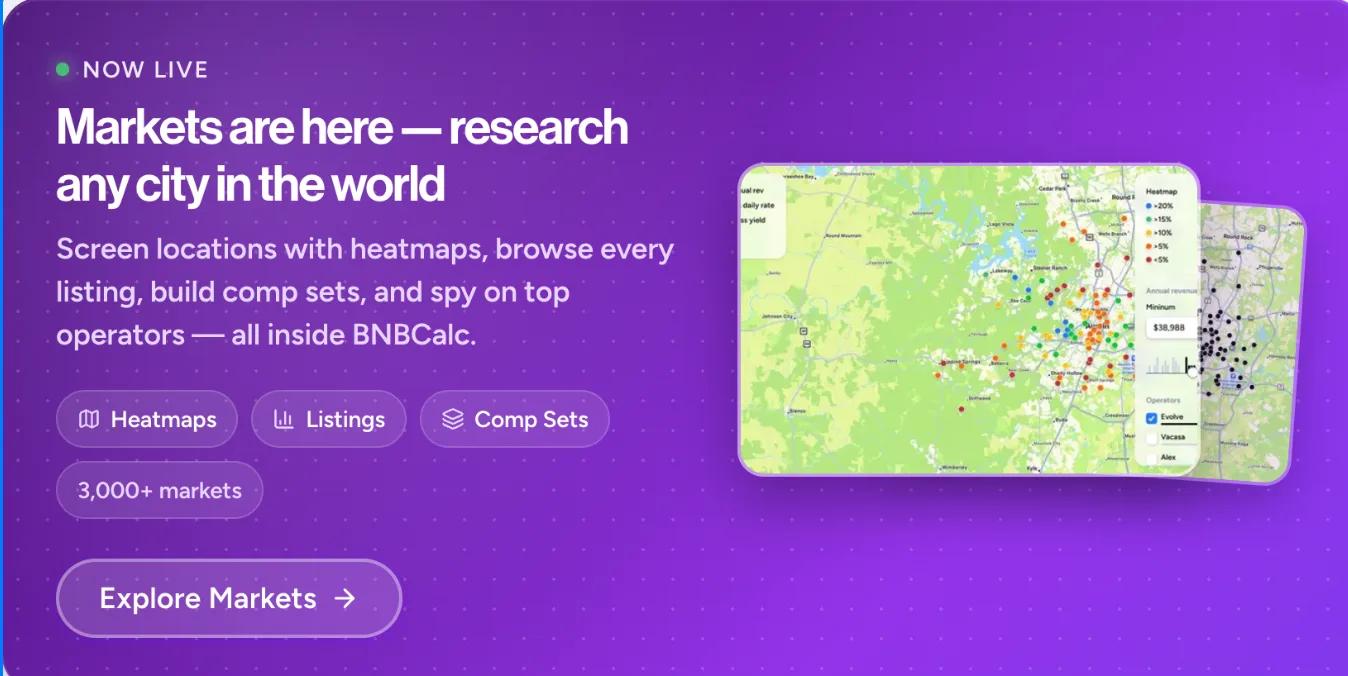
The rebuild took about 18 months, though the second half of this conversation is the part you can act on. Andrew won't make a macro call. Every decision in this space is local, he says, so pull the numbers for your own market before you trust anyone's forecast. BNBCalc's market data is one place to start.
Key Points
- Lyric went from an idea to 800 doors in about four years, three and a half years, across 14 markets and "24 or 26 buildings, I can't remember", on about $100 million raised.
- At the end of January 2020, a board member told the team to model revenue dropping 95% for the next 12 months. They laughed it off. An OTA had been sitting in that boardroom sharing numbers, and once China and Italy got hit, OTAs were seeing booking volume dropped by 99%.
- The company was burning five, six mil a month when COVID hit, and revenue on the public-facing software dropped about 80% too. Lyric moved out of all its leases and laid off 92% of the company over Zoom, leaving 12 people.
- Andrew says he cried once through the whole thing, and it was over the board giving guidance to take as good care of the laid-off team as was legally possible. He won't name that board member on air, since he still works with him today.
- The rebuild ran about 18 months. Eleven months to build and launch the professional version of their revenue management platform, then growth to a little less than 2 million in revenue before an existing investor agreed to restructure, in what Andrew calls effectively a massive down round.
- Winning the industry's Data and Revenue Management Award about six months after launch didn't mean product market fit. Operators told him "congrats on your award, I don't want what you're selling", and he thinks real fit landed another 12 months after that, once his team built what those operators kept asking for.
- Andrew declined to give a macro read in 2024. He'd only say markets were booking a little bit slower with lead times down, and that you should go look at actual data for your own market instead, because every decision in this space is local.
Full Transcript
Listen to the full episode on Apple Podcasts, Spotify, or YouTube.
Andrew: ...in equity we had raised, so we had to restructure that cap table to basically get our business back. So we only did that once Wheelhouse started to take off again and grow. Because Wheelhouse was a public-facing software at the time, revenue off of that dropped about 80% initially as well. So we're like, dmn, is the short-term rental space just fcked for three years, two years, if so?
But because vacation rentals bounced back, demand for our software grew. The weak part of the software market, in our opinion, was property managers and enterprise weren't served well by PriceLabs or Beyond. So we attacked that and got just enough revenue to justify to investors to restructure the business. And we did that. But yeah, I haven't been back here for four years since COVID hit to even see New York or see the hospitality scene here.
Jeremy: That's crazy, because I didn't know that side of you, but it sounds like...
Andrew: Oh, it's a really fun era. We've got some juice over there.
Jeremy: Okay, so how long did things take to bounce back, sort of at first? I'm curious. I know you said you looked at it and you said, all right, Katrina never bounced back. We think things are going to take a while here. We're burning six mil a month. How long did, because things did bounce back, right?
Andrew: Well, they bounced back in vacation rental markets. So basically...
Jeremy: But not urban markets.
Andrew: Not urban markets, right. And we were a corporate travel brand, so business travel took longer to return. I think business travel just this past year got back to pre-COVID levels. And I think leisure markets are about the same when you look overall.
But what happened, the unexpected kind of shift that happened during COVID, was a huge amount of demand started going to vacation rental markets.
Jeremy: Like more rural markets.
Andrew: Rural markets. Families wanted to get together, so bigger places were selling really well. And then travel to Europe basically fell off the cliff from the American consumers. So that finally bounced back in the last two years.
Jeremy: I got lucky and you got dislucky, because I was completely rural. Like rural, lake, like on the water.
Andrew: Fantastic.
Jeremy: Tranquil, like mental health, get out of your house, nature experience. So 2021, 2022, and a little bit 2023 were great.
Andrew: And it also was interesting. The question was, for you all, for people who have vacation rental properties, is like, okay, well, did enough new consumers get exposed to your properties that now buying patterns will shift towards short-term rentals as opposed to hotels? Which seems to be persisting a little bit.
But yeah, urban area got totally, I mean, big time in trouble. And when you look at New York, what makes it difficult to talk about a bounce back is since COVID, Airbnbs have become illegal in New York City. So there's no true comparison you can look at.
Jeremy: Unless you have like hotel zoning.
Andrew: Yeah. So if you have a hotel, right.
Jeremy: If you have a hotel license. So that building you were in.
Andrew: Had a hotel license. Yeah, so it would have been okay. So it operates still today, but I don't know the occupancy numbers anymore.
Jeremy: They don't use Wheelhouse?
Andrew: They're pure hotel co.
Jeremy: I know, right? I was going to say, those bastards.
Andrew: It's a friend who took it over, so I...
Jeremy: I was going to say, that's a silver lining. It would be awesome.
Andrew: Wheelhouse, they use more, all their properties are more of hotels. So we have talked about a potential transition. But Wheelhouse today really serves distributed single family portfolios much better than we do a hotel stack.
Jeremy: So let's go all the way back.
Andrew: Sure.
Jeremy: So I think we had Jeff, I'm going to butcher his last name.
Andrew: Iloulian. Oh yeah, HostGPO.
Jeremy: Yes. He was sitting in the hot seat where you were, a few weeks ago. But he talked about how he was initially an operator, and he did a similar model to, looks like a smaller scale, but big corporate lease arbitrage model. He did it in Los Angeles. Los Angeles cracked down. He also, I mean, turns out he was a serial entrepreneur doing a bunch of things. But one of the ideas or things he had was HostGPO. And when times got tough, he put all of his attention and his eggs into HostGPO, which it seems like you have a very similar parallel to Jeff.
Andrew: 100%. Jeff's a great guy.
Jeremy: That's awesome.
Andrew: I didn't realize he'd been in the hot seat recently.
So if you want to go all the way back, my first exposure to the short-term rental, vacation rental market, which needs a better name...
Jeremy: Where are you from?
Andrew: From Seattle.
Jeremy: From Seattle.
Andrew: Moved to San Francisco 17 years ago. Didn't really know what startups were until I got there. Then this crazy thing called Airbnb launched about 18 months after I arrived, and the rest is history.
And by that, I mean I got brought in 12 years ago, roughly today, to start a company that was called Beyond Stays and became Beyond Pricing. So I got brought in to the CEO of now our team's biggest competitor. Built that business for about a year and ended up getting into a little, well, into a dispute with the other co-founders that had been brought in as well, and ended up taking the data science team, leaving Beyond and founding what became Wheelhouse and Lyric, our operating company, at the same time.
Lyric eventually, it was basically, when you think about Wheelhouse plus Lyric, the vision was, could you take data to not only improve pricing but eventually select better assets? I don't know. Maybe that resonates with you a little bit.
And we also thought, especially when you looked at urban hospitality, Lyric was leasing apartments to put on the short-term rental market. An apartment isn't really designed for a perfect hospitality experience. It's just not. It's big. You have a big fridge. It's just under-optimized. So Lyric's eventual vision was, could we use Wheelhouse to be a data source that eventually not only told us what to buy but how to design it, how it should look, impact everything from the design of a building to the merchandising of that asset?
So that was the bigger goal we took on. We raised about $100 million around that vision. And when COVID hit, we lost it all. So that's a very accelerated version of being an operator who got our team, unfortunately, got handed. We got dealt a pretty tough card with COVID coming. We definitely didn't expect that, and pivoted fully to software and have been there ever since. But have done multiple software plays, multiple operations plays within the category.
Jeremy: So tell me how, it seems like, so you had, you said 17 locations across the U.S.?
Andrew: We had 24. Yeah, we were in 14 markets, 24 or 26 buildings. I can't remember. It's been a little while now.
Jeremy: So that was a big operation. I can only imagine. How many doors was that, or units?
Andrew: 800 doors.
Jeremy: 800. So you were, and you said, yeah, you were burning five, six mil a month. So you had...
Andrew: When COVID hit.
Jeremy: Yeah. So that was a large rent, like liability. So I would imagine you were doing a lot of volume on the revenue side as well.
Andrew: We were. I mean, we had not figured out everything for sure, right? We were basically, Lyric had gone from an idea to 26 buildings, 800 doors in about four years, three and a half years. Now that was with the CEO who had never built a hospitality company before, and we were doing that. We were building technology. So we were building a PMS. We had our RMS.
In retrospect, it looks a little bit like hubris. The reality is Lyric was being built in a capital environment that's very different than today, where you had people who were making bets that you could basically use technology to scale operating companies faster than ever before. We were in the WeWork era, right? So it wasn't hubris to us. In fact, we were really excited about building. We thought there was kind of a unique moment in the history of hospitality.
Jeremy: Kind of the Sonder, Vacasa era.
Andrew: Yeah, we were biggest competitor with Sonder, right? Vacasa was doing vacation rental homes management, and Sonder and us were both scaling on the lease model. And the lease model is great if you want to scale fast. It is not great if there's a sudden market downturn where you carry all the exposure.
And we and other investors were willing to make a bet that you could grow fast enough that you could become a true corporate travel brand. So for example, a true corporate travel brand in our mind had to have a New York City presence. Otherwise, who are you kidding? You're not corporate travel in America, right?
So we definitely paid to move into great assets with the goal that eventually you'd be able to use the technology to cut the traditional operating costs of a hospitality asset, use the data to better select and better optimize assets, and take this moment in time where hotel rooms were looking kind of boring and create a new brand that resonated with customers that could bring people to location. So you basically leverage a brand and technology play to do an end around on very well-run companies, which are Marriott and Hilton and others. So that was the bet we all made. And we did not get to see it, partially due to COVID.
Jeremy: So COVID hit. I can only imagine. So like you said, in four years, you've gone from zilch to a hundred listings. And then all of a sudden one day, I know it kind of transpired over a couple of weeks.
Andrew: Yeah. We started hearing the rumblings. Oh, something's going on in Asia. Then, oh wait, something's going on in New York was the first spot.
Jeremy: I remember how I feel at that time. I could only imagine how you were feeling. Take us, put us in your shoes.
Andrew: So I'll probably never forget many moments in the, hey, this COVID thing is real, the timeline that eventually resulted in us moving out of all of our leases and laying off 92% of the company before trying to rebuild.
But what was really wild is kind of at the end of January of 2020, we presented a board meeting, and a board member in that meeting said, you all need to run a downside scenario where your revenue drops 95% for the next 12 months and figure out how you're going to survive. So that board member was way ahead of the curve, [inaudible] and a revolutionary. And we kind of laughed and said like, we don't need to run the numbers. How would that happen? Like that's just obvious, right? Like a nuclear bomb hits. Like what's going to make that happen?
We were in conversations with OTAs at the time about some deals that would have been actually very additive to Lyric's vision. So we were about to exit the lease model. We had another a hundred million dollars in capital. We were lining up to buy assets. I mean, we even thought till the end of February, I thought we were going to sign the largest deal in industry history. And I remember calling my dad and saying, COVID is real, but we're about to sign these deals. We'll be perfectly positioned to survive it, and we're going to buy up the whole industry on the other side. And he said, well, have you signed the deal yet? And I said, no, but we have one of the two signatures required to get the deal done. And he said, well, why don't you call me when the second one hits? And that was February, the last day of February.
Jeremy: And was this to buy an asset?
Andrew: Oh, this was a large capital raise in a deal with an OTA that would have driven their traffic directly to Lyric. So very additive partnership.
Jeremy: Got it.
Andrew: Unclear whether we could have survived even with that.
Jeremy: Sure. But it would have been crazy. It would have been a revolutionary concept, or...
Andrew: We would have taken a different course had the deal hit, almost for sure. That deal fell apart on March 1st, and that OTA said, hey, we'll see you on the other side of COVID. Good luck, right.
What had happened before America got hit was China got hit and Italy got hit. So OTAs were seeing booking volume dropped by 99%. And that's why our board member, because another OTA sat in our boardroom and was telling us some of the numbers here, that's when our board member said, run that downside scenario.
So we knew we were toast. And honestly, there's kind of like, in startups, if you're going to be, for lack of a better term, well, if you're going to be in a tough position, it's better to be in a really, really, really tough position. Because the really tough position we were in, I had teammates coming up to me by kind of the end of February, early March saying, you have to lay us off, and you know it and we know it. And this has been an awesome run, but it's time to pull the plug on what is Lyric and try to rebuild post COVID.
So that's what we did. Very emotional. We were distributed office at that point, because COVID had basically shut down San Francisco. So we laid off 92% of the company over Zoom. And to the other 12 people who remained, we said, we're a software company now, and we might build back an operating co after COVID passes, but we don't know.
Jeremy: Did you cry?
Andrew: I cried once. I cried because our board member did an incredibly nice thing for the people we laid off. And the incredibly nice thing he did was, he basically said, we're not laying... So technically we could have given our teammates very little in severance, and our board gave us the guidance that we could take as good a care of them as was legally possible.
And I called him later that night after we had laid off everyone. And I said, you have never met a single teammate that you just took the best care of that we legally could have. And I just want to say thank you. And as you know, venture capitalists sometimes have the reputation of not caring about folks. And this person took care of our team in a way that was to me so indicative of the character he had, that yes, I definitely cried there. And I was like, thank you so much, because you allowed me to take care of people that I care about. So that was the moment that really got to me, but everything else before that was just, it was so absurd. I didn't even have time to pause and think until that moment.
Jeremy: Wow. Kudos to him. Amazing individual. What's his name? Should we give some love?
Andrew: I would totally name this individual, but it's a board member I am still lucky to work with today. And just because when stuff like that happens, I just actually keep it a little closer to the chest in case there's ever a ramification.
Jeremy: Yeah, totally. Totally. Okay, so we're moving on. So effectively you burned your ships, kept a couple of the ships.
Andrew: Yeah.
Jeremy: You burned practically all of them.
Andrew: Yeah.
Jeremy: However, you gave the folk on the ships time and resources, life, you gave them watercraft to get back to shore and build for themselves, which was great. How did you, with the limited ships you have, how did you, what's the term, like the Phoenix rises from the ashes. How did you rise?
Andrew: It took a little while, because of COVID a bunch of us just sat in our desks and at our rooms for 12 months. And what we needed to do was to grow our software business where the revenue had dropped 80%. We needed to grow that at least back to the point where we could go to investors and say, there's a viable, interesting business here. If we had not achieved that, we would have gone bankrupt, right?
So we kind of held that like, our team at that point knew, holy smokes, we are in a dead sprint to build a product offering that gets enough traction that investors will support recapitalizing this business and reforming it. That took, yeah, I think 18 months.
It took us 11 months to build and launch what we now call Wheelhouse Pro, so professional version of a revenue management platform. And we were aided in that quest or journey because we had operated at 800 doors. We had built Wheelhouse and we had built kind of tools above our pricing tool. We had built our own version of Wheelhouse internally that we're like, if we bring this to market, I think professional operators are going to like it. So we brought V1 of that to market about 11 months later, whatever it was, 10, 11, 12 months later, and started going out the door and bringing it to customers who had a really good response.
But it was only when we got back to, I mean, we were still like a little less than 2 million in revenue when the current investor said, hey, we'll restructure this business, let's go. So that was a number of years ago now, but yeah, we had enough traction. And basically when you restructure a business, you say, hey, we had raised a hundred million dollars in equity. We had to go to those folks and say, hey, we need to reposition this team to have a chance to build a true...
Jeremy: To raise again.
Andrew: Yeah, to raise again. And for our employees all have upside. And we kind of settled on what looked like a down round, effectively a massive down round.
Jeremy: Yeah.
Andrew: Where we restructured the business, where we ended up looking kind of like a Series A company coming out of it. And in that case, I was able to go to all my teammates who had fought and said, hey, we all trusted our investors again, that they would handle this situation well. And they have. They want to keep building it together.
So yeah, it was about 18 months of that uncertainty, but putting trust in the teammates to be very good at development, and in our board who had already taken care of all the team, the teammates we had let go, basically betting again that, should we build an interesting venture, we would find the fair way to handle it. And we did.
So yeah, that was the Phoenix rising. It was a little bit of product work, revenue growth through new motions of B2B software sales, and a trust that the restructure would ultimately result in a business that it made sense for everyone, leadership team, product team included, to continue building.
Jeremy: So when did you find, did you have that aha moment? Like you said, I know you guys were using the tool Wheelhouse internally. I'm sure it wasn't called Wheelhouse, it wasn't branded at that point. What was the point where you're like, I think we have something for others? I know you told me before that you felt that the large property managers or the growing property managers were underserved.
Andrew: Yeah.
Jeremy: When was that point where you're like, oh, we have product market fit here?
Andrew: Well, I was wrong about that too. So having built Beyond Pricing, Wheelhouse really has two main competitors today. We have Beyond Pricing and we have PriceLabs. And what was very interesting to us when COVID hit, we were like, well, we would never have bought either of those softwares. But the question is why, right? Was that just hubris, or was there something behind it?
What was interesting to us at the time was you had these teams making pricing recommendations who had never published any pricing research. And when you looked at their roster of talent, so their employees, none of them were employing advanced like PhD level machine learning, or any folks like statisticians who we thought were the requisite talent. Now, we had that and we had built it and we had analyzed our research for a long time. And so we kind of thought initially that all we had to do is publish our research and everyone would be like, oh my God, this is so clearly the best pricing engine out there.
So our first move was to take what was really a pricing engine and launch that, make all of our data, all of our research public, and also bring two data tools around it. So competitive sets and market reports. And we wanted that. We thought that would kind of suffice, be a better product for any large operator, right? A fully transparent pricing engine where you could look at all the data inputs, being market report and comp set.
So we launched that really at the start of 2021. And that product we called Wheelhouse Pro, which I thought was going to have crazy market fit, and we won an award almost about six months later. We won the Data and Revenue Management Award for innovation and product in the industry. All that eventually taught us was a bunch of folks came up to us and said, congrats on your award, I don't want what you're selling. We actually want to buy a revenue management platform and not a pricing engine.
The difference is pricing engines are kind of set it and forget it. Turn it on, tweak a few knobs and dials. Revenue management looks a lot more like, hey, what's that A/B test you're going to run to optimize your minimum stay policy? Revenue management looks like, hey, I've got 150 doors. I'm not going to fully trust a pricing engine, but I need a way to be able to quickly analyze and edit a strategy. So say I just want to take the next 30 days across 150 properties and drop them 8%. On a tool like Beyond, that action, you'd have to do 150 separate actions to make that take place. If we could just unify into one call, we could make the platform 150 times faster.
So what Wheelhouse focused on when we found product market fit was not just launching a pricing engine, but launching a revenue management platform where the thing our customers bought was a very fast way to build their perfect pricing strategy. And that's when we found product market fit. So we thought we had it. We launched it. We won an award. We hadn't found it. True product market fit came, I think, not for another 12 months after that award, because people told us you're wrong, and we listened to them and built what they needed.
Jeremy: You listened to customers.
Andrew: It only took seven years.
Jeremy: Rule 101 of startups.
Andrew: There's listening to your customers, and then there's hearing your customers, because your customers won't always be able to tell you really what they want. So just continuing to poke at that, like, hey, you said X, we built Y.
Jeremy: They also don't always know what they want, right? Because if no one's built it, then they're not sure what it looks like.
Andrew: Yeah. Sometimes they don't know what technology can deliver, right? They don't know that they can have it 150 times faster. They don't know that a page load speed of 10 seconds is not sufficient and that it should load like that. So those type of things, which sometimes matter to buyers, aren't obvious, especially in our industry where a lot of the property management companies, they're not served by great technologies historically.
So being able to see a technology where all of a sudden they said, this job used to take me 40 hours a week, and now I can do it in two. You just gave someone an entire employee back. Of course, they're going to pay you 20 bucks a month for listening. Right. Like, that's a no brainer.
So yeah, sometimes people don't realize what technology can provide. And so an entrepreneur, you've got to stick to all that, what the customer complains about, what they don't know about, what they might not say, into product market fit. It's a fun journey, right? You do the same thing.
Jeremy: It's easier said than done. Yeah, for sure. I mean, granted, I would say that for me, I needed to grow my portfolio. That was my goal. And for me, I needed outside capital partners on both the equity side as well as the debt side, like buying properties, as well as I needed to convince people that I should manage their properties.
So I had a process that was Excel spreadsheets and PowerPoint presentations that were different for both of those. If I was sending a bank, I would send them a certain spreadsheet and create a certain PowerPoint for them. If I was sending an investor something, I would do the same. So everything was very manual and time intensive. And for myself, if I was analyzing a property, it took me a while. I was copying and pasting information from 15 different places.
So what I did at first was, I'm going to take this process I have that I know is the right process, but it's slow AF. And I know there's a way to make it faster and better, and I'm going to do it. And I hope there's people like me out there, frankly.
Andrew: Yeah. I mean, that's the best. I mean, if you serve yourself first, right? Customer number one is a dream position for an entrepreneur. And I've seen what you built today. It's awesome. It is an informed by usage product that others can now use. And now you made it available everywhere, right? It's a fantastic innovation pattern for sure.
Jeremy: Yeah. And I did have the one thing that I had that was unique to me and in hindsight was beneficial, you could say lucky, was I had started sh*t posting on TikTok back in 2020.
Andrew: Who knew?
Jeremy: Yeah. And people were like, how are you raising money to buy these houses? And I'd go, I've got this spreadsheet over here, and I've got this PowerPoint over here. And people are like, well, can we buy it? And I was like, I mean, it sucks. If you really want, I'll sell you this spreadsheet that I'm not the proudest of it. But sure. And people would buy it. And I was like, oh wow, if people are going to buy this, effectively, A, it's going to give me money to fund what I think is better. But B is some degree of validation that there are people out there who want.
So you built something complex and you really had to, it took a while. But I always recommend to folk, try to sell something as simple as possible. And if you're able to sell that and you have some degree of traction there, then try to build something, APIs, yada, yada, that technically is more difficult.
Andrew: Yeah. But I mean, it's not like hotels are written on or underwritten off anything different. Like they're still underwritten on an Excel spreadsheet and the data inputs are different. And what you recognized was like, hey, could you take a form factor and start to supply the right data around it to help people invest in really a fundamentally new asset class? Right. So like fantastic opportunity for scrappy entrepreneurs to build technology and to leverage like good enough solutions to build a business.
I think it's one of the reasons I love our category so much is because the distributed nature of assets, of like how someone can get in the door, and how are you going to merchandise these assets, and how are you going to sell them across all these new emergent channels? And how are you going to underwrite the asset and figure out where to invest? Like Airbnb going mainstream enabled a whole generation of entrepreneurs to start building solutions for these new folks. So pretty excellent in retrospect.
Jeremy: So I agree. And this is what I say. Like if I were doing commercial real estate, no matter what I did, I don't think there's any way at like 27 years old where I could host like the commercial real estate podcast and actually people listen and be like, oh, this guy has something credible to say. This is such a new industry where young folk, you seem, you got a youthful spirit, so I'm going to call you young.
Andrew: 41.
Jeremy: That's young. I mean, for all sakes and purposes, though, that is young. And most like real estate, probably traditional property management, that's like an old, it's been around hundreds of years.
Andrew: Yeah. Yeah. Well, and technology shifted that game. And look, I mean, when we built Lyric, a hospitality company, I would never say I'm a real estate expert, and I would never say I was a hospitality expert. I mean, Lyric was a premium brand. It was a new sector.
Jeremy: New sector.
Andrew: Yeah. But the advantage we had was technology and trends. So trends were, holy smokes, this new inventory type Airbnb has come along. And all of a sudden hospitality went from selling someone a bed and a television to your porch, pool, patio, Wi-Fi, pickleball court, basketball court, et cetera. And that pickleball court is worth more in the summer than it is when it's covered in snow.
Jeremy: Right. So technology and trends enabled new entrepreneurial ventures to emerge on the commercial side.
Andrew: It's interesting because I actually would say COVID is ultimately going to probably reinvent the commercial. I mean, it already has to some degree reinvented how a lot of commercial spaces are going to be used, in retail. So in some ways, again, it's kind of like, well, what's the new trend, or is there a new technology that gives younger folks an edge over the traditional, the folks who have the huge asset base and all the experience to leverage. The suits.
Jeremy: The suits.
Andrew: And that's where experiential hospitality, you have the edge over the suits. Because the folk, there are a couple of reasons. I would say the folk who want to deploy a hundred million dollars in assets, it is really, really, really hard to deploy that much capital and have an edge in short-term rentals.
It really comes down to being thoughtful about the experience you're creating. The way you can quantify that is pickleball courts, basketball courts, swimming pools, hot tubs. Amenities are the easiest way. But in reality, it's really just actually having a feel and a care for making sure people have a great time, which it's easy to, one property, it's easy to do that. Two properties, it's pretty easy to do that. I do believe 25 or so is where I think it's still relatively easy to do that. When you get to like 100, 200, 300, 500, it is more and more challenging to have that same degree of attention to detail that you do when you have a smaller portfolio. So I do think it's a place where the little guys can win, like the David Goliath, like the David can come out on top.
Jeremy: For me, a 23 year old could grow a business and quit his job in a year, which if there was another way of doing it, I would have done whatever way there was to do it. It was just, frankly, to me, the only way to do it. And I got lucky. I kind of stumbled into it.
But I think you're seeing this play out right now with the Vacasas. They tried to buy up all the property managers, all the boutiques. They scaled from, I mean, do you even know when they started?
Andrew: I don't know. Not the exact year, but probably 2011 ish, 2012 ish, maybe 2013.
Jeremy: But granted, yeah, they went from zero to 40,000 by eating up all the Davids and paying the Davids well.
Andrew: Yeah, the Davids walked out. They were very happy.
Jeremy: The Davids are on a beach right now. They're okay.
Andrew: Yeah. But they did that. And now they're a Goliath and they're struggling because it's hard for them, six employees down the ladder, the one who's actually interfacing with the homeowner or interfacing with the property, to care. Right?
And I think it's one question that's been asked about our industry is like, can folks get to scale in our industry? And with Vacasa, it's interesting because it's such a roll up. Maybe it was harder to consolidate to gain true advantages against locals. In Europe, you do see very large companies that are at that scale and larger who are succeeding.
So I always say that someone in America is going to successfully build that 40, 50 thousand door hospitality company in the short-term rental space. I just think they're your age, and I think they're going to figure out how to use technology and a unified brand and potentially new assets, or potentially assets really, truly built around the use case of a short-term rental. So I think the emergence of that very large door successful hospitality company is going to happen in the next five to 10 years in our space.
Jeremy: And I think what's important there is accentuating the benefits that you get at scale. And it seems like that's what you're told, because, for example, I'm on a lake. When I started, there was three properties on that lake. We were the third one. Now there's 80 lake houses. We are eight of them. So we own four. We manage four.
Our pricing is so much more dialed in than everybody else. If you look at all 80 properties in the market, you stack the revenue, we're like one, two, three, five, 10, 11. And I would say, yeah, sure, part of it is because I'm a pro. I know the tips and tricks and whatnot. But I would also just, like, I have the data. I have eight properties. So if like six of them just got booked, all of a sudden I'm like, oh, these other two here, like, trigger, right? Something's going on here. Time to jack the rates on these ones. So there are times when scale does give you...
Andrew: I would preface that, though, with like scale in a specific area.
Jeremy: Yeah.
Andrew: Multi market opens up new challenges versus like if you can be really dominant in one market or very good in one market. That's kind of a predicate step for attempting a second market, in my opinion. Some folks go distributed right from the start. You're taking the approach, it sounds like, being...
Jeremy: I am distributed for each location. I mean, I do have more than one.
Andrew: Yeah.
Jeremy: Which is a nice advantage. I'm in like five, I'm in five markets. I would say I'm relatively distributed. But at this point, I got a property that I saw last night that's actually close to here. And I'm like, d*mn, it's kind of the perfect property. It's kind of what I'm looking for. But at this point, really hard for me to be like, I'm going to do a new market, just because I already have my vendors. I already have everything. I already have my pricing dialed in.
I know that you have to learn a market, in my opinion. Like you don't just jump in. From a revenue management standpoint, if you're just going to set it and forget it with a software, that's fine. But I actually want to be intimate and understand why. Why the heck is this week this year going crazy? What's going on? Wait, why is it not going crazy?
Actually, I'll give an example. This September on that lake. Traditionally, September is the best month. People go, why? It's a lake. Why is September the best month? Because the Blue Ridge Rock Festival, as well as the national, like, Ferrari racing, are at the Virginia International Racetrack down the road. And it's been there every year in the last three or four years. This year, neither of them are happening.
So what I did was, I'm like, okay, I know the pricing software is telling me I've got to be at $1,000 a night because that's what we hit the last three years. I know these two events aren't happening. The market occupancy is going to go from like 70, 80% this month, I think, to like 30, like 30, 40. September is like an edge and people go back to school. So what I did was I dropped my prices precipitously in advance and I got filled up. I'm doing half the revenue this month that I did last month, which is, this is my first year-over-year monthly decrease I've had in like a long time.
Andrew: It's really good that you haven't had that yet.
Jeremy: Yeah. So it hurts a little bit, but it's because I had that intimate knowledge of the market where it's still a profitable month. It's still fine.
But I'm curious with you, because you're getting, what's your average customer? How many listings do they have, or what's the range you have?
Andrew: Yeah. So our average customer, so we serve folks in 100 countries. We certainly have people with one or two listings. Our average customer has 15 listings. Our largest customer is north of 5,000.
So a couple years ago, Wheelhouse had basically no one with more than 100 properties. I mean, we had a few folks. And I shared that what Wheelhouse wanted to attack after we lost Lyric was serve the needs of these large property managers, large operators. So we have gone from essentially no enterprise business to, I think, something like 80% of our revenue now comes from people with north of 100 properties. So a massive amount of our revenue stream comes from serving the needs of those folks.
So we kind of pick people off of Beyond, and people, when they scale on PriceLabs, they usually come over to Wheelhouse once they reach a certain point. And we really focus on serving the needs of those larger folks. And our average listings per user would be much higher if we hadn't had that long tail of folks who actually were already using Wheelhouse with like one or two properties.
Jeremy: So the folks with 5,000 properties, 100 properties, how do they remain successful at scale? Are those folks growing, shrinking? What are they doing?
Andrew: The large majority, we like working with the large folks because they are still acquisitive right now. So they're acquiring people with 100 plus properties. But at 5,000, they're looking at various markets they can go into and purchase the David, right? And buy scale.
Jeremy: Buy scale often, yeah.
Andrew: And also they're really good at, they'll have acquisition functions that are very effective. So they'll target 100 properties in a market with a flyer or an outreach or whatever it may be.
So the large folks have enough scale where they start to have, I mean, the way I think about it is, revenue management is an extremely boring term for what should be your growth function. Pricing is set and forget it. Revenue management is like, okay, how do you communicate with owners to make sure they stay with you forever? How do you communicate with the owner who's not with you now and say, hey, if you moved over to my property management business, we can increase your revenue by 8, 20, 30 percent? So advanced teams will have someone who is looking at owner acquisition, owner retention, et cetera, to very much outperform folks on the retention and acquisition game. So they're scaling their portfolios.
Jeremy: Got it. So folk with 5,000, folk with 100, what are you seeing with them? Are people getting to 100? I'm curious. I feel like you just have a very good grasp of what's going on.
Andrew: So our listing retention as a platform for enterprise is about 120 percent. And what that means is people stay and grow with us. That's an annualized listing retention. And that's inclusive of, a few folks will leave the platform. So what that's really saying is the customers who stay with us are growing quite a bit, like more than that 120 percent.
Jeremy: Seems like the customers who are using you are also the more on it customers.
Andrew: Yeah, I mean, when we think about serving the needs of our customers, it's not, are we going to help you price a day perfectly? It's, are we going to help you scale your portfolio and eventually exit your business should you want to?
Jeremy: I thought it was really cool when Andrew gave me the demo. I'd never seen anything like it, but you showed me like a topographical 3D view of, I think we looked at like Breckenridge, Colorado or some mountain market, where you were like, yeah, you can actually, if you're in Breckenridge and you're managing 10, 20 properties, do you want your listings to be pulling data from a property on the other side of the mountain that doesn't have access to the ski lifts? No, you want the 50, you want to be able to pick the ones that are within walking distance.
Andrew: Within walking distance of the ski [inaudible]. That is the comp set that you should be comparing yourself to.
Jeremy: Exactly. And even the view of it, I was like, literally, I saw the mountains and it was so cool. I felt like I was flying like a bird.
Andrew: Yeah. I mean, it's kind of funny. A very important aspect of hospitality is combining geographic insights and performance data, right? So you're right. If you were looking at Breckenridge for the first time and you saw two dots that were very close, you might make an assumption that they're very similar. They should have similar performance. But if in between those two dots, one's on the shaded side away from the mountain, that is going to have a significant impact on what you're selling to customers at the end of the day.
And Zillow and other real estate sites have created that ability to discern value really well, in a way that the short-term rental space has not. But we will. And it'll be teams like you and teams like Wheelhouse that probably combine a little bit to deliver that.
Jeremy: Let's go. Let's get it. We're helping folk grow. And I think that's the important thing, is helping people grow their portfolios. That's what you want to be. That's like, I guess, if you think about your mission as a company, to me, that's like BNBCalc. It's like, what is BNBCalc? I mean, frankly, it is a tool for specific use cases, but really it's that mission of folk like myself who wanted to grow and still want to grow, still want to grow. Granted, BNBCalc, the more of y'all who use it, I don't know, the less time I can...
Andrew: You build software.
Jeremy: Yeah.
Andrew: Yeah, yeah. And help everyone build.
Jeremy: Yeah. Yeah, exactly.
Andrew: But I mean, you kind of nailed it earlier too. Like, okay, so when you look at sitting with a property manager or a large operator, you would think about serving the entire financial needs of their business eventually, right? So pricing a night is one thing. Helping retain an owner is another thing. Thinking through merchandising strategies. That's all part of using data to inform a better revenue strategy as opposed to just automated pricing.
And when you mentioned earlier that you had to go to banks and talk to folks about raising capital, it's like, well, do you think a bank is better positioned to understand whether you are a good operator of your business, or would a team like BNBCalc or Wheelhouse? I would argue in time, we'll have a far better signal about whether someone should be in a position to scale their portfolio than Wells Fargo figuring out, should I write you a loan for 5 million bucks so you can go expand?
Jeremy: That's interesting. So financing is something you think is potentially on the horizon.
Andrew: I don't think we'll build it. I think we'll...
Jeremy: Partner. Yeah, you'll partner with the bank and you guys will effectively help underwrite the deal.
Andrew: Yeah, right. Or provide risk profiles.
When you go to the core thesis of Wheelhouse, it's, we think a fundamentally new asset class has and will continue to emerge. And that no traditional, you can't take a hotel model and slap it onto the space, or a long-term rental model and slap it on the space. So with a new asset class should come a new entire financial stack. And we think there are a multitude of outcomes that can be derived by building that.
And our way of getting there is like, well, it's hard to underwrite if you can't price a night well. So we try to be very, very, very good at that one specific thing, expecting it to ladder up to all other financial decisions that a company makes.
Jeremy: But plugging in and being exposed on that per night basis, you have a very good visibility overarching on what's happening. And question for you: what is happening? 2024, you said obviously you've been through all the waves, 2019, 2020, good days, whatever, bad days for cities, good days for rural vacation, pushback to cities, lesser demand, higher supply in rural vacation markets. What's going on today? And then what can we expect from Wheelhouse moving forward?
Andrew: Sweet. So I'll predicate this by, I'm not an economist and my business is not actually coming up with macro definitions. Like Key Data is really good at that. And I rarely am super comfortable talking about macro, but I'll explain why.
Publicly right now, Vacasa is in a very difficult position, hemorrhaging units. Okay, well, there's a lot of private operators with 1000, 5000 units who are snatching up those portfolios now and are putting together large capital raises to go acquire that inventory. So the public perception of Vacasa falling apart is actually a massive opportunity for certain folks.
Jeremy: Trust me, that's literally what folk I work with in our mastermind. I'm not going to say only Vacasa, but big property managers who are underserving their clients are the ripest fruit to pluck from the tree.
Andrew: Right. And then you'll go to markets like, so historically, I'll put on my economist hat for a second, 21, 22, and 22 in particular, were absolutely banner years. And most markets have seen some fall off from those highs. Although the fall off is a little bit determined by like, well, luxury and large properties generally are still selling well.
So when you want to understand like, how's your portfolio doing, you have to be in our category. The challenge is you have to get so d*mn granular and specific to understand performance. So when you were saying that Wheelhouse has a new tool, we call it Navigator, that helps you draw a boundary around like just properties that are near a ski resort. Well, certain ski resorts did really well last year, and certain ones that didn't get snow, guess what? They didn't do well. So there's like, I actually think macro trends...
Jeremy: So I'm scared of the Poconos a little bit.
Andrew: Yeah.
Jeremy: So like 20 years from now, is there still going to be snow on those hills? I don't know, right?
Andrew: I know, right? But then it's like, okay, well, maybe snow making equipment will get better. Who knows what's going to happen, right?
So I always think, I don't read enough about trends everywhere to know generally what's happening. I know our customer base is expanding at a good clip, about as fast as they ever have. So I think that's obviously a signal that I'll take. But I think the risk of sharing a macro strategy is it causes someone to make a bad business decision, when I think in our space, every decision is local.
Jeremy: It's all local.
Andrew: Right. So I'll say generally markets are booking a little bit slower. Lead times have decreased for sure. In your case, your case listeners, it's probably going to be really different. So to understand what business decision you should make from anything I share, go look at actual data for your market. Too bland of an answer?
Jeremy: No, that's right. And I think that, I mean, there's so much freaking nuance in this game. Like if you even were sitting in New York City, New York City went from 17,000, 18,000 listings down to like four or 5,000. All right, is the end of the world coming? No. Operators in Newark, New Jersey, Jersey City are absolutely caking right now. Right. Also hotels are kicking, but that's a story for another day.
Andrew: There's all that nuance that you kind of named, how events do shift around and that changes an impact on a month. But there are larger trends of, like, where are people traveling to, that are always fluctuating.
And our space is so exceptional because most people know their local business really well, their local community really well. And when you think about it, it's all entrepreneurs. All the portfolios are run by entrepreneurs, not by suits, which meant when COVID hit, people had health policies out the door in a week saying, hey, here's how we're cleaning our homes now with COVID, come and stay with us. Here's how our pet policy changed during COVID, because it makes sense to leave your pet at the vet for two days, but not for 14. So when longer stay patterns emerged, our space adapted with very fast pet policies, right?
So this all to say that our space is so reactive. Our entrepreneurs are so reactive. The data is so specific. Like for me to tell you what you should invest in next, I need to see how travel trends have changed. Are more groups coming to your market? Are more corporate travelers coming to your market? If so, what are they buying? Like electric charging is looking like a good investment from an amenity perspective, and five years ago that wasn't the case, right? So there's just all this fluidity and nuance that makes me, even if I spent all my day reading about broad trends, I don't know that I would communicate it without a massive number of caveats. So that's what I do.
Jeremy: Yeah, no, I appreciate you doing that versus just being a hype beast. I think people are, greatest time ever.
And I think it's also a cool space because you can have very specific, tangible bets. For example, when I started, 2020, 21, the four properties that we have that we bought are on a specific lake. And the rationale for that was a couple of things. One, from an appreciation standpoint, they're not building new lakes. So I think things are only going to go up in value, supply and scarcity. I call it natural scarcity. This is something you can't rebuild.
From an actual rental revenue standpoint, I do think we have like a crazy COVID boom right now, and it's going to wane off to an extent for these rural areas. But they're building a Caesars Palace down the road. And it just makes sense to me that if you're going to go to... So in Virginia, they allowed six casinos to be built. And we're in North Carolina, the lake's on the northern tip. And then right across the border is Danville, Virginia, which is old, a town that was struggling economically. So they allowed them to have a casino. Caesars came in, billion-dollar casino. And I'm just like, okay, you're going to tell me that you wouldn't want to just go to the lake for a weekend and then rip the casino, rip a Caesars at night?
Andrew: Or win, win and come...
Jeremy: Yeah.
Andrew: You can't stay longer, right?
Jeremy: Yeah. Lose all your money and then need to go be on the water in order to save yourself mentally.
So that was a bet, but it was like a tangible bet based off specific things. So if you look at the entire macro and your strategy is dependent on the world, you're not doing yourself service. You need to really think about, all right, how am I going to position myself within this new growing emerging field? What do I have conviction on? For me, it was, all right, large houses. I don't want to compete with hotels. Frankly, the properties in our portfolio that have competed with hotels are the ones that have had the most issues.
I ended three leases. I only had three apartments. I guess I have four apartments, but one of them is on top of a four-bedroom unit, so together it equals a six-bedroom house. I had three apartments and we ended our lease. I do some rental arbitrage, co-hosting, and then I also buy... Sorry. So even within that game, I also do glamping. So even within short-term rentals, there's nuance on the different strategies that you can do.
Right now is a great time for co-hosting because these Davids are not providing the service they need to provide. So there's tons of opportunity. However, for arbitrage, the small apartment arbitrage game is getting tougher because there's so much new supply of multifamily inventory in the United States. There were so many buildings, four-story. If I'm in the South, I can literally drive around and I see all these boring looking four-story buildings.
Andrew: Mostly in Nashville.
Jeremy: Yeah, exactly. In North Carolina, you see them everywhere too. And those three apartments I had, 16 apartments down the road got completed, renovated, and someone is arbitraging every single one of those units. So there's new supply of multifamily, but there's not as much new supply of single family. There's so much freaking nuance here. We could go all day.
Andrew: Yeah. But what I think is interesting, so you mentioned like, okay, what macro can you bet on, or what macro maybe is interesting? So let's think about how unoptimized our space is right now.
For example, we're in New York right now. And tomorrow, one of TikTok's representatives is coming to speak about how TikTok is very interested in vacation rentals and people listing their vacation rentals on TikTok. And you have a very new, interesting distribution channel, which is you have 100,000 plus Instagram followers, right? And there's these new distribution channels that are emerging.
When you think about merchandising in our space, well, for one of your places that has a pickleball court, for a family, you might want to show the pickleball court. But if you knew the person looking at your property was a business traveler, you'd probably want to show them the desk that they can work at, looking out over a beautiful spot. So merchandising is super nuanced or super early in our space, basically underdeveloped, completely undeveloped, even though a new asset class has emerged.
When you look at other technology trends that are bigger, I think distributed inventory is going to be in. And partly, I'll go to the absurd right now, but I live in San Francisco and about 10% of the cars on the road right now are self-driving cars. And that technology is not 10 years away anymore, it's five. Oh, and there's about 50% electric.
So all of those trends, like, well, when self-driving cars are available, do we think people are going to travel more or less? More is the answer, right? So does that mean that distributed inventory is more likely to be in? I would say yes, because all of a sudden you can safely drive a family member out to a particular location, or you can drive and work. Like all of these trends, productivity increases because instead of driving, you're spending your time doing work on the road, and work from anywhere. And Starlink's incredible, right? Starlink is making rural America incredibly accessible from a work perspective. So all of these technologies are playing into, I would argue, the start of distributed hospitality being the dominant accommodations offering.
So that's the macro trend I can trust, which is just technology. What is the curve of technology look like? What's inevitable about adoption? Like, I think electric cars are inevitable at this point. I think self-driving cars are inevitable. And can you think about opportunities that emerge from those trends, where maybe you can have a large amenity rich offering that all of a sudden it doesn't take someone an hour to get to, it takes them one work meeting when they're working anyway? And that's the stuff that's like, oh, we're still in the early innings of how this asset class emerges.
Jeremy: Yeah. I liked your point earlier about TikTok, because, so Kyle, whose episode should have dropped before this one, maybe one or two weeks before, Kyle does massive Barndominiums in the Midwest. A large part of his distribution is through social media. And I've been trying to help him on a revenue management strategy. And we're just like, it's so hard to price this thing because it's such a unique offering.
And if the traffic is coming from social media, it makes sense to double down on the social media and then use that. Oh, if we have a viral post and all of a sudden 20, 30% of our calendar fills up, okay, we need to increase pricing. That's the triggers. So that trigger isn't even, an Airbnb down the road got booked, we need to increase our pricing. It's, oh, we had a viral TikTok.
So I think we can both agree that there's just so much exciting new stuff, which creates a lot of opportunity, but you have to be willing to roll with the punches. Explore them, find what works for you and roll with them.
Andrew: A hundred percent.
Jeremy: Beautiful. So if folk are trying to see how you roll with the punches and are exploring, how can they stay up to date with your journey?
Andrew: Well, Wheelhouse, we're on all social, but sadly I post the most on LinkedIn and then Twitter next. For the journey, I mean, first of all, if we can be helpful to anyone, like I always love talking to entrepreneurs or people scaling portfolios, I'm available at [email protected] or message me on any platform where I'm out there.
Our company, Wheelhouse, yeah, we serve folks with one listing and 5,000, and we're happy to help. If we can help you scale your portfolio to achieve your goals, that's where we'll be available. And otherwise we go to a lot of conferences, we hang out with a lot of folks and always happy to say hello.
Jeremy: Beautiful. Well, thank you so much for physically coming here today, Andrew. Super fun. And everybody stay tuned to the next episode of the Short-Term Rental Pros Podcast.
Airbnb Tax Deduction Calculator
Paying too much in taxes? We have the perfect solution. Simulate an Airbnb home purchase below.
Purchase Price
$450K
Structure Value
70%
Apply Trump's Tax Cut (Bonus Depreciation)
Depreciation
$117,695
Interest
$21,600
Tax
$6,750
Year 1 Deduction
$146,045
Want to claim this deduction? Get a free cost segregation benefit analysis from CSA Partners — no obligation.
Get Full Analysis