Free instant analysis
Reveal Airbnb revenue for any address or city
Quick Summary
Brian's idea started with comps. He'd watched one houseboat in Annapolis pull $500 a night on Airbnb, so he scraped every other houseboat listing he could find, then went looking for partners who could raise the capital.
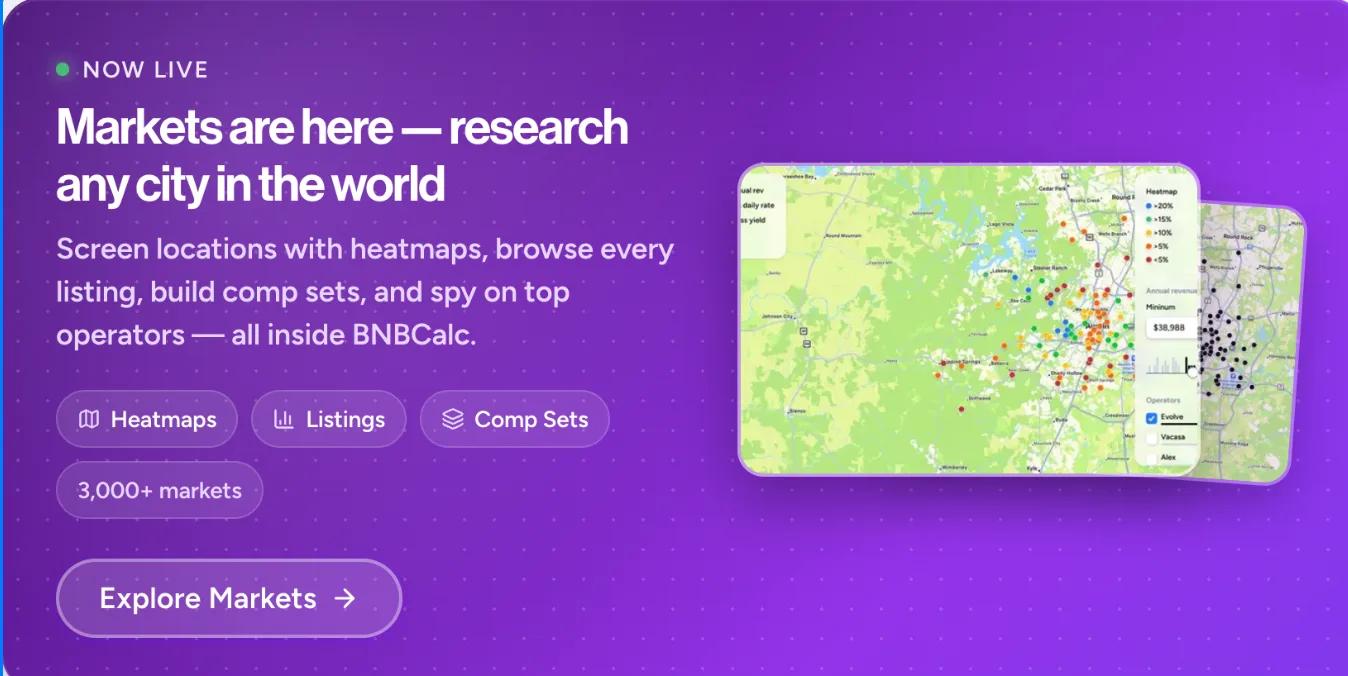
Everything after that is the unglamorous half. Marina slip rent, blackwater pump outs, mini splits and spray foam, and a legal bill higher than he'd planned for, since he had to go city by city and argue that the short term rental rules didn't apply to a boat. His comps instinct is the part worth borrowing though, and BNBCalc Markets does that same job for houses on land.
Key Points
- The whole idea came from one houseboat already listed on Airbnb in Annapolis, pulling $500 a night and close to booked out with no real amenities and no rooftop. Brian scraped every other houseboat listing he could find before he tried to build anything.
- Ready to rent Flow Homes ran $215,000 to $475,000 at the time of this conversation, and that price covers the unit plus furnishing, shipping and launch. Four models, from a 30 by 14 suite up to the one and two bedroom units at 53 by 16.
- The bigger boats listed at five, $600 a night, though Brian says plenty of guests end up paying seven to 800 once they add a romance package, a private chef, a masseuse or a yoga teacher. Flow Home takes a spiff for connecting guests to those providers.
- Baltimore licensed Flow Home as a hotel, so it pays hotel tax and faces no cap on how many boats it can place in the city. Annapolis went the other way early on and the company moved its first boat out, which Brian calls one of the model's biggest advantages, since the asset can float away from a bad jurisdiction.
- Over 70% of bookings came direct through the website, with Airbnb at 18 to 20% and VRBO and Google splitting the rest. Instagram went from 30,000 to 70,000 followers in under two months off a couple of viral videos, and Brian ties that straight to bookings.
- Most of the demand is local. People who already live in the area book a staycation or a special occasion, which is why the company chases urban waterfronts instead of vacation towns. In 2024 Brian said the fleet had been hovering around 85 to 90% occupancy since March, with five Flow Homes open, a sixth nearly ready and two more being built.
- Flow Home builds the boats itself because no US manufacturer could produce them at the volume it needed, and production is where the growth gets stuck. A sales form put out in January drew over 500 inquiries with more than 100 vetted as qualified buyers, and at the time of taping the seed round stood at $2.1 million of a $2.5 million target.
Full Transcript
Listen to the full episode on Apple Podcasts, Spotify, or YouTube.
Jeremy: We are live with the Short-Term Rental Pros Podcast, and today I'm here with my guy Brian, who I needed to reach out to because his business incorporates two of my favorite things. One of those being hospitality, short-term rentals, and the second being boats. I do boat rentals, but you don't sleep on the boat. You go on it for the day and you bring it back, or maybe you're staying at an Airbnb you sleep at overnight.
Brian, his company is, we were joking about this before we hopped on, I was like, is it a boathouse or a houseboat? What are they called? He corrected me, and I'm going to let him explain what it is, because it is one of the most unique short-term rental models that I think I've seen to this point. So super excited to get into your story, and thank you so much for coming today, Brian.
Brian: Yeah, I appreciate it. I've been in stealth mode the last year or so, but now that we have our first fleet and this is our first full booking season, we've been gaining a lot of traction and a lot of attention. So I felt like it was a good time to come out and tell everyone what we're up to.
Jeremy: Deservingly so. And everybody, you listen to today, y'all are hearing it first, because Brian, he's been building. He hasn't been talking. So Brian, fill us in, man. How did you get into floating hotels?
Brian: Yeah, it's a really awesome story, because it's all interconnected in just my personal life. I grew up in the Eastern Shore of Maryland, grew up on the river wakeboarding, and then as soon as I got my driver's license, started heading to the beach surfing.
And then I was really fortunate to be able to go to college at the University of Hawaii at Manoa, which was an amazing experience in so many ways. But while I was out there, after the fourth year, I wasn't really burnt out from surfing, but was interested in doing something new. And in Hawaii, outrigger canoe paddling is like the state sport, similar to how we treat football and the major sports here in the US. And I just walked down to the local canoe club and joined. And the first session I got in the canoe, I was hooked to what turned into a life of paddling, which I still do today.
Long story short, from a personal journey, I was adopted as a newborn and actually reached out and found my birth parents after I graduated college, which inspired me to leave Hawaii. A lot of people ask, why would you ever leave Hawaii? That's the reason. And moved to Annapolis, Maryland. I moved here in 2012.
And when I was here, I was kind of figuring out what I wanted to do in life, meeting my new families. And then I got the entrepreneurship bug. At the time, I started paddling competitively and stand-up paddleboarding and started racing around the country, did some international races. And then I was like, man, it'd be really cool to start my own business. Had no idea how to start a business. It was basically like Googling how to write a business plan.
But a lot of things came together. There's a historic marina in downtown Annapolis that a guy had just bought and wanted to redevelop. So he thought it was a good idea of me coming on board and opening up this little paddle business, because he wanted some more activity in the marina. Little did he know what he was in for. But it was myself and two of my friends, and we took a hundred-year-old building and created a thriving paddle community. The company is called Capital SUP.
And what we really did, and how it relates to Flow Home, is that in Annapolis, really the only way to get on the water was if you owned a boat or took one of the boat tours. So it was really a small demographic of people. And what we did is for less than $30, you could paddle around downtown Annapolis and see the historic city the best way you can, which is on the water.
And so we blew the company up. A lot of our business was just purely rentals, but we were nationally known for all the crazy experiences that we did. Floating stand-up paddleboard yoga, LED night tours, yappy hours where kids bring their dogs out. I mean, any creative idea, we would do it. And so that really inspired me to be like, man, I could build a business, a career around building business around the water.
From Capital SUP, I then started a nonprofit called Live Water Foundation. I've always been really focused on giving back. And so we created Live Water to create paddle programs for local veterans, underserved youth, and clean water activation. And through that process, I ended up selling Capital SUP to my partners. It was a seasonal business. It was three of us. We started as friends. I always call that experience going to get my MBA, because I left that with just ultimate confidence and be like, man, I can really do anything if I put my mind to it.
And we were really fortunate enough to be living at the marina as well, with me and my now wife and my partners. We kind of had our own little reality TV show at the house. But we ended up having to move. And I was like, man, I really want to still live on or near the water. I've been able to my whole life. And we couldn't afford a place in Annapolis. And so my wife was really into floating homes, I mean, I'm sorry, tiny homes. I was [inaudible] related to water.
And so I was paddling one day and found this houseboat in downtown Annapolis on Back Creek. I was like, oh, that looks kind of cool. And so I just paddled up and I was like, I'm going to go knock on the door and see who lives there, and ended up doing that. And it was a pretty old houseboat from the outside. But when I walked inside, they had redesigned it and rebuilt it to look like a home. And when I walked in and saw the living room with the floor to ceiling windows and the dining table and the modern kitchen, just a light bulb went off in my head. And I was like, wow, I can really live like this.
And I actually was really inspired to be like, hey, I actually want to see if I could buy this boat. And I convinced the owners to try to sell it to me. And through that, I went through a personal journey of learning about the limitations when it comes to houseboats and how it's hard to actually buy them because of financing and all the rest. And so I ended up not purchasing the houseboat. But the idea always stuck with me.
Fast forward two years later, three years later, COVID. COVID hits, I'm just sitting around like everyone else, just figuring out what the heck's going on. Like, what are we doing in our lives? And I just kind of really just spent a lot of time thinking about really what I want to do in life.
And there was actually a houseboat in Annapolis that was on Airbnb that was being rented out. And when I say houseboat, it is a registered houseboat, but it looks more like a floating home, because there's some differences in this type of houseboats. But I was watching on Airbnb and it was getting 500 bucks a night. And it really wasn't designed that well. It didn't really have any amenities. It didn't even have a rooftop. And I was like, this is kind of crazy, but they're getting $500 a night and they're pretty much booked out. So that's when I was like, man, there's something here.
And then I started scraping Airbnb and looking at all the other houseboats. And granted, this is during COVID, so everything was inflated. But still, they were getting great ADRs, they're pretty much fully booked out.
So one day my wife and I were just talking and just got inspired. We're like, you know what? There's something here. Let's think of a name. And we were just spitballing names. And we came up with Flow Home and was looking at the domains to see what was available. And Flow Home, [inaudible], F-L-O-H-O-M-E, was taken. So I dropped the E, and then that's how it made Flow Home.
But at that point, it was just an idea. It was still like a long way to go to get it to where it is today. And I knew that because this was so new and really doesn't exist as far as creating a brand behind it, that I needed experienced partners to help me raise capital and really kind of take this idea and make it a real business.
And so through the journey, I was able to meet two very experienced, successful entrepreneurs that have scaled large companies and exited. And so I'm really grateful that they were like, man, this is an amazing idea. I'd love to join with you and help you build this and help do all the things that is required to make it into a company.
And so here we are today with five Flow Homes open. Number six is getting ready. And we have two more being built, and we'll talk about it. But I mean, we have a very high vision in where we want to take this.
Jeremy: And I love that light bulb moment. I mean, there's so much to unpack here. Geez, I'm so curious about so many things here. But I just love how you had that light bulb moment of, I was just on Airbnb and I saw this unique property that was just doing obscenely well. And they weren't even professionals. They didn't have the best photos. They didn't have the best design. And I said, you know, I think I can do this, and I can do this better. And then you acted on it.
Because I think a lot of people, they want to look for like exact, like, X, Y, Z software is going to tell me something's going to do ABC. Like, you just find an example online of a house that's doing really d*mn well and you unpack it. And that's just what you did.
So also, I'm going to take a step back. Professional paddleboarding, what the heck is that? Paddleboarding, like literally racing, like who can [inaudible]?
Brian: Yeah, it was longer. It's kind of funny, because at the time it was like the fastest growing water sport in the world, just because it was so accessible. And right when I really started paddling is really when the professional scene started to take off and it was becoming like a professional sport.
Jeremy: You're an athlete. You're a fake guy. I mean, that's not a sport.
Brian: Well, yeah, I mean, you can paddle without practicing. Yeah, no, it's an amazing workout. That's one of the reasons why I love it. But the sport grew so fast and then it really like went down really fast, too. But so I caught it at like the perfect time.
Actually, it evolved. Water sports more involved in the foiling, which is really where I spend a lot of my time now. So I do a couple disciplines in foiling. If anyone looks at my Instagram account, they'll quickly see. But I do wing foiling, I have an electric hydrofoil, which is like the most fun you can ever have on the water. So I'm all about just having fun.
You know, I think overall, just my secret sauce in this whole company is that Flow Home is a lifestyle. It's not a business. And so there is no failure. This is how I want to personally live, and I'm just building the business to allow me to do it personally. And so there's just so many cool things, so much opportunity that we'll be able to do. But it all comes back to shifting society to have more of like an on water, like living lifestyle experience, so that all the water sports, the Flow Home, and whatever boat rentals or whatever else we can create, to create this more water centric way of life.
Jeremy: Yeah, I love that. And I love, Brian, we were talking about earlier that we definitely have some parallels in our backgrounds and our entrepreneurial journey. For me, the boat rental business, that was definitely my MBA. I mean, I'd worked in companies and startups, but largely with like doing my role. You know, I played a role in the company. But even if the role was wearing multiple hats, there were different team members. Where the boats were like, I'm responsible for everything. Like startup, the website, how do we get customers in the door, to talking to customers on the phone, to figuring out how to take payment from the customers, to figuring out insurance, to making sure that we have repeat customers. And we actually got the boats. Like all the logistics, it was everything.
And like, I feel like once you're able to do that, then it's like, well, I can do anything. And I feel like boat rentals or paddleboard rentals, I mean, it's a pretty logistically intensive business.
So yeah, tell me, start with the paddleboards. Like, walk me through kind of the logistics, the operations you had there, and then how you translated that into, you know, I want to get into the inner workings of what you're doing now. But I would love to see how your mindset and how going from a paddleboards business gave you insights that you then utilized for the new endeavor.
Brian: Yeah, it's interesting, because it's pretty similar. When I started paddleboarding and started Flow Home, in the paddleboarding business, Capital SUP, it was just, and I'm sure you're familiar with it, anyone in the water sports kind of rental world, but FareHarbor, the software system, they had just started and basically was like a lifesaver as far as the business, because we were working off spreadsheets. And then when they came about, we transitioned everything online. Like FareHarbor, there's Peek Pro.
Jeremy: Yeah, yeah, yeah, there's a couple of them.
Brian: But it just, that was like a huge difference in the business, just from a time saver and getting, you know, and creating the operations from getting someone to book to showing up. So that was one big part.
But really, the other bigger part, more important part, and also relates to Flow Home, is social media. Like Instagram, Facebook was out there. And it was really, they had just started ads. And I just immediately was like, our businesses are so visual, like, you have to visually see what it is to capture that person to come experience themselves. And so I wasn't even like a photographer or videographer, I just was like, these are tools I need to learn as fast as possible, because I'm going to be able to leverage that content and push it through social to get people to come and experience Capital SUP.
And so I started creating all the content, I started learning how to use ads, and that [inaudible] of content and leveraging social media ads was huge early on, like getting people exposed to the business. And still today, and I'm always into it with Flow Home, I'm a huge believer in social media, from a marketing standpoint, and it's been a huge success both with my former company Capital SUP, and also today with Flow Home.
Jeremy: Okay, so Capital SUP really gave you that groundwork. And I know you touched on this earlier, the financing for boats, which I want to get into. But correct me, I mean, at least my interpretation of this is, it was kind of the low risk business, so to speak. An SUP, a stand up paddleboard, is what, if you're getting a nice one, maybe 1000 bucks. And that's like a very, I don't know the ones you are buying. But I buy, like for my properties, like the ones that you get from like Sam's Club, Costco, that are pretty much, I'm trying to think of the material. But yeah, they definitely break, we definitely have to replace them. But it is, it's all par for course.
But then with that, you're like, all right, now I'm comfortable, I've seen, I'm gonna go knock on this houseboat, which I think is hilarious. What, you roll up on a paddleboard, and then walk onto the houseboat?
Brian: I did. No, everyone's cool. People are friendly on the water. You know, you drive past someone on the boat, you wave, they wave back. You drive past them in a car, you wave.
Jeremy: At least in New York City, they're definitely not that friendly. So yeah, tell me, what is an investment in a houseboat? Like, what does that look like? How much do these things cost? What is the financing for them? Is it possible? Is it not possible?
Brian: Yeah, so from a cost standpoint, I can tell you what our models run for. So we have four models that we're building, from like a 30 by 14 suite all the way up to what we call our SELUX models, which are one bedroom, two bedroom, they're 53 by 16.
Now when I talk about pricing, because we're renting these out, we're beginning the process of people buying Flow Homes and putting them back into our rental business. So the price I'm talking about is a ready to rent price, which includes the cost of the Flow Home, but also furnishing it, shipping and launch and all that. So from a range, our ranges are anywhere from $215,000 to $475,000 for the big ones.
Jeremy: Oh, wow. But just to unpack this model, how many of them are there currently? And do you own any, all of them? Or have you been partnering with private money, so to speak, for each one?
Brian: Yeah, so I kind of just jumped ahead on where we're actually at with the ranges. So as of today, we own all the Flow Homes ourselves. I would love, maybe one day I'll break down the actual true costs of them, but I don't want to give up that information yet. But yeah, so we own all of them today. And that was really our initial plan, was to build and own as many of these as we can.
But due to the success of the business, and just the amazing experience we've created for people, I just started getting so many inquiries from people like, how do I own one of these? Like, this is amazing. And I was like, how do I own one of these? I want to know.
So yeah, I was like, all right, well, I was talking to the team, I was like, let's create a sales form and just put it out there and just see what the interest is. And I mean, as of today, we launched it in January, we have over 500 inquiries, we've vetted at least over 100 of them of like qualified buyers. There's a lot to meet the demand, like, we're not there yet. It's still part of the learning process. And we're moving quick.
But there are limitations. I mean, and that's the benefit to the business. There's really, I mean, there's a lot of limitations, but there's two significant barriers to entry that are now to our benefit, because we've broken through them.
One is houseboats historically have a very negative connotation in the marina industry, because aesthetically, they didn't look very good. They didn't fit in the marinas. And the people that were living on them weren't typically the types of people marinas wanted. And so there's that part, that people are like, they don't want houseboats in marinas. And then there's the short-term rental side, which has its own polarization. So when you combine the two, it's a recipe for disaster if you don't do it the right way.
But I always say there's always the right way and a wrong way to do something. We've chosen the right way. We're very intentional about everything we do to make sure we don't disrupt the community of the marinas that we're in. So now that we've done that, that is a significant barrier to entry, that we've proven that we can get into not only a marina, but the top marinas. So that's one part.
The other part is production scale manufacturing. There isn't a manufacturer in the United States that can build these at scale, which is why we became a builder really more out of necessity than interest or want. Like if there was a builder out there that was able to produce the amount that we needed, we probably wouldn't even have really gotten into the building part. But now that we're doing it, we realize how important it is. It's the key to the whole business. And so yeah, we're building now.
And the other one is financing. So again, this is like a new asset. So these are registered houseboats, but we're not really moving them. I mean, we move them in certain situations if we have to, but they mainly stay docked, at least for the guest experience. So financing is limited. Because of our success so far, we've made some pretty awesome banking relationships that we now are actually at the final stages of unlocking the financing program. That's good enough to get started. It obviously will be better over time with more opportunity, but at least it's good enough to where I can confidently be like, hey, you can apply to get financing and it's a good deal.
Jeremy: And then these people who are buying, are they buying to rent them out again? Or, you said you're building because nobody else has created the product or is building the product that you guys need. Or are people just buying for their own personal use and enjoyment?
Brian: So pretty much most of the people that are considering buying a Flow Home right now will be putting them back into our rental fleet for us to full property management. Again, we didn't really wanna get into property management. We're not building a property management company, but it all came back to, wow, it's really interesting. If our goal is to continue building our own company, own fleet, and we have people that wanna buy Flow Homes, it's like, all right, well, the margin that we make off of building the Flow Homes for our customers, we can recycle that to accelerate our own fleet.
And also, from a high level thinking long-term, it's like, all right, well, if we find the right mix, then that means we may not have to raise as much money as we initially thought and or get as much debt that we thought we would need. So there is a lot of benefit. Economies [inaudible] the retail side of the business. And so now we're just still in the journey of just figuring out what the right mix is.
The other thing too, with people wanting to live on it full time, we do have people interested in that. And the issues in the past, there was like, all right, well, where are you gonna put them? Because most marinas don't want these kind of, this quote unquote live aboard. But we've actually, due to our just presence in our brand and proven like, hey, we're building a great business, is that some of our marina partners are now approving us to be able to allow people to buy Flow Homes and then live in their marinas full time. So that's another kind of like big accomplishment recently, that we're able to now be able to place people that wanna live full time in our Flow Homes and marinas.
Jeremy: Yeah, I love how, and I love right now how I can see your wheels are turning. Like you are very much in the midst of building. And I do also, when I think about businesses that are successful that like haven't been done before, you look at, I'll give like Facebook, for example. Facebook was successful because everyone, and why was Facebook like a startup came out of nowhere? Why were they successful? Well, it was because everybody believed that that just wasn't something. Oh, only college kids are gonna do this. Like why would an adult put all their photos online? Like no adult's ever gonna do that. That's a thing for kids. Oh wait, now adults are doing it. Okay, well, there was always, is this a preconception that this wasn't possible for some reason.
For you, I think you just, you nailed on like, yeah, nobody thought this was possible, because people just have that preconception that, I mean, I even think of it, when I'm thinking of a houseboat, someone who like lives on a houseboat full time, well, A, I'm a little envious because I personally love the water, but B, I do have like an image. I think of, I don't wanna display that image, but yeah, definitely, maybe a hybrid between Aquaman and someone I might see walking around in the streets of New York today.
But I love how you've kind of been alleviating this concern that marinas have, and you're able to put proof to the pudding and create a product that is like, and then you're creating the product, you said, and there's no other builders, but also now you are displaying the product through social media marketing, through video. I mean, I have your website pulled up, it's beautiful, drone shots. You are creating this new conception, and then you're using that to build a new type of business.
And then obviously you're figuring out how to build it each day. Like you don't have, I love how you don't have, this is exactly what we're doing, but this is something we've seen. We put out a form, 500 people filled out the form. All right, we think we have something here. So I love that, kudos for that. Now, back to questions I have, how do people go to the bathroom?
Brian: Yeah, so how it works in a marina is, and I'll kind of just talk about all the utilities, but part of the, like, we pay a monthly, as you know, we pay a monthly slip rent to occupy that space. Pretty much all marinas, at least all the marinas we're in, that also includes permanent water. So potable water, we have water lines hook up, includes electric, so we have electric from each slip.
And then we have, you know, we went luxury. We have the most luxury kind of marine toilets that are out there. I mean, they're as close as like a normal toilet that you would have in your home on land. And we have blackwater tanks on the boats that hold the sewage. And then the marinas have their own pump out systems. And so every other day, or whatever occurrence that we need, is that part of the amenity that we get for paying that slip is that the marina staff will pump out our boats. And so it's a pretty seamless operation. The guest never knows, it's super clean. But yeah, using the restroom on a Flow Home is the same experience as on your home on land.
Jeremy: So actually that's very similar to my Airstream. So I have an Airstream camper that I have parked actually in my parents' backyard in North Carolina. I did it as a test, frankly, and it's still a test. I want to at some point build landscape resorts.
And I actually thought the model, I'm going to parallel it to the model you're talking about. But I was like, d*mn, it'd be really cool if you bought or built kind of what's akin to an RV park, and then essentially you outfitted it with electrical, septic hookups, all the utilities that you just described. And then you'd have a couple of options of like, oh, you can either buy and put like an Airstream here, or you can buy and put, I don't know, four different options of quote unquote recreational vehicles. And then we would also potentially manage it on the back end, or they could obviously manage it themselves and we would just charge for that monthly slip, so to speak, or I guess in an RV park it's called a pad, I believe.
So that was one of, I mean, I have a lot of ideas, but that was kind of one of the ideas. Maybe at some point we'll roll with it, but it seems like that's kind of a similar-ish to the model that you're thinking about. Obviously you're partnering with the marinas, but essentially you're creating the infrastructure and the logistics, you're making it like plug and play, and then you're also managing social media marketing on the back end.
Brian: Yeah, and we're actually taking it one giant step forward from that as well. So to be truly vertically integrated, we also want to own the marinas themselves. And we actually just acquired our first marina a few weeks ago in Baltimore, because it's important for a lot of reasons. One is defensibility. We own the real estate, we can make our own rules, so it mitigates the risk there. But more importantly, I've been inspired by the unique stay operators that are building such cool concepts all over the world.
And I know that what we're doing is unique in itself, but what we ultimately want to do is transform marinas into futuristic on-water resorts, where we combine the Flow Home model with the upland unique stay model, whether it's mirror cabin or whatever we want to build upland, but also having a food and beverage component.
There's a whole nother side of the on-water space that we are just diving into, which is just building floating commercial structures. So like floating special event centers, floating saunas. So we want to build these types of commercial structures in the marina so that we can build resorts where we can have weddings, corporate off-sites, where we're booking year round just for those types of events and things like that, where our Flow Homes are going to be booked year round just from that, without even really having to do the standard short-term rental.
And so that ultimately is our vision. We just got our first marina in Baltimore and we're constantly looking, and we hope to have a portfolio of them over time, but that really is like the true vision and vertical integration of what we're building.
Jeremy: I love that. I mean, what, 80% of the world is water. And we talk about the housing crisis. Some people blame short-term rentals for that, which personally I find totally bogus. And in a city that completely banned short-term rentals and still had rent go up 4% year over year and hotels charging all-time highs. But I saw, or I read when I reached out to you, and I'm curious, what are the freaking regulations on a floating hotel?
Brian: Yeah, depending on how you look at it, you could consider it like a very challenging barrier to entry, or
Jeremy: How do you define it? What do you even call it?
Brian: As an opportunity. Yeah, I mean, cause each jurisdiction and regulations, two things. There's regulations on houseboats and there's also regulations on the short-term rentals. On the houseboats, it's still gray, but it's kind of more defined.
Although, our first Flow Home started in Annapolis, but, and again, let me take a step back. When I was talking at the beginning, I was like, there's a houseboat renting on Airbnb and had been for years. But of course, when we show up, one of my business partners has a marina in Annapolis. And so we docked it there, and the marina right next to him is like a very historic sailing marina. And the second we parked it, docked it there, they just started complaining and then the city got involved.
And in Annapolis, there's very antiquated, like very gray rules of what they call a house barge. That's a whole story to tell, but it'll take a while to explain. But anyway, the city kind of came after us and we ended up moving Flow Home One to Baltimore, which that right there is one of the biggest advantages that we have as a company, is being mobile. We can move them. So if we get in situations like that again, which I'm sure we will at some point, like we can move them, or we can move them just because maybe it's not performing as well as we thought. We've moved to another marina. Like we've already done all of that. And it's amazing that we're able to do that, which the more I think about it, the more, you know, the benefits of this business model. But
Jeremy: Can you take it to Florida in the winter?
Brian: Yeah, so in that scenario, what we would probably do is take the Flow Home out of the water and break it down, so that we can flatbed it to Florida. I don't think realistically we'd probably do that in short term, maybe in the longterm, but like we can.
Jeremy: Are you building them to be compartmentalized?
Brian: Yeah, we are. So that's the houseboat. But then on the short-term rental side, none of the short-term rental rules were written to consider boats in commercially zoned properties.
Jeremy: I wouldn't have thought to. Operating rules, that's the last thing I'm thinking about.
Brian: So what we've had to do was, I mean, our legal bill is a little higher than what we initially thought it would be. But what we had to do is, we had to go to the cities and educate them on what we were doing. Be like, hey, look, the short-term rental laws don't apply to our business. We're a net positive for the city. We're a one of one. This doesn't exist anywhere else from building a brand behind this. Like you should want us in your city.
And this city of Baltimore, for example, agreed. And so they licensed us as a hotel. So we pay the hotel tax. There is no limit to the amount of Flow Homes that we can place in Baltimore city. And more importantly, we proved precedent that we were able to achieve that, that now we're able to take that playbook to any jurisdiction that we're in and be like, here's what we did in Baltimore.
And so in Baltimore, we're a hotel. We also have a Flow Home at National Harbor, which we're just like completely exempt from being licensed as a short-term rental. However, we still pay the appropriate taxes. So it really just depends on the jurisdiction.
And it really just comes down to, now that we have a brand and a company that people can look at, it's a much easier conversation with them than before, when we didn't really have anything and they're like, well, what is this? Like, what are you guys doing? Now the momentum has shifted and it's much easier to have those conversations.
Jeremy: And you talked about being in the Chesapeake Bay, but that covers a variety of different cities, right? You have, like you said, National Harbor, that's towards DC, Baltimore, obviously, Annapolis. Also, does it go all the way up to Delaware? But yeah, what areas, like let's say you have to take a boat out of Baltimore today, what other areas could you just float it on over to?
Brian: Yeah, I mean, the Chesapeake Bay is amazing. I will say, just kind of a sidebar on my paddling and my passion, is I became the second person ever to paddle the entire length of the Chesapeake Bay during COVID. I did it in six days. I went from Havre de Grace, which is at the very north, all the way to Virginia Beach. It was about 240 miles, but
Jeremy: I'm going to call it Brian's Bay from now on.
Brian: One of the inspirations for doing that is that in the Chesapeake Bay, historically, it's been a thriving area. And there's a lot of these like bay towns that kind of just went dead for a while. But now with the internet and technology and just new industries, a lot of these bay towns are coming back to life. And so I wanted to just experience them for myself, or at least just paddle by them, just to get a sense of what the community was like.
Because what's cool about Flow Home is that we can create experiences and stories around waterfront communities. And the Chesapeake Bay is an amazing place to do that. And so we have a vision in the next couple of years of creating the Chesapeake Bay Flow Home experience, where we have Flow Homes in all of the waterfront communities, from Baltimore to DC, to Annapolis, to the smaller places like Rock Hall, Crisfield. And so being able to, people both in the state and also traveling to Maryland and the surrounding Chesapeake Bay region, are able to see all these cool bay towns and cities while staying in a Flow Home.
Jeremy: Yeah, and I personally have the Baltimore area connection. My sister lives in Severna Park, which is right outside Annapolis. I was watching one of your guys' videos and I saw the building, the Exelon building, where I interned at with my brother-in-law during college. And I'm just thinking, this is making Baltimore look a lot cooler than I remember Baltimore being when I was there.
Brian: Well, Baltimore is one of the most polarizing cities.
Jeremy: Yeah, west and east.
Brian: Well, rightfully polarizing, rightfully so, because, I mean, crime is a serious issue. It's usually one of the top crime cities. No one's denying that, definitely has its issues. However, it also has one of the most beautiful and diverse waterfronts for an urban city in the United States, period. I'll go debate anyone that. And that's where we're focused on, is bringing the connection and activity to the waterfront.
And we have been crushing it in Baltimore and I love it, because what we've proven is, really, if we can do what we're doing in a place like Baltimore, this really can work anywhere. But even better for us is, we didn't really think of this at the beginning, but we're now continuing to target urban areas where there's just lots of people, because another interesting aspect about our business is that typically, unique stays or Airbnbs or short-term rentals, you're mostly relying on people traveling in and out of a certain place. Well, for us, the majority of our bookings are from people that live in the area. They're booking Flow Homes to celebrate special occasions or to do a staycation or a quick getaway.
I mean, we just created a whole nother, still small, but a whole nother kind of business on its own, is these experiences. So romance packages, birthday packages, private chefs, masseuses, yoga teachers. We've now baked in all these additional services that we're creating. We get spiffs on connecting our guests to these providers or setting up a romance package. And so on our bigger boats, they go for five, $600 a night. Well, in a lot of cases, they're actually paying seven to 800 if they have all these add-ons. And so there's just so many crazy things that are happening that are really making us like, wow, this is really interesting, that we didn't really expect. And how do we monetize this?
Jeremy: Yeah, and I think being on the water, and I definitely saw this during COVID and I felt it personally, the water is just, it's healing.
Brian: To me, it's everything. It's my place to think, it's my place to meditate, it's my place to go be free, it's my place to be alone in my thought. I mean, it's my purpose in life. And it turns out a lot of people think the same way. And we're building a really big company based on the water.
And it's actually funny, I met someone recently, he told me about this book that I wasn't aware of, but it's called Blue Mind, and it kind of dives more into the scientific aspects of why people are drawn to the water. So I immediately read it and immediately put it on every single one of the Flow Homes, right on the coffee table, right when they walk in. So while they're sitting there, contemplating life and their amazing experiences, they're reading about the scientific benefits, almost as a sales pitch, because I have my sign on the table next where they can just QR code the sales form to then start to become a Flow Home owner.
Jeremy: And that right there is why Brian and Flow Home will be successful, because it's not, oh, what's the exact numbers on, oh, we can only, let's buy X piece of furniture, because it's gonna, no, it's the little things. In hospitality, it is the little things. And then in business as a whole, you need to have them.
Brian, at this point, I'm assuming you've built out a team. It's not only you. I know there was you and two other partners at the beginning, but tell us what's the current operation, like how many of [inaudible]. Yeah, I'm curious, does everybody share this same love and passion for just doing things on the water?
Brian: Well, honestly, I'm on a level above anyone else, which is a good thing because I'm the leader of the company.
Jeremy: Well, totally. You're a leader.
Brian: Totally. But I have two business partners. One of them is all focused on the production side of the business. So he's solely focused over there. We have a production team, mostly using contractors, and he's been building for 30 plus years. So, I mean, he's got an amazing network of people.
My other partner is, think of him more as like the chairman of the board. I mean, this guy built one of the largest parking companies in the US, 13,000 employees, 350 million annualized revenue, like just a monster. And he's been investing in other companies and he's the person that you go to when you have questions, or really how to structure the company, or tap into his network of fundraising.
So it's us three, but then on like the day to day, I basically manage or own all aspects of the business except actually building. Currently, we're still a scrappy startup, but focus solely on the operational side. Obviously as an entrepreneur startup co-founder, you have to learn how to build what you're creating to then be able to pass it on to someone else.
And so I managed the whole rental side of the business and been very fortunate to find really dependable cleaners who are super high quality. But more importantly, and I did this strategic at the beginning, I was like, I wanted to share them the vision of Flow Home because I wanted them to buy in, because I wanted to buy in first, because right after that, I was going to ask them to do more than what they typically do when they clean, because there's just more involvement with being a boat in a marina and also a luxury experience.
So, I mean, as you know, cleaning is like the most underappreciated but like most important part of a short-term rental, because it's the first thing people see when they walk in is like how clean the place is. And so I demand excellence and so far they've provided excellence for me. We have five-star rating reviews and a lot of them are like, man, this place is like simply immaculate, and that's because of them and the processes that I helped create with them.
We have a maintenance team. We have a concierge team that will come in and decorate the Flow Homes. And on the marketing side, I followed the same playbook as Isaac French, some of the others, utilizing social media, Instagram.
Jeremy: So I got a quick plug for Isaac's episode. He's been on the pod, so definitely check that one out. Because yeah, I see the huge parallel with the little things he did. Cookies, cookies from a local bakery. That was kind of his personal touch. So I see that. But yeah, keep going there.
Brian: I was just going to say, on the marketing side, he used Content House to really kind of boost his Instagram and his social. And I had contacted Nate last fall and was like, hey, man, what do you think? Because my background actually too is, I don't consider myself a content creator because I don't really care about creating content for myself. But I love photography, I love videography. And also, as I was building Flow Home, I taught myself how to shoot real estate photography and videography and was shooting both rental and commercial as a way to make money while building Flow Home. And so all the listing photos, I shoot and edit myself.
But on the video side, Nate and his team, actually Nate's team was just here this week shooting all the Flow Homes. And so them right there is one of the most important aspects of the business, because we're following the same playbook. Instagram, social media is the marketplace. We have, in the last less than two months, we went from 30,000 to 70,000 followers on Instagram. We've had a couple like pretty like viral videos and that's correlating directly to bookings. Over 70% of our bookings are direct through our website. Airbnb is like 18, 20%, and then VRBO, Google is the rest.
And so we don't necessarily have a lot of full-time people yet. We're still a very scrappy startup. A lot of the capital that we've raised goes directly into the assets themselves. But as an entrepreneur, one of my biggest best skill sets is the ability to learn. And so right now I'm like overwhelmed and swamped, but I love it. I love the sense of urgency that every day I put on myself. But I am looking forward to the next step of bringing people on to kind of delegate some of these day-to-day tasks so I can continue working on the business, not just in.
Jeremy: Yeah, my fiancée, I've been using her terminology, but building the machine, so to speak.
Brian: That's right. Every day. I say that all the time.
Jeremy: It's great. I heard it from her first, but I guess it's a popular saying. But as an entrepreneur, that's what you got to do every day. And like you said, build the machine, and you want to build to the point where the manual tedious tasks, you can remove yourself from tasks and be able to focus on growth opportunities, which it seems like that's kind of what you're working on, or where your wheels are turning.
So I want to go all the way back first, because I have a question on this and I put it in my notes and I didn't touch on it. But yeah, tell me, what's it like to finally, after, I don't know, however old you were, meet your birth parents? And if you don't mind sharing a little bit about that. But yeah, I'm curious, obviously you're learning about your entrepreneurial outlook, but I'm sure, was that something that kind of made you the guy you are?
Brian: 100%. Growing up, I never really took school that seriously. Just did enough to kind of get by. But I always knew like I had something in me. I just, school just wasn't for me.
And then when I met my birth families, I mean, that was just a life changing experience. On my birth mom's side, her family is a historic political family in the state of Maryland that I had no idea about after I met them. So I kind of walked into this like family that was like, my grandfather is like one of the most historic politicians in the state of Maryland. And actually because of him, not in a bad way, but because of who he is, is like one of the reasons why I was adopted. Like my birth mom had to give me up for adoption.
But meeting their families and just understanding how their family dynamic is, it really kind of inspired me in a way, because it's interesting, every family has their own dynamics. And in this specific family, the grandparents really kind of were the hierarchy and really facilitated their love and their network and helping people find the right things that they want to do in life, which is totally cool. And I experienced that myself, but as just who I am personally, it just wasn't what I wanted or needed.
And I just felt like, I've always been a super independent person, which is how I've ended up where I am today. And so that independence and that kind of curiosity to just really just follow my passions in life, no matter where they take me, is what has created Capital SUP, my nonprofit and really Flow Home. For me, it's like finding purpose in life and just putting all my eggs in the basket and just going for it.
Because the great thing in my situation is I have my parents that raised me are amazing. And I always knew I had like, quote unquote, like a safety net. Like if I truly failed, like they're going to be there to help pick me back up so I can go try again. So like my risk tolerance is like extremely high, which you need to do something like this, because like the success rate is very small. And I just basically was like, this is, there's no failure, failure is not an option. It's like this is the only way that I want to live my life. And because of my experiences meeting my birth families and just really having such an amazing support system, that just gave me the confidence and belief that I can actually build something like this.
Jeremy: Got it. So meeting them. So, I mean, also, I'm curious, did learning that you came from, I know, a significant family who had done, it sounds like they've done some things, polarizing things perhaps, but maybe just they are significant, like people who had made a difference, kind of make you be like, you know what, I'm actually, I'm born to do some crazy sh*t. Like, let's make it happen.
Brian: Yeah, a hundred percent. I mean, honestly, as any entrepreneur, just like when you create something and you get to feel the success of it, it's just an addicting feeling knowing that you were part of creating that. So yeah, to me, that's the only way that I could ever foresee myself living moving forward, is doing things that I'm doing right now, because it all comes down to, this is what I love to do.
Even when the days are long and bad and rough, it's just like still like, man, this is so amazing, because just the other day, I had a super long, rough day, but then I was just sitting on the rooftop of one of my Flow Homes, 80 degrees, sun's out, I'm literally just laying on the sofa, just like staring up at the sky. And I was like, this is amazing.
Jeremy: Pretty cool. So yeah, I want to talk about that feeling, that first booking. So when exactly did you get the first one up? What was that first booking? What did that look and feel like? And then when did you just know, all right, we're on to something here? Let's pour some fuel on this fire.
Brian: Yeah, so the first booking was my partner's friend of a friend whose daughter was getting married. And so her fiancé, groom, we let them stay on the boat. It's like him and his brother. And I stupidly bought like a bottle of whiskey for him, just as like a celebratory. And of course, they stayed up late, late night. And they were being loud and the neighbors were like complaining. I was like, oh my God, this is exactly what I didn't want to do. But they still had a great time.
But the moment that I knew we had something was five days later, when we had done 25,000 in bookings. And I was like, holy crap. It seems like [inaudible] all of those bookings were direct through our website, which was still at that time still being built, still had a lot of work to do.
Jeremy: And they come through Instagram? Or how'd they find you?
Brian: Yeah, Instagram and just locally, like people knew what I was doing and were kind of just waiting to see how it was going to turn out. But quickly that 25 grand was more than cut in half, because then the city of Annapolis was like, hey, you have to cease operations. So we had to like refund a bunch of people. I was able to get people to book when we moved it back to Baltimore. But so it was like this super high and then like super low.
And then I was like, oh, we can move to Baltimore. And I was like, all right, I don't know. I hadn't really performed in Baltimore, so I didn't know how I was going to do. And then I mean, it was the best decision we ever made. It's just been full bore since we've been there.
But I would say, so that moment, but also this winter. The biggest unknown on this business was, how would these perform during the winter? I mean, because most people just assume we would shut down. And I was like, no, we're going year round. And we had a great December. January was decent. I mean, January is always the slowest month around here for everything. But then February, we crushed it, because we realized February is the month of romance and Flow Homes were made for love. So I love that. We were made for love. All month we were booked out.
And the winters are pretty mild here, but there was one week where it did get into the teens. All of our Flow Homes were booked. And we had some maintenance issues, not necessarily on the Flow Homes, but like being that cold, obviously, like the water's freezing. So we had heated water lines from the water spigots to the boat. But what would happen is that the actual pipe that was coming out of the ground froze. And so I had to get some heated wire to unfreeze it. But I went to the Flow Homes and talked to the people and they were absolutely having a blast in like 15 degree weather in the middle of winter on a boat in Baltimore.
Jeremy: These boats have, they have central HVAC, central heating as well? Like, is it mini splits, or? I'm so, like, the logistics, utilities, they geek me out.
Brian: Yes, we use mini split units, Senville mini split. We also spray foam all over the boat, so it insulates the AC and heat really well. But yeah, I mean, we had zero issues with heat this winter.
But looking back and seeing how we performed during the winter, really not just opened my eyes, but especially my partners, when they're like, oh wow, like we really do have something here. And then just this year is really kind of our first full booking year, where people knew about us, we have a social presence. And I mean, we've been, since March, hovering around 85 to 90 percent occupancy.
Jeremy: Wow.
Brian: Getting rates that were pretty far above what we originally performed.
Jeremy: So that's 300 days a year getting booked. If you're, let's just throw out January, conservative here, you probably get booked over 300 days a year per Flow Home.
Brian: Yep.
Jeremy: And I'm guessing what, 600 ADR on average?
Brian: No, no. So we have different models. So our higher end models are right now in the five, six hundred range. But I would say if you annualize that out, they'll probably be in like the high fours, and then our smaller boats, our smaller ones are in the high twos, mid threes. So even out like a whole fleet, we're probably in like the high threes, low fours. But these are, I mean, these are one bedroom. Most of these are one bedroom units. We do have a two bedroom.
Jeremy: Got it. So that's higher end units, 150K a year revenue, low, quote unquote, lower end units, 90, 90K a year.
Brian: Yep. Give or take.
Jeremy: Pretty solid. I mean, I'm napkin mathing that, that 100K of revenue for me, like a 500K purchase price house, that's a really good investment. 150K, that napkin math, that multiply, and I'm doing the 20 percent revenue to rent ratio. But that supports a three quarter of a million purchase. And I'm assuming, I don't go into the cost structure, but you're building these things. You're not spending three quarters of a million dollars to build one of these things. So for you to do that, yeah, the math is less than that.
Brian: The math is math.
Jeremy: And well, this is so interesting. One thing. So it seems like for you, moving forward, the biggest thing, you've got the construction down. Y'all are good at that. Obviously, I'm sure, as you know, if you have to build 100 of them at a time versus building a couple of them at a time, that's obviously a totally different thing. But let's just assume you guys will figure that out. Is really the thing just kind of the partnership with marinas, is that really the biggest thing for you guys in your growth?
Brian: Yeah, placement. Yeah, it's the three P's. It's placement, production and people. We have the people. It's really the placement and production.
In the marina industry, I mean, this is a whole nother topic, but in the marina industry, like most other industries, there's been consolidation at the top. Private equity, permanent capital's come in, creating ownership groups, acquired pretty much all the premier marinas. And these are financially savvy people that are interested in making money. It's a pretty easy pitch to a marina in our situation, like, hey, look, we're running a business out of this slip, we want to pay a premium to operate out of here. And so when you add a couple of Flow Homes over putting boats in slips, the financial dynamic of a marina really starts to change.
And so marinas are now really starting to warm up to putting Flow Homes in there, now that we've proven we can run a good business. And so the placement's a big one. And not just, because we want to be in the best marinas. And so just finding what those marinas are and creating those relationships. We're fortunate to have a relationship with the largest third party marina management company in the United States. And so a lot of the marinas that we're in today are through them. And so we look forward to continuing that partnership.
And then on the production side, I mean, technically, like you said, we haven't figured out. As far as, like, we know how to build them. We still have a long way to go in scaling production. I mean, that really is where a lot of our attention is being spent right now. And like you just said earlier about, you got to build the machine, is like I keep telling my team, it's like, we know how to build the boats, but we need to build the machine that builds the boat, all the processes, the operations, the systems to be able to do that. And so that really is a key focus for us over the next year, is scaling production so that we can meet the demand, because the demand is there. We just, at this point, we can't build them fast enough, but we're getting there. We're learning quick.
From a capital standpoint, we raised a two and a half, we have been raising two and a half million seed round. We have 2.1 raised today. Now that we've had all this early success, we're closing in that last three to 400 here, hopefully in the next 45, 60 days. And then we have a financing partner, a local bank that has bought into what we're doing. So we have all the things in place now. Now it's just about how fast can we go, but maintain the quality of what we've created.
And that to me is super important, is maintaining the highest quality that we can, because I don't want to just create this hyperscaled company but we lose the quality of the experience, because that to me is the most important, is creating the guest experience. And so that will be the next challenge, is how to do both, scale and maintain the experience.
Jeremy: Absolutely. And yeah, given my boat background and done a good bit of networking with, I mean, I'm sure a lot of your leads came through FareHarbor, like your marina partners. Have they done some intros there, or I guess?
Brian: No, FareHarbor is what we use for Capital SUP, but we haven't. But yeah, the marina actually just, a little backstory is, one of my partners who I was telling you started the parking company, think of him as like an all-time legend, like NFL football coach, where if you look at the coaching tree, there's like 10 other now CEOs that were underneath him. And so that basically is what he created. And one of them, who was his top lieutenant, then created this marina management company, who then created the largest management company. And then he is now helping us out and advising us.
And so it's been really cool to kind of, the tree of life of all these people kind of come, started here and then have kind of gone their own way. And now like, oh, this is a really cool idea. And so like bringing the crew back. And it takes, this Flow Home is much bigger than me. It's definitely not about me. I'm just the leader and putting the pieces together. And we need a lot of smart people and we're getting a lot of smart people to help build this vision that I have. And it's come to fruition and we still have a long way to go, but we've made significant strides so far.
Jeremy: Beautiful. No, this sounds great. And after here, I'd love to, I'm happy to share any connections I have. The Equip is like the booking software I use. So it's like an insurtech. It's actually probably the only company that cold called me that I've ever actually signed on with. But essentially it's a booking platform. It's kind of like Peek or FareHarbor, but it's also with a heavy emphasis on insurance, but they've raised a good bit of money, founded by like a former NFL player. I think that would be cool. And then my friend, I have a friend who is a private equity firm who buys marinas.
Brian: So, yep, I guess I probably, I might know the name of who they are.
Jeremy: Sure. Well, when we're off here, we can touch on that. But yeah, this is awesome, man. I guess, how can folks stay in tune with your journey and just see how you do this thing?
Brian: Yeah. So flohome.com is our website. Flohome underscore OFC is our Instagram account. So you can follow along on Flow Home. I spend most of my personal time on Instagram as far as like posting stuff. I'm just more of a visual person. So what is my Instagram? It's underscore Brian Meyer. And then I'm on LinkedIn, I'm on Twitter. I don't really post much because I don't really have time at this point, but hopefully I'll have some more time to kind of start kind of sharing the insights. Isaac and Ben Wolf and them are always like, oh, you got to build in public. I was like, I totally get that, I just don't have any time to do that right now, but there will be a time to do that. So I can kind of share.
Jeremy: And Ben Wolf has also been on the pod too. We're going to plug that episode as well.
Brian: Yeah. But yeah, flohome.com is a website and then you can kind of link to all our social accounts. And then if anyone ever, if anyone has any questions or wants to chat, I'm always down to have a conversation, share what we're doing.
It's funny, Isaac just, I was grateful, he wanted to do a little kind of a post and story on me, which he did on LinkedIn and Twitter, which blew up my inbox. So I got to meet a lot of new people from that. And that's how we're here.
Jeremy: This is, this will probably be another one of those things where people are going to tune in and be like, oh, I need to reach out to Brian.
Brian: So I'm sure I'll get some more messages and we look forward to having those conversations.
Jeremy: Yeah. Well, you guys hearing this, Brian's inbox is open. I hit him up on LinkedIn and apparently that was an effective means of getting on here and hearing his story. Something I ask everybody, what is your biggest pro tip for succeeding in this game?
Brian: Biggest pro tip in the game of short-term rentals or hospitality.
Jeremy: We can even go short-term rentals, boats. There's a lot of, we're covering a lot today. It's a big umbrella.
Brian: I think for me, the number one priority in my business is the guest experience. As long as you create an amazing guest experience, I promise you everything else will work out.
Jeremy: Amen. I couldn't second that more. Well, Brian, thank you so much for joining us today. And as always, everybody stay tuned to the next episode of the Short-Term Rental Pros Podcast.
Airbnb Tax Deduction Calculator
Paying too much in taxes? We have the perfect solution. Simulate an Airbnb home purchase below.
Purchase Price
$450K
Structure Value
70%
Apply Trump's Tax Cut (Bonus Depreciation)
Depreciation
$117,695
Interest
$21,600
Tax
$6,750
Year 1 Deduction
$146,045
Want to claim this deduction? Get a free cost segregation benefit analysis from CSA Partners — no obligation.
Get Full Analysis