
Free instant analysis
Reveal Airbnb revenue for any address or city
Quick Summary
John's complaint is that Airbnb investors only ever learn half the equation. They optimize for pretty, overpay for the A frame in the great location, then find out the real estate side never worked. Jeremy pushes the same point from the resale end, since $200,000 of amenities might only move a sale price $50,000.
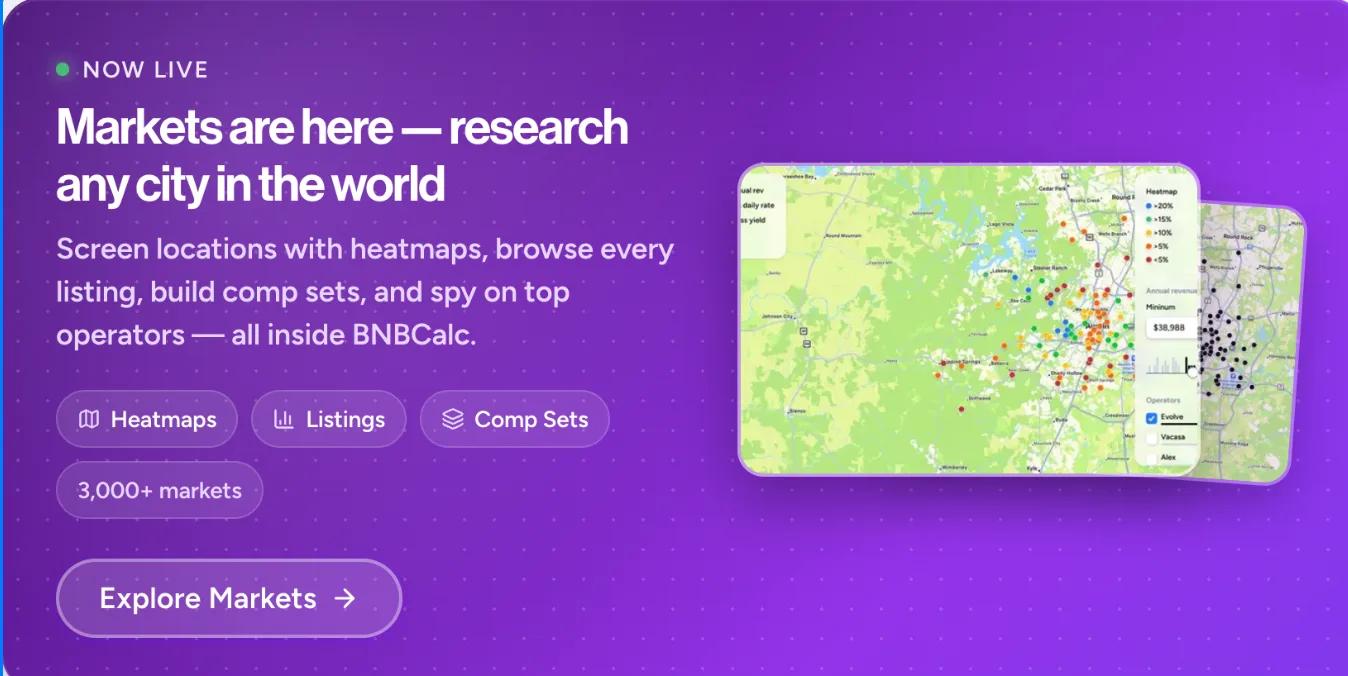
John's own fix is to underwrite to the worst case number and plan on holding five years minimum, because a forced sale wipes out the furniture and the equity both. If you want comps and revenue data before you commit, BNBCalc Markets is where I'd start.
Key Points
- John never underwrites to the best case. He wants to feel extraordinarily confident a property clears its worst case number first, and everything above that is upside. Beat it by $10,000, great. By $20,000, also great.
- His floor for holding is five years, ideally longer, because the position you never want is being forced to sell. You're selling into a bad market, the property has likely gone down, you made no cash flow, and the furniture, the equity and whatever you paid a designer or project manager are all gone.
- Jeremy is blunt about amenity spend. Put $200,000 into a house and you might only sell it for $50,000 more, so three years of cash flow just gets you back to where you started. John's answer is that you can't break even in this game, because breaking even means you lost everything you put in.
- Most Airbnb investors never learned to buy real estate, John says. The tell is the beautiful A frame in a great location that costs way more than any other three bedroom in the area. It'll cash on Airbnb and still be a poor purchase, since there's no built in equity underneath it.
- He hasn't booked an Airbnb for solo travel in about three years, because a hotel room is consistent and a one bedroom Airbnb isn't. Hotels own that traveler. Large groups are the part hotels can't take, which is where he'd put the money. Jeremy adds natural scarcity to that, since builders now put up 200 cookie cutter 1,700 square foot homes per subdivision and a lot of the big houses date to the early 2000s.
- Hotels in smaller cities converged on 120 rooms and four floors because that turned out to be the optimal build, and John's read is that Airbnb hasn't found its equivalent yet. The version he wants to build would drive around $300,000 in revenue and cash flow at least $100,000 a year. That property type doesn't exist on the market, so you'd have to build it.
- One deal Jeremy invested in but didn't lead was a two bedroom cabin in Maggie Valley, west of Asheville. It cost 429K, did 85 grand its first year, then paced toward 68 grand. They sold for 545 to 550, though John's read is that anybody who bought in that window made money on price alone.
Full Transcript
Listen to the full episode on Apple Podcasts, Spotify, or YouTube.
Jeremy: We are live with the Short-Term Rental Pros Podcast. I am joined by a guest that I have had the pleasure of having on, I think, twice at this point, and he is deserving of the continuous appearances. Today he has flown in from Canada to be here with us this week, and timing for the flight arguably could not have been worse.
But yeah, man, fill me in. What was your travel like today?
John: Yeah, hands down, the worst day to travel probably ever on record for anyone across the country, because we just had that whole virus issue that shut everything down. Not a pandemic virus.
Jeremy: Not a pandemic virus.
John: Yeah, this is a computer one.
Jeremy: As annoying, though.
John: But yeah, so it shut everything down. They were putting people in lines based off of what flights they were going into, so that everything was trying to be more organized. It was just the most chaotic thing.
Jeremy: He texted me that they were literally writing out flight tickets.
John: Yeah, writing them out. And then the software came back on. Once it came back on, people were able to get their actually printed tickets. So then when we got to the boarding, to get onto the plane, some people had them written out, some people had them actually printed out, and that caused a whole other kerfuffle. And then they ended up just cancelling a whack load of flights. Luckily, mine did not get cancelled, though, so we're here.
Jeremy: Yeah. Made it.
John: We fought through and persevered.
Jeremy: Yeah, but we'll see what happens. So this weekend we have about 30 folk who are supposed to be here in Dumbo just to mastermind, network, have fun, have a great day. And we'll see. A lot of people's flights have gone cancelled, have gone delayed.
John literally texted me earlier that his flights were messed up, and his last text was about them handwriting the tickets. To me, I'm like, all right, they're screwed. That's not happening.
John: I was gonna text you this, but I'm like, I'll just save it for when we're in person. If it wasn't for you, I would have been driving back home without a doubt, because it was such a sh*t show.
Jeremy: I owe you a drink.
John: I was literally gonna be like, man, if it wasn't for Jeremy Werden, there's no way I'm coming out. This is the first thing I've done since having Remy.
Jeremy: Really?
John: Yeah, first thing. Everything else has just been like, I can't make it, not coming out, whatever. But you're like, hey, one day, New York, come on out. Easy flight. I'm like, I'll do it for you. Easy direct flight.
Jeremy: Yeah, I'm sure there's a million flights a day.
John: There were. There's a whole bunch of flights. They're just an absolute sh*t show to get on them.
Jeremy: But yeah, man, how you been? You been good?
John: I've been good. Yeah, I was just in San Diego, Patrick at his STR Nation conference.
Jeremy: How was that?
John: It was great. I think that conference definitely probably skews younger, demographic wise.
Jeremy: Because of Patrick, right?
John: Yeah, which makes sense. It's Patrick's conference. Nothing wrong with that. I think that brings out a good group of eager young guys.
Jeremy: And fun.
John: Yeah. Fun. I couldn't hang. People were going out like every night. I couldn't hang.
Jeremy: I went there. I did it last year. Awesome time. The people that I met there, I'm still good friends with, from that event specifically. And still, we do a bunch of stuff together. So I was a little upset I couldn't go to that one.
John: Like Blue and Bridget.
Jeremy: Blue and Bridget. We do a ton of stuff. Matt Stillman. I'm pretty sure that's his last name. So man, we still do a bunch of stuff together. I mean, Patrick walked in. Yeah, we've done a bunch of stuff too, right?
So that event was awesome to be a part of. I'm upset I missed out on it. Hopefully Patrick does it again. Yeah, the timing on him walking in could not be better as I'm praising his event.
John: Nah, we were actually talking trash about you, man.
Jeremy: Yeah. But Patrick came in from California, so super grateful that his flight situation worked out. We've had like three people who are like, yeah, my flight got canceled, the next flight I tried to get got canceled again, and it'll be like three days before I can get there. Which is just absolutely crazy in this day and age.
Because apparently what happened, and this is not a podcast about cybersecurity or anything like that, we're not that smart, but I've read a couple of articles on this. Cloudflare, I think their DNS protection software, they did an update, and I guess no one QA tested it.
John: So you have a software background, so you can maybe speak about this a little bit better, because even the fact that you're using DNS as a term means you know a little bit more.
Jeremy: Right. I know that a little bit.
John: From my understanding, these things get tested like crazy before they would ever be actually released, right? They're tested behind the scenes, then they're released out to the public. How does something like that get missed?
Jeremy: Yeah, good question. I mean, for example, today. So on BNBCalc, which is the software that I work on, I don't work on protection, cloud, blah, blah, blah, any of that stuff. We work on Airbnb stuff.
We're doing a push where we're going from 10 to 40 comps, and we're making it so you can filter by revenue. So if you have a slider, you can say only show comps that are making between this much and this much. And that alone, we need several people to QA test before we push it live. So Parker was like, hey guys, can everybody please, we're not going to push this live until everybody's gone through it and made sure that it works and there's no bugs, there's no issues, nothing like that.
John: Right. Doesn't shut down the entire site.
Jeremy: Exactly.
John: How is BNBCalc going?
Jeremy: It's good. We're just really focused on providing very specific use cases that are helpful for people trying to grow their portfolio. And we just built out, one of our big customer demographics is property managers, and we built a widget. So if you're a property manager, you can embed BNBCalc in your website and use it as a lead gen tool.
John: Nice. And what is it doing on their site? Is it helping people underwrite, or is it helping people predict what the annual revenue would be?
Jeremy: So it's really just high level, a kind of revenue range and then seasonality. But if you're a property manager, you then get that person's phone number, their email, their name, the property that they're looking at, and you have a report automatically generated for that property.
John: So then if I'm a property manager, I can just go and I say, oh, well, look at this property, it looks like it's going to make this much.
Jeremy: So let's say you're a property manager who gets a hundred hits a month, a thousand hits a month on your website. You get 20 people filling out this form. Before, you'd have to create a report for it, you'd have to then send that person a report, you'd have to call them.
John: I mean, that's what I pretty well want to do for a living, or part of it, is that reporting and determining the annual revenue. And I know it's an absolute b*tch to do and it takes a very long time. So I can only imagine what that'll help your property managers do.
Now, from my understanding, AirDNA had something like that already, but it costs a lot of money to get their version of it. I'm not really privy on exactly what that is.
Jeremy: I've seen the just put in, you get a revenue estimate and it's on the website. And apparently you could get it onto your site if you wanted to, but every single time someone used it, it actually cost quite a bit. So it was a very expensive lead magnet. I'm not privy. I've never inquired for that, so I don't know anything about it.
John: Gotcha.
Jeremy: But it was just something that was asked from our users, our property manager users. Hey, can we embed this on our site? We're not going to obviously embed the whole thing, but we'll give the slightest little snippet and allow you to use that as essentially a lead generation device.
John: Which is great. One thing that I keep learning from you is the process of building out BNBCalc. How you started with being able to provide value in a very straightforward way, and then you added to it and you added to it and you added to it, and you have continued to do this for however long BNBCalc has been going. And again, every time I talk to you, I feel like you have a new update that's coming out.
So I think that's interesting on my end, because I'm also curious in the software game and what that looks like. And I actually have two things I want to run by you. So I actually want your advice, if you're open to giving it out.
Jeremy: Live on the pod?
John: Live on the pod, yeah.
Jeremy: Live on the pod, all right.
John: This is like the first time talking about it. We might as well just talk about it right here.
Jeremy: We've had John on twice, but first, we're only a few minutes in here, we should probably say who John Bianchi is and why he's deserving of asking me questions on this podcast. But yeah, John, give us a little bit of your background for those who may have not listened to your other episodes. If you haven't listened to those, you should check those out.
John: Yeah, those ones are more focused on advice and whatnot. But so, John Bianchi, go by the Airbnb Data Guy. I have helped identify at this point over 180 properties and help allocate over $70 million. I think it's actually over 80 million at this point. And every single one of those properties that is up and running as an Airbnb is cashflow positive. So we have a hundred percent success rate with identifying profitable properties. And we did all that within the last two years, when everyone was complaining about high interest rates and overpriced properties.
So that's my background. I love Airbnb data. I'm obsessed with it without a doubt. And I love building businesses around it. And I always make sure that the businesses that build around Airbnb data are focused around ensuring that nobody buys an unprofitable property again. So if you look at a lot of what I've done, it is always tailored around that.
So my strategy to build out that and ensure that nobody buys an unprofitable property is by giving away free content. So I've got six free Airbnb data courses teaching every single last little step of how I have found all those properties, right? So that's my quick resume.
Jeremy: And John and I have been friends from about when you started doing this. And I credit a lot of my success in getting the right properties from learning from him, and what he's doing and what he's seeing.
John: So I've said this so many times. I'm going to say it one more time, because you brought it up again. [inaudible] The reason we're friends is because I went through, I studied a whole bunch of different portfolios, and I came across Jeremy's portfolio, and I genuinely looked at it and was like, I don't know who this guy is, but this portfolio is one of the nicest ones that I have seen.
And then to learn that you're a guy in your 20s who's put together this amazing portfolio, which is at a level higher than almost everybody else out there. I had so much respect for you at that point. I was like, I'll be friends with this guy. I want to be friends with this guy.
Jeremy: I like how that's John. It's not like you're funny.
John: That's my way to make friends. They're nice. If the properties are not nice, you got to step up your game a little bit and then we can be friends.
Jeremy: All right. Well, I need to keep stepping up the game so we can remain friends. But John also just had his first newborn too.
John: Yeah. Yeah, man. Yep. Four months old. Remy. I've said this to you already, but having a child is the greatest thing in the entire world. Nothing even comes close to it. Everything I've ever done in my life means jack sh*t in comparison to that.
It wasn't until I had Remy that I actually realized this, and it's really hard to explain if you don't have a kid. And so that's why I'm always going to pressure everybody else that I know for the rest of my life into having a kid.
Jeremy: He's pressured me a little bit.
John: I've already started pressuring you a little bit when Kate was around as well.
Jeremy: Hey, I'm down.
John: I'll keep pushing as far as I can. I'm telling you, man, it's the best thing. And I hope to God that you get that chance one day to have the kid, so you'll know what I mean. And then we can have those conversations.
Jeremy: That'll be the follow-up pod. It'll be when you're a dad, we're just talking about kids at that point.
John: Part of episode 10 between us will be when you finally have a kid.
Jeremy: Each one is just less and less about Airbnb.
John: Yeah. What are we talking about today? I don't know, the weather or something.
Jeremy: Yeah.
John: But yeah, questions. All right. So I want to run this by you. You know the Profit Map software that I've been trying to build for a while, right? Had some ups and downs between that. And within the past little bit, we have had something that's come up that's allowed us to pursue it a little bit further than we were expecting, right?
And right now, sorry, a little more context so you can have all the information. As of five months ago, I no longer have an exclusivity contract with Techvestor. And so I can help out absolutely anybody to be able to find a property. And it's a service business, right, where I actually go out and somebody comes to me with a $200,000 budget and they say, hey, where should I put this? And I help them determine which property makes most sense specifically for them, right? And that service is needed, from what I've seen. There's a ton of people who are needing it.
Jeremy: And there's a good bit of people who are kind of offering it.
John: True. Yeah. And I'm also very good at it. And so [inaudible] it's right up my alley, and it doesn't have to deal with software either.
And so it's a business that I also love, because if I help one of these people, they're likely going to need help again on the next property, right? And then I'm also ensuring that they're not buying a bad property, which makes me feel really good. And it's a business that if you build it up for a 10 year period, you have such a huge client base of people that you're working with, and reputation and everything. And it's just a good business model over a very long period of time, right?
But this software, I just can't stop thinking about. And so I don't want to pull myself away from what I'm currently doing, because I have such a mountain to climb with this service, but I can see an opportunity here with this software.
And so there's two things that we're looking at actively doing. One is that we're likely going to be building out, well, we are in this moment building out, an AI demographic tool. So if you were to have a property and you're trying to figure out what is the target demographic that's going to drive the most revenue for this property, right? You can't design a property without knowing your demographic, because if you're going to be focusing on a bachelor bachelorette trip, right, you're not going to put a jungle gym in there. And so you have to know who you're targeting before you even start the designing. And so understanding who is the absolute best demographic to focus on is crucial.
Jeremy: The customer avatar.
John: The customer avatar. If you market to everybody, you market to nobody, right? A lot of the people losing in the Airbnb game are just not hitting the right demographic, or they market to absolutely everybody, and it might as well be a hotel at that point. Whereas if you can cater to a very specific demographic, you can create an experience for them.
And the homes outside of Disney World are a great example of that. The really extreme themed Disney ones. They're very much catered to families and the kids, and create an experience outside of Disney World and in the home that they're in, right? And so there's an experience premium that you get for that. And if you understand your target demographic, then you can get that experience premium. And so therefore it's important to understand that.
And so we're creating an AI bot essentially, or tool, software, that will allow you to be able to either plug in your address or plug in your listing. And you'll be able to know that information with all the data behind it to prove it, and almost instantaneously. And it'll also pop out like, hey, here's a title you should use, here's the description you should use, right?
So that's one thing that we're looking at doing. And then that ties in slightly with the Profit Map software as well, because it's a different business model.
And so I guess, hold on, I'm explaining a lot. I'm giving you a lot of context, right?
Jeremy: I'm listening.
John: Giving you a lot of context, because you are building BNBCalc, right? And you have been for a while, and it's been going well, right? And the longer you keep pushing on it, the better it keeps going, but I'm assuming you're putting a good amount of time into it. And right now I'm putting every last second I have into this service of finding properties for people. And I don't even know if I can find time to do this other service, but I really want to make it happen.
So I guess the question directly would be, do you think it's worth it to focus on the software and try to build that out? And two, if I did, do you have advice on how I could maybe do both at the same time?
Jeremy: Yeah. I mean, I would say my general advice to people, and to be successful, is you create a repeatable framework for doing something, obviously something that can make money, and just cranking. And it seems like you have that, is what it sounds like. And I know it's a good service, so you have a good service. It does provide a lot of value. It is a repeatable framework. And then the more you repeat it, the more repeat customers then come from it. So I would say you have a very good thing going there.
John: [inaudible] Well, we're so early on. That's it. So that's the part I agree with you, that we've got our systems in place, right? We've got our systems in place. We have our people in place. We're kind of building the machine.
Jeremy: We're building the machine.
John: And I feel like the machine is not built yet. And I'm concerned about turning away and looking at another machine that I have to build while this one's not built.
Jeremy: I would say get that machine where it can be to a degree on autopilot. And then once you can kind of let that thing just kind of, it's moving, it's a cruise liner that's moving. Because a lot of businesses at the beginning are kind of like speed boats. Do I go this way? Do I turn? Do I go this way? It's very haphazard. Where once you get them going, and you bring in people, that's what you need to build a machine. You need to bring in people.
I'm looking at Mikey right here. My fiancé, she always says, oh, we need to build like a machine. It's a terminology. It's exactly what her brothers, yeah, her brothers use that terminology a lot, so she started saying it too. But it's like, all right, we need to bring in Mikey so that she's out doing something and filming something, and things are still happening. Mikey brought in Omar. Omar is a guy based in Texas who's a video editor. So Mikey can focus on the more creative things, where Omar is just pumping out their core videos, which is like her running interviews. That's an example.
So I would say first, yeah, build the machine. And then once you build a machine. For me, that was like my properties. I had to bring in virtual assistants before I did BNBCalc. I brought in virtual assistants. I had it so they could do 90%, 95% of everything. Once I felt like I was in a good place there, then we build out BNBCalc.
BNBCalc, early on, it was me and Parker. It was me and one other guy, and kind of like, all right, well, we don't know what to do. I'm doing some marketing on TikTok, but is this long-term going to be the only sustainable, all right, we need to figure out other growth avenues. All right, we brought in a growth guy.
John: I'm going to jump in right there, because that's actually where we're at. So the parts of the machine that we have built out so far, we have our head of data, we have our head of sales to be able to talk to the clients, we have our head of acquisitions to ensure that the properties are going to be good properties. Then we have the people behind the scenes that are actually handling the operations, customer service. We have these people where we can help a good amount of people on a monthly basis, right?
The part that we're still building is the leads, and getting more people to know that we exist and that we can help them. And that's all on me right now. And so it's my job to make sure everyone knows.
Jeremy: That's a lot of pressure, because that's what feeds the whole operation.
John: Exactly. But you were just saying, as you're explaining that, that when you were starting BNBCalc, you were doing a lot of organic social things on your side. And you're like, is this what we're going to continue to do? And then you realized, hey, no, we could actually bring in somebody to help with growth. So what does that look like?
Jeremy: Yeah. I'll take a step back and even say the first machine I made was the boat rentals. I used to be the one picking up the phone. Literally someone would call for a boat rental at the lake back in 2020. Jeremy picks up the phone, or maybe I don't pick up and I call them back an hour later.
Jeremy: But I was literally the call service. I even did some of the first boat rentals. Very early on, we built a local team who did the boat rentals. And now I have someone, essentially a call center person, who deals with all the reservations. They deal with some of the marketing. So that was the first machine. Built that machine, went into the houses, VAs, local operations managers, built that machine. Now, okay, talking about the BNBCalc machine.
Yeah, what you need, you need an MVP product. I did the MVP. And you've done an MVP. You've had...
John: We have an MVP for the software. We have an MVP for the service.
Jeremy: Let's talk about the service right now. We can move on, we can talk about the machines built for the service, and then we can talk about something else.
John: Okay. I'm like, yep, I'm following you.
Jeremy: Yeah. So, BNBCalc. And the thing with startups is they're just like a house. An Airbnb business is not that complicated. The textbook has been written. That's why so many people are jumping into it.
John: Yeah. It's not rocket science.
Jeremy: It's not rocket science. If I can figure it out, most people can figure it out. I mean, I do think you can have new ideas. I'm going to show you the house I'm under contract on later. It's like ideas for the future, because I think a lot of people do what worked like a year or two ago. They're playing from a year or two behind, whereas I try to play from what do I know is like five years from now. Like what you want to be in, like what are our forces?
John: Let's actually, let's talk about that. We have so many things to talk about. After we talk about...
Jeremy: We have so many things to talk about.
John: I actually want to talk about...
Jeremy: This always happens with John and I.
John: I was just going to say, let's use that as a topic to make this a bit of an Airbnb conversation. But I want to just, the growth side that you were saying there. So how did you hire the growth person for BNBCalc? What did that look like? What did they take over? What did they do?
Jeremy: Yeah. So first we figured out, well, we had a friend, a guy we went to college with, Rob. So Parker and I went to UNC together. We had a friend, Rob, who's like a growth marketer, a performance marketer. So he does paid ads, so Facebook, Google. We put him on, or we just, I don't know, I don't even think he charged us. Started running Facebook ads for us, Google ads, and they were working. They took some time, there's a whole process there, but they were working. And he said, hey, I think you guys, there's opportunity. Here is kind of what my plan would be. And we said, all right. We came to terms, gave him upside, gave him equity in the business. And yeah, we hired him, brought him in.
Over time, Facebook gets harder and harder. That's a very known thing. Facebook's good at first, and over time it gets harder. So you have to be creative and think about other things. SEO is one of those growth channels that we've really invested in. But essentially, it was a team member who is supposed to be the domain expert on that topic. I feel like I'm a jack of all trades. Most entrepreneurs are.
John: Yeah.
Jeremy: But you need to fill in. You need to hire the experts.
John: Yeah.
Jeremy: So we brought him in. And we've also kind of even brought in a CEO at this point. He's actually a Canadian. I don't even know. He just leads our team calls. So I don't know, technically I guess I'm quote unquote CEO, but I'm going to be honest, he's the one leading our team calls at this point.
John: I didn't know that. That's interesting.
Jeremy: Yeah. He's a beast. He's honestly a super interesting guy. Just serial software startup entrepreneur. He has five companies right now at the same time.
John: Does he want a sixth one?
Jeremy: Does he want a sixth one? I don't know.
John: I don't know. I'm just kidding. I'm kidding.
I'm always intrigued by people who are experts in their field, because I hate to even call myself an expert, but I feel like I know my craft well at this point. I still feel like I have a ton to learn, but I feel like I know it well. And I just see the difference from how I look at Airbnb data compared to most people. And so now whenever I'm thinking of hiring somebody, all I want is the expert. I don't want anyone else. I don't want anyone who's good. They just have to be great at what they do. And that's it, because it just makes a world of difference.
So anyways, that's you saying this guy, that's all he does, all he focuses on. He's got multiple different companies. He's figured out a way to scale these companies.
Jeremy: Yeah. Well, they're startups. So he's raised money for companies before and had negative experiences.
John: What are your thoughts on raising money?
Jeremy: I mean, we haven't [inaudible]. I think if you have certain, if there was the right company, it makes sense to raise money. Also, there's different money. Is it venture money? Is it friends and family money? It totally depends. I mean, a lot of people look at venture capital as the barometer for success, saying, oh, I've raised. And I feel like the opposite, right?
John: And let's see. So I've looked into raising quite a bit at one point, just I was very curious about it. Studied up on it. And the craziest thing about raising venture money is that you get a lump sum and then they go, you have one year to hit these metrics and then we'll give you more. And then they give you more and they go, you have now one more year to hit these new metrics and then we'll give you more. And if you miss those metrics, your company's over, right? They're not going to keep funding you.
Jeremy: They're not going to keep funding you.
John: And at that point, because of how you built out the company and how much money you've sunk into it, you can't run it without those things, without getting more money. You have to get the next seed, right?
And so that part to me, I think it works for some companies, but I also think it's really dumb for a lot of companies. But then again, I'm not a venture capitalist by any means. They have their logic and they have the reason behind it. But yeah, it's just always scared the sh*t out of me.
Jeremy: Yeah, I think at some point in my life I will want to go after moonshot ventures. But the last four years, because I've frankly kind of worked at a couple of those.
John: You have that background, right?
Jeremy: Yeah. And so in 2020, when COVID hit, we were a company, I worked for a New York based private equity startup that needed money, at that time literally needed venture capital. And pretty much I was put on the chopping block. And I was like, F this, I never want to feel like this again. I'm going to build a cash flowing business where I don't need anybody else. It's me.
John: It's exactly how I feel about it too. If your business doesn't make money, what are you doing?
Jeremy: Granted, but then you start cash flowing and you start building business, you start building real estate, and you're like, oh, this is great. But let's take a couple of moonshots while we're at it, you know?
John: Right. Yeah, that's fair. So if you have the base, if you have the machines built out, right, and those machines are working for you, then why wouldn't you, I guess. I say that, but I also know that Airbnb wouldn't exist without venture backing, right? Because it needed to build up to a certain point for it to make logical sense, and you need the venture backed money to get to that point, right? Same with Uber, which I used to get over here, and needed that as well.
So I'm following. I think it makes sense for some companies, others maybe it doesn't. I think I've just heard a lot of horror stories when it comes to that. But anyways, that was helpful advice. I do appreciate that. I think what I'm going to take away from what you said is that just build the machine, and then build the next machine once you've had that machine built out, right? And we are looking into ads as well. I'm not sure how much ads are going to play into this service, but I'll just keep building it. I'll keep building the machine before I take my eye off it, because I don't want to fail, right? I want to be...
It's not even about failing. It's just that, let me tell a story.
Jeremy: Okay.
John: Let me tell you a quick little story on why I need this to keep succeeding in the way it's going.
Jeremy: Because you got the baby at home now, you got a mouth to feed.
John: That's one baby.
Jeremy: You got a hungry baby.
John: That's one baby. But then you start to take on more responsibility in a way, right? I genuinely feel responsible to live up to this idea of ensuring that nobody buys a non-profitable property. And I don't know how many people you've talked to who have failed in the Airbnb space, but I've talked to a lot. And every single time I talk to them, it hurts. Because I think in my head, I'm like, hey guys, I haven't missed in the past two years for a reason. And if you just follow that path, you would also not miss, right?
Jeremy: I feel like you guys have also very much narrowed and narrowed and narrowed your guidelines.
John: That's how you succeed, right? That's how you don't miss. And we can get into that in a second.
The story that I want to tell is that I talked to this lady two years ago and she was telling me about how she was going to be buying these two properties in a market I'm not going to mention. But she's buying these two properties in this one market. And I told her, I'm like, that's not a great market to go into, for a variety of reasons. And with the budget that you have and what you're going in, in that market, it's going to be really, really hard to win. And then on top of that, there's better places to put that money. This was two years ago, when I didn't have as much experience as I have today, right?
And about a month ago, she reached back out and she goes, hey, my properties are not performing, I'm going to 1031 exchange and I want to use your service to find these new properties. And in that scenario, that's where I feel a level of responsibility, because I tried to talk her out of those properties, right? I tried to guide her to what would have made more sense. But yet she's so on forward with it because of her own reasons, right?
But it takes about a year to two years to realize that you're failing with your Airbnb. The first year, maybe you make no money and you go, it was our first year, we were just figuring things out, maybe we just need to throw more money at the property. And then the next year goes and you made no money again. And now that's two years of working for free and sinking all this money in and making no money during that entire time period, where you finally go, this property is not going to work.
And so I feel a level of responsibility to try to stop that from happening, so that people can just put their money into these great properties and be happy with those scenarios. And so when I talk about not wanting to take my eye off of building this machine that I'm building out, because it's an infant right now, and the way it's set up and the way the offer is structured and everything is the worst way it's ever going to be set up, right? Because there's so many other variables to this of how we're going to put it together. Just keep making it more robust.
But yeah, so I just want to ensure that I keep building out that machine so that people like her in that scenario, I can continue to serve in 20 years from now. That's how I'm thinking about it. Do you see that?
Jeremy: And you have, there is things that drive you towards wanting to make sure this is successful that are beyond business. You have a mission. Well, you have a genuine mission, and that's good business.
John: Yeah. Agreed. I don't want to say that I'm like the, I don't know. Anyways, I agree. I agree.
Jeremy: I see that. There's a light above your head right now. It kind of looks like an angel ring.
John: That's not what I want to come across.
Jeremy: John is your guardian angel, keeping you from losing money on Airbnb.
John: I don't know. That's not what I'm trying to get across.
Jeremy: I get it.
John: What I'm trying to get across is that I can help people, and I'm good at it, and there's a way to be able to build out a business that allows that to happen. But I'm not your guardian angel, I guess is what I'm trying to say, right? You can do this stuff for yourself for free.
But let's actually jump into what you were saying there before, which was where you see Airbnbs in about two to five years from now and how you're thinking ahead. Because I have some thoughts on that as well, naturally. So tell me what you think.
Jeremy: Yeah. Well, just to bring this back, I think you said earlier it takes you a year or two to figure out if something's a failure. I would come back with, well, how long does it take for you to know if it's truly a success? Does it take year one, 25%, 20% cash-on-cash return, check, this house is good? Or in reality, do you need like four or five, 10 years to really understand the outcome of the investment?
John: Well said. That's a great way to look at it. That's a great way to look at it actually. Because this is one thing that I don't think enough people are thinking about when they're buying Airbnbs, is that when the market crashes, a lot of Airbnbs are going to fail left, right, and center.
So I used to be a financial advisor before. And when you're a financial advisor, you study the stock market, right? And you study the economy in a sense. I wasn't great at it, but I could understand that the markets dropped, right? And when the markets drop, people don't travel, not nearly as much. And they usually don't travel for about a year. That one year is like pain for the entire country, or the world, whatever it looks like. And then the following year gets a little bit better. And usually by the third year, it's the best it could ever be. Everything's booming, everything's going great, right?
And I don't think enough people are buying properties and trying to win during the next recession. So who's the guy that is like the greatest investor ever? His name has a B in it.
Jeremy: Warren Buffett.
John: So there's a Buffett metric that he came up with, which is essentially how much has the economy raised in comparison to how much the stock has raised. So if you were to look at it right now and compare it to 2008, I think it's twice as high right now as the numbers in comparison to 2008. Which means that if there isn't a recession in the next year, it just doesn't make any logical sense as to what's going on within this economy, right? If it's not within two years from now, it also makes no sense, is what I'm trying to say.
So your question was, what makes a good investment when it's at the four year mark and it's still cash flowing, still going well. I would say, yeah, without a doubt, that's where, if you can get to five years, you're probably in a really good position. If it's cash flowed well, if it's gained equity, because if the markets take a dip right now, it might be a bit till they come back up, right? And I'm not just talking about the stock market here, I'm talking about also your properties. And the properties are at record high. You can see a bunch of indexes kind of showing them starting to either level off or come down a little bit, right?
And so if you get a property, you should almost always have the mindset that I should hold this property for a minimum of five years, but ideally as long as I want. And so I guess what I'm trying to say is you never want to be in a position where you're forced to sell, because as soon as you're forced to sell, you're screwed. You're absolutely screwed, because you're likely selling in a bad market to sell. Your property has likely gone down. You've likely not made any cashflow from the property. And then all of the furniture and equity that you put into that property is gone. You're not going to get almost anything back from that. Let alone what you might've paid a designer or project manager and all those additional fees, and your time to run the property. That's a worst case scenario, right?
And one of the reasons why we have had this 100% success rate of finding cash flowing properties is because whenever we have gone to look for a property, we always try to feel extraordinarily confident that we will be able to at a minimum hit our worst case scenario. We never, ever, ever buy a property and say, we're buying this property because we believe it can do the best case scenario. We do it and we say, we know it can hit this worst case scenario extremely confidently. And so we're always buying with the worst scenario in mind. And if we're happy with that worst scenario, anything above it, you're happy, right? If it makes $10,000 more, great. Makes $20,000 more, great, right? Both of those are good, because you beat your worst case scenario.
So if you're looking into buying a property, your metric should be long-term, can I keep this property? But to keep the property long-term, it has to cash flow every single year. I mean, it can break even. You just did a whole bunch of work for an entire year for nothing, right? But it should cash flow every year for you. So if it cash flows in year one and cash flows in year two, hopefully you can kind of keep that going.
Jeremy: Yeah. So that right there is saying you're optimizing for cash flow, and continuous cash flow over an extended period of time equals success.
John: Exactly.
Jeremy: I would say, honestly, day one when I started, I would have probably agreed with you. That would have probably been what I thought about the most. But now that I have a portfolio and it's a couple of years in, and I've gone, it's actually not necessarily the properties.
We sold a house. We sold one house. So a lot of the houses that I'm an investor of, I've led the deal, I found it, I put it together. One of the houses I've invested in, that was not the case. It was my friends who had invested with me before. They went out to do their thing, wanted to support them. I told them, I said, guys, I'm going to be honest, this investment is not my thesis. It was a two-bedroom cabin in the Smoky Mountains. Beautiful view, hot tub. We put in the hot tub, put in the fire pit. It had like a third sunroom that we used. Beautiful place. But I was like, I think in the long run, in order to predictably succeed, we want to go after larger properties that we can value add and really amenitize. I think that if a recession comes, no matter what, I think these places are going to do well.
That house actually did really well the first year. It did like insane, a lot better than we expected that first year. That second year kind of fell off a cliff.
John: What year was the second year?
Jeremy: It was 2022, and then 2023 was the second year.
John: It was in the Smokies?
Jeremy: It was like Western North Carolina.
John: Oh, okay.
Jeremy: Yeah, it didn't really fall. It went from, it did 85 the first year. So it was 429K purchase price, did 85 grand the first year, and then looked like it was pacing towards like 68 grand the second year.
John: You went from like a COVID market. It sounds like you bought in a COVID type market, so markets that thrived during COVID.
Jeremy: Also supply, insane supply boom market, and a lot of small cabins, which I thought...
John: What market was it? Can you say?
Jeremy: Maggie Valley.
John: What's around Maggie Valley? I know it.
Jeremy: It's west of Asheville.
John: Yeah. Yeah. Okay. I know it. Yeah, yeah, yeah.
Jeremy: It was at the time people were like, oh, Maggie Valley's great. We also got a house in Silva, a four-bedroom cabin that was 3,000 square feet, two-car garage, we put a game room in, large house, sleeps 14 people, and highly amenitized. That property, still doing well, whereas the small cabin fell off.
But that being said, we sold it a year and a half later. We bought it for 429. We sold it for 545, 550. It was a successful investment for all sakes and purposes, but the ROI was insanely high for a one and a half year investment.
John: Yes. But you're talking about the one time in American history where housing prices shot up. So anybody who bought during that time made money.
Jeremy: Well, you say one time in American, generally speaking, yes. But actually, I do think there are ways to predict appreciation.
John: For sure. But I'm just saying everybody appreciated during that time. Everybody. So if you bought in anywhere random, whatever. I was going to say, anyways, if you bought anywhere.
Jeremy: Certain properties in certain markets can, in my opinion, predictably appreciate more than certain properties in other markets.
John: For sure. I agree with that. And I hate predicting, trying to make up what's going to happen in these uncontrollable things, so I don't dive deep into it. But there is definitely ways you can look into it and try to avoid certain things. I think there are some properties that you could look at and know that they're overpriced, or know that their value doesn't make a ton of sense, and then it's kind of writing's on the wall that it's going to come down, right? And other ones where it's just like, yeah, I think that property will be steady. It'll be fine. It'll be okay, right?
Jeremy: Well, there's also, I would say, properties where the money you put into them initially. So when you set up, we talk about amenities a lot. A lot of the times, amenities, let's say I put 200 grand in amenities in a property and I go to sell the house, I might only be able to sell the house for 50 grand more. Even though I just put in $200,000 to the property, I only get 50 grand out of appreciation. So in a way, on paper, you've actually lost money. Yes, you can cashflow year one, you can cashflow year two, you can cashflow year three. But if the house hasn't appreciated at all, you're just getting back to where you started.
John: Another reason why it's unbelievably important to cashflow in the Airbnb game.
John: You can't break even. You've lost everything you've put towards the property if you break even.
Jeremy: Exactly. So there's ways where actually, when you do do work to a property, certain properties, if you think about it, oh, this will actually increase value to the house and it will drive Airbnb. So I kind of now try to optimize for both at the same time, if that makes sense.
John: Okay. So this is one thing that I actually have said this week to somebody else in the long-term rental community. There's a long-term rental coach I ended up getting on a call with, and I told him, I was like, you should put together a mini program for Airbnb investors, because the majority of Airbnb investors don't understand how to buy property well. They are not buying a property with a good basis that they can add value to, that's going to give them some sort of built in equity, that if the property does go down, they're going to be okay, right?
And instead what people are doing is they're optimizing for pretty, right? They're optimizing for overvalue, like a property that's a beautiful A-frame in a great location, but it's way more expensive than any other three bedroom in that area. But because it's an A-frame, it's like, yeah, it's going to cash on Airbnb, but it's not necessarily a great real estate purchase. And so you're missing half the equation.
So if there's any Airbnb coaches out there, make a small light version about how to properly buy real estate, because it is being missed in the Airbnb community without a doubt. I don't know it well enough to teach it, but I have a good buddy who's crazy about buying good properties. He will never buy a bad property, but he does long-term rental, and they understand how to buy property with value.
Jeremy: Yeah. And that's like right now, I'm actually looking at a house and I put an offer on it, and the house needs a lot of work.
John: Is this one you were telling me about in the Northwest?
Jeremy: The one in, no, that one we're under contract on.
John: Okay. Okay. So another one.
Jeremy: So there's another one.
John: Did you just put an offer without running it by me?
Jeremy: It's literally a couple of hundred feet away from a house I currently own, so I saw it and I was like, I know that I have to take that.
John: I just like to be in on the deal.
Jeremy: Yeah, I'll tell you. Well, I'm not under contract.
John: Okay, all right. Send it my way. We'll talk about it this weekend.
Jeremy: It was literally like yesterday.
John: Yeah. Okay. All right.
Jeremy: You're coming, we're here, we'll show you. But the house needs a lot of work. And even regardless of Airbnb, it needs work. Essentially the house smells like cigarettes.
John: But that's what you want to buy.
Jeremy: No, I know. But the thing is, the floor plan is just so bad that even the work I'm going to have to do to try to fix it, it won't. The house, let's say I put in 200 grand to it, it's going to be capped. The value is going to be capped. It's going to be worthless.
John: So then why would you put an offer on that one? We have run into a couple of homes like that and we're like, the floor plan makes no sense. It was like, why did they build this house like this? And you just don't buy it because of what you just said.
Jeremy: Yeah. So the dilemma I'm going to run into, and I'm talking to the seller's agent, they're trying to say, oh, after this house is done, it's going to be worth 700,000. And I'm like, my butt. There's never been a house in this entire town that has ever in history sold for $700,000. Nevertheless this house, with this weird, essentially the situation was they built the house, and then I think the people who lived there got old and they wanted to turn the downstairs office into a master, and they chopped the kitchen in half, weirdly chopped the kitchen in half, and moved the bedroom down there. But it actually is a massive house with a bunch of bedrooms, has a huge yard, all things that you can...
John: Is that a pool?
Jeremy: It has a pool.
John: Of course it does.
Jeremy: Granted, it's a 40-year-old pool and it's currently completely empty.
John: You know you can't get a loan, a DSCR loan, with an empty pool?
Jeremy: I'm not surprised, because we're going to have to, I've already talked to, essentially you need to fill the pool, you need to let it sit for a week, you need to pressure test everything, because it could be leaking under. If it's leaking under the pool, you're screwed.
John: Then you might as well, you'd be better off without a pool.
Jeremy: Yes.
John: It doesn't sound like a very good buy. So why are you still thinking of moving forward with it? And I'm asking out of curiosity, I'm not like, you're the one who's put everything down on it, right?
Jeremy: I would have to literally show you, here's my properties in the area, this is what I did to them, this is what they're making. I would have to kind of show it to you. You'd get it, you'd get the situation.
But I just don't want to put, if putting $200,000 into a house, or let's say putting $100,000 into the house, irregardless of amenities, then makes it worth $0 more.
John: Yes. There's no point.
Jeremy: Yeah, exactly. There's no point in that.
John: That would be an example of a bad buy.
Jeremy: But even in cashflow, let's say cashflow is 60 grand a year after we do all this.
John: I know.
Jeremy: Then it's...
John: Right.
Jeremy: That's the dilemma.
John: This is where you can get sort of into, you could call it analysis paralysis, but it's more of just constantly optimizing to try and find the best possible property, when sometimes you just got to go, I'm just going to buy that one, it's going to work, right? Because my next thought was, well, why don't you just wait to find another big property with a pool in the same area that's a decent price that you could add value to. And the reality is that maybe it just doesn't exist.
Jeremy: Well, supply is just so limited.
John: Exactly, right? So there you go, it just doesn't exist. This is the opportunity that you have. You know you can make a good amount of cashflow off it, and you're just going to have to hope that appreciation works out in that town over time.
Jeremy: Hope that a rising tide lifts all boats, that lower interest rates lead to increased prices. But yeah, I think we can agree that there are multiple variables in this game. And ultimately, yeah, people who have analysis paralysis and don't do anything, they lose.
John: Well, you know what? And you know Taylor Jones, right?
Jeremy: Of course. Yeah. [inaudible] Yeah, that's right.
John: So Taylor Jones, he's like the ying to my yang, is what I always say. Because at Techvestor, it was him and I were the acquisitions guys, right? But it was my job to study the data and essentially tell Taylor what to hunt. And then Taylor just understands the buying process, and when properties are overvalued, and how to make them work, and all these different things extremely well. He just sees it the same way I see the data. And so it's this perfect combination, because he also is the trigger guy. So I could study the data to the day I die and not pull the trigger. But then I get Taylor, who I give him all that data and he pulls the trigger left, right and center.
He'll see a property that'll crush. He can see, like, that'll crush, I know it'll crush, so you do this, this, this, this, based on these numbers, on the data, it's like that's gonna be a property. He puts in an offer, right? And he just pulls the trigger all the time.
And so I guess what I'm trying to say is that maybe you need somebody in your life who can help you pull the trigger, right, if you can't pull the trigger yourself, or practice pulling the trigger.
Jeremy: So something I hate is feeling rushed. So literally every house that I have bought, where I've been the one who's led the deal, it's sat on the market a while, and I've had time to really think about it. And I've gone back and forth with the agent several times, I've negotiated. When a house just hits the market and I see it and I'm like, oh, that's perfect, honestly, I hate it. It's like the worst thing in the world for me.
John: Those are, I can't even tell you the amount of times that we have seen a home hit the market and bought it in that first four or five days, because we see it and we have such a clear buy box of what works. We see them, we're like, yeah, that's an absolute home run of a deal. Why would we not purchase it?
Jeremy: Granted, you guys are trying to deploy tens of millions of dollars.
John: Regardless, though. Even regardless.
Jeremy: For me, it's like, I've got another 150k. Like I got it.
John: Yeah. You want to make sure you're nailing it.
Jeremy: Perfectly deployed.
John: I guess what I'm trying to say is that I would say that our best deals have been the deals that we have found that we have put an offer in within that first week. [inaudible] We will call the agent and say, hey, we're putting an offer in. And sometimes if it's a really great deal, we're like, we're putting a full offer in. I don't need a video tour. Like, you put the offer in before, give me the video tour.
And then we say to them, like, if they take the offer before doing a showing on the weekend, that's, I don't know, you add some sort of negotiation so they don't show the property to anybody else, because we can clearly see it's such a good deal. You see that massive backyard, that we'll do it. We'll do what we got to do to be able to get the deal, right?
Jeremy: Taylor loves when they have like the puny little front yard and the massive backyard.
John: Yes. We just saw it. We just found a deal. It was such a cool deal. It's on Zillow and they took the photos of the entire property, and then they have this fence that's almost like right around the pool. So there's almost no backyard to this home. So we just look at it and we're like, well, if there's no backyard, we have no competitive advantage, right? At a minimum. So let's not even look at it. We just went on.
Our realtor then comes back to us like a day or two later and goes, hey, it turns out the property line is actually this, and it's like this huge lot behind it. And so one of our clients picked it up like a day or two later.
Jeremy: So you'll just take the fence and just tear it down, open up, put up a new fence.
John: What I love about it is that our realtor is the one who pointed that out to us.
Jeremy: Which market was this?
John: One of our markets that we're in.
Jeremy: Okay.
John: One of our Florida markets.
Jeremy: Yeah. Okay. Well, I don't know the realtor. Zander was here the other day.
John: Yeah.
Jeremy: They don't have fences.
John: Yeah.
Jeremy: They don't really have pools either.
John: No. They have those above ground pools.
Jeremy: Yeah.
John: Zander's awesome, man.
Jeremy: Zander is the best. He was on the pod.
John: Yeah. We talked about it.
Jeremy: Sitting where I am. Him and Mark Shea.
John: Yes, sir.
Jeremy: I love that. Mark Shea's awesome too. He's been with us for a long time period, and he's awesome to talk to. His knowledge is so deep in the Poconos.
But yeah, so you've helped people buy so many properties, $80 million, but you wanted one for yourself. I know you've been itching of late, and you mentioned to me that you might want to go out to that area. Tell me about that.
John: So...
Jeremy: Are we doing a day trip?
John: I would love to. I just want to see it. I don't know if I need to, but I would want to see it.
I have a couple of things in mind that I want to do, and I don't know if buying actually makes the most sense for me, because I have studied the data so much that I know for a fact there's a certain model of a home that if you were to put it in the right spot, it just drives insane revenue. And so if you can build it, and when I say insane revenue, I mean like 300,000, and it's worth 300,000, right? It's not one of these properties that's not worth 300,000, without getting too deep into that. And then the cash flow on it would be like at a minimum $100,000 a year, right? And if you can build it properly, then you also have the built-in equity, right?
And so in my mind, to build is a whole other scenario. I would need to work with somebody who actually knows what they're doing. Sebastian, who was sitting here earlier today, he builds.
Jeremy: Right.
John: So I'm not saying that I wouldn't put my own money into some of these exact same homes that I'm seeing, because I see these homes, and I know even the homes that I'm looking at, some of them can cash flow $100,000, right? And they're already built, and all you've got to do is buy it and do some things to it, and it's a lot easier, right? But I'm so intrigued by this idea of building, because what I know works, you can't buy. This very specific property type doesn't exist. You have to build it.
Jeremy: This is the one Taylor was talking about too?
John: I don't know which one he was talking about.
Jeremy: This is something you guys have to be in the room to know. This is the one I think I know. Taylor and I were spitballing on it. I think it's the same thing.
John: So Taylor and I are considering to build together, and if it is what Taylor was talking about, it's a version of that. We're on the same page.
Jeremy: You got to be in the room to know what we're thinking about here, because it's not there.
John: We want to be the ones who make it there, make it a thing, and then we can talk about it. When we're talking about where does Airbnb go, this is where I believe it goes, and I think this is the ultimate version of it.
Jeremy: I think we're seeing the same thing right now. I think we're seeing the exact same thing, and people are probably listening to this about where it goes in the future, building for something that stands the test of time.
John: I'm going to talk about what I believe the future looks like, and then you guys can paint the picture of what I see, right?
I believe strongly that Airbnb is still finding its footing, and I think that Airbnb in whole is going to continue to evolve until it is truly matured, right? An example of this is that if you look at most of the hotels that are built nowadays, they're all 120 rooms and four floors. The reason being is because that is the most optimal way to build out a hotel. It took a very long time to figure that out, right? Now obviously we're not talking about a hotel in New York, right? We're talking about a hotel in these smaller cities. Those are the most optimal ways to build, and they are building them all over the place, right? Because that is the best thing to have. Now, it took a long time to be able to figure that out, right?
When it comes to Airbnbs, there are a ridiculous amount of Airbnbs that are failing. And there's also, at the exact same time, a ton of Airbnbs that are making an outrageous amount of money, and people are walking away with tons of cash flow, right? And so if both of those things are true at the exact same time, then there is a formula of how to make it work and how to fail, right?
And so if we just kind of bring it back to, how do people use Airbnbs the most? And so you're a software guy, right? And when you're building a software, you have to think about the customer journey. That's what they always talk about. What is the customer journey, and how do you build it out into a software? If they click this button, where do they go next, right? How do they navigate around the page? Why are they going to this page? What do they need from you, and how do you give it to them in the most optimal way, right? How do you build this out?
And so I like to think about the customer journey for services, and then also Airbnb, right? And I genuinely believe that Airbnbs are about groups. And so if I'm traveling and it's just myself, I will never book an Airbnb, and I haven't for the past like three years, because a hotel room is consistent. I know exactly what I'm going to get. And with an Airbnb, it could be all over the place. And even if the Airbnb was a little bit cheaper, I just don't know what to expect. And so these ideas of like these one bedrooms scare the hell out of me, right? And I wouldn't personally invest in these one bedrooms, because I think hotels are better when it comes to that scenario.
So then therefore, if hotels are better at one bedrooms, and the exact opposite is an Airbnb, that is a larger Airbnb that can host large group, right? Because a large group would almost never want a hotel.
Jeremy: It's a differentiated product.
John: Differentiated product, right? So there's a certain way that people use Airbnbs. And there's a certain ideal customer that you want to be able to hit that is never going anywhere, right? Hotels are never going to be able to dominate large groups when it comes to travel. Airbnbs are always going to dominate in that category. And so then therefore, as time goes on, I believe that that's going to become more and more prominent. You know this yourself, you're buying all of these five bedrooms, right?
Jeremy: Yeah.
John: I mean, you're buying larger homes. But then on top of that, there's the experience side to it. And I think the experience of an Airbnb is a huge piece that people are still missing. People don't want to just buy a bedroom, a kitchen, a bathroom, and a living room, right? When you put together an Airbnb that has no style, no design, no feel, that's what you're giving your client, your guest. You're giving them a hotel room, essentially, inside of a house. Whereas if you can create some sort of experience that enhances that person's trip, they're going to be willing to pay more for it, right?
And so the easiest example of this is always a bachelorette group. So imagine that you have this all pink house, everything's pink, there's neon pink lights all over the place, and you are going on a bachelorette trip to that home. It's going to feel like you're on a bachelorette trip at all times, whether you have the satchels and you're out at the bars, or if you're in the home and you have all these different areas where it's completely pink, and there's the makeup room, and you can take selfies with a really cool wall behind it. It's creating an experience, right?
So what I'm trying to say is that a lot of people are failing an Airbnb. And if we think about the customer journey of how people use Airbnbs the most, and when they love them, and where hotels cannot compete, it's in the larger groups traveling for some sort of an experience. And if you can continue to target that demographic and that idea, you're going to win in today's market. And then as time goes on, I think people will continue to see more and more and more of these, until that is just sort of the norm. Do you know what I mean? Does that make sense?
Jeremy: I mean, what I would add to that is natural scarcity.
John: Scarcity?
Jeremy: Scarcity.
John: Okay. Sorry. I thought you were... Sorry. Sorry, I didn't mean to correct you like that.
Jeremy: My non-Canadian accent. I don't know which one is right.
John: Yeah. No worries. Okay. I'm following you. Natural scarcity.
Jeremy: But yeah, these bigger, it's really expensive to build big homes nowadays. So they just don't. They pop up these little suburban neighborhoods where they have 200 cookie cutter, 1700 square foot homes. But are they building those, what I'm calling mega properties, anymore? The answer is no. They're not building. A lot of them are from early 2000s.
John: Right. So then you're talking about scarcity within the type of home that you have, not necessarily a small market.
Jeremy: Well, I'm just saying you said the future of Airbnb, differentiated product, large group travel, doesn't stay at hotels, they're going to stay at Airbnb. So that demographic is going to only increase, increase. Let's say that group travels 10% more a year. That means they're doubling every five years. Every five years, there's twice as much demand for this big group travel, which I agree with. I think that that's only becoming more and more prominent.
I think I'm seeing this firsthand in my portfolio, grandparents who've never used Airbnb keep booking. That's like 40% of my summer is like a first time grandparent who's never used Airbnb. That's one of the groups that's growing in. But those people are the ones who have only booked hotels their whole lives, you know?
And young people, I mean, I have 20 reviews as a guest through Airbnb. And to me, I don't even do Airbnbs that much, and I go, oh wow, I have 20, that's a lot. Most people only have one, two, three. Most people, it's only a couple. So yeah, we're still very much in the first innings.
And if you create differentiated products, that's what you were alluding to earlier, that is not commoditized. Hotels are commoditized, stay away from that. And then has some degree of natural scarcity, meaning it can't be easily recreated. You're setting yourself up to win for the long term.
John: Yes. And you buy right. So you buy at the right price, right? You add some value to it if you can, so you have that built-in equity, right? Be smart on the buy as well. And it's not just about the cashflow.
Jeremy: Exactly. And those right there are the characteristics for success.
So John, anything fun coming up for you? And yeah, it seems like you've already given a lot of tips today. I was gonna say, what's your biggest pro tip, but you've probably given so many already.
John: Yeah, I feel like my biggest pro tip is that you need to go through the Bianchi method. It's a free 40 hour long course teaching you every single last step of my process that I've used to buy all these properties, and we have a hundred percent success rate using that method. I promise you it works. You just got to put the legwork in. So it's out there for you guys, to ensure you never buy an unprofitable property again.
Jeremy: Yeah. Well guys, John, thank you so much for coming. This is going to be an awesome weekend. I mean, we got a little bit of a road bump, nothing like an international, like power technology outage just in time for your...
John: Still making it happen though.
Jeremy: We're all here for the most part. We'll see.
John: We'll do it again, maybe.
Jeremy: That's what I said. If you guys are listening, maybe we'll have to do it again sometime. You guys can be in the room with us. And John, you're a legend. Everyone listening, y'all are legends. Stay tuned to the next episode of the Short-Term Rental Pros Podcast.
Airbnb Tax Deduction Calculator
Paying too much in taxes? We have the perfect solution. Simulate an Airbnb home purchase below.
Purchase Price
$450K
Structure Value
70%
Apply Trump's Tax Cut (Bonus Depreciation)
Depreciation
$117,695
Interest
$21,600
Tax
$6,750
Year 1 Deduction
$146,045
Want to claim this deduction? Get a free cost segregation benefit analysis from CSA Partners — no obligation.
Get Full Analysis