Free instant analysis
Reveal Airbnb revenue for any address or city
Quick Summary
Zach's core argument is that greatness has to be differentiated, and you can't differentiate much on land you rent. Use the OTAs, he says, but if 80% or more of your guests are unknown to you, you don't have a business worth much.
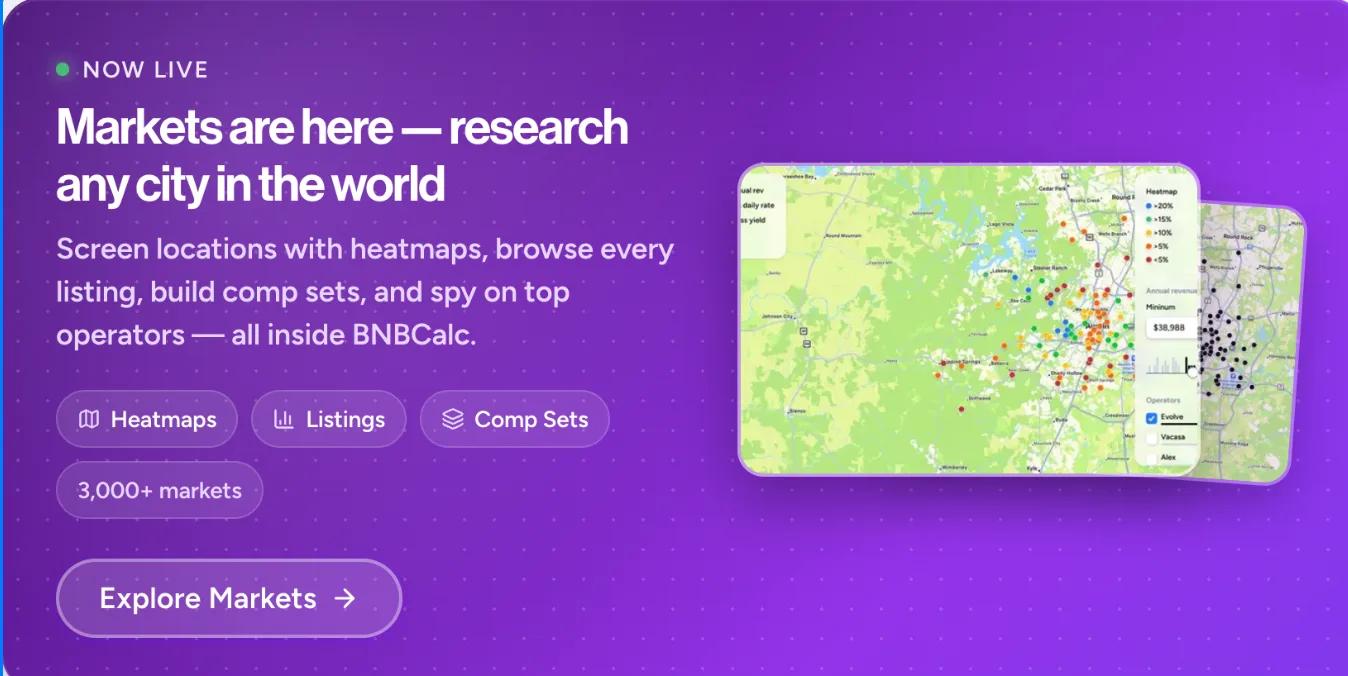
Jeremy pushes back, since social carries its own algorithm risk, and they land on fewer units per site plus an audience you own. Any of that still needs a market that pays, so check the revenue underneath the idea in BNBCalc Markets before you buy the treehouse.
Key Points
- Zach's company, which ran the Behind the Stays podcast, was acquired by Journey, announced on Friday, November 1, less than two weeks before this conversation. Journey is a points program covering vacation rentals and independent boutique hotels, and Brian Kelly of The Points Guy is an investor and advisor.
- Journey doesn't take bookings. Members get routed to your own direct booking site and earn more points for booking direct, and Zach's role at the time was head of Alliance, recruiting what he called stays with soul, including funky spots at $200 to $300 a night rather than only ultra luxury.
- His ownership test: if 80% or more of your guests are relatively unknown to you, you don't have a valuable business, however well your listings rank.
- Jeremy's benchmark for playing the Airbnb game well in 2024 was a $640,000 house bought the previous December, listed in March, on pace for $140,000 to $150,000 of revenue in its first nine months, refinanced at an $820,000 valuation, at 30% to 35% cash on cash.
- A guest at the 6,000 square foot Wisconsin barndominium Jeremy invested in posted a reel that went viral, Airbnb commented on it, and roughly $30,000 of bookings landed inside 48 hours.
- Instagram takes none of the nightly rate against the 15% to 30% the OTAs charge, though Zach warns against leaning on one channel: a friend touting 80% direct bookings from Instagram was down to 60% a while later.
- As Zach relays it, Isaac French, who built Live Oak Lake, argues for two to four units per site instead of a 60 key hotel, and Zach's own point about exits follows from that: 10 cabins in New England price very differently once 100,000 Instagram followers, 200,000 email addresses and 50,000 phone numbers come with them.
Full Transcript
Listen to the full episode on Apple Podcasts, Spotify, or YouTube.
Jeremy: It's been a pleasure being on Zach's podcast, Behind the Stays, probably, what, a month or two ago at this point. And it was a podcast that I've been listening to, and I'm excited to have Zach on. Would you say you're in like a transition period right now, or kind of a new beginning in a way, right?
Zach: A new beginning for sure, man. Yeah. So my company, StayWatch, which owns Behind the Stays (Behind the Stays was sort of our media arm), was just acquired by a new startup called Journey, which is building a next-gen loyalty program that's sort of marrying vacation rentals and independently owned and operated boutique hotels. So it'll be a first-of-its-kind platform where travelers will get to earn points on cool glamping resorts, cool urban hotels, cool beachside villas, and all that fun stuff.
The team there is just absolutely incredible. They sort of approached me while they were still in stealth mode and said, "Hey, we love what you're doing. Can we bring you guys on?" And the rest is history. So yeah, we just announced the acquisition on Friday, November 1st. Still very fresh, but super excited to be a part of this Journey team and building a next-gen loyalty program.
Jeremy: Have you heard of Bilt Rewards?
Zach: Yes, yes. Actually, so Brian Kelly, who's the founder of The Points Guy, is a big investor and advisor in Journey. And he is also an investor in Bilt. And so we've been learning their playbook, and we've been able to network a bit with their team. So yeah, a huge, huge fan of Bilt. I've never used it myself, but I have loads of friends who swear by it. My wife and I bought a condo, and then I felt like Bilt came on the scene right after that. But otherwise, I absolutely would have been paying my rent using Bilt. So yeah, big fan of what they're doing.
Jeremy: For some context, so Bilt, you can pay your rent on a credit card and get whatever, a percent and a half back that you can use dining, travel. We actually, last week, I was at a Griffin concert, and we were there with Ankur Jain from Bilt.
Zach: No way.
Jeremy: So I've got to know him decently well. He's a cool guy. Really interesting, really interesting guy. And yeah, it's interesting. I see the parallels between Journey and what Bilt has done, so I'm excited.
So tell me, man. Let's go back. You've done a lot. You've done things beyond short-term rentals, hospitality. So can we get, I would love to hear kind of like your origin story. What'd you start doing, and then how'd you get into this world?
Zach: Yeah, that's a great question. And I'm a pretty verbose person, so I'll try to keep this relatively concise.
Jeremy: SparkNotes.
Zach: Yeah, the SparkNotes version. So the long story short is that I have always been really curious around sort of the intersection of media and community, and actually also travel, although I never really thought I would be working in travel necessarily. But as a kid, I just remember always being really interested in content. I remember reading books on how to interview people, randomly. And I remember reading books like, George Lucas, I read his biography, right? As a, I don't know, maybe 10, 12 year old, just because I was interested in people who've created worlds and who've created mass value in the form of content, and people who've really captured attention. And I was like, how do you do that? And how do you do that well? And what's the value of attention capture?
So I just remember as a kid always being really interested in that space. Didn't really do anything with it. I was always pretty entrepreneurial, did the whole lemonade stand thing all the time, car washes, tried to make money in loads of different ways as a young kid. My parents were educators, and so we didn't, they also had six kids, so we didn't have a lot of money. And so from a very, very young age, just anything that we wanted, we had to find a way. If we wanted to buy even new shoes, sometimes it was like, "Hey, great, awesome. How are you going to do that? Go do something, make some money, and then you can go buy the new pair of Nikes you want," or whatever. So had sort of that foundation.
And then going into college, I was going to be paying for school by myself. And so I knew that I didn't want to take on a ton of debt, and I therefore had to work my way through school. So I was fortunate enough to join a pretty small marketing agency at the time. And this was right around the time when inbound marketing, so this idea of content marketing, really started taking off. So HubSpot, they're a huge CRM company today. They're sort of taking on Salesforce these days. But back then, they were this very small marketing automation platform. It was really just getting off the ground. And the agency that I joined as a super low level marketing intern at the time ended up growing, and leading growth there for almost a decade. Actually, we were one of HubSpot's first agencies.
Jeremy: How old are you? You don't seem like a guy with a decade of previous experience.
Zach: I just turned 30. So yeah, I started working at the agency, I think when I was 19, or maybe even 18. So yeah, it was fresh, fresh.
Jeremy: You go to college?
Zach: So no, I was going to go to college, right. And ended up taking a gap year in order to get residency, because I'm originally from Hawaii. We won't go into that whole story, but moved to Virginia halfway through high school, decided I wanted to go to a Virginia state school because I wanted to pay in-state tuition. And then I needed to become a resident first. So I took a year off, became a resident, started working at this agency, then went to school and went to George Mason University right outside of DC while I was working full time at the agency.
And so I did a lot of night classes and online classes. So I did not have your traditional, typical fun college experience. I was in classes with people in their forties and fifties that were completing their degrees at night. Right, that was sort of my college experience. But yeah, wouldn't have traded it for the world. Learned a ton about great time management, learned a lot about discipline, didn't get into too much trouble.
And then fast forward a few years into working at that agency, and I started realizing, hey, this idea of being an entrepreneur has always been something I was fascinated by. I was a Tim Ferriss disciple, read all of his books, couldn't get enough of self-help and productivity and time management courses and podcasts and all that fun stuff. And so eventually decided to go off on my own. So we can get into any more of that, but that's the very concise version, believe it or not, of my story.
Jeremy: Got it. And then, yeah, what inspired you? What's the behind the scenes of Behind the Stays?
Zach: Great question. So while I was actually at the agency that I helped scale, I started getting that entrepreneurial itch. So I was going to go off and build a media company. And this agency specialized in higher education marketing. And so think about the people that would, you know, college and university folks that would recruit you, right? As a high school student, you get emails and people come to your school, right? And they try to...
Jeremy: The college business industrial complex, guys. These colleges, they're marketing out there too.
Zach: They are not, they are, yeah, they are selling an increasingly irrelevant product.
Jeremy: I go to UNC Chapel Hill. So I do resonate with the Virginia state, in-state tuition. UNC, highest value education pretty much every year on whatever publication reports on value. That's a big deal.
Zach: Hey, that's actually a metric that more schools should pay attention to and report on. That's awesome.
Jeremy: Instead, they care about percentage of people you reject. Acceptance rate is what they try, so they try to market so you apply there and get rejected. That's the metric that Harvard and Princeton and Stanford, that's what they care about. They want to be inclusive by being exclusive.
Zach: Dude, I have so many, we could talk about higher education this whole podcast, because I have so many hot takes on that. But long story short, I ended up starting, I was fascinated by Morning Brew and The Hustle, which, so HubSpot bought The Hustle. The Hustle, for folks who don't know, is this really trendy, cool media brand. It was reinventing the business news for younger millennials and eventually Gen Z folks. And at the time I was coming up, as I was in college, Morning Brew was just becoming a thing, right? The Hustle was its biggest competitor. I followed Sam Parr, founder of Hustle, on the Twitter. Wow, I almost sounded like a 50 year old there.
But anyways, long story short, thought, hey, if all of these niche media companies are being bought out by verticalized CRM companies and or even larger media establishment brands, I bet I could build a trendier higher education marketing news entity. And anyways, that's what we ended up doing with Enrollify. And so instead of going off on my own, I sort of incubated this at the agency I was at, which was amazing. I got to keep a paycheck, which was really nice. And then grew that for about four years. We built the largest podcast network in the higher education ecosystem. People were coming to us for fun, innovative, really cool content. That was great. But inevitably I got bored, and we ended up selling that to a CRM company in the higher ed space, actually just last year.
And then before that, along the way, when COVID hits and sort of interrupts everything, my wife and I were living in DC, and we decided we needed more space. So we left DC and we spent like 18 months just traveling and staying in new short term rentals every few days, like no plan. We would literally pull up the Airbnb app, we'd find a cool stay, we'd book it and we'd drive there, and then we'd stay there for four days and work there, and then do it over the next few days. And it was just a wild, amazing adventure.
And along the way, I just really fell in love with hospitality. I really fell in love with short term rentals and this idea of next gen hospitality. And so given, being that I had started a podcast and grew a podcast network before, I just felt like I had to start a podcast in this space to talk to all the incredible people that I was meeting along the way. And my goal with my show was to be less of an investment focused podcast, less of a how to host focused podcast, and much more just, Guy Raz is one of my biggest heroes, Guy Raz from How I Built This, the NPR podcast.
Jeremy: You kind of sound like him.
Zach: That's trained, by the way. I practice sometimes in the mirror at night. Not really, but that would be weird. But I do channel a lot of Guy Raz energy, because I'm a huge fan. But the idea of a founder focused sort of story has always been what I've been interested in doing. So what I try to do with Behind the Stays is accurately tell founder stories of folks who are building next gen hospitality businesses.
Jeremy: Beautiful. So let's now get into next gen hospitality business. And I've listened to your pod, so I would say, and maybe correct me or give your take, but I would say you like to focus more on experiential hospitality, landscape resorts. What you see is a lot of those having success. They utilize Instagram marketing, they leverage video content, and that's the next gen, like getting off Airbnb. I would say that's the commonality between a lot of the folk on your pod. It's not just like best practices for Airbnb. It's like, how do you build a business and experience and connect with folk directly and build a brand that stands by itself?
Zach: Yeah, a hundred percent. And what I will say is that I think that's a very accurate sort of depiction of who I like to bring on the podcast. And I definitely have folks who are incredible operators that have hundreds of units under management that are exclusive to the OTAs, right. So I definitely bring, because I think that's certainly a healthy perspective as well.
But at the end of the day, right, I believe that if you want to build something great, it has to be different. I think there are very few examples of great things that look just like other great things. I think that most of the time greatness has to be differentiated, and it's very difficult, no matter what business you're in, to be differentiated if you kind of rent your land, as they say, as opposed to own it.
So Airbnb, amazing, amazing resource, huge, I mean, massive brand. And I have the utmost respect for that platform. I have huge, huge, huge respect for the brand. I know several of the early employees at Airbnb. But at the end of the day, if you want to build a memorable next-gen hospitality experience, you should use the OTAs, but they can't have too much power over your business. Otherwise, it's really hard to control your business when, if your business is fully determined by where you're ranking on a Tuesday, right, for [inaudible] in your area, it's really difficult to scale that business. It's very difficult to develop growth metrics for that business, because it's so volatile, quite frankly, right. And at the end of the day, there's one algorithm tweak or a couple algorithm tweaks, and now you're all of a sudden randomly on page two for God knows what reason. And that could have a huge instrumental impact on your business.
So at the end of the day, and all of this is really funny, because I got a lot of hate early on when I started my podcast from folks in the book direct movement, because I would just call everything an Airbnb, and people would like to send me super long emails being like, "Zach, we're not Airbnbs." And I'm like, yeah, but you're an Airbnb. Like, yeah, but everyone calls you an Airbnb, so you're an Airbnb. And some of that I think is still true.
But at the end of the day, if you want to build a differentiated product, if you want to build something super memorable, and quite frankly, super valuable, you have to have your own brand channels, you have to own sort of the core audience. At the end of the day, you have to own your guests. And if you don't own your guests, right, and if 80 plus percent of your guests are relatively unknown to you, then you don't have a valuable business is really just what it comes down to.
Jeremy: And I would say, so something that I've been thinking about lately is with Airbnb. So if you go back a couple years, you could get a property, throw it up on Airbnb, add a fire pit, maybe kind of like do the bare, not only say the bare minimum, but follow what at the time was known as best practices.
Zach: Yep.
Jeremy: In the right area, the right bedroom count, and you could get stupid returns. Yeah, like 100% cash on cash is like insane. Insane numbers.
Today, I mean, like for example, I bought a house last year in December for 640 grand. We're about to hit the one year mark. We listed in March. It should do, within its first like nine months, so by the end of the year, about 140, 150 grand in revenue. We actually got a refi, and that refi is at 820, so 820 valuation. So that's either the property, the work we did on it, maybe the market has a hold on it a little bit. But that's like, to me, that's about as good as you can do on, quote unquote, Airbnb in 2024. Like very good. The house has cash flowed, we're probably 30, 35% cash on cash return, it appreciated $180,000 in a single year. So our initial cash investment was like 180 grand. So essentially, we've ROI'd like 100%, we've cash flowed, whatever, 30%. Like, great, for all sakes and purposes, a very, very, very good investment.
But what I'm seeing is those that are beating that, like beating those numbers, getting 60, 70, 80% cash on cash in 2024, like the ridiculous numbers that could be got in 2021, pretty much by kind of like throwing darts at a dartboard, the way they are doing that is by creating unique experiences. So things that when people see, they're like, what the hell is that? I've never seen anything like that. And then highlighting it through social media, not just putting it on Airbnb and hoping the algorithm, you know, when someone puts in 12 guests in a certain area looking for a certain type of property, that they filter you up top. But really capturing people's imagination in other places.
So for example, my most recent property investment was back in June. It was actually with one of my mentees who reached out to me a year ago saying, "Hey, this is a property that I'm looking at. I've listened to your podcast, I know what your ethos is for property types and how to amenitize them. This is a property, I think, kind of fits into what you're talking about, but I have ideas for kind of how to do it, like direct marketing, and do it in a different way." And I said, oh d*mn, I really like that. That's really interesting.
Since then, and I've had him on the podcast a couple times, Kyle, he's done six more of them. And I invested in one of them. I don't know why it took me so long to invest, but it did. But I invested in one of the more recent ones. And at first, we got the place up on Airbnb, and it was doing like okay. But then we had a freaking reel go off. This lady from, I think, Madison, Wisconsin, went and stayed at it. It's like a 6,000 square foot barndominium in middle of nowhere Wisconsin. Like, I don't really see, so I guess some people maybe go there for vacations, but it would never be a place I would attribute as a destination or vacation area. But the lady stayed there with her family, made a reel, posted it. It went viral. Airbnb actually commented on it. And within maybe 48 hours, got probably like $30,000 of bookings.
Zach: Wow.
Jeremy: And so like, just seeing that firsthand, I'm just like, what the hell? I'm like, this is just a different ballgame. It's just not even, it's the same concept, it's a property, it's a house, just like anything else. But seeing the power of direct marketing is just eye opening. And now I'm like, d*mn, can I go back to just put a house on Airbnb and just like follow best practices and see how things go? I don't know. I don't know if I can go back to that anymore.
Zach: Well, I mean, the landscape has certainly changed. But even just from a broader perspective, I like to think about e-commerce and DTC brands as a really interesting example and use case here. Because when you think about sort of traditional brands, right, if you built a great product, your goal was to get into like the biggest retailers of the world, like Walmart at the time, like the creme de la creme. If you could get a product in Walmart, that was like, you made it, basically, right.
And then basically what happened was the internet came around, and then social media came around relatively shortly thereafter. And then all of a sudden, social media turned from this place of just interacting with friends, liking each other's photos, to a place of commerce. And the minute that that happened, it enabled entrepreneurs of all shapes and sizes to basically build out their entire business on social and not rely so heavily on traditional retailers. So obviously Amazon came into the picture as well. They were just a bigger online retailer than Walmart, but the same principles applied, the same take more or less applied.
But now, what you could do with Instagram is if you had a really exceptional product and you were decent at telling your story and you took some really cool photos of that product, all of a sudden you could market that product and your margin was significantly greater. You weren't paying, you weren't at the whim of the retailer anymore.
And so in the same way, I think what's happening in the unique stays space, the reason unique stays work on social is because they're different, because they're great products, because they look special, like your barndominium, for example. It probably looks a little bit different than maybe a more run-of-the-mill, more traditional house in Florida or something like that. Nothing wrong with vacation rentals in Florida, but they don't look the same as a tree house.
And so because the product is novel, you can shoot it, you can capture it, you can tell the story of the product in a medium that you control, social. You control how you put that reel together. Yes, you don't control the algorithm, but most social networks do a pretty decent job of telling you what's going to work, because they want to keep their users engaged. So when Instagram's all of a sudden pushing reels, that's their way of signaling to the user, hey, you should really be doing more reels. Every button on Instagram is now trying to get you to create video content. That's intentional. Lean into what the platform is requiring. Don't fight it. Even though personally, I hate creating reels. It's very difficult for me. I don't like doing it. But that's what the platform requires.
So this is a long way of saying, I'll bring this back to something a little bit more tangible. But this is a long way of just saying that the reason unique stays work, the reason why direct booking, the direct booking movement really works for differentiated stays, is because there is a really novel product. And there's now a vehicle and channel to connect direct to the consumer, your guests, right, without needing to rely on traditional methods of discovery for travel. Traditionally, you had to go to the OTA because that was the platform of discovery. Now Instagram, quite frankly, is the platform of discovery for travel and experiences. So it's a pretty just like really fun, interesting, dynamic time. And it's cool to watch. I've got other hot takes on social if we want to go that route. But anyway, that's sort of mine.
Jeremy: This is a friendly zone for hot takes. The hotter, the hotter, the better. But yeah, social as well. I mean, my experience with social, I've posted on TikTok back in 2021, initially about growing a boat rental business, and grew a decent following specific to that. And then as I transitioned into housing and started posting more about the houses, my following became more Airbnb related. And Instagram, I noticed in 2022, I hadn't posted any reels there, maybe it was 2023. I was like, d*mn, they are really pushing these reels right now. I could just kind of take what I did on TikTok and, you know, and also they wanted you to edit in app.
Zach: Yeah.
Jeremy: And I was like, if you use our editor and you post in here, we'll gas you up. So I took TikToks, I just kind of like played around with them a little bit, I put them in Instagram, and then got 100,000 followers on Instagram. And then maybe four or five months later, helped and saw my fiance grow a social media following, and have been pretty in tune with, or have tried to be at least, for myself, for her, but like, what are these algorithms? What do they want from you?
Because I would caveat, Airbnb, sure, you're playing by their rules. Yes, they want people who are doing the right things and providing like a high value experience. They want them to be successful. Ultimately, I have an Airbnb account manager. She wants, we look, she looks through my stuff, and she wants to give me ways to do better. Like, hey, it looks like your click through rate is not as high as it could be. Let's try to unpack that. Why might that be? So they do want you to succeed. And in theory, in theory, these social media channels want you to succeed if you are doing the right things.
However, their algorithms do change, and it is a trade off for them. I mean, they stopped pushing reels because I think the OG Instagram influencers were mad because their photos were not doing as well as they had used to be. So then they said, all right, we're going to make reels like 30%. And then I think right now, what's good about, you know, why you can market properties on social media, on Instagram in particular, is because they're pushing like locality. So they'll say, hey, if there's this house here, we're going to push this to an audience like within 60 miles. But do they stop pushing locality? So I guess my question for you is, in that sense, are you now building your business on the back of like a social media algorithm? Isn't that, couldn't that be as dangerous as building it on Airbnb itself?
Zach: Yeah. So I love this conversation, because this is something I tell my friends who are super bullish on Instagram all the time. I'm like, look, guys, yes, you're bullish now, because everything's working for you now. But the minute the algorithm changes, it's going to suck for you, right? You're touting like 80% direct bookings from Instagram. Okay, great. Well, I just heard from a buddy who was touting that a little while ago, and now it's like 60% from Instagram booking direct.
Jeremy: I bet I could guess the buddy.
Zach: I bet. Maybe, maybe write a comment. Are we talking to the same person?
Jeremy: Oh, yeah.
Zach: But anyways, point being, right, that like, you absolutely need to be careful when you're working with any platform, right, to over rely on it. And that's the whole point, is like, you just don't want to over index on any one channel. That's ultimately the point.
I think the difference between Instagram and the OTAs is that Instagram is obviously not taking like a cut, right? So when a guest does go to book and they do book through Insta, right, it's not like they're taking Airbnb's take. Instagram's not taking a 15 to 20, 30% of the nightly rate like the OTAs are. So that is a big difference. People say like, it'd be great, like cool, the algorithm changes, but my margin is still much better from folks that come in through Instagram than from folks that come in through Airbnb.
But again, to be very, very clear, I think Airbnb is incredible. And I freaking love the brand. I love the company. And to your point, Jeremy, anyone that's like, Airbnb is out to hurt hosts, or everybody's out to kill hospitality brands, like, dude, like you guys, literally, they are incentivized to the nth degree to reward great hospitality. So if you're not getting rewarded, you have to look in the mirror and be like, okay, well, am I delivering a great product or not? And a great product, right, is this ever moving target. A great product, to your earlier point, in 2021 is not the same as a great product in 2024.
I also have, this is not even a hot take, let's call it like a lukewarm take, that traveler expectations, consumer expectations are continually skewing towards luxury. Like everybody wants nice things. Even people that can't afford nice things want nice things. And that target of what a nice thing is is continuing to move, right, it's continuing to move up. So in the same way that like a hot tub might have been considered like an amenity in 2021, in 2024 it's sort of like, all right, well, like, if you're a cabin, you don't have a hot tub, like that's weird. Like that's table stakes. Like, why isn't there a hot tub? And so in that, that hot tub is the definition of luxury. But I think that people aspire to have and want nicer things more than ever before. And I actually think social is the reason for that, right? We all grew up, I mean, Jeremy, I think you're younger than me. I don't know how much younger you are than me.
Jeremy: My birthday is Wednesday, the day this comes out.
Zach: Wednesday.
Jeremy: Yeah, if anyone wants to wish me a happy birthday, you can. You don't have to, but it'll definitely make me feel good.
Zach: I love it. I will remember that. But point being, right, like, we're relatively close in age. And at the end of the day, we grew up on social media, right? And when you are introduced to beautiful things like on Instagram, and you're introduced to people showing off their really cool lives on Instagram at a very, very young age, you just come to kind of expect beautiful things from social, right?
Jeremy: Like Instagram versus reality.
Zach: Exactly, exactly, right. But take that even a step further. And like, there's more reality right now, meaning, I think what's happening, right, is that folks have been able to achieve some success, folks have been able to sort of deliver cool things, editing tools have gotten way better so that you can piece together a very beautiful and dynamic reel with very little effort that looks like it was produced by a proper production house. Like, that's amazing that you can do that on a social app. And so what that means is that the content and the quality of the content on social is just better, right?
So this is, again, a somewhat tangential way of just saying that I think consumer preferences are just shifting towards luxury and differentiated and unique. And that's for all consumers. It's not just for the ones that can actually afford it. It's the aspirational consumer that they want to stay in the treehouse that costs $1,000 a night, even though they should not be spending $1,000 a night on a treehouse, right.
And so I think it's just really important as hospitality entrepreneurs and operators to keep these things in mind, that if I was a betting man, I'd say like, hey, if you have the opportunity, figure out how to focus on doing fewer things, make those units, make those structures as incredibly unique and as special and as luxurious as possible, rather than focusing on scale. Because I think consumers are going to just demand nicer, more differentiated, and quite frankly, at the end of the day, more expensive experiences. And you want to be on the other side of that as the business. And if you're not, somebody else will be.
Jeremy: Yeah, and I would say the caveat I would give to that, I totally agree, and I see this with my portfolio, like folk who stayed in 2020, 2021 versus 2024. Like, they were so appreciative back in 2020, 2021. I mean, maybe that was also people were like stuck in their house for four or five months and this was their first time out of the house, and they're just like, thank you for giving me a place to go that's relatively, reasonably priced, that I can just not be in my house. Like, thank you for that. Like, that by itself warrants like thank you. Like, thank you for opening your home, just opening your home to us. Whereas now it's like, same house, same experience, people are like, I found one hair, like one hair on a pillow, like refund me for two nights. Two nights at five. And you could argue maybe that's the economy tightening and people don't have as much disposable income.
But I've kind of, I haven't really gone luxury, but I've just focused on how do I have as many things to do at my property as humanly possible. Like, there will be more things to do. You book my place, you're going to just have more things to do than any of our other competitors. I'm not going to try to say that our sheets are like the nicest sheets in the world. I'm not going to beat you out on the little, like making sure I provide a wine with a note, a handwritten note, and some chocolates. I'm not going to do that. But you're going to come with your family and you're never going to be bored. That's what I've tried to focus on. And I kind of call that value, like a high value.
So I would say, to caveat, I agree, like luxury. And I think you see that there's a lot of stats that come out that say the luxury market of short term rentals is growing by far the fastest. Because you only have finite time for vacations. You might only have like two a year. And if you find something on Instagram, you see something, you're planning a trip three, four, five months down the line, you don't want there to be, it needs to be perfect. Versus maybe 2020, 2021, people didn't have to go into the office, so they could kind of travel all the time. So it was a little bit of different expectations. It was just like, hey, I'm glad this place is open. I'm glad you have availability. Whereas someone's like, hey, six months ago, I've been thinking about this every day for six months, and every little thing is not perfect.
But yeah, I would say there's high value and luxury. And I think the high value bang for buck, things are going to keep moving that direction. And you can provide more and more amenities, and that's what people are doing. It's called the amenities arms race. I'm writing a chapter, whenever, in my friend's book. Mark, who's been on this podcast, he's writing a book called The Amenities Arms Race. So I would put that under the high value umbrella. And then there's the luxury umbrella, where every little thing is accounted for and thought of.
Zach: Yep. Yeah, I would totally agree. And so I think a perfect case study of this too is you just look at the work that my friend Taylor Jones and the Techvestor team have done with sort of their outfitting. They're all set up.
Jeremy: Oh, Mark. I think we're talking about the same Mark.
Zach: Yeah. He's amazing. I love Mark.
Jeremy: He's had a hand in the setup of their properties. I think I can say that.
Zach: Yes, exactly. Exactly. Yeah, he does a ton for them.
And so, point being, case in point, you go in and you just figure out, how do we make every square inch of this property fun? You're optimizing for fun. And I think that you're a hundred percent right, that that's the other angle.
I think what's really going to get hurt is just the average supply. Unfortunately, most of the STR space is, quite frankly, just average. And I think that we're going to see a mass reduction in sort of these, and or just consolidation, or people just flipping them into longer term rentals. Because the reality is, as more people in the luxury space come into play, as more people that are optimizing for value and amenity packing...
Jeremy: Listening to this podcast. As more of the folk listen to this podcast, get into the game or expand their portfolios, the people that don't listen to this podcast have to go do something else.
Zach: Yeah. Yeah. So anyways, it's going to be interesting. But as more supply comes on, I guess is what I'm getting at, it's just going to force folks to leave who aren't willing to invest and, quite frankly, who just don't want to do this as a real business. And so they're transitioning from, okay, well, I used to be able to do this hobby thing with a couple listings and just have some extra cash every month, cover the mortgage of my vacation rental or whatever. And I think that that avatar of operator is just going to be really hurt in the years to come, unless you change.
So Airbnb's whole push to just, again, return to the whole single host, like an Airbnb host is somebody who rents out a bedroom in their home, or their one vacation rental there. They still push, in a lot of their marketing, they still push these messages. And I just think that that's, I don't know. I think I'm way more bullish on the fact that stronger operators are coming into the space. Hotels are coming into the space. A lot of institutional capital is starting to come into the space. And as more of this, as more supply comes to market, it's going to be very, very hard to justify. Like, wait, why? If there's a difference in price by a hundred bucks a night or 50 bucks a night, and I can stay in this luxury villa that's really cool, or this very average home near Disney, I'm going to go with the luxury villa. So anyways, that's what I think is going to happen.
Jeremy: I agree on your take. And what would you say? So the folk that you've interviewed, the question is, what are your pro tips? What do they share? Maybe this can be a human trait about them as individuals, or specific things you see them doing, like folk that you're seeing have success. What parallels do you draw?
Zach: Honestly, this is not an answer I think people are going to really like, but the best people are true craftsmen, right, the true craftspeople. Meaning the folks that I see having wild success and really, really loving the work that they do are folks that treat this as a craft. Hospitality is a craft, right? And my job as the entrepreneur is to figure out, how do I want to apply my take on hospitality in the most beautiful, the most dynamic, the most engaging way that I can within my skill set and within my resources.
And I think when I think about my best guests, the people that I learned the most from, the people that I've been most inspired by, the people that I see that are very active on social that I think are crushing it, they're folks that really, really love hospitality, and they love the craft. And yes, they're smart business people too, you have to be both, but they're artists, they're artisans. And I think that that's why they have been able to create such memorable places, is because they approach the stay as a canvas, right, and not just as a door. And I think that that's maybe the biggest difference.
Jeremy: And they're crazy in the sense where they are obsessive over the details, like the tiniest things.
Zach: Yep. Yep.
Jeremy: And I think some people, yeah, they have it, it's kind of caring, you know, they care. And some people have it like they can go to a spot and kind of walk through it and be like, all right, if I'm in a guest's shoes, what do I want? Oh, there's a breeze coming from the east. Oh, we need to accentuate that breeze by putting chimes that go off in perfect harmony. That's a little bit of exaggeration. But ultimately, you need to care. That's, I think, what that kind of boils down to, is being obsessive about the guest experience.
Zach: One of my good friends, Isaac French, who built Live Oak Lake, which many of our listeners have had eyes on.
Jeremy: Isaac has been on the pod, great episode. I don't know which episode it is, but it's on there. Check it out. Go listen to that one, because he's just, I mean, he's a beast, man. He's like in a category of his own, you know, he's really in his own lane, I think. Like 97 brothers, and his parents have also done, like his dad has done old train cars that he's moved over, and they've done, his brother hand renovated a three story grain silo. I'm like, yeah, I think I commented on how many freaking brothers you have, man.
Zach: They're all from a family of, I think he is, I think he's like one of nine or 10. Yeah. So he's got a lot of siblings.
I think why I brought him up is he says this thing. He actually, I just caught up with him on a different friend's podcast. We were on a panel together, and shout out to Nick Pursla, who has the Unique Hospitality Podcast. And we have an episode coming out in a couple weeks or whatever.
But point being, one of the things I said on that pod, which I thought was just really moving and inspiring to me, is that as I've studied these businesses, as I've met people that are incredible operators in the space, as I've met other amazing entrepreneurs and craftsmen, at the end of the day, I'm really bullish on the fact that you should do fewer units on a site. And then if you really want to grow a massive portfolio, if you really want to grow a big brand, if that's your end goal, then just have multiple sites. But don't try and do, in Isaac's words, don't do like a 60 key hotel, if that's your end game, right?
Like, I'm seeing, I don't know if you're seeing this, Jeremy, but more and more of the professional STR people are now being like, oh, I'm going to go buy a motel, and I'm going to go to a hotel.
Jeremy: No, everyone's into the hotel on this pod. And it's like, you should call it, glorified motel is the more fitting name.
Zach: Yeah. Somehow, once you do figure out how to deliver a great hospitality experience, you start seeing all these opportunities where it's like, well, this is a terrible customer experience. I bet I could go buy this and do it better. And I actually do think that that's a very, if you want to grow really in this space, and if your end game is like, hey, I want to build an incredible hospitality empire, then I think that you do have to get into the hotel space at some point, right? I mean, the margins there, it's a different ballgame for sure. But that's where you really learn hospitality, I think. Anyways, that was a tangent.
But the point I'm trying to make here is that Isaac is very bullish on the fact that you should do two, three, maybe four units on a site, and just do those units exceptionally well, obsess over every detail of that site, right? And then again, if your goal is, hey, I want 100, 200, 300, whatever units, and that's the sort of path I'm on, then great, just go find other sites, right? But really stick to just a few units on each site, make sure that you respect the land that you're developing on.
Isaac, I guess for context, he's all about ground up builds, that's sort of his thing, and finding beautiful land, buying it, and designing beautiful, experiential stays on that land. And I just think that when I heard him say that, the business person in you is like, dude, you're an idiot, like, what, two to three units on the 20, beautiful, five acre plot of land or whatever? That's ridiculous. But then you hear his reasoning. He's like, I just think it's really hard to do things exceptionally well at scale. So if you want scale, then just go and find lots of different sites where you can do small things exceptionally well. So anyways, for whatever that's worth, that was a really interesting take that you don't hear every day.
Jeremy: Totally, and I agree with that. And I think that's also part of the craftsmanship. I say this, it's so much harder to be exceptional. So let's just give Airbnb superhosts as an example. I think something like, what is it, like 60% of hosts are Superhosts or something? Maybe, I don't even know percent, I don't know, it's a lot, decently high percentage of people are Superhosts. But then as you get up to higher volume of properties, it drops off substantially. So having five properties, it might be 10% of people are Superhosts. Having 10, it's kind of like a power law. It's like 1% after 10 properties, and then 20, it's extremely hard.
So I had Superhost for five years, or four, maybe four and a half, five, pretty much since my first quarter on Airbnb. And then I just lost it. Yeah, I know. It's so stupid, because it's just like, I was telling my Airbnb rep, I gave her an example. I was like, look at this property. I've had 36 five-star reviews and one one-star review. I'm like, I don't get four stars, I get one star. And it's because the guest is mad about something that's trivial. It's the hair on their sheet where they want a review, or they want a refund of like half their nights. I'm like, look, I manage this property for a homeowner. I can't tell them that I gave you half your nights back because of the hair on the pillow. And it could be your hair. It's your hair. And then they go, okay, well, and sometimes they'll be like, oh, well then I'll give you a terrible review. And I'm like, let's go, perfect, because then you can get that removed. But if the people know the game, and I think also you have more people who know how to play Airbnb, so they know not to say the things that will get the review removed.
So yeah, I lost it. I think it's my first time saying this on my pod. I did lose Superhost. It is what it is. It doesn't really affect anything in my experience so far. They still have Guest Favorites. So if I have a house with 4.9 or above, it still says Guest Favorite, which is more powerful or impactful than Superhost. Superhost lost its impact like a year or two ago, unfortunately.
So my point being with this is it's harder with higher and higher unit and volume count to keep the experience perfect, which is effectively what Guest Favorites is, like 4.9. It only takes one one-star review, you're never going to be at a 4.9. That's just, a five versus a one is just mathematically, there's such an absolute difference there. But yeah, people with like a hundred or a thousand, there's just really nobody. It's a challenge at scale.
So with that being said, Isaac's advice is just keep the unit count low, focus on the highest value experience possible that you can humanly actually do. Is that kind of the way he looks at it?
Zach: A hundred percent. Yeah. I mean, and I don't want to quote him exactly, but that was what I took away from our dialogue, was just do fewer units, but then do them better, spend more on them, you know?
And the last thing I would say on this point, Jeremy, is that I think the reason why you would want to go build a successful brand, build a direct booking website, right, really think critically about your business as a hospitality business and not just a short-term rental management company. You're not just an Airbnb co-hosting business. Again, nothing wrong with those things as great positioning statements for your average consumer, but why you should think about your business as a hospitality business is if at any point in time you want to sell the business, right? It's really hard, quite frankly. There are not great metrics available for selling a co-hosting business.
And even in the traditional vacation rental management company world, I've got lots of friends who've acquired businesses in vacation rental management. I was talking to somebody who's got a huge portfolio, that's very well known, very recently, literally we had a conversation with him yesterday. And one of the things he was saying to me is like, Zach, someone's trying to sell me their business, and what they want is literally 10X what I will pay for it. And he's like, the problem is, they're sad, because they spent 15 years building this company, blah, blah. And they think it's worth this. And he's like, but when you actually run the numbers, it's like, dude, you guys are actually worth significantly less, almost an order of magnitude less than you think that you're worth.
And point being that it's very, very difficult. If you have a management company, it's very, very difficult to know how to properly sell that, because at the end of the day, depending on how your contracts are structured, like, great, I take over your management company. Well, what if 50% of your owners cancel on me in the next year? Right? Like, that sucks. And the value of your business goes into question.
So where I think you have a better chance at mitigating this, if exiting is a goal of yours, is if you've built a hospitality brand, if you've got a strong social presence, if you've got branded content, if you understand how to build audience. Those things become assets that you value, emails, right, that you can value as a part of your business. So it's like, no, no, no, we don't just have 10 cabins in New England. We've got a hundred thousand Instagram followers, we've got 200,000 email addresses, we've got 50,000 cell phone numbers. All of a sudden the value of your business dramatically changes. Even if, again, even if you're a management company and you still rely on managed contracts there, the value of that business is wildly different because of the owned audience.
And I think that that's the really big, important takeaway for folks. If that's ever a goal, it's very, very hard to sell something valuable when you're just renting it, right? You're just renting real estate on an OTA. It's much, much more valuable if, in addition to the value and the social proof that Airbnb gives you, if you've got your own audience, you've got your own brand, you've got your own channels, the value of that business is significantly greater. And people who are valuing these businesses, people that are going to buy these businesses, they're going to look at those things.
Jeremy: I couldn't agree more. And I think that is the next domain. And frankly, personally, the projects that I'm, when I get off on a call here, that's what we're talking about, actually talking with, how do we take a portfolio of seven of these massive unique properties, how do we then get them to 10, and then how do we sell them? How do we maximize value for sale? Which frankly, what you just outlined is how you need to. It's not just here's the Airbnb listing, here's the previous bookings. It's here's the social media account traffic, engagement. Here's the emails of previous guests who have stayed here. Here's the metrics on the percentage of guests who are previous guests who are staying at the property. Those tangible data points are what increase the value of the asset, not only the asset itself, which is great, because that's where there's crazy opportunity. That's where there's alpha, which is what I love. It's a unique landscape, but it is a unique landscape where you can win, and it's a unique challenge.
So I love the insights you've shared. I really think what you've talked about is frankly the way to, if you do everything you talked about and do it well. And yeah, let's caveat Instagram. Maybe don't over-rely on one social media platform, but there are a bunch of social media platforms. So if you can have a YouTuber stay at the property and drive traffic that way, that's, I know I didn't touch on that, because I should have asked, okay, how do you not over-rely on Instagram? And I think maybe the short answer is, well, just post on every social media channel.
Zach: Yeah. And build an email list.
Jeremy: Yeah.
Zach: Yeah. And the one thing I would just add to that too is, remember at the end of the day, people, especially in the management space, I get questions from folks like, hey, should I have a separate Instagram for owners versus guests? Or should I have a separate website for guests versus owners? Because if you're in the management business, you have two customers, right? You've got your guests, and then you've also got future and prospective homeowners.
And my whole thing is like, look, if you're a homeowner, all you want to see is a great guest experience. And if you've delivered a solid brand that is speaking exceptionally well to guests, if you've got great imagery, if people are posting about you on social, if you've got really good social proof that sells itself, you don't need to create owner specific content and then figure out how to balance that on an Instagram page that's really traveler or guest focused. Just focus on creating an exceptional experience for the consumer, the guests, and then the owners will follow. They'll find a way to get in touch with you.
Of course you can have a little CTA somewhere on your website that leads them to your prospect form or whatever it is. But I hate when you go to a website as a traveler and there's two huge CTAs. It's like, connect with us if you're interested in listing your home with our management company, and or book your stay. It's like, no, everything front facing should be consumer. And anything that has to do with a homeowner from an inbound perspective potentially contacting you, they will, if they're interested, they will find a way to get in touch with you. It's not rocket science. You're very reachable. Create an exceptional consumer brand. I think that that's the future.
Jeremy: And I would caveat that, or my recommendation there would be, you have two things. You have your brand. So for me, at least for my property management business, it's Heiko Stays. But then there's Jeremy Werden. Jeremy Werden talks about how to be successful. Heiko Stays just highlights the properties.
And I'll give an example of my friend Patrick, who just acquired The Co-Host Company. Patrick Switek. I don't know if you had him on, you should, I can connect you if you're interested. But Co-Host Company is one of the most well-known property management businesses, and he just acquired it.
So I'm going to start with point A. I know we're about to hit an hour here. So point A is, you can sell property management businesses. They do trade. Granted, it's not as easy as one might think. You don't just list it on Air, you don't list a property management business on Airbnb. It is relationships and brokers and all that, but they do trade. You can buy and sell property management businesses. Patrick, who I've had on this podcast probably like three or four times, has purchased three of them, I believe.
You can't really sell an arbitrage business. It just doesn't happen. Those leases, a property management contract has some tangible value to it. There's ways to structure them. Essentially you say, hey, we're going to ensure the owner doesn't leave you. If the owner doesn't leave, then we get rewarded. So the churn that you talked about earlier, alluded to, property manager or arbitrage, there's no, I mean, the landlord, if they reject your renewal, then your business is worth nothing.
Obviously you can sell portfolios of houses. The dilemma in short-term rentals is when you buy a single family residence, you can only sell it based off the comps, generally, unless you have an all cash buyer. A bank's only going to give a loan for it if the comps, that were home sales probably to just mom and pop homeowners, if the comps support the valuation you're trying to sell for. So your rental income doesn't help, unfortunately. However, if you have something that's zoned commercial, that's where you start playing a different game. And that's why I think a lot of vacation rental operators, individual hosts, have gotten into hotels, because they've seen, all right, my home's gone up in value 30%, but wait, maybe if I buy this motel and turn it into a glorified motel or boutique hotel, I can increase the value 400% by increasing the NOI. So just to touch on that point.
But then, yeah, my last point was, Patrick, he has a video on YouTube that's like how to buy an Airbnb successfully in Joshua Tree in 2024. And he said that he's gotten tons of leads from that video. Essentially he's informing his competition, because he's still buying there, on what to look for, but he's providing value to people and showing that he's an expert. And by showing that, people then trust him and reach out to him for him to manage their home.
So yeah, twofold. If you're a property manager, you should be talking about how to be successful from yourself, and then you should have a brand that highlights your property. At least that's my opinion. I don't know, Zach, if you think there's a better way of doing it.
Zach: No, I think you nailed it. I a hundred percent agree. And the one thing I would just add to that is, when it comes to, I get questions from folks again who want to build experiential stays all the time. It's like, hey, I'm trying to get investment, right? I've got this great idea. Or folks who've piloted the concept with maybe one or two tree houses, and now they're trying to scale something and they need investment in order to do that.
And my big takeaway, or my big piece of advice to all of them is like, look guys, at the end of the day, unless you're a well-known name, it's still a very big risk to go to an investor and be like, hey, I'm going to go invest in Jeremy. Jeremy's built a tree house, that's cool. But now Jeremy wants to raise $5 million to go and do 10 tree houses on this new pot of land. Like, I don't know, one tree house in his backyard is very, very different, right? How do I trust Jeremy? Like, what's the social proof there?
And I think at the end of the day, if you are serious about building a business, and if you want to build unique stays and that's your end game, right, and you want to go do this for the next 10, 20, 30 years, you have to build some sort of social proof so that people know who you are, they know how you think, and they come to you. I think it's very, very difficult to get people to invest in novel things and novel ideas when you're an unknown entrepreneur, when you're an unknown operator.
So everything that you said, Jeremy, and then just, if your goal is to go do stuff in the experiential space, you do need, I believe you need some sort of either incredible reputation, and or you need some sort of social proof, like having a podcast or being active on social, being active on YouTube, whatever it might be, in order to get people to trust you and help people understand like, oh, no, no, this is how this person thinks. I can invest in them, I can invest in their project. So that's what I'd say on that point.
But yeah, dude, it's an exciting time. I'm super excited. I think that while there's definitely a lot of challenges, there's so much opportunity in this space. And I literally think we're seeing the future of hospitality change and develop right before our eyes. And I just think it's the most exciting time ever to be in this business.
Jeremy: I agree. I agree. And I appreciate you coming on today. For those who are trying to stay in tune on, d*mn, we didn't even really touch on, freak. Well, we touched on that at the beginning, Journey, but how do we follow your journey at Journey?
Zach: Yeah, yeah, well, absolutely, man. So yeah, Journey, just to reiterate for folks who are still here, we're building the next gen loyalty program. So we believe that folks should be able to earn points of cool vacation rentals and unique stays and also hotels. And we're currently building out what we're calling the Journey Alliance. So my role as head of Alliance is to help find the best properties in the world and bring them onto our platform, and enable folks to start staying in these incredible homes and earning points on that.
So Journey's not an OTA. We're directing all traffic directly to our Alliance members' direct booking sites. And we're going to have loads of, we're building the product right now, so it's still very much in its infancy, but at the end of the day, what we're doing right now is looking for top tier properties, top tier operators who have really cool bespoke collections of stays. It doesn't have to be super high end luxury, right? Our whole mantra is just like, we're going after stays with soul, right? So the stay has to have some soul. It can't just be a run of the mill condo. That's not necessarily what we're curating for right now, but it doesn't also have to be $5,000 a night in ultra luxury, right? Some of the most soulful properties I've ever stayed in were 200, 300 bucks a night, but they were this very quintessential, funky, amazing spot. Those absolutely qualify for Journey as well. So if you think you have inventory and supply...
Jeremy: Are you guys effectively an OTA with a rewards program?
Zach: So we're not an OTA, because there's no booking through us, right? So what we'll be doing is we'll be integrating with everyone's direct booking sites, their PMS directly, so that when a Journey user, a Journey member, right, finds your property and they go to earn points or redeem points at your stay, all of that traffic will be sent direct to your direct booking channel.
Jeremy: Okay.
Zach: Yep. And we're going to incentivize people to earn points when they book. They're going to earn more points if they book directly with you. Again, we're trying to become a true partner to our Alliance members, helping them market, helping them understand how to attract better, higher quality, and quite frankly, guests who are willing to pay a little bit more. We're definitely targeting a more affluent traveler with Journey. But that doesn't mean, again, all of the supply needs to be ultra luxury. So if you've got inventory that you think might be a great match, I just invite you to go to joinjourney.com, and you can submit an application and we'll review your portfolio. And if we think it might be a good fit, we'll be in touch.
Jeremy: Beautiful. And the website's join journey, joinjourney.com.
Zach: Yep.
Jeremy: Got it. Very cool. Well, everybody, yeah, feel free to ping me on that. I think I have some properties in mind that I think could be the right good fits for Journey. So everybody, Zach, appreciate you coming today, and everybody stay tuned to the next episode of the Short Term Rental Pros Podcast.
Airbnb Tax Deduction Calculator
Paying too much in taxes? We have the perfect solution. Simulate an Airbnb home purchase below.
Purchase Price
$450K
Structure Value
70%
Apply Trump's Tax Cut (Bonus Depreciation)
Depreciation
$117,695
Interest
$21,600
Tax
$6,750
Year 1 Deduction
$146,045
Want to claim this deduction? Get a free cost segregation benefit analysis from CSA Partners — no obligation.
Get Full Analysis