Free instant analysis
Reveal Airbnb revenue for any address or city
Quick Summary
Start with the horror stories. A septic pump fails at a property Federico manages for one of Madi's investor clients and takes a $6,000 booking with it. A homeless man lets himself into one of Madi and Skyler's San Diego arbitrages, and the guest asks to stay anyway. Their own Big Bear flip took two or three inches of water in a flash flood they had no coverage for, all out of pocket.
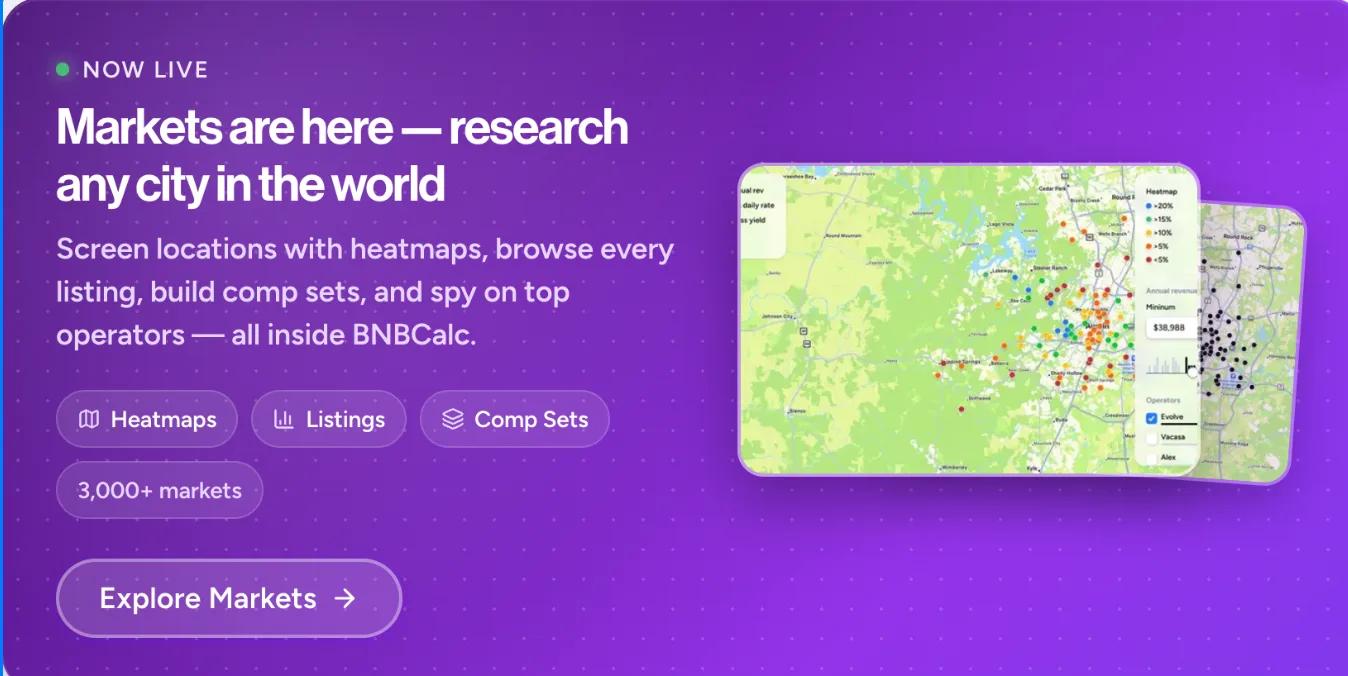
The rest is mechanics. Service fees, equity splits, remote renovations, and why the room keeps buying where the data is thin. BNBCalc Markets is where you'd check yours.
Key Points
- Federico scaled his first management company to 75 units across Texas, Arizona and Alabama, then stepped back into a passive ownership role there and started a second company aimed at higher end properties. Ten years training airline reservation staff is why every VA he hires sits through a two week program, including the ones who already worked at Airbnb. He also got certified as a short term rental safety inspector, which earns a 10% insurance discount on properties that pass.
- Sarah, one half of Karwell Designs, 4x'd her business in a year, one Michigan lake house to four. She held on to managing them herself for two years because every dollar counted, and it took chapter two of Buy Back Your Time to make her hand that piece to Federico. She was the third Airbnb on her lake, and the count got to 52.
- Madi says the properties she sets up, her own and her investors', run 40 to 60% higher than AirDNA projected for them. She still underwrites each deal at the number the property should realistically do, so the outperformance stays upside rather than the plan.
- Skyler was finishing his 30th renovation in 15 months without being there, having visited maybe once or twice in a year. Day one is what he calls the security purchase, Ring cameras and Schlage locks, so he can see which contractors turn up and whether the packages arrived. In the Poconos he sticks to three or four contractors he's run roughly 10 projects with apiece, and pays a couple hundred extra a week to keep deliveries out of the rain.
- The fund Skyler project manages for buys three to five bedroom houses in the Poconos, somewhere around $400,000 to $500,000, puts 20 to 25% down, then spends roughly $150,000 more on renovation and furnishing before the listing goes live. Those figures belong to the fund rather than to Skyler, and his read is that a first time investor who feels even slightly skeptical should pick a different market.
- Madi's entry deal is a trial run. One property, a much larger service fee taken as a 50% deposit plus payments along the way, and no equity or cashflow for her side. If the fit works, the deals after it carry a smaller fee plus a share of the equity and the cashflow. Then a private money lender told her she could have charged the fee and taken both, which Skyler admits made everything they had already signed look worse in hindsight.
- Buying abroad means cash. Federico counted $250,000 by hand across a table for a condo in Argentina, and the room's read on overseas deals is that financing is the whole difference, 100% of the price up front where an American buyer grumbles about 20% down.
Full Transcript
Listen to the full episode on Apple Podcasts, Spotify, or YouTube.
Jeremy: What's up, guys? We are live with the Short Term Rental Pros Podcast. So excited to be here today with not one pro, not two, not three, but four. Four of them.
We are live from Lower Manhattan, New York City. They're all visiting for the weekend. Super stoked. Let's just go in a circle. Everyone introduce yourselves, and what do you do for a living?
Federico: All right, should I start here? So my name is Federico Zimmerman. I know that's a tough one. Freddy is fine as well.
I am a short-term rental operator. I have a property management company. I've been in the space for three, four years already. Growing, managing for some people around here. So we're just touring properties, visiting New York.
Jeremy: And you help Sarah out. How did you get hooked with all this squadron?
Federico: I was always starting together with Sarah in Texas. It was like the first arbitrage deal that we got. It was through Sarah.
Jeremy: And you were designing properties.
Federico: I was like, let's see how it goes. It was our first arbitrage deal with my friend Steve. I'm from Argentina, that's where my accent is from. He was managing from there, he was in Texas. I had already rented my property, my spare room in Argentina. He was doing some house hacking. And then we got introduced to Sarah. She brought this deal and we tried it. It went really well.
From there we went to a second arbitrage, third arbitrage, fourth. And then some people reached out and were like, hey, it looks like you know what you're doing. Do you want to manage for me? I was like, yeah, sure, let's give it a try. And we scaled to 75 units, mostly in Texas, Arizona, Alabama. And then you catch up on that. We grew a lot.
And then I realized that I had a vision on more hospitality. That's just not quantity, but quality. And then I started a new management company a month ago to cater for that market, which is just more luxury, higher end properties.
Yeah, and a vision on hospitality. So it's not that if you have a luxury property and you also own like an apartment based on an arbitrage, and it's declining, if you have the vision on providing a unique stay. And that unique stay could be through location, design, theme. But it's something that will drive demand.
And you will let me do what I like, which is providing hospitality. If I need to set up a gift, I can do it. If I need to fix something quickly, I have the room to do those type of things. Because something that I explain is that every penny that I put in the property is going to have an ROI. It's going to be maybe not immediate, but those reviews that you're going to get, those amenities are going to pay out in the future.
And I think that the struggle that I had before is when you're working with anyone, and a lot of people go into real estate, they don't understand. They don't see what it takes to win at this game. They're penny pinching and they're handcuffing you from doing your job and doing what you actually want to be doing for a living.
Jeremy: Okay, cool. Well, we're going to get into your operations in a little bit, because managing properties for other people, co-hosting, as many call it. But yeah, let's just keep rolling. We got Madi. Tell us about yourself.
Madi: So I'm Madi. I work with investors to find, manage, design, set up Airbnbs for them. So they own them outright and they come to me to do all the work for them, like A to Z. Find the property, set it up, design it, put all the amenities in there. And then Federico is the management portion of that process.
Jeremy: Fist bump. You guys going to fist bump?
Madi: And we met through Sarah and Emily, because she was sharing all about Federico and saying how passionate he was, how good he is at it. And we felt the same way. And management just wasn't for us.
Jeremy: And you have your own portfolio as well, right?
Madi: We have four arbitrages in San Diego and then one arbitrage in Hudson. So we're mainly focused on upstate New York now.
Jeremy: You arbitrage? Well, we'll get into it. I guess we got to keep going. I was about to say, the barn? You arbitrage a barn?
Madi: Oh no, that's a client's property.
Jeremy: Oh, that's a client's property.
Madi: So we have a portfolio of properties in upstate New York that are each owned by different investors.
Jeremy: Gotcha. Sarah.
Sarah: Well, hello. I'm Sarah. I'm one half of the Karwell. So the other half of our business is not here. Shout out Emily. She's currently wrapping up a property, and the last portion of the properties are always just a monster.
But we mainly are in Michigan. So we have a couple of arbitrage properties in Texas that Federico, of course, has managed over the last two years. And then we decided to start actually purchasing properties in Michigan instead of arbitrage. And so now we're up to four properties in Michigan, some investor funded, some self funded.
And then we have a huge education component on top of our business. So right now we're focused on growing our community before we really decide how we want to scale. So that's where we're nailing it right now.
Jeremy: Skyler.
Skyler: Yep. Hi, guys. I'm Skyler. In addition to working with Madi on all of our rental arbitrage properties, I also work for a short-term rental fund where I project manage renovations and design projects pretty much all the way through. So my main gig is from the minute we close on a house to the minute that we go live on Airbnb. It's really just managing that.
And I think one of the coolest parts of it is it's all from my laptop. So I hardly ever visited these properties, maybe once or twice over the last year. And I'm about to finish my 30th renovation project in the last 15 months.
Jeremy: I think that's great. I texted you, I was like, bro, how do you do it? Even doing like one project managing. I try to do like one at a time. And to me I'm like, what's going on?
Skyler: Yeah, I'm not actually at the property. So I'm like, yeah, there's pros and cons.
Jeremy: Well, we can dig into it.
Skyler: But yeah, there's definitely some benefits. There's a little bit less stress, in my opinion, involved when you're just doing it from your laptop. You really have to rely on your boots on the ground in the particular market. But it's nice being able to build out relationships with folks as well.
Jeremy: If it's for a fund, are you less? Because for me it's like mortgage payments come and due. I got to, this thing's got to start making money. Like I'm buying a ticket, I'm flying there. I walk in, I'm like, what, this thing's over here, this thing's over here, what the hell is going on? I call every dude I can find and get him in the house. Let's get this.
Skyler: Yeah, there's a lot that goes into it. I think the biggest thing is timeline, like what you're talking about, in terms of those holding costs that are involved. And there's definitely some room for error, which also the company that I work for, I think, built in understanding a little bit more over the last year of, hey, we're not there in the market doing this. I'm not at the property, I can't really make things go quicker, being that can't get their furniture assembler.
Speaker: Exactly. So it's taking five hours to put together a freaking TV.
Skyler: Yeah. So there's some room for those buffer periods. I think if I was there in person, they would be able to be completed a little bit quicker. But instead of being there, you just have to do the due diligence from FaceTime, video calls, stuff like that. Really need trustworthy people.
Jeremy: Yeah, well, I think it's really cool.
Skyler: Yeah.
Jeremy: I feel like in this room I ask a lot of questions to the folks. I haven't asked you questions yet, but I've got plenty, plenty coming for you. That's why I'm so excited for today.
But I think what we should do first, and I know this is stealing from Sarah's playbook, so I'm sorry, but let's say there's the good aspects of everything going on. Let's start with the not so good. Let's give some horror stories. Federico, I don't mean to pick on you first, but.
Federico: No, that's fine. It's just that at this point it's like we became so used to things from time to time going wrong that it's like, okay, it's not that bad for us. And then you talk to other people and they're like, oh, if that happened to me, I'll go crazy.
Jeremy: Yeah, but I mean, we can tell. You don't sweat it.
Federico: The other day, one of the properties, like the septic tank.
Speaker: Oh, yeah.
Federico: It was like first property, first day. And that's in New York. Beautiful house. Everything's going great.
The morning the guests are checking out, they reach out and say, hey, by the way, there's an alarm going off in the basement. We don't know where it's coming from. We think, okay, maybe it's a smoke detector or the CO detector. Do you want to check that? No, it's coming from another place. Okay, well, we're going to check when our cleaners arrive. Cleaners arrive. Hey guys, the basement bathroom is flooded.
Jeremy: From the septic or from like the well?
Federico: At the moment we have no idea. We'll probably tell by the color of the water. Yeah, send pictures. Send pictures.
So we say, okay, we have someone to send. So we're going to send someone, because we have a check-in. Guests arriving, $6,000 booking, so we didn't want to lose that.
So immediately I reach out to the guests and I tell them, listen, just to let you know, we have this going on. We're working on a resolver right now. I'll keep you posted. I don't want to push it to the last minute to see if we can solve it and then tell them when they're five minutes away.
We send a plumber, so there are problems with the toilet, but then we still can't figure out the alarm. Long story short, we had to cancel the stay.
Speaker: This was the septic pump that was pushing the water to the city.
Federico: Yeah, exactly. So it took us like three, four days to fix it, because we're having different people coming from the septic company, from the plumber, from the owner.
And then the owner was like, okay, let me find someone, I'll send someone from my crew. We tell that to the guys that we have working there. It's like, you're doing a mistake. He got mad at us. And then that had to end up finishing the job, because the owner didn't find anyone else. So burning bridges, it's like, no, we want to keep the relationship. So like that, yeah.
Jeremy: Got it. A reason one. Of course it's the first day. It's like you come out the gate swinging, just wanting everything to go right. First day, septic issue. I feel like it's natural. So was it prior to, that was at the end of the first day?
Federico: Yeah, so it was for the second.
Speaker: Yeah. And it's often what you find is the first time. A lot of these houses, and honestly, probably all of our portfolios, mostly more vacation houses that really nobody has lived there for a long time, which is why we're able to get deals on them, because they smell bad when you walk in and tour them. They're dilapidated.
Jeremy: What do you mean? Never smelled it.
Speaker: They smell like the sulfur or whatever. And that's why people don't buy them. And that's why you can get deals, because they haven't been used.
Speaker: They haven't been used. And you can kind of, we paint on top of everything, but stuff like the septic and the wells and all that, you can't really paint on top of it.
Federico: Also, Madi, like any new investment you need to put in the contract that after the property is ready, we're going to throw a rager all together for three days. Use all the toilets. Make sure it works.
Speaker: Yeah. Yeah.
Speaker: It was one of those things too, where we didn't know what alarm they were talking about, because it was up in the corner and they had put tape over it. So I was like, it must be a light switch for something that has to stay on in the house. So we had no idea what it was. And then they were so adamant that we were on city sewage. So no mention of a septic pump or anything.
Jeremy: Oh, wow. Like the previous owner or the owner. Isn't that, that's not a disclosure? That's like a closing disclosure. That's literally supposed to be in that document. You got to check which one it is.
Speaker: It is on city, but it still has a septic system. It's a tricky. Because it has to go uphill. So the toilet is here and then the pump is here with the city stuff. So it has to pump the stuff into it. It was mostly like a pump issue.
Skyler: Yeah. And this is, I think, a good point too. It's like when you're working with investors too, this is their first time especially buying an Airbnb property. They should absolutely be doing every last bit of due diligence prior to closing on that. And this was a problem that probably could have been figured out before he even closed on the property.
But this is why this homeowner, or the investor that Madi's working with, he wasn't really upset about the situation, because he's honestly like, this was my bad situation. And so we were just there to facilitate the issue.
But I talked to the septic guy and I was like, is there any way we could have known? Is there something I should have done to have been aware of this? And he said a good home inspector would have caught it, because in the electrical panel there was a spot labeled for septic pump. So he was like, had you had a really good home inspector, they probably would have noticed that there was a pump, and then they would have recommended the septic inspection.
Speaker: Like the additional pressure.
Speaker: Yeah. We both had septic issues. In my house, my first property that I purchased also had, like, from now on it's like I'm going to do all the inspections.
Speaker: Yeah, everything. Chimneys, bugs, structural, septic, wells.
Speaker: As you can tell, we can go on and on about septic.
Speaker: Yeah, I pump those suckers all the time. I was like, any potential septic, pump it. Pump it. Get everything out fresh. After high season, it'll be like six months after we pumped it and we're like, no. These houses are used to having like two people in there all summer long, and you max it out every single day with 10 to 12 people. Pump it. Pump it.
Speaker: Oh, it looks like there's an issue. All right, come over. Pump it. Literally. Oh, the issue went away. All right, cool. I don't need to know what the actual issue was as long as we got it. It's for a later problem.
Speaker: Yeah. Obvious.
Jeremy: Our next story.
Speaker: Which one do you want to tell? Because we have shared stories, so it's like.
Speaker: You pick whatever, because I can pick from whatever.
Speaker: Which one?
Speaker: The one with the homeless guy.
Speaker: Oh yeah. Oh, this one makes us look so bad. But yeah, there's something we could have done.
So at our arbitrage units in San Diego, they're in a really good location, but they're downtown. So it's like noisy, there's some homeless people. It's just stuff you deal with being downtown.
And we had a guest check in and she sent us a photo of the bed and she was like, I don't know if the cleaners actually came, because the sheets were folded over and the pillows were flat. It looked like someone had just stood up and walked out and just slept in the bed. And we were like, no, they came, but it was the day before. So there was a night open that, I don't know. We were like, maybe they didn't clean, but they swore they cleaned, and she was okay with it. She was like, it's fine, I'll still stay, not a huge deal as long as you're sure it was clean. And we're like, yeah, we're sure.
And then she's sitting in the living room, and you can see a back door from the couch, and a guy walks in and he was like, what are you doing in here? I slept here last night. A homeless guy says this to our current guest.
Jeremy: Oh, goodness.
Speaker: And she tells us that. She calls me and she tells me this. Are you okay? Are you safe? What are we going to do? Let's get you out of there. And she's like, no, no, no, I really want to stay. Please let me stay. And we were like, it's up to you. If you're comfortable staying, I'm not going to kick you out. And then he came back again.
Speaker: Yeah. And she's just fine with it. She just kept telling me. She's like, I love it here. She's like, this is the best Airbnb I've ever stayed at. And we were like, respect.
Jeremy: This is like a horror story. It's like a guest dream. Sounds like you're the best guest ever. Airbnb. How did we let this happen? Like, I'll give her a discount.
Speaker: Yeah. And then we went to meet her. And it was one of the situations where she had been kicked out of her previous Airbnb, so Airbnb paid for her to stay in ours. And she was just crazy town.
Speaker: Yeah. Crazy town. Just as crazy as the homeless person.
Speaker: Oh, I thought you said she was like imagining the homeless person.
Speaker: No, no, no, no, no. [inaudible]
Speaker: I think the reason we actually found out she wasn't lying was we were actually living in San Diego at this point, and I think I went by the next day and I saw the homeless guy just chilling around there, and eventually he just left. But I think that's what verified, oh yeah, this is define a legality.
Madi: He like trying to get in like our courtyard again. He came up to Skyler and he was like, that's my friend's house, can I go, and.
Speaker: And we were like, that is not your friend's house, dude, that's our business. Please, please, please.
Speaker: She ended up like deep cleaning, literally. She cleaned all our ceiling fans. She was cleaning the actual ceiling of the Airbnb when we went to go check in on her. So I think crazy attracts crazy, like that wouldn't have happened to one of our normal guests. It was just like when it rains and storms with these crazy situations.
Jeremy: That's crazy.
Speaker: That story is one of my favorites. So a homeless man spent the night in our Airbnb. He didn't take anything either. He truly just slept in the bed and then left.
Jeremy: Left. Gotcha. Can't just provide that good of an experience.
Speaker: Yeah. He couldn't resist.
Jeremy: Your guest literally is so thankful that they are literally going to clean your ceilings. Did she leave a review?
Speaker: Did she leave a review? No, the homeless man.
Speaker: Oh, yeah. Funny. Homeless man say, hey, can I have your computer? Let me, I really. A few suggestions. Maybe lock your door and don't let someone break in.
Speaker: Yeah, exactly. None of the snacks in the fridge.
Jeremy: Yeah, I'll go quickly. So most recently, like Federico, I feel like I have so many that it's just like, I don't think last week, the week before.
But most recent would have been, had like a refugee family, like families stay at one of the properties, and cleaners came at 10 a.m., 11 a.m., whatever, when they're supposed to go. And they were not leaving. They were not going. They're all in their pajamas. They were like laughing at the cleaners. Cleaners sent photos of them. They were like laughing at the cleaners.
Just being like, and having them like, oh, they have family there. Sending photos of them just being like, to our companies.
I called the, what's it, like a refugee agency? It was like a religious group, and I called them. I was like, yo, they gotta go. We got folk coming at 4 p.m. And they were so apologetic, because they need to work with folk like us who provide housing for their clients, or what they call them. So they just called them a bunch of ubers and literally had someone come make them leave. So that was like last week.
Also wasn't bad. I've charged like a $1,000 cleaning fee and they paid it to me. I was like, d*mn, I could have gotten that probably. I had to tell the next guest who was staying for a month like, yo, can you come, sorry, it's gonna be like 8 p.m. Because they also, I mean, they didn't do damage, but there was crud everywhere.
So yeah, that was that. And then like a couple weeks ago I had a guest who, there was a dog. So we have like three apartments right next to each other. And there was a dog barking, one of the guests' dogs just wouldn't stop barking, I guess. So another guest took it upon themselves to literally break down the door. And they didn't do anything to the dog. I think they just scared it somehow to stop barking. They literally broke down the door, they broke the window.
And these guests, honestly, I don't want to make it, I was assuming in my mind the guests who broke down the door, they must be younger, more like, whatever. I was coming to my own conclusion. But they were like a grandma, grandpa, like going to town to see their grandkids at like Duke University. They were like an affluent family. And yeah, same thing, charged them like whatever, $1,000. They paid it instantaneously.
Speaker: Yeah. So I mean, you need money for both.
Speaker: Yeah. So this is a horror story.
Speaker: These horror stories are like dream situations.
Speaker: Exactly. It's a positive experience.
Speaker: Yeah. It's very stressful in the moment, like your nervous system definitely reacts, but it always worked out.
Jeremy: Luckily it was VRBO guests who got broken into, because they were like, hey, someone broke into here, and we're like, oh crap, someone broke in. But then we look at the cameras and it's like, wait, it was literally a guest in another apartment who broke in. Is that good or bad?
Speaker: Right. It might be bad, but it was VRBO, so it's not the whole Airbnb taking you down.
Speaker: Taking like 10 phone calls just to be here to answer.
Sarah: I've been thinking of what horror story I want to share. I'll share one of my favorites though. This was probably six months ago, maybe, at one of our lake houses. So weed is obviously legal in Michigan and.
Speaker: Obvious. Why is it so obvious? I didn't know this.
Sarah: News to you all.
And so we have a family arrive at the lake house and they don't arrive until like 9:30 at night, so it's already dark outside. We see them come on the cameras. They have one small dog with them. So it's like mom, dad, three kids, small dog.
And they're there for like 45 minutes. And all of a sudden we get a message from them and they're like, our dog consumed something in your house. It's acting funny. We had to immediately rush to the vet. We're expecting you guys to compensate us for this vet bill, so on and so forth. We don't know what's wrong.
And so I'm like, what could possibly, like what is a dog going to consume after it's been professionally cleaned that's going to land this dog in a hospital situation? And so we just wait, and we look at the cameras and you can see they're all rushing out. The mom is holding the dog, everybody's panicked. And I'm like, what in the world?
And so a couple hours later they messaged us again and they're like, the vet let us know that our dog must have found an edible on the ground and ate the edible. And so they were like, we do not consume marijuana at all. That is not our family's thing. This is something that was in the Airbnb already. This is your fault, yadda yadda. And I'm like, what? There's no way that we missed an edible, but maybe, who knows? And so.
Speaker: Oh, leave the brownie in the fridge.
Speaker: And it's like, when you're a host, you can just throw everything out, throw everything out. I don't care what, it doesn't matter what a day I'm like, oh, it's a bottle of champagne.
Speaker: No alcohol. No alcohol.
Sarah: And so I was like, you get jaded as a host after a while, because you see so many horror stories about people lying to get refunds, so on and so forth. And so.
Speaker: That's a unique one.
Sarah: And so I was like, well, maybe their kids had it and their kids don't want to tell the parents, and they were eating edibles to hide that they were getting high on this family vacation. I get it. And so I was like, I've been there.
And so I'm trying to determine whether it's justified for us to give them a refund or not, right? Because we had it clean. We have recordings of it being clean, so on and so forth.
So I decided to reach out to the previous guest. And I was like, look, you are not in any way in any trouble. You absolutely are allowed to smoke on our property or eat marijuana on our property. Totally fine with it. But I just want to know if you guys had edibles. And the guest responds immediately. And she's like, yes, we did. And I was like, oh, no.
So we ended up refunding the guest because they didn't come back to the property. She was like, I'm worried that my dog is going to find another edible. And so we ended up having to refund that guest. We did not make any money on that situation, but their dog survived. It just took a long nap.
Speaker: And I think that's fine. Actually, think about it.
Speaker: Yeah. One, literally probably most recent guest, checked in like yesterday. They were like, it smells like weed in one of the bedrooms. And our cleaner had sent us a picture of like a J in a toilet. And I was like, can you get the smell gone in the next six hours? Do I have to get like a smoke remediation service? And she was like, yeah, we can do it. And I was like, all right, sweet.
And then, nope, never mind. But they were cool. They were like, oh, we just fortunate having a bunch of bedrooms. They were like, we'll just use other bedrooms. Just an FYI.
Speaker: Yeah. You always have the guest serving going to be cool in situations. Most guests, most guests. But it's a game of percentages, unfortunately.
Skyler: This is one that Madi and I have told a bunch, but you haven't heard it yet.
Speaker: Oh, sorry.
Skyler: Yeah. We had a house in Big Bear, California. It was like our first, actually did like a live in flip. And since, I've sold the property about a year ago now. But it's a single family home, but we kind of turned it into like a makeshift duplex to run it as two separate units on Airbnb.
And we had gotten the first unit all done, and we've had our first guest check in. Madi and I took a trip down to San Diego for the weekend. And we get a call at like nine o'clock at night. The guests had gone to dinner, came back, and they called us and they're like, hey, we just got back from dinner and your entire unit is flooded, completely flooded.
We kind of looked at the weather. There was like some rain happening. So we're like, oh, dang. Okay. So ended up, we drove back up to Big Bear that night. They checked out, we get there, and it's just like you walk in and it had carpet at the time. So just like mush. There was probably at least like two or three inches of water inside that whole, you know, we had just finished this.
And so had to go through the whole process, like next day drive all the way back down the mountain from Big Bear, go rent like dehumidifiers, we rip up all the carpet. Madi starts looking into like our insurance policies and stuff. Ended up being a flash flood in the neighborhood, and we didn't have flash flood insurance as a part of our homeowners insurance. So this ended up all coming out of pocket for us.
Jeremy: But ended up being a lot of people in California about to face that this week. The first hurricane or tropical storm apparently ever to hit the western part of the US.
Speaker: Yeah, I'm like, how? How does that?
Speaker: Our guests are reaching out because we have arbitrage in San Diego. We have two guests checking in tomorrow that are already like, hey, just checking in and see if there's any additional information. I'm like, no, there's no information we have that you don't have.
Speaker: Exactly. Yeah.
Speaker: The question I need to ask them, huh? Do you buy the travel insurance?
Speaker: Yeah. So no, it's like, well, sorry. Thankfully, none of them have asked yet for like a cancel. I think one said that they might just move their check in date to like the next day, which I don't know how it would handle a refund of that first day or not.
Speaker: Y'all in Florida, you don't know how to literally. You're like, hurricanes.
Jeremy: Yeah. Last year it was, honestly, hurricanes actually worked out pretty well because they hit other parts of the state. So it was like everyone's freaking out because they're like, we need housing because our house is about to get hit by a hurricane.
Speaker: Yeah. Surge pricing. I'm just kidding.
Jeremy: We didn't know that. We're like bringing them water. And so that was, well, that was, so yeah, last year.
Sorry, I know I'm asking you guys questions. But last year, the hurricane that hit Florida, I think it was Ian. Was it?
Speaker: I think so.
Jeremy: And it hit, so it hit the western part. So fortunately, we have two in like West Palm, which is on the east side. So I say West Palm, east side. Sorry, I'm going to use anyone there. But it hit like the Tampa, St. Pete side. But still, we got like tornadoes, we had. But still a lot of people coming from that area needed housing. So they stayed with us. And it was actually really nice because, well, it was a sad experience, but they were really thankful because they needed housing. So it felt.
But then that hurricane went up to the Smoky Mountains, where we have properties in the Smokies, caused power outages everywhere and a bunch of mayhem, then whooped it over to like central North Carolina where we have the rest of the portfolio, and literally had power outages like every house. And I happened to be in town, which normally I am not in town. I happened to be there. So I was like, yes, I'm just going to bring everybody. I was actually at a wedding there. So I just brought everybody water.
And they were really thankful. So everyone was thankful. And I don't think we really had to refund much or anyone, even though hurricanes literally hit every single one of our properties.
Speaker: Yeah. I'm assuming that content being like, oh, I'm so glad that's isn't crazy.
Federico: Like, I think we all been through a crazy experience when we launch our properties and we still are in the space and thriving. But I mean, you've got a property, everything's stolen, which you just started, and COVID. I go with my first arbitrages, I go, there's [inaudible] or whatever it was called, a winter storm in Texas that basically was a mess, like cleaners couldn't go to the properties and everything was shut down.
I mean, you had the flood, the flash flood. We all got like something crazy.
Speaker: Your capacity just gets so much bigger, though, for chaos. It's like, even, we've had nightmare stories this week, right, that have been really dramatic. And we've had conversations internally where we're like, this we would use to lose sleep over. We would be like, oh my gosh, this is going to be the thing that crushes my business. And now we're like, of course. It's just part of it. You just get used to it. Your stress response is not the same. You're like, okay, it's part of it.
Madi: It's interesting working with investors because they're very fearful of those things. They're like, what if the septic backs up? What if they're done that? And it's like, I have a hard time sympathizing because it's like, well, figure it out. What do you mean? If that ever happens, we'll be fine.
Speaker: It's almost like it's gonna happen.
Speaker: Yeah. You have to like go into it. It's inevitable.
Federico: And that's something I tell a lot of people when they're asking about getting into space. It's like, how do you deal with the situation? What do you do if this happens? Like, well, it's going to happen. You need to know that sometimes it's fine to having to cancel a stay. Sometimes you may sadly ruin someone's vacation, but it's something that happens even in hotels, airlines. It's part of the industry.
But you know, you keep after so many issues, you forget about in life, because now we were talking about horror stories and I thought about one that was really horror story.
There was a guest left like the gas open on purpose on the stove because he was p*ssed about something. Of course I'd call it. I think they want to overstay, to have to call them and get them out. And when they closed one inside, it was like, this smells really, really weird. He found the stuff, like he shot the gas and then left. And of course I got a call, a safety team on Airbnb. It's like, you need to get these people off the platform.
Speaker: Yeah. That's bad.
Speaker: Yeah. That's terrifying.
Speaker: I saw one on TikTok where the guests plugged all the drains and left all the water running when they checked out. So someone walked in and their whole house is just filled with water. All the faucets are on. Can you imagine?
Speaker: Unfortunately, well, Airbnb, if they stay through Airbnb, doesn't like those stories getting out. So you do have a little bit of protection with them when someone books. But if someone doesn't book through Airbnb, VRBO for instance, I think they're, I don't know, I mean, you probably know more like VRBO. They don't really care. You can't really escalate stuff with them. They just, you have a liability insurance with them if things really go south, but it has to be a big issue.
Speaker: Yeah. Otherwise you need to make sure that people are paying for their third party. But even their third party, it goes up to like 5,000. They pay 50 bucks, it goes to 5,000.
Jeremy: I do a deposit. And honestly, I do like VRBO because you can hold their deposits, like no questions asked. Not that I'm going to do that to someone who doesn't deserve it. But a guest last time, the hot tub is supposed to be off in the summer. You're not supposed to use the hot tub. They filled it up. They turned the water, it was disgusting water. So, you know, do all that jazz to it. Plus they left like all their IDs and credit cards, so our crew had to go drive over and sh*t.
It's just, I'm not even going to add everything up. Just 500 bucks. Y'all, this was, y'all were annoying. 500 bucks, and no, VRBO, two seconds later, accepted.
Federico: And that's why it's also important that you keep all the communication in the platforms. That's a mistake that we learned the hard way, but saved us a bunch of times, which is if you are communicating anything outside of the platform through calls, text messages, go back to the platform and put everything that was discussed. So you have proof in case of things happen. So you have a proof to Airbnb. Airbnb was like, hey, we had this conversation with the guest.
Speaker: Yeah. Versus like sending them screenshots of text messages. They don't really.
Speaker: Or if it's a call, you have no proof.
Speaker: Yeah. At this point, yeah, I don't even entertain texting with guests anymore. It's like if they even try and text me, or even if they call me a lot of times, I let the first call go to voicemail, and then they double call me, I'm like, I'll pick up now. Or I'll just immediately message them on Airbnb. I'm like, what's going on?
Jeremy: Yeah. I just finally got my virtual assistants, like OpenPhone. Because I try to, and I feel like we're probably all, like you said, quality versus volume, like try to stay five star. Our properties, they f*cking crush. They're not these cookie cutter, one bedroom apartments that I do a zillion of them. Each property crushes.
And I always had the feeling like if I was going to offload the phone calls to a VA, that the quality would go down. But then I said, why is that, f*cking, I don't care. I'm not getting texts anymore. That was like a this week thing.
Speaker: Well, it's like, I know the book, I think all three of us are reading right now, is the Buy Back Your Time. And I just love the part where he talks about just the cadence of the process of training people. It's so helpful. Taking them through, making them videos, the checklist, everything that he outlines in that book. I think it's just perfect for what we do, in terms of especially training people to communicate with your guests. It's crucial.
Federico: Yeah. That's exactly what I do. I mean, I have a team.
Jeremy: Yeah. How many people you got? I mean, how many properties are you now managing?
Federico: So right now, I went from 75 to 10 now, but scaling quickly. So I do invest a lot.
Jeremy: Where are those 75? They're the old company?
Federico: Yeah. I'm still part of that company as owner, but in a passive role where I still like provide.
Jeremy: Any drama there? What is it? Any drama there?
Federico: No, no, actually it was luckily like my partner.
Speaker: It's a safe zone for partnerships.
Speaker: Now we're doing partnership horror stories.
Speaker: We don't have enough time.
Speaker: We've got two hours. I don't know. We've got plenty of time.
Federico: It was hard having the conversation, but I'm glad that I had a conversation, because it is a friend. Steve is a good friend. He helped me coming to America through this company. So I'm so grateful. I think that the company that was started let me achieve a lot of goals, like leaving my nine to five, moving to America.
Okay. But I don't think that he was able to achieve some goals that he wanted, like retiring and things like that. So it's like, I'm going to step aside, focus on what I want to do, and you can run this the way that you want to run it and hopefully achieve your goals. So everything's fine over there. But yeah, over there we have 75. It was around the number that I've had. Now I'm around 10, but I'm more like five more.
So the thing that I'm very invested is into training, because that's what I did in my nine to five, or 10 years in the airline industry, training people around the world in the reservation offices. And just to take a call, to make our booking over the phone, is a month worth training. And I realized the power of training when you have a team.
So all my VAs go through a process of training. It's a two week program that we do where they learn all the hospitality. Even if they worked at another management company, even if they worked at Airbnb, I want them to understand how I like things to be done.
Many times you need to do a deeper, I mean, of the communication part, and you probably hire VAs. You know what I mean? Which is like the conversation is very support chat. Like if you're talking to, I don't know, your bank or something like that, and you're being handled in the Philippines or something like that, which, it's not that it's wrong, but it's not what I want to provide. Because I don't have a property management company face on Airbnb. I keep our face.
Speaker: As you should, they do better.
Federico: Exactly. If otherwise I'd probably be a little. And it's like, how do I make it where they understand that they have to communicate like if there were Mario or Sarah or Skyler or another one of my clients.
Speaker: They need empathy.
Federico: The empathy, but also the type of words, because it's very common for them to use like, kindly let me know this. Right. And those are very, that words.
Speaker: Passive aggressive.
Federico: But they think that sounds good, because that's how they talk in when you learn English as a foreign language, which is how I learned English.
Speaker: I have a question. Have recently you seen your VAs trying to using ChatGPT more often?
Federico: You know, I actually encouraged them. I told them anything that you can use that's going to help you on the job, I'm happy that you use it as long as we keep the same standards. So if it makes it easier.
Jeremy: I said, no ChatGPT, you're writing this stuff for yourself, using your d*mn fingers. None of this. Because you can just tell it's ChatGPT. I'm like, ChatGPT question mark. Like I started a screenshot and they're like, yeah, ha ha. And I'm like, not funny.
I'm just kidding. I'm kidding. If I can't tell, then it's fine. But if I can tell, this is obviously, because also when they'll ask questions about an area, that's the issue. When like a guest will ask, what are some things to do in the area? And then they ChatGPT and it tells them stuff that was opened five years ago. Like, this is a very fun family activity to do. That's a no more.
Speaker: How do you set up those systems? So you already have something prepared for that.
Federico: So we try to have like all the common questions, like, I don't know how to do the pool heater. So we already have something there. So I tried to.
Jeremy: You let them touch the pool heater?
Federico: Yeah.
Jeremy: Oh, I blocked that off. I put a fence around that with a lock. No pool equipment. 85 degrees. It's not changing. I'm not paying more money to blast it to a hundred degrees.
Speaker: Well, it'll never get to a hundred degrees while they're there. That's like such a big pool.
Speaker: We do tell them like the range of temperature you can use.
Jeremy: 85. That's where it is.
Speaker: That's good advice.
Jeremy: We were at 78 and we were getting too many complaints. 85 is the optimal. Because the people at 90, they're like, it's too hot. Like, well, it's Florida. I can't turn the sun down.
Speaker: Yeah. We did 78 too. That's good to know, because I googled it and it said 78. I was like, sure, the optimal temperature.
Jeremy: Mark my words.
Speaker: We just had a conversation we had this week, right?
Speaker: Yeah. We were just there yesterday. What's the best temperature? 78 is like kind of chilly, right? I don't know. We didn't get in.
Speaker: Maybe upstate New York. It seems like counterintuitive to have a heated pool and a hot tub. So I'm like, don't you want this? It's crazy. Because I went to Palm Springs for Christmas and I'm going again this year. And the pool was like a hundred degrees. And there was a hot tub, it was like 105. I'm just like, this is, I mean, I was like, I'm not paying this electric bill. I don't see any solar panels on this house.
Jeremy: That's what they got to do there though. That's like Palm Springs.
And I guess next part I'm gonna get to, I feel like commonalities amongst us is like, we're investing in places that there's probably less data, less competition. You know, the Scottsdale, the Palm Springs, like those markets, you don't have the heated pool, don't have the hot tub, don't have the pot pot at this point, like you're screwed. You're screwed. You're not winning. But in some other places, Michigan, upstate New York, like North Carolina, there's no like blueprint for what exactly you need to do to win.
But I guess my question is, how do y'all, how are we winning? How are we all winning? Because I feel like we're still hitting home runs, where a lot of people you see on social media, maybe in 2020, they actually were really good investors and they pretty easily hit home runs. And now maybe they're making so much money with everything they're doing that they can spend a half million dollars in cash to hit what appears to be a home run online. But how are you doing it for investors? How are we still hitting home runs?
Madi: Yeah. I think for our properties that we set up for investors and our own, we're performing like 40 to 60% higher than what AirDNA told us that we would, which is amazing. But we don't bank on that happening. So we obviously have to make sure, especially with investors, that it underwrites at whatever the actual revenue should be, and then so we can outperform them.
But I think it's all about the design and all about the photos. That's it. Once you have that, then it's like the welcome gifts and the amenities and the good customer service.
Jeremy: Y'all all do welcome gifts here? I do zero welcome gifts.
Speaker: Oh, you have to start.
Speaker: Well, it depends on your clientele.
Speaker: Yeah. Mine is simple though. It's not extravagant.
Sarah: You go above and beyond, but you're in a very bougie market, right? Hudson is perfectly curated.
Speaker: Instead of going to the Hamptons this year, I'm going to try out Hudson. I'm going to try it out.
Sarah: In lake houses, the expectation is so much lower. For us it's like, okay, we're just going to stock graham crackers, like s'mores kits, right? Or maybe pancake mix that's just add water.
But even that, compared to, you see other Airbnbs, and even over the last five years a lot of those getting whittled out of the market. But it's just like, compared to a place that doesn't even have K-Cups in it and you're providing a s'mores kit, that's already such an elevated experience that they're used to.
Federico: I mean, something that we're doing is, I'm building with my teams on top of like on search section on our internal system, which is like, okay, let's understand who's coming to our properties every time, like every state that we have, what are they coming for, and what can we do to make it more special?
Which is some of the things that you've seen the last couple of weeks, where we had all types of things from weddings, anniversaries, like a 50-year-old wedding anniversary. It's like, okay, let's do something, and let's have the cleaner write a note or something like that with our names.
We had a family that, this is a really nice story. It was a family that they reach out and they say, hey, we're 16, which is the maximum capacity, but I was wondering if we can bring another two kids because these are cousins, so they want to be together. Nope, maximum capacity, 16.
Speaker: Right.
Federico: But what she's sharing is like, one of my nephews is going through a heart cancer treatment, very aggressive. And it's like, of course it can be 18. But it's like, okay, what can we make? Because we want to make something special without making it on the spot. So it's like, okay, so nephews, like cousins. So we asked her, is there any dietary restriction or something with treatment? No.
So we set up like a campfire kit with s'mores and popcorn. And when you get the review and she says, my grandma was in tears from happiness just for that small touch. That's what I love to do. That's what I love to do. For me, I have so much joy because I know these people are going to come back to stay with us. But that's not why we do it. But that's the ROI I'm talking about when we put that extra dollar.
Madi: Yeah, yeah. And I think in our bubble we're so used to all this stuff, and we're like, of course it's design and amenities. But I feel like when I started posting our numbers on social media, I'm like, look how good we're doing in upstate New York. People will message me and be like, I'm going to invest in upstate New York.
Speaker: Yeah, automatically.
Madi: What town are you in? Oh, you're in, I don't know, d*mn Hudson, whatever. Oh, Hudson. Yeah, I just bought a townhouse. I just bought a $1.7 million townhouse with no backyard in Hudson. Like, why am I not getting booked?
They're not going to get, like, if you want to invest upstate New York and you want those numbers, you have to work with me. I'm so confident. There's no way you could go do that and hit what we're hitting. It's years of experience.
Speaker: All of us combined.
Skyler: Yeah, I think what you were saying too, when you first answered Jeremy's question, it's like the design and the photos. But I think even beyond that, it's more so just the vision of a particular property, especially in these markets.
It's like, to your point, you can't just go buy a random townhouse in the same city. That's not how this works. You have to find the particular house in the particular city that works. And a lot of times, I'm not saying it's like an it factor, like you have it or you don't, but ultimately you have to have that experience level to know that market well enough, and to know, like, maybe this property that's across the street from the one that would do really well would not do well. Sometimes you really have to just know your stuff and have that experience to be able to answer that.
Jeremy: At this point, do you guys agree or disagree that there is no market in the US where automatically you can just buy any property, or rent arbitrage for that matter, any property, and you're automatically going to win?
Speaker: Unless it's like some random a*s small town that you live in, so you know these intricacies.
Speaker: Yeah. There's no way that we could find one.
Speaker: Yeah, or it's a place like, sometimes you'll find there's a big construction going on at some random place in some random area, and all these construction workers need housing for two years. So you can just have a vanilla house a couple blocks away from the construction house, and for a couple of years things are really good. There's definitely one off cases of, in certain times where.
Speaker: Like oil towns.
Speaker: [inaudible]
Federico: But the students understand the cost part, especially if you are doing arbitrages, because I've seen that a lot where people see that a market is performing and it's like, well, I'm not getting an arbitrage. But it's like, okay, you're going to be paying rent and your base costs are already high. So if you also want to have a management company, you're going to be way higher that the owner that is self-managing. So you already have to have higher rates for the beginning to break even. And then a lot of people are disappointed when other people are making money and you're not, but your costs are high.
Jeremy: And I think something with arbitrage in particular, I mean, I make assumptions that we're all like in agreement here that owning long term is the way to go, like owning unique properties that someone can't just come in and plop.
So I think the thing with arbitrage especially, people who want to get in with less money, they want to go after one bedrooms, two bedrooms, studios. And if they do that, you get a one bedroom up. Sure, it costs five thousand dollars to get a one bedroom up. But the thing is, a hundred other people can just come in and just do the same exact thing you're doing. Sure, you guys are buying off someone's furniture sheet online, and you've got the property management system and the PriceLabs, but everyone's got that.
Jeremy: So maybe it works for you for six months, but then, oh, the winter doesn't go as planned. So you truly, again, I know I'm preaching to the choir here, but you got to be unique. You got to be unique. You got to do something someone else can't do. Like you guys just said, upstate New York, if you want to crush it, you got it. These are the kingpins there.
Speaker: Yeah, I still think that arbitrage has a place.
Sarah: Oh, for sure. It was the beginning of all of our journeys. It is a good stepping stone, which I always tell people is like, you better get ready to deploy that money into something that you own. That ship, it doesn't have longevity behind it. Whether it be the landlord that's going to kick you out, or the fact that it's so replicatable that it gets oversaturated, or whatever the case may be.
If you're going to have arbitrage as a part of your strategy, pour it into something that you own. Have that be a stepping stone. Because if you don't make that transition, then there is a shelf life on it.
Jeremy: Or I would say you need to be in a city where there is right. If you're going to do like the apartment game, one, two, you got to be in a city where there's regulation and the right zoning, and there's some barrier to entry. That's all I'm saying is, there has to be a barrier to entry, whatever you're doing. Or you're doing like a type of property. You got a big property with a big backyard.
Speaker: Yeah, that luxury arbitrage is a game. That's a play right now. There's a lot of people that are crushing it. Even like the midterm arbitrage game in these big cities like LA or New York. It's crazy.
Speaker: But you're seeing that shift, right? A lot of us, when we first entered this space, it was like the one arbitrage method of true competition with hotels was working. And now you're seeing this divide of either people going in the direction of midterm rentals with that style of property, or into more unique stays. And so that direct competition with hotel version of arbitrage that existed so heavily before really is kind of fizzling out.
Speaker: Yeah. And so it's definitely in the cities where there's just no, I mean, think about pretty much every Texas city. Even like Austin's getting crushed right now.
Speaker: Yeah. And Houston was like the first one where it was just literally like negative barriers to entry.
Jeremy: Were you in Houston?
Federico: Oh yeah, Houston.
Speaker: Yeah. Both of them were free for all.
Federico: I mean, I took management on a property in Houston right before that. And when you're not performing the numbers and you're just learning, it's so disappointing to go to a client and say, listen, we're crushing the competition and still not making money.
Speaker: It's a lots and lots of competition.
Federico: Yeah. And the only operator now that I know that's really excelling in Houston is arbitraging super luxurious properties.
Speaker: I guess you've got high barrier to entries. They're probably spending.
Speaker: 30 to 50k.
Speaker: They're setting it up. Convincing the homeowner to put in a hot tub.
Speaker: Yeah, you have to. And at that point, you have to sign a ridiculous lease. It has to be like three to five years for you to justify that spend. But people are doing it and they're crushing at it, and it's still less expensive than buying a property.
Speaker: Yeah. I think for us it's been like a lifestyle play. We want a midterm rental arbitrage in LA because we want to be there for part of the year.
Speaker: Yeah. Same with Hudson. The building that we rent, an entire building, it's probably worth 1.5 million. If we were to buy it and Airbnb, we would make no money. Arbitrage makes a lot of sense.
Jeremy: You rent an entire building?
Speaker: Yes. Because in Hudson, you can only have an Airbnb if it's on your primary residence parcel.
Jeremy: So you live in that building?
Speaker: Yes.
Speaker: They do.
Speaker: We do now, but our plan is six months in a day.
Speaker: Give it time.
Speaker: Yeah, give it time. But six months in a day. So it's like.
Jeremy: How many other apartments in the building?
Speaker: One. It's just two total. So we live upstairs and the Airbnb unit's downstairs. But the regulations are kind of fun in Hudson. You can make it work for us. We want it to live there. And similar to our hopeful new midterm rental in LA over the next couple of months that we can get.
Jeremy: I'm going to LA at the end of the month, y'all.
Speaker: Oh, yeah. Oh, 100%.
Speaker: Oh, yeah. I'm going at the end of September.
Speaker: Yeah. I'll be there. We'll all be there end of August.
Speaker: Oh, no. Staying in a hotel.
Speaker: But we'll see you in San Diego, though, right?
Speaker: Yeah, yeah, yeah.
Speaker: Oh, let's go.
Speaker: But yeah, to your point about the regulation play, I think with arbitrage and just anything, you can almost now use it to your advantage. Like in Hudson, I think our unit is luxurious. But I think also part of that is there's not a lot of options in Hudson, because some of the Airbnbs did get grandfathered in. But I want to say they're actually taking away those permits eventually here too. So the supply is going to even come further down. And since it is the residence that we kind of live in, our primary residence, we're able to still run that listing.
Jeremy: Quick question for you. Upstate New York or the Poconos?
Speaker: Depends on what type of Airbnb investor you are.
Speaker: I would say, I mean, what do you mean by that?
Speaker: This could be more of a conversation about, even what you were saying, we kind of personally all go after markets that don't have that data necessarily to support. Poconos got a lot of it now.
Jeremy: Poconos is the opposite. Thanks to your colleagues.
Speaker: I think that's ultimately when you are starting to see all this institutional type of money come into the space, like taking over.
Skyler: When he says that, he says me.
Speaker: Yeah, he's part of that.
Jeremy: This is big, big pharma Airbnb right here.
Skyler: Just play my role. It's just, a check's a check, a check's a check.
Speaker: But I think it's your point. You don't even want to go look at some of the listings that these types of companies are putting out, because you just don't have the capital as a first time Airbnb investor to compete with something like that. So why would you? There's other markets out there that you could go after.
Federico: That's the problem that a lot of people are trying to invest. They look at these markets and say, well, so many people are making so much money, I should get in that market. And then they're crashed because.
Skyler: Yeah, like in the Poconos, on an average, typically we're buying between three and five bedroom homes. The average renovation and furnishing price on one of those is probably around $150,000. And that's not even including your closing costs, down payment. That's just what we spend on a renovation and furnishing of that place. So you really have to have a decent amount of capital if that's the type of game that you want to play.
Speaker: And that house is probably costing you like $400,000, $500,000.
Skyler: Yeah, somewhere around there.
Speaker: Putting 25, 20% down.
Skyler: Yeah. Something like that.
So, I mean, I'm not, I'm not the wrong person to ask about like the acquisitions and stuff like that. I truly just play that renovation management type role. But just even from that perspective, if you're a first time Airbnb investor and you're even a little bit skeptical, just stay out of those types of markets. There's no point for you to try it.
Speaker: I think it's interesting why institutional people go into these markets. And it's because they have so much risk playing with so much of other people's money.
Speaker: Yep.
Speaker: You have to go into a market where it's almost as for sure of a thing as it can be. And that is the Poconos, Scottsdale, Florida. Because there's so much data available that it's much safer for them to deploy.
Speaker: Yeah. Even for a lower return, it's worth it for them.
Skyler: It's almost cool to look at now, if from that side of things also, is like they have so many listings in a particular market that you not only become your own competition, but you become your own data source, right? Like every time now that we're looking at buying a different house in the Poconos in particular, we don't even need to go look at other listings there. We just go look at, what did our portfolio do over the last few months, and we can now estimate what this new home is going to do.
Speaker: Yeah. It's pretty wild.
Speaker: Owning your own data.
Speaker: Yeah. But I was going to say, I think as new investors, and seeing institutions come in and play this game, you have to go where there is a lack of data if you want to have a return that's impactful.
Jeremy: Yeah. Or you got to be the one who creates the data. So then when Skyler and his cronies roll through and plop in 20 properties, they're just pushing your property value to the moon.
Speaker: Yeah. And then you sell.
Sarah: Yeah. I'll say like, the lake I started on, we were like the third Airbnb on the lake or something. And then got TikTok, posted a couple little videos here and there. Next thing you know, there's 52.
But honestly, we're still doing fine. And I manage some of the other people's too. But the property values at this point, they've just completely skyrocketed. So you got to get in, you got to make money, you got to scale your portfolio, and then start talking about it.
Speaker: That's like, I feel like the next conversation is in the next five years, with all the Airbnbs and how the industry has just grown. I know people have talked about purchasing homes based off of like cap rate and not necessarily like the home's value. I actually think you had a story about this. Someone said they wanted to sell their home for like 700,000 based off of the Airbnb data. But the house was worth like 400,000.
Speaker: Well, the issue with that is the banks aren't going to appraise your property. It has to be cash.
Speaker: Yeah. And then you got the appraisal gap issue.
Jeremy: Well, that's, I like your, I'm not like throwing shade at your employer. I'm joking, I'm joking. That's kind of your guys' hypothesis, is that at some point you're going to sell them. And when you do, you're selling them to like a big hedge fund or something at a cap rate, which I'll be super curious to see if that happens.
Skyler: Yeah. I believe so. On like a couple individual properties. They've done quite a few.
Speaker: Yeah. Because there are people who will have cash. So like people with cash essentially, because the bank's not going to finance it.
Madi: Yeah. And if you think about, if an investor works for me, my service fee is like an appraisal gap coverage. So you could turn P and put the service fee towards that coverage instead.
Sarah: Well, and I think we forget that people have two problems in the world. It's either not enough cash or too much. And so if you find someone with too much, and they can bury it in real estate and receive the tax benefits and have something that's already set up, it makes sense for them. But for us on this side, we're like, why would anyone ever pay that gap? There are people out there where it makes perfect sense for them to do that.
Jeremy: So let's get into tax benefits. Everyone's favorite. So what I think, I think you were the one who kind of opened my eyes to it, of like investors in your, I say Dodge caravan, caravan, Dodge. It's like a type of car.
Sarah: Cadillac.
Jeremy: Dodge caravan.
Sarah: Cadillac.
Jeremy: I'm calling it Dodge caravan from now on. Dodge caravan. Sorry, your Ferrari property, Lambo.
But you were like, yeah, the investors, they're real estate investors, so they already make money from the real estate and they want to offset that. And so tax advantages was the reason they wanted to invest. I'm like, people invest for tax advantages? What are these tax advantages of real estate?
Because I'm assuming for most of us first, it was like, we got to make money. We don't want jobs, we don't want normal jobs. So the first step is let's make some cash. Cash is key. And then it's like, oh, you started making cash. And it's like, wait a minute, I paid a little bit too much last year to Uncle Sam. Oh wait, that's why investors buy. Not for cash, to pay less to Uncle Sam. Light bulb.
Sarah: Yeah. I remember the employer that we've mentioned several times on this podcast. He sat with all of us, because that's how I met Madi and Skyler, right. He sat with all of us right when we all started working for this fund, and he went through top to bottom how real estate works.
And I personally have never had that education, right. I understood interior design, I understood Airbnb, but I didn't understand how the money moved full circle, all the way through.
And I remember sitting on an hour call with him, and he starts going over cost segregations and bonus appreciation and investor motivations. And he just explained it in a way that was so digestible that I remember him pausing the call and him being like, Sarah, your jaw is on the floor. You just had a light bulb moment.
And for me, I was like, that just flipped my world upside down, because it helped me see what the investor was interested in. And we have such a hard time breaking from our own lens and our own motivations. And so for him to expand it in that way, I was like, oh, what if I wouldn't have had this full understanding for another 10 years? But it makes dealing with investors so much easier because you understand their motivation, and it's not cashflow. Their problem is that they have too much cash and they're figuring out how to deploy it anywhere other than to the government.
Jeremy: If you're one of those people, please set us up. This podcast is brought to you by DM, click here. Minimum check size, a hundred grand.
Skyler: That is a crazy thing. I feel like the last couple of years, that's been a big realization for me, is there's so much money in the world just in general, and how real estate is that perfect vehicle for those folks to just plant their money in. And how can we be the supporting cast of making it passive for them at this point? I think at least that's where I think Madi and I are like, let's put our heads down for a few more years and just help these people get to retirement quicker. And that'll help us get to retirement quicker as well.
Sarah: Well, and it's really one of the only ways to turn this into like a built out career, because you're going to run out of your own capital at some point, right. And then you have to wait for your bank account to fill back up. And then it's prolonging the life that you want to live, because you can't spend the cashflow that you're making because you have to reinvest it.
And so if you understand how to work with investors, then all of a sudden you get all of your cashflow back plus access to all of their cash. So you have to lean in to working with investors. If you want to scale in this business, you have to understand that component a hundred percent.
Jeremy: I feel like for me, I started predominantly working with investors, and then was like, dmn, each one of these deals is kind of a lot of work. I'd rather, I don't know, give me any debt in the world, I'd rather take it on all myself and partition the success to investors. But then I also heard how you structured your deal, and I sound like, dmn, maybe we can structure deals a little differently now. Like, you f*cked that one up.
Speaker: You have to though.
Speaker: Yeah. It makes it worth your while. Otherwise it's just not worth your while to do.
Speaker: Yeah. But when you're talking about how you structure it, and you worked with friends and you pooled a bunch of money and everybody brought 25, 35, 45K, you have to have that experience at the beginning to even understand how to make people move, right.
But in an ideal case scenario, you have one investor, one boots on the ground. And they're there, you're doing your job, they're writing the checks, they're not asking too many questions, and you have your one call, you explain it, and then the money starts coming into them. They're happy. That's it. You don't need to talk on the phone every night.
Speaker: I have clients on both ends of the spectrum. I have one client who sent me all the money. I sent him the design plans. He's like, yeah, sure. I'm like, we need this, we need this. I don't care. And then it's all done. He's like, amazing, this is perfect.
And that is the best kind of investor you can find, is someone who fully trusts you to just do your job. Because if they don't, it feels a lot like having a nine to five. It feels a lot like having a boss again, if you have someone who is super, super involved in every single little detail.
Speaker: I think that's where for you it goes to the property management, wanting to work with the investors who like, no.
Federico: And I'll speak for myself. I started arbitrage property management. I was like, arbitrage, you really just pay their landlord money. And for the most part, that's it. Whereas the homeowner might be a little bit more, especially if they're going to the home as their second home.
Jeremy: Do you have those where people actually go to them, or more just the investor clientele?
Federico: No, I had some of those. And again, I have some people that were able to purchase property at one that was cheap at 3% and didn't know what to do with the property. Oh, I heard that Airbnb is the best option.
And that was a struggle, because they wanted to keep all the high margins with low investment into the property. Or something, because you put like $20,000 in resurface in the pool, that should be enough to cover for all the deficiencies of the property and guests should be happy.
And that became really challenging. Again, I was like having stress of time, panic attacks almost, people reaching out for the minimum thing. As I know, I don't want to work with this anymore.
Sarah: So I was like, I introduced that investor to him, and he's like, dammit, Sarah. He's like, can I let this person go? I'm like, by all means. My feelings won't be hurt. If it's making anyone lose sleep, if there's not synergy between you and your investor, you and your property manager, whoever the case is, it ruins the whole thing.
Federico: But I think you have to go through that for multiple reasons. First of all, because that's how you get started.
Speaker: Yeah. That's how you learn.
Speaker: Beggars can't be choosers.
Jeremy: And that's what, honestly, I know we're all kind of venting a little bit right now, but we'll all take this a thousand times over a f*cking job. This is, you got to, humans are going to complain about things. That's nature.
Speaker: But it's a relationship game for sure.
Federico: Yeah. And at the end of the day, what do you do with that experience? Again, I learned what I don't want to work with, who do I know I don't like to have as a client, and now I can say, well, I want to choose who I want to work with.
But in the beginning, you're excited. It's like any new property that you onboard in your property management company, it's like a big, huge win. Even if the person does not align with your vision.
And I'm guessing your first deal with investors is going to be something similar. It may be a person that is not the ideal client. It may feel like a nine to five for a while, but at the end of the day, it's going to give you all the lessons and learning of how do you do the deal. And also, okay, now I know when I interview a potential client, what do I need to ask so I don't end up with the same type of client or situation.
Speaker: Yeah. So it is a learning lesson.
Sarah: Well, and I think Madi is doing something very interesting with investors, because at the end of the day, you are getting into a business partnership with this investor. And so you have another hand in the pot. And the way I structure Orange Cadillac, I am in relationship with those investors until we exit the property, right? Whereas you are doing something completely different that allows you to be in and out as quickly as possible.
Madi: Yeah. It's like a test, like a trial period. Let's do one property together. They pay a much larger service fee because we don't keep any of the equity or the cashflow.
Speaker: And it's upfront.
Madi: And it's upfront. Well, 50% deposit and then payments while we do the property.
But I think our ideal scenario is we work with someone once on that larger service fee. And if it works really well, and if we all vibe together, then it's a very long-term partnership where we do have a smaller service fee and a share in the equity and the cashflow, because that allows us to not have to keep working forever.
Speaker: Yeah. It's like the monthly income.
Speaker: And every deal is going to be different too, based off the investors too. Going back to the conversation, some don't really even want the cashflow. So if we can maybe take a higher split of the cashflow, give them more of the equity. So if you're grouping investors together or you're working with an individual, you really have to ask them those types of questions on what's important and what's going to get that deal done. Because we're also very flexible, I think, in those positions as of right now.
Jeremy: Yeah. Honestly, y'all are providing an awesome service. It is a great service. And it works.
Speaker: I think the one really cool thing, especially with these initial investors, was that service fee was baked into the pro forma. So it's not like the pro forma said it was going to be X cash-on-cash return, and then, oh, we also have this hefty service fee that we're not counting in this. It was all baked within the pro forma. So the service fee, yes, it was hefty, but the deal still works with that service fee included. So it's almost a no brainer for the investor to be like, yeah, please do it for me.
Speaker: We did have our minds blown the other day though.
Speaker: Oh yeah.
Skyler: We were talking about different deal structures, and we were dealing with someone who is a private money lender. And he told Madi, he was like, you can keep your fee that you charge as a service fee and have equity and cashflow, all three. Like, you're still leaving money on the table.
And although that's hard to hear, from our perspective of the deals we've already made with partners and investors, and you're looking at it and you're like, well, now that my eyes have been opened to this option, it makes everything we've done up to this point seem like a L, you know?
Speaker: It's like, you know you left money on the table, so you have to go through those deals and just accept that you are paying the price of learning by leaving money on the table, and that's okay, right? It's okay to listen to somebody else's deal and be like, wow, that was so good. Wow, what did I do?
Federico: I'm pretty sure that if you wanted to start to like that from the beginning, it may not have happened.
Speaker: Right. Yeah.
Jeremy: And this is literally how you learn. Like, wow, the richest people pretty much in the world are people who get money given by investors to invest on their behalf. That is a fact right there. That is predominantly how people get wealthy. They aggregate other people that get rich people.
They don't get $2 from a hundred people. They don't pool money from a bunch of 22 year olds, like your 23 year old, like your boy over here. They get one, three pension funds who give millions of billions of dollars.
Sarah: Well, I think there's this perception that if you're going to raise capital, you have to have this huge network. The reality is, if you had five investors that could fund one deal a year, you're set. That's all you need. It's five relationships. It's not this monstrous thing that you have to build out.
Jeremy: It's just one, two, or people talk. Investors talk. So you do well for one person, they go to the country club. I own a house in Smoky Mountains now. Oh, that's cool.
Speaker: And inherently we're doing something fun that everybody is interested in. We have the advantage of having that lifestyle component, where investors can either be proud that they own this vacation home that maybe they never go to, or they're like, oh, I have this very lucrative investment that I also can go to. And they do. And so I think we have their attention because it's both an investment and a lifestyle.
Speaker: And it's like a hot topic nowaday, or it's become a very, yeah.
Speaker: Everyone be investing.
Speaker: It's like the sexy option for everyone. That's like not in real estate at all.
Speaker: And honestly, in terms of individual investing, there really is not many alternatives to actually making money. Right. I mean, the couple of years ago was a self storage.
Speaker: That was because everyone had all this crap during COVID, and then it's hard to make money in self storage now. That door kind of closed.
Jeremy: I mean, I looked, I was like, d*mn, that sounds so dope. People just got to type in a code at a gate and they don't have to employ anybody. You don't have to clean anything. This sounds like a pretty, like I'm kind of looking into this. I'm like, wait, actually, really, short-term rentals is like the only way to. At least, you guys know of anything else, tell me, I'm open ears.
Speaker: I think an Airbnb guru is fun, but I don't care.
Speaker: Yeah. No, it is a lot of fun. I think the only other one that I've ever looked at, like potentially leaving Airbnb for, would be buying businesses, like small businesses that are old and don't have technology and haven't been streamlined, like Cody Sanchez's model.
Speaker: Like software companies, software companies.
Speaker: No, it's funny because we're doing all of this. I love this week when we're touring properties and going to this property, and it's all, I was telling them, this is like playing The Sims. I'm a grown up version. I grew up playing The Sims. I came in like these cool houses, I was like, well, now we get to do it.
Jeremy: We're like, y'all play The Sims, d*mn, all right. Look at all these commonalities here.
Speaker: Yeah. We're like laying by the pool while Fede does like the breezeway inspections. It's such a lifestyle play. It's so fun.
Speaker: I remember playing The Sims, like get a cheat code to get like a thousand more dollars. I would put like a stapler on top of the enter, so it just keeps giving me more money. I'd come back an hour later.
Speaker: Yeah, I had a jailbroken Sims game. And so I would make like floating houses, so I can make like floating houses and things like that. I'm just rolling like balls to the walls in The Sims.
Jeremy: Yeah. So now let's talk about, I know we started on the scary parts, and we vetted, or we vented a little bit about investors and stuff like that. The lifestyle part. What's awesome? What are the awesome aspects of what we do for a living? What do you love? What do you love?
Speaker: Just owning my own time. I mean, owning my time and just whatever I want to be doing, whatever I want to be doing from whatever.
Jeremy: That's amazing.
Federico: Yeah. I mean, I think that many of us, we come from this factory type of education where you go to school, college, and then nine to five, enjoy the weekends and then retire, right?
And actually living this lifestyle, where I'm here in New York right now, enjoy with you guys while my business is running, it's just amazing. I never thought I would be able to do that. I think there's something that for all of us at some point made a change in our brains that, okay, this could be possible and this is the life I want to live. And just being able to live that life, I feel so grateful and lucky.
Madi: Yeah. I feel the exact same way. And I think it's as small as, when I wake up in the morning, if I don't feel like working that day, I don't have to, and I don't have to log onto Slack and pretend I'm sick. I don't have to do anything. I can go to Pilates at 1pm and not worry about getting an important email while I'm in class. I truly answer to no one, and it is so freeing. I haven't worked in a week because you guys are visiting, and that is a luxury that a lot of people don't have.
Sarah: Well, and even for me beyond that, because I could echo both of those things and be like, yeah, completely resonates. But beyond that, I think that the community and short-term rentals, the people who are doing this all are very visionary, very aspirational, have an ideal life that they're all pursuing. But it's put us in places that I think a lot of us are genuinely happy. And so it doesn't feel as competitive as corporate America felt.
It feels like, when I meet people like all of you, all of a sudden I'm like, these are the friends that I wanted my entire life. It's like the people that you get to build alongside, you really vibe with.
And so I think that has ultimately turned into one of my favorite parts, where I'm just like, the lifestyle component of having houses is amazing, being able to be anywhere you want is amazing, the financial freedom is amazing, but also the people in the industry, you guys are like our closest friends, and it's so nice.
Speaker: Yeah. Oh, thank you.
Speaker: Yeah. Madi's going to cry.
Skyler: Yeah. I mean, I would just echo what you guys said. I think for me personally, it's just the specific idea of only ever having worked in office nine to five for like a year out of college, and then realizing that is never going to be my life again. It's kind of just mind boggling.
Because, to your point especially, with families, especially here in the United States, I think our generation of kids, I'll call us, but getting through high school and needing to go to college and then just living that lifestyle of 30 years working at a company. I truly, when I think about that situation, can't fathom that. That's what our parents did. That's what even a lot of my friends are doing now. We're taking a trip with a friend in a couple of weeks and he's got like one week of vacation time to use, and that's his trip for the year. I literally can't even fathom that lifestyle anymore, which I know is a very big privilege to say.
Speaker: But that also, with all of us, came with work, even just to get to the point that we're at right now, trading the nine to five to work 24 seven. It's not for everyone, because a lot of people like the stability of just knowing that they clock in at this time, clock out at this time, and they go focus on what they like. So sometimes I think, could everyone be doing what I do? Is this something that everyone could be doing? And the answer is no, not everyone.
Speaker: So we do have that mindset. They might be able to do, if you set things up in a good way and things for the most part can run themselves now, yeah, they can maybe do that. But then the groundwork to require it, to build that.
Speaker: Yeah. That starts to feel like the mindset. I still struggle with that all the time. But I think even just taking the leap of, this is what I'm going to do, with my back against the wall I'll have to just move forward in this one direction. Which I think a lot of people, whether they're never put in that position or choose not to put themselves in that position, the mentality is where it starts with. And if you don't have that, you're just going to be stuck in that job forever.
Jeremy: Yeah. I guess, well, I feel like the lifestyle thing is something that people portray online, and they obviously show, they don't really show the process. They just show kind of the result. Or then for some people, they didn't actually do the process. They just kind of said they did the process and then they show the result, and that allows them to, whatever. We don't have to get into that.
But I'll say for me, I kind of like living, I don't want to say a crappy lifestyle, but that was something that makes me feel more gritty, if my living conditions are not great. But now you'll see.
Speaker: Yeah, you'll see.
Jeremy: I'll feel like more in touch with.
Speaker: Are we going to the Hamptons tomorrow?
Jeremy: But y'all will see, like my girlfriend, we have a really nice lifestyle. Now y'all see how we're living. It's pretty good. We're going to Positano like next month, Italy. We're going to LA. We're about to, going to Positano.
Speaker: I thought that was a restaurant here in New York.
Jeremy: Yeah. People say, oh, Airbnbs are more expensive than hotels. I don't even want to tell you guys what we're paying per night for a freaking hotel room in Positano, Italy. It's ridiculous.
Because I just got a really good booking at one of our houses. I was just thinking about it. I was like, we've got a really good booking. There's a once a year or twice a year conference in the area. So my five bedroom house with a pool in the backyard, heated pool, 85 degrees, got booked, $7,000 for like six nights. I'm like, yeah, that's pretty good. Mortgage is $2,700. Like, all right.
No. Well then I'm like, Positano, a hotel room, not even like the best view one really, which was the only thing that was available. $2,000 a night for seven nights. Plus, yeah, it's like 20 grand for like a week. And that was the only, there was no other options.
Speaker: D*mn, it's a hotel Airbnb thing.
Speaker: It was cheaper when I went a few years ago.
Speaker: Yeah. Oh, before COVID.
Speaker: Positano?
Speaker: Yeah. Before COVID we went, it was like 400 a night for a place on the beach.
Jeremy: Did it blow up? TikTok made Positano blow up?
Speaker: Yeah, it did. We went in 2016.
Jeremy: Probably why I'm going. It wasn't my decision.
Speaker: Yeah. We went in 2016 and I got robbed that day. It was my 21st birthday and they took my wallet. They took my passport.
Jeremy: In Positano?
Speaker: Yeah. In Positano.
Jeremy: Kate, do not. We won't go. I already paid for the hotel.
Speaker: You have to. But I was like, look, I'm in the most beautiful place I've ever seen in my life. I guess I live here now.
Speaker: Yeah. I don't need physical possessions. But it is magical. You will love it. It's just the train ride there is a little sketch, but other than that, it's fine.
Speaker: Well, we rented Ferraris.
Speaker: Okay, good. I'm kidding. I'm kidding. I'm kidding.
Jeremy: You rented Dodge Caravans?
Speaker: Yeah. No, we rented a Ferrari for the day just to make videos.
Speaker: That's amazing. That's amazing. Too funny.
Speaker: Yeah. So the lifestyle is your favorite part?
Jeremy: No, well, I mean, the lifestyle. I would say, I don't feel like I'm the normal traditional of, oh, I'm doing this so I can chill out. That's just not me. I feel too comfortable now. I feel weird sleeping in a really nice place and having a really nice gym, and having a gym in my building that no one's in, and then also having another gym next door that has a basketball court. It's like too comfortable.
But for me, my job right now is starting a software business. That's really hard. It's really hard to do one of those. They're not easy. They're very difficult. So that's kind of more akin to a job.
And honestly, being like a producer for my girlfriend, for what she does for a living, that actually to me feels like, literally yesterday I spent middle of the day, I didn't wake up planning to do this, Kate's just like, oh, I want to.
Okay, sorry to give content. My girlfriend does running interviews with different people. And yesterday she did Vinny from the Jersey Shore. I don't know if you guys watch Jersey Shore. I told him I never watched it, because I don't like to look like I'm, I like to, if I, yeah, I'm like, I don't know who you are.
Speaker: You don't want to.
Jeremy: Yeah, no, you just don't want to. I don't know, because they get people, they get annoyed a lot. But yeah, I filmed her and Vinny. I was literally a camera guy for her and Vinny yesterday for four hours.
No, not every time. But she wants to do YouTube now. So she normally does it with her phone and that's just, she can hold it, but now trying to transition to short form plus long form means you need a second camera, because you need someone doing horizontal.
Speaker: Assistant runner.
Jeremy: Yeah. I mean, I guess maybe, oh, it's actually an idea. Maybe she could do two cameras on her selfie stick.
Speaker: Oh yeah.
Jeremy: Then I would, there's got to be something made for that. This is why I'm a producer. That's what, the idea is, I'm not a cameraman, because he literally thought I was a cameraman. But this guy, he didn't ask any questions. He was cool though. I mean, he's cool, but he's coming on this after us.
He actually, I told him to, because everyone has like this, and I think short-term rentals are getting a good place. Like, what's next? Everyone's always like, what's next? Things are in a good place, whatever. I've got my housing and my lifestyle covered. Like, what's next?
But for him, this guy, Jersey Shore for 15 years, and he's definitely thinking like, what's next? So we were telling him like, dude, do it, do a podcast. And I was like, he lives probably four minutes from here, five minutes. I was like, dude, just come down to WTF studios and do a podcast. And he was like, well, I need like a co-host. I was like, well, I can't help you there. But he wanted a girl.
Well, I didn't recommend it. I was just like, dude, definitely, you just come here and do a podcast. You're Vinny. People are going to listen to you.
Speaker: Oh, for sure.
Speaker: I don't think none of them live in New York. I know it's weird.
Jeremy: I never really, well, I watched like two episodes of Jersey Shore 15 years ago. And then I've been watching a lot, because he ran with Vinny and I'm like, d*mn, it's actually a sick show. This is a really cool quality drama.
And she ran with like Matt James from the Bachelor, but that's like another reality TV show person. She's about to, well, she's found a niche of community.
Speaker: Right. It's like people love that.
Speaker: Yeah. I mean, it's just like an interesting avenue, or an interesting way to learn about people, and a uplifting, good energy.
Sarah: Well, I remember when we were in Nashville, you were like, Kate's been trying out all these different.
Jeremy: I was like, we found it. We figured it out.
Sarah: You were like, what do you think of this video? Like one took off and I'm wondering if it'll happen again. And I remember watching it and being like, because there's that girl that does it with photography, right, where she'll walk into a restaurant and she'll be like, hey, you're beautiful, I want to photograph you. And it's got kind of that same element.
I've never seen, TikTok's never given that to me on the algorithm. And so it's the element of, is this planned or is this not planned? And so Kate's got that same little twist at the beginning of her video where it's like, is this actually all random? And after you consume her content for a while.
Jeremy: It was a lot. I mean, that was like a whole process of figuring out what series do well. That was a job. That was a job, figuring out like, oh, these are five types of series. Why did they all do well? What were the commonalities that they shared?
And I think we were in Nashville. I was like, this is like, we figured it. I was like, I'm pretty calm. I was like, this has got to work. I was like, we took long enough, figured it out. I think we did. And then I think I showed you, literally because the car or the idea or whatever was like the day before, flew to Nashville, and I think filmed the first one the first day in Nashville. I think I showed you at dinner. I was like, this is going to work. I guarantee it.
Speaker: So you brought up what's next. What's next for you?
Jeremy: I'm asking you guys. What's next for all y'all? My bad, I didn't mean to start talking so much. What's next, Sarah?
Sarah: Oh, on the spot. Wow. What's next?
Jeremy: What can folk be expecting from you?
Sarah: Yeah. I mean, one, it's so exciting because it's starting to feel like we have unlimited options, right? Like all of a sudden we're like.
Speaker: Too many options.
Sarah: Yeah. Which, yeah, it's a struggle by itself.
Speaker: Half has and half empty.
Sarah: Yeah. And we know we want to be in the space, right? And so it's kind of understanding where the space is going, and then also where we're most passionate. And so for me, with the rinse and repeat lake house model that we've done now four times, it's put cashflow in our pocket.
Jeremy: Oh, so everybody on that lake, there's a thousand Airbnbs on the lake now.
Sarah: Yeah. They ain't making anything like we're making. Come at us. Try.
Jeremy: Sarah, I bought a house on the same lake.
Sarah: Yeah. It's fine.
Jeremy: Why isn't making half as much as you?
Sarah: Yeah. I'm not going to tell you.
Speaker: You don't got the it factor.
Sarah: You can join the mentorship. Hear about it. But I think ultimately.
Speaker: I'll send you an invoice and then you can.
Speaker: Send you a bill first for the secrets.
Sarah: But now I think I have a little bit of an itch to do ground up. I think I would like retreat centers, or like a bunch of tiny homes, or something along those lines. But my biggest thing is I don't want it to feel like a copy paste. I don't want to take what somebody else has done and just do it in a new location.
Speaker: Which is under the canvas.
Sarah: You're not under the canvas Michigan. Right. I love the concept, but I want it to be like one of one, but have it be able to be repeated.
Jeremy: I will say, have you seen the one that I'm very envious of, that I want to do, and I've been trying to kind of, it's really hard to find a property where you can do this. It's in Texas, it's like this Scandinavian homes on the pond.
Speaker: Yeah. He built the pond. He put the pool in Waco.
Speaker: Yeah. What did the guys do?
Jeremy: And for me, also the geography is, I mean, most of my stuff's in North Carolina. The Texas, North Carolina geography is kind of similar, and I'm just like, I want to do that. I'm copy pasting that sht. I don't care. I'm digging a pond. Give me an excavator. I will go out there. I'll fcking dig a pond.
Sarah: Yeah. But I think that that's a natural progression, right. And a lot of people that get into the space, it's like you have to have that conversation around, okay, I understand you want to do X, but maybe we have to do Y first, to take care of putting food on your table and introducing you to the space and getting familiar with real estate.
And so it's just such a bigger bite to think about ground up development, and rinsing and repeating one boutique style experience. And so you're really going all in on something that doesn't have as much data, that you're spending a ton more time on. So you're not going to see that cashflow for maybe a year or two years, as opposed to three months in.
But now that we're at that point, I'm like, okay, food on the table is taken care of, the income stabilized. Now I've got some time freedom. Let's do something bigger.
Speaker: Level up, level up.
Sarah: Yeah. I think I want like a true hotel brand that we can rinse and repeat going forward, which seems crazy to say. I never thought in my life it would be feasible to think about building a hotel, or building an experience.
Jeremy: So I'm also, well, for you in Michigan, not that you're only doing stuff in Michigan, but like the Ohio, there's the Bali. Have you seen like the Bali? And I'm like, I want to go to Bali just so I can like.
Sarah: Hawking Hills area in Ohio is insane.
Jeremy: Is it like the geography is actually cool, or just what they're doing with the Bali inspired? And just for context, what's it called?
Sarah: The Hawking Hills is the area that draws everyone to Ohio, but you've seen a ton of architects and developers come in and do really unique things around.
Jeremy: Somehow they have like semi natural, like pool waterfall thing. It's almost like a swimming hole in your backyard. Is that a thing in Hawking Hills, or do they build those?
Sarah: That's a good question. I haven't looked into it. I've only seen a lot of rocks there, I guess.
Speaker: Yeah. The rocks are cool.
Speaker: Rocks are cool.
Jeremy: I'm trying to find North Carolina, like a property that just has like rocks, like tall rocks. That's not that it rocks.
Speaker: The Northeast has a lot of rocks.
Sarah: Well, unlike the Midwest doesn't really, but Hawking Hills, Ohio has a bunch of big rocks. But we stayed at a property called the Ledge there. And so it's not a property that you were talking about where you've got the pool and, you know, it's all over Instagram right now. But the Ledge, it's a piece of property that they built several new builds on. I think there's three that are already up, but in the backyard there are all of the waterfalls. And so you get to listen to the water all the time. But you have to find that land. And then developing that land is impossible, because you're dealing with rocks and water.
Speaker: It's hard terrain.
Speaker: It's its own game. Definitely its own.
Sarah: Yeah. So I just don't know anything about purchasing land, walking through it, ground up construction in that way. And so it's a much bigger bite, but I want to do that. That's where my brain is. So that's where I think we're headed.
Jeremy: Have you looked at all at international? Because I feel like the numbers in the U.S., I mean, I'll just say this for myself, my quote unquote buy box for the last like three years. Yes, I've done arbitrage. Yes, I've done co-hosting. But predominantly have been focused on a 500K house that can make me a hundred thousand dollars. That's pretty much what I've done. Maybe it's a 430K house that can make 95, but roughly there.
In the U.S., that equation is kind of getting a little bit more difficult. I just did it. I'm not going to say can't do it, but it's like before it was really fcking easy, now it's, but you look at Europe and abroad, the inefficiency there is huge. They don't got folk like us who are just finding all the fcking, taking up the Poconos and dropping 3000 Airbnbs.
But what do you guys, I guess, have you guys looked international at all? Or is that something y'all are thinking about? Maybe you, you are international.
Federico: I am. Yeah. I'm from Argentina, that I'm renting. I'm doing very well.
Jeremy: Yeah. Let's talk after this. How's Argentina?
Federico: Screwed up, but it's a nice place. But you know, some guys that's huge in foreign countries. You got to, yeah.
And I have a house in Spain coming up that is from my father-in-law, that we just found out that finally he was able to get a squatter out. And it's in the Mediterranean, nice area. We just need to go there and do some work. But so yeah, Spain, Argentina, the U.S. Who knows?
Jeremy: Do you run the numbers on foreign opportunities?
Federico: Yeah. But the thing is that it really depends on the area. But in foreign countries you have huge seasonalities, which is something you also have here in some markets. But like Spain or the Mediterranean, you have a lot of people like June till August.
Jeremy: Everybody's going to Europe in the summer. And that's why I'm paying $2,000 a month and frigging night. Positano.
Federico: But not only are like, you chose from Europe, from United States, but you also have like the snowbirds from Europe. So from England, Germany, Scandinavia going south.
Jeremy: So you're calling Spain the Florida of Europe.
Federico: Exactly. It is. So then in winter it gets really cold. So that's what sometimes you have like retirees that are living those countries just to spend a few months. And so that's not that cold, but again, it's not when you're going to make a lot of money. So yeah, that's a factor to consider.
Jeremy: What about like Barcelona or like a city?
Federico: Oh, those places are super regulated. So it's not that simple.
Jeremy: So cities in Europe are regulated.
Federico: Very right. Europe. Yeah. I have another mentality. So it's not that.
Jeremy: South America?
Federico: Question mark. It depends on the country. The problem that you have with this country is like, you have a lot of regulations. Things are way slower to do business. That's something we talk a lot with, we start coming from another country. You don't realize the opportunity you have in America to do business, access to credit, and the speed to set up something. So when you go to all these countries, unless you come with a lot of cash, it's really slow.
Jeremy: Is it hard to get contractors to like the, because what's the middle of the day that you do in Spain?
Speaker: Siesta.
Federico: Yeah. But it's not only that. Getting permits in some countries is stupid. You have to have like thousands of permits. Some countries you really need to bribe people to get, not have done it.
Jeremy: See, that's what I want to find, a country where you can just bribe people.
Jeremy: And just get things done. And then you could just, hey, do you want to come? Hey, America's a little more difficult. Do you want to have a sick a*s Bali inspired house in Bali or in another country? I've got you. And yeah, you got to bribe someone, but that's part of it.
Speaker: I'll tell you to bribe.
Federico: But yeah, it is what it is.
Speaker: When we've looked at international markets, and when we've talked to like you, or our friends with property in Mexico on Airbnb, the biggest difference is the financing, right? You have to go in with a hundred percent of the cash to purchase property.
Federico: Literally, literally the bills. So I was telling the story, when we bought the condo in Argentina, we had to count $250,000 in cash. You're feeling the narcos episode. So you spread it out on the table and everyone's counting, and here's a thousand and a thousand, and you start getting.
Speaker: It's crazy.
Speaker: So it's like, put it in your socks.
Speaker: And you're like, you're $10,000 short. And you're like, no, I'm not. We just count it.
Speaker: And then they pull out the pistol.
Speaker: Yeah. That's when it gets fun.
Federico: Yeah. So again, doing business in America is so simple, so easy, so great. And that's why you have a lot of people coming here to the business. So actually something where you need to look at is people that have money in those countries where they can't afford it, which is something I'm trying to do. Because I'm telling you, I come here, I'm a lot of people through each other. It's like, hey man, I know you're doing real estate in the United States. How can I be part of that?
Speaker: Exactly.
Speaker: Yeah. How do you invest as someone from a foreign country?
Speaker: Yeah. That's a huge.
Speaker: Cash dies there. It's literal cash.
Speaker: Yeah. There is no, and people in America are like, ah, 20%, it's so hard to get. But it's like anywhere else, you're going to have to pay a hundred percent.
Speaker: Yeah, exactly. It's a whole different ballgame.
Jeremy: So I think I asked you, I guess, what's next. I guess we'll go around the circle again.
Sarah: Yeah. I answered that.
Jeremy: All of you have to answer as well.
Skyler: Yeah. I mean, Madi might have a different answer than me, but I think this will be awkward.
Jeremy: Madi, please leave the room. We'll have you come back in five minutes.
Skyler: Yeah. I feel like, because Madi and I have some shared work right now, but we do kind of work separately, both in the short-term rental space. But I don't know, I feel like for me, just the last year of learning how to do this renovation project management, I feel like it can also be used on just non short-term rental related real estate as well.
Speaker: You want to do bigger things too.
Skyler: Yes. I mean, I would love to. I mean, we're all doing bigger things.
Speaker: Literally come over this afternoon. Let's get the whiteboard out.
Speaker: Hawking Hills.
Speaker: Yeah, exactly.
Skyler: So yeah, just gaining relationships with contractors, just learning more about the ins and outs of just how a home operates and how it needs to be renovated to look really nice. I think it's just a skillset I would like to start applying even to just properties that we buy, and whether we flip it, sell it, rent it, maybe these houses are in short-term rental friendly places. So kind of continuously just working on what I'm doing now, but just continuously doing more and more.
I think in the next like month, we're going to hit 50 short-term rental properties that Madi and I combined have worked on over the last like three years. So would love to get to a hundred at some point. And then also I think in addition to that, just start doing some of our own flips on properties as well.
Madi: I think I would be really excited for, because of your skillset doing this project every day, eight to 12 at a time. Can you imagine if we just did eight to 12 of our own flips at a time?
Speaker: Yeah. Crazy. Crazy.
Skyler: And flipping a property is 50%, not even. And this is what I always say, is my job is not just the renovation part, but it's also managing the designer through the process, managing the furniture, showing up at the house, managing the furniture getting built.
So I'm thinking of this in a scenario of seeing some of these houses that have been purchased and been flipped, right before we see that profit mark. And I'm just like, so I could do half my job and make 18 times more. No furniture was involved in that process.
Speaker: All right. They painted the whole house.
Skyler: Yeah. And I do think that is a market, I think, that people haven't really thought about, is flipping homes in short-term rental friendly places, and then just selling that house to someone looking to start their first short-term rental.
Jeremy: You put the fire pit in the backyard for them?
Skyler: Literally. Just do the simple interior paint, interior flooring, spruce up the kitchen, bathrooms, get it pretty much rental ready for someone, to just put a new fence on the outside, put in a fire pit.
And there's a few people, we've been talking about the Poconos. There's one guy in particular that I know that, I'm not kidding when I'm telling you, he's making about 200 to $300,000 profit every time he does this. All he's doing is buying sh*tty, distressed houses, flipping them, and then selling them to institutional investors that want to get into that market. He's making bank.
Speaker: Flooring, paint, bathrooms, kitchen. Done. Done. 200, 300.
Speaker: And you're kind of familiar with the regulation.
Skyler: Yeah. Like the last one that I looked at, the Zillow listing that we purchased was, I think he bought it for 170 and then ended up selling it for 595. And I now have a rough understanding.
Speaker: Big house, big sh*tty house.
Skyler: Yeah, like four bedroom house. I mean, 2000 square foot. So nothing crazy crazy. But understanding a little bit of the numbers of renovation project management in the Poconos, I'm thinking this guy probably put a hundred K into this. So that's what I think when I see that. I'm like, okay, so he's doing half my job and making that much more.
Speaker: Yeah. Go back to that knowledge thing, where it makes every deal that you've done up to this point less exciting.
Speaker: Literally.
Jeremy: Yeah. We're going to have to do our own episode, that's just, how do you project man. I mean, I'm curious. First thing you do, Ring cameras?
Skyler: Sometimes. Yeah. So this is all the buffer thing with doing it from my laptop. It's like in the markets that I'm comfortable with, like in the Poconos, I can get all that stuff done in a day.
Jeremy: A Ring camera.
Skyler: Exactly.
Jeremy: But the code, the locks.
Skyler: A hundred percent. Yeah, all of that, we call like our security purchase. So it's the Ring cameras, we always do Schlage and codes, kind of like the standard run. And then get those up and running as quickly as possible.
Jeremy: So you can then see which contractors come, like, are there packages here?
Skyler: Yeah. A hundred percent.
Jeremy: Are they actually working when they say?
Skyler: Yeah. And that's like the huge demand. When you're doing this virtually too, if you don't have a relationship with the contractor you're working with, or if it's in a one off market where you're working with one person one time, they have zero loyalty to go above and beyond for you.
So in a place like the Poconos, I work with maybe three or four contractors, and we've now done probably 10 ish projects with each one of those people. And the first few are always rocky, right? They're like, excuse me, you want me to bring in like 18 packages that just arrived and it's not my material that I'm using? So you have to preface some of these things where, hey, I'll throw you an extra couple hundred dollars every single week, you make sure these packages don't get rained on or something like that.
So you do have to go above and beyond with short-term rentals, especially with contractors, because I think they're just not used to the amount of attention to detail that we need to get these up and running in a good amount of time.
Speaker: Yeah. It's fun though.
Jeremy: Yeah. So flipping, so flip stirring, flipping in short-term rental friendly places and selling them to folk you potentially know or don't know, or knowing the numbers on them. So being like that first part, there's a value chain here. And you think people doing pure short-term rentals, they're not going to flip the house. They're not going to do all. They're not going to, what do they, knock down any structural walls?
Skyler: Sometimes they do. I mean, sometimes they do. We've been adding bedrooms quite a bit, even when I start the role of the project management of the renovation, we've been adding bedrooms quite a bit.
Jeremy: That means you probably just do drywall, right? You're not adding in drywall.
Skyler: And the hardest part is always the permitting process. I mean, you're talking about that, but the Poconos is an interesting place because they run off townships. So depending on what township you're in, some are easy to work with, some are sh*tty to work with. But it's more so of the waiting period.
Speaker: That sucks.
Skyler: Not necessarily. Emails for three and a half weeks back and forth to get like one simple question. Is notified a word.
Speaker: Exactly, write this word here.
Speaker: Yeah, yeah. Like, can I just send that over email? Literally.
Speaker: Bigger, bigger projects, that's great.
Jeremy: Okay, we're definitely going to figure out the project management stuff.
Federico: So for me, what's next, we'll keep growing with you guys, whatever projects coming up. I'm starting also my education side. We launch a mentorship soon, which is something I'm passionate about. I mentioned before, I did training for 10 years in the previous industry where I was working. I love sharing knowledge. I think that's something gets me really excited.
And it's going to be complementary to what you guys are sharing, because one side is how you acquire a property, but then it's like, how do you run it in an efficient way that you can scale that, you're not going to be burnt out, and all the mistakes that we already made so you don't have to go through them again.
So I'll say, yeah, that, and I keep growing this new management company that I'm pretty excited about. That's happening.
Speaker: Yeah, that's fine.
Sarah: Well, the one thing that you have heard us, none of us talk about on this podcast, is property management. It's because it's like the beast, elephant in the room, that is always so difficult to do right, especially at scale. So yeah, it's awesome that we all found you.
Federico: Thanks.
Speaker: So happy to offload that.
Sarah: Yes. Just like when Federico talks about switching over to this new management company that he started, it was like, it's been a long time coming. I mean, Federico and I have been able to grow parallel for the last two, two and a half, three years.
And so I've been holding on to management of these Michigan properties for the last two years for extra cashflow, right? Because I'm like, okay, I need as many dollars, like right now every dollar counts, and eventually that role will reverse. But every dollar counts.
And so finally, this summer, well, last year we 4x'd our business. So we went from one lake house to now we have four lake houses. And even though that doesn't seem like an insane jump, it's a 4x of your business. It's like, if you have one problem once a week in one property, on average all of a sudden every single week is a nightmare.
And so Ethan and I this summer, we were like just bulldozed. June happened, and it gets busy in Michigan in June, and every single day it was like we were bringing a property to life and then there was just chaos. Washing machines are broken, and septic systems have issues, and whatever the case is happening. I was like, oh my gosh, this management side of things is now the thing that I'm least passionate about.
And so I was reading the book that all of us are either currently reading or have read, Buy Back Your Time. And I got to chapter two and it was just talking about, what makes you the least amount of money that brings you the least amount of joy? Offload that. And I literally, like that day, I was like, Federico, I know I said I'm not switching to you until January of this year, but we're doing it now.
Speaker: Yeah, we're doing it tomorrow.
Sarah: And so I was like, I just want to understand where you're at, how you're growing, where your vision is. And I was like, because I want to grow something alongside you, and I know that we have the same vision on the ideal hospitality experience that we want to offer.
And so he was partnered with Steven, who had a different vision, and we were trying to understand how that relationship work. And like 12 hours later Federico calls and he's like, I've started a new company, we're doing it.
And so it's just been like a long time coming, that finally, I cannot express how much happiness I have not having to manage these properties. That is not my wheelhouse.
And so it's like, when you start developing these relationships and partnerships, I think you're naturally gravitated towards people who do the same thing as you. That's why Madi and I get along, right, is we have a very similar skillset. But the beauty about Federico, and why he's so intimately involved in my business, is because we have the opposite skill set.
Speaker: Yeah, it's like very complimentary.
Sarah: So now I don't like, see his start to grow alongside ours. I'm just like.
Speaker: Yeah, I think early on, with just Airbnb investing, I feel like all of us got into it and we're like, we have to do every piece of the pie to make it work. Which I think was the correct decision still, and then you learn a little bit about everything.
But then I think now with all of us being a few years into this, you can start figuring out, okay, what about this pie am I really good at and that I like, and just run with that. And I feel like all of us have done a good job of finding that little niche within our niche of short-term rentals, to figure out what we can just rinse and repeat a lot easier.
Jeremy: Well, I would say what we're probably all uniquely good at, I don't want to single you out, maybe you are being good at this too, I just, if you are, correct me, is we're uniquely good again. Like I'm sure, yeah, we can all, I'll call a guest and, yeah, walk them off whatever panic attack they're having.
Speaker: I cannot, or make them panic more.
Jeremy: I would say we're probably all uniquely good at the finding a property, seeing if it has that it factor, and then turning it into the experience. That really is, in my opinion, the most important part of the game, is the upfront part. And it's the part you're literally getting paid $50,000 for. So there's a reason, and you're getting paid it up front for a reason.
So it's like, do you want to spend your time focused on that? Or maybe it's going from the 500k houses to semi RV glamping park slash bigger, bigger things. It definitely makes sense to keep trading your time for what you're uniquely good at, and leveling up on that side of things.
Federico: It's an interesting part, because on one side, I appreciate working when people have been through management and know the hassle. Because if you just did the part of investing into a property and they hang it over as soon as you got it, you do not understand what I'm doing. And sometimes people don't appreciate things because they take you for granted, this should happen, and they don't know the value of what you are providing.
So that's one side. But then you can do the whole underwriting and get the right property and everything, but if you hand it over to the wrong management company, you don't know exactly what you're doing, then the property is not going to perform as it should. And that's something I go across very often, people. It's going to just go to crap. I might do okay for a year and a half, two years, but the market is going to crush you.
And that's something I've seen a lot of people, I wanted to self-manage but they didn't have the time. They tried to put a connection with PriceLabs, or a lot price, I'm saying, but they didn't know how to use it, or any PMS that they know how to use, and that ended up hurting the business. Because they didn't take the time to learn how the system works, and they didn't put the right settings, instead of giving to someone that actually can help them and make the property perform the most.
Speaker: Well, yeah, on the management side too, what we've been working on a lot is just like the quality control aspect up front, to make the pass off to whatever property manager you're going to use as seamless as possible.
And that's like, when you think you have enough information about your property, you probably need to go and comb through it like another five more times. And that's everything from, take a video of how the hot tub works, take a video of how do you turn on the grill. So it's having a video or photo or at least a response to every single question that you could possibly get. And there's always going to be something that you miss, but just trying to get to that quality control as much as possible.
Speaker: Yeah, it's how you prepare.
Federico: It's very interesting how people look at short-term rentals and they see like, okay, I want to create a cool space that's going to be nice and people are going to enjoy. But there's so many things around it.
I talk a lot about how you wear a lot of hats when you have a short-term rental property, because think about it, we're competing against a hotel. And in a hotel you're going to have revenue management, quality control, maintenance, safety, accounting, front desk, concierge, and so many others.
Speaker: Housekeeping.
Federico: Yeah. And you have to do all of that for one property. And then you scale, like me, that had to manage multiple properties, and to provide that to multiple properties, right? So it's like, how do you? You need to excel, or at least be proficient, in each one of those.
Recently I got certified as a short-term rental safety inspector.
Speaker: It was a site. I didn't have my set skills.
Speaker: You got certified as a short-term rental safety inspect?
Federico: Through this way. It's a program that they have, you get certified. And it's pretty cool because you can go to a property inspection, and if they pass, you get a 10% discount with Proper, for example. So it's pretty cool.
Speaker: But that's one of the, Proper, this can, they give the discounts?
Federico: Now the thing is that we start finding things that before we didn't see, like none of us will see in a property. And you do not realize the importance of that. And you think, okay, I'm putting people here that they're enjoying their vacations and everything. But at the end of the day it's like, hey, we need to be careful. So many aspects and sides of the business.
Speaker: Oh yeah. To me it's just funny that all the stuff that we've been going through on these safety inspections, it's like I can't believe it's just not already taken care of. It's like this should be a standard thing that's in every house. But yeah, when you go through these inspections you're like, wow, I thought we had everything covered. And we, carbon monoxide.
Speaker: And it's crazy, because one of the houses we were still missing a few things. I mean, it's in a town in upstate New York, and we had a fire and safety inspection from the town, they came out, they approved that house. Then we do the one with that.
Jeremy: And you guys use Proper for, yes?
Speaker: One has Proper. Yeah. It's expensive, but I've gone through two claims with them now and it is just like such a seamless process.
Jeremy: The claims are good? Yeah, because that's my worry. Knock on wood, all these different types of insurances, all these different types of things, and I don't do the club, I'm like, yeah, I met one day actually calling them, what, I'm paying them a lot of money.
Speaker: Oh yeah, they're so easy to work with. They're very thorough. They compensate you for like loss of income, I think. Have a lot of things that go for, I mean, he's off the property.
Jeremy: They're like, oh, you actually messed up on something. They try to come at you.
Speaker: They're not accusatory at all. I mean, obviously with any insurance thing you have a third party who goes out and tries to find like the root cause. But they were, I was worried about that too. I was like, oh my god, are they going to spin this story and make it the owner's fault or something? But not even, they were very much so on our side.
Jeremy: We'll talk about that. We'll talk about, we're going to, yeah, offline. We're going to compare insurance notes. Make sure this is not sponsored by anyone. These companies out there, let's send your offers. And speaking of that, yeah, how could you guys send your offers?
So how could everyone stay up to date with what everyone here is doing?
Madi: Yeah, Skyler and I are at Skyler and Madi on Instagram, and at Madi and Skyler on TikTok. We couldn't get the same one, so they're flip-flopped. Yeah, we post about, I thought you, like, we were going to have completely, like, a lot about our upstate New York properties, a lot of like portfolio updates, little things that we do. So yeah.
Sarah: You can find me and my missing business partner currently at the Karwells on literally everything.
Federico: Yeah, STR Guide. Right now I'm posting on Instagram. Maybe start TikTok, a few videos. But I'm new in the Instagram and social media space. I know you've been pushing me to get started. So yeah, slowly but steady.
Jeremy: Awesome. Well, that was a marathon. Maybe we just put this into two episodes. I'm not sure, given how long this is. I don't know if my podcast editors. Yeah, so we're about, you stay tuned. Today we're about to go, right, have a fun time.
And I guess, so I have one thing I ask people. So last thing: what is just like a quick tangible tip you have for those listening, like one thing that can help them out?
Sarah: I would say specifically around Airbnb, and we've started really applying this, I would say, across all of our positions, is go deep, not wide. I think especially in the space, we see a lot of people that will half-a*s everything, and you're leaving so much money on the table by doing that, and then creating more of an operational beast on the back end as well.
And so if we can get people to understand that the investment of design and amenities is worth it, then they'll have a better experience across the board, both from their guests and from the overall ROI that they're pulling out.
So I'm a big advocate of just reinvesting in the properties that you own, making them absolutely exceptional, make it a huge gap between your property that's top in the market and the next property around you, and just doubling down and going deep and not wide.
Jeremy: Deep, not wide. You heard it here first. Yeah, Madi, Madi, Skyler.
Skyler: I would say one would be just like, make sure you're hiring the right people, and if you need to find new people, don't be afraid to do so.
Jeremy: That's the corporate in him talking.
Speaker: Institution, right.
Skyler: And then the other one I was going to say is like, within just the Airbnb space in particular, make sure that you're okay taking on risk when you're thinking about investing in Airbnbs. As many people like there is like us in the world, you still have to be comfortable making sure that you know the risk that you're getting into.
Nothing is going to be a sure thing. We talk to way too many people, and you have to understand that this is not something that is just going to come overnight. And you have to be comfortable, especially in some of the markets like we talked about today, it may go south. This may not be the answer for everyone, and you have to be comfortable with that opportunity as well.
Madi: Yeah. I would say know your value and know your worth. I feel like I struggled with that a lot on both ends, like maybe charging too much or charging too little. Understand what your skill set is and what people are willing to pay for it, and hold to that.
I think if you go too high you're going to have a hard time finding people to work with, and if you go too low you're going to find the wrong people to work with. So you really have to find like a sweet spot for what you're charging for anything.
Federico: Yeah. I'll say that this is a people's business. So you need to understand if you have the skills to deal with people. Great. If not, try to offload that to someone else, especially if you're dealing with guests. Property managers can help you a lot.
And then if you are self-managing, make sure to keep your listing up to date, continue educating yourselves. It's not something that you set up and let it run. You actually have to be on top of it.
Jeremy: Beautiful. Awesome. Well, thank you guys so much for coming today. Let's go to Brooklyn.
This is the Short Term Rental Pros Podcast. Please like, subscribe, comment, all that stuff, and we'll see y'all next time.
Airbnb Tax Deduction Calculator
Paying too much in taxes? We have the perfect solution. Simulate an Airbnb home purchase below.
Purchase Price
$450K
Structure Value
70%
Apply Trump's Tax Cut (Bonus Depreciation)
Depreciation
$117,695
Interest
$21,600
Tax
$6,750
Year 1 Deduction
$146,045
Want to claim this deduction? Get a free cost segregation benefit analysis from CSA Partners — no obligation.
Get Full Analysis