
⚡️
Revele a rentabilidade de qualquer propriedade no Airbnb e aluguel de longo prazo
Quick Summary
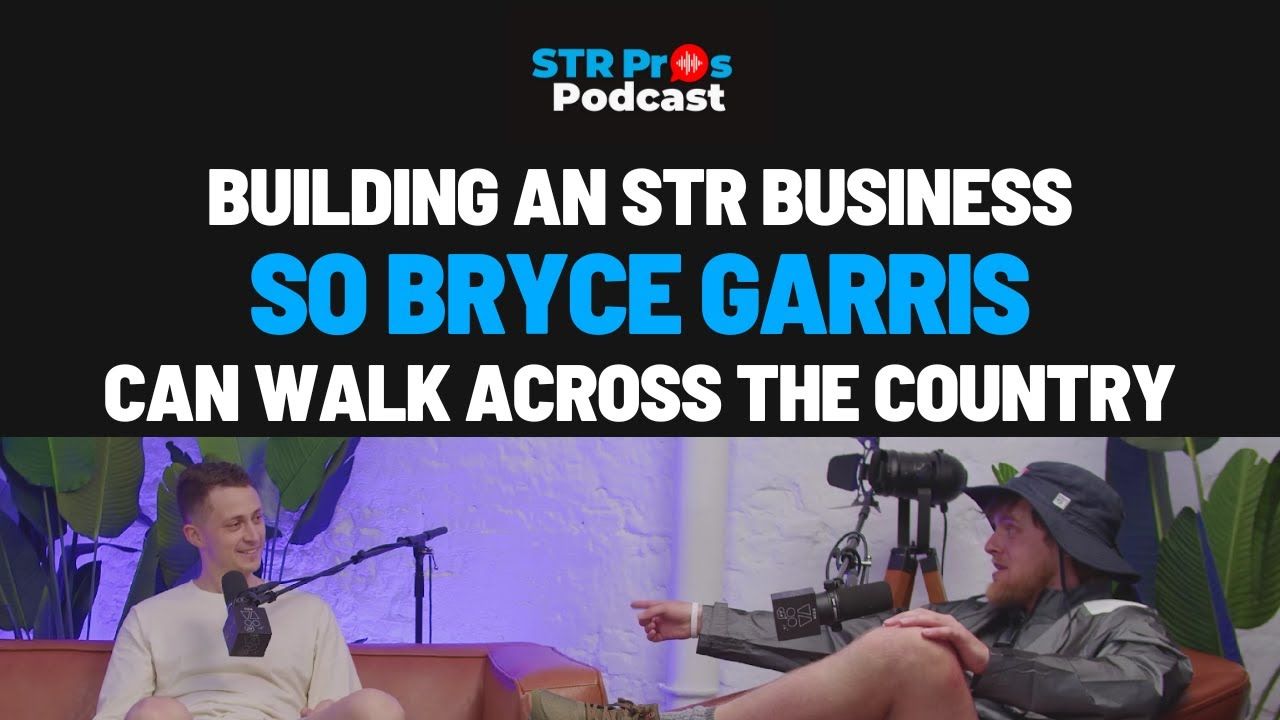
The transcript is a conversation between Bryce Garris, an Airbnb entrepreneur and world traveler, and Jeremy, the host of the STR Pro podcast. Bryce shares his journey from varied careers, including acting and coaching, to becoming an Airbnb Superhost. He emphasizes how short-term rental (STR) arbitrage and dynamic pricing have allowed him to build financial freedom. This business model enabled him to pursue long-held dreams, such as walking across the United States, without worrying about financial stability.
Bryce also shares practical advice on starting an Airbnb business, the importance of personal relationships with landlords, and insights into designing unique and guest-focused properties. He underscores the need for perseverance, as his path involved early failures, including lawsuits and challenges with co-hosting.
Key Points
- Renting a property from a landlord, furnishing it, and listing it on Airbnb.
- Success hinges on finding landlords open to the model and maintaining good relationships with them.
- Leveraging dynamic pricing tools to maximize income during peak times like events (e.g., the Kentucky Derby).
- Investing in lesser-known but lucrative markets like Kentucky’s Bourbon Trail.
- Understanding local attractions boosts guest demand.
- Early struggles included issues with landlords and lawsuits due to misunderstandings or mismanagement.
- Perseverance and adaptability are key to overcoming initial hurdles.
- STR business can provide location and financial freedom, enabling life goals and passions (e.g., walking across the U.S.).
- Focus on unique properties and guest satisfaction to stand out in saturated markets.
Full Transcript
Check on the full podcast on:
Jeremy: What’s up, guys? We are here. I’m here with Bryce Garris, Airbnb legend, and we are live on the STR Pro podcast. Bryce, tell us about yourself.
Bryce: What’s up, everybody? My name is Bryce Garris. I am, uh, an Airbnb Superhost and now a world traveler—country traveler, I guess. But yeah, man, I’ve been in the short-term rental space for about two years now, not even. Been a college basketball coach before, been an actor before.
Jeremy: Bit of a crazy background;
Bryce: I’ve done a lot of stuff, but nothing has stuck.
Bryce: That’s the issue—until now. I was just bouncing around doing stuff.
Jeremy: Until now.
Bryce: That’s why I got into Airbnb in the first place. I was like, “Hey, apparently, you can invest some money, set it up to the point where you don’t have to do anything, and you can bounce around and do things.” Do thing to thing, so that’s why Airbnb was kind of.
Jeremy: Was something that appealed to you.
Bryce: Definitely,
Jeremy: And that’s a big part. A lot of folks, you know, in the STR space, the reason they got into it is because they wanted time freedom, location freedom. You can set up Airbnb businesses and be purely remote. I mean, you know, I live in New York City right now—none of my properties are in New York City. I also don’t really spend that much time on a day-to-day basis managing them anymore.
But yeah, so tell us: where are you from? Where is your portfolio? How is it constructed? Give us some background into your Airbnb business.
Bryce: Yeah, I live in Louisville, Kentucky, and that’s where a majority of my places are. I have one right across the river from Louisville in Jeffersonville, Indiana, which is a place that a lot of people are like, “What’s Jeffersonville, Indiana?”
Jeremy: I don’t know exactly Jeffersonville.
Bryce: Exactly. No one knows—but it’s literally like... it’s like New Jersey. What’s the city across from New Jersey?
Jeremy: Jersey City.
Bryce: It’s like Jersey City—that’s exactly what it is.
I went there because I could get cheaper rent, a nice place. It was a quiet town, and it’s probably the closest four-bedroom house to a downtown area in Louisville that there is right now—in Louisville and Jeffersonville, Indiana. I also got another place on a lake that I manage, and I’ve had some places in Cincinnati, but some issues got in the way of that one.
Jeremy: Issues are part of it.
Bryce: Lawsuits!
Jeremy: Oh, wow, okay, we’re going deep today.
Bryce: But no, so all of them are in Kentucky now, which is a really good market. Luckily, I didn’t know when I first got into it. I was like, “Who comes to Kentucky?” Because it’s one of those things where everybody has that mental constraint. It’s like, “Why would anybody come to this area?” Yeah, and I was the exact same way until a buddy of mine was like, “Bro, no, people come here because of bourbon.”
I didn’t know that people—bourbon is a huge industry.
Jeremy: What’s that... what’s the name of that big whiskey? It’s, like, huge.
Bryce: Bro, I don’t even know! I don’t know a thing. But I didn’t know that. It’s one of those things—people from all over the world come for the Bourbon Trail. I didn’t know it existed until I got into Airbnb because I’m not originally from Louisville. I’m from Kentucky, but I’m not originally from Louisville.
Jeremy: Because you got the Kentucky Derby, at least.
Bryce: You do. I just got booked up for the Kentucky Derby. I got one more place to book up for the Derby, but I just got booked up yesterday. I made six thousand bucks for a three-night stay!
Jeremy: Wow.
Bryce: Like, that—that’s the beauty of Airbnb, yeah. And that’s the beauty of dynamic pricing. Because if I didn’t have that, like, I probably would’ve been booked up for, like, 300. I got booked up for, like, 1500 a night.
Jeremy: That’s crazy.
Bryce: No, that’s the—that’s the beautiful thing about the dynamic pricing. But the Kentucky Derby is a huge pull—all the events leading up to the Kentucky Derby are huge.
You know, you got bourbon and the Derby—that’s really all there is, which is good. But Kentucky’s one of those mid-tier markets where people say, “Why would I invest there?” And so they don’t. I’m like, “All right, I will.”
Jeremy: Yeah, exactly. That was actually one of my realtors, who I’ve purchased houses in North Carolina with. He has a partner agent in Kentucky now, and he’s leading a lot of investors onto the Bourbon Trail.
Bryce: You actually asked me a few months ago. You were like, “What’s the best place?” You were like, “Oh, Lawrenceburg, Kentucky, looks really good,” or something along those lines.
Like, yeah, bro, you should invest, because one of the things about all these places along the Bourbon Trail is that they’re in really small areas. Really small towns, where it’s like you either have a hotel or it’s a regular house. So if someone—and I want to be this person—has a unique, very small, unique place, you would murder it. Yeah, you would crush it.
Jeremy: I’ve been looking at a few there, and I’ve been like... a lot of folks I work with, I tell them, “You guys, look at the Kentucky Bourbon Trail.” The issue is, like, they are small towns, so there’s not, from a buying standpoint, a lot of people.
Bryce: A lot of people fight it. They fight, like, local regulations fight it.
Jeremy: Yeah, but I would say also there’s just not that many houses for sale.
Bryce: Yeah, that’s why you gotta build.
Jeremy: Like, that’s why you buy land. Like, I want to see the ones that are appealing. It’s like, man, you have a house, but you also have, like, 20 acres.
Yeah, because then you could do some crazy-ish. You know, you could throw some glamping stuff on there.
Bryce: Yep, glamping is big time. A lot of people are wanting to get into it. I want to do—uh, my partner, I do have a partner—his name is Michael. Great dude. He offsets me in a way that is needed because I’m like, “Let’s go, man, let’s go. Put the money there, do this, do this,” and he’s like, “Whoa, bro, slow down.”
And that’s what I want. That’s what I wanted. I actually met him via TikTok about two years ago.
Jeremy: And we met each other via TikTok as well.
Yeah, and for those of you guys who don’t know Bryce, his TikTok page is awesome. I mean, hey, it’s educational. I find it hilarious. You know, he throws a lot of comedic relief in there that you don’t really see in financial education.
Bryce: You gotta make it—you gotta make education entertaining these days, because I wasn’t a good student, and I know the power of knowledge. It’s so important.
The teacher makes everything. It really does. I remember teachers I had growing up where it was like, “I mess with this teacher. I really like this one,” and I would pay attention.
And so once I learned that—the power of your delivery—and the power of, you said it earlier, dumbing down information, that’s a great way of putting it. Because I’m not a good learner. Like, I need very specific ways to learn. And the smarter people are, in terms of, like, saying complicated words and things... bring it down. Explain to me like I’m a fourth grader, because my vocabulary is about as smart as a fourth grader.
So being able to communicate as such—everybody can grasp that.
Jeremy: And I think what’s also cool is you communicate topics that maybe some, like myself, I don’t know, maybe some folk make seem too complicated. And you, you know, dumb them down, but also just tell people, “Don’t overthink it. This isn’t actually that complicated of a business model.”
So, Bryce, you specifically do the Airbnb arbitrage strategy. Can you explain, for someone who’s never heard of it, what that is? If you want me to put it in the dumbest-down way, like a fourth grader?
Bryce: It’s literally renting a place from a landlord—somebody who already owns the property—and then furnishing it and putting it on Airbnb. Like, it’s really that simple. The only part about it is that you gotta find a landlord who’s willing to let you operate your business in that property.
And everybody, when you tell them that’s what it is, everybody’s like, “Oh, no landlord would ever go for that.” I’m like, “Oh, well, I got seven who will.”
And I’ve had other people asking me, “Hey, do you want this property?” I had one guy who owned a lot of properties around Kentucky who was like, “I have 75 properties. Do you want all of them?” Because I explained the business model to him, and he was like, “That makes sense to me.”
And, you know, we had that face-to-face connection where he kind of got the sense that I knew what I was doing. I already had the track record of successful properties, and he was like, “I have 75 properties. Do you want all of them?” I was like, “No, I don’t.”
Jeremy: That’s a lot of furniture.
Bryce: I cannot afford that right now. But in the simplest terms, that’s what it is. You just find a landlord who’s willing, you sign a lease, put an addendum to it that says, “I can operate short-term rentals in this area,” and then he agrees, and you go do your thing.
And if a landlord is not allowing you, is saying, “No, no, no, no, no,” your pitch probably isn’t good, or they’re just not getting a good feel for you.
Jeremy: I think something you said interesting before is you met face-to-face with the landlord.
And I will say, personally, early on... at this point, it’s really, now that I have a track record, I could just send them my Airbnb profile, and they’re like, “Holy crap, your properties look really, really good.”
Bryce: Yeah, now that you have a portfolio, it’s like, “Oh, yeah, sure, go do your thing.”
Jeremy: They’re like, “Wow, you can make our house look that beautiful? I mean, our current tenants are absolute hoarders.” Like, “We would love someone who…”
Bryce: “Actually takes care of the property.”
Yeah, you’re literally their best tenant they could ever have if you actually care about your business. Because people could let it deteriorate if they’re terrible people.
But that’s trust factor. So, like, early on for me, I would be like, “Hey, you know, this is what I do. I would love to get a beer with you and, like, explain it, or get a coffee.” Yeah, for me, face-to-face. So, I think that’s really key. You said you met the person face-to-face?
Yeah, and that’s something that I think just has, you know—for those starting out—let’s say you’re young, you have time on your hands, don’t be scared to say, “Hey, like, where do you live? I’m coming over now.” Or maybe, you know, meet at a neutral third-party site.
Bryce: But, right, because, like us now, we have a portfolio and we have a track record. We can just send them that, and they’re like, “All right, sounds good to me.” For the starters, like, what would your— you have some arbitrage properties, don’t you?
Jeremy: Yeah.
Bryce: Your first one wasn’t arbitrage, though, was it?
Jeremy: Yeah, so I started—my first ones were co-hosting. And then actually, honestly, I did some arbitrage relationships, but at the time, I didn’t even know it was called arbitrage.
Like, I didn’t. I just—honestly, at that time, I didn’t have TikTok. I was just like, somehow, some of these owners, you know, they want me to manage the property for them, which I just called property management. I didn’t call it co-hosting. And I was like—some of them were like, “So, what’s the deal here? Can you just pay me monthly rent, like stabilized rent?” And I was like, “Yeah, sure, I can do that.”
So I didn’t even think of it as—like, I thought of it as just property management, but I was paying them.
Bryce: But you were paying them.
Jeremy: Yeah, yeah. Right. And then later, I was like, “Oh, that’s arbitrage.”
Bryce: Yeah. That’s kind of how I swing it to landlords. It’s like, “Bro, I’m going to be your property manager, and I’m going to pay you. I’m going to pay you to manage the place for you.” That’s pretty much how I—
Jeremy: Yeah, yeah, exactly. And that’s probably not just like—you’re simplifying it for them.
Bryce: Exactly. Because a lot—and to be honest with you, now, if you’re in real estate and you don’t know what arbitrage is, I’m actually very, very surprised. If you don’t know what it is. But I still have to, like, explain it to people. It’s crazy.
But for the first people, if you’re just trying to get your first property right now, this is what I’ll say: because I didn’t have a track record of anything. I was like a month into knowing what equity was at that point. Like, I’m telling you right now, “What is equity?” I had to Google it.
Bryce: I had to Google it back when I was, like, 26 years old. “What is equity?” Because I was studying for the real estate exam in Kentucky, and I was like, “Bro, I don’t—” because someone told me I’d be good at real estate. I had just lost my coaching job because I was a degenerate alcoholic. At the time.
Jeremy: At the time.
Bryce: At the time, a degenerate alcoholic, and I lost my job over it. And I was down bad. My coaching job was actually paying for my house as well. So I lost my house.
Jeremy: Lost your house?
Bryce: So I spent a couple days in my car until I had to drive back up to Kentucky. Because I was in Florida at the time. I had to drive back up to Kentucky and just, like, swallow my pride and go, “Mom, Dad, hey, I might have been fucked up a little bit.”
Um, but, uh, someone just said, “Hey, man, I think you should get into real estate. You have the personality for it. I think you’d be really good at it.” And I was like, “Bro, what is real estate? Real estate? Equity? Zero.” Like, literally knew zero percent.
So, if that’s a testimony for anybody who, like, wants to get into it, I don’t know what is. Because, like, genuinely, I had to Google what equity was. I had no idea. And about a month into actually passing my real estate test—which took me three times
Jeremy: Third time’s the charm.
Bryce: Third time is the charm, apparently.
About a month in, I wasn’t selling anything. So I was like, “Sales sucks. I hate sales. I need to find a way to make money.” Found out about arbitrage. That’s—that’s officially when I found out about arbitrage. Because, like, selling stuff isn’t doing it.
I need to invest this money because I’m seeing a lot of people—the real people who make the real money are the ones who are investing it. The people who are making good money are the ones selling stuff. I want to make the real money. I want to invest.
So, I found out about arbitrage. I was like, “Well, that makes sense. That’s what I can do.”
Jeremy: Tell us about that first unit.
Bryce: That first unit—I made about 98 phone calls in one day. The 99th phone call was the one I eventually got. I actually found it on a Craigslist ad because they were scamming. They were just using the building that I got into as the scam picture on the Craigslist ad. So, they were marketing a one-bedroom apartment for like $650, all utilities included. I was like, “Oh damn, this place looks great!” So, I emailed them, “Hey, I’m interested, blah blah blah. I want to come and check it out. Do you allow subletting?”
“Yeah, we do. You can come check it out.” I was like, “Can I come in like 30 minutes?” “Yeah, but you need to send us a background check.”
I was like, “No, I’m not. No, that’s not how it works. You get the background check after we do everything.”
So, I was like, “No, that’s not right.” But I looked at the building—it’s the Glassworks Building in Louisville, Kentucky. I was like, “What’s the Glassworks Building? Beautiful building. Is this real?” So, I looked it up on Google, and lo and behold, it was. I called the number, and I’m like, “Hey, I just saw this ad. Is this you?”
“It’s a multi-use building,” she said. “It could be a private owner, but it’s not our leasing department. So, I can’t help you if it’s a private owner, but it’s not one of ours that we’re currently leasing.”
I was like, “All right, cool. Well, I want to come check out your leased units. Do you have any available, and would you allow this?”
She’s like, “I don’t see why not.” I was just talking to the secretary; she had no idea. “I don’t see why not. People Airbnb their private units, so I don’t see why we couldn’t make it work.”
So, I was like, “All right, cool.” I drove down there 30 minutes later. I was like, “Hey, I’m the guy you just talked to. Can I go see a unit?” So, they showed me. Face to face, I talked through what I wanted to do, and they were like, “Oh, I mean, I don’t see why not.”
And it was like peak pandemic—kind of. So, they had not had that place rented for like six months. They were like, “Well, we kind of need to get it rented. Let’s take a risk on this kid who has no experience.” But they eventually let me do it because, for a month straight, I just kept on showing up, kept on showing up, kept on showing up, and kept on calling.
I found that place on June 1st. Didn’t sign a lease until June 30th and then started officially July 1st.
Jeremy: And if I can remember from one of your videos, did you even get a lease of that number or anything like that?
Bryce: No, bro. I signed the regular lease that says no subletting allowed. I asked the owner of the building, “Hey, it says no subletting allowed. Do we need to change that?”
Bryce: He’s like, “Nah, bro, you’re good.”
Which—I don’t recommend. I don’t recommend ever doing that because, the thing is, he could have pulled that at any moment, sued me, anything. I could have pissed him off, or he didn’t like something that happened, and he could have completely kicked me out.
Jeremy: He would have had full recourse to do so.
Bryce: I could have not done a thing. So, don’t do that. But that’s what I did, and it worked out for me. Don’t recommend it. But a big reason why I wasn’t worried is because I made sure that all my relationships in that building were phenomenal—strong.
Jeremy: You showed face. And I know, you cleaned the place for six months. Yeah. So, you were there. You were in person.
Bryce: When there were issues—which I had one big issue; cops got called twice in one night—I was there, like, 4 o’clock in the morning, dealing with it with the cops and all that stuff.
And they were actually very... they were like—because of my relationship with everybody in the building, tenants included—no one was mad at me. They really all kind of gave me a pass. But also because I handled it personally. Like, at 4 o’clock in the morning, “Y’all gotta get the fck out of here.”
They were like, “Hey, thanks.” So, my relationships in that building were great.
And that’s why I eventually got kicked out of there—because the lease ended, and they wanted to do it themselves. Which is why I always recommend multi-year leases.
Jeremy: Multi-year leases. But they ended up doing it themselves in that same unit?
Bryce: They didn’t. That unit is still sitting empty to this day.
Jeremy: That’s ridiculous.
Bryce: Because the owner of the building, his daughter, was going to move into that one. They were going to—she got two units side by side—and they were going to tear down that wall, make one big unit.
Jeremy: And Airbnb out the whole thing?
Bryce: Nah, she was going to live there.
Jeremy: Oh, okay.
Bryce: And then she ended up buying a house in the suburbs somewhere, so that unit today is just sitting empty. It pisses me off because I haven’t—I got another unit in that building because they did some weird thing. I actually don’t think it was 100% legal, what they did, because they didn’t let everybody get a fair go-around to try and buy it.
But they sold off half the floor to the HOA president of the condos and didn’t tell anybody. So, like, no one got a fair trade in the building—a fair chance in the building to go and try and get a unit. But whatever.
The guy who’s the HOA president—I got his number, and I blew him up. “Hey, if you ever need me to manage any of these Airbnbs, if you ever need me to rent one of them, let me know, blah blah blah.” It was like four or five months in the making of doing that until, like, December.
He had an issue getting a loan from a bank, and he needed a lease.
Jeremy: He needed someone—he needed stabilized renter.
Bryce: Exactly. So he’s like, “Do you want to do this?” I was like, “You bet your sweet ass I do.”
Jeremy: I’ve got that furniture sitting in storage.
Bryce: I’m good to go, ready to—yeah, literally just put it back in like it was before.
So now, that one—I got that unit. Now, I’m paying a little bit more in rent than I want to, but everything’s included. It’s like 1,300 bucks a month. I’m making like 3,500–4,000 bucks.
Jeremy: Wow, so you’re making—so, 3X rent?
Which is very, very solid. My general rule of thumb—well, it depends. For me, because I do some apartments and some big houses.
Bryce: You got a duplex, don’t you?
Jeremy: I have a duplex.
Bryce: You got it—you got everything, bro. You got every—
Yeah, my mom is up here with me right now because she’s so terrified about what I’m doing. By the way, I don’t think I’ve mentioned this—I’m walking across the country right now. We’re in New York City.
That’s exactly why I’m here. I’m not here for—I’m not here for a good time. I’m here to possibly kill myself.
Oh yeah, I told my mom about you because I was like, “I’m gonna do this podcast tomorrow with this dude that I met on TikTok. He does Airbnbs as well. Like, he’s a millionaire.” This dude has, like—I don’t know how many properties you have—like 17?
Jeremy: Well, 25 listing
Bryce: “You’re making, like, over a million in revenue now, aren’t you? This guy, like, come on now, man, come on now, man. That’s awesome. That’s awesome. But all through Airbnb?”
Jeremy: Yeah, I also have seven boats.
Bryce: I forget about the boats! You started with boats, though, didn’t you?
Yeah, that’s how you really started during COVID.
Jeremy: That was like—yeah, that was how I really started, I would say, a short-term rental business. Because the boats were very much their own business. And then, yeah...
Bryce: How are the boats? I want to do that.
Jeremy: I would say COVID was like a freak—like, just totally unreal time for boat rentals. So, I look at Google search trends. You can see if you look up a specific term—like, the app I use is the Google Keyword Planner—and you can type in something like “boat rentals.”
For me, it was “boat rentals at this specific lake.” I looked it up after the fact, like, “Oh, things have kind of died down a bit.” Also, I TikToked a little too much about it and went from being the only boat rental shop on the lake to everyone and their mom within an hour’s radius deciding they were going to run boat rentals.
Bryce: That’s the shitty thing about media, I guess. You create your own competition.
Jeremy: Oh, 100%. But even still, I just looked, and it was like every year was pretty much the same for boat rentals. Then COVID hit, and it literally quadrupled. Because think about it—you couldn’t do anything inside. Boat rentals, you’re outside. You’ve got, you know, the wind, you’re driving. So, it was just seen as a safe activity when there weren’t other safe activities.
Actually, a lot of boat rental operations kind of shut down.
Bryce: Really?
Jeremy: Yeah, well, they just kind of were like—you know, a lot of them were marinas and stuff where they actually…
Bryce: I don’t want to cut you off but I just got like a $5,000 booking.
Jeremy: Let’s go! While we’re sitting here. That’s passive income! That’s passive income. That’s what passive income looks like.
Bryce: What’s this guy say? I’m so anal about—I’m so anal about—uh, oh snap, what’s that?
Jeremy: What’s the worry? Uh-oh. Twister. All right, well, wait. So, are you doing all your guest messaging and inquiries?
Bryce: Yeah, right now I am.
Jeremy: How are you gonna do that while crossing the country?
Bryce: I have my partner helping me out.
Jeremy: Okay, good. Because, I mean, if you’re out in the middle of nowhere with no internet service, I don’t really know how you would—how you would deal with, you know, guest issues. Have those thumbs working like they’re working.
Bryce: Yeah, I told my partner—because, like, VAs, I feel like for right now, I’m not making enough to hire VAs. I mean, they’re not that expensive, but I need something to do on a daily basis. I need something to worry about.
Jeremy: Sure, you know. Yeah, you can’t—so, I’d say VAs, like, they deal with—let’s say you just got an inquiry, and you know it’s obviously a bad inquiry. They would know how to vet them, ask them questions, and reject them. But, like, let’s say you actually have that group, and they blow up the house, you know, and the landlord wants to talk to you.
Jeremy: Yeah, you don’t want to probably put him on the phone with your VAs.
Bryce: Right, exactly, exactly. You know, I got ADHD out the mind. Like, it’s so bad. And I don’t take any pills for it because of prior issues with them.
Jeremy: Not funny.
Bryce: Yeah, not funny, but we can joke about it, you know—we have to. But so, I’m like straight—don’t do anything. So, with that comes its advantages and its disadvantages.
And I like to—I like my spark. When I take them, I’m just kind of like, “What’s up?”
Jeremy: It mellows you.
Bryce: It mellows you, and I don’t like being mellow. For some reason, I like chaos.
Jeremy: So, got a booking?
Bryce: Got a booking. If so—because of that, if I completely just, like, offhand it to somebody else, I will forget that I even do it. Like, honestly, I will. Which may not be a bad thing, but when certain issues come up, it’s not gonna be great because I’m gonna have no idea what’s going on.
Like, even—I rented my car out while I’m doing this trip. I literally forgot that I had it. After, like, three weeks, the guy was like, “Hey man, I’m gonna bring the car in. Just do this, blah blah blah.” I was like, “Oh sht, I totally forgot you had that.” So, if I can’t see it, if I’m not constantly actively doing something with it every day. It’s a good reminder.
Jeremy: Okay, so you’re going to manage them. You have a partner, so if something…
Bryce: I told him, “Give me three minutes to respond to anything, and if I don’t respond within three minutes—within three minutes—take over, because I’m either phone’s dead, out of service, or dead.”
Jeremy: Okay, well, what happens to your car when you die? Bryce has a Tesla. So, while I live in New York City—maybe I can…
Bryce: You can have it, man. Oh my God, yeah, it’s all yours. It’s all yours if I die. Because no one else—no one else even wants it. Like, the guy that I live with—I told him today, “Hey, he’s bringing the car back. Please drive it while I’m gone. I know it’s just sitting there.” And he was like, “No, it’s too scary for me.”
Because people in the South—they’re—they’re not—they’re just not good with technology. They’re just very scared about it.
Jeremy: Hey, I’m a Southerner!
Bryce: Oh man, I forget. I always—come on now, I forget you’re from North Carolina.
Jeremy: Yeah, I am from NC.
Bryce: How’s that? Why New York?
Jeremy: So, I went to the University of North Carolina. And before I graduated, I came to New York kind of like, “I want to try out the big city.” I was born in New Jersey.
Bryce: Oh, were you?
Jeremy: Yeah, so it was always a pull. You know, I have a lot of family from New York. I wanted to come here, see what it’s about. Came here, started working for a New York-based startup. And a lot of my friends moved here. But I moved out of New York, really, to pursue Airbnbs and build my business, which for me, I was going house to house. For a while, like setting up a house.
Bryce: That’s where you would live?
Jeremy: Yeah, I would live there for a month, two months. Set it up. Bang. Next one. Like, literally, while we were doing a house, we would get under contract on another. Or we would, you know, sign a lease on another. So, it was really just bouncing property to property to property.
Jeremy: So, I would say—so, I did that for about a year.
Yeah, about a year. I quit my job in May of 2021. So, I started in March of 2020. Boat rentals largely at the beginning, then doing Airbnbs. Honestly, a lot of it was through the people renting boats being like, “Hey, we’re buying a house on this lake,” or, “Hey, we own a house that we only come to like—the reason we’re renting a boat is because we only come to this house once a year.”
Bryce: What a life?
Jeremy: And I’m like, “Oh, interesting.” And they’re like, “Do you know anything about house rentals?” And I’m like, “Dude, I said, well, I know something about beer, and I can meet you for a beer, and we can talk it over.”
So, yeah, I met clients at the Weaver Street Market in Carboro, North Carolina, and we talked about what we could do with their property—which I think I didn’t—you know, I just made it up pretty much and locked down some property management clients that way.
Bryce: Property management’s awesome. Yeah, I mean, for Airbnb at least,
Jeremy: I would say so. The flip side to me of property management is, like—to me, so, I’ve had multiple instances where I’ve started property managing, and then the homeowner has decided, “I actually want to sell the house,” or—
Bryce: Oh yeah, that’s the bad thing.
Jeremy: Or, “Actually, you know what? Like, I don’t even need this money. I don’t want people in my house.” Yeah, like, I sent an owner, like, eleven thousand dollars for one month. They were just like, “Don’t even waste my time sending me eleven thousand dollars and texting me about it.” I’m like, “Okay, do you want me to keep the money? Like, if it’s not worth your time...”
Bryce: Don’t send me eleven thousand dollars, what the heck.
Jeremy: Yeah, it was—it was pretty crazy. And it was, like, annoying because it was a house that was not ready for Airbnb. And, like, I’d set it up. Like, I drove to all these furniture stores, loaded up the truck, went to the house—it was a beautiful house. But, like, the pool, frankly, was just—the owner didn’t swim, so he didn’t care about the pool. But, like, it had a pool.
Bryce: Yeah, and you’re like, we gotta do something about the pool, bro.
Jeremy: Yeah, the pool has to work. Like, you know, there are pictures of a pool. Like, right? Like, we can’t hide the pool. And guests booked this house, and they said,
Bryce: “Oh, they want the pool.”
Jeremy: Yeah, they booked the house because of the pool. And, like, literally, the water
Bryce: That’s where people succeed and fail in the short-term rental business, though. And that’s why, if you are one of those types of people, you need a manager. Because if you’re not going to care for the stuff, it’s going to reflect in the reviews.
People are like, “Oh great, yeah, pool was disgusting, and the pool didn’t work, and blah blah blah blah.
Jeremy: We’re paying, you know, fourteen hundred, fifteen hundred dollars a night, and
Bryce: They’re expecting a pool to work.
Jeremy: Yeah, and literally, like, I had to—the pool literally didn’t— That particular pool didn’t circulate.
Yeah, like the circulation was all messed up.
Bryce: Stale.
I literally had our crew every single day coming and, like, just moving around the water themselves for, like, the first month. And I was just like, “Dude, I can’t have our crew coming over every day and literally spending an hour moving around the water. Like, that’s just—that can’t work. Like, that’s just not how—like, we gotta get someone out here ASAP. Like, you’re gonna have to foot the bill and do this.”
And then, “Well, you know, people, if they don’t like it, like, too bad. I’m taking it off the market.”
And I’m like, “All right. I spent four days—like, literally four days—driving around, setting this up.” And bro, one month in, I made, like, twenty of fourteen grand. Like, I made a couple thousand dollars. But—
Bryce: Better than nothing. But it’s better than—better than my story with co-hosting, bro. I got a place in Cincinnati. I had two places in Cincinnati. Don’t have either of them now. One was an arbitrage, and one was a co-host.
I found the co-host because I was trying to get an arbitrage deal out of it. He had it for rent, and he was like, “Well, why wouldn’t I just do that myself?”
And I was like, “Well, it’s your place. Why aren’t you?”
He said, “I just don’t know how, blah blah blah.”
I said, “Well, I do know how, so how about we do this?”
So, that’s when I talked him into co-hosting. And the very first week that we started working together, I wasn’t even talking to my partner. I was like, “This guy’s like Red Flag City.” Because he was talking about, like, “What happens when we don’t work together anymore? What happens if this happens? What happens...” Like, talking very strongly about not working together anymore.
Like, we haven’t even started yet, and we’re already talking about not working together. I don’t like that. But I needed the money. So, I was like, “Screw it, we’ll do it.”
He sued me three weeks in because of suggestions that we gave him. We’re like, “You need locks on your door—smart locks on the door. Can’t do hard-copy keys. We need a noise monitoring device. We need this, that, blah blah blah.” He was like, “No, I don’t want to do that.” Why? I still don’t know.
But we didn’t do it, and three weeks in, they destroyed the place—like, water damage.
Jeremy: Who destroyed it?
Bryce: The guests. Yeah, just destroyed the place. Water damage—like $5,000 worth of damage.
Jeremy: Honestly, five grand worth of damages. It’s not—in all, grand scheme-it’s not horrible.
Bryce: It’s not horrible, but still. It’s still a pretty good lick. And, you know, he was very adamant about getting it done, which I was taking care of. I was like, “That’s my job—to get that taken care of.”
And he was just a nightmare situation since. He ended up suing me because I wasn’t communicating with him enough—is what he was saying. But, exactly. He sued me. And because it was in Ohio and all this other bullcrap, all these lawyers were like, “Bro, just pay him. Just pay him. It’s not worth it.”
Jeremy: Yeah, not worth it.
Bryce: Pay him. So, I had $2,000 out of pocket just to settle the case.
Jeremy: Oh my.
Bryce: Which, honestly, again—bro, are you serious? So, if you’re gonna do co-hosting, make sure it’s the right person. If they’re giving red flags at the beginning, don’t do it.
Jeremy: Beggars can’t be choosers. Yeah, and that’s like a freak—you know, that’s one story. I mean, I was hoping that’s kind of the only thing that, in that realm, has happened that crazy. That’s as bad as it’s gone.
Bryce: Pretty bad.
Jeremy: Yeah, I haven’t had—I’ve had some crazy stuff with properties we own, properties we co-host. Yeah, I’ve definitely had a fair share of crazy stuff. But, honestly, I’ve never even—you know, I’ve never been sued or had to settle anything.
Bryce: The last time I worked with a lawyer too—he was a lawyer. So, he was, like, ready to sue me at the smallest thing.
Jeremy: He could fund his own losses.
Bryce: Exactly. Nothing came out of his pocket to file the claim.
Jeremy: Yeah, that stuff’s— I mean, working with lawyers—you know, one phone call just to discuss it, you gotta throw over several hundred dollars.
Bryce: Disgusting.
Jeremy: Oh, okay. So, all right. So, you know—and I think also what you do is you don’t over-glorify things. I think—I don’t over-glorify—And there are definitely folks on TikTok who are like, “A thousand million percent!
Bryce: “I made $10,000 today on Airbnb!”
Jeremy: Yeah. Or, like, “Yeah, I make—” You know, there are people who do actually make…
Bryce: Just flexes their Lamborghinis.
Jeremy: But there are people who actually do make the money. And then, you know, there’s some who actually show that there are months that they lose a lot of money too—which I respect. That they show that seasonality is a big part of this game.
But then, there’s also the folk who don’t even have Airbnbs to begin with, and they still show that. You know.
Bryce: they’re selling—they’re selling a course, and they’ve never done Airbnb in their life.
Jeremy: Yeah. And they can just, “Oh, I’m, you know, making $170,000 a month right now.”
Bryce: Right. Isn’t it funny how there’s only, like, a sliver of the population of Americans that are making six figures, but everybody on TikTok is making six figures? Every TikTok is making six figures. It’s sick.
Jeremy: Yeah, and some are making seven.
Bryce: Some are—Some are making seven. He’s actually making seven, though, is the cool thing. He’s actually making seven.
Jeremy: Gross. Gross. I do pretty well from a net perspective. But I will be very honest and transparent. In one of my episodes I did earlier—when it was called the Jeremy Warden Podcast, it’s now the STR Short-Term Rental Pro Podcast, but that one—I think it’s been released—I actually did a full breakdown of, like, full transparency over my 2022 finances.
So, I don’t know. Can I link that here somewhere? It’s somewhere.
Somewhere on my page. Watch every video until you find it on YouTube.
Bryce: What a—what a—Yeah, good statement right there. Watch every video until you find it, and comment and share and like every single video.
Jeremy: Trying to—trying to get the YouTube game going.
Bryce: Bro, I have no idea what my finances look like. I don’t look at it.
Jeremy: Yeah, I—I do. Like, I’m trying to do a better job. But, I mean, obviously, when taxes come, you have to do full-year accounting and have your balance sheet and whatnot.
Bryce: Get my accountant— My accountant hates me. I just give her—
Jeremy: Why is that not surprising?
Bryce: I just give her sht. She was so pissed at me because I just put, like, all this crap. She’s like, “What is this?” I was like, “That’s—it’s everything.”
“It’s everything that we spent and made.”
Jeremy: So, what we would advise though, Bryce, would you advise having, like, pretty good bookkeeping of your P&L for everything?
Bryce: Oh, absolutely. But I can’t say, “This is what you need to do,” because I don’t do it. I really don’t. Because I don’t necessarily care so much about the money, actually.
Jeremy: And this is a good point. I wanna—I wanna parlay this into, What is your why? I think that’s super important. People who get into this game—like, short-term rentals—the cool thing about them is you have relatively predictable monthly cash flow. You can do the business from anywhere. You can be walking across the freaking U.S. and doing it. So, you have that location freedom.
You have that time freedom. Like, you don’t—you know, how many hours a day do you spend managing your Airbnb business?
Bryce: Oh, probably not even an hour, to be honest with you—unless I have to actually go to the property. Which, if I do go to the property, it’s because I want to. Like, I’ll go cut the grass today or fix this chair real quick.
Jeremy: But nothing you can’t get someone else to do for you.
Bryce: But nothing you can’t get someone else to do for you.
Jeremy: Yeah, but I want to. Probably into what is your why? You know, I think that’s super important—knowing why you’re getting into this. Because you’ve got to get into it for the right reasons. And yeah, it is not—as much as people make it seem—like a get-rich-quick scheme. Like, you’re gonna buy a Lamborghini after two weeks, right?
It is something where, if you want to continue growing and building, you should be reinvesting your cash flows. However, if you want that predictable income... For me, it wasn’t that hard to replace my personal income.
Bryce: It wasn’t hard for me.
Jeremy: Yeah, well, I know it’s definitely not hard for you. You could find a penny on the ground and replace your income. But for me, my salary got cut to $2,500 a month.
I had to go home with my parents too. My rent was $2,000. Like, the math—I subletted. I—well, I didn’t technically Airbnb, but I—
Bryce: You got somebody in there to cover it for you.
Jeremy: Yeah, exactly. I medium-term rented my apartment in the city, or my bedroom in an apartment. But yeah, for me, that first week—I rented a boat, and now I’m very much like 99% Airbnbs at this point. But back then, it was really about—that first week, I brought in about $5,600 and made two grand that first week.
Bryce: Wait a second.
Jeremy: Yeah, I was just like, “Whoa. That math here—I gotta get more boats.”
Bryce: And then, when I lost my job and moved back in with my parents, I got a job as a dishwasher. I was making $10 an hour and working 20 hours a week.
I told my parents, “After I pass my real estate test, I’m gonna give it another month. I’m gonna quit this job and go full-time in real estate.”
They were like, “How about you wait until you start making money in real estate, and then quit your job? That way, you have at least a couple bucks coming in.”
And I was like, “Mom, for the first time in my life, I did the math. If I work every hour for an entire year that I’m supposed to, I will make less than $10,000. If I sell one house, I will make $10,000. Now, I’ve never even sold a house, but I’ll say, if I sell one house—”
Jeremy: Conceptually.
Bryce: Conceptually, if I sell one house, I’ll make $10,000. And she’s like, “All right.”
But I knew that I wasn’t going to be able to go full throttle into it if I had that other job in the back of my mind. Because, after working all day washing dishes, the last thing I was going to want to do was go do something else. So, I needed to have that full throttle.
As soon as I got my first place, I made $3,000. I was like, “well…”
Jeremy: Well, the math here
Bryce: The math is mathing. This makes more sense.
Jeremy: You didn’t make three million dollars—that first month, you made $3,000.
Bryce: and that was like—that would have been, you know, four months of dishwashing.
Jeremy: So, tell us about that first property. I know you said now rents $1,300 and can pull in, you know, between three and four grand. But yeah, tell us about that life-changing realization with that first property. Like, how much it cost to rent and then how much you made for subletting it.
Bryce: It was $995 a month for a one-bedroom in downtown Louisville, with all utilities except for electric. So, hell of a deal. And the place was so cool, so unique. I told myself, “I’m the only one that can screw this up.” I had no idea what I was doing, but I was like, “This is a really cool place in a prime—”
Jeremy: And you probably didn’t know financial analysis.
Bryce: Dude, I didn’t do a thing.
Jeremy: Now, if you did the financial analysis—
Bryce: I still don’t do that. That’s what my partner’s for. Because that’s what it was
Jeremy: If you did do it, what would you? What tool would you use?
Bryce: I would use the BNBCalc.
Jeremy: This is—this, uh, podcast is brought to you by:
Bryce: This is very impromptu right here. BNBCalc, his software that he has for running properties—actually, like, it actually is really good. I like the fact that I can see my cash-on-cash return. Like, “This is what you should expect it to be.” I love that.
And it even gives you a pretty accurate representation of how much you’re gonna be spending on furniture, given the square footage. I’m like, “Damn, that’s really good.”
Because I never—I never knew. Like, I didn’t know. When I got my first place, it was literally like, “It’s a really cool place in a really cool part of town. I’m gonna do it. And if it fails, it fails. But I really got nothing to lose at this point.” That was another reason why it was pretty easy to—it was stressful, but pretty easy to take that risk.
Because I was like, “If this fails..”
Jeremy: You’re back against the wall?
Bryce: What happens now? Like, nothing. Like, literally nothing changes in my life.” So, that made it a little bit easier. But the analysis part—I would say I actually ran numbers on BNBCalc for my first place ever, and it was—it was accurate. It was accurate.
You know what wasn’t accurate?
Jeremy: What?
Bryce: AirDNA.
Jeremy: Well, I mean…
Bryce: You extract data from AirDNA?
Jeremy: So, we extract the revenue estimate. However, if you think about how AirDNA comes up with that number, they’re gonna say—they’re gonna base it off all the one-bed, one-baths in the area and put you at that 50th percentile. Yeah, so if you’re super cool…
Bryce: I was in the 90th percentile with what I was making.
Jeremy: If you’re in the 90th percentile, then yeah, you’re gonna do better. If you’re in the fifth percentile, or maybe you just make the apartment look like crap and manage it extremely poorly. AirDNA is not an exact science—it’s a starting point.
Yeah, and that’s what I definitely convey it as—it’s a great starting point. But you have to, you have to reverse-engineer it and say, “Look at the properties around there and see how they’re doing. Are they getting booked up? Are they charging premium rates? Oh, wow, they’re charging $5 a night, and no one’s staying there.”
Bryce: I did that. I looked around at all the one-bedroom places in downtown Louisville, and I read almost every single review of every single one of those places. I was like, “All right, well, this is just a normal place. This is just a normal place. This is just a normal place.” And people were like, “Hey, really good place, blah blah blah.”
I did a lot of stuff in my own place because of those reviews. I kept on seeing the same reviews: “Great place, wish I knew that you had to pay 20 bucks a night for parking.” “Great place, but—” “Great place, but this.” “Great place, but this.”
And I was like, “All right, if I’m no butts, I will get around.” So, I’m paying a monthly parking fee for just people for my place. I have all the food, and I made sure to be super responsive because I kept reading reviews saying, “The host wasn’t responsive.”
There was one person who said, “They didn’t really give any recommendations. I wanted recommendations, blah blah blah.” So, I made a dartboard of all the restaurants around the area. I was like, “Where you throw is where you go.” Don’t take out the guesses.
I made some cool games and stuff that would really highlight itself in the review section—something that people wanted.
Jeremy: And amenities. Yeah. Maybe you didn’t have the highest rent apartment, but you provided the amenities because you liked their reviews. You saw what people wanted—parking spots.
Bryce: No matter what you do, you can have the best software in the world to predict the revenue, but at the end of the day, it comes down to how you run it.
Jeremy: Yeah, that’s the design, the amenities. Beat them on amenities. Beat them on design. Beat them on management. Control what you can control.
With that being said, that first apartment—$995. So, I rented it and got the rent for just under a thousand bucks. And then, how much did you make?
Bryce: The first month was $3,200. And I was like, "Oh!"
Jeremy: So then, that cash flow—Was probably about. You cleaned it too?
Bryce: I cleaned it too, so that was another reason why I was able to get my investment back so fast. I got my investment back in, like, two months.
Jeremy: Yeah.
Bryce: Initial investment—because I cleaned it. That was an extra thousand bucks that I kept for those two months. But yeah, $995 a month.
Jeremy: So, you made a couple thousand—
Bryce: A couple thousand right there.
Jeremy: And at that time, you didn’t do dynamic pricing. You could have squeezed the orange more.
Bryce: Now, I’m doing dynamic pricing and charging $350 a night and getting it. Whereas back then, the highest I ever went for a regular weekend was like $180.
Jeremy: Yeah. Okay, so—But my point here is, like, all right, you made a couple of G’s of cash flow and you made your money back really quickly. You didn’t rent a Maserati or buy a Lambo. You reinvested it and got to, you know, several thousand dollars a month of cash flow—which was life-changing, right?
Bryce: Yeah, big-time life-changing. Big-time life-changing. And then I bought a Tesla.
Jeremy: And then you bought it.
Bryce: But I justified that purchase. My monthly car payment right now is through the roof. I got screwed so bad. But I bought the Tesla because I was gonna put it on Turo.
And I just didn’t put it on Turo. I was like, "Oh, I keep on driving it." But I’m justifying it because—no gas. Gas was like $5 a gallon at the time. And how much I drove in my truck, I was burning like $125 a week in gas. So, I was like, "All right, well, that’s like $500 a month."
Right now, my car payment’s $700. Now, I don’t have oil changes, I don’t have gas, virtually maintenance-free, tax write-offs—because the government really wants you to get EVs. So, I got tax write-offs with it. I’m damn near driving a Tesla for the same price as the ’02 F-150.
Jeremy: Oh, that’s—And you’re whipping in style.
Bryce: And it creates conversations. That’s the biggest thing.
Jeremy: Got a red Tesla, right?
Bryce: A red Tesla. The very first day I had it, I had three conversations with people asking me about it. And I was like, "This is what I really want right now. This is going to be better for me in the long run just because it’s creating conversations with people."
Jeremy: Interesting. As someone who lives in New York City and rides a city bike around town…
Bryce: Which is great, I love it.
Jeremy: I enjoy it, and it keeps me active. But yeah, maybe—maybe I’m gonna justify at some point a nice car purchase because of conversations.
Bryce: You should. I mean, honestly. I’m not even a car guy, so I don’t know if I’m using it correctly. I don’t—I don’t even know if I’m using it correctly.
Jeremy: I mean, technically—They’re used to move around.
Bryce: I’m there to move around, baby. I’m there to move around. But yeah. So, I eventually bought that, but it was after I was making enough to justify it as well.
I did dump a lot of stuff. I used a lot of credit—business credit—to get going on stuff as well. Now, I think I’m pulling in, in revenue, $20,000–$30,000 a month off of everything too.
I have other ventures as well. You know, I sell a book. I was selling a course for a while—I don’t do that anymore. I do other property management stuff too. I manage a warehouse and make, like, $700 a month off of that.
Just—Just send, like, one email a month. It’s awesome. I didn’t go too crazy. My lifestyle is very low-key. I’m a nomad. I’m a drifter.
Jeremy: So you have—So, again, it didn’t take you a million dollars a month to achieve freedom.
Bryce: And it shouldn’t.
Jeremy: And it shouldn’t for most people. But now that you have that relatively predictable cash flow, what are you doing with your freedom?
Bryce: Anything that I want. Like I said, I lost my coaching job back in 2020 because I was in a really bad place. And I’ve always wanted to walk across the country—like, since I was 16 years old. So, the fact that it’s happening now is—it’s cool. I don’t even know how to feel because it’s something that I’ve wanted to do for so long. And now it’s happening because I made it happen.
Jeremy: And you started in Lower Manhattan?
Bryce: Lower Manhattan.
Jeremy: And where are we right now? Where are we?
Bryce: We’re in Lower Manhattan. I backtracked a little bit today. I was in New Jersey last night.
Jeremy: You walked to New Jersey?
Bryce: Yeah, I walked to New Jersey, bussed back into town, then—yeah.
Jeremy: I was like, "Bryce, you gotta get back." Yeah, we’re popping this for you guys. We gotta share your story. The people want to hear it.
Bryce: Yeah, well, maybe not. We’ll see.
Jeremy: You made it this far. You’re in the right place.
Bryce: But I’ve always wanted to do it. So, when it happened, I had my brother-in-law, who’s the one who was like, "Hey, get into real estate." Because he’s big-time in real estate. He’s making a lot of money in real estate, and he’s like, "You need to get into real estate." I’m like, "Bro, I don’t know anything about it."
He’s like, "Do this, this, this, this." He really was a good guiding mentor for me to get started, even though I’m the one who actually taught him about Airbnb.
Jeremy: Sure.
Bryce: He’s like, "Get into real estate." And I was like, "No, man. I just want to walk across the country. That’s what I’m gonna do."
And he was like, "And then what?" "Oh, and then what?"
And I’m like, "You know, figure it out from there."
He’s like, "That’s what you constantly keep doing. You bounce around from thing to thing to thing." And I’m like, "Yeah, because I find something interesting, and I want to go do it. Then it wears off, and I hate it, and I want to go do something interesting again."
He was like, "All right, well, how about this? Walk across the country. He was the very first person in my life who didn’t shoot it down. Yeah, he encouraged it, but he’s like, 'Let’s do it smart. How about you build up a business, and then go do it?
Jeremy: How about have your passive income, pay for your tent.
Bryce: Exactly. So, that gave me a lot to think about. I was like, "Well, he’s right. It’s gonna continuously be, 'And then what? And then what?'" And it’s still that way—"And then what?"
But now, it’s like, I can actually go and do it and not have to worry about what’s next because I absolutely have to. It’s like, "What do I want to go tackle now?"
So, after he said that to me, I really thought about it. I was like, "Okay, I’m gonna go full throttle into building a business. I’m gonna get some money coming in." That’s when I found out about arbitrage and all that.
The reason I got into Airbnb is not necessarily because I wanted to make a lot of money. It’s because I realized—like I said—I have really bad ADHD. That takes its form into getting really interested in stuff and then just burning and crashing.
I was like, "All right, I’m gonna continue to do that because, like I said, I’m not taking any more medication. That’ll lead to worse stuff for me in the long run." So, I really game-planned the future in terms of, "If I do this now, if I struggle now, if I take the risk now, and it works, I’ll have that in the background always."
I can walk across the country. I can climb Mount Everest. I can try and become a rapper. I can write a book. I can do all these things because it’s always working in the background.
And once I found it, I was like, "I’m making enough money to support my lifestyle with everything I have going on. I don’t want to add to it. I’ll take stuff away, but I don’t want to add anything to it."
I’m comfortable with the amount of money I’m making right now to go and do that. So, that’s where we’re at.
I learned, I saw it, and I said, "All right, I’m here. I’m doing this. I’m gonna go live the life that I want right now."
Because right now, I’m younger than I’ll ever be. The time is right to try and attempt to walk across the country. It may not work. I may fail. I may die. I may break a leg and have to go back home. I don’t know. But I’m trying it because that’s what I want to do.
And I’m sure I’ll get tired of it and be like, "All right, cool. Walked across the country, what’s next?" But I’ll be able to do it because of Airbnb. It’s great.
Jeremy: So you no longer have a limiting belief in what you can do because you have that business, that operation, as your foundation?
Bryce: Exactly, exactly, exactly. I’ve never had a limiting belief anyway—I’ve always been like that.
Jeremy: But now you have a logistical belief.
Bryce: Yeah, and that’s why I’m in such debt to Airbnb—because it created that time freedom. That’s what I was after more than anything. If I want to sleep in until 2 in the afternoon, I can sleep in until 2 in the afternoon. I don’t do that, but if I wanted to, I could.
That’s the biggest thing because I’m a drifter. Like, for some reason, I like being homeless. I don’t know what it is.
Jeremy: To each their own.
Bryce: I don’t know what it is, but I like going out and doing things like that.
Jeremy: Probably the only Airbnb guru who glorifies being homeless.
Bryce: It’s—Bro, there’s a spiritual aspect to it, I guess. That’s what I’m really trying to find. I didn’t want this to necessarily be a spiritual experience, but as it’s leading up to it, it’s definitely becoming that.
The more I walk, the more clarity I have, and I can think and piece things together. So, we’ll see what happens. I don’t know.
Jeremy:Well, I’m very excited for you. I’ve been following your journey for probably about—since when you started.
Bryce: Yeah, bro. I followed you—I had like 14,000 followers when I found out who you were.
Jeremy: And we did a live—Yeah, we did a live chat together. The first time I found out about you, I was like, "Let’s go live!"
Bryce: Mooching off my success, look at you.
Jeremy: I thought you were funny. I was like, "I want to talk to you."
Bryce: No, and I’m glad you did. I’m glad you did because, like you said, there are a lot of people who market rental arbitrage and Airbnb just to sell courses and don’t have anything.
It’s very nice to see other people who are really genuine in the space that you can trust to get knowledge from. Because I’ve watched a lot of your videos too, to pull away information from.
Just because you—you can just tell based on your personality that you’re not trying to screw anybody over just to sell a course. You like making videos, and you want to give information. It’s, you know, just that genuine aspect to it that I really enjoyed seeing.
Jeremy: I appreciate that. And I think your storytelling is amazing.
Bryce: I always wanted to be a writer. That’s what it was—I always wanted to be a writer. Now that I found that outlet to do it, TikTok was great. I’m in debt to TikTok too. TikTok has opened up a lot of doors for me.
Jeremy: I believe it.
Bryce: A lot of doors. Good and bad doors.
Jeremy: Doors nevertheless.
Bryce: Doors nevertheless.
Jeremy: I guess it’s up to you. You have the freedom to decide which doors you want to go through.
Bryce: All those doors—I said yes to everything at the start. Which, if I had to go and redo it, I would have done it again, even though some of those yeses turned into failures.
But now, because I’ve done that, I’ve learned my worth.
Jeremy: No doors I’ve opened for you have turned into other failures, right?
Bryce: No, no. There have been. There have been some bad ones. There have been some bad and some big wastes of time. But again, it comes down to the fact that because I said yes, I learned. By getting screwed over or stabbed in the back or something like that, I realized, "Okay, let me not just jump into this thing. Let me really think about it for a second and get all the information before I say yes."
Jeremy: Not be as much of a Yes Man.
Bryce: Exactly. And now, through Airbnb, I have that foundation. I don’t necessarily have to say yes just because you’re offering me money. I’m like, "Is what you’re offering me even worth me doing?"
So, I found out my worth through saying yes, because I got stabbed in the back so many times and things didn’t work out. And, yeah. Guys, there’ll be more doors in the future, I hope.
Jeremy: Okay, so, takeaways here: Airbnb opens doors.
Bryce: Absolutely it does.
Jeremy: And, you know, don’t overthink things.
Bryce: No, no. Do things the right way, though.
You know, as someone who’s done things the right and wrong way, it’s easy—it’s very easy to do the right things because the right things are so simple to do. It’s like, "Make the pool work." That’s a very simple thing. We got the pool. The pool needs to work.
We don’t need to be over here stirring up the pot every day. Make the pool work. You know, that’s the right thing—make the pool work. Spend the money, make it work.
Doing the right things is very simple. It just all comes down to who you are as a person. So, if you’re a shitty person, I would say don’t get into Airbnb. Because it’s not real estate—it’s hospitality.
Jeremy: It’s hospitality. Or it’s like a hybrid—Real estate and hospitality thing.
Bryce: Exactly. But if you’re going to be the one managing it and all that stuff, you’ve got to have some sort of people skills. You’ve got to have an attention to detail that is a little bit different than normal life. Which, you know, I’m great at attention to detail because I’m OCD.
Jeremy: OCD and ADHD. Hey, if Bryce can do it, anyone can do it. But, yeah. Bryce, what is the biggest piece of advice you have for our listeners?
Bryce: Bro, you just said it—don’t overthink it. If it’s something that you want to do, go and do it. Find a way to do it because you’re going to be kicking yourself.
The only reason I’m walking across the country right now is because it’s been in my mind for 12 years. And I told myself, if it’s been in my mind for 12 years and I don’t do it, I will really be kicking myself in the future when I’m no longer physically able to do it.
So, if Airbnb is something that you’ve been wanting to get into and try—do it. And if it fails? Okay, it failed. You know, you can move on to something else knowing that you tried.
Jeremy: And I think that’s great. When I talk to people who are like, "Should I buy? Should I arbitrage?" I’m like, "Look, if you’re this type of way about it..." I think everyone should own real estate in the long run.
I don’t think there’s any better way to build long-term wealth. You know, 90% of the millionaires in the United States are millionaires through real estate.
There is no better way to build long-term wealth—no better tax advantages, no better ways to leverage and take advantage of other people’s money, namely the banks.
However, if you’re going to be this flippity right now about it, just rent a damn property. Rent it. Rent a one-bedroom studio apartment, you know?
Well, literally, if it didn’t get rented—which is not going to happen—nope, your place, as long as you design it really well, or even if you just design it well, it doesn’t have to be amazing, and you’re just responding to people, you’re going to get booked. And even if it doesn’t.
Bryce: There are two things that don’t ever stop: drinking and travel. Like, those things don’t stop no matter what the economy is like.
Jeremy: If the economy is worse, you could argue there might be more of at least one of those.
Bryce: But that’s what I’ve noticed. Like, COVID—Airbnb flourished during COVID. People wanted to get out of their own houses. They wanted to. So, if Airbnb flourishes during a time like that, it’s like—the only thing now is just oversaturation.
And I believe in oversaturation—yet I don’t at the same time. Because, you know, markets are always moving. Even in the same cities, there are new areas coming up and down. But even then, it’s like, all right, be the best.
Jeremy: Well, that’s what—you control what you can control.
Bryce: Exactly.
Jeremy: Beat everyone. Beat them on design. Beat them on management. And that’s—for us, you know, I’ve always kind of been concerned in the back of my head that demand is going to go down, something bad could happen, and supply is going to go up.
Okay, what can I do proactively now to prepare myself? Well, A) you know, what types of properties do you have? Are they cookie-cutter things that anybody else in the world can do? Are they those one- or two-bedroom apartments that someone can go and take ten of and rent ten of them out right next door?
Or are they things that are unique? Lake houses, mountain houses, beach houses—things with amenities that are hard to come by. So, I’ve tried to just control what we can control.
And I think that has led to the fact that I really am not feeling the effects of oversaturation. I would say again, I have some two-bedroom apartments, and those—I definitely kind of feel it a little bit because, like I said, you can easily create a two-bedroom or one-bedroom apartment.
It’s hard to create a mountain house with beautiful, long-range views. You can’t just snap your fingers and do that.
Also, our properties—a lot of them are in the boondocks. It’s hard to manage a property in the sticks. You need to have infrastructure there, which is more difficult.
But that being said, I’m just—I'm like trying to echo your point of, like, don’t overthink things. Control what you can control.
Bryce: Yeah, and that’s why I like investing in Airbnb and not, like, stocks or anything—because you can control it. You can’t control a stock. You can control your Airbnb. So, if it’s not doing good, be really honest with yourself about why.
Jeremy: These photos look like sht.
Bryce: Exactly. There’s always something you can fix. Mainly, it’s price—always.
Yeah, price and pictures. That’s really what it comes down to. But yeah, don’t overthink it. If it’s something that’s always in your mind, like, "Man, I gotta do this, I gotta do this, I want to try, I want to try, I want to try," literally do it. Try it. Or you’ll kick yourself.
And I’m not going to be kicking myself. I don’t want to be an old man. I want to die, maybe like 35.
Jeremy: Wait, what? You want to die at 35?
Bryce: 35 is probably going to be a good run for me.
Jeremy: Oh, all right. Let’s not talk that into existence on my podcast.
Bryce: I thought I was gonna die when I was 27. I was very convinced of that.
Jeremy: And did you?
Bryce: Nope. I’m 28 now, so I’m like, "Well, hey, I didn’t die at 27, so obviously, I’m supposed to be on this earth for a few more reasons."
Jeremy: I hope you’re on the earth. I enjoy you too much.
Bryce: But it’s—don’t—you don’t want to live a life of regretting not doing something that could potentially change your life. And I’m not going to be that person that regrets not trying things that are in my mind. I think those thoughts are in your mind for a reason. Your mind’s telling you that for a reason.
Jeremy: You’re on this earth for a reason.
Bryce: Exactly. So, I’m gonna go and tackle life to its fullest ability, because Airbnb gave me that freedom. That’s all I’m trying to do, man.
Jeremy: That is beautiful. I look forward to watching your journey. So, tell us—for those listening—where can they, they wanna continue with Bryce and see you walk, see your journey, however ADD direction it takes you.
Bryce: I don’t even know where I’m going, to be honest with you. I have not planned it out. But @BryceGarris on TikTok, Instagram, and YouTube. Well, that’s not my YouTube handle—I don’t even know my YouTube channel. I haven’t posted on YouTube.
But @BryceGarris on TikTok and Instagram. I’m gonna be walking New York, New Jersey, Pennsylvania, West Virginia, Ohio, Indiana, Illinois, Missouri, Kansas, Colorado, Arizona, and California.
So, if anybody is around those areas and wants to come find me and walk with me, by all means, please do. No murders or pedophiles allowed, though.
Jeremy: Disclosure.
Bryce: Disclosure. Just for the record, you’re not allowed.
Jeremy: What a disclosure.
Well, Bryce, it’s been a pleasure. First time—again, me and Bryce have probably talked on the phone, you know, multiple times—
Bryce: Multiple times.
Jeremy: And, you know, DM’d and messaged and whatnot. But it’s our first time actually seeing each other in person when I walked into the studio today.
So, quite a pleasure. Being with you
Bryce: Yeah, absolutely.
Jeremy: And for you guys listening, again, this is the Short-Term Rental Pro Podcast.
Bryce: Not the Jeremy Warden Podcast anymore.
Jeremy: Yeah, we have named change. And we’re moving in the right direction. Again, our goal here is to help you guys have that freedom that Bryce is talking about. Be able to just do—you’re on this earth. Do you want to be spending all your days behind a computer?
Granted, yeah, I spend a lot of time on the computer. But, you know, it’s 10 a.m. on a Monday, and we’re sitting here.
Bryce: We’re just chilling, dog. We don’t have to go into the office.
Jeremy: Actually, my office—I biked past my old office this morning.
Bryce: Oh, really?
Jeremy: Yeah, it’s not a WeWork anymore. I was like, "It used to be a WeWork, and now it’s called something else."
Bryce: I walked past WeWork yesterday. There are a bunch of WeWorks in New York.
Jeremy: Yeah, but I was like, you know, this is a Monday morning. This is about the time I would have had to get into my office.
But my point being, our goal is to help you guys achieve freedom and flexibility in your lifestyle by leveraging short-term rentals. It’s a wave, and a wave that you guys should be a part of.
Stay tuned for my next episode. Bryce, maybe at some point, we’ll have you back to fill us in on your walk and your journey. But Bryce, thank you so much for coming today. It’s been such a pleasure.
And yeah, stay tuned for next time.
Airbnb Tax Deduction Calculator
Paying too much in taxes? We have the perfect solution. Simulate an Airbnb home purchase below.
Purchase Price
$450K
Structure Value
70%
Apply Trump's Tax Cut (Bonus Depreciation)
Depreciation
$117,695
Interest
$21,600
Tax
$6,750
Year 1 Deduction
$146,045
Want to claim this deduction? Get a free cost segregation benefit analysis from CSA Partners — no obligation.
Get Full Analysis