
Analisi istantanea gratuita
Scopri i ricavi Airbnb per qualsiasi indirizzo o città
Your homeowner's insurance policy has a clause in it that could cost you everything — and most hosts never read it until it's too late.
Short term rental insurance isn't optional for STR investors. It's the difference between a recoverable loss and a financial disaster. Yet thousands of hosts list their properties on Airbnb and VRBO with nothing but a standard homeowner's policy and a vague hope that platform protections will cover the gap. They won't. Here's exactly what you need to know about securing proper short term rental insurance coverage.
Why Standard Homeowner's Insurance Won't Protect You
Standard homeowner's insurance excludes commercial activity — and renting your home to strangers is commercial activity.
The Coverage Gap Most Hosts Discover Too Late
Most homeowner's policies contain explicit language voiding coverage when the property is used for "business purposes" or "rental activity." A guest slips on your stairs, files a liability claim, and your insurer pulls up your Airbnb listing. Claim denied.
This isn't a corner case. It's the standard outcome when a host files a claim without proper short term rental insurance policies in place.
What Happens When You File a Claim as an Undisclosed STR
Your insurer can deny the claim, cancel your policy, or both. In some cases, they can pursue reimbursement for claims they already paid out once they discover the rental activity.
The cost of getting caught without the right coverage far exceeds any premium savings. Understanding what STR investing actually involves — including the legal and financial risks — is step one before you list a single night.
Types of Insurance Coverage STR Investors Need
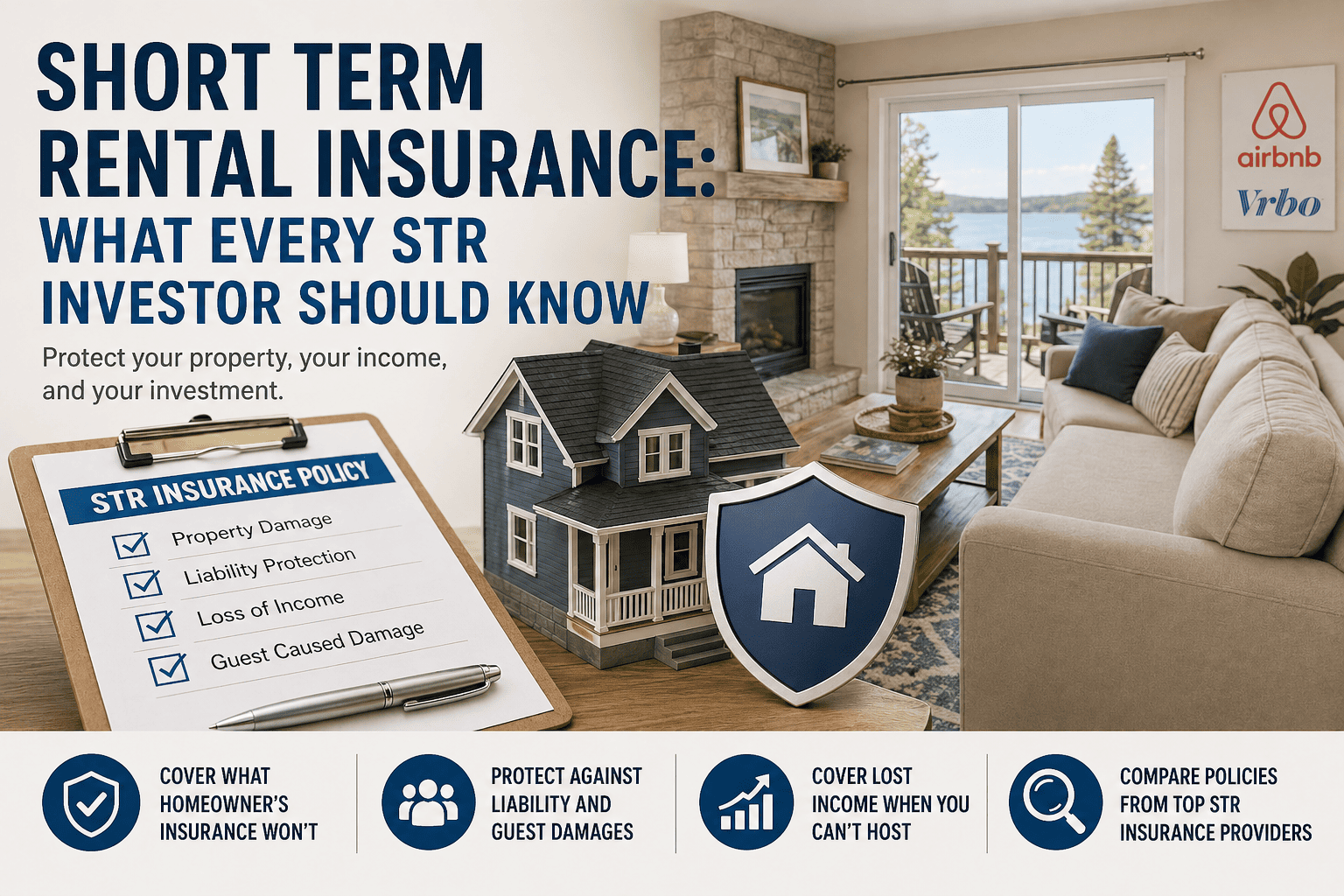
Comprehensive short term rental insurance bundles several coverage types that a standard homeowner's policy deliberately excludes.
Property Damage Coverage
This covers physical damage to the structure and its contents caused by guests. Think: broken furniture, fire damage, water damage from a guest who overflowed the bathtub, or a complete trashing after a party that got out of hand.
A commercial short term rental insurance policy will typically cover both the building and your personal property inside it up to specified limits. Unlike homeowner's insurance, it won't void the claim just because a paying guest caused the damage.
Liability Protection
Vacation rental liability coverage protects you if a guest — or even a third party — is injured on your property and sues. Medical bills, legal fees, and settlement costs are covered up to your policy limit.
Liability limits of $1 million are standard in most STR-specific policies. For high-traffic properties or those with pools, hot tubs, or outdoor amenities, consider $2 million or umbrella coverage on top.
Loss of Income / Business Interruption
If a covered event (fire, flood, major structural damage) makes your property unleasable, this coverage replaces the rental income you're losing while repairs are underway.
For investors running properties with strong seasonal revenue, losing peak-season income without business interruption coverage can be financially devastating. This is the coverage most hosts skip — and most regret skipping.
AirCover and Platform Protections: What They Actually Cover
AirCover is Airbnb's host protection program, and it provides real value — but it is not short term rental insurance.
What AirCover Includes (and Excludes)
As of 2026, AirCover includes up to $3 million in damage protection and up to $1 million in liability coverage for incidents that occur during a stay. On paper, those are large numbers.
The gaps matter more than the headline figures. AirCover excludes:
- Cash, securities, and collectibles
- Damage caused by pets (in many cases)
- Wear and tear or gradual deterioration
- Vehicles, watercraft, and certain outdoor property
- Bodily injury claims that fall outside specific criteria
- Any damage you can't document to Airbnb's satisfaction within their claims window
AirCover limitations also include a resolution process that routes through Airbnb — meaning the platform, not a licensed insurer, makes coverage decisions. That's a meaningful distinction.
Why Platform Protection Is Not a Substitute for Real Insurance
VRBO and other platforms offer similar host guarantees with similar exclusions. None of these programs are regulated insurance products. They have no state-mandated claims processes, no independent oversight, and no legal obligation to pay. For a deeper look at how Airbnb and VRBO compare as platforms, that distinction matters beyond just coverage considerations.
A dedicated short term rental insurance policy gives you a licensed insurer, a formal claims process, and legal recourse if a claim is denied. Platform protections give you none of that. Use AirCover as a supplemental layer — never as your primary coverage.
Top Short Term Rental Insurance Providers
The STR insurance market has matured significantly since 2020. Purpose-built options now exist that weren't available to early hosts.
Proper Insurance
Proper Insurance is the most widely recommended commercial short term rental insurance provider in the industry. It's underwritten through Lloyd's of London and designed specifically for STR properties — not adapted from landlord or homeowner's forms.
Coverage is comprehensive: property damage, liability, loss of income, and host-specific endorsements. Proper operates in all 50 states and covers properties listed on any platform. It's the default recommendation for serious STR investors seeking dedicated short term rental insurance.
Slice / Safely / Cbiz and Other Specialized Options
Safely focuses on guest screening combined with damage and liability protection. It's often integrated directly with property management software, which makes it attractive for hosts managing multiple listings.
CBIZ Vacation Rental Insurance (formerly offered through various brokers) targets larger portfolios and commercial operators. Their policies are more customizable but typically require working with a broker.
Slice offered on-demand, per-stay coverage for part-time hosts — ideal for someone renting out a primary residence occasionally. Check current availability, as on-demand STR products have seen provider changes in recent years.
For hosts operating in markets with specific local regulations — like Bend, Oregon or Orem, Utah — confirm that your chosen insurer covers properties in regulated jurisdictions before binding coverage.
How to Compare Policies: Key Questions to Ask
Before you commit to any short term rental insurance policy, get clear answers on:
- Is this a commercial STR policy or an adapted homeowner's form? The language matters legally.
- What is the per-occurrence liability limit and aggregate annual limit?
- Does the policy cover loss of rental income, and for how long?
- Are guests explicitly covered, or does guest-caused damage require a separate endorsement?
- What's the claims process — direct with the insurer or through a third party?
- Does coverage apply to all booking platforms, or only specific ones?
How Much Does STR Insurance Cost?
Short term rental insurance typically costs between $1,500 and $4,000 per year for a single-family property, though premiums vary widely.
Factors That Affect Your Premium
- Property value and rebuild cost — higher replacement value means higher premiums
- Location — coastal, wildfire-prone, or flood-zone properties carry significant surcharges
- Amenity risk — pools, hot tubs, fire pits, and waterfront access all increase liability exposure
- Occupancy rate — properties with higher guest turnover carry more risk
- Coverage limits selected — $1M vs. $2M liability changes the premium meaningfully
- Prior claims history on the property
A $250,000 property in a low-risk market might cost $1,500–$2,000/year. The same property near the coast or in a high-fire-risk zone could run $3,000–$5,000+. Use BNBCalc's STR analysis tools to factor insurance costs into your pro forma before you buy.
Balancing Coverage vs. Cost as an Investor
The cheapest short term rental insurance policy is rarely the right policy. A $500/year gap between a basic and comprehensive policy is meaningless if a $300,000 liability claim goes uncovered.
The smarter calculation: treat insurance as a fixed operating cost, target 3–5% of gross rental revenue as a benchmark, and shop coverage first — then price. For deeper guidance on how much coverage you actually need, that breakdown is worth reading before you call any insurer.
How to Choose the Right Policy for Your STR
The right short term rental insurance policy depends on how you operate, not just what you own.
Single Property Hosts vs. Portfolio Investors
Single-property hosts renting a primary or secondary residence occasionally can often get adequate coverage through Proper Insurance or a homeowner's policy with a short-term rental endorsement (where available). The priority is liability and property damage — loss of income is secondary if the rental income isn't critical.
Portfolio investors need commercial-grade short term rental insurance, ideally from a carrier who can write blanket policies across multiple properties. Individually insuring 10 properties with 10 separate policies creates administrative complexity and gaps between policy terms. Work with a broker who specializes in STR coverage — it's a different conversation than what a standard insurance agent handles. Understanding how landlord insurance differs from STR coverage is also worth reviewing before you make any decisions.
Checklist Before You Buy
- Confirm your current homeowner's policy does NOT cover STR activity
- Get quotes from at least two purpose-built short term rental insurance providers
- Verify the policy covers all platforms where you list
- Check that liability limits meet or exceed $1M per occurrence
- Confirm loss of income coverage is included
- Read the exclusions section — not just the coverage summary
- Verify the policy is compliant with any local STR regulations (check local requirements in markets like Troy, Michigan or Lynn, Massachusetts)
Final Takeaways
Short term rental insurance is a non-negotiable line item for any host operating above the "renting my spare room twice a year" level.
Platform protections are marketing, not coverage. Standard homeowner's policies have exclusions that will bite you. The short term rental insurance market now has purpose-built products that are affordable, comprehensive, and specifically designed for how your property operates.
The question isn't whether you can afford STR coverage. It's whether you can afford a six-figure liability claim, a denied homeowner's claim, or months of lost income with no protection — because that's the actual alternative.
Get a quote from a commercial short term rental insurance provider before your next booking window opens. That's the move.
Frequently Asked Questions
Does my homeowner's insurance cover Airbnb rentals? Standard homeowner's policies explicitly exclude commercial activity, and short-term rentals qualify. If you file a claim after a guest incident without disclosing the rental use, your insurer will likely deny the claim and may cancel your policy.
What's the difference between landlord insurance and short term rental insurance? Landlord insurance is designed for long-term tenants under lease agreements — it assumes stable, known occupants and lower liability exposure. Short term rental insurance is built for high-turnover guest stays, includes guest-caused damage, and typically covers loss of rental income in addition to standard property and liability coverage. The two are not interchangeable.
Is AirCover enough, or do I need separate Airbnb host insurance? AirCover provides supplemental protection, but it is not a regulated insurance product. It has significant exclusions, routes claims through Airbnb's internal process, and offers no legal recourse if a claim is denied. Dedicated short term rental insurance from a licensed carrier is required for adequate protection.
How much does short term rental insurance cost per year? Most hosts pay between $1,500 and $4,000 annually for a single-family STR property. Location, property value, amenities, and selected coverage limits are the primary cost drivers. High-risk locations (coastal, wildfire zones) can push premiums significantly higher.
Can I get STR insurance if my property is in a heavily regulated market? Yes, but confirm with the insurer directly. Some carriers restrict coverage in markets with restrictive STR ordinances. Always check local regulations first — markets like Gary, Indiana have specific rules that may affect your insurability or coverage terms.
Airbnb Tax Deduction Calculator
Paying too much in taxes? We have the perfect solution. Simulate an Airbnb home purchase below.
Purchase Price
$450K
Structure Value
70%
Apply Trump's Tax Cut (Bonus Depreciation)
Depreciation
$117,695
Interest
$21,600
Tax
$6,750
Year 1 Deduction
$146,045
Want to claim this deduction? Get a free cost segregation benefit analysis from CSA Partners — no obligation.
Get Full Analysis