
Analisi istantanea gratuita
Scopri i ricavi Airbnb per qualsiasi indirizzo o città
Most Airbnb hosts don't fail because they bought the wrong property — they fail because they underestimated what managing it actually takes.
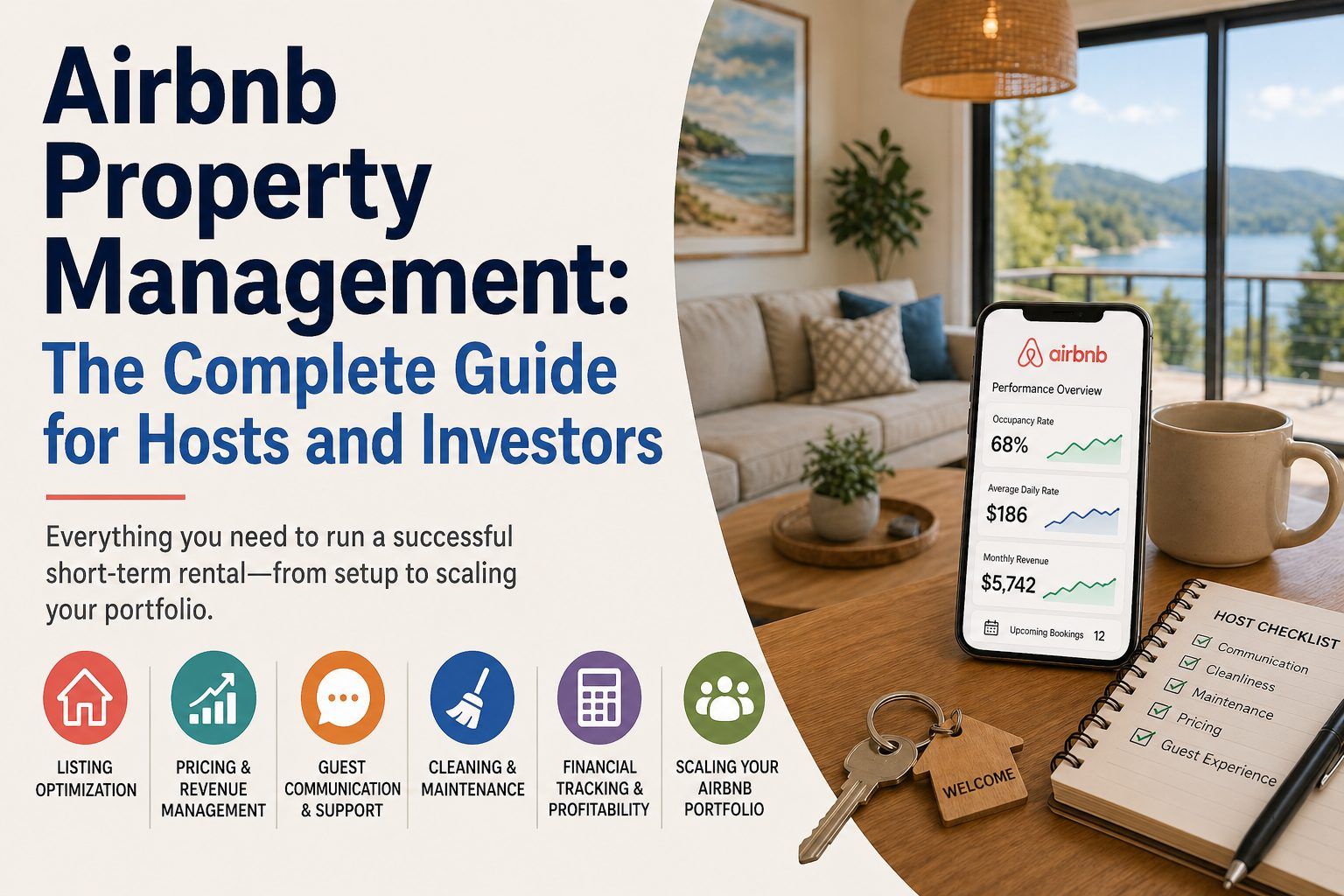
Airbnb property management is part hospitality business, part logistics operation, part data science. Done right, it generates reliable passive income. Done poorly, it produces bad reviews, surprise expenses, and a calendar that's permanently half-empty. This guide covers every layer of short-term rental management — from listing setup to scaling a portfolio — so you can make decisions based on how your operation actually runs, not how you hoped it would.
What Is Airbnb Property Management?
Airbnb property management is the full set of tasks required to run a short-term rental profitably: pricing, guest communication, cleaning coordination, maintenance, financial tracking, and compliance. It's not just "managing bookings" — it's running a hospitality business from a residential property.
Self-Managing vs. Hiring a Property Manager
Self-managing keeps more revenue in your pocket but demands real time and attention. Hiring an airbnb property manager costs 15–30% of gross revenue (sometimes more in premium markets) but removes most of the operational weight.
Here's how the two approaches compare:
| Factor | Self-Management | Professional Management |
|---|---|---|
| Cost | $0 in fees | 15–30% of gross revenue |
| Time required | 5–15 hrs/week per property | Near-zero for owner |
| Control | Full | Limited |
| Response time | Depends on your availability | 24/7 coverage typical |
| Best for | 1–2 properties, hands-on owners | 3+ properties, remote owners |
| Revenue potential | Higher net margin | Lower net, less stress |
Self-managing works well if you live near the property, have flexible hours, and genuinely enjoy the hospitality side. The moment managing the property starts feeling like a second job you didn't want, it's worth running the numbers on professional help.
When to Consider a Management Company
Hire a management company when your time cost exceeds what you're paying in fees — or when poor management is actively costing you in bad reviews and low occupancy. Remote owners, investors with multiple properties, and anyone who has missed a guest message at 11pm and felt that stomach drop should seriously consider delegating.
If you're in a market with strong local operators, you may get access to pricing tools, cleaning networks, and distribution channels you couldn't build alone. Check out local options — for example, if you're investing in coastal Southern California, Airbnb property management companies in Oceanside and surrounding areas offer full-service vacation rental management that's worth comparing against your self-managing costs.
Setting Up Your Airbnb for Success
A well-set-up listing earns more per booking, converts browsers into guests faster, and attracts the kind of guests who leave five-star reviews.
Optimizing Your Listing for Search and Conversions
Your title, photos, and first 150 words of description do the heavy lifting. Airbnb's search algorithm weighs acceptance rate, response time, listing completeness, and review scores — not just price. Use all photo slots, lead with your strongest room shot, and write a title that highlights the property's single best feature (not "Cozy retreat" — something specific like "Designer Loft | Walk to Downtown | Fast WiFi"). For a deeper dive into what actually moves the needle, check out this data-backed guide to Airbnb listing optimization.
Three listing elements most hosts underinvest in:
- Captions on photos — most guests read them; they're free SEO
- Neighborhood section — builds trust and helps guests picture the stay
- Guidebook — reduces pre-trip questions and improves review scores
Pricing Strategy and Dynamic Pricing Tools
Flat pricing leaves money on the table every weekend and every local event weekend. Dynamic pricing adjusts your nightly rate based on demand signals: local events, seasonality, competitor availability, and booking lead time.
Tools like Wheelhouse, PriceLabs, and Beyond each pull market data and adjust automatically. A short-term rental industry report from 2025 found that hosts using dynamic pricing tools earn 10–40% more annual revenue than those using static rates. The lift varies by market, but the direction is consistent. If you're evaluating which tool to use, this PriceLabs vs Wheelhouse comparison breaks down the differences from a host's perspective.
Set a price floor you're comfortable with — dynamic tools can push rates down in slow periods, and you need a minimum that still covers your costs.
House Rules, Policies, and Guest Screening
Clear house rules reduce disputes, protect your property, and filter out guests who don't belong there. Write rules that are specific (not "no parties" — "no gatherings of more than 6 people, including registered guests") and front-loaded in your listing so guests read them before booking.
Guest screening on Airbnb has limits compared to long-term rentals, but you can:
- Require verified government ID
- Require positive review history (set minimum reviews in booking settings)
- Enable Instant Book only for guests with no negative reviews
- Use a pre-booking message to qualify intent for longer stays
Day-to-Day Operations
The operational layer of short-term rental management is where most hosts burn out or fall behind. Automation fixes that.
Automating Guest Communication and Messaging
Set up automated messages for every touchpoint: booking confirmation, check-in instructions (sent 24 hours before arrival), mid-stay check-in (sent day 2), and checkout reminder (sent evening before departure). This alone handles 80% of what guests need to hear from you.
Tools like Hospitable, Lodgify, Guesty, and Hostaway let you build message templates with dynamic fields that auto-populate guest names, dates, and door codes. A well-timed automated message sequence will boost your review scores — guests rate communication higher when they feel proactively informed.
Reserve your personal attention for actual problems. Respond to those within an hour.
Cleaning and Turnover Management
Cleaning is the single most reviewed element of any Airbnb stay. One bad turnover tanks a five-star streak. Build a cleaning system, not just a cleaning relationship. Understanding what professional Airbnb cleaning services cost — and what they actually include — helps you set the right expectations and budget from day one.
Practical airbnb host tips for turnover management:
- Use a detailed photo checklist your cleaner completes after every turnover
- Build 30–60 minutes of buffer between checkout and next check-in
- Keep a small inventory of replacement items (batteries, light bulbs, toiletries) at the property or with your cleaner
- Pay your cleaner well — good cleaners are the hardest part of this business to replace
- Do periodic spot checks, especially after long stays
Maintenance and Repairs: Building a Reliable Team
Every vacation rental property eventually has a plumber-at-midnight situation. The hosts who handle it well already have a plumber's number saved. Build relationships with licensed contractors before you need them — HVAC, plumbing, electrical, and a general handyman at minimum.
Create a simple maintenance log (a Google Sheet works fine) tracking every issue, when it was reported, who fixed it, and what it cost. This data helps you spot recurring problems before they become emergency expenses, and it's essential for tax documentation.
Financial Management for Airbnb Owners
Most Airbnb hosts know their nightly rate. Fewer know their actual profit margin after cleaning fees, supplies, platform fees, and taxes.
Tracking Revenue, Expenses, and Profitability
Track every revenue and expense line in a dedicated spreadsheet or accounting tool — not in your head and not mixed with personal finances. Key metrics to monitor monthly:
- Gross revenue (total guest payments before platform fees)
- Net revenue (after Airbnb's host fee, typically 3%)
- Operating expenses (cleaning, supplies, utilities, maintenance)
- Net operating income (net revenue minus operating expenses)
- Occupancy rate (booked nights ÷ available nights)
- Average daily rate (ADR)
- RevPAR (revenue per available room night)
These six numbers tell you whether your airbnb property management is working. If RevPAR is flat while your market is growing, something in your pricing or listing needs to change.
Using an Airbnb Investment Calculator to Benchmark Performance
Before you buy and after you're operating, benchmark your property against market data. BNBCalc's investment calculator pulls real STR data for any address and shows projected revenue, occupancy, and cash-on-cash return — giving you an honest picture of what a property should earn, not a best-case scenario.
Use this kind of tool to answer two questions: Is this property performing at market rate? If not, is the gap a listing problem, a pricing problem, or a management problem? If you want to understand how to evaluate a deal before pulling the trigger, this guide on how to analyze an Airbnb investment property walks through the full framework.
Tax Considerations for Short-Term Rental Income
Short-term rental income is taxable at both the federal and state level in most jurisdictions, and the rules differ meaningfully from long-term rental income. The IRS "14-day rule" matters: if you use your property personally for more than 14 days or 10% of rented days, certain deductions get limited.
Deductible STR expenses typically include:
- Cleaning and maintenance costs
- Platform and management fees
- Mortgage interest (proportional to rental use)
- Depreciation (major one — don't miss it)
- Supplies, furnishings, and capital improvements
- Insurance and professional services
Work with a CPA who has experience with short-term rental properties. The tax treatment is specialized enough that a generalist accountant often leaves money on the table. If you want to understand how depreciation can dramatically reduce your tax burden, read up on bonus depreciation strategies for Airbnb hosts.
Scaling Your Airbnb Portfolio
Going from one property to five isn't five times the work — but only if you build systems before you scale.
Systems and SOPs for Managing Multiple Properties
A standard operating procedure (SOP) is a written process for every recurring task: how a turnover gets completed, how a maintenance issue gets reported, how a new booking gets processed. Document these while managing your first property, when you still remember every step.
SOPs let you hand off tasks without losing quality. They also make it possible to spot where a process is breaking down — if guests keep asking where the WiFi password is, the check-in instructions SOP needs updating.
Choosing the Right Property Management Software
At one property, a shared calendar and a phone work fine. At three or more, you need a property management system (PMS). Look for:
- Channel management — syncs calendars across Airbnb, VRBO, and direct booking sites
- Automated messaging — template-based, triggered by booking events
- Cleaning task automation — notifies cleaners automatically on booking
- Financial reporting — owner statements, expense tracking
- Mobile access — you'll need this at 10pm
Top platforms used by vacation rental management operators in 2026: Guesty, Hostaway, Lodgify, Hospitable, and OwnerRez. Pricing and features vary significantly — match the tool to your scale. For a side-by-side breakdown, this roundup of the best property management software for rentals covers what each platform does well.
When to Hire a Co-Host or Full-Service Manager
A co-host handles day-to-day operations in exchange for 10–20% of revenue — a middle ground between full DIY and a property management company. They're often local hosts who know the market and have existing cleaner relationships.
Full-service property management companies make sense at three or more properties, for remote investors, or when self-managing is clearly costing you in reviews and occupancy. Compare local operators in your market carefully — the quality gap between a top-tier firm and a mediocre one is real. For example, if you're evaluating options in the Southeast or Pacific Northwest, look at management companies in Birmingham, Alabama, Salem, Oregon, or Richmond, Virginia to understand what full-service looks like in different markets. Similarly, Honolulu and Reno are strong benchmarks for high-demand vacation rental management markets.
Key Takeaways for Airbnb Property Owners
- Airbnb property management is a business operation — treat it like one from day one
- Dynamic pricing beats flat rates in virtually every STR market
- Automation handles 80% of guest communication — set it up before your first booking
- Track six core financial metrics monthly — gross revenue, net revenue, operating expenses, NOI, occupancy rate, and ADR
- Build your contractor network before you need it — emergencies don't wait
- SOPs make scaling possible — document processes at one property, deploy at five
- Compare management companies carefully — fees matter, but quality of execution matters more
The best airbnb host tips aren't about working harder. They're about building a system that runs well whether you're watching it or not. Start with one property, tighten the operation, prove the model, then grow it.
Frequently Asked Questions
What does Airbnb property management cost? Professional airbnb property management typically costs 15–30% of gross rental revenue, though some full-service vacation rental management companies in premium markets charge up to 35%. Co-hosts generally charge 10–20%. Self-managing costs nothing in fees but requires 5–15 hours per week per property.
Is it worth hiring an Airbnb property manager? Hiring a property manager is worth it when your time cost exceeds the management fee, when you're investing remotely, or when poor management is actively reducing your revenue through low occupancy and bad reviews. Run the math: if a management company charges 20% but improves your occupancy rate by 15 points, the fee often pays for itself.
What software do Airbnb hosts use for short-term rental management? The most widely used property management software for short-term rental management in 2026 includes Guesty, Hostaway, Hospitable, OwnerRez, and Lodgify. Each handles channel sync, automated messaging, and cleaning coordination — the core needs of any multi-property operation.
How do I screen guests on Airbnb? Enable ID verification requirements in your booking settings, require a positive review history, and turn on Instant Book only for guests who meet Airbnb's requirements. For longer stays, send a pre-booking message asking about the purpose of the trip — guests who aren't a fit typically self-select out.
How do I know if my Airbnb is performing well? Compare your RevPAR, occupancy rate, and ADR against your local market benchmarks. Tools like BNBCalc let you pull real STR data for comparable properties in your area, giving you an objective baseline. If you're below market on occupancy, investigate your listing quality and pricing. If you're below market on ADR, investigate your pricing strategy and listing positioning.
Airbnb Tax Deduction Calculator
Paying too much in taxes? We have the perfect solution. Simulate an Airbnb home purchase below.
Purchase Price
$450K
Structure Value
70%
Apply Trump's Tax Cut (Bonus Depreciation)
Depreciation
$117,695
Interest
$21,600
Tax
$6,750
Year 1 Deduction
$146,045
Want to claim this deduction? Get a free cost segregation benefit analysis from CSA Partners — no obligation.
Get Full Analysis