
Kostenlose Sofortanalyse
Airbnb-Umsatz für jede Adresse oder Stadt anzeigen
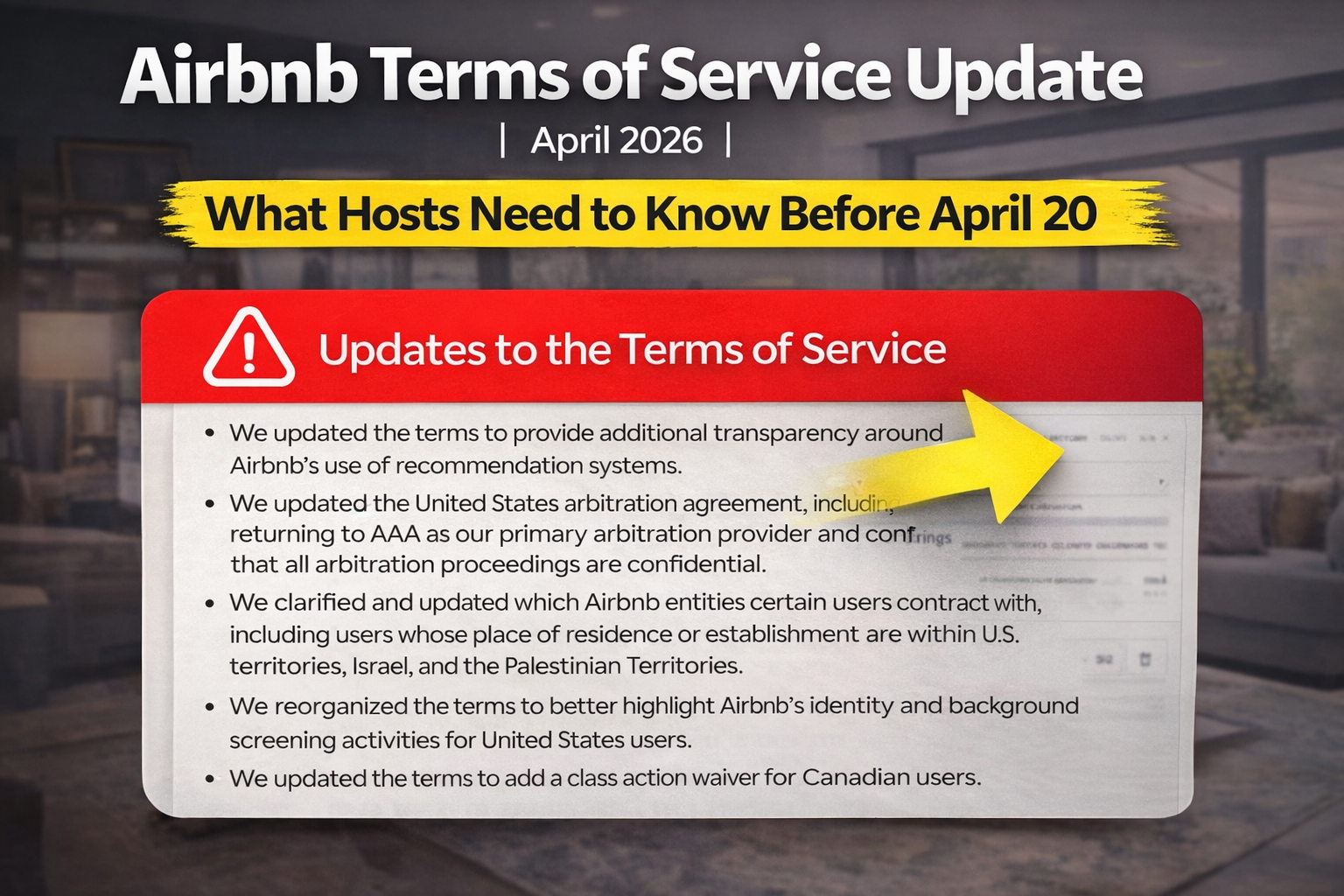
Airbnb Terms of Service Update April 2026: What Hosts Need to Know Before April 20
Airbnb just updated its Terms of Service, and this one requires action from you — not just a passive scroll-past. If your account was created before February 5, 2026, you must actively re-accept the new terms by April 20, 2026. Miss that deadline and Airbnb will shut off access to your bookings, payouts, and Host tools until you do.
The airbnb terms of service update 2026 is broader than most ToS revisions. Five meaningful policy changes are packed into this update — covering AI-generated content in damage claims, smoke odor rules, arbitration, consumables, and how acceptance works. Each one has real implications depending on how you run your listings.
Here's a breakdown of everything that changed and what it means for your business.
Why This Airbnb ToS Change Is Different From the Usual Fine Print
Most ToS updates are passive — Airbnb pushes them live and your continued use counts as acceptance. Not this time.
This airbnb tos change requires every eligible host to actively log in and accept the new terms before April 20, 2026. That applies to all accounts created before February 5, 2026. If you manage multiple listings under one account, one acceptance covers them all. But if you co-host or manage properties under separate accounts, each account needs its own acceptance.
The stakes are straightforward: no acceptance, no access. Airbnb will block bookings, withhold payouts, and restrict access to Host tools until you comply. For anyone running STR as a primary income stream, that's not a disruption you can afford.
The 5 Key Changes in the Airbnb Terms of Service Update 2026
1. AI-Generated Content Is Now Banned From Damage Claims
This is the change with the most direct financial risk for hosts.
The updated terms explicitly prohibit AI-generated photos, videos, or other content as evidence in damage claims through the AirCover resolution process. Submit a claim with AI-generated imagery — whether you created it intentionally or pulled it from a third-party tool — and Airbnb can reject it outright.
What this means in practice: your damage documentation workflow needs to be airtight. Use real photos taken at check-out, timestamped and stored somewhere you can retrieve them quickly. Tools that auto-enhance or AI-retouch photos are a gray area worth avoiding for claims documentation specifically.
Airbnb is drawing a hard line, and the burden of proof now falls more heavily on authentic documentation. Building a reliable check-out process is one of the fundamentals covered in any solid guide to starting an Airbnb — and this update makes that documentation step more important than ever.
2. New Smoke Odor Rules
The airbnb terms of service update 2026 adds explicit language around smoke odor as a separate violation category.
Previously, smoke damage was treated primarily as a physical damage issue — ash, burns, staining. The new terms establish smoke odor as its own actionable issue, distinct from visible damage. A guest who smokes inside without leaving visible evidence can still be the subject of a legitimate AirCover claim if odor is documented.
For hosts, this is a meaningful expansion. If you've had situations where guests clearly smoked but you had nothing tangible to show beyond the smell, the updated terms give you more ground to stand on — provided you document it properly. Date-stamped notes, air quality readings from smart home sensors, and cleaner reports all strengthen an odor-based claim.
It also reinforces the value of clear, strict no-smoking language in your house rules. The more explicit your listing policy, the stronger your position under the new terms. Which is why it's essential to formalize your Airbnb house rules.
3. Arbitration Agreement Updated
The arbitration clause has been revised, and it's worth understanding before you click accept.
Airbnb's arbitration agreement determines how disputes between hosts and Airbnb are resolved — specifically, it requires most disputes to go through individual arbitration rather than class-action lawsuits. The updated language refines which disputes fall under arbitration and adjusts procedural details around how arbitration is initiated.
Reading the full arbitration section before accepting is worthwhile, particularly if you've had ongoing disputes with Airbnb or operate at scale. The terms of any active dispute could be affected by what you accept. If that applies to you, a quick consultation with a lawyer familiar with platform disputes is a reasonable precaution — this isn't legal advice, but it's worth flagging.
For most hosts, the practical day-to-day impact is minimal. Knowing what you're agreeing to still matters.
4. "Consumables" Definition Added
The updated terms introduce a formal definition for "consumables" — items like toiletries, coffee, cleaning supplies, and other goods that guests reasonably use during a stay.
This definition creates a clearer framework for what hosts can and cannot claim as damages. Consumables are explicitly excluded from damage claim eligibility. If a guest uses your shampoo, finishes the coffee pods, or empties the paper towel roll, that's an operating cost — not a damage claim.
On the surface this feels obvious, but it closes a gap that was previously open to interpretation — and signals that Airbnb is tightening what counts as a legitimate damage claim overall.
If you're not already separating consumable costs from your operating budget, now is the time. Running a projection that accounts for consumable replenishment per stay keeps your numbers honest and your pricing accurate. BNBCalc lets you build out these projections before you commit.
5. Acceptance Is Now Active — Not Passive
Unlike previous airbnb tos changes where continued use of the platform counted as implicit acceptance, this update requires explicit action. You must log into your account and manually accept the updated terms. There is no auto-accept mechanism.
Airbnb will prompt you through the app and dashboard, but the responsibility is yours to complete it before April 20, 2026. Set a calendar reminder now. If you have a property manager or co-host with account access, confirm who is responsible for acceptance — and make sure it actually gets done.
What Happens If You Miss the April 20 Deadline
Airbnb has been direct about the consequences. Accounts that haven't accepted the updated terms by April 20 lose access to:
- Incoming and existing bookings
- Payouts and payment processing
- Host tools, including messaging and listing management
This isn't a grace period situation. The cutoff is hard. Guests with existing reservations at your property will still show up — but your ability to manage those bookings through Airbnb's system will be restricted until you accept.
This airbnb host policy update compounds quickly for anyone already dealing with operational pressure. A platform lockout on top of tight markets or regulatory headwinds is the kind of problem that hurts revenue for weeks, not days.
How to Accept the Updated Terms
The process is straightforward:
- Log into your Airbnb account on desktop or mobile
- Look for the acceptance prompt on your dashboard (Airbnb will surface it prominently)
- Read through the updated sections — particularly arbitration and the AI content policy
- Click accept
If you don't see a prompt, navigate to your account settings and look under "Terms of Service" or check the notification center. Don't wait for it to surface on its own — go looking for it.
What This Airbnb Host Policy Update Means for STR Investors
If you're running Airbnb as an investment — one property or a full portfolio — there are several operational takeaways worth acting on now.
Audit your damage documentation process. With AI-generated content explicitly banned from claims and smoke odor now a formal violation category, your check-out documentation routine needs to produce authentic, timestamped evidence. Photos, videos, smart sensor data, cleaner reports — build a workflow that generates all of this automatically. A solid Airbnb cleaning checklist can anchor that process and ensure nothing gets missed between guest stays.
Revisit your house rules. The new smoke odor provision rewards hosts with explicit no-smoking policies. If your house rules are vague on this, tighten them. Clear rules create clear violations, which makes AirCover claims easier to pursue.
Factor consumables into your pricing. Airbnb has formally defined consumables as non-claimable costs, so treat them as a fixed operating expense per booking. If you haven't modeled this yet, run the numbers — particularly when evaluating whether a market or property still pencils out. BNBCalc lets you build out these projections before you commit.
Know what you're signing. The arbitration update isn't alarming for most hosts, but it's worth reading. If you have a pending dispute with Airbnb, get a read on whether acceptance affects your position before clicking through.
It's also worth noting that this isn't the first time Airbnb has made mid-year policy adjustments with real operational consequences. The Airbnb Introduces Updates To Cancellation Policy Covering Unforeseen Events update followed a similar pattern — changes that seemed procedural on the surface but required hosts to adjust how they manage reservations and guest communication.
STR investing rewards operators who treat it like a business. If you're still evaluating whether Airbnb investing makes sense in specific markets, the breakdown on best Airbnb markets is worth a look for understanding what actually drives returns there.
The Bottom Line
The airbnb terms of service update 2026 has a hard deadline — April 20 — with real consequences for missing it. Five changes are worth knowing: the AI content ban in damage claims, new smoke odor rules, updated arbitration terms, a formal consumables definition, and the requirement to actively re-accept.
None of these changes are cause for alarm, but they require attention. Read the updated terms, update your documentation workflow, and get the acceptance done before the cutoff.
If you're thinking about a new Airbnb investment or want to stress-test how your current properties perform under updated operating costs, BNBCalc gives you the projections to make that call with the numbers.
April 20 is the date. Don't let a compliance deadline be what disrupts an otherwise well-run listing.
Airbnb Tax Deduction Calculator
Paying too much in taxes? We have the perfect solution. Simulate an Airbnb home purchase below.
Purchase Price
$450K
Structure Value
70%
Apply Trump's Tax Cut (Bonus Depreciation)
Depreciation
$117,695
Interest
$21,600
Tax
$6,750
Year 1 Deduction
$146,045
Want to claim this deduction? Get a free cost segregation benefit analysis from CSA Partners — no obligation.
Get Full Analysis