
Free instant analysis
Reveal Airbnb revenue for any address or city
Your renters insurance policy almost certainly won't pay a dime after a guest trashes your apartment — and most hosts find this out only after filing a claim.
If you're renting out your place on Airbnb and counting on renters insurance to cover damages, liability, or lost income, you're exposed in ways your insurer hasn't told you about. The question of does renters insurance cover Airbnb comes up constantly in host communities, and the answer is almost always the same: no — with very few exceptions. Here's exactly what you're covered for, what you're not, and what short-term rental insurance actually looks like when you need it.
Does Renters Insurance Cover Airbnb?
The Short Answer: Usually No
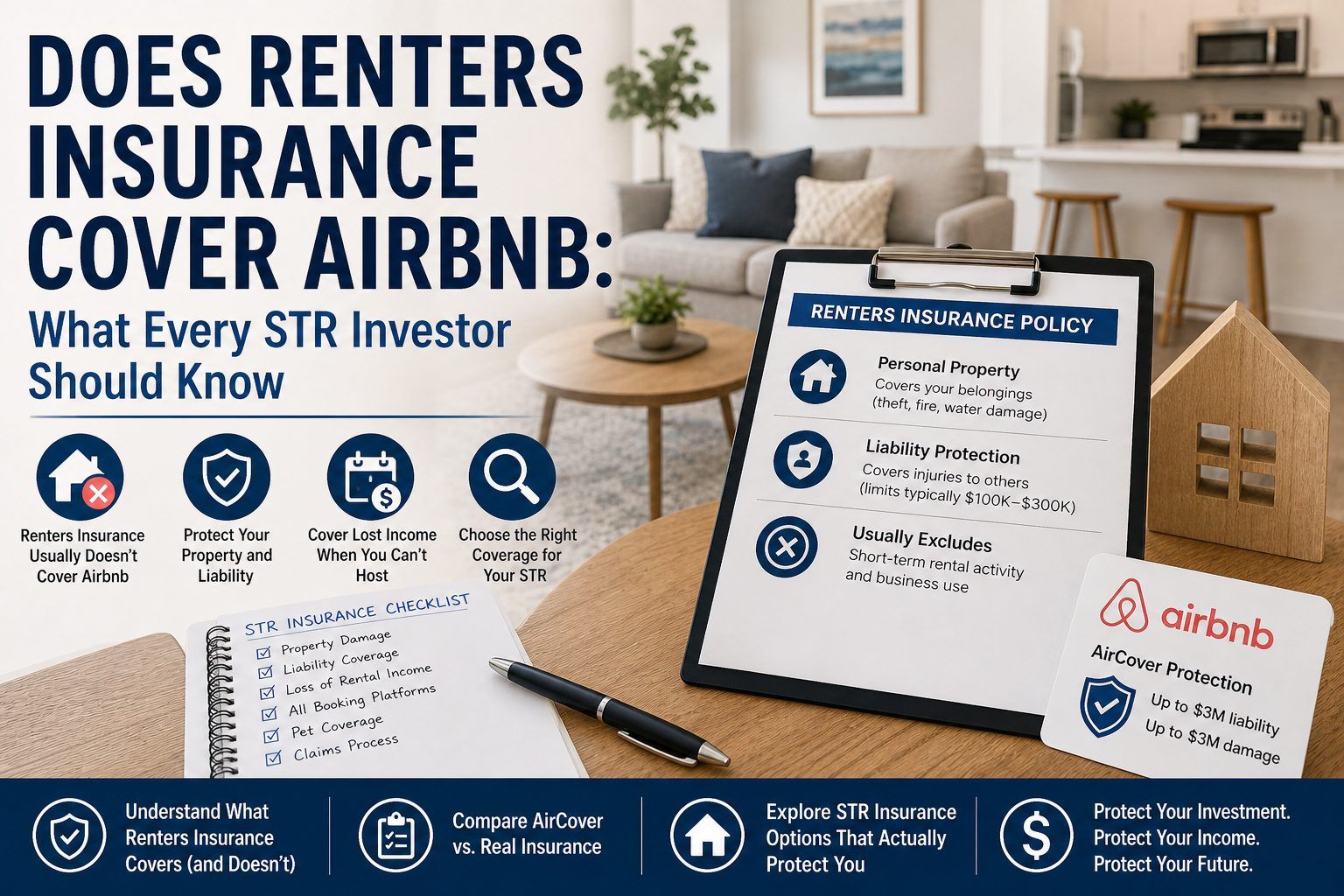
Renters insurance does not cover Airbnb hosting activity in most cases. The moment you accept money from a guest, your insurer classifies your unit as a commercial operation — and standard renters policies are written exclusively for personal residential use.
This isn't a loophole or a gray area. It's a fundamental underwriting distinction. Most policies include explicit business-activity exclusions that void coverage the instant you begin earning rental income.
Why Standard Renters Insurance Excludes STR Activity
Insurance companies price renters policies based on occupancy risk tied to a single tenant. Short-term rental activity multiplies that risk — more people, more turnover, and commercial-level liability exposure — none of which is priced into your $20/month premium.
Insurers also argue that once you run a business from your home, the nature of the property has changed materially. The result: a claim filed after a guest incident is likely to be denied outright, and your policy canceled.
What Renters Insurance Actually Covers
Personal Property Protection
Renters insurance covers your personal belongings against theft, fire, water damage, and certain other named perils — but only for items used personally, not for running a business. If a guest damages your furniture during their stay, that's not a personal-use loss. Your insurer will likely deny it.
Some policies do cover your belongings even when traveling or in storage. That protection generally stays intact as long as hosting hasn't voided your policy entirely.
Liability Coverage and Its Limits
Standard renters liability coverage protects you if someone is injured in your unit during personal use — a friend slips, a visitor breaks their arm. It does not extend to paying guests under a commercial arrangement.
Liability limits on renters policies typically run $100,000 to $300,000. For STR investing where a single liability event can reach seven figures, those limits are thin even if coverage applied — which it usually won't.
When Renters Insurance May Apply (Edge Cases)
There's one narrow scenario where renters insurance may hold: if you're renting out a spare room while you're still living in the unit, some insurers treat this as incidental rental income rather than a business. Even then, coverage is not guaranteed.
The only way to know for certain is to call your insurer and ask directly. Don't assume silence means coverage — get it confirmed in writing.
What Airbnb's AirCover Provides
AirCover for Hosts: What's Included
Airbnb's AirCover for Hosts provides up to $3 million in liability protection and up to $3 million in damage protection for eligible claims. It's included automatically for hosts listing on Airbnb, at no extra charge.
AirCover covers guest-caused property damage, damage to your belongings, and certain liability claims from guest injuries occurring during a stay. For basic hosting scenarios, it's a meaningful baseline.
Critical Gaps in AirCover Protection
AirCover is not insurance — it's a guarantee program run by Airbnb, and Airbnb decides what it covers. Claims require documentation, host cooperation, and Airbnb's internal review. Hosts frequently report disputes over claim approvals, valuation, and payout timelines.
AirCover also doesn't cover:
- Loss of rental income if your property is damaged and uninhabitable
- Cash, securities, collectibles, or rare items
- Shared areas in multi-unit buildings beyond the listed space
- Liability claims filed after a guest checks out
- Damage caused by pets in many cases
- Properties listed outside Airbnb — meaning your Vrbo or direct booking stays have zero AirCover protection
Hosts who list across multiple platforms like Vrbo carry coverage gaps on every non-Airbnb booking unless they hold a standalone STR policy.
Insurance Options STR Investors Actually Need
Short-Term Rental Insurance Policies
Purpose-built STR insurance is the right answer for anyone running a short-term rental as a business. These policies are underwritten specifically for the commercial-residential hybrid risk of short-term hosting.
A solid STR insurance policy covers:
- Property damage from guests and covered perils
- Liability for guest injuries on premises
- Loss of rental income during covered repairs
- Theft of host property by guests
- Building coverage (for owned properties)
Top providers in 2026 include Proper Insurance, Steadily, Slice, and Hippo. Premiums typically run $1,500–$3,000 per year for a standard single-family STR property, though high-value properties or coastal locations run higher.
Landlord Insurance vs. STR Insurance
| Feature | Landlord Insurance | STR Insurance |
|---|---|---|
| Long-term tenants | ✅ Covered | ❌ Not designed for |
| Short-term guests | ❌ Excluded | ✅ Covered |
| Loss of rental income | ✅ Yes (long-term) | ✅ Yes (STR-specific) |
| Liability per incident | $100K–$500K typical | Up to $1M–$2M |
| Vacancy clauses | Often restrictive | STR-aware |
| Price range (annual) | $800–$2,000 | $1,500–$3,500 |
Landlord insurance covers long-term tenants — think 12-month leases. The moment you shorten stays to under 30 days in most states, standard landlord policies exclude coverage just like renters insurance does.
Umbrella Policies as a Supplement
A personal umbrella policy adds $1M–$5M in liability coverage above your primary policy's limits. For STR investors running multiple properties, it's a cost-effective way to extend liability protection without buying a separate high-limit policy for each unit.
Umbrella coverage typically runs $150–$300 per year per million dollars of coverage. The catch: it only pays after the primary policy is exhausted, so the primary policy must actually respond to a claim. If your base policy excludes the STR activity, the umbrella won't trigger either.
How to Choose the Right Coverage for Your STR
Key Questions to Ask Before Buying
Before purchasing any STR insurance or Airbnb host insurance policy, get clear answers to these questions:
- Does the policy cover all booking platforms, or only Airbnb? — Critical for multi-platform hosts.
- Is loss of rental income included, and what's the waiting period? — Some policies require 72+ hours of documented damage before income coverage kicks in.
- What's the liability limit per occurrence vs. aggregate? — Per-occurrence limits matter most in a serious injury claim.
- Are pets covered? — Many policies exclude pet damage entirely.
- Does the policy cover a property manager or co-host? — Relevant if you use Airbnb concierge-style management services that operate under your listing.
- What does the claims process look like? — Ask for average claim resolution time before you commit.
Top Providers to Compare
| Provider | Best For | Avg. Annual Cost | Notable Feature |
|---|---|---|---|
| Proper Insurance | Comprehensive STR coverage | $2,000–$3,500 | Commercial-grade liability |
| Steadily | Multi-property investors | $1,200–$2,500 | Fast online quoting |
| Slice | Flexible/part-time hosts | Pay-per-night model | Only active when hosting |
| Hippo | Tech-forward single properties | $1,500–$2,500 | Smart home discount |
| CBIZ | High-value luxury properties | Custom quote | High liability limits |
All figures are general 2026 market ranges. Your actual premium depends on property value, location, occupancy rate, and coverage limits selected.
Hosts evaluating investment property financing should also confirm with their lender whether STR-specific insurance satisfies their mortgage hazard insurance requirement — some lenders require confirmation.
Bottom Line for STR Investors
Does renters insurance cover Airbnb? No — and treating AirCover as your backup plan isn't much safer. AirCover has real value, but it's not insurance, it doesn't cover every platform, and it won't replace lost rental income when your property is out of commission.
The right coverage stack for most STR investors looks like this:
- STR-specific insurance as your primary policy (property + liability + income loss)
- Umbrella policy if you own multiple units or carry significant personal assets
- AirCover as a secondary layer for Airbnb-specific bookings only
STR insurance is one of the least exciting line items in your hosting business — and one of the most expensive to skip. A single uninsured liability event can exceed annual revenue by a factor of ten.
If you're still sizing up a market or deciding whether a property pencils out before committing to full STR insurance overhead, BNBCalc's analyzer lets you run projections based on real local data to confirm the numbers first.
The best time to sort out your renters insurance short-term rental gaps was before your first booking. The second-best time is today.
Frequently Asked Questions
Does renters insurance cover Airbnb damage caused by guests? No. Standard renters insurance excludes business activity, and hosting paying guests is classified as a business use. Guest-caused damage claims are almost universally denied under renters policies. You need either AirCover (for Airbnb bookings only) or a dedicated STR insurance policy.
Can I get in trouble with my insurance company for hosting on Airbnb? Yes. If your insurer discovers you've been hosting and you file an unrelated claim, they can deny it and cancel your policy for material misrepresentation. Always disclose STR activity to your insurer or switch to STR-appropriate coverage.
Is AirCover the same as Airbnb host insurance? No. AirCover is a guarantee program — Airbnb decides whether to pay, and it only applies to Airbnb bookings. True Airbnb host insurance is a licensed insurance product that pays based on your policy terms, regardless of Airbnb's internal decisions.
What's the minimum insurance an Airbnb host needs? At minimum, a dedicated STR insurance policy covering property damage and $1M in liability per occurrence. Hosts with significant assets or multiple units should add an umbrella policy on top.
Does renters insurance cover Airbnb if I only rent occasionally? Occasionally renting doesn't change your insurer's exclusion. Even a single paid booking triggers the business-use exclusion in most policies. Part-time hosts have options — Slice's pay-per-night model is built specifically for low-frequency hosting — but standard renters insurance still doesn't apply.
Airbnb Tax Deduction Calculator
Paying too much in taxes? We have the perfect solution. Simulate an Airbnb home purchase below.
Purchase Price
$450K
Structure Value
70%
Apply Trump's Tax Cut (Bonus Depreciation)
Depreciation
$117,695
Interest
$21,600
Tax
$6,750
Year 1 Deduction
$146,045
Want to claim this deduction? Get a free cost segregation benefit analysis from CSA Partners — no obligation.
Get Full Analysis