
Kostenlose Sofortanalyse
Airbnb-Umsatz für jede Adresse oder Stadt anzeigen
Most Airbnb hosts pick the wrong property classification before they ever collect a dollar in rent — and it costs them thousands.
The difference between a second home vs investment property isn't just semantic. It determines your mortgage rate, your down payment size, which deductions you can claim, and whether the IRS treats your rental income as passive or active. Getting this wrong at closing isn't a paperwork problem you fix later. It reshapes your entire return on investment.
Here's what every short-term rental investor needs to know before signing anything.
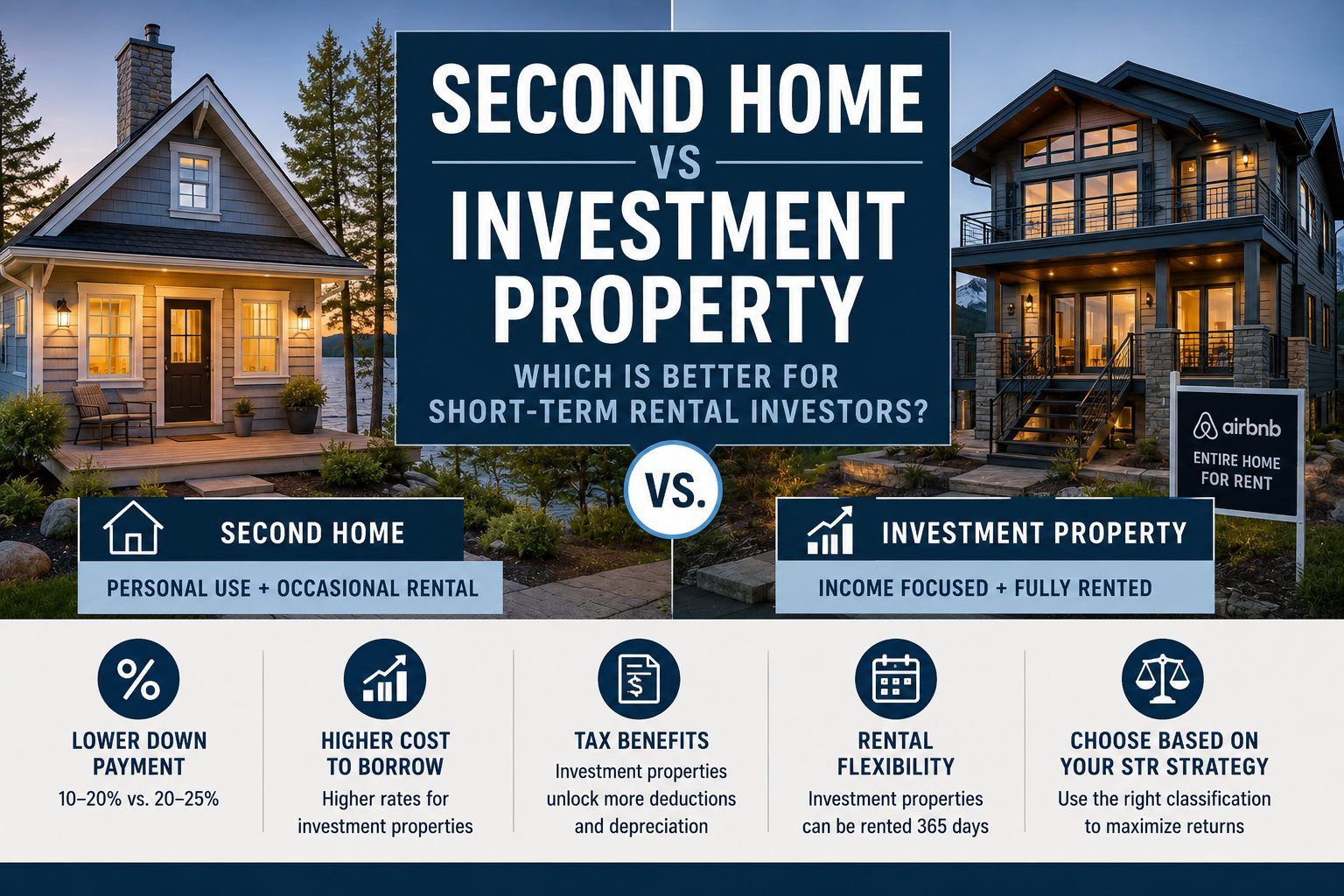
Second Home vs Investment Property: Key Differences
How Lenders Define Each Property Type
A second home is a property the owner personally occupies for a significant portion of the year. Lenders and the IRS generally require you to live there for more than 14 days annually — or more than 10% of the total days it's rented at fair market rate, whichever is greater. The property must also be a one-unit dwelling suitable for year-round use, and most lenders require it to be a reasonable distance from your primary residence (typically 50+ miles).
An investment property has one purpose: generating income. You don't live there. You don't treat it as a personal retreat. The IRS and your lender both view it as a business asset, which triggers a completely different set of rules for short-term rental property classification.
Why Your Classification Changes Everything
Your property's designation at the time of purchase locks in your loan terms, your tax treatment, and your deduction eligibility from day one. Misrepresenting a property as a second home when you intend to rent it full-time is considered mortgage fraud — lenders take this seriously, and so does the IRS.
The classification also affects your Airbnb property designation in the eyes of your lender during a refinance or equity pull. If your use patterns change significantly after closing, reclassification can happen — sometimes with consequences. Before changing the debt structure, compare selling versus refinancing using the property's current equity, projected cash flow, and sale costs.
Mortgage and Financing Differences
Second Home Loan Requirements
Second home mortgages follow conventional loan guidelines but come with stricter occupancy requirements than primary residence loans. You must occupy the property personally for part of the year, you cannot rent it full-time or list it with a property management company year-round, and the property must be suitable for personal use (not a commercial structure).
Lenders treat Airbnb second home mortgage applications with increasing scrutiny as of 2026, particularly in high-demand vacation markets. Many will ask for rental history documentation, current listing URLs, or signed declarations confirming intended personal use.
Investment Property Loan Requirements
Investment property loans require no personal occupancy — but lenders price that flexibility into the rate. Qualifying for one requires stronger credit scores (typically 680+, though 720+ gets the best rates), proof of stable income or documented rental history, and in some cases, cash reserves covering six months of PITIA (principal, interest, taxes, insurance, and HOA dues).
STR loan requirements for investment properties are distinct from long-term rental loan requirements. Some lenders specialize in DSCR loans for Airbnb properties, which qualify you based on the property's projected rental income rather than your personal W-2 income. This is increasingly popular among STR investors operating multiple properties.
Down Payment and Interest Rate Comparison
| Feature | Second Home | Investment Property |
|---|---|---|
| Minimum Down Payment | 10–20% | 20–25% |
| Typical Interest Rate Premium | +0.5–0.75% above primary | +0.75–1.5% above primary |
| PMI Required? | Sometimes (below 20% down) | No (20% minimum required) |
| Personal Occupancy Required? | Yes | No |
| Full-Year Rental Permitted? | No | Yes |
| DSCR Loan Eligible? | No | Yes |
The rate gap matters more than most buyers realize. On a $500,000 loan, an additional 0.75% in interest translates to roughly $3,750 per year in extra carrying costs. For investors, that's real money that needs to be factored into STR revenue projections.
Tax Implications for Short-Term Rental Investors
Tax Benefits of the Investment Property Classification
Investment property classification unlocks the full range of investment property tax benefits STR owners can claim — none of which are available to a second home. These include depreciation deductions (typically over 27.5 years for residential property), deductions for every rental-related expense, and potential pass-through deductions under Section 199A.
Active STR investors who spend more than 750 hours per year managing their properties can qualify as real estate professionals, which allows them to offset non-passive income with rental losses. This is a significant tax advantage that simply doesn't exist under second home classification.
The 14-Day Rule and Second Home Tax Treatment
The 14-day rule is the dividing line between second home status and investment property status for tax purposes. If you personally use the property for more than 14 days (or 10% of rented days), the IRS classifies it as a personal residence with limited rental deductions.
Under second home treatment, you can still deduct mortgage interest and property taxes — but rental expense deductions are capped. You cannot deduct losses against other income, and depreciation is heavily restricted. Hosts who rent a beach house for most of the summer but stay there for three weeks have likely crossed the line into second home territory without realizing it.
Depreciation, Deductions, and Schedule E
Short-term rental properties classified as investment properties report income and expenses on Schedule E, and cost segregation studies can dramatically accelerate the depreciation timeline. A cost segregation study breaks the property into components — appliances, flooring, fixtures — that depreciate over 5 to 15 years instead of 27.5. This front-loads deductions into the early years of ownership when they have the most impact.
Allowable deductions under investment property classification include:
- Mortgage interest
- Property management or co-host fees
- Cleaning and maintenance
- Platform fees (Airbnb service fees, listing fees)
- Utilities, insurance, and HOA fees (when rented)
- Furnishings and supplies
- Marketing and photography
- Depreciation (building and components)
- Professional services (accountant, attorney)
- Travel expenses related to managing the property
Second homes can deduct only items 1 and 2 from the list above, and only proportionally based on rental days.
Which Classification Is Better for Airbnb Hosts?
When a Second Home Designation Makes Sense
A second home classification makes sense if you genuinely use the property yourself and want lower entry costs. The minimum down payment can be as low as 10% with strong credit, which reduces upfront capital requirements. If you only rent the property occasionally to offset carrying costs — not to generate serious income — the second home structure fits that use pattern.
For investors who want a property that doubles as a personal retreat in a destination market (think a lakehouse you rent out 120 nights a year but use 30 nights yourself), the second home designation may be the honest and appropriate classification. That said, you're leaving significant tax advantages on the table.
When an Investment Property Classification Wins
If maximizing STR income and tax efficiency is the goal, investment property classification wins outright. Full deductibility, depreciation benefits, DSCR loan eligibility, and the ability to operate year-round without occupancy constraints give investment properties a structural advantage over second homes.
Investors executing the BRRRR strategy in STR markets specifically need investment property classification — the refinance step doesn't work as cleanly under second home rules, and lenders scrutinize occupancy claims carefully during cash-out refinances.
How Rental Income Frequency Affects Your Choice
The more nights you rent, the stronger the case for investment property classification becomes. According to 2025 STR data, top-performing short-term rental markets see median occupancy rates between 55–75%. At those occupancy levels, annual personal use of 14+ days quickly becomes the exception, not the norm.
For hosts who list on multiple booking platforms to maximize occupancy, the math is even clearer. High-occupancy listings and second home classification are fundamentally incompatible — you can't maximize rental income and simultaneously satisfy the IRS's personal-use thresholds.
How to Qualify and What to Watch Out For
Lender Overlays and STR-Specific Rules
Many lenders apply overlays — additional requirements beyond Fannie Mae and Freddie Mac guidelines — specifically for short-term rental financing options. As of 2026, a growing number of conventional lenders restrict or prohibit Airbnb-style rental activity on second home loans. If you close on a second home mortgage and then list the property full-time on a booking platform, you may violate your loan's occupancy clause.
DSCR lenders, on the other hand, are designed for STR use. They evaluate the property's income potential using market rent data or current booking revenue rather than your personal income. Short-term rental financing options through the DSCR market have expanded significantly, with some lenders now offering STR-specific DSCR products that use projected Airbnb income for qualification. Investors weighing their options can compare how DSCR loans stack up against conventional mortgages before committing to a financing structure.
Common Mistakes That Trigger Reclassification
The most common mistake is purchasing under second home classification with the undisclosed intent to rent the property full-time. Lenders monitor Airbnb listings, and when they find a property listed for 300+ nights per year on a second home loan, they have grounds to call the loan due — or refer the case for fraud review.
Other triggers include:
- Personal use below 14 days annually on a second home mortgage
- Using a professional property management company full-time (lenders view this as evidence of investment intent)
- Listing the property before closing in a way that contradicts occupancy declarations
- Cash-out refinancing where rental income doesn't match the "occasional rental" story in the original loan application
Working with a realtor who specializes in short-term rental investments from the start reduces the risk of misclassification significantly. They understand how lenders read your use patterns.
Final Verdict: Making the Right Call for Your STR Strategy
For the majority of short-term rental investors, investment property classification is the stronger choice. It costs more upfront — higher down payment, slightly higher rate — but it returns more in tax efficiency, deduction depth, and operational flexibility. The math consistently favors it at scale.
Second home classification has its place for owners who genuinely want dual-use properties and aren't trying to optimize for maximum rental revenue. There's nothing wrong with that approach — just go in knowing the trade-offs.
The biggest mistake investors make is treating the second home vs investment property decision as a minor administrative detail rather than the foundational choice it actually is. Use BNBCalc's revenue estimation tools to model both scenarios before you submit a loan application — the difference in projected after-tax returns will make the right call obvious.
Whether you're converting a historical property into a short-term rental or building a portfolio from scratch, your property classification follows you for the life of the loan. Get it right the first time.
Frequently Asked Questions
Can a second home be used as an Airbnb? Yes, but with restrictions. A second home can be rented short-term, but personal use must exceed 14 days or 10% of rented days annually to maintain second home tax status. If the property is rented year-round with minimal personal use, the IRS reclassifies it as an investment property — which changes your deductions, not always in a bad way.
What's the minimum down payment for an investment property? Most conventional lenders require 20–25% down for investment properties as of 2026. DSCR loans follow similar guidelines. Some portfolio lenders will go lower, but expect a higher interest rate in exchange. Second home loans can require as little as 10% down with strong credit.
Does investment property classification hurt your mortgage approval odds? It can make qualification stricter — lenders want to see stronger credit scores, cash reserves, and documented income. But DSCR loans bypass personal income requirements entirely by qualifying based on the property's rental income potential, which makes them ideal for investors with complex income situations.
Can the IRS reclassify your second home as an investment property? Yes. If your personal use falls below the 14-day threshold and you rent the property at market rates for most of the year, the IRS treats it as a rental property regardless of how your mortgage classifies it. This can be advantageous — it unlocks depreciation and full deductions — but it should be a deliberate choice, not an accidental one.
What is a DSCR loan and is it right for STR investors? A DSCR (Debt Service Coverage Ratio) loan qualifies you based on the property's rental income rather than your personal W-2 income. If the projected or current rental income covers the mortgage payment (typically at a 1.0–1.25x ratio), you qualify. These loans are specifically structured for investment properties and are one of the most effective short-term rental financing options available in 2026 for investors growing a portfolio.
Airbnb Tax Deduction Calculator
Paying too much in taxes? We have the perfect solution. Simulate an Airbnb home purchase below.
Purchase Price
$450K
Structure Value
70%
Apply Trump's Tax Cut (Bonus Depreciation)
Depreciation
$117,695
Interest
$21,600
Tax
$6,750
Year 1 Deduction
$146,045
Want to claim this deduction? Get a free cost segregation benefit analysis from CSA Partners — no obligation.
Get Full Analysis