
Analisi istantanea gratuita
Scopri i ricavi Airbnb per qualsiasi indirizzo o città
Airbnb Listing Optimization: 11 Ways to Rank Higher in Airbnb Search (2026)
Most Airbnb listing optimization guides recycle the same advice: "use good photos" and "write a great description." That's not wrong, it's just not useful.
Here's what actually moves your search ranking. Airbnb's algorithm predicts two things before any guest books your property. How likely is this guest to book? And how likely are they to leave a 5-star review? Every optimization you make either improves those predictions or doesn't.
At the 2025 Professional Host Summit, Airbnb confirmed their ranker uses 800+ signals to predict these two outcomes. We went through Airbnb's own published resources, their engineering papers, and real listing data to figure out which ones you can actually control.
But before we get into the 11 tactics, you need to understand something most guides skip entirely.
There are two types of ranking factors (and you need both)
Airbnb's search algorithm page lists nine official factors: total price, quality, popularity, availability, Instant Book, response time, Superhost/Guest Favorites, accuracy, and fewer restrictions.
Those are the scoreboard. But they're not the playbook.
There's a second category we call reaction factors that feed directly into the official ones. Your title and cover photo drive click-through rate. Higher CTR means more page visits. More page visits boost your popularity score, which is an official ranking factor. Same thing happens downstream:
- A clearer summary leads to fewer "not what I expected" reviews, which raises your quality score
- More wishlist saves increase your popularity signal
- Accurate descriptions prevent complaints, which improves your predicted 5-star probability
The official factors are what Airbnb measures. The reaction factors are how you move the numbers. You need to optimize both, and that's what this list is really about.
1. Earn the Guest Favorites badge (worth ~25% of your ranking)
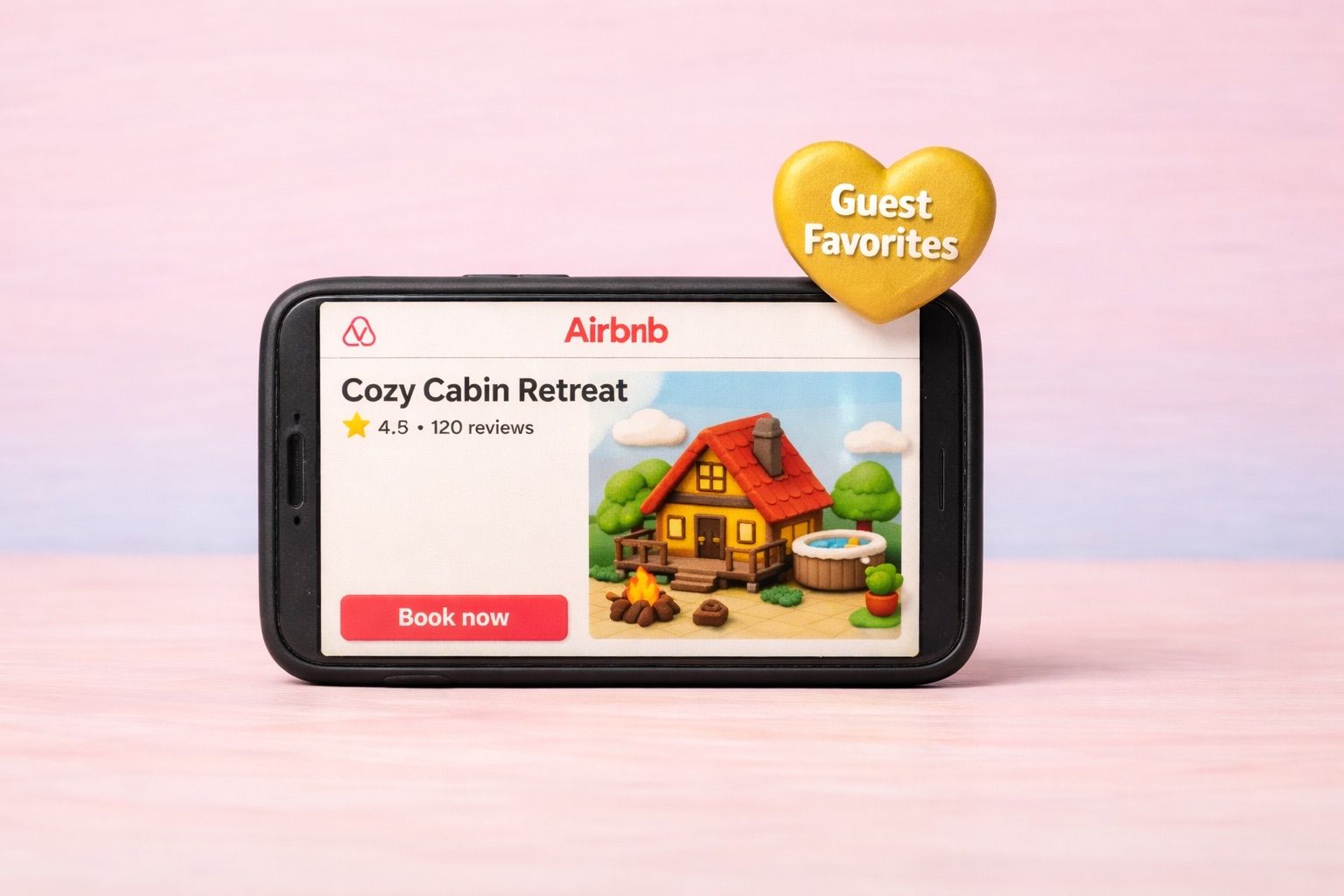
This is the single biggest lever. In 2025, Airbnb replaced Superhost as the top quality signal with Guest Favorites, the gold heart badge. It's worth roughly 25% of your overall search position.
Unlike Superhost (which rewarded host tenure and basic metrics), Guest Favorites is based on recent guest ratings and review quality. The algorithm actually reads review text, not just star counts. A cluster of enthusiastic, specific reviews from the last few months carries way more weight than a pile of old 5-star ratings with generic "great place" text.
How to earn it:
- Deliver a stay that matches or exceeds what your listing promises (accuracy is everything here)
- Send a post-checkout message asking guests to mention specifically what they loved in their review
- Fix recurring complaints fast. The algorithm weights recent reviews more heavily
- Don't chase 5 stars by overpromising. A 4.9 with accurate expectations beats a 4.7 with inflated ones every time
One thing that helps with this: study what top-performing listings in your market are doing. On BNBCalc, you can pull up comparable properties and see which ones have Guest Favorites, what their review scores look like, and what amenities they're offering that you might be missing.
2. Price for total cost, not nightly rate
This is the factor Airbnb themselves call the heaviest weighted. Their search page says it plainly: "The algorithm prioritizes the total price of a listing."
Here's a mistake we see all the time: a host sets a competitive nightly rate, then tacks on a $250 cleaning fee. The nightly rate looks great in isolation. The total price, which is what the algorithm actually compares you against, makes the listing uncompetitive.
Three pricing moves that improve rank:
- Bake cleaning costs into the nightly rate (or atleast keep the fee under $75). A high cleaning fee that inflates total price will tank your ranking even if your nightly rate looks reasonable.
- Add weekly (10-15%) and monthly (20-30%) discounts. These boost rank for longer-stay searches and attract higher-value bookings.
- Price last-minute dates 15-25% below your normal rate. Open dates within 7 days are opportunities, not failures. Filling them improves your booking frequency, which is its own ranking signal.
The tricky part is knowing what "competitive" actually means in your specific market. What are comparable 3-bedroom homes with a pool actually charging per night in your area? BNBCalc's market analysis shows you average daily rates, occupancy, and revenue for comparable listings so you're not just guessing at your price point.
3. Enable Instant Book
This is the single easiest win on the list. One toggle, and you get 15-25% more visibility in search. Airbnb explicitly names Instant Book as a ranking factor, and guests who filter by it (which alot of them do) will literally never see your listing without it.
Instant Book removes friction. It tells Airbnb's algorithm that you're a reliable host who won't decline requests. If your worried about unvetted guests, use Airbnb's built-in guest requirements (verified ID, positive reviews, house rules agreement) as your filter instead.
Do this today: Go to your listing settings and turn on Instant Book. If it's already on, move to #4.
4. Use your photos to stop the scroll, not document the house
Your first 5 photos show up in search results. They need to stop someone mid-scroll on their phone, not give a room-by-room tour of the property.
Your cover photo (slot 1) should confirm the filter the guest just clicked. If they searched with the "pool" filter in a Florida market, they need to see a pool. If they're looking at mountain cabins and filtered for "hot tub," your hero shot better have a hot tub in it. This sounds obvious but we see it wrong on probably half the listings we audit.
Photos 2-5 should showcase your most distinctive features. And here's something a lot of hosts get wrong: a genuinely spectacular bedroom can absolutely be in your top 5. We're not talking about a standard queen bed in a beige room. We mean a Bali-themed canopy suite with palm wallpaper and a skyline balcony, or a kids room with a built-in slide. If a photo makes someone stop and say "I want to stay there" - it belongs near the front.
What works:
- Lead with your top filter-match amenity (pool in warm markets, hot tub in mountain markets, waterfront for lake houses)
- Include at least one photo that creates a real emotional reaction. A golden-hour pool shot, a dramatic master suite, a game room that makes someone say "we need to book this"
- 24-30 photos total is the sweet spot
- Every photo needs to be excellent. 20 great photos beat 40 where half are dark bathroom shots
A good exercise: search your own market on Airbnb and look at the first page of results. Which thumbnails make you want to click? That's your benchmark. You can also use BNBCalc to find the top-earning listings in your market and study what their first 5 photos look like, what amenities they highlight, and how they present the property.
5. Write a title that converts on a phone screen
Here's something most optimization guides get wrong: Airbnb does not list title keywords as a search ranking factor. Theres no mention of title text matching search queries anywhere on their algorithm page.
Your title still matters a ton. But not because of keyword matching. It matters because it drives the click that starts everything else. A guest scrolling through 20 thumbnails on their phone decides in under 2 seconds whether to tap yours.
Two title formats that work:
Amenity-stack (best for properties with 4+ standout features):
Pool, golf sim, game room, sleeps 18
Scene format (best for character-driven or fewer-amenity properties):
Mountain hideaway with hot tub and sunrise views
Title rules:
- 50 characters max (Airbnb truncates beyond this in search results)
- Sentence case only. Capitalize the first word and proper nouns (this is per Airbnb's own guidelines)
- Use commas to separate features, not pipes or special characters
- Lead with the amenity your ideal guest cares about most
- Skip location (Airbnb already shows it), skip property names, skip "Welcome to"
6. Nail your summary in 500 characters
Airbnb hard-truncates your summary at 500 characters. That's roughly the length of this paragraph and the next sentence. Every word has to earn its spot.
Structure that works:
- Hook (1-2 sentences): Property identity + top 2-3 selling points
- Bullet list (5-7 bullets): Top amenities ordered by what your ideal guest searches for first
- Review quote: A specific, real quote under 10 words. Not "Great place!" but something like "Fit all 13 of us without any issues"
- Key distances: 3-4 drive/walk times to the spots your guests actually care about
What to cut: Generic adjectives (cozy, charming, stunning), amenities listed as plain nouns without specifics ("WiFi" vs. "400 Mbps WiFi"), and any word that doesn't help a guest decide to click Book.
7. Set accurate expectations (the 3 Pros / 2 Cons method)
Remember that second prediction the algorithm makes? "Will this guest leave a 5-star review?" That prediction is heavily influenced by how accurate your listing is. When the listing matches the real experience, guests are happy. When it doesn't, they write disappointed reviews that tank both your rating and your search position.
Proactively name your property's limitations. We use a simple framework: list 3 pros and 2 cons in your Space description. The cons should be honest but framed fairly:
- "Pool is not heated - December swims will be chilly"
- "Street parking only - the neighborhood is walkable but plan ahead for groups of 6+"
- "No A/C - Leadville sits at 10,152 ft and rarely needs it"
This feels counterintuitive. Why would you highlight weaknesses? Because guests who book knowing about the limitations don't leave surprised 3-star reviews. And a guest who would've been bothered by the issue self-selects out, which means the guests who do book are more likely to leave 5 stars.
Thats the algorithm working in your favor.
8. Fill out every field (especially the ones most hosts skip)
Airbnb's algorithm evaluates listing completeness. Incomplete listings rank lower. This sounds basic, but most hosts leave entire sections blank.
The most commonly skipped section? "Interaction with Guests." Most hosts either leave it empty or write something generic like "We're available if you need anything." This is a free win. Write 2-3 sentences about your response time, how you communicate (Airbnb app, digital guidebook), and whether you're hands-off or happy to give local recommendations.
Also check:
- Every amenity checkbox that actually applies to your property (pet-friendly, dedicated workspace, self-check-in, EV charger)
- All text fields in The Space, Guest Access, and Other Things to Note
- Your neighborhood section with real distances, not "close to downtown"
This matters even more now because Airbnb personalizes search results based on guest history. If a repeat pet owner searches your market and you haven't checked "pet-friendly," your listing won't show up, even if you actually allow pets.
9. Respond fast and accept requests (your 30-day averages are always running)
Response rate and response time are official ranking factors, calculated over a rolling 30-day window. Airbnb's guidelines say to respond within 24 hours, but under 1 hour is what top-ranked listings actually do.
What hurts you:
- Any response over 24 hours counts as "late" in your rolling average
- Declining booking requests lowers your acceptance rate, which directly impacts rank
- Slow responses during peak inquiry periods (Friday evenings, holiday weekends) are weighted the same as any other day
Quick fix: Turn on Airbnb notifications on your phone. Set up saved quick replies for common questions. If you use a property manager or co-host, make sure they're responding on that same timeline.
10. Keep your calendar clean and your minimum stays flexible
Two factors that are easy to overlook but genuinely affect your ranking:
Calendar management: Blocked dates that aren't actually unavailable confuse Airbnb's availability signals. If you're holding dates "just in case," either open them or block them intentionally. A clean, regularly-updated calendar signals to the algorithm that you're an active, bookable listing.
Minimum stay restrictions: Airbnb explicitly lists "fewer restrictions" as a ranking factor. A 5-night minimum during peak season might protect your revenue, but it also removes your listing from every 2-3 night search. Consider:
- 2-night minimum as your default
- 3-night minimum on holiday weekends only
- No minimum for last-minute bookings (within 7 days)
Every restriction you remove expands the pool of searches your listing appears in.
11. Study what's actually working in your market
This one ties everything together. The best way to optimize your listing isn't to follow generic advice. It's to look at what the top-performing listings in your specific market are actually doing.
What amenities do the highest-earning properties in your area offer that you don't? What do their cover photos look like? How are they pricing relative to you? What does their review profile look like?
This is where BNBCalc comes in. Run a market analysis and you can see comparable listings ranked by revenue, see their amenity sets, nightly rates, occupancy rates, and review scores. Instead of guessing what "competitive pricing" means, you can see exactly what similar properties charge. Instead of wondering which amenities matter most, you can see which ones the top earners have in common.
A lot of listing optimization is really market research in disguise. The hosts who rank highest aren't just good writers or good photographers. They know their comp set and they've built a listing that competes with the best in their market, not just the average.
The checklist (do these this week)
If you want to improve your Airbnb search ranking, here's what to prioritize in rough order of impact:
- Work toward Guest Favorites by asking recent guests for specific, enthusiastic reviews
- Check your total price against comparable listings in your market (include that cleaning fee)
- Enable Instant Book if it's not already on
- Add weekly and monthly discounts (10-15% and 20-30%)
- Audit your first 5 photos - do they stop the scroll or just document the house?
- Review your title - is it under 50 characters? Does it lead with your best amenity?
- Count your summary characters - are you under 500? Is every word pulling weight?
- Add 2 honest cons to your Space description
- Fill out every section - especially Interaction with Guests
- Check every amenity box that applies (especially pet-friendly, workspace, self-check-in)
- Set up fast response notifications - aim for under 1 hour
- Lower your minimum stay to 2 nights where possible
- Run a comp analysis on BNBCalc to see how your listing stacks up against the top earners in your market
Airbnb Tax Deduction Calculator
Paying too much in taxes? We have the perfect solution. Simulate an Airbnb home purchase below.
Purchase Price
$450K
Structure Value
70%
Apply Trump's Tax Cut (Bonus Depreciation)
Depreciation
$117,695
Interest
$21,600
Tax
$6,750
Year 1 Deduction
$146,045
Want to claim this deduction? Get a free cost segregation benefit analysis from CSA Partners — no obligation.
Get Full Analysis