
Analyse instantanée gratuite
Révélez les revenus Airbnb pour n'importe quelle adresse ou ville
Most W-2 earners assume rental property losses are locked away from their active income forever. The material participation rules for the short-term rental loophole change that assumption entirely — and for investors who understand the mechanics, it's one of the most powerful tax strategies available in 2026.
This guide breaks down exactly how the loophole works, which IRS tests you need to satisfy, how to document your hours, and why this strategy doesn't require real estate professional status to execute.
What Is the Short-Term Rental Tax Loophole?
The short-term rental tax loophole allows property owners to use rental losses — including depreciation — to directly offset W-2 or other active income, bypassing the passive activity loss rules that normally trap those deductions.
It works because of how the IRS classifies rentals. When your average guest stay is seven days or fewer, your rental activity is treated as a business, not a passive rental. That reclassification opens the door to real-time loss deductions against any income source.
Why Average Rental Period Matters for Tax Classification
The IRS uses average rental period as the dividing line between a passive rental and an active business. Properties where the average guest stays seven days or fewer fall outside the standard rental property rules under IRC §469.
This is the foundation of the short-term rental tax loophole. Unlike a traditional long-term rental — which is passive by default — a short-term rental can be treated as a non-passive activity if you materially participate.
The distinction doesn't require anything exotic. Hosts already operating on platforms like Airbnb or VRBO alternatives often satisfy the average stay threshold without adjusting anything.
How the Loophole Lets You Offset W-2 and Active Income
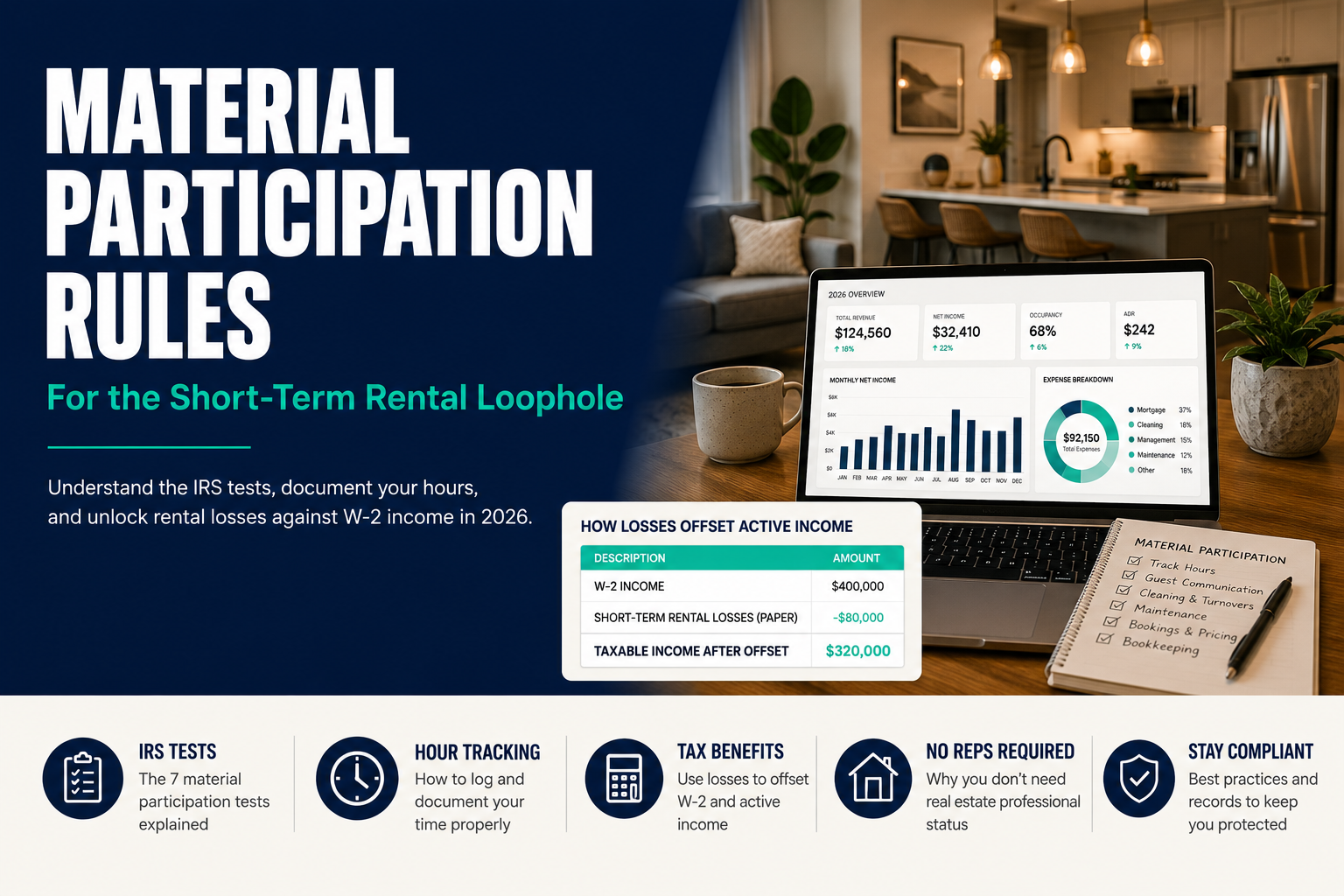
When a short-term rental is classified as a non-passive activity, losses flow directly onto Schedule E and offset your total taxable income. A physician earning $400,000 in W-2 wages who generates $80,000 in paper losses from depreciation can reduce their taxable income to $320,000 — without selling an asset or changing their job.
The losses are typically accelerated through cost segregation, which front-loads depreciation into the first year. Combined with bonus depreciation rules still active in 2026, this produces significant paper losses in year one.
The short-term rental tax loophole doesn't require leverage tricks or aggressive structuring. It requires meeting the material participation rules — consistently and documentably.
The Material Participation Rules for the Short-Term Rental Loophole Explained
Material participation means you are involved in the activity on a regular, continuous, and substantial basis. The IRS defines this through seven specific tests, and you only need to satisfy one.
The Seven IRS Material Participation Tests You Must Know
The IRS outlines these tests in Treasury Regulation §1.469-5T. Here they are in plain language:
- 500-hour test — You participate in the activity for more than 500 hours during the tax year.
- Substantially all test — Your participation constitutes substantially all of the participation in the activity (including participation by non-owners).
- 100-hour test — You participate more than 100 hours, and no other individual participates more.
- Significant participation test — The activity is a significant participation activity (more than 100 hours), and your total hours across all significant participation activities exceeds 500 hours.
- Prior five-year test — You materially participated in the activity for any five of the prior ten tax years.
- Personal service test — The activity is a personal service activity and you materially participated for any three prior tax years.
- Facts and circumstances test — You participate more than 100 hours, no single person participates more than you, and the facts and circumstances show regular, continuous, and substantial involvement.
For most Airbnb hosts, Tests 1, 2, and 3 are the most relevant. The material participation rules for the short-term rental loophole don't require 500 hours — many hosts qualify under Test 2 or Test 3 with far fewer.
Which Test Is Easiest to Satisfy for Airbnb Hosts?
Test 2 — the "substantially all" test — is the easiest for hands-on hosts who self-manage. If you handle all guest communication, cleaning coordination, maintenance, and booking management yourself, your participation constitutes substantially all of the activity, regardless of hours.
Test 3 is the next easiest. If you log more than 100 hours and no other person (including a property manager or co-host) participates more than you, you qualify. This is achievable for most self-managing hosts without changing their current operations.
The material participation rules for the short-term rental loophole are more accessible than most investors assume. The barrier isn't hours — it's documentation.
How Material Participation Differs from Real Estate Professional Status
Real estate professional status and material participation are two separate IRS concepts that serve different purposes. Conflating them is the most common mistake investors make when researching the short-term rental tax loophole. Understanding how the STR tax loophole compares to real estate professional status is essential before deciding which path fits your situation.
Why You Do Not Need Real Estate Professional Status for This Strategy
Real estate professional status (REPS) under IRC §469(c)(7) applies to long-term rentals. It requires 750+ hours per year in real property trades or businesses and that real estate comprises more than 50% of your personal services. It's designed to let long-term rental investors escape passive classification.
The short-term rental loophole bypasses this requirement entirely. Because STRs with an average stay of seven days or fewer are not classified as rentals under IRC §469, the REPS rules don't apply. You don't need 750 hours. You don't need real estate to be your primary profession.
A W-2 employee working full-time can satisfy the material participation rules for the short-term rental loophole on a single property without qualifying for real estate professional status. That's what makes this strategy viable for high-income earners who wouldn't otherwise qualify for REPS.
Passive Activity Loss Rules and How the Loophole Bypasses Them
The passive activity loss rules under IRC §469 prevent investors from using passive losses to offset active income. Standard rental properties are passive by default, which means their losses sit in a suspended bucket until the property is sold.
Short-term rentals with average stays of seven days or fewer are not subject to the rental activity presumption. They are treated as a business activity — like a hotel or a bed and breakfast. When you add material participation to that classification, the activity becomes fully non-passive.
The result: losses from depreciation, mortgage interest, repairs, supplies, and operating expenses offset your W-2, self-employment, or business income dollar-for-dollar. The passive activity loss rules become irrelevant.
The $25,000 passive loss allowance (available to landlords earning under $100,000) is a separate, weaker provision. The short-term rental tax loophole is not subject to that income cap — it's available regardless of your AGI.
How to Document Material Participation to Survive an IRS Audit
Documentation is where this strategy succeeds or fails. The IRS can disallow material participation claims with no records, and a disallowance turns your non-passive losses back into passive ones.
The burden of proof falls on you. Treasury Regulation §1.469-5T(f)(4) explicitly states that contemporaneous records are the most reliable evidence, though the IRS also allows "any other reasonable means" of establishing participation.
Recommended Time-Tracking Methods and Records to Keep
Start tracking from day one of ownership — reconstructing hours after the fact invites scrutiny. Here's what to keep:
Time logs:
- Daily or weekly spreadsheet entries with date, activity type, and hours spent
- Calendar apps (Google Calendar, iCal) with activity descriptions
- Project management tools (Asana, Notion, Trello) with timestamps
Supporting records:
- Guest communication logs from your booking platform
- Maintenance requests, contractor invoices, and repair receipts
- Cleaning coordination records (texts, emails, scheduling apps)
- Listing updates, pricing changes, and platform activity logs
What counts as participation time:
- Responding to guest inquiries and messages
- Managing pricing and calendar availability
- Coordinating turnovers and inspections
- Reviewing and responding to guest reviews
- Property maintenance and oversight
- Bookkeeping and financial management related to the property
Hosts who use channel managers still participate in strategy, pricing, and guest experience decisions that count toward their hours — automation doesn't eliminate participation.
Time spent improving the guest experience — whether through upselling amenities, redesigning the space, or planning seasonal themes — counts toward participation hours. Keep a brief note alongside each log entry to make the connection clear.
One additional layer of protection: Use the BNBCalc material participation hours tracker, which helps you log and categorize qualifying hours throughout the year so nothing slips through at tax time.
Use BNBCalc to Model Your Short-Term Rental Tax Savings
The math behind the short-term rental loophole is compelling — but only when you model it against your specific income, property value, and depreciation schedule.
BNBCalc lets you run those projections before you buy. Enter a property's purchase price, financing terms, and projected revenue, and the calculator outputs estimated cash flow, net operating income, and — critically — the depreciation-driven paper loss you can potentially deploy against your active income.
Markets matter too. A property generating strong revenue through multiple OTA platforms produces more gross income and more depreciable expenses, both of which affect your loss picture. Recent STR data shows that top-quartile short-term rentals generate 2–3x the revenue of bottom-quartile properties in the same market — a gap that compounds when you're optimizing for tax efficiency alongside returns.
Hosts adding guest experience amenities — from fitness-focused features to upgraded kitchens — often increase both their depreciable asset base and their nightly rate, improving both the revenue and the tax position simultaneously.
Model the numbers first. The short-term rental tax loophole is powerful when deployed strategically — and the material participation rules for the short-term rental loophole are only worth satisfying if the underlying property economics justify the effort.
Frequently Asked Questions
How many hours do you need to materially participate in a short-term rental?
There is no single universal hour requirement. The 500-hour test is one path, but most hosts qualify through Test 2 (substantially all participation) or Test 3 (more than 100 hours with no other individual participating more). If you self-manage your property and no property manager or co-host outpaces your hours, 100+ hours is typically sufficient. Log those hours with contemporaneous records to protect the deduction.
Can you use short-term rental losses to offset W-2 income?
Yes, when you satisfy the material participation rules for the short-term rental loophole and the property's average guest stay is seven days or fewer. That combination removes the activity from passive classification, allowing losses — including accelerated depreciation from cost segregation — to offset W-2, self-employment, or other active income directly. The passive activity loss rules that would otherwise block this deduction do not apply.
Do you need to be a real estate professional to use the short-term rental loophole?
No. Real estate professional status applies to long-term rentals under IRC §469(c)(7) and requires 750+ annual hours in real property trades with real estate as your primary profession. The short-term rental tax loophole uses a different mechanism — short-term rentals are classified as business activities, not rentals, so the REPS requirement doesn't apply. Any W-2 employee can use this strategy without qualifying for real estate professional status.
What activities count toward material participation for a short-term rental?
Any work you perform in your capacity as the owner-operator counts. This includes guest communication, pricing and calendar management, cleaning coordination, maintenance oversight, listing optimization, bookkeeping, responding to reviews, and time spent managing or improving the property. Work performed by third-party contractors doesn't count toward your hours, but time you spend managing those contractors does.
How does the IRS define a short-term rental for tax purposes?
The IRS uses average rental period as the key metric. A property where the average guest stay is seven days or fewer is not treated as a rental activity under IRC §469 — it's treated as a business activity, similar to a hotel. This classification is what enables the short-term rental tax loophole when combined with material participation. Average stay of eight to thirty days triggers a different, slightly more complex set of rules that still offer tax advantages but require additional analysis.
Airbnb Tax Deduction Calculator
Paying too much in taxes? We have the perfect solution. Simulate an Airbnb home purchase below.
Purchase Price
$450K
Structure Value
70%
Apply Trump's Tax Cut (Bonus Depreciation)
Depreciation
$117,695
Interest
$21,600
Tax
$6,750
Year 1 Deduction
$146,045
Want to claim this deduction? Get a free cost segregation benefit analysis from CSA Partners — no obligation.
Get Full Analysis